



Study Abroad Expert | Updated On - Sep 18, 2026
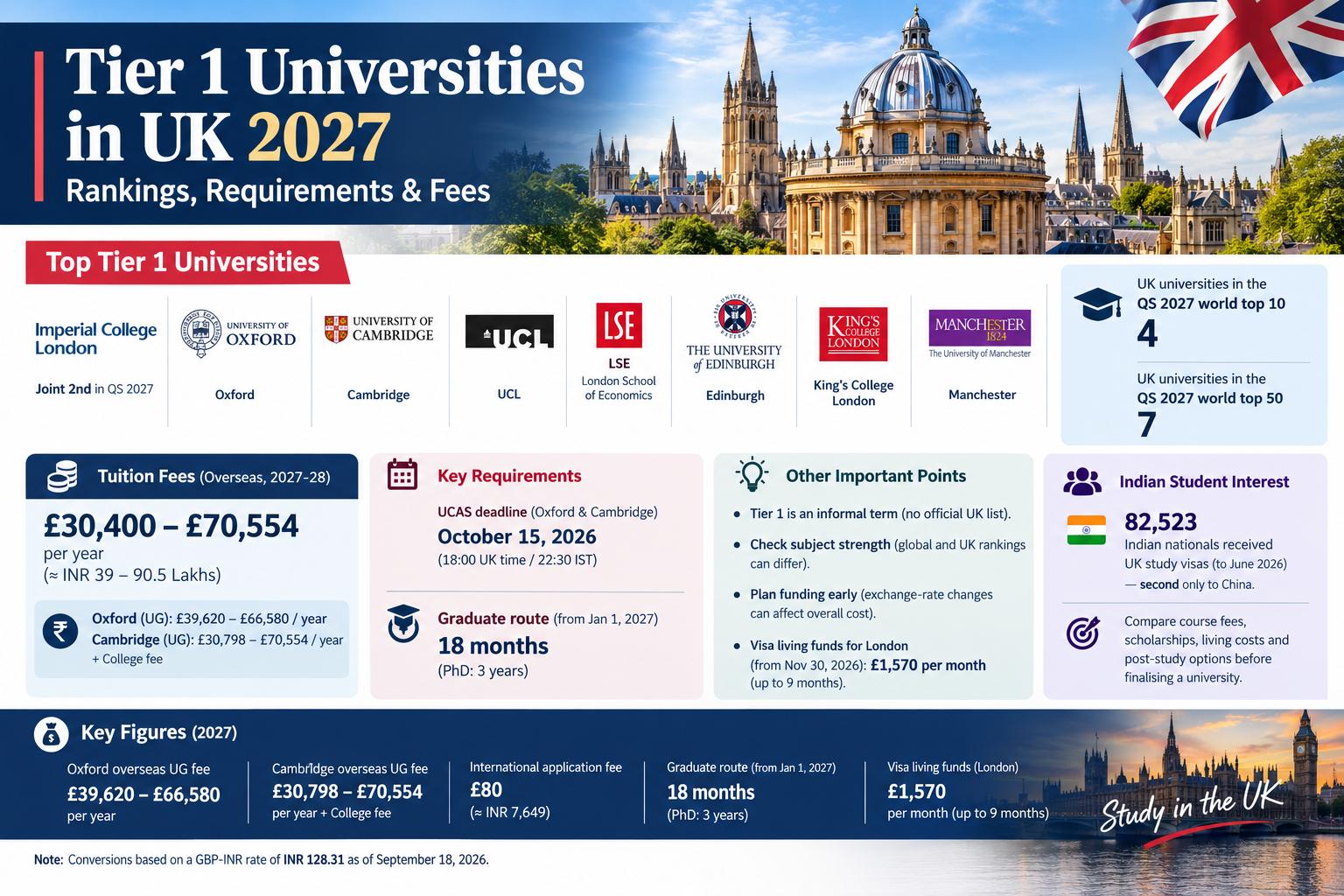
Tier 1 universities in the UK for 2027 include Imperial, Oxford, Cambridge, UCL, LSE, Edinburgh, King’s College London and Manchester. Imperial is ranked joint 2nd in the QS World University Rankings 2027. For 2027-28, overseas tuition fees at these universities generally range from around £30,400 to £70,554 a year, or about INR 39 to 90.5 Lakhs. For Oxford and Cambridge, the UCAS application deadline is October 15, 2026.
- Tier 1 is an informal term, so there is no official UK government list.
- Check subject strength before choosing a university, as global and UK rankings can differ.
- The shorter Graduate route applies based on the visa rules, not the university’s ranking.
- Plan funding early, as exchange-rate changes can affect the overall cost.
For Indian students, the UK remains a major study destination. 82,523 Indian nationals received UK study visas in the year to June 2026, second only to China, according to Home Office data. Students should compare course fees, scholarships, living costs and post-study options before finalising a university.
| Parameter | Detail |
|---|---|
| UK universities in the QS 2027 world top 10 | 4 |
| UK universities in the QS 2027 world top 50 | 7 |
| Oxford overseas undergraduate fee, 2027-28 | £39,620 to £66,580 a year |
| Cambridge overseas undergraduate fee, 2027 entry | £30,798 to £70,554 a year plus a College fee |
| UCAS deadline for Oxford and Cambridge | October 15, 2026 at 18:00 UK time (22:30 IST) |
| Graduate route for applications from January 1, 2027 | 18 months (PhD: 3 years) |
| Visa living funds for London (applications from November 30, 2026) | £1,570 a month for up to 9 months |
Note: Conversions based on a GBP-INR rate of INR 128.31 as of September 18, 2026.
Also check,
- Study in the UK: Top Universities, Courses and Intakes
- Top Master's Colleges & Universities in UK in 2026
- Cheapest Universities in UK for Indian Students 2026
What Are Tier 1 Universities in the UK?
Tier 1 universities in the UK generally refer to the country’s most selective and highest-ranked research universities, although Tier 1 is an informal label and is not officially defined by the UK government or any regulator. The core group is often referred to as the G5, comprising Oxford, Cambridge, Imperial, LSE and UCL. The wider group is usually drawn from the Russell Group, an association of 24 research-intensive UK universities. UK university labels at a glance:
| Label | Who Is In It | Status |
|---|---|---|
| G5 | Oxford, Cambridge, Imperial, LSE and UCL | Informal nickname |
| Tier 1 | Top-ranked group that varies by league table | Informal label |
| Russell Group | 24 research-intensive universities | Formal membership association |
Russell Group membership is a formal classification, while Tier 1 status is an evaluative label rather than an official UK university category. For 2027, a clearer way to define the group is by using the QS World University Rankings 2027 top 50. LSE can also be included based on its 3rd-place position in the Complete University Guide 2027, although this is a separate ranking criterion from QS.
What the Tier 1 label signals:
- The university sits near the top of major global or UK league tables.
- Its research output and reputation are strong across many subjects.
What it does not signal:
- Whether the chosen subject is strong at that university.
- What the course costs or how much funding exists.
- How employers in India or the UK rate that specific degree.
Tier 1 Universities in UK 2027 by QS Rank
Seven UK universities feature in the QS World University Rankings 2027 top 50, with four ranked among the global top 10. QS published the 2027 edition on June 18, 2026, covering 1,504 institutions worldwide. The table below compares the QS 2027 global ranking with the Complete University Guide (CUG) 2027 UK ranking for the UK's top 10 universities in the QS rankings:
| University | QS 2027 World Rank | CUG 2027 UK Rank |
|---|---|---|
| Imperial College London | =2 | 5 |
| University of Oxford | 4 | 2 |
| University of Cambridge | 6 | 1 |
| UCL | 8 | 13 |
| University of Edinburgh | 35 | 19 |
| King's College London | 37 | 16 |
| University of Manchester | 40 | 24 |
| University of Bristol | 57 | 17 |
| LSE | 62 | 3 |
| University of Warwick | 68 | 7 |
Imperial now shares 2nd place with Stanford University. UCL rose one place to share 8th with ETH Zurich. Oxford and Cambridge held 4th and 6th from 2026.
Key Insight: LSE ranks 62nd in QS but 3rd in the UK table. The Guardian University Guide 2027 also placed LSE 3rd and Imperial 5th. UK tables lean on teaching, entry grades and graduate outcomes.
Three UK-table standouts sit outside the QS UK top 10:
- St Andrews ranks 4th in CUG 2027, its sixth straight year in that spot.
- Durham ranks 6th in CUG 2027.
- Loughborough ranks 8th in CUG 2027 and 9th in the Guardian 2027 table.
Times Higher Education (THE) publishes its 2027 world table on September 30, 2026. Oxford has topped THE's table for ten straight years.
Must check: QS-ranked UK universities.
Tier 1 Universities in UK Fees for Indian Students
Most official 2027-28 overseas undergraduate fees at Tier 1 universities fall between £30,400 and £70,554 a year. Medicine sits at the top of that range. Humanities and social science courses sit near the bottom.
Overseas undergraduate fees per year for 2027 entry:
| University | Overseas Fee per Year | In INR | Fee Rule |
|---|---|---|---|
| University of Oxford | £39,620 to £66,580 | around INR 50.8 lakh to INR 85.4 lakh | Clinical medicine costs more |
| University of Cambridge | £30,798 to £70,554 | around INR 39.5 lakh to INR 90.5 lakh | Fixed for the course, plus a College fee |
| LSE | £30,400 to £41,900 | around INR 39 lakh to INR 53.8 lakh | Fixed by year of entry |
Note: For Computer Science and Engineering, the University of Cambridge charges around £46,872 per year (INR 60.1 Lakhs) for international students. Imperial College London and UCL set international tuition fees based on the individual course. UCL also offers a cohort fee guarantee for most international undergraduates, meaning their tuition fee is generally protected from increases during the course.
Master's Fees at LSE for 2027
Master's courses draw 62% of all UK sponsored students, Home Office data shows. LSE's 2027-28 overseas fees show a typical Tier 1 spread.
| LSE Programme | Overseas Fee 2027-28 | In INR |
|---|---|---|
| MSc Data Science | £41,900 | around INR 53.8 lakh |
| MSc Economics | £43,100 | around INR 55.3 lakh |
| MSc Management (12-month) | £44,900 | around INR 57.6 lakh |
| MSc Finance (full time) | £53,600 | around INR 68.8 lakh |
Visa Living Funds for 2027
Tuition is only part of the bill. The Student visa also asks for proof of living funds for up to nine months. If you apply for the visa on or after November 30, 2026, then London study needs £1,570 a month. That means £14,130 (around INR 18.1 lakh) for nine months.
- Outside London: £1,203 a month, or £10,827 (around INR 13.9 lakh) for nine months.
- Before November 30, 2026: the current £1,529 (London) and £1,171 (elsewhere) still apply.
- Holding rule: the money must stay in the account for 28 days in a row.
Entry Requirements for Tier 1 Universities in UK
Oxford accepts Indian Class 12 results only from the CBSE and CISCE boards. It asks for grades at the very top of both systems. Each course sets its own offer level.
Oxford Class 12 Requirements for Indians
Oxford converts its A-level offers (the UK school exams it uses as a benchmark) into Indian grades:
| Oxford Offer Level | CBSE Grades | CISCE Marks |
|---|---|---|
| A*A*A courses | A1 A1 A1 A1 A2 | 90% overall, with 95% or more in four subjects and 85% or more in the fifth |
| A*AA courses | A1 A1 A1 A2 A2 | 90% overall, with 95% or more in three subjects and 85% or more in two |
| AAA courses | A1 A1 A2 A2 A2 | 90% overall, with 95% or more in two subjects and 85% or more in three |
CBSE students applying to the University of Oxford need an A1 grade in a subject relevant to their chosen course. Students can apply before receiving their final CBSE results, so predicted grades included in the school reference can be important during the application process.
Oxford admitted 3,302 undergraduate students in 2025, including 2,609 UK residents. This means around 693 places went to students from outside the UK, showing the limited number of undergraduate places available to international applicants.
English Test Scores Needed
- Oxford asks for IELTS Academic 7.5 overall with at least 7.0 in each part.
- All four IELTS scores must come from one test sitting.
- Oxford does not accept IELTS Online.
- TOEFL iBT tests taken from January 21, 2026 are not accepted until Oxford finishes a review.
Edinburgh sets a lower bar for arts, humanities and social science courses. It asks for 80% overall in CBSE or CISCE, with 75% in three subjects including English.
Also check, University of Oxford Admission Process
How to Apply to Tier 1 Universities in UK
Undergraduates apply through UCAS, the UK's central admissions service. Master's applicants usually apply straight to each university. For example, Imperial takes applications through UCAS or its My Imperial portal.
Key Dates for 2027 Entry
Dates that matter for Indian applicants, in order:
| Date | What Happens |
|---|---|
| September 30, 2026 | THE World University Rankings 2027 released |
| October 6, 2026 | Chevening 2027-28 applications close |
| October 15, 2026 | UCAS deadline for Oxford, Cambridge and most medicine, dentistry and veterinary courses at 18:00 UK time (22:30 IST) |
| November 30, 2026 | Higher visa living funds apply to new visa applications |
| January 1, 2027 | Graduate route falls to 18 months for new applications |
| January 13, 2027 | UCAS equal consideration deadline for most other courses at 18:00 UK time (23:30 IST) |
| Mid-April 2027 | Imperial Inspires undergraduate award decisions |
Equal consideration means universities must treat all on-time applications the same way. Each applicant can pick five course choices in total.
Steps to Apply for 2027 Entry
- Shortlist five courses by subject ranking and entry grades.
- Take IELTS Academic early so the score is ready before the deadline.
- Draft the UCAS personal statement and line up a teacher reference.
- Submit through UCAS by October 15, 2026 for Oxford or Cambridge.
- Accept an offer and receive a CAS (Confirmation of Acceptance for Studies).
- Apply for the Student visa with 28 days of proof of funds.
If your first choice is Oxford or Cambridge, then UCAS must receive the form by October 15, 2026. That means the personal statement and reference must be ready in early October.
Also check,
Graduate Route After Tier 1 Universities in UK
Graduates applying for the UK Graduate route from January 1, 2027 will get 18 months to stay and work or look for a job, instead of the current two years. The duration is based on the date of the Graduate route application, not the course start date.
- Bachelor’s and master’s graduates: 18 months for applications from January 1, 2027
- PhD graduates: Three years, with no change
- Applications by December 31, 2026: Two years under the current rules
The change was introduced through HC 1333, a UK immigration rules update laid on October 14, 2025. For example, a student starting a one-year master’s in September 2027 would normally apply for the Graduate route in 2028 and receive an 18-month post-study work period. According to Home Office data, 64,495 Indian nationals received Graduate route extensions in the year to June 2026, the highest among all nationalities, while Indian study visa grants fell 16% during the same period.
Note: A Tier 1 degree does not buy extra post-study time. Every non-PhD graduate gets the same 18 months, whatever the university's rank.
Also Check:
| Russell Group Universities List | UK Universities List | UK Post Study Work Visa |
| MBBS in UK | Imperial MSc AI, Economics and Policy | UCL New Master's Programmes for 2027 |
For the 2027 UK intake, leading universities include Imperial College London, the University of Oxford, the University of Cambridge, UCL and LSE, followed by the University of Edinburgh, King’s College London and the University of Manchester in the QS top-50 group. Overseas tuition for many 2027-28 programmes falls between around £30,400 and £70,554 per year, before living costs. The 15 October 2026 UCAS deadline applies to Oxford and Cambridge, while other universities may have different deadlines. Students should also check the latest post-study work rules, as eligibility and visa duration can vary by course and student circumstances.
FAQs
Ques. Which are the Tier 1 universities in UK for 2027?
Ans. Imperial, Oxford, Cambridge, UCL and LSE form the core group. Edinburgh, King's College London and Manchester complete the seven UK universities in the QS 2027 top 50. Tier 1 is an informal label, so lists vary by source.
Ques. Is LSE a Tier 1 university in UK?
Ans. Yes. LSE ranks 3rd in both the Complete University Guide 2027 and the Guardian University Guide 2027. It sits 62nd in the QS World University Rankings 2027.
Ques. What is the fee at Tier 1 universities in UK for Indian students?
Ans. Most official 2027-28 overseas undergraduate fees fall between £30,400 and £70,554 a year (around INR 39 to 90.5 lakh). Medicine costs the most. Cambridge also charges an annual College fee.
Ques. What percentage is needed in Class 12 for Oxford?
Ans. CISCE students need 90% overall with 95% or more in two to four subjects, based on the course. CBSE students need two to four A1 grades, depending on the course. Subjects linked to the course must be at A1.
Ques. Does Oxford accept state board students from India?
Ans. No. Oxford accepts only CBSE and CISCE Class 12 results. State board, NIOS, NEET and JEE results do not meet its entry rules.
Ques. What is the UCAS deadline for Oxford and Cambridge 2027 entry?
Ans. October 15, 2026 at 18:00 UK time, which is 22:30 IST. Most other undergraduate courses close for equal consideration on January 13, 2027.
Ques. Which scholarships can Indian students get at Tier 1 UK universities?
Ans. Chevening fully funds a one-year master's for Indians with two years of work experience. Imperial Inspires pays £15,000 a year to at least 300 overseas students for 2027 entry. Chevening applications close on October 6, 2026.
Ques. How long can Indian students stay in the UK after graduating from a Tier 1 university?
Ans. 18 months for bachelor's and master's graduates who apply from January 1, 2027. PhD graduates keep three years. The university's rank does not change this.
Ques. How much money is needed for a UK student visa in 2027?
Ans. London study needs £1,570 a month for up to nine months for applications from November 30, 2026. That totals £14,130 (around INR 18.1 lakh). Outside London the figure is £1,203 a month.


1720766750.png?tr=w-305,h-145,c-force?h=175&w=350&mode=stretch)



Comments