




These structural organisation in animals class 11 notes bring together every level of organisation, tissue type, and frog system that the CBSE Boards, NEET and CUET papers actually test in 2026-27. Revise the whole chapter fast, with how cells build tissues, organs and organ systems, and the complete morphology and anatomy of the frog Rana tigrina, system by system, in one place.
A single-celled organism does every job with one cell, but a frog cannot, so the work is shared out across cells, tissues, organs and organ systems. The frog is studied here because it represents the vertebrates, and its systems reappear in the human physiology chapters later in the year.
- CBSE Weightage: 3 to 5 marks, usually one diagram of the frog's digestive system plus one short answer on tissues or the frog's organ systems.
- Topics covered: the levels of organisation, the four basic animal tissues, the frog's habit and habitat, its external morphology, and the digestive, respiratory, circulatory, excretory, nervous and reproductive systems.
- Key rules: only four tissue types build every organ, cardiac muscle is striated yet involuntary, frog RBCs are nucleated, the heart has three chambers, and the frog is ureotelic.
These structural organisation in animals class 11 notes are curated by subject experts, based on the 2026-27 NCERT textbook, and checked against the last five years of CBSE Board and NEET papers.
Topic-by-Topic Summary of Structural Organisation in Animals
The chapter has two halves. The first sets up the idea that complex bodies divide labour across four tissue types, and the second walks through one real animal, the frog, from the outside in. Fix the levels of organisation first, then the frog becomes a tour of the same four materials arranged into working systems. Here is the quick map of what each topic gives you before you revise the detail.
- Levels of organisation: cells to tissues to organs to organ systems to organism, driven by division of labour.
- The four basic tissues: epithelial, connective, muscular and neural, kept as a NEET extension.
- Frog morphology: habit, habitat, skin, external features, and sexual dimorphism of Rana tigrina.
- Digestive and respiratory systems: the short carnivore gut, its glands, and dual respiration on land and in water.
- Circulatory and excretory systems: a closed system with a three-chambered heart, and a ureotelic excretory plan.
- Control and reproduction: the brain, sense organs, endocrine glands, and the two reproductive systems.
Revise in this order, because the frog uses every idea from the first half. Learn the four tissue types and the morphology-versus-anatomy split first, and every frog system reads as an application of them. These structural organisation in animals class 11 notes follow the same sequence as the NCERT textbook.
Levels of Organisation: From Cells to Organ Systems
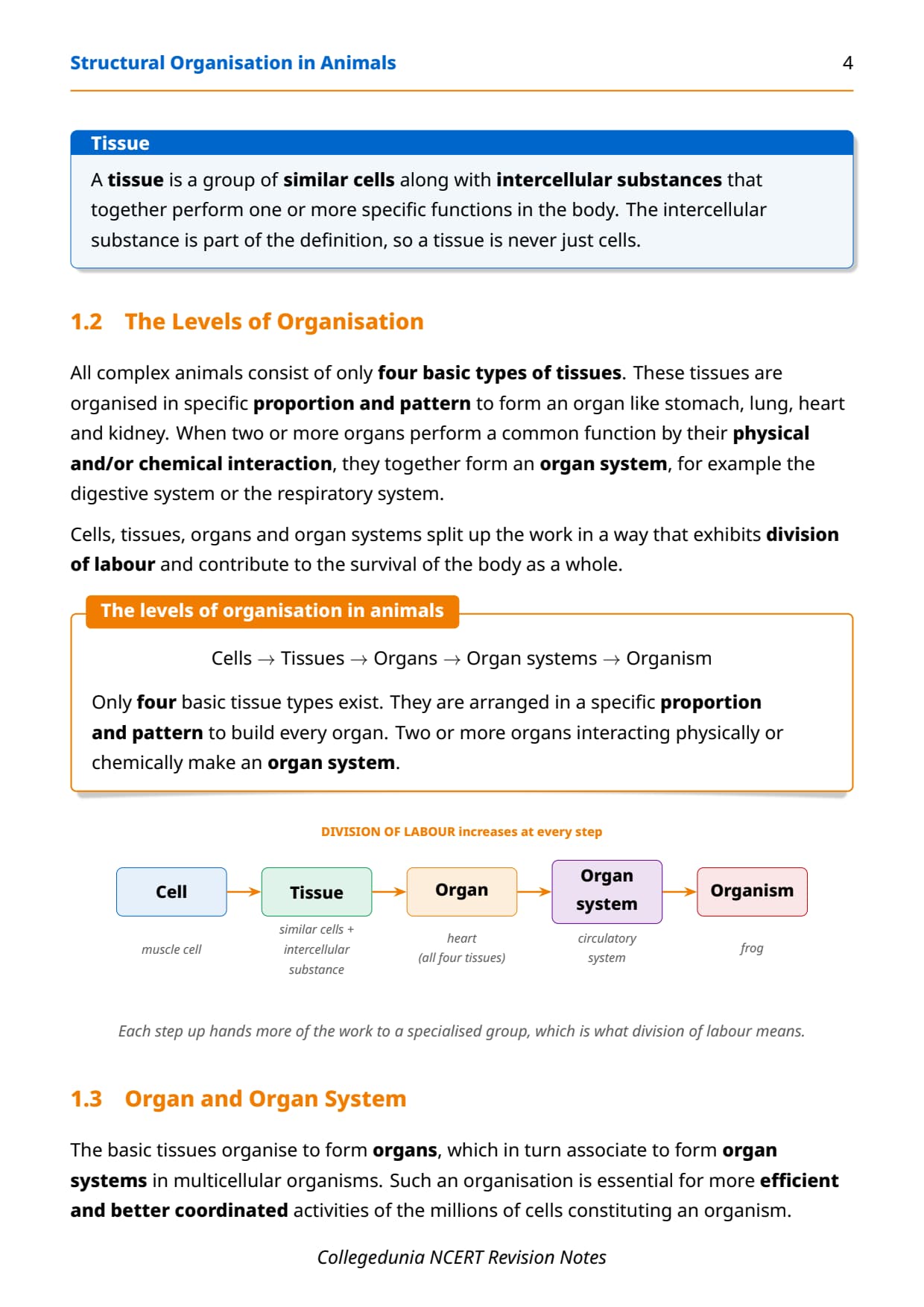
In unicellular organisms a single cell performs digestion, respiration and reproduction. In multicellular animals the same functions are shared among different groups of cells, and this sharing is called division of labour. A group of similar cells along with intercellular substances that perform a specific function is a tissue, and the intercellular substance is part of the definition, so a tissue is never just cells.
- The ladder: cells build tissues, tissues build organs, organs form organ systems, and organ systems make the organism. Only four basic tissue types exist, arranged in a specific proportion and pattern.
- Organ and organ system: each organ is made of one or more tissue types, and the heart is the standard example because it contains all four. Two or more organs interacting physically or chemically make an organ system.
- Morphology and anatomy: in animals, morphology is the external appearance while anatomy is the study of internal organs. Both terms apply to animals.
The two words morphology and anatomy get swapped in exams, so keep them apart: morphology is the outside, anatomy is the inside. When asked to name an organ made of all four basic tissue types, the NCERT answer is the heart, not the stomach or the kidney. Division of labour is why cardiac muscle can specialise in tireless contraction while gut epithelium specialises in absorption, which is the same logic that makes specialists outperform generalists.
The Four Basic Animal Tissues (NEET Extension)
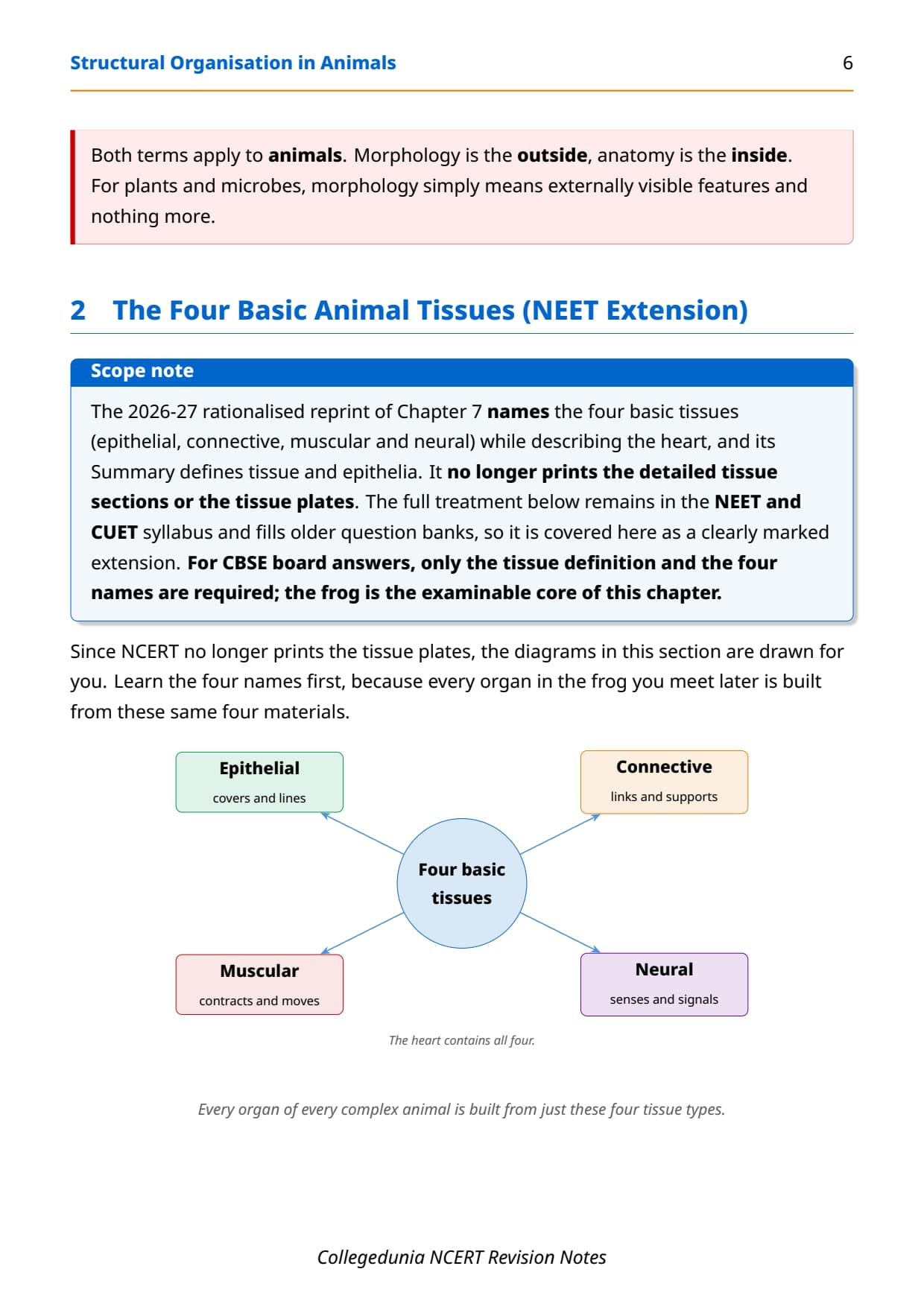
All complex animals are built from just four tissue types. The 2026-27 rationalised reprint names them while describing the heart and defines tissue and epithelia in its summary, but it no longer prints the detailed tissue sections or plates. NEET and CUET still test the full treatment, so it is covered here as a clearly marked extension; for CBSE board answers only the tissue definition and the four names are required, and the frog is the examinable core of this chapter.
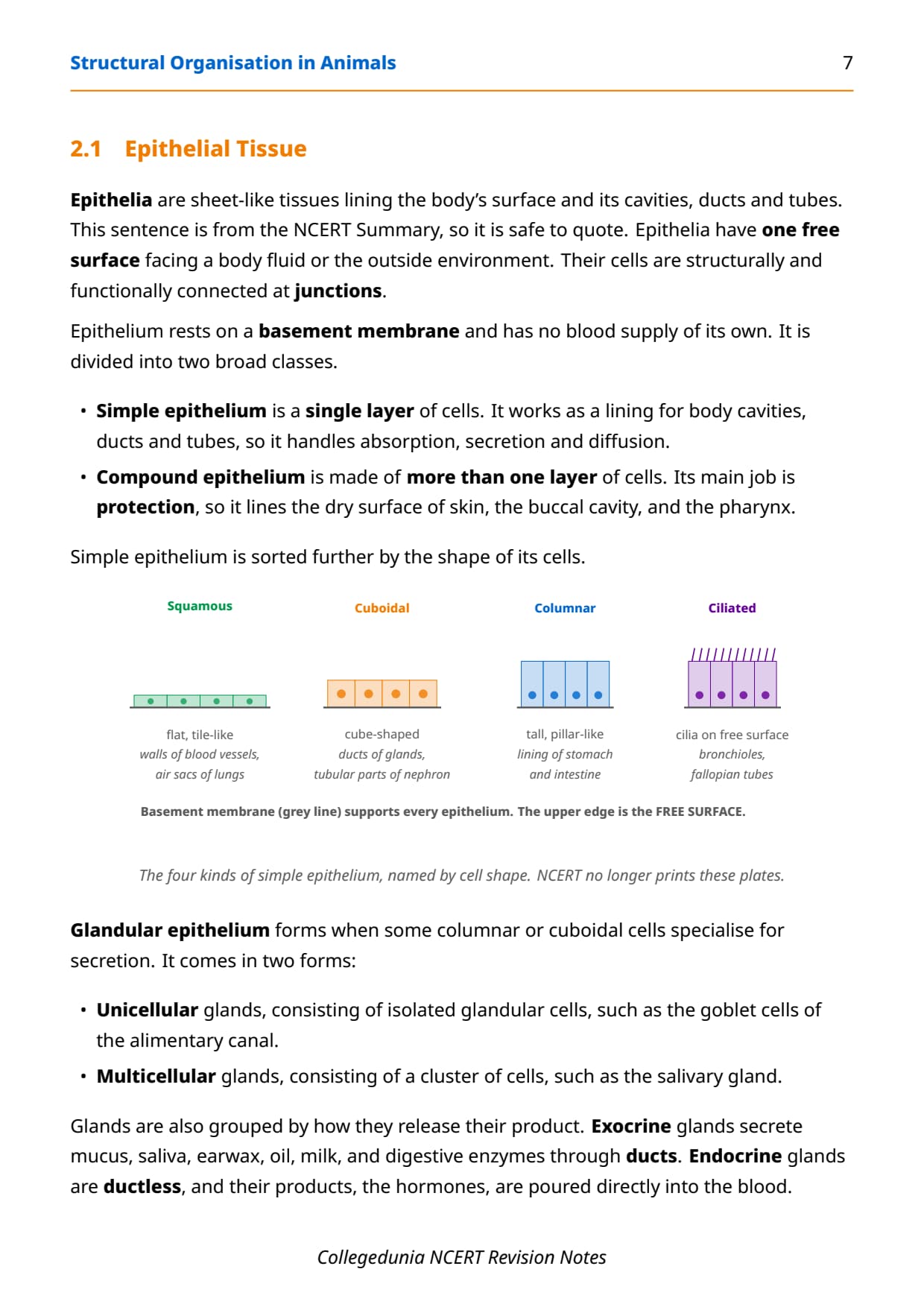
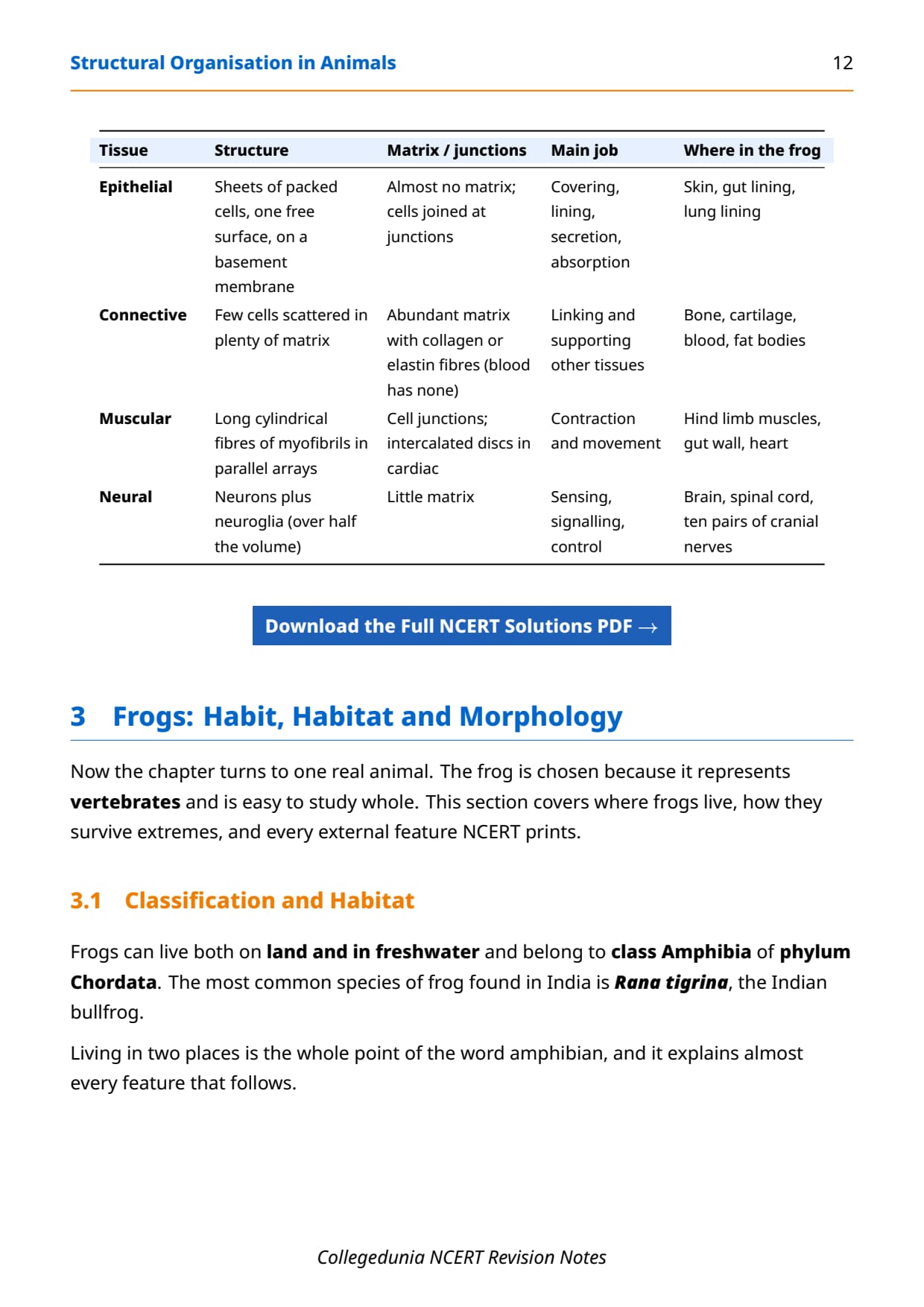
- Epithelial tissue: sheet-like cells with one free surface on a basement membrane. Simple epithelium is a single layer (squamous, cuboidal, columnar, ciliated) for lining and diffusion; compound epithelium has many layers for protection. Glands are exocrine if they secrete through a duct and endocrine if they are ductless.
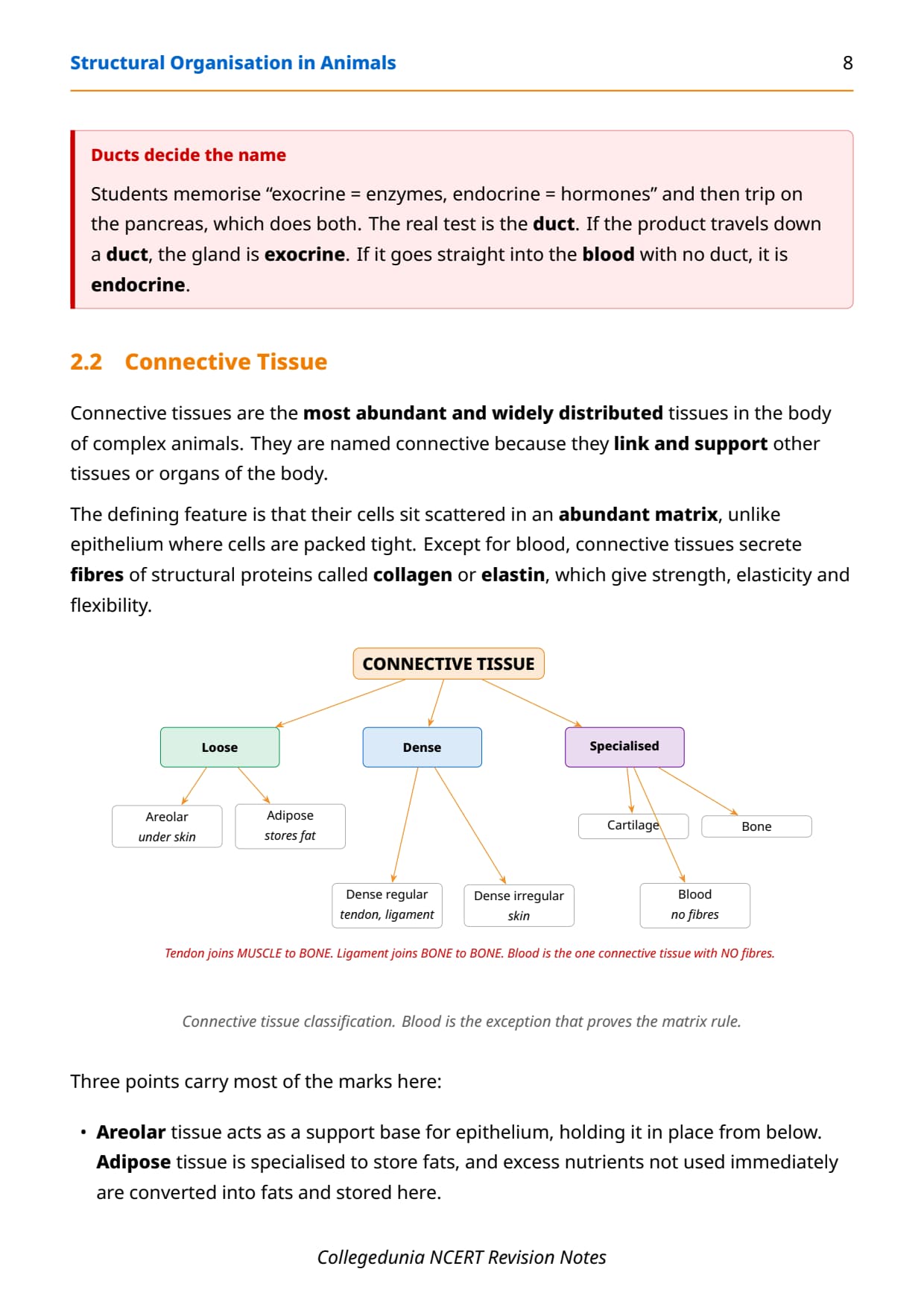
- Connective tissue: few cells scattered in an abundant matrix; the most widespread tissue. It covers loose (areolar, adipose), dense (tendon joins muscle to bone, ligament joins bone to bone), and specialised (cartilage, bone, and blood, which has no fibres) types.
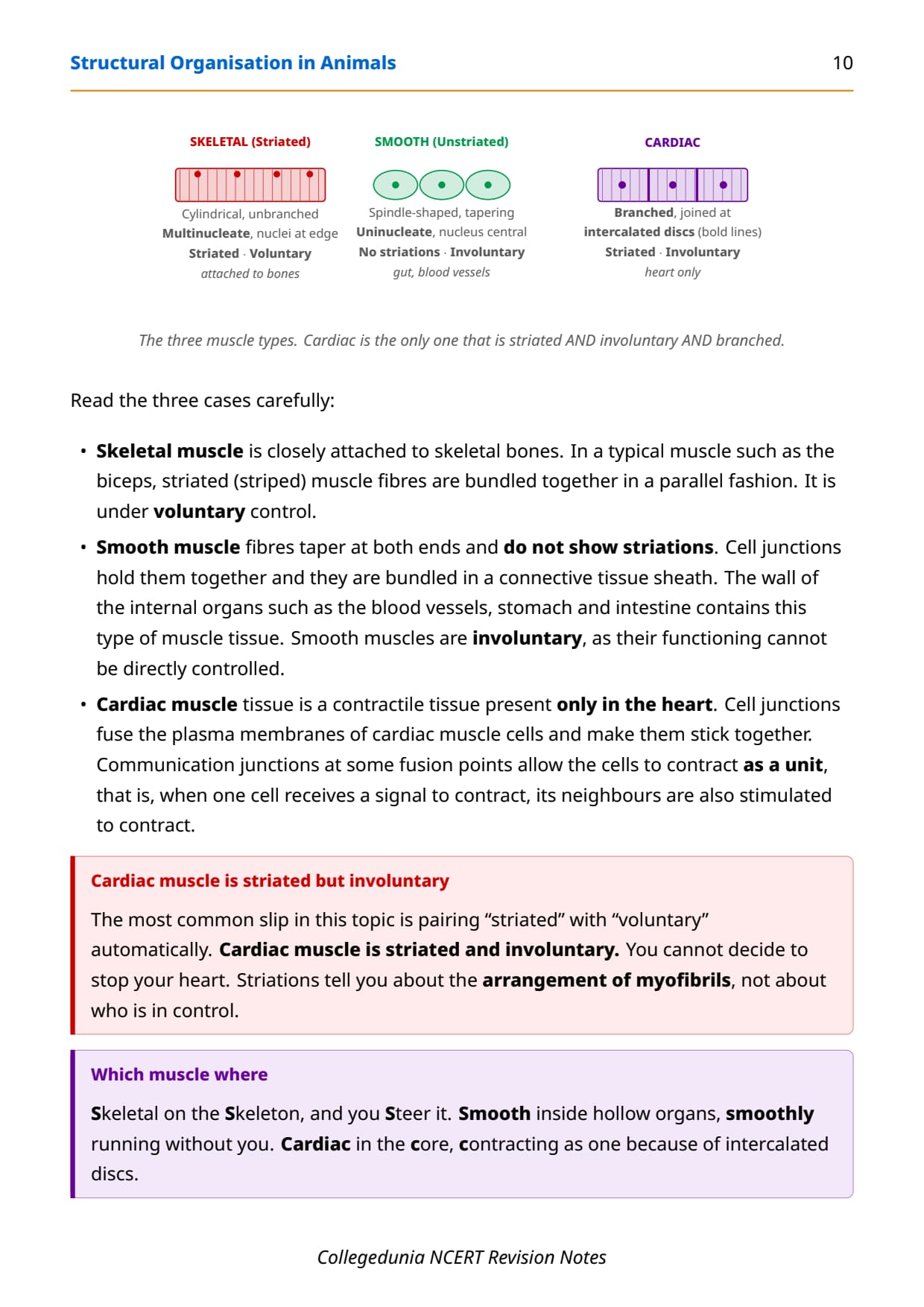
- Muscular tissue: skeletal (striated, voluntary), smooth (unstriated, involuntary), and cardiac (striated, involuntary, branched with intercalated discs).
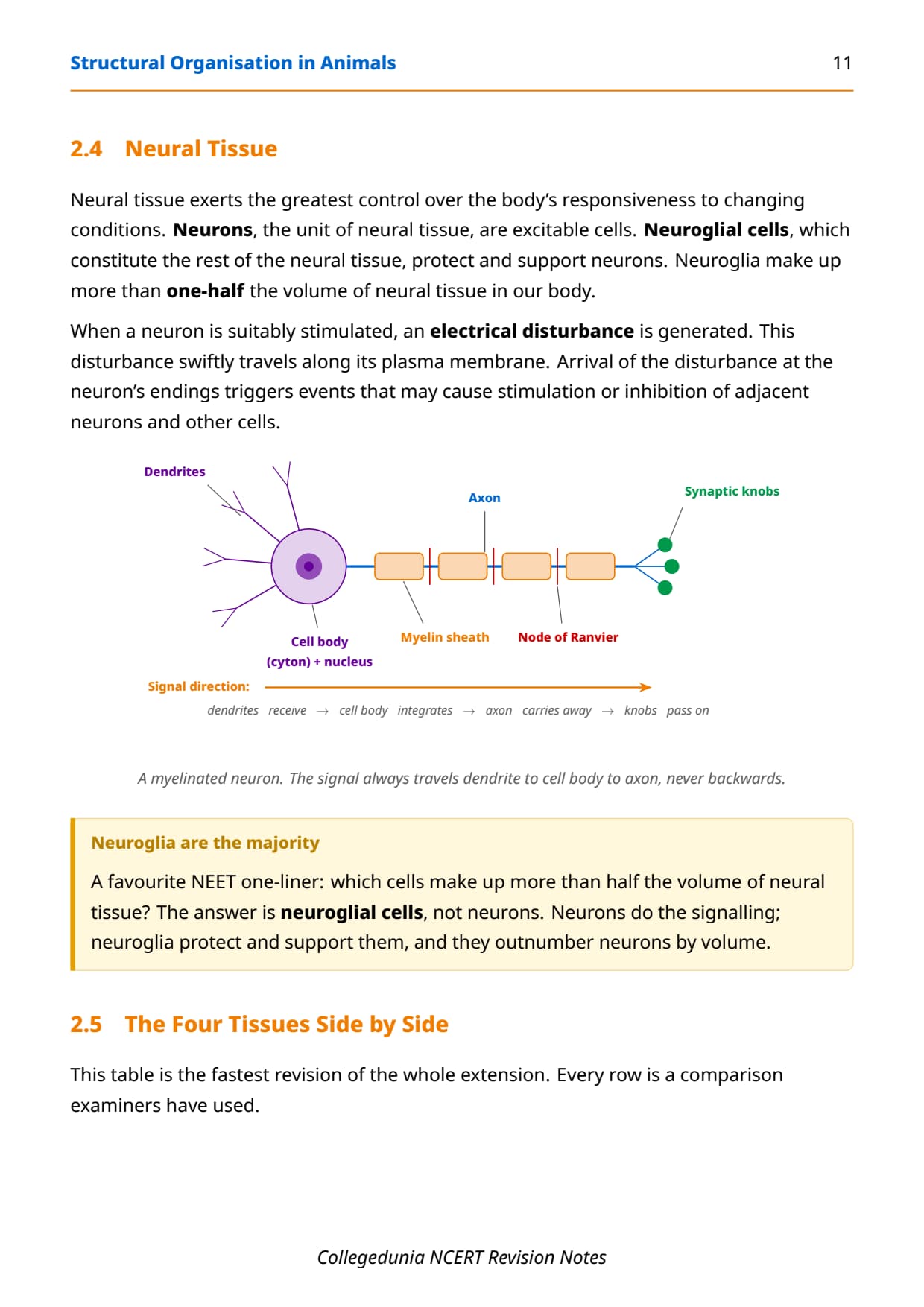
- Neural tissue: neurons that signal, plus neuroglia that support and make up more than half the volume of neural tissue.
Two traps recur here. The gland test is the duct, not the product, so a ducted gland is exocrine even if it also makes hormones. Cardiac muscle is striated and involuntary, because striations describe the arrangement of myofibrils, not who is in control. Tendon attaches a muscle, ligament attaches two bones, and blood is the one connective tissue with no fibres.
Frog: Habit, Habitat and Morphology
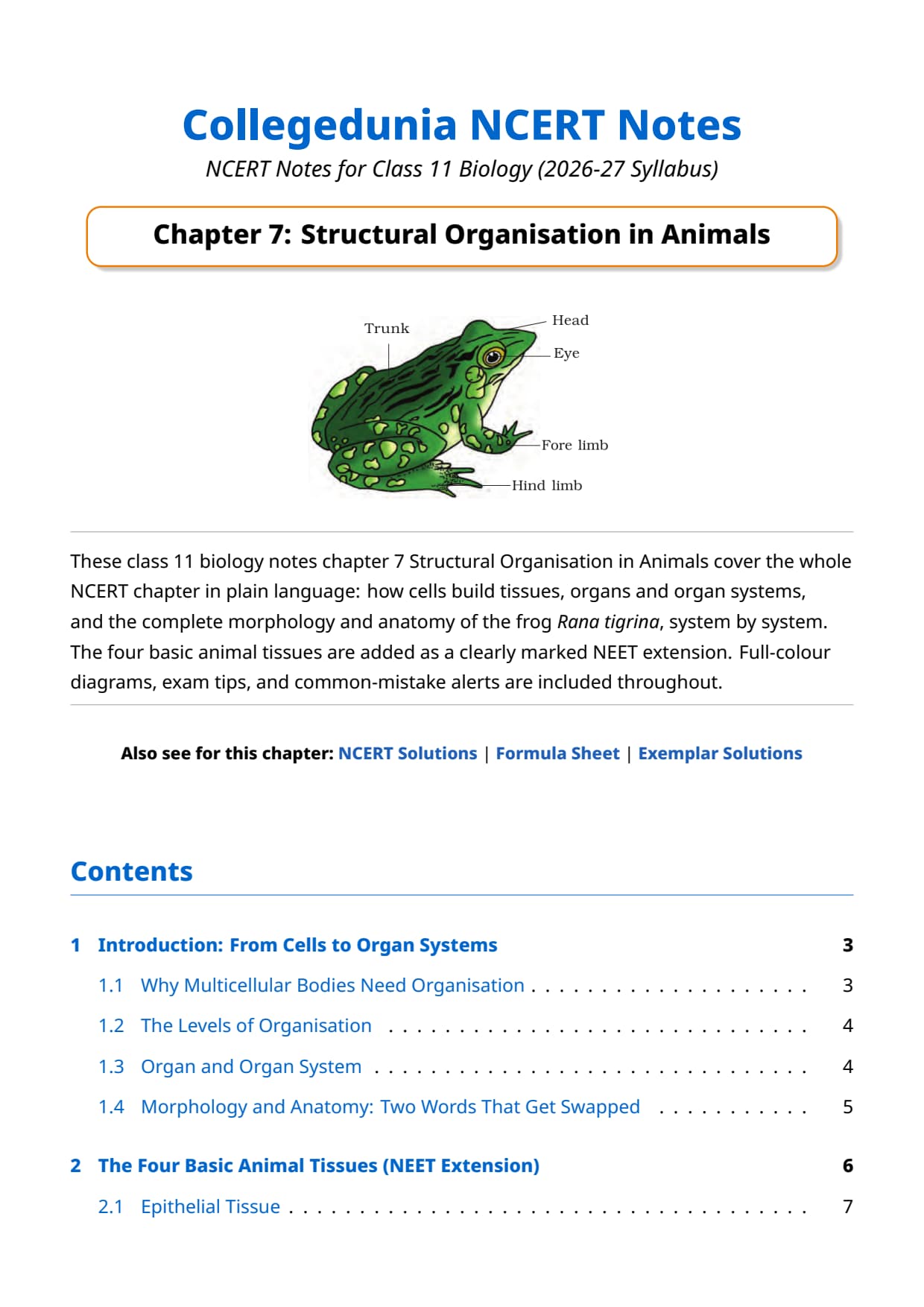
The chapter now turns to Rana tigrina, the Indian bullfrog, which can live both on land and in freshwater and belongs to class Amphibia of phylum Chordata. Living in two places is the whole point of the word amphibian, and it explains almost every external feature that follows, from the moist skin to the webbed feet.
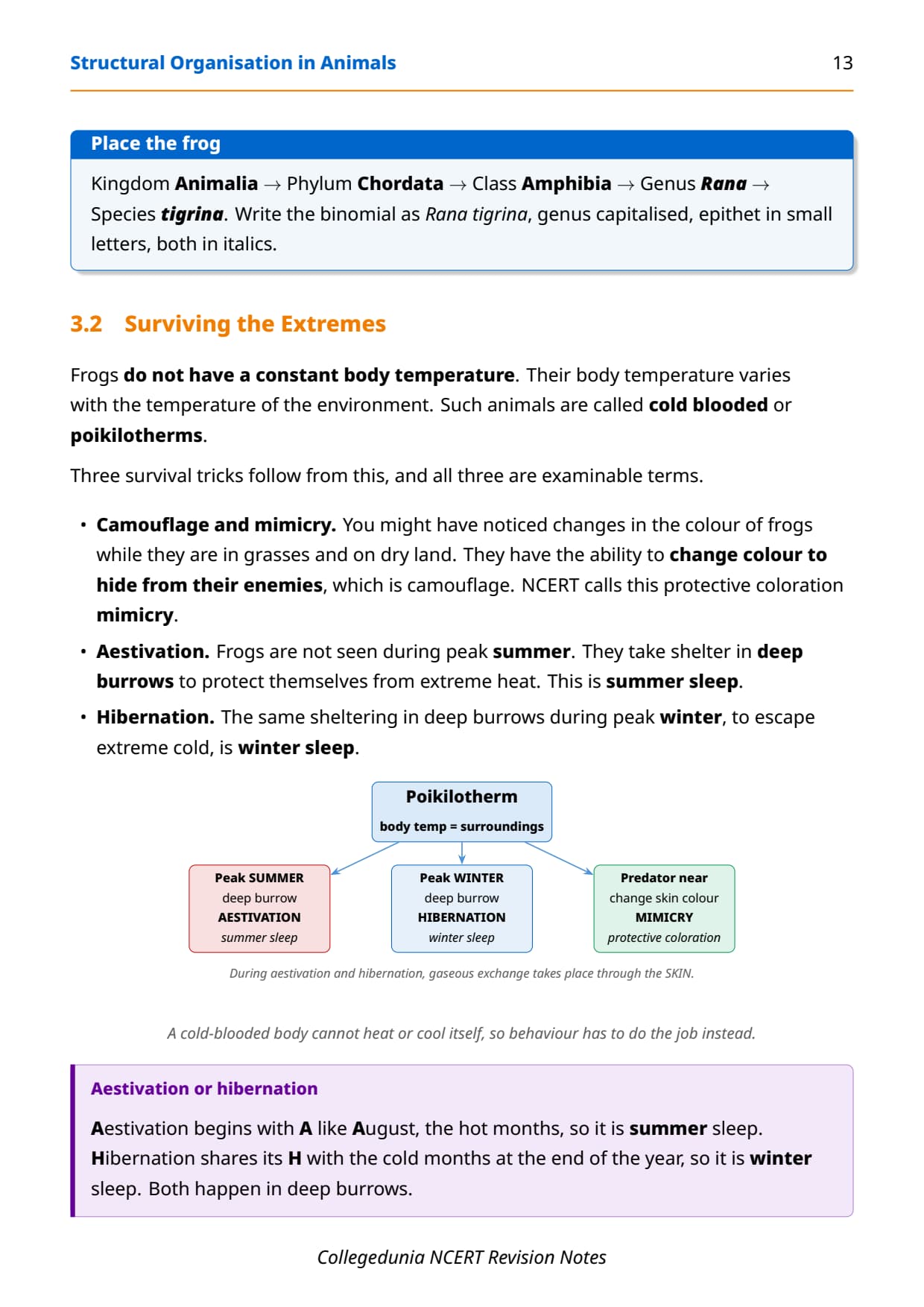
- Cold-blooded survival: frogs are poikilotherms, so their body temperature tracks the environment. They show mimicry (protective colour change), aestivation (summer sleep in deep burrows) and hibernation (winter sleep), and during both sleeps gas exchange is through the skin.
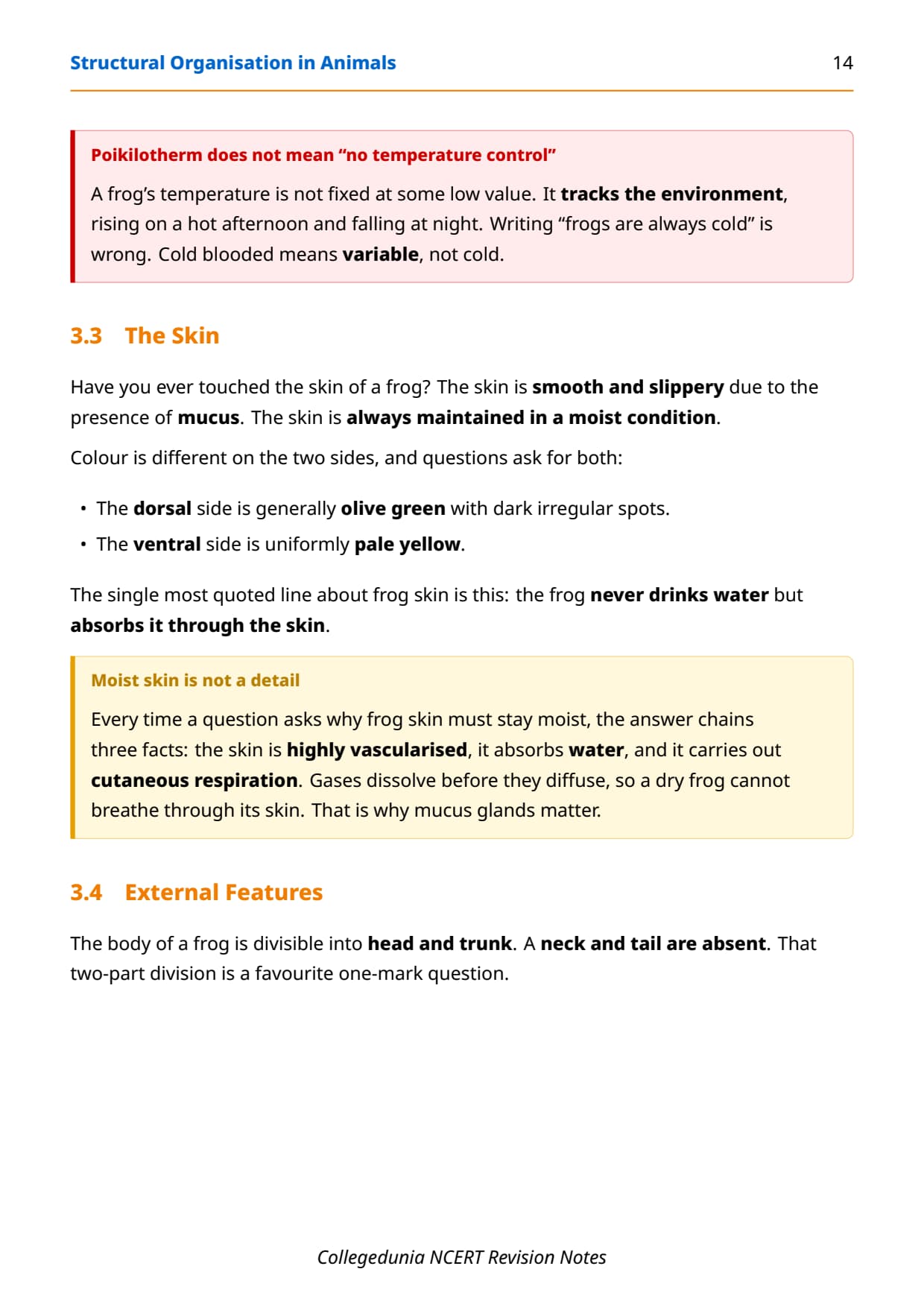
- The skin: smooth and slippery with mucus, always moist, olive green with dark spots on the dorsal side and pale yellow on the ventral side. The frog never drinks water but absorbs it through the skin.
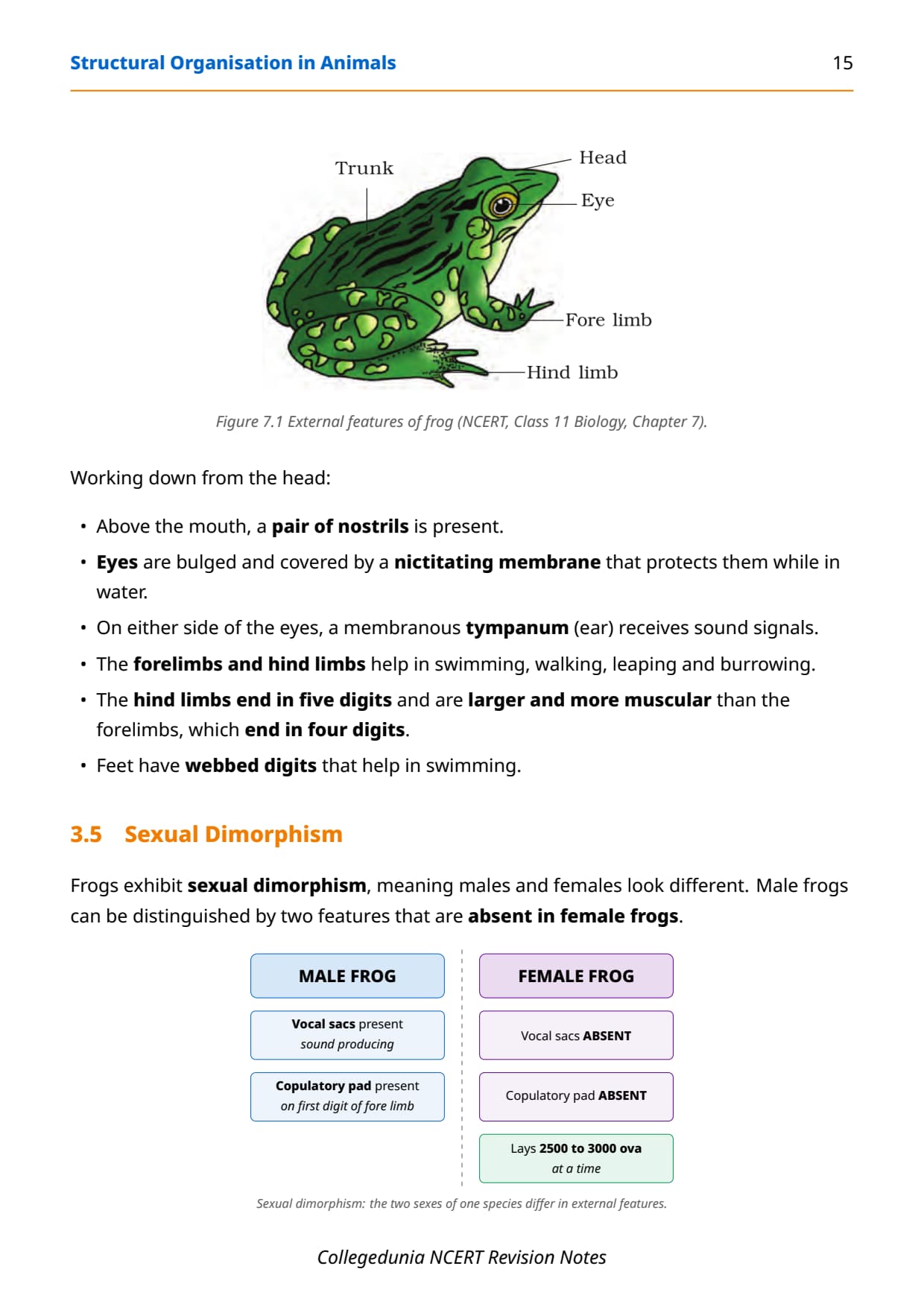
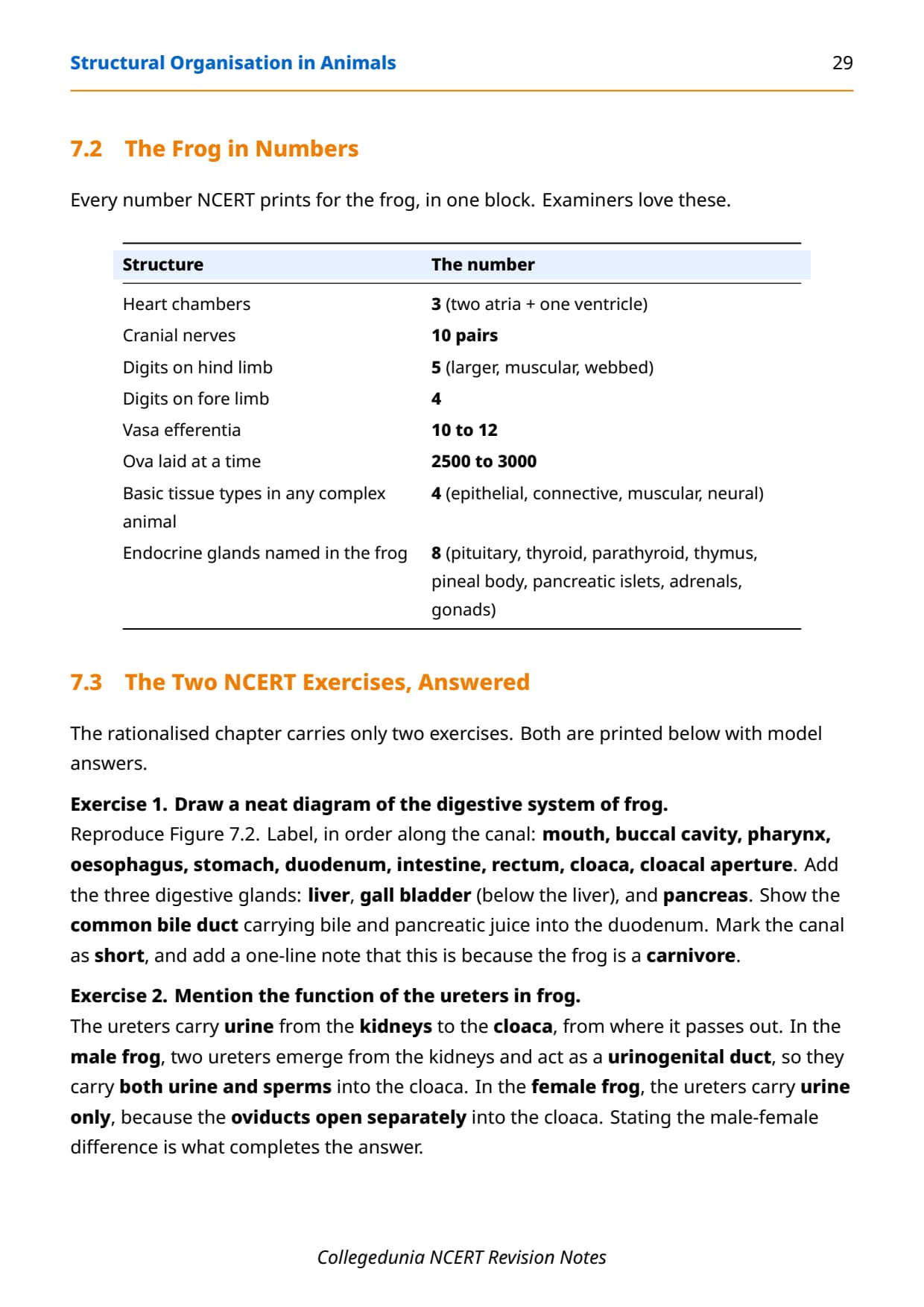
- External features: the body is divisible into head and trunk with no neck or tail; there are a pair of nostrils, eyes with a nictitating membrane, a tympanum, hind limbs ending in five webbed digits, and fore limbs ending in four.
- Sexual dimorphism: only the male has vocal sacs and a copulatory pad; a female lays 2500 to 3000 ova at a time.
The single most quoted line is that the frog never drinks water but absorbs it through the highly vascularised skin. Moist skin is not a detail, because a dry frog cannot carry out cutaneous respiration, since gases must dissolve before they diffuse. A useful hook is that Aestivation starts with A like August for summer, while Hibernation shares its cold-month feel with winter.
Digestive and Respiratory Systems of the Frog
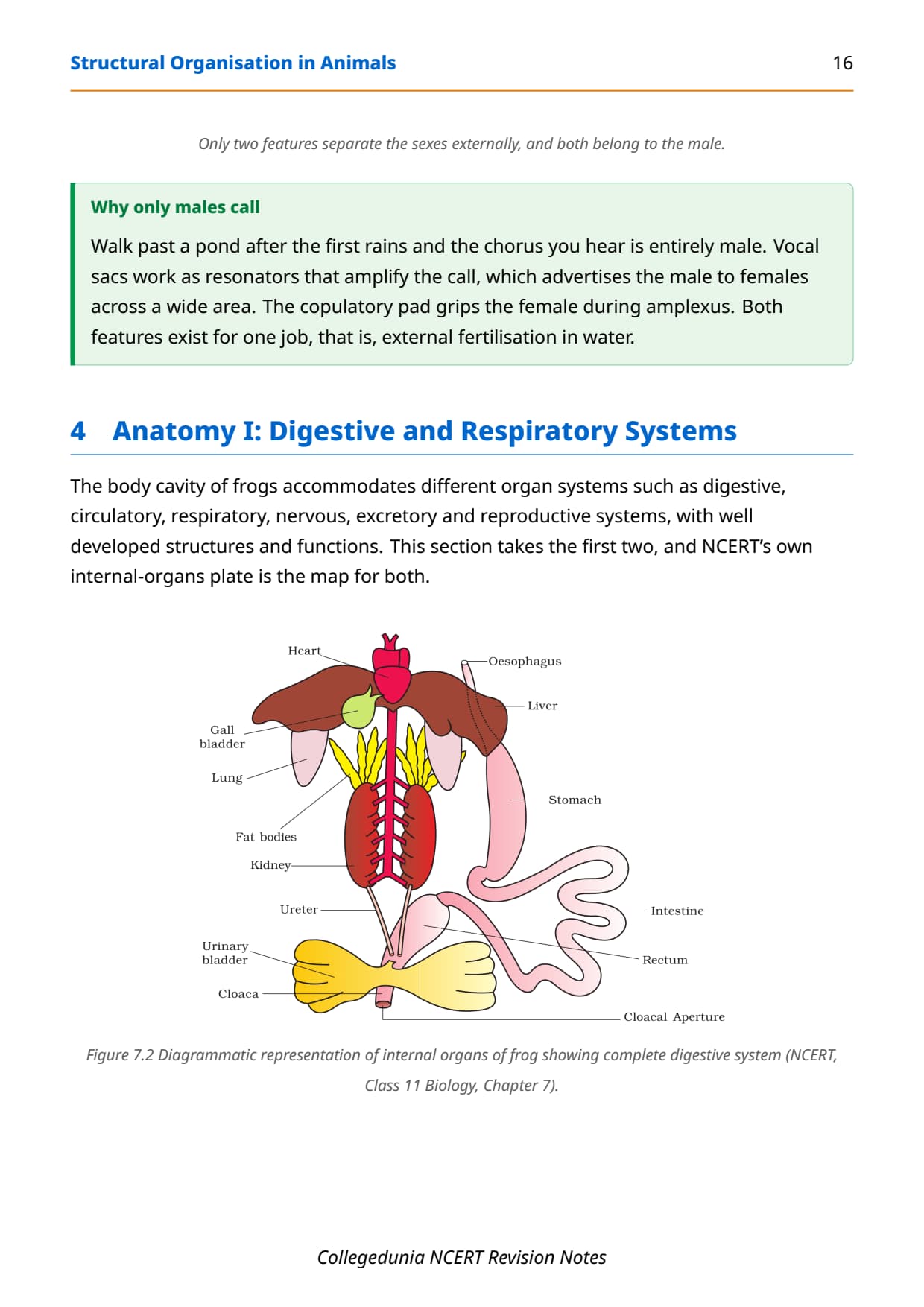
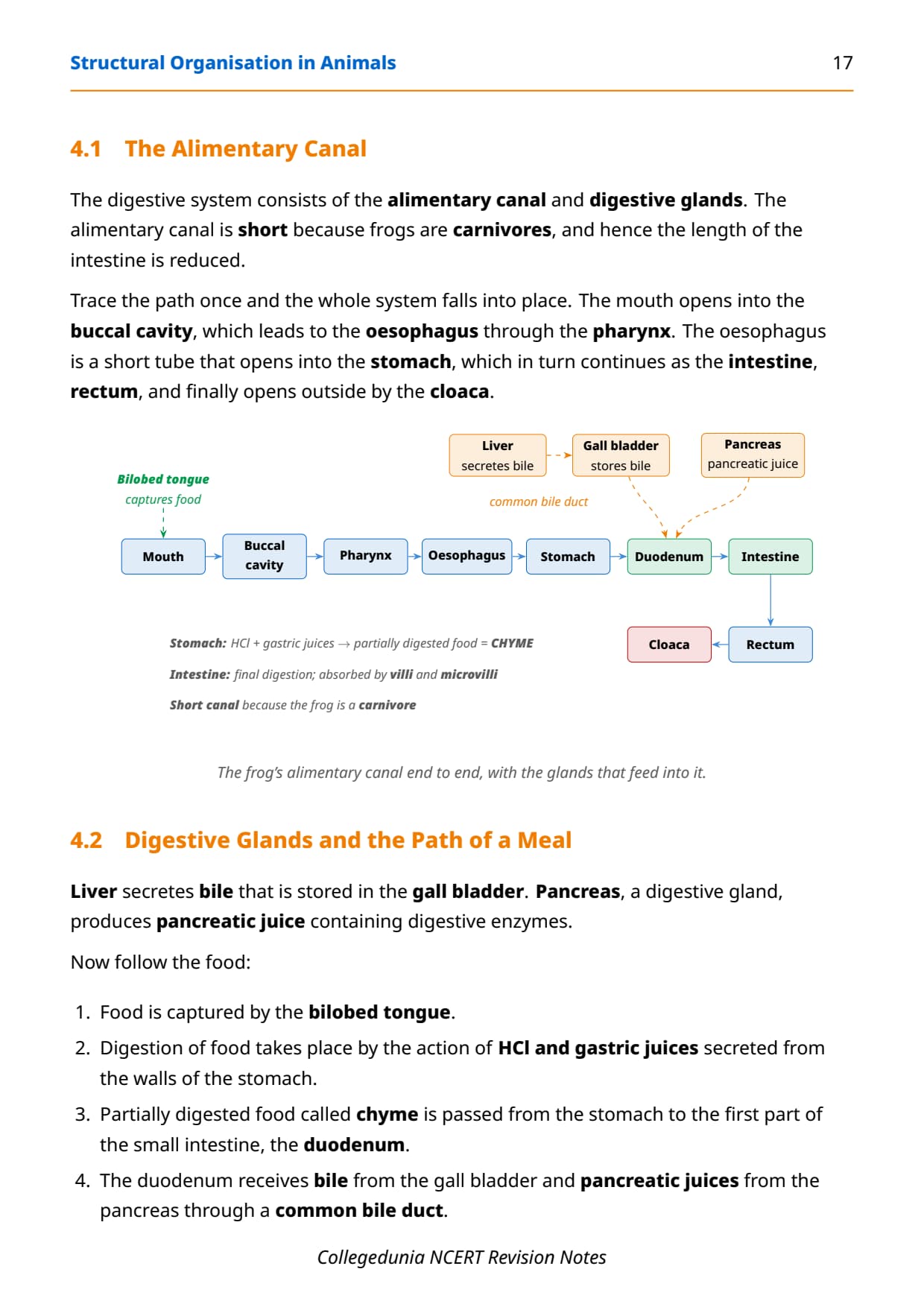
The frog's alimentary canal is short because the frog is a carnivore, so less intestine is needed. Food is caught by the bilobed tongue and passes through a fixed sequence of organs, with three digestive glands feeding into the gut. Respiration is dual, which is the clearest sign of an amphibian body, and both systems appear on NCERT's internal-organs plate.
- The canal in order: mouth, buccal cavity, pharynx, oesophagus, stomach, duodenum, intestine, rectum, and out through the cloaca. HCl and gastric juices turn food into chyme, and digested food is absorbed by villi and microvilli.
- The glands: the liver secretes bile stored in the gall bladder, and the pancreas makes pancreatic juice; both reach the duodenum through a common bile duct. Bile emulsifies fat and carries no enzyme.
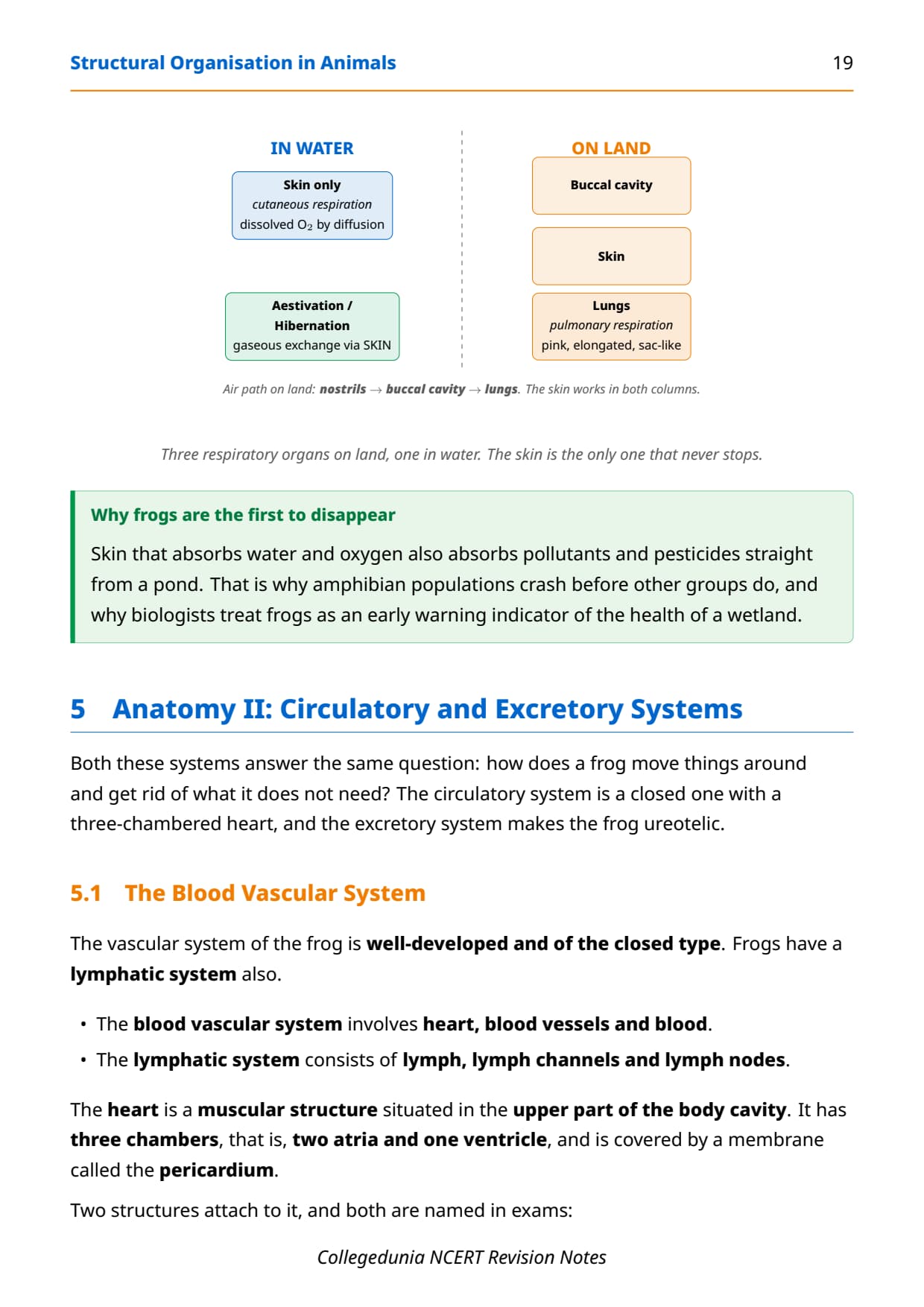
- Respiration: in water, the skin alone is the respiratory organ (cutaneous respiration by diffusion). On land, the buccal cavity, skin and lungs work, with pulmonary respiration through the pink, sac-like lungs.
A frequent error is writing that bile digests fat. Bile only emulsifies fat and contains no digestive enzyme. Remember that the skin is the one respiratory organ that never stops working, which is why gaseous exchange during aestivation and hibernation happens through the skin. The same permeable skin that absorbs oxygen also absorbs pollutants, which is why amphibians are early indicators of a sick wetland.
Circulatory and Excretory Systems of the Frog
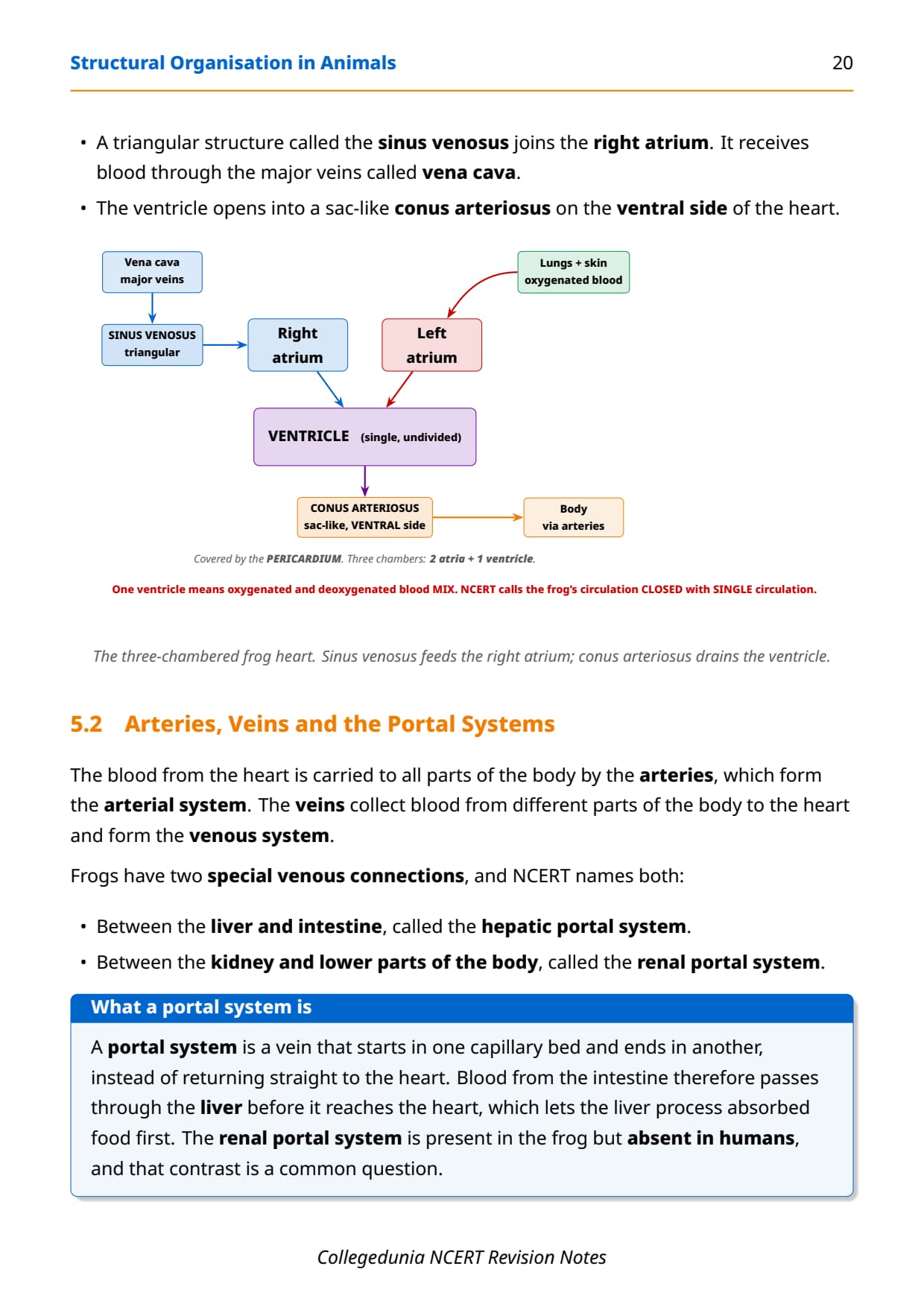
The frog's blood vascular system is well developed and of the closed type, and the frog also has a lymphatic system. The heart is muscular, covered by a pericardium, and has three chambers, that is two atria and one ventricle. The excretory system disposes of nitrogenous waste through kidneys, making the frog ureotelic. Both systems answer how a frog moves substances around and removes what it does not need.
- The heart: the triangular sinus venosus receives blood from the vena cava and joins the right atrium, and the ventricle opens into a sac-like conus arteriosus on the ventral side. One undivided ventricle means oxygenated and deoxygenated blood mix.
- Portal systems: the hepatic portal system links liver and intestine, and the renal portal system links kidney and lower body. The renal portal system is present in the frog but absent in humans.
- Blood and lymph: frog RBCs are nucleated and contain haemoglobin; lymph lacks a few proteins and RBCs.
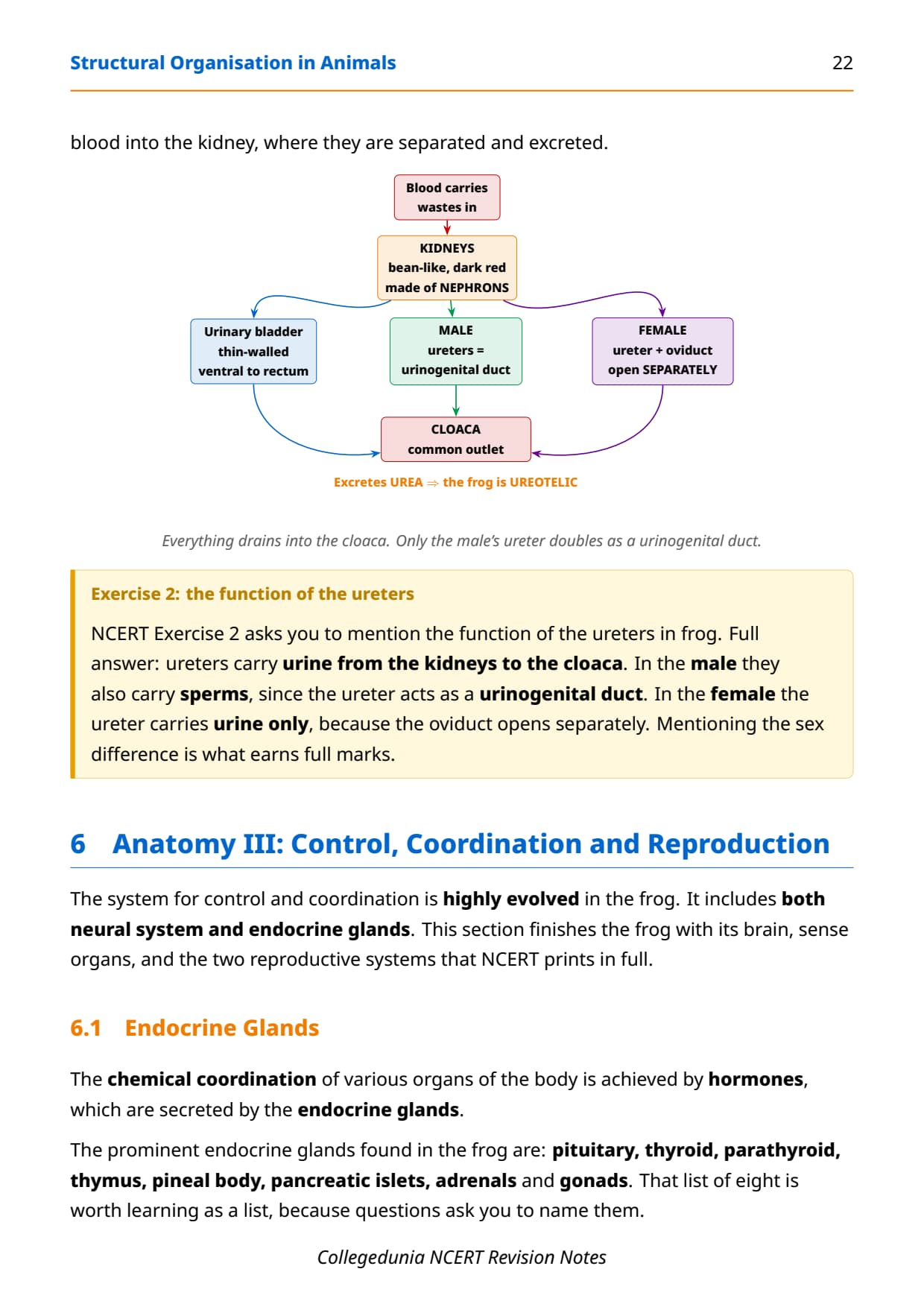
- Excretion: a pair of bean-like kidneys made of nephrons, plus ureters, urinary bladder and cloaca, excrete urea.
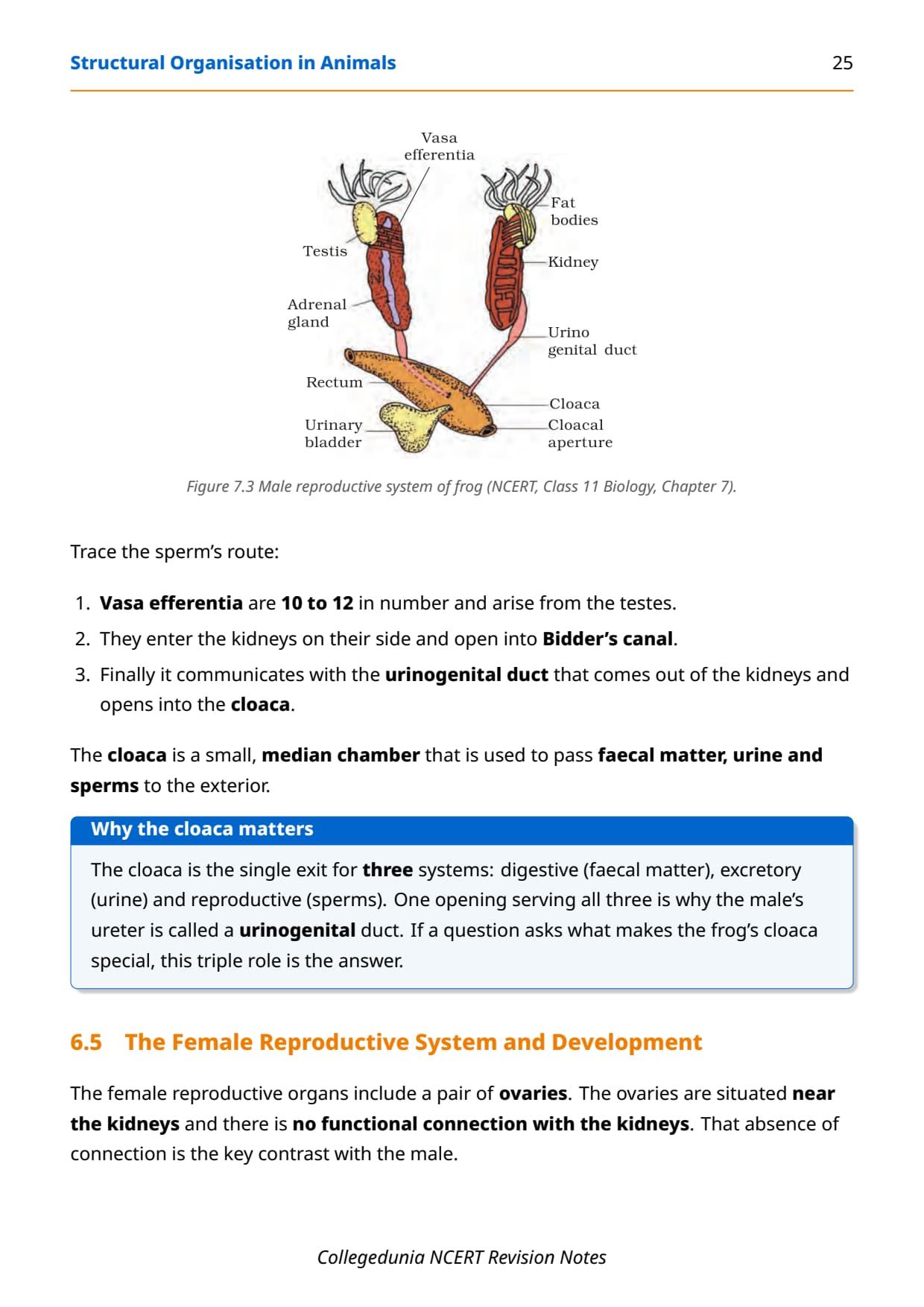
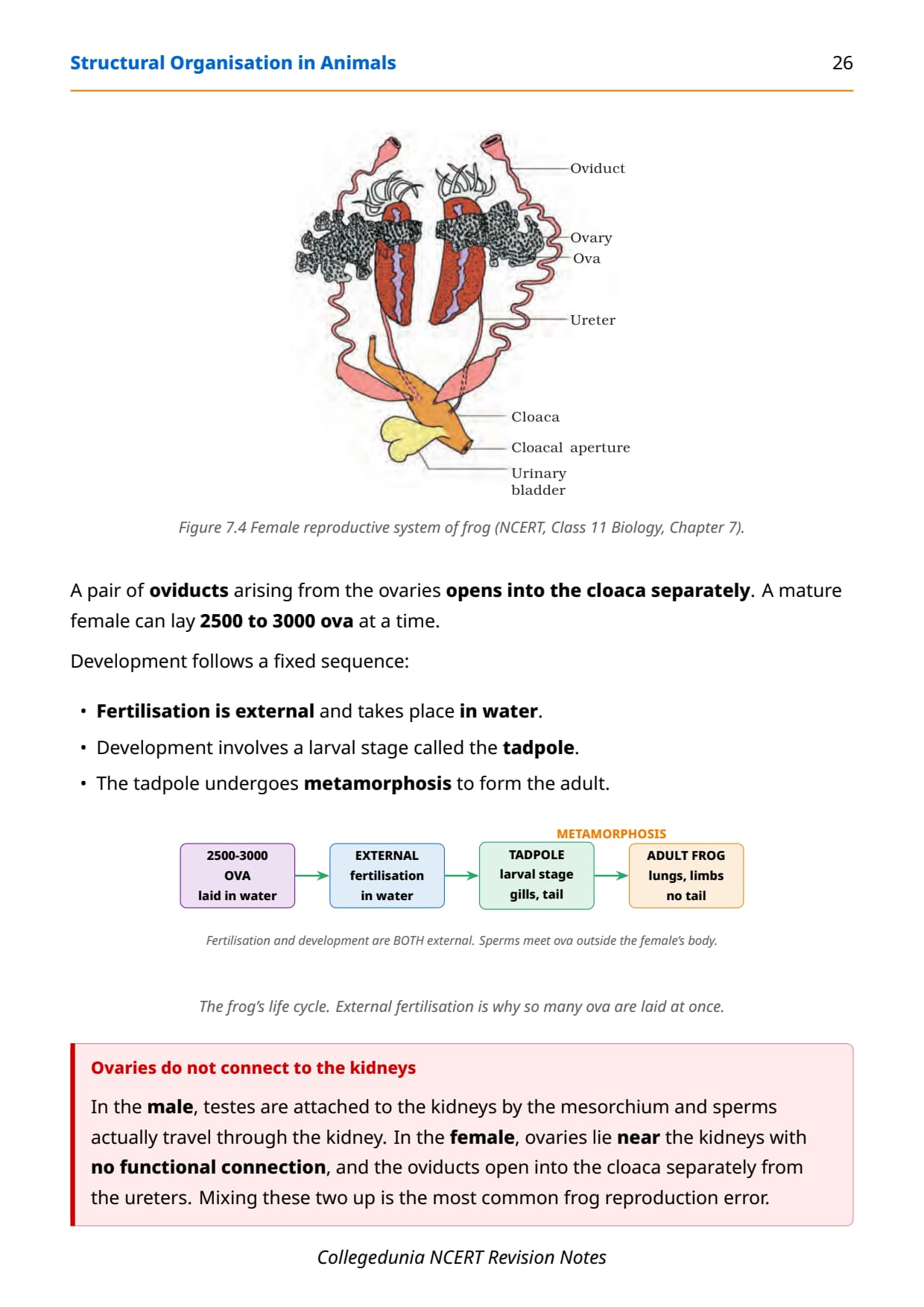
The ureters carry the sex difference that exams test. In the male, the two ureters act as a urinogenital duct carrying both urine and sperms, while in the female the ureters carry urine only because the oviducts open separately into the cloaca. Do not carry the human RBC fact across, because frog RBCs are nucleated while human mature RBCs are not. The single ventricle is also why the frog heart is called three-chambered with single circulation.
Control, Coordination and Reproduction in the Frog
Control and coordination in the frog are highly evolved and use both the neural system and the endocrine glands. This section finishes the frog with its brain, sense organs, endocrine glands, and the two reproductive systems that NCERT prints in full, including the fixed sequence of external fertilisation and metamorphosis.
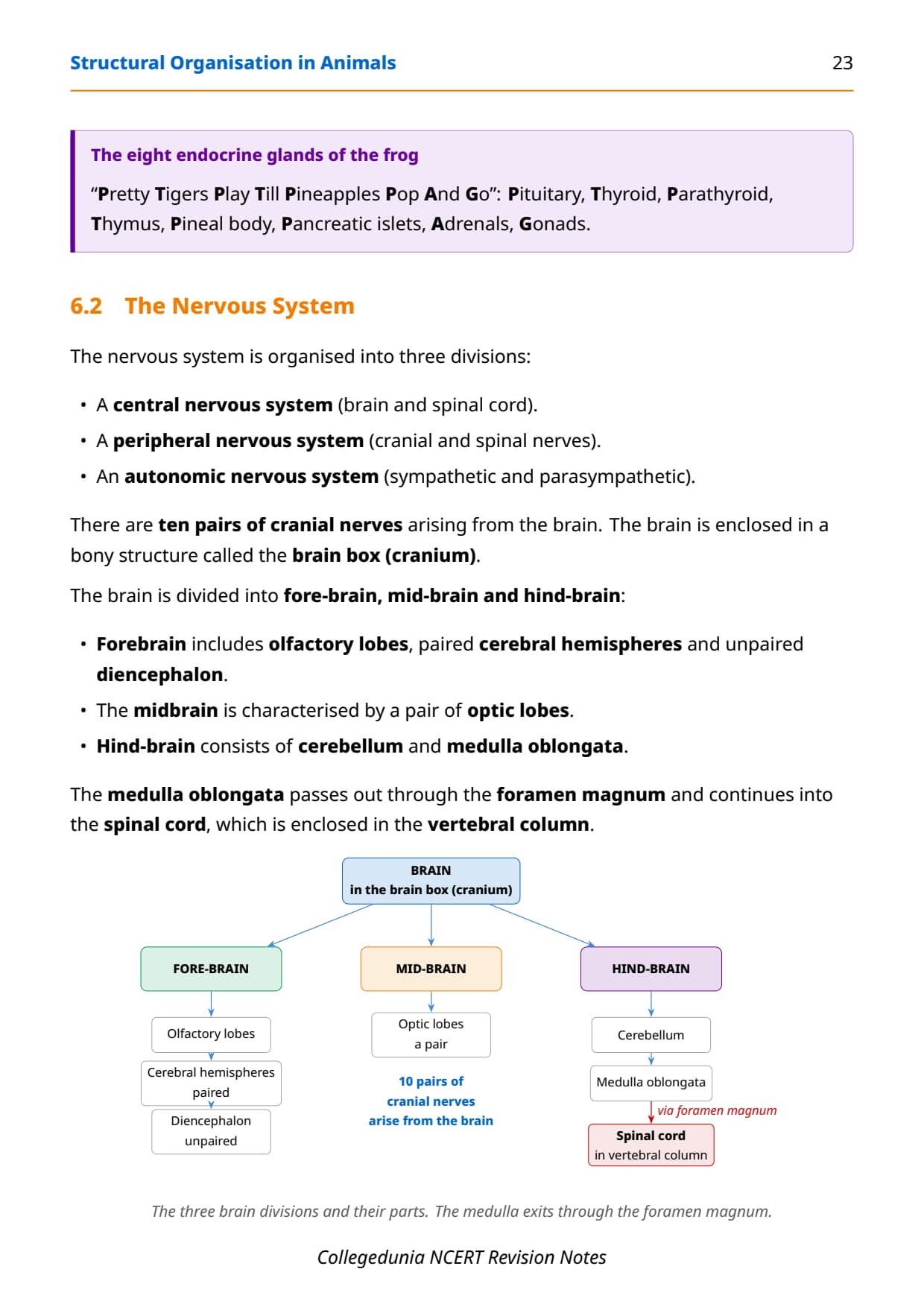
- Nervous system: organised into central (brain and spinal cord), peripheral (cranial and spinal nerves) and autonomic divisions. There are ten pairs of cranial nerves, and the brain has a fore-brain, mid-brain and hind-brain.
- Endocrine glands: eight are named, that is pituitary, thyroid, parathyroid, thymus, pineal body, pancreatic islets, adrenals and gonads.
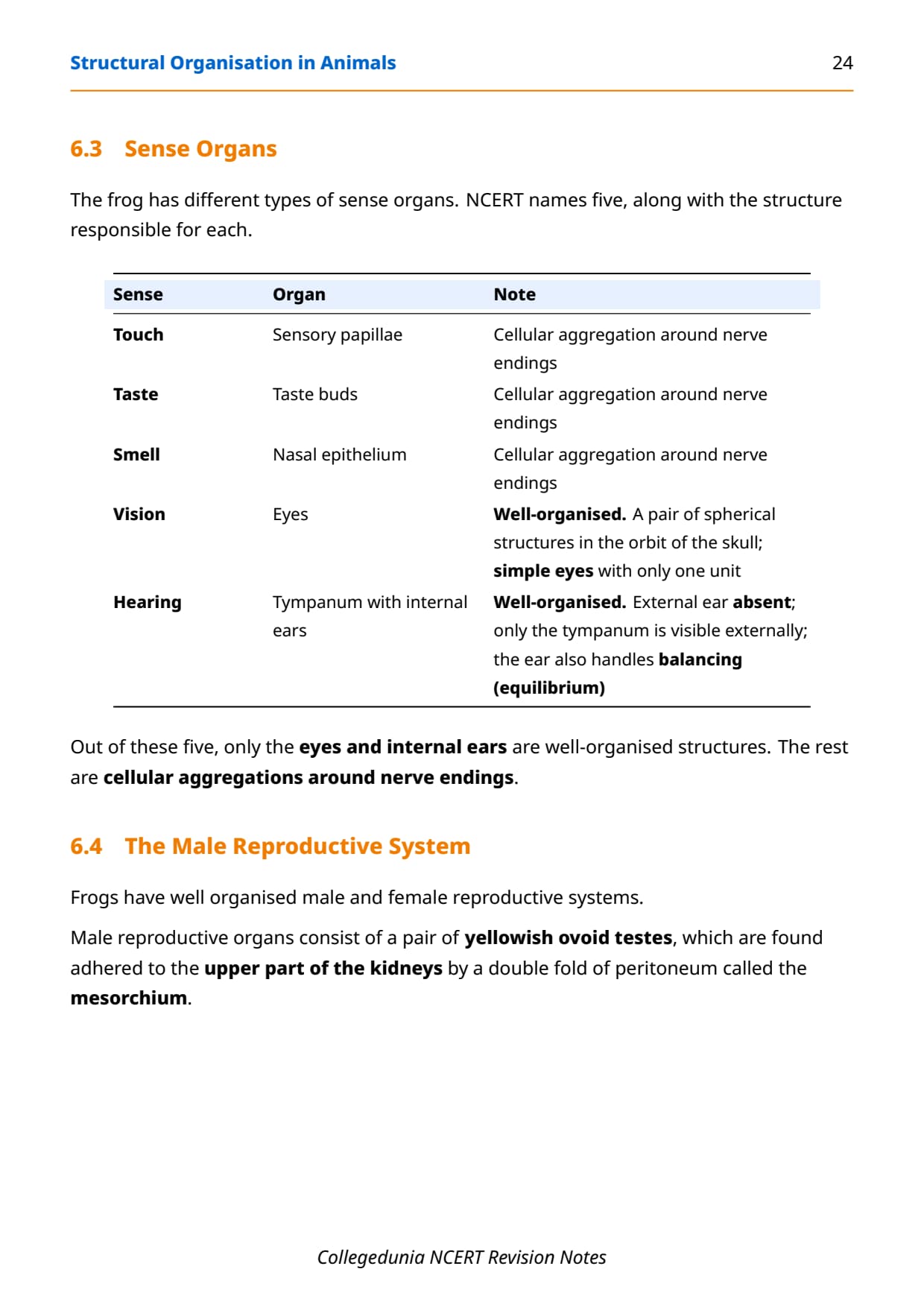
- Sense organs: touch, taste, smell, sight and hearing; only the eyes and internal ears are well-organised, and the rest are cellular aggregations around nerve endings.
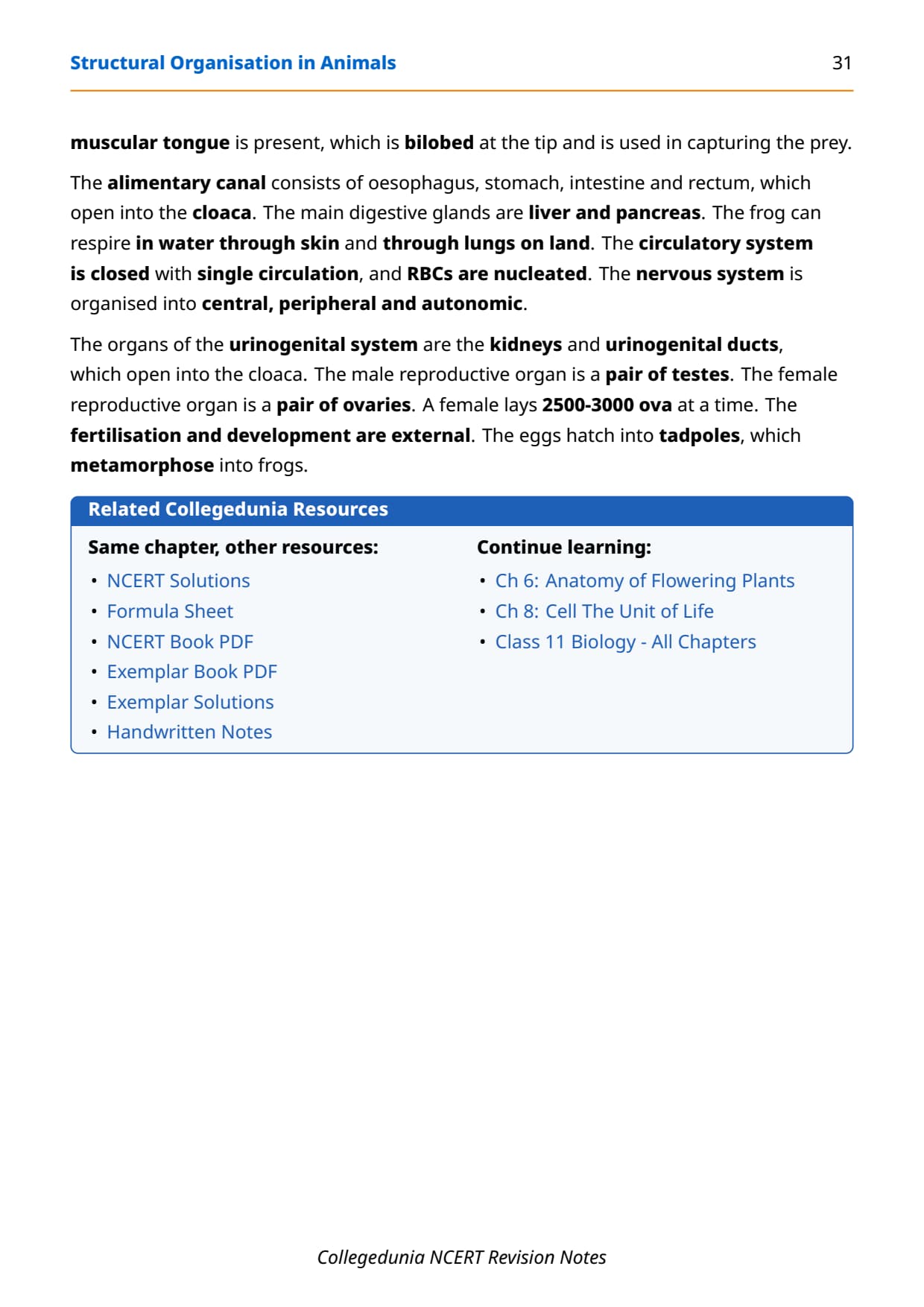
- Reproduction: a pair of testes attached to the kidneys by the mesorchium in males, and a pair of ovaries with no functional connection to the kidneys in females. Fertilisation and development are external, through a tadpole that undergoes metamorphosis.
The cloaca is the single exit for three systems, that is faecal matter, urine and sperms, which is why the male's ureter is called urinogenital. In the male, testes attach to the kidneys and sperms travel through them, but in the female the ovaries only lie near the kidneys with no functional connection. Frogs matter because they eat crop pests and hold a key place in the food chain, so protecting them is both an ecological and an economic argument.
Key Definitions in Structural Organisation in Animals
Board short-answer questions often ask for a clean definition in one or two lines, and a vague answer loses easy marks. Learn these word-for-word, because the wording of the exam question is usually built straight from the NCERT definition. Each term below also connects to a system or example you can be asked to explain.
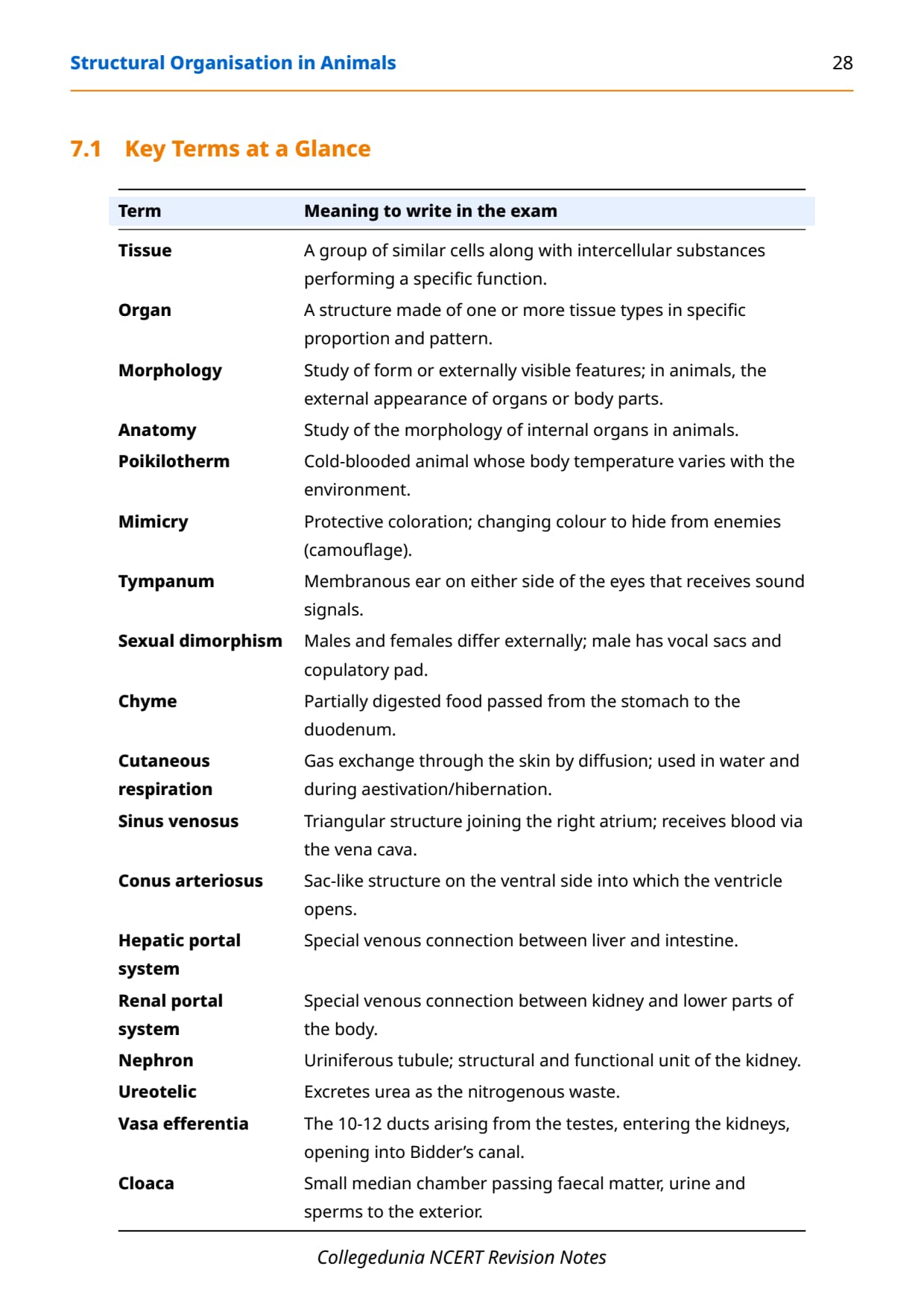
| Term | Definition |
|---|---|
| Tissue | A group of similar cells along with intercellular substances performing a specific function. |
| Anatomy | The study of the morphology of internal organs in animals. |
| Poikilotherm | A cold-blooded animal whose body temperature varies with the environment. |
| Chyme | Partially digested food passed from the stomach to the duodenum. |
| Cutaneous respiration | Gas exchange through the skin by diffusion, used in water and during aestivation and hibernation. |
| Ureotelic | An animal that excretes urea as its nitrogenous waste. |
| Sexual dimorphism | Males and females differing externally; the male frog has vocal sacs and a copulatory pad. |
A common board question asks you to define cutaneous respiration and then say when the frog uses it. State the definition first, then add that the skin is the only organ in water and the only one during aestivation and hibernation. Learning these definitions makes the wording of almost every one-mark and two-mark question in this chapter familiar.
Common Mistakes Students Make in Structural Organisation in Animals
These slips happen because a frog fact looks like the matching human fact, or because two terms sit close together. Each one costs 1 to 2 marks in the paper, so watch for them at the exact step where they occur.
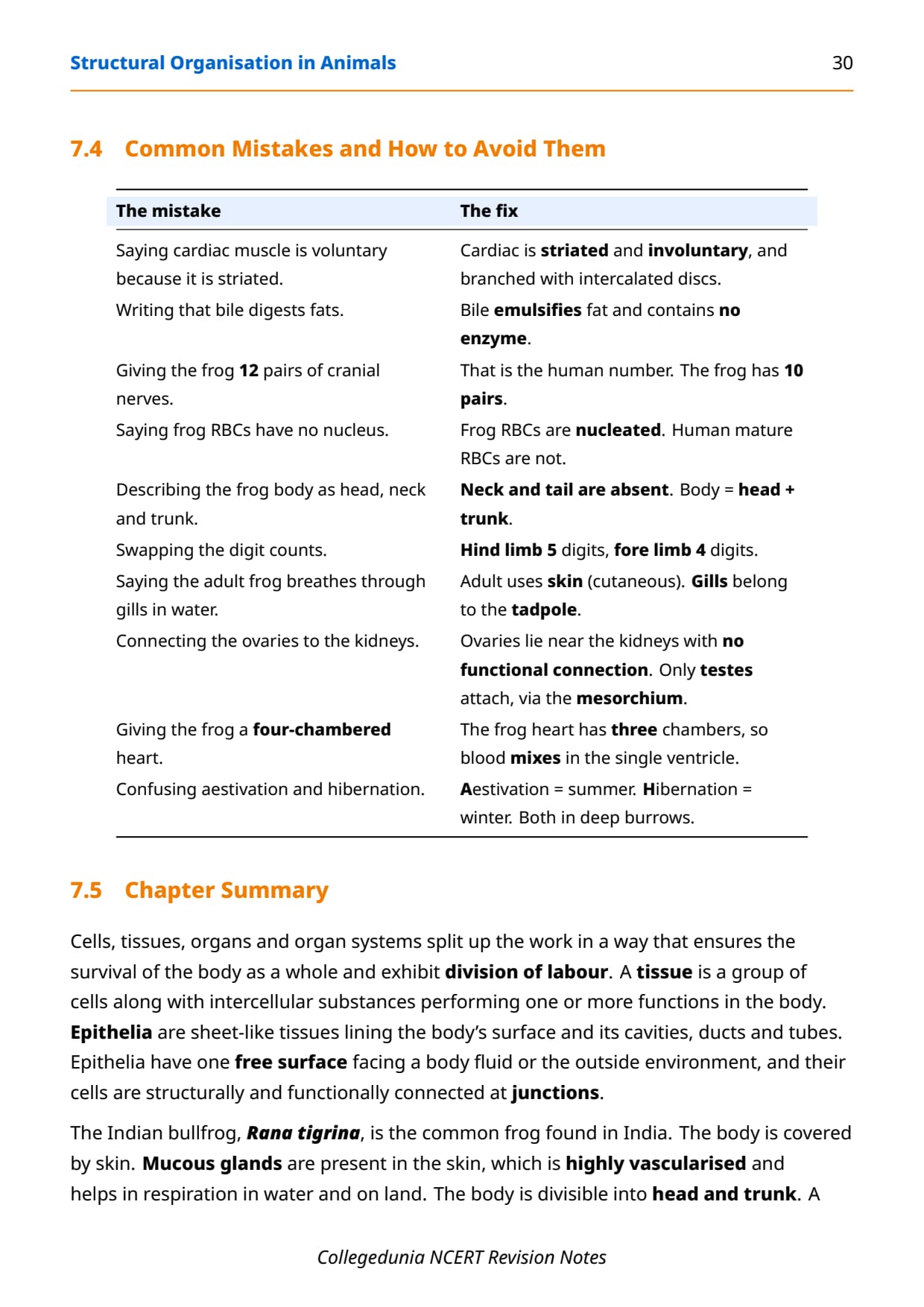
Mistake 1: Saying cardiac muscle is voluntary because it is striated. Cardiac muscle is striated and involuntary, and branched with intercalated discs.
Mistake 2: Writing that bile digests fat. Bile only emulsifies fat and contains no enzyme.
Mistake 3: Giving the frog 12 pairs of cranial nerves. That is the human number; the frog has 10 pairs.
Mistake 4: Saying frog RBCs have no nucleus. Frog RBCs are nucleated; only human mature RBCs are not.
Mistake 5: Giving the frog a four-chambered heart. The frog heart has three chambers, so blood mixes in the single ventricle.
Structural Organisation in Animals Weightage in CBSE Boards, NEET and CUET
This chapter is fact-dense and reliably scoring. It usually carries a labelled diagram of the frog's digestive system and a short answer on tissues or organ systems, and its tissue ideas feed the human physiology chapters later. Here is how the marks split across the main exams for 2026-27.
| Exam | Typical weightage | What is asked |
|---|---|---|
| CBSE Boards | 3 to 5 marks | A labelled diagram of the frog digestive system plus a short answer on tissues or the ureters |
| NEET | 2 to 3 questions | The four tissues, muscle types, frog circulation, and reproduction facts |
| CUET | 1 to 2 objective questions | Levels of organisation, frog numbers, and morphology versus anatomy |
The frog's organ systems and the four basic tissues are the most tested ideas from this chapter across all three exams. Master the digestive system diagram and the tissue comparison first, then the circulatory and excretory facts, then reproduction, in that order of return on effort for the 2026-27 session.
How to Revise Structural Organisation in Animals Quickly
Use these structural organisation in animals class 11 notes for a fast, ordered recap the night before a test. The checklist below takes about 25 minutes and hits every marks-heavy idea in the chapter without opening the full textbook.
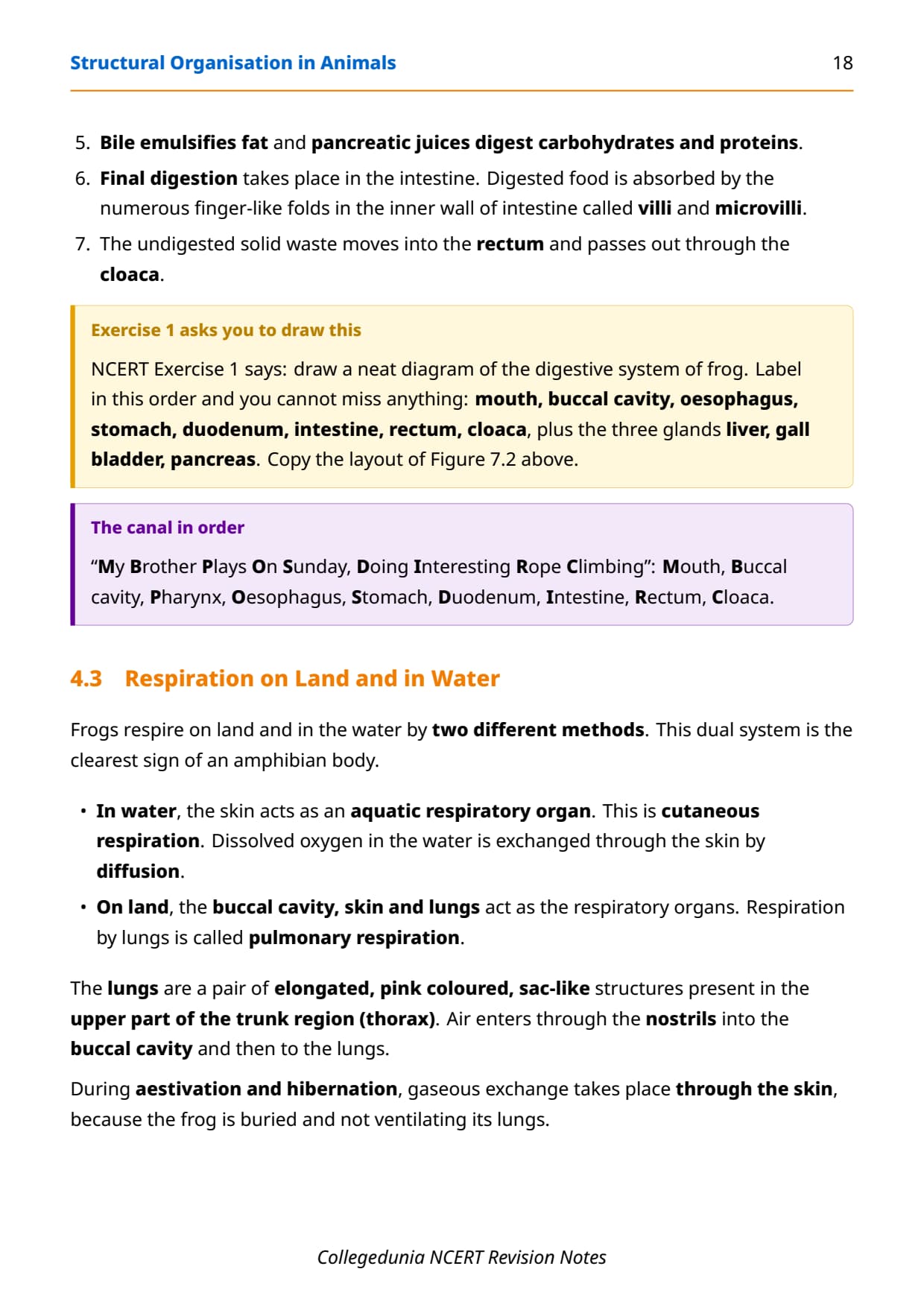
- First 8 minutes: draw and label the frog's digestive system in canal order, then add the three glands and the common bile duct.
- Next 9 minutes: write the four tissue types with one example each, and note that cardiac muscle is striated yet involuntary.
- Last 8 minutes: list the frog numbers (3 heart chambers, 10 cranial nerve pairs, 5 and 4 digits, 2500 to 3000 ova) and the male-versus-female ureter difference.
Close the loop by explaining why the male ureter is called a urinogenital duct while the female's is not. If you can do all three blocks without notes, the chapter is exam-ready. Keep the frog-in-numbers list beside you for the first pass only, then try the whole checklist closed-book.
Student Feedback on the Structural Organisation in Animals Notes
What 11,970 students told us about their Structural Organisation in Animals revision:
- 69% of students rated the frog digestive system diagram and the frog-in-numbers list as the parts most worth memorising for the exam.
- Most-confused pair: aestivation versus hibernation, mixed up by about 3 in 10 students.
- Students who learnt the three muscle types as a comparison table said the striated-yet-involuntary question felt easy afterwards.
Source: 2026-27 Class 11 Biology student poll. Sample of 11,970 students from CBSE schools across 15 states, conducted before the 2026 boards.
Other Structural Organisation in Animals Class 11 Biology Resources
Pair these notes with the solved answers, the formula sheet, and the textbook PDF for the same chapter.
| Resource | Link |
|---|---|
| NCERT Solutions | Structural Organisation in Animals Class 11 NCERT Solutions |
| Formula Sheet | Structural Organisation in Animals Class 11 Formula Sheet |
| Exemplar Solutions | Structural Organisation in Animals Class 11 Exemplar Solutions |
| NCERT Book PDF | Structural Organisation in Animals Class 11 Book PDF |
| Exemplar Book PDF | Structural Organisation in Animals Class 11 Exemplar Book PDF |
NCERT Notes for Class 11 Biology: All Chapters
Jump to the revision notes for any other Class 11 Biology chapter below.
| Chapter | NCERT Notes |
|---|---|
| Chapter 1 | The Living World |
| Chapter 2 | Biological Classification |
| Chapter 3 | Plant Kingdom |
| Chapter 4 | Animal Kingdom |
| Chapter 5 | Morphology of Flowering Plants |
| Chapter 6 | Anatomy of Flowering Plants |
| Chapter 7 | Structural Organisation in Animals |
| Chapter 8 | Cell The Unit of Life |
| Chapter 9 | Biomolecules |
| Chapter 10 | Cell Cycle and Cell Division |
| Chapter 11 | Photosynthesis in Higher Plants |
| Chapter 12 | Respiration in Plants |
| Chapter 13 | Plant Growth and Development |
| Chapter 14 | Breathing and Exchange of Gases |
| Chapter 15 | Body Fluids and Circulation |
| Chapter 16 | Excretory Products and their Elimination |
| Chapter 17 | Locomotion and Movement |
| Chapter 18 | Neural Control and Coordination |
| Chapter 19 | Chemical Coordination and Integration |
FAQs on Structural Organisation in Animals Class 11 Biology Notes
Structural Organisation in Animals Notes - Frequently Asked Questions
Ques. What topics do the structural organisation in animals class 11 notes cover?
Ans. These structural organisation in animals class 11 notes cover the levels of organisation from cells to organ systems, the four basic animal tissues as a NEET extension, and the complete morphology and anatomy of the frog Rana tigrina, including its digestive, respiratory, circulatory, excretory, nervous and reproductive systems. Every key definition, comparison table and frog number is included for fast revision.
Ques. What are the four basic types of animal tissues?
Ans. All complex animals are built from four basic tissue types. Epithelial tissue covers and lines surfaces with one free surface on a basement membrane. Connective tissue links and supports, with cells scattered in an abundant matrix. Muscular tissue contracts to move the body, in skeletal, smooth and cardiac forms. Neural tissue senses and signals through neurons and neuroglia. The heart contains all four types.
Ques. Why is cardiac muscle striated but involuntary?
Ans. Cardiac muscle is found only in the heart and shows striations like skeletal muscle, yet it is involuntary because you cannot decide to stop your heart. Striations only tell you about the regular arrangement of myofibrils, not about voluntary control. Cardiac muscle is also branched and joined by intercalated discs, which let the cells contract as a single unit.
Ques. How many chambers does the frog heart have?
Ans. The frog heart has three chambers, two atria and a single undivided ventricle, and it is covered by the pericardium. Because there is only one ventricle, oxygenated and deoxygenated blood mix, and NCERT describes the frog's circulation as closed with single circulation. The triangular sinus venosus feeds the right atrium, and the ventricle opens into the conus arteriosus.
Ques. What is the function of the ureters in the frog?
Ans. The ureters carry urine from the kidneys to the cloaca. In the male frog the two ureters act as a urinogenital duct, so they carry both urine and sperms into the cloaca. In the female frog the ureters carry urine only, because the oviducts open separately into the cloaca. Stating this male-female difference is what earns full marks on the exercise question.
Ques. Why must the frog keep its skin moist?
Ans. The frog never drinks water but absorbs it through the skin, which is smooth, slippery with mucus, and always maintained in a moist condition. The skin is highly vascularised and carries out cutaneous respiration, and gases must dissolve in the moisture before they can diffuse across. A dry frog cannot breathe through its skin, which is why the mucus glands matter.
Ques. What is the weightage of this chapter in the CBSE board exam?
Ans. Structural Organisation in Animals carries about 3 to 5 marks in the CBSE Class 11 Biology paper, usually a labelled diagram of the frog's digestive system plus a short answer on tissues or the frog's organ systems. It also appears in NEET and CUET as objective questions on the four tissues, muscle types, frog circulation and reproduction, which makes it a reliably scoring chapter for the 2026-27 session.



Comments