




The class 11 biology NCERT solutions chapter 7 Structural Organisation in Animals cover every back-exercise question, according to the latest 2026-27 CBSE syllabus, and help students prepare for the CBSE Boards, NEET and CUET. Each answer is worked step by step, from drawing a neat labelled digestive system of the frog to explaining exactly how the ureters differ between the male and the female frog.
This chapter moves from single cells to whole bodies, and the frog, Rana tigrina, is the one animal it works through in full, so its systems are what the exercise and NEET both test.
- CBSE Weightage: 3 to 4 marks, part of the Structural Organisation in Plants and Animals unit alongside Morphology and Anatomy of Flowering Plants.
- Topics covered: the four basic animal tissues, the levels of organisation, and the morphology and anatomy of the frog, including its digestive, excretory and reproductive systems.
- Exercise count: 2 back-exercise questions in the rationalised syllabus, one labelled-diagram task and one function-and-reason task.
These class 11 biology NCERT solutions chapter 7 Structural Organisation in Animals are curated by subject experts, based on the 2026-27 NCERT textbook, and checked against the last five years of CBSE Board and NEET papers.
Why Structural Organisation in Animals Matters and What the Chapter Covers
This chapter answers a simple question with a lot of detail: how does a body get built from single cells? The route is a ladder of levels of organisation, from cells to tissues to organs to organ systems, and the chapter then studies one animal, the frog, from the outside in. In the rationalised 2026-27 syllabus the cockroach and earthworm accounts have been dropped, so the frog, Rana tigrina, is the single animal you must know completely.
- Core idea: all complex animals are built from only four basic tissue types, which combine into organs and then organ systems.
- The model animal: the frog, whose morphology (external form) and anatomy (internal organs) are studied system by system.
- Why it recurs: the digestive, excretory and reproductive plans you meet here return, in more detail, across the human physiology chapters of Class 11 and Class 12.
Both exercise questions are drawn from the frog, so a labelled diagram of its digestive system and a clear account of its ureters are the two highest-value skills in the chapter. The frog is a favourite in NEET precisely because it packs a full set of organ systems into one animal, letting a single figure test many labels at once. The class 11 biology NCERT solutions chapter 7 Structural Organisation in Animals below follow the same order as the NCERT textbook so students can check their working and their diagrams line by line.
The Four Basic Animal Tissues
Before any organ can be understood, the chapter fixes the four basic tissues that every complex animal is made from. A tissue is a group of similar cells with a common origin performing one function, and organs are simply combinations of these four tissues arranged to do a job. NCERT makes the point vividly by noting that the heart contains all four tissue types at once.
| Tissue | What it does |
|---|---|
| Epithelial | Covers and lines body surfaces and cavities; a protective and secretory sheet resting on a basement membrane. |
| Connective | Links and supports other tissues; includes bone, cartilage, blood and adipose tissue. |
| Muscular | Produces movement by contraction; skeletal, smooth and cardiac types. |
| Neural | Senses stimuli and transmits impulses; made of neurons and supporting glial cells. |
These four tissues are the alphabet of animal anatomy, and every organ in the frog or the human body is spelled out of them. Epithelial tissue always rests on a basement membrane and has one free surface, connective tissue is defined by an abundant non-living matrix, muscular tissue is built for contraction, and neural tissue is built for conduction. Understanding that organs are combinations of these tissues, rather than single materials, is what lets students make sense of why the same four building blocks appear again and again across the digestive, circulatory and excretory systems studied later in the chapter.
The Levels of Organisation: Cells to Organ Systems
The title of the chapter is its main concept: structural organisation is the idea that a body is arranged in a series of levels, each built from the one below it. Cells group into tissues, tissues combine into organs, and organs work together as organ systems. This hierarchy is why a large animal can carry out many complex jobs at once, with division of labour at every level.
- Cells: the basic unit of structure and function, specialised for particular roles.
- Tissues: groups of similar cells of common origin performing one function, of the four basic types.
- Organs and organ systems: organs are combinations of tissues, and organ systems are groups of organs carrying out one broad task such as digestion or excretion.
The chapter also draws the clean distinction between morphology and anatomy: morphology is the study of external form, while anatomy is the study of internal organs. A body that is organised into levels can specialise, so muscle handles movement, neural tissue handles signalling and epithelium handles covering and secretion, and no single cell has to do everything. Holding this ladder in mind makes the frog easier to learn, because each organ system you study is one rung, and each system is itself a set of organs built from the same four tissues introduced above.
Meet the Frog: Rana tigrina and Its Body Plan
The animal at the centre of this chapter is the frog, Rana tigrina, which belongs to class Amphibia of phylum Chordata. NCERT studies it because it shows a full set of organ systems in a body small enough to dissect and diagram, and because so many of its features illustrate general principles of animal life. Its external form and habits are worth fixing before its internal systems.
- Cold-blooded: the frog is a poikilotherm, so its body temperature changes with the surroundings, and it shows protective colouration, a form of mimicry that helps it hide from predators.
- Dormancy: it survives extremes by aestivation (summer sleep) and hibernation (winter sleep), passing harsh seasons in an inactive state.
- Body regions: the body is divided into head and trunk, with no neck and no tail in the adult, and moist skin that also serves in respiration.
These external features are not trivia, they set up the anatomy that follows. Because the frog is a poikilotherm that lives both in water and on land, its organ systems are adapted for a double life, which is exactly why it is such a useful teaching animal. The chapter then works through the frog's systems one at a time, and the two NCERT exercise questions both come from this section, one from the digestive system and one from the excretory system, so those two systems repay the closest study.
Digestive System of the Frog
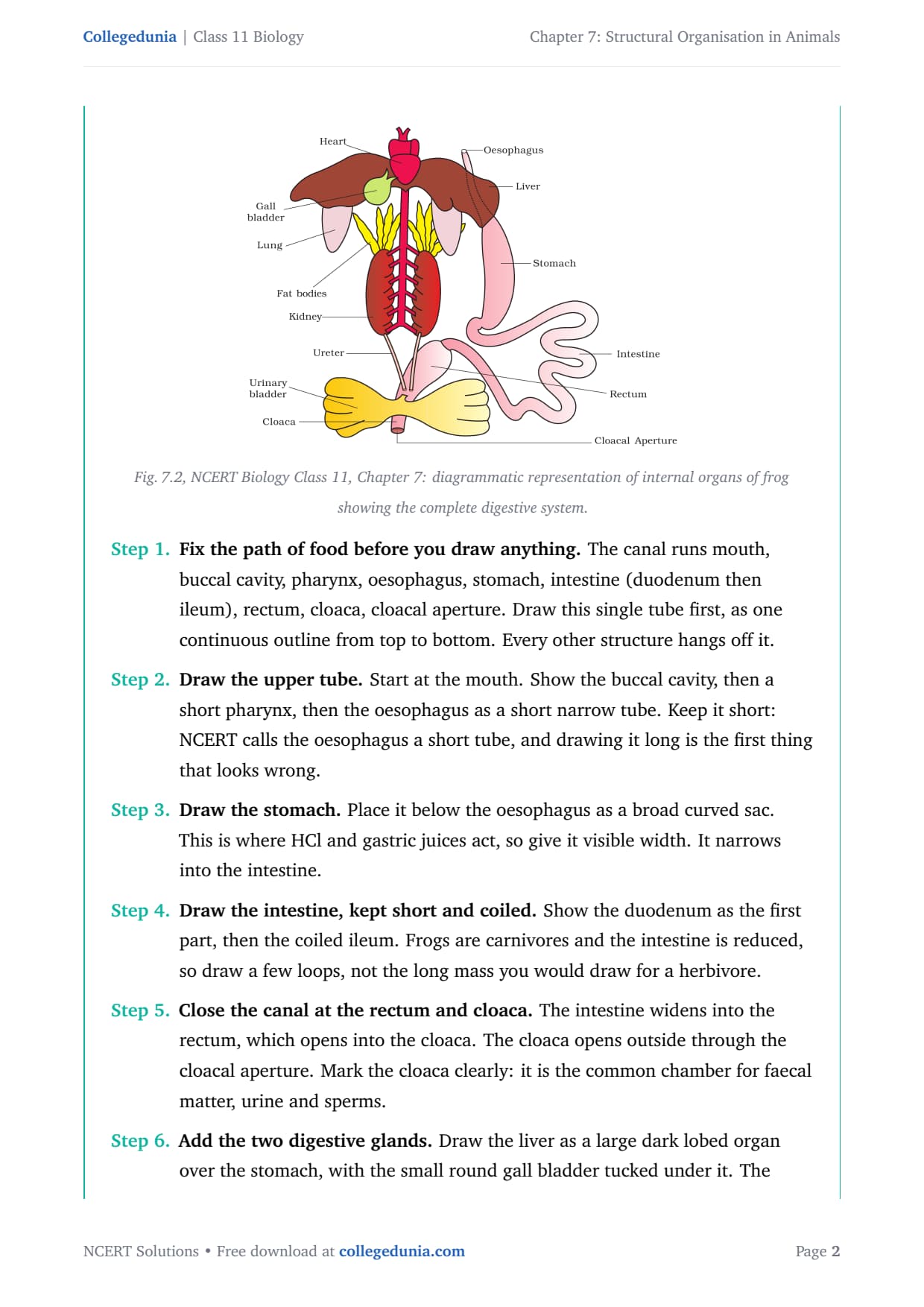
Exercise Q1 asks students to draw a neat diagram of the digestive system of the frog. The digestive system has two parts, the alimentary canal and the digestive glands, and the key to the diagram is to draw the canal first as one continuous tube and then hang the glands off it. NCERT gives the figure that your answer should reproduce, showing the whole canal in place. See Exercise Q1 for the labelled diagram.
| Part of the canal | Note for the diagram |
|---|---|
| Mouth, buccal cavity, pharynx | The start of the canal, leading into a short oesophagus. |
| Oesophagus | A short narrow tube; drawing it long is the first thing that looks wrong. |
| Stomach | A broad curved sac where HCl and gastric juices act; give it visible width. |
| Intestine (duodenum, ileum) | Short and lightly coiled, because the frog is a carnivore. |
| Rectum, cloaca, cloacal aperture | The rectum opens into the cloaca; there is no anus. |
| Liver, gall bladder, pancreas | Glands that pour bile and pancreatic juice into the duodenum by the common bile duct. |
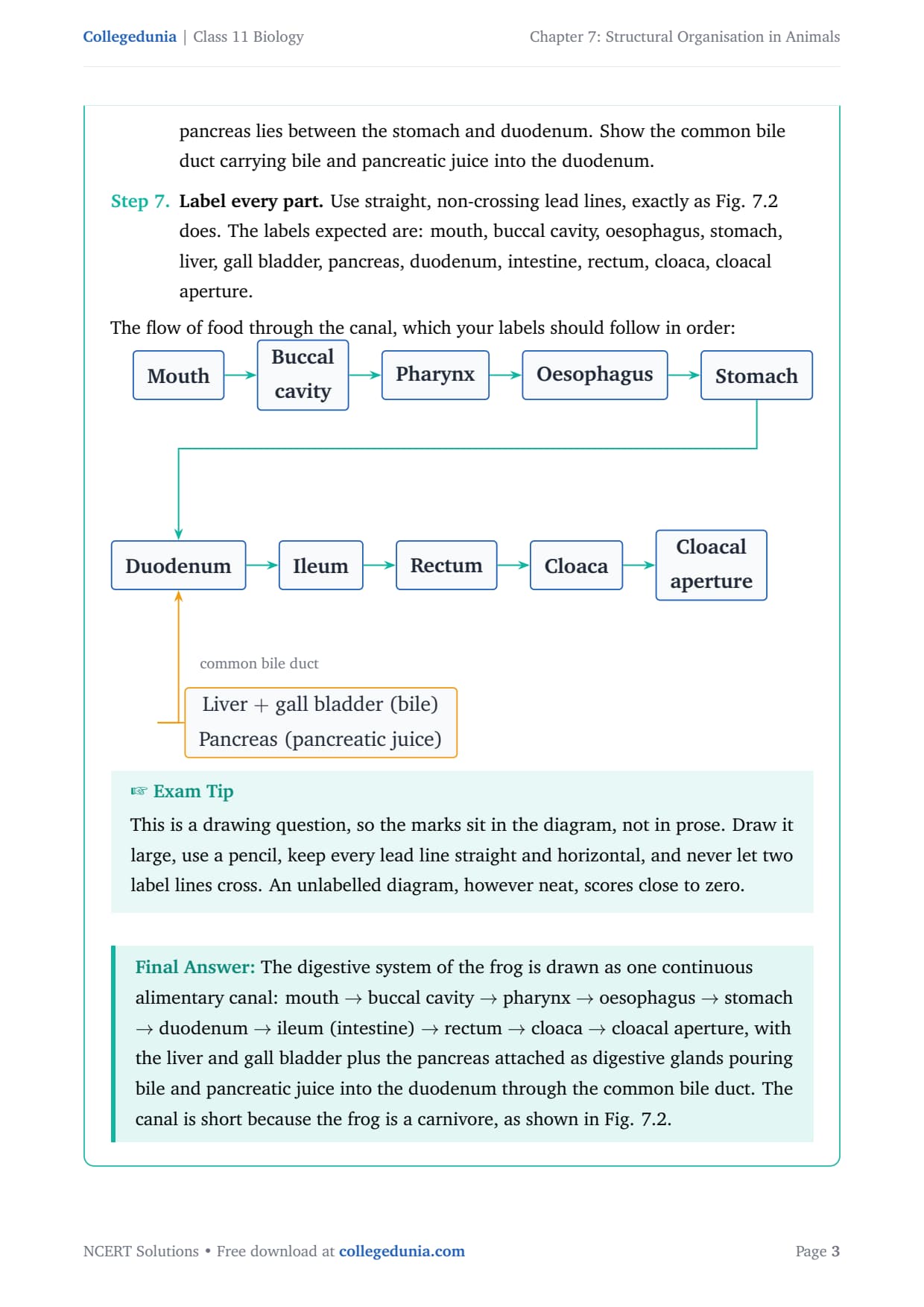
The path of food runs mouth → buccal cavity → pharynx → oesophagus → stomach → duodenum → ileum → rectum → cloaca → cloacal aperture, with the liver and pancreas feeding the duodenum. The canal is short because the frog is a carnivore, since protein-rich food breaks down quickly and needs less gut length than the cellulose a herbivore must digest. Because this is a drawing question, the marks sit in the labelled figure, not in prose, so draw it large, keep every lead line straight and non-crossing, and label all twelve parts. The two slips that cost most marks are copying a long coiled human intestine and ending the canal at an anus instead of the cloaca.
Excretory System and the Function of the Ureters
Exercise Q2 asks students to mention the function of the ureters in the frog, and the full-mark answer is never a single line. The frog's excretory system is a pair of kidneys, the ureters, the cloaca and a urinary bladder. The kidney separates the waste, and the ureter is the duct that carries away what the kidney makes, but the way that duct is used differs between the sexes. See Exercise Q2 for the full reasoning.
- Common to both sexes: the ureter carries urine from the kidney to the cloaca, from where it leaves through the cloacal aperture.
- In the male frog: sperms from the testes reach the kidney through 10 to 12 vasa efferentia and Bidder's canal, so the ureter carries both urine and sperms and is called the urinogenital duct.
- In the female frog: the ovaries have no functional link with the kidneys, and a separate oviduct opens into the cloaca, so the ureter carries urine only.
The name of the duct is simply read off its cargo: a ureter when it carries urine alone, a urinogenital duct when it carries urine plus gametes. Because the male frog runs both its excretory and its reproductive output through one duct, the two systems together are often called the urinogenital system, the same idea Class 12 meets again in the human male urethra. The commonest error is answering that the ureter carries urine to the urinary bladder, copied from the human system, but in the frog the ureter opens into the cloaca, and the thin-walled bladder also opens into the cloaca and fills from it rather than from the ureter.
Reproduction and Development in the Frog
The frog rounds off the chapter with a clear example of external fertilisation and indirect development, both of which reappear in later reproduction chapters. Frogs have separate sexes, and the whole cycle takes place in water, which fits the amphibian's double life on land and in water. This section is short but a reliable source of one-mark and assertion-reason questions.
- Egg number: a female lays 2500 to 3000 ova at a time, a large clutch that offsets the heavy losses of external fertilisation.
- Fertilisation and development: both are external, taking place in the surrounding water rather than inside the body.
- Metamorphosis: eggs hatch into tadpoles, which then metamorphose into adult frogs, an example of indirect development.
Excretion ties back into this life history too, because the frog is ureotelic, excreting nitrogenous waste as urea, and each kidney is built of many uriniferous tubules, the nephrons that actually form urine. The large clutch of 2500 to 3000 eggs and the external fertilisation go together, since fertilisation in open water is wasteful and only a high egg number keeps enough offspring alive. Learning the frog as one connected animal, where the short carnivore gut, the shared urinogenital duct and the water-bound life cycle all make sense together, is far more durable than memorising each system as a separate list.
Structural Organisation in Animals Exercise-wise Breakdown
The rationalised NCERT back exercise has 2 questions, both drawn from the frog, one a labelled-diagram task and one a function-and-reason task. The table below maps each question to what it tests so students can focus their practice.
| Question | What it tests |
|---|---|
| Q1 | Drawing a neat, fully labelled diagram of the digestive system of the frog, canal plus glands. |
| Q2 | The function of the ureters, including the sex difference between the male urinogenital duct and the female ureter. |
With only two questions, both carry weight, and both reward precise, labelled answers over general description. For Q1 draw the canal as one continuous tube and label twelve parts; for Q2 always give the sex difference, since marking schemes keep a mark for it. The rest of the chapter, the four tissues and the frog's other systems, is examined through short-answer and NEET-style questions rather than the back exercise, so students should revise those from the notes alongside these solutions. Every question in the class 11 biology NCERT solutions chapter 7 Structural Organisation in Animals PDF is solved with each step of reasoning and the full diagram shown.
Practice the solved questions: Work through the full question bank with step-by-step answers, labelled figures and expert tips.
Structural Organisation in Animals Class 11 Solved Practice Questions
Common Mistakes Students Make in Structural Organisation in Animals
Most marks in this chapter are lost on diagram detail and on copying human anatomy onto the frog, not on hard ideas. Each mistake below costs 1 to 2 marks, so watch for it at the exact step.
Mistake 1: Ending the frog's digestive canal at an anus. The frog has no anus; the rectum opens into the cloaca, and the cloaca opens outside through the cloacal aperture.
Mistake 2: Drawing a long, heavily coiled intestine copied from a human diagram. The frog is a carnivore, so its intestine is short and only lightly coiled.
Mistake 3: Writing that the ureter carries urine to the urinary bladder. In the frog the ureter opens into the cloaca, and the bladder also opens into the cloaca and fills from it.
Mistake 4: Answering Q2 with "the ureter carries urine" and stopping. The examiner keeps a mark for the sex difference, so name the male urinogenital duct and the separate female oviduct.
Student Feedback on Structural Organisation in Animals Solutions
What 11,420 students told us about their Structural Organisation in Animals preparation:
- 61% of students said labelling the frog's digestive system diagram accurately was the part they practised most before the exam.
- Most-skipped detail: the frog has no anus and the rectum opens into the cloaca, missed by about 4 in 10 students.
- Students who learned the male urinogenital duct versus female ureter difference as a pair said the excretion question became a guaranteed mark.
Source: 2026-27 Class 11 Biology student poll. Sample of 11,420 students from CBSE schools across 15 states, conducted before the 2026 boards.
Other Structural Organisation in Animals Class 11 Biology Resources
Pair these solutions with the revision notes, formula sheet, exemplar solutions and NCERT textbook PDF for the same chapter.
| Resource | Link |
|---|---|
| NCERT Notes | Structural Organisation in Animals Class 11 Notes |
| Formula Sheet | Structural Organisation in Animals Class 11 Formula Sheet |
| Exemplar Solutions | Structural Organisation in Animals Class 11 Exemplar Solutions |
| NCERT Book PDF | Structural Organisation in Animals Class 11 Book PDF |
NCERT Solutions for Class 11 Biology: All Chapters
Jump to the step-by-step solutions for any other Class 11 Biology chapter below.
| Chapter | NCERT Solutions |
|---|---|
| Chapter 1 | The Living World |
| Chapter 2 | Biological Classification |
| Chapter 3 | Plant Kingdom |
| Chapter 4 | Animal Kingdom |
| Chapter 5 | Morphology of Flowering Plants |
| Chapter 6 | Anatomy of Flowering Plants |
| Chapter 7 | Structural Organisation in Animals |
| Chapter 8 | Cell: The Unit of Life |
| Chapter 9 | Biomolecules |
| Chapter 10 | Cell Cycle and Cell Division |
| Chapter 11 | Photosynthesis in Higher Plants |
| Chapter 12 | Respiration in Plants |
| Chapter 13 | Plant Growth and Development |
| Chapter 14 | Breathing and Exchange of Gases |
| Chapter 15 | Body Fluids and Circulation |
| Chapter 16 | Excretory Products and their Elimination |
| Chapter 17 | Locomotion and Movement |
| Chapter 18 | Neural Control and Coordination |
| Chapter 19 | Chemical Coordination and Integration |
FAQs on Structural Organisation in Animals Class 11 NCERT Solutions
Structural Organisation in Animals NCERT Solutions - Frequently Asked Questions
Ques. What do the class 11 biology NCERT solutions chapter 7 Structural Organisation in Animals cover?
Ans. These solutions cover both rationalised back-exercise questions, drawing a neat labelled diagram of the digestive system of the frog and explaining the function of the ureters in both the male and female frog. They also work through the supporting concepts the exercise draws on, including the four basic tissues, the levels of organisation, and the morphology and anatomy of Rana tigrina. Every question is solved step by step with figures.
Ques. What are the four basic tissues in animals?
Ans. All complex animals are built from four basic tissue types: epithelial tissue (covering and lining surfaces), connective tissue (linking and supporting, including bone, cartilage and blood), muscular tissue (producing movement) and neural tissue (sensing stimuli and conducting impulses). Organs are combinations of these four, which is why NCERT notes that the heart contains all four tissue types.
Ques. What is the function of the ureters in the frog?
Ans. The ureters carry urine from the kidneys to the cloaca, from where it leaves through the cloacal aperture. In the male frog the ureter also receives sperms through the vasa efferentia and Bidder's canal, so it carries both urine and sperms and is called the urinogenital duct. In the female frog it carries urine only, because the oviduct opens into the cloaca separately.
Ques. Why is the frog's intestine short?
Ans. The frog is a carnivore, and carnivorous food is protein-rich and breaks down quickly, so it needs less time and less surface area than the cellulose a herbivore must digest. As a result the intestine is reduced and only lightly coiled. Drawing a long coiled intestine copied from a human diagram is therefore a factual error, not just a drawing flaw.
Ques. Does the frog have an anus?
Ans. The frog has no anus. Its rectum opens into the cloaca, a common median chamber that receives faecal matter, urine and sperms, and the cloaca opens to the outside through the cloacal aperture. This is one of the details that separates a correct frog diagram from a mammal diagram, and it is a frequent one-mark question.
Ques. What is the weightage of Structural Organisation in Animals in CBSE Class 11 Biology?
Ans. Structural Organisation in Animals carries about 3 to 4 marks in the CBSE Class 11 Biology paper, usually through a labelled-diagram question on the frog and short-answer questions on tissues and organ systems, within the Structural Organisation in Plants and Animals unit. The frog's systems are also tested regularly in NEET.



Comments