




These locomotion and movement class 11 notes gather every definition, structure, and step that the CBSE Boards, NEET and CUET papers actually test in 2026-27. Revise the whole chapter fast, with the three types of cell movement, the three kinds of muscle, the sarcomere, the sliding filament theory, the human skeleton, and the three classes of joints in one place.
This is Chapter 17 of the NCERT textbook and a high-yield topic in the Human Physiology unit, because its labelled diagrams, bone counts, and stepwise contraction mechanism convert straight into board and NEET marks.
- CBSE Weightage: 3 to 5 marks, usually one question on the sliding filament mechanism or the sarcomere plus one on muscle types, the skeleton, or joints.
- Topics covered: types of movement, the four muscle properties, muscle types, the structure of a muscle fibre and sarcomere, the sliding filament theory, red and white fibres, the axial and appendicular skeleton, the three classes of joints, and disorders.
- Key numbers: muscle is 40 to 50% of body weight, the skeleton has 206 bones (80 axial and 126 appendicular), 26 vertebrae, and 12 pairs of ribs.
These locomotion and movement class 11 notes are curated by subject experts, based on the 2026-27 NCERT textbook, and checked against the last five years of CBSE Board and NEET papers.
Topic-by-Topic Summary of Locomotion and Movement
The chapter moves from how single cells move, to how muscles contract, to how the skeleton and its joints turn that contraction into walking, running, and lifting. It builds the vocabulary of the muscular and skeletal systems in a fixed order. Here is the quick map of what each topic gives you before you revise the detail.
- Movement and locomotion: the difference between the two, and why all locomotions are movements but not the reverse.
- Types of movement: amoeboid, ciliary, and muscular, each with a mechanism and an example.
- Muscle types and structure: skeletal, visceral, and cardiac muscle, and the fine structure of a muscle fibre down to the sarcomere.
- Muscle contraction: the two contractile proteins and the sliding filament theory, step by step.
- The skeletal system: the axial and appendicular skeletons, with the bone counts examiners love.
- Joints and disorders: the three structural classes of joint, the synovial types, and six muscle and bone disorders.
Revise the topics in this order, because each one uses the one before it. Master the sarcomere and the sliding filament theory first, and the muscle types, skeleton, and joints fall into place around them. These locomotion and movement class 11 notes follow the same sequence as the NCERT textbook.
Movement and Locomotion: The Basics
Movement is one of the clearest signs of life, but not every movement counts as locomotion. In a single-celled organism such as Amoeba, the streaming of protoplasm is a simple movement, and humans move their limbs, jaws, eyelids, and tongue. A voluntary movement that changes an animal's location is called locomotion. Walking, running, climbing, flying, and swimming are all forms of locomotion. The one line examiners want is stated exactly like NCERT.
- The key statement: all locomotions are movements, but all movements are not locomotions.
- Shared structures: the same organ often does both jobs, so in Paramoecium cilia move food and drive locomotion, and Hydra uses its tentacles to capture prey and to move.
- Why animals move: to search for food, shelter, a mate, a suitable breeding ground, or better climate, and to escape from predators.
These six reasons for locomotion are a free one-mark answer if you simply name three of them. The mechanism of locomotion varies with an animal's habitat and its need at the moment, but the muscular, skeletal, and neural systems always work together in a coordinated way. Getting this vocabulary right here makes the rest of the chapter, and the whole unit on control and movement, much easier to follow.
The Three Types of Movement
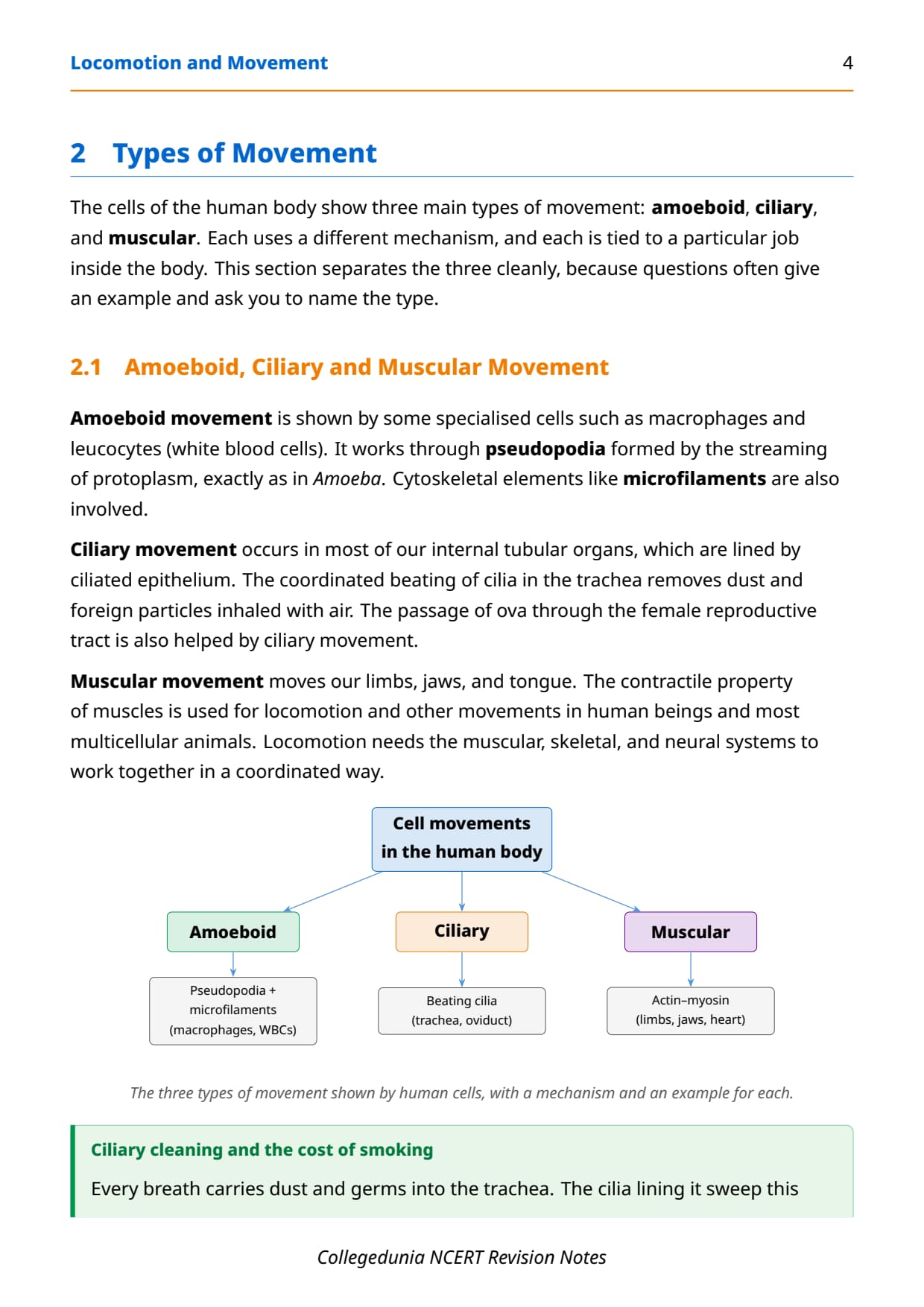
The cells of the human body show three main types of movement: amoeboid, ciliary, and muscular. Each uses a different mechanism, and each is tied to a particular job inside the body. Questions often give an example and ask you to name the type, so learn the three cleanly as a set.
- Amoeboid movement: shown by specialised cells such as macrophages and leucocytes (white blood cells). It works through pseudopodia formed by the streaming of protoplasm, helped by cytoskeletal microfilaments.
- Ciliary movement: occurs in the internal tubular organs lined by ciliated epithelium. The beating of cilia in the trachea clears dust, and cilia in the female tract move the ova.
- Muscular movement: moves the limbs, jaws, and tongue using the contractile property of muscle, and it drives locomotion in most multicellular animals.
The easiest way to keep these straight is to match the example to the type. Trachea and oviduct point to ciliary, macrophages and leucocytes point to amoeboid, and limbs, jaws, and the heart point to muscular. These movements have real value in the body: ciliary cleaning protects the lungs, which is why smokers whose cilia are damaged cough and catch chest infections more often, and amoeboid movement lets white blood cells crawl to a wound and engulf invading bacteria, so a movement that looks primitive is central to the body's defence.
Muscle: Types and Structure of the Sarcomere
Muscle is a specialised tissue of mesodermal origin that makes up about 40 to 50% of an adult's body weight. All muscles share four properties, excitability, contractility, extensibility, and elasticity, and they are classified by location into three types. Learning the three types and the fine structure of a fibre is the base for the contraction mechanism that follows.
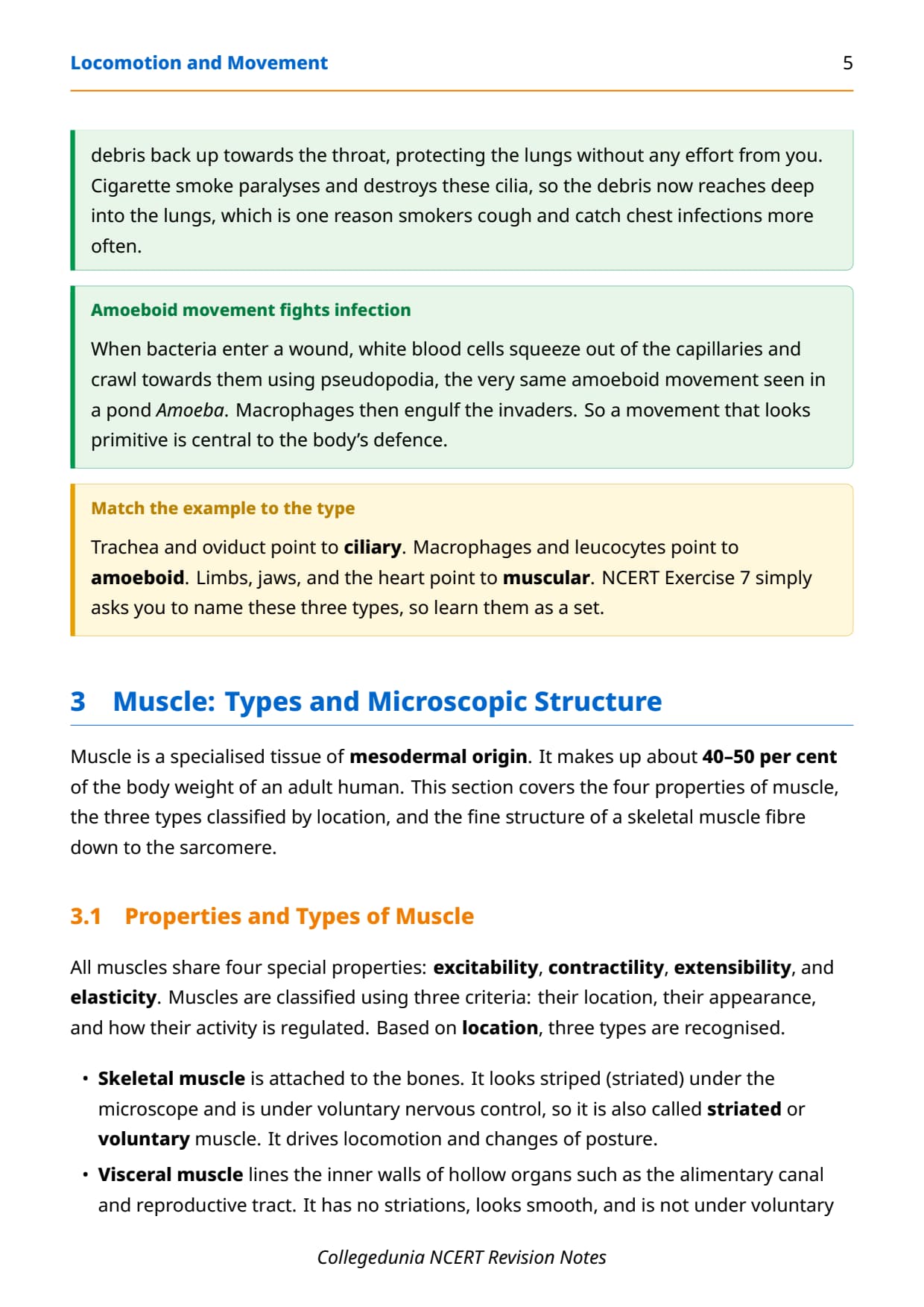
- Skeletal muscle: attached to bones, looks striped (striated), and is under voluntary control, so it is also called striated or voluntary muscle. It drives locomotion and posture.
- Visceral muscle: lines the walls of hollow organs, has no striations, and is not under voluntary control, so it is smooth or involuntary muscle. It moves food through the gut.
- Cardiac muscle: the muscle of the heart, with cells in a branching pattern. It is striated in appearance but involuntary, the odd one out.
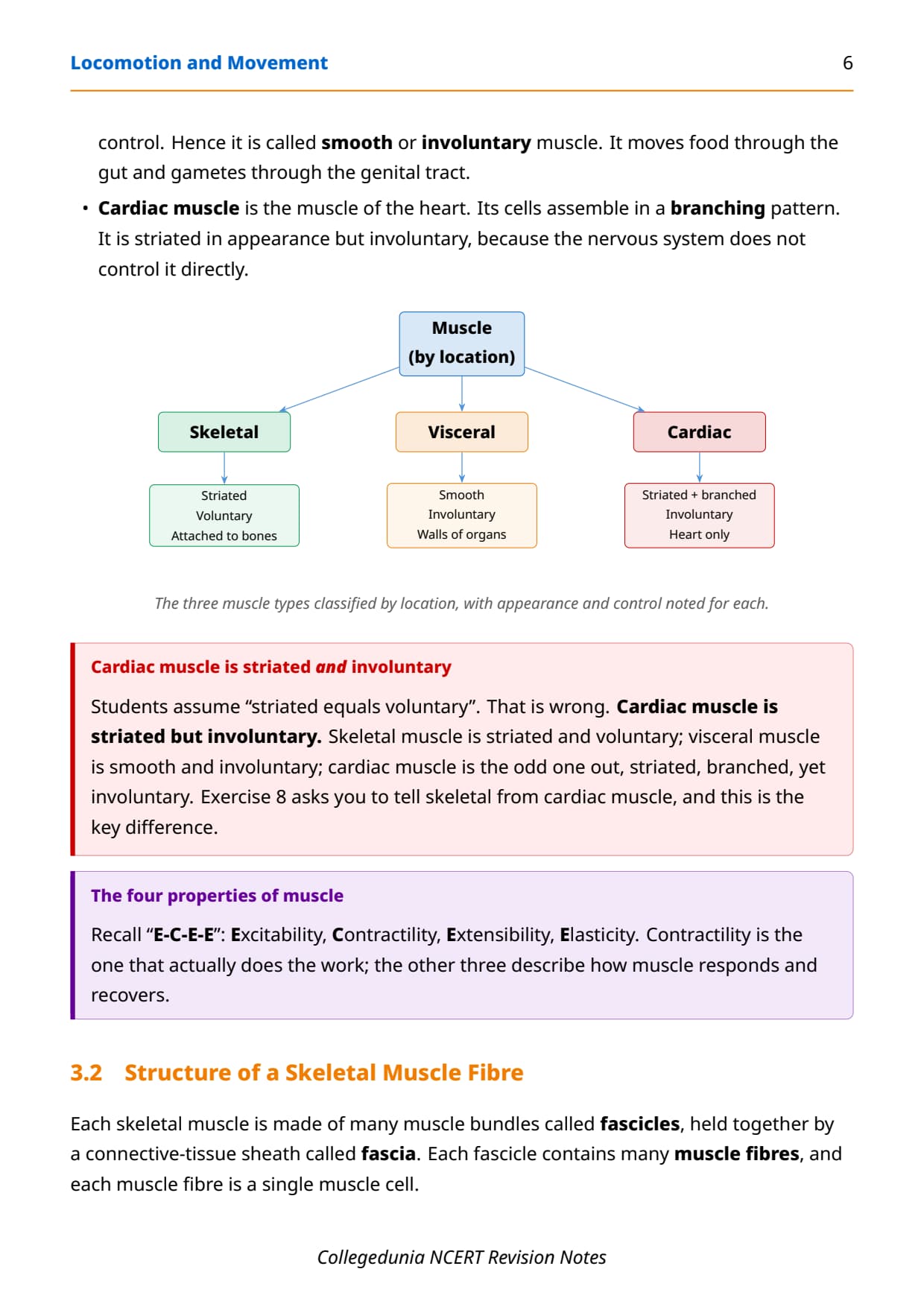
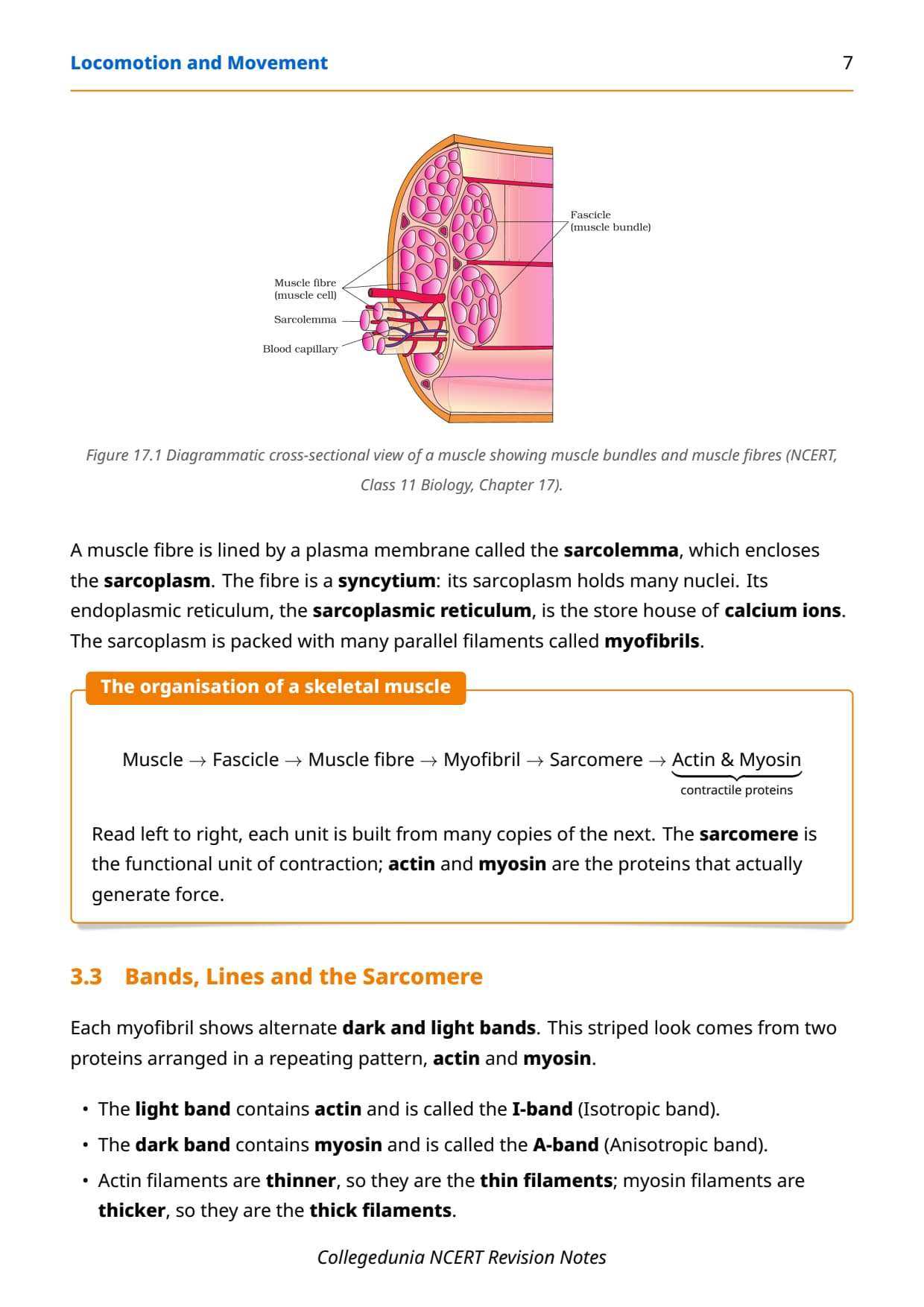
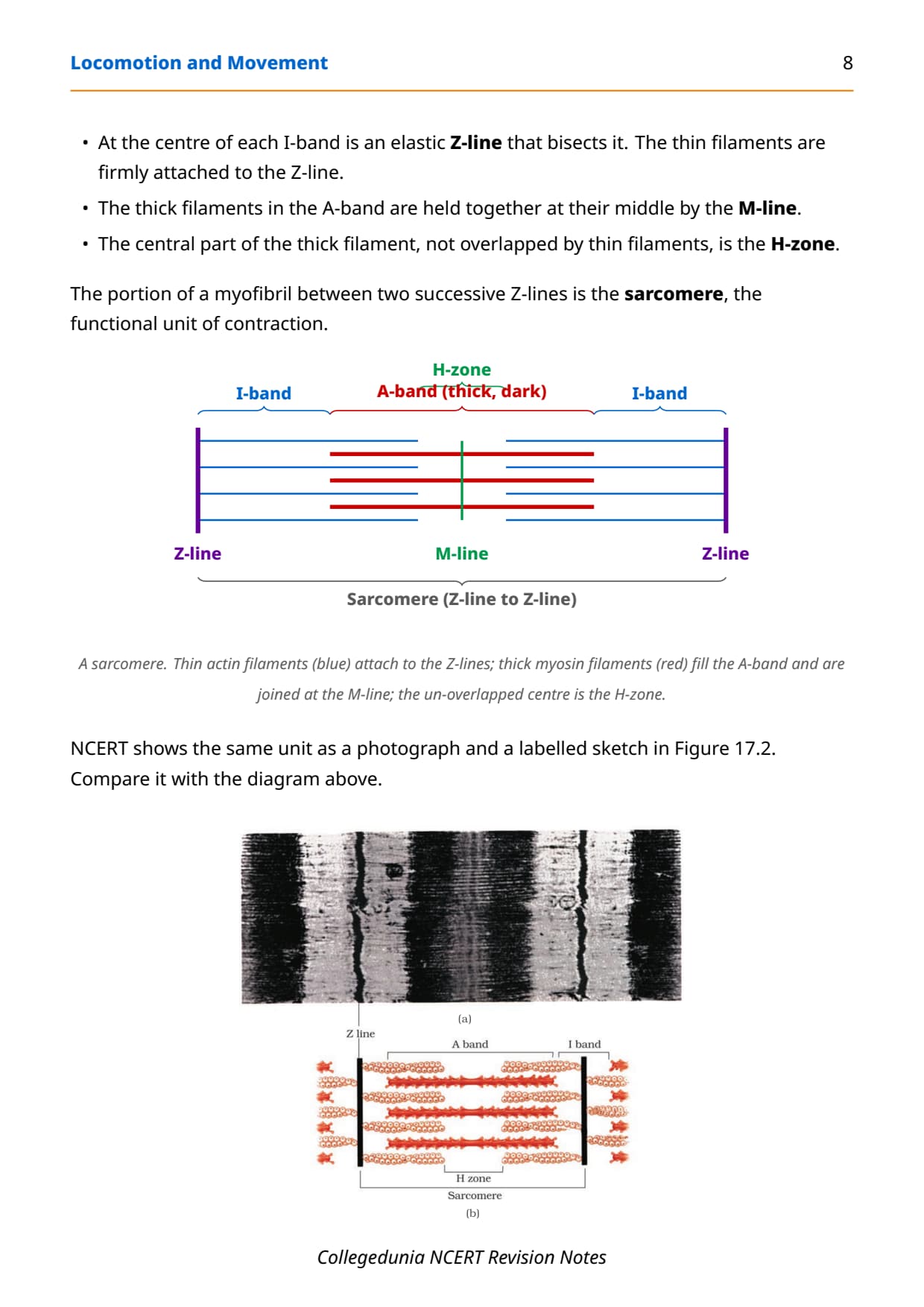
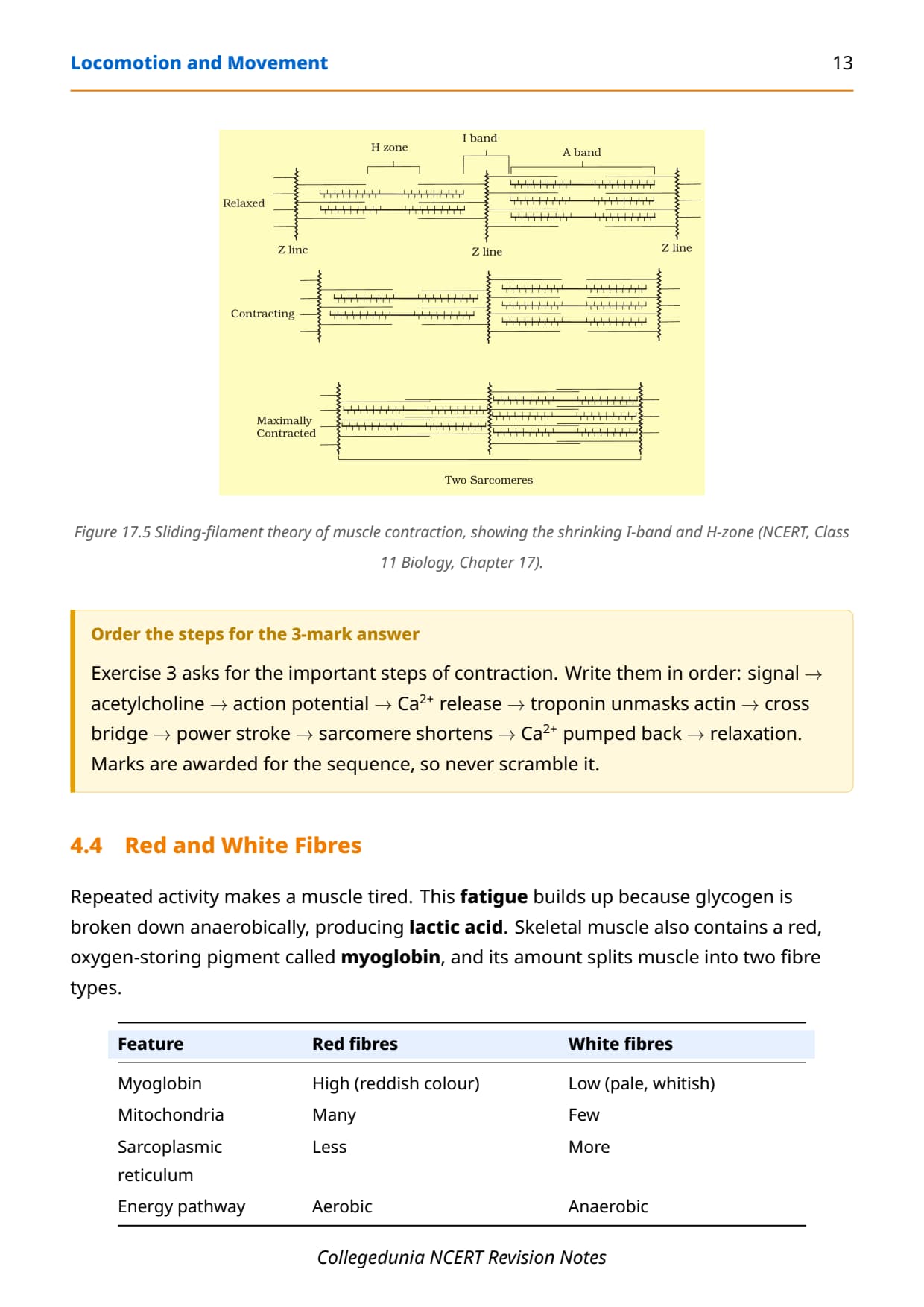
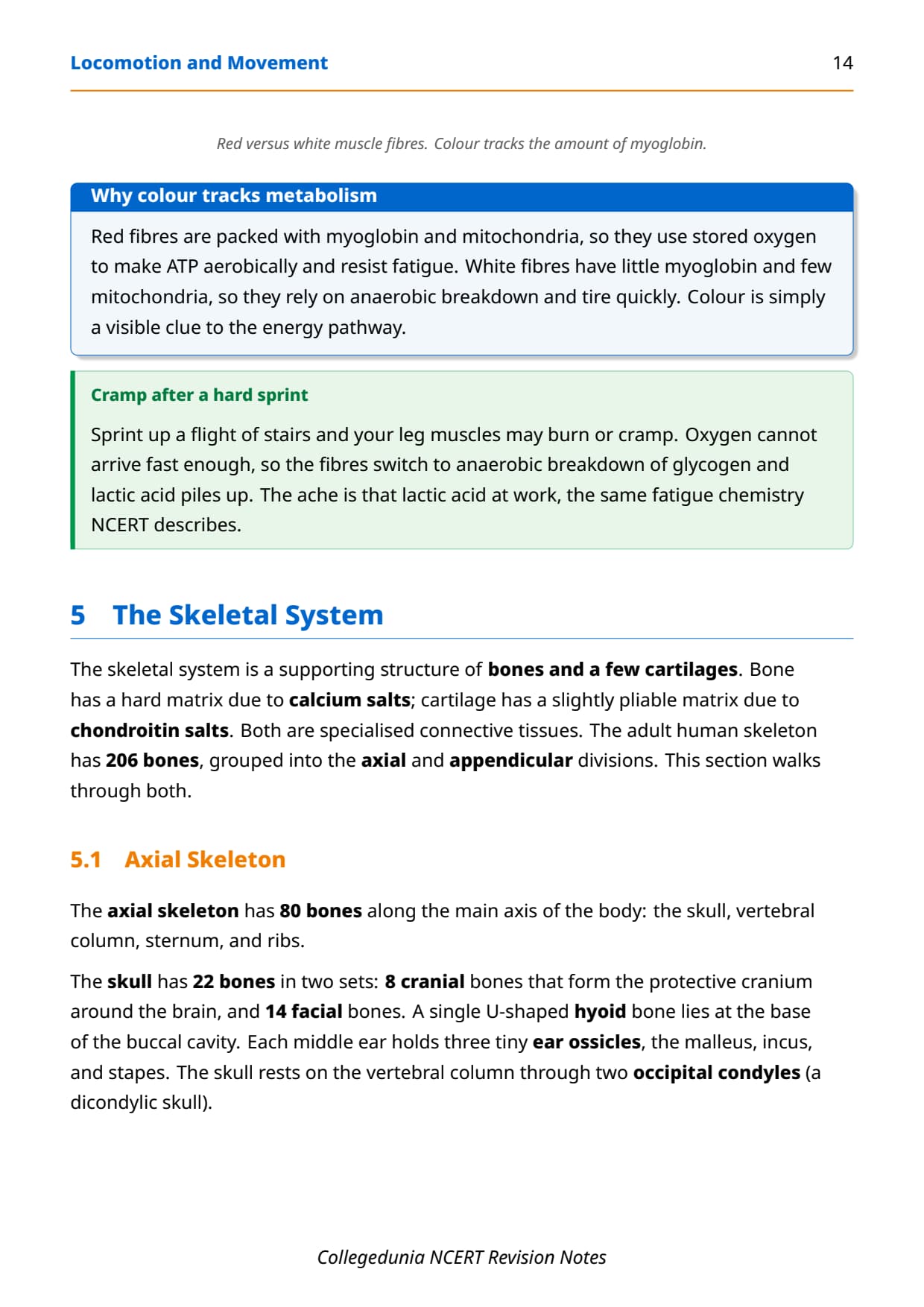
A muscle is built of bundles called fascicles, each holding many muscle fibres, and each fibre is a single muscle cell lined by the sarcolemma and filled with sarcoplasm. The fibre is a syncytium with many nuclei, and its sarcoplasmic reticulum stores calcium ions. The sarcoplasm holds parallel myofibrils, each showing dark and light bands. The light I-band holds thin actin filaments and is bisected by the elastic Z-line, while the dark A-band holds thick myosin filaments joined at the M-line, with a central H-zone of thick filaments only. The portion between two Z-lines is the sarcomere, the functional unit of contraction. A frequent slip is swapping the bands, but the A-band is anisotropic, dark, and holds myosin, while the I-band is light and holds actin. Remember that cardiac muscle proves striated does not always mean voluntary.
Muscle Contraction: The Sliding Filament Theory
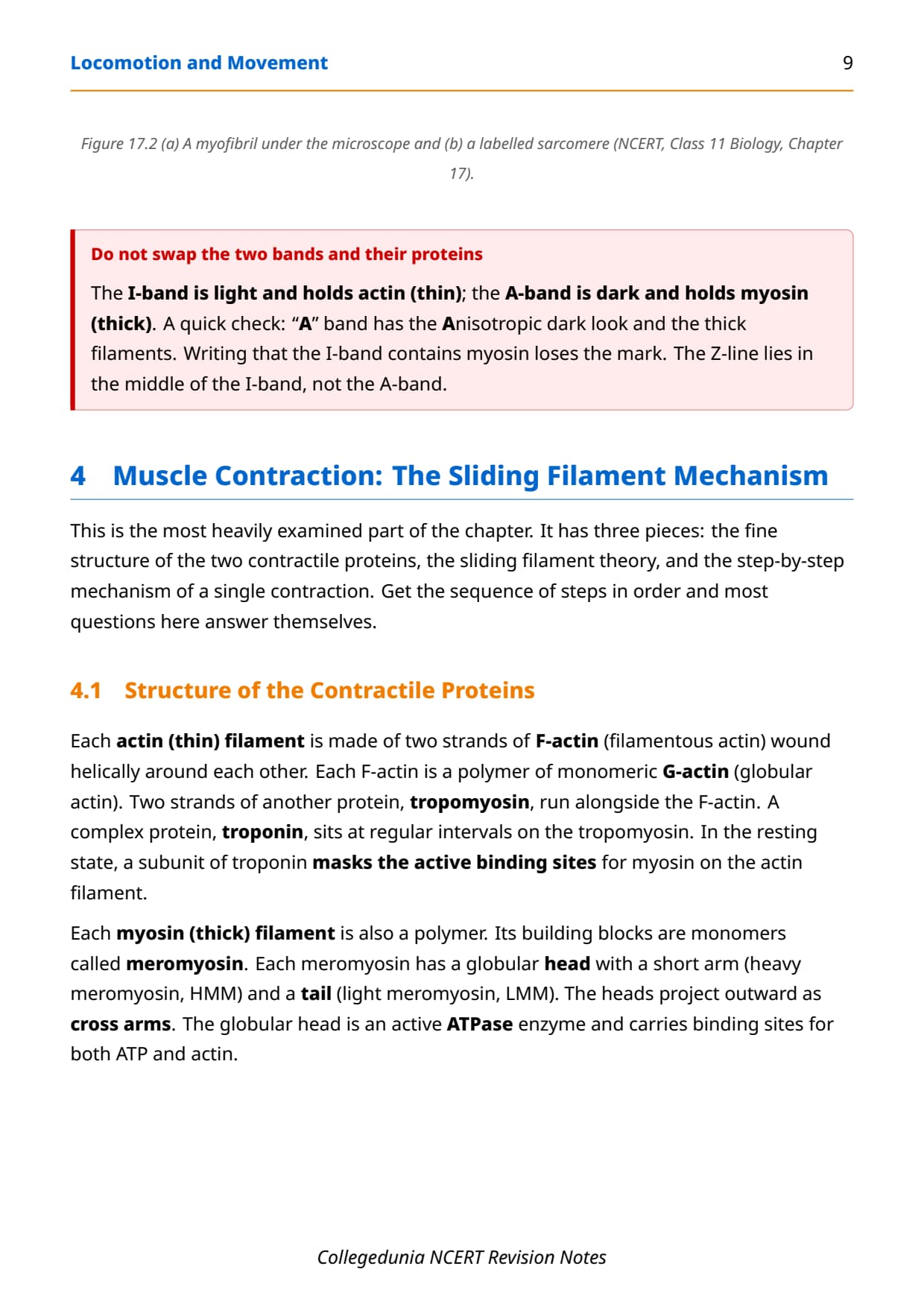
This is the most heavily examined part of the chapter. It has three pieces: the fine structure of the two contractile proteins, the sliding filament theory itself, and the step-by-step mechanism of a single contraction. Get the sequence of steps in order and most questions here answer themselves. Each actin (thin) filament is two strands of F-actin wound helically, with tropomyosin and troponin that mask the myosin-binding sites at rest, while each myosin (thick) filament is a polymer of meromyosin whose globular head is an ATPase that projects as a cross arm.
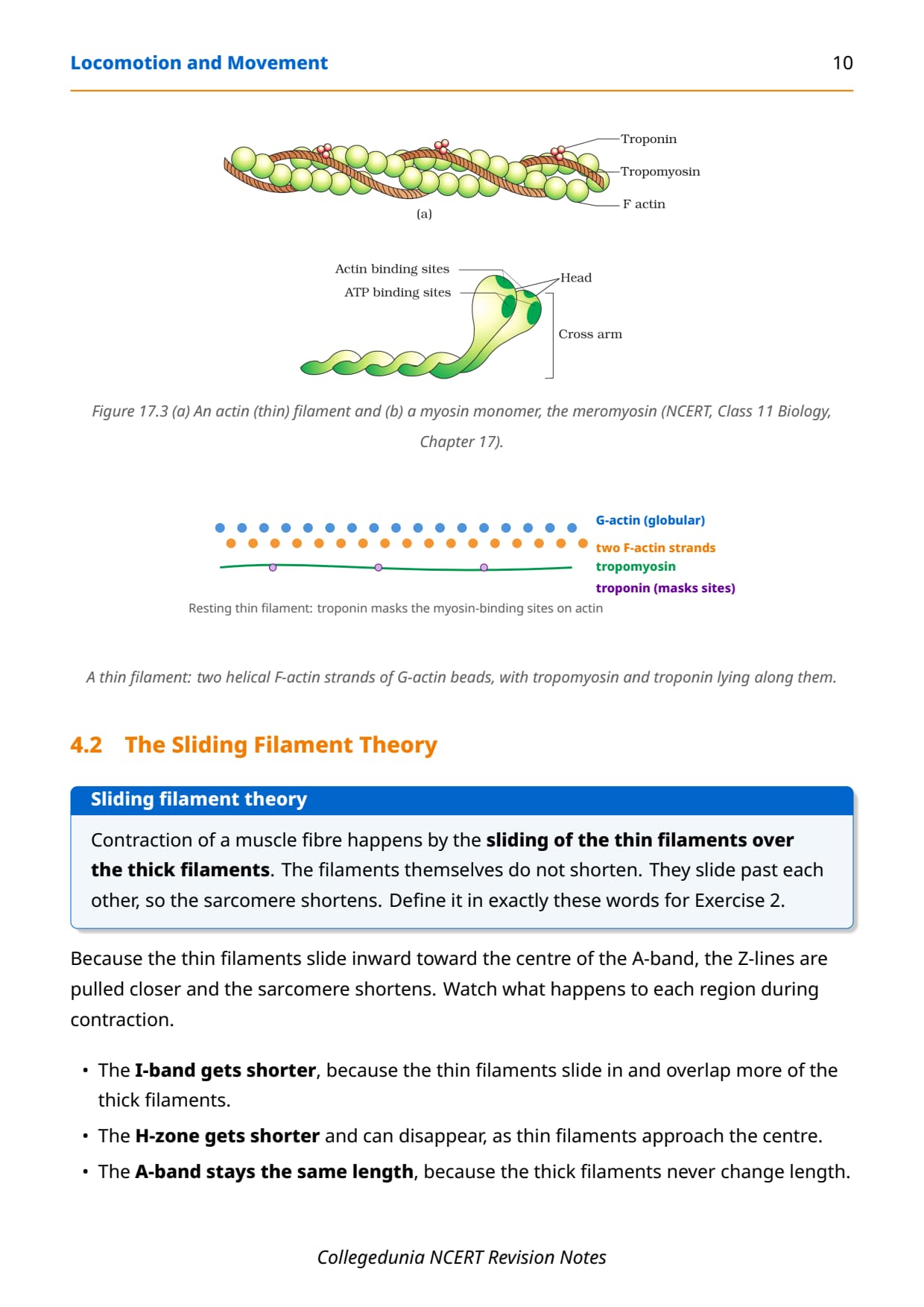
- Sliding filament theory: contraction happens by the sliding of the thin filaments over the thick filaments; the filaments themselves do not shorten.
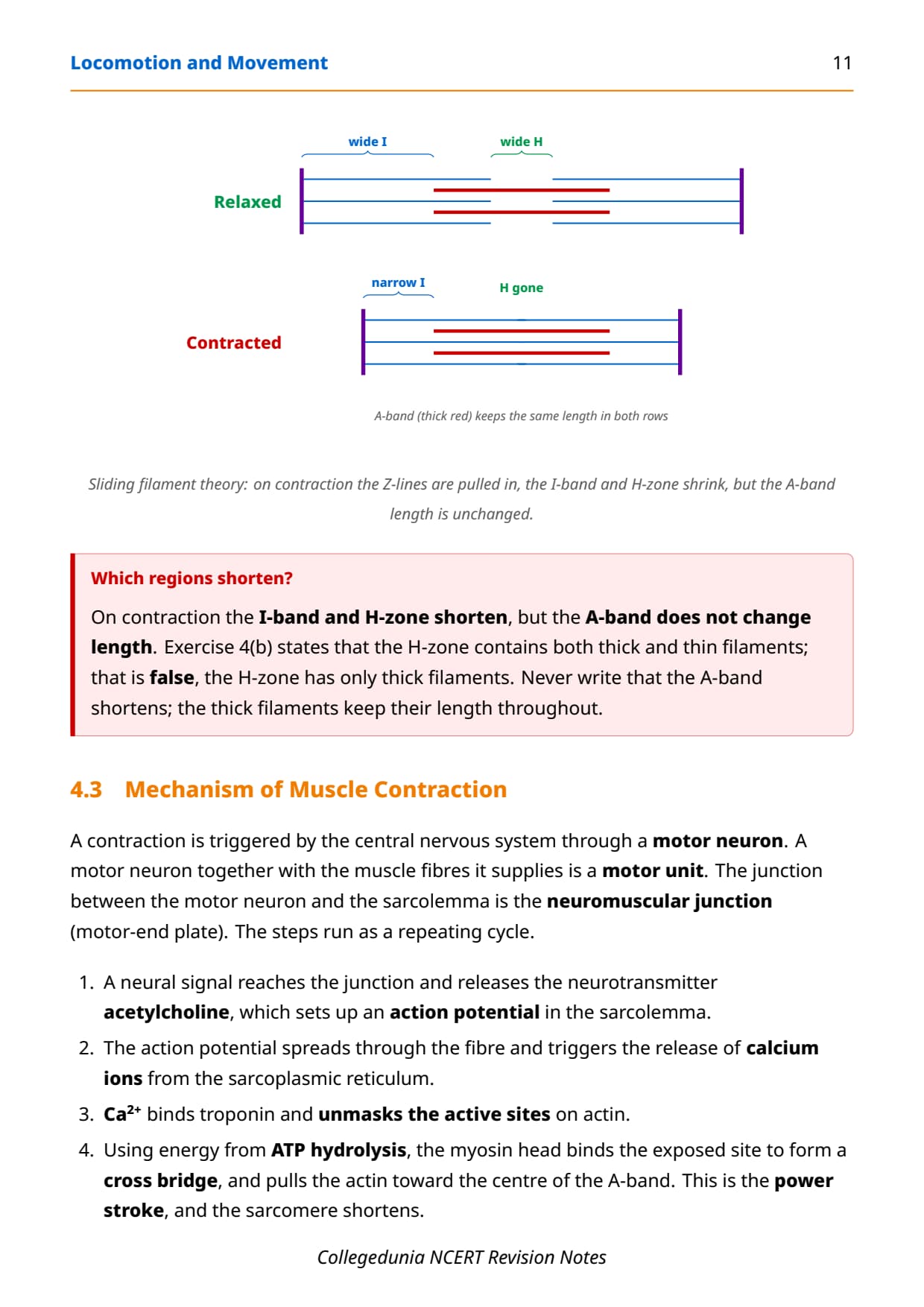
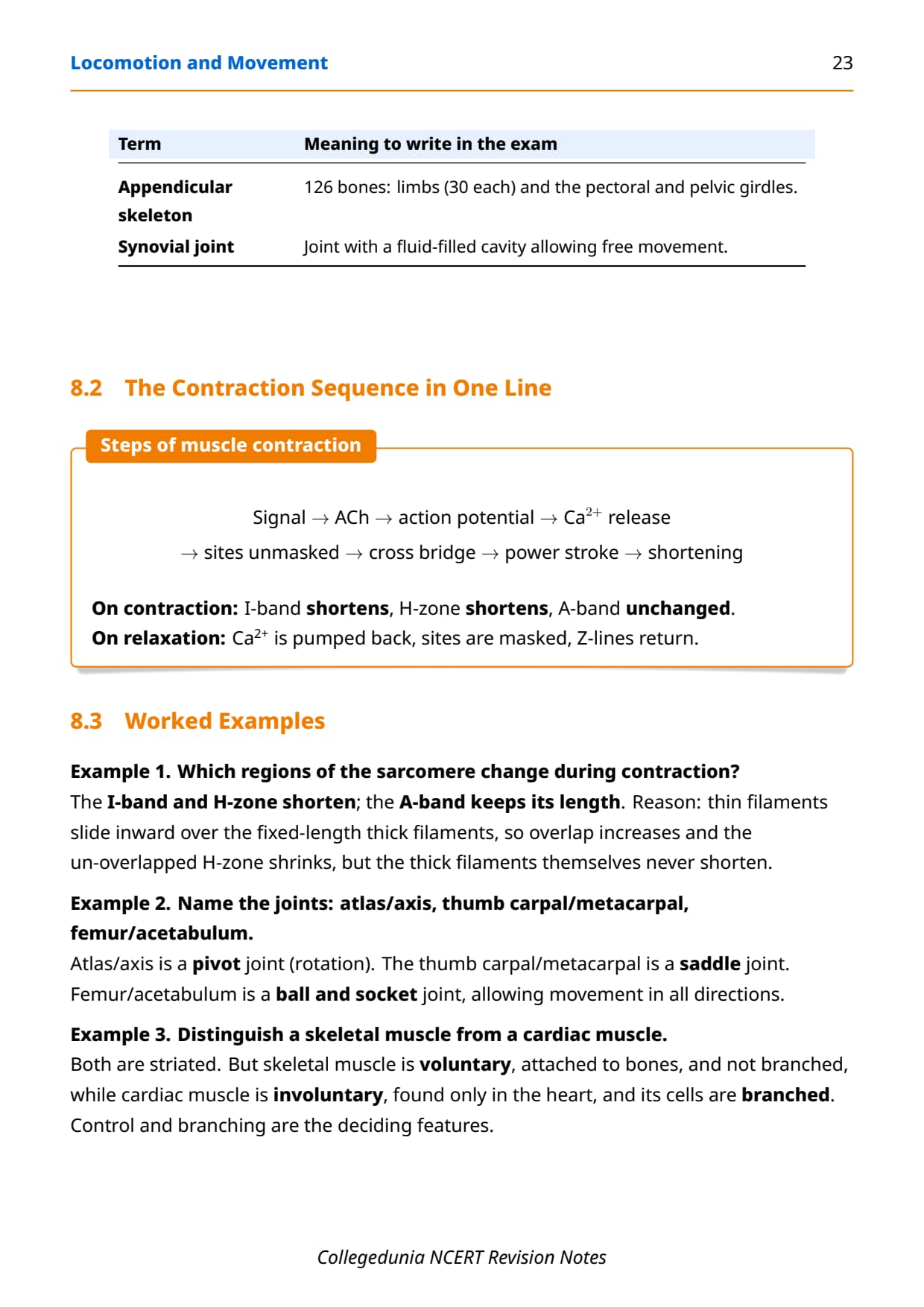
- On contraction: the I-band gets shorter and the H-zone shrinks and can disappear, but the A-band stays the same length, because the thick filaments never change length.
- The trigger: a motor neuron and the fibres it supplies form a motor unit, meeting the sarcolemma at the neuromuscular junction.
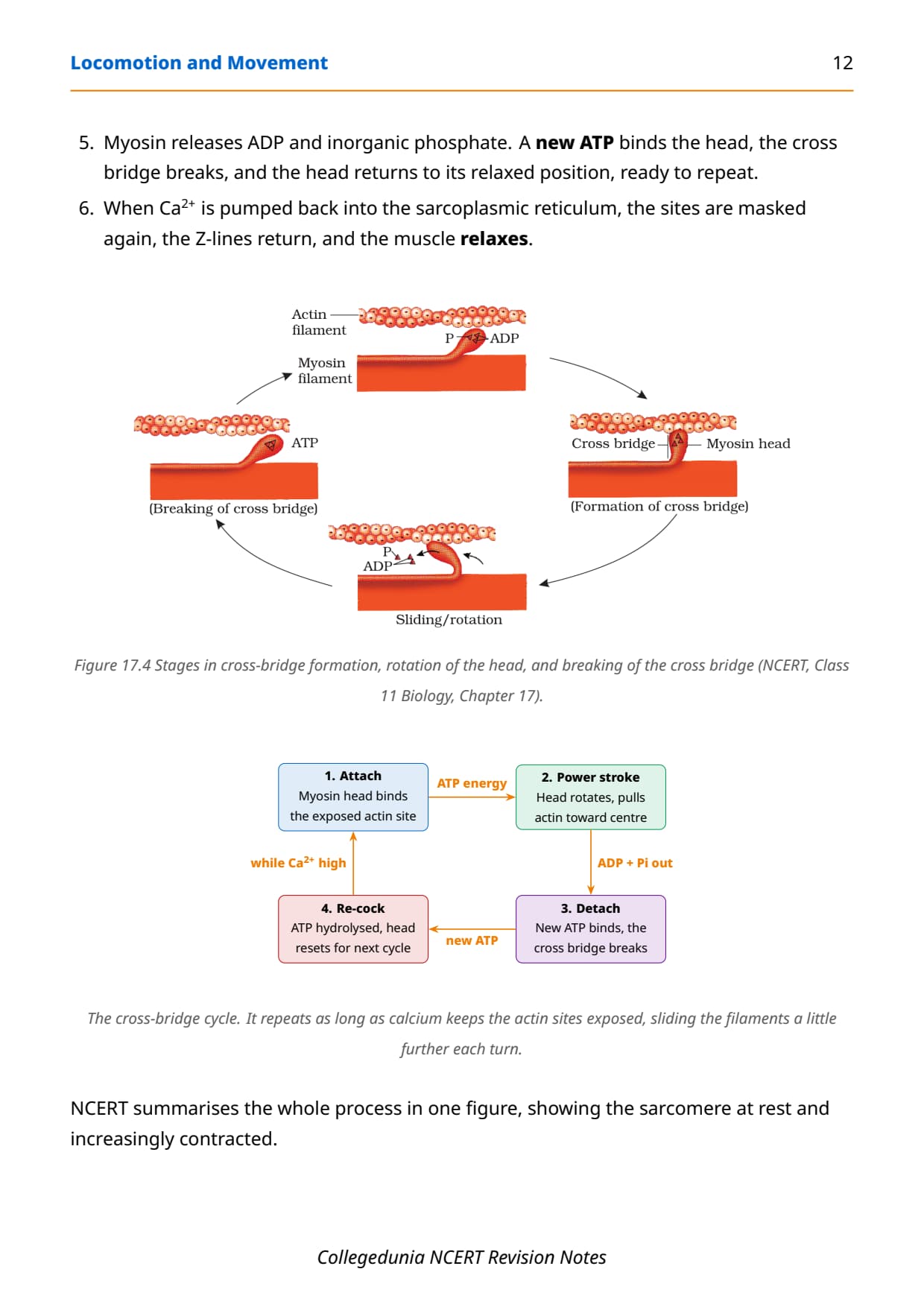
The mechanism runs as a repeating cycle. A neural signal releases acetylcholine, which sets up an action potential in the sarcolemma. This triggers the release of calcium ions from the sarcoplasmic reticulum, and Ca2+ binds troponin to unmask the active sites on actin. Using energy from ATP hydrolysis, the myosin head binds the exposed site to form a cross bridge and pulls the actin toward the centre in the power stroke, so the sarcomere shortens. A new ATP then breaks the cross bridge, and when Ca2+ is pumped back, the sites are masked again and the muscle relaxes. Marks are awarded for the correct sequence, so never scramble the steps: signal, acetylcholine, action potential, Ca2+ release, sites unmasked, cross bridge, power stroke, shortening. Repeated activity causes fatigue as glycogen breaks down anaerobically to lactic acid, and the amount of the pigment myoglobin splits muscle into aerobic red fibres and anaerobic white fibres. You can practise this sequence in the chapter Solutions when you work through Exercise 3.
The Skeletal System: Axial and Appendicular
The skeletal system is a supporting structure of bones and a few cartilages. Bone has a hard matrix due to calcium salts, while cartilage has a slightly pliable matrix due to chondroitin salts. The adult human skeleton has 206 bones, grouped into the axial and appendicular divisions. Learning the bone counts and their sub-counts is what earns the fill-in-the-blank marks.
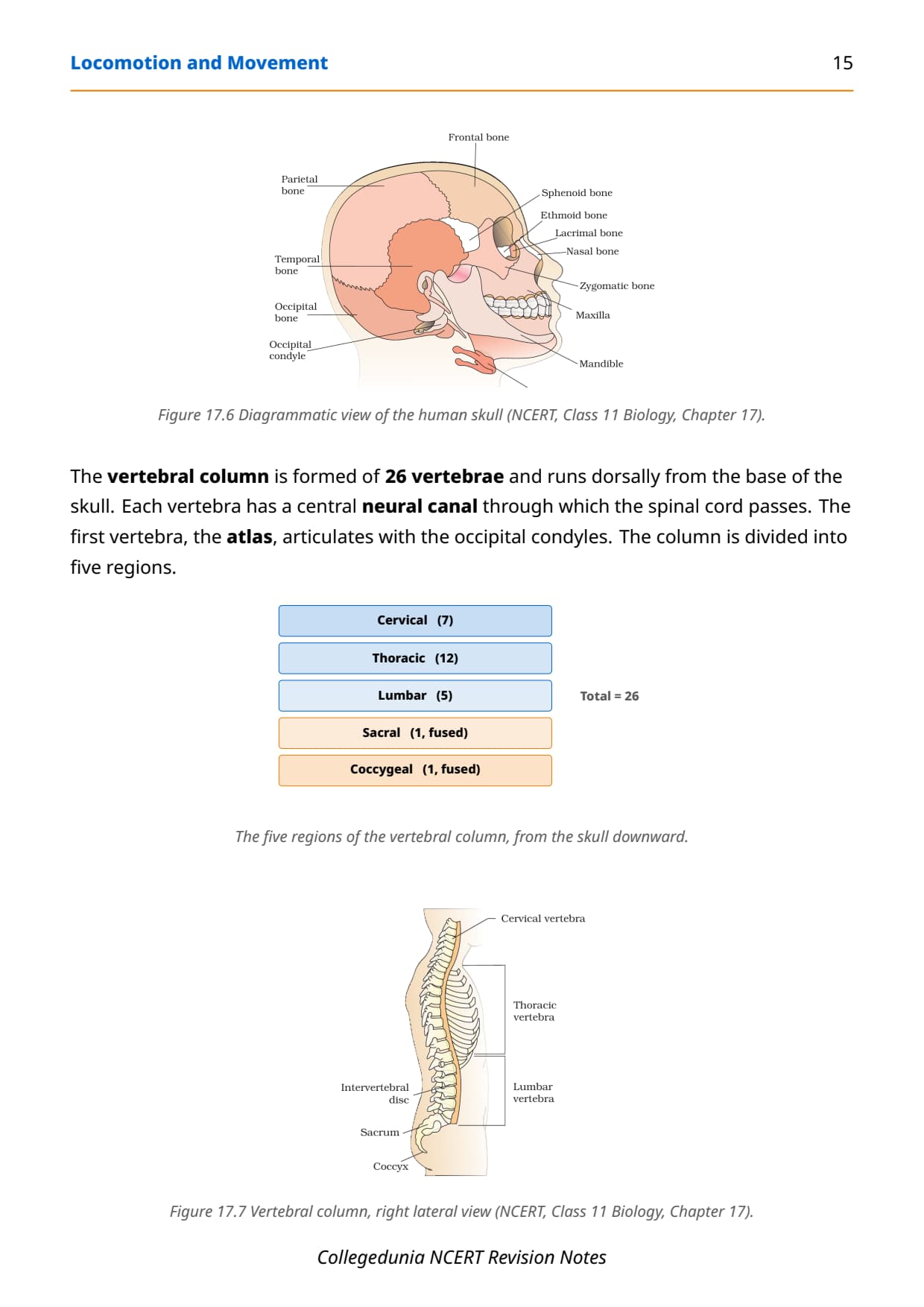
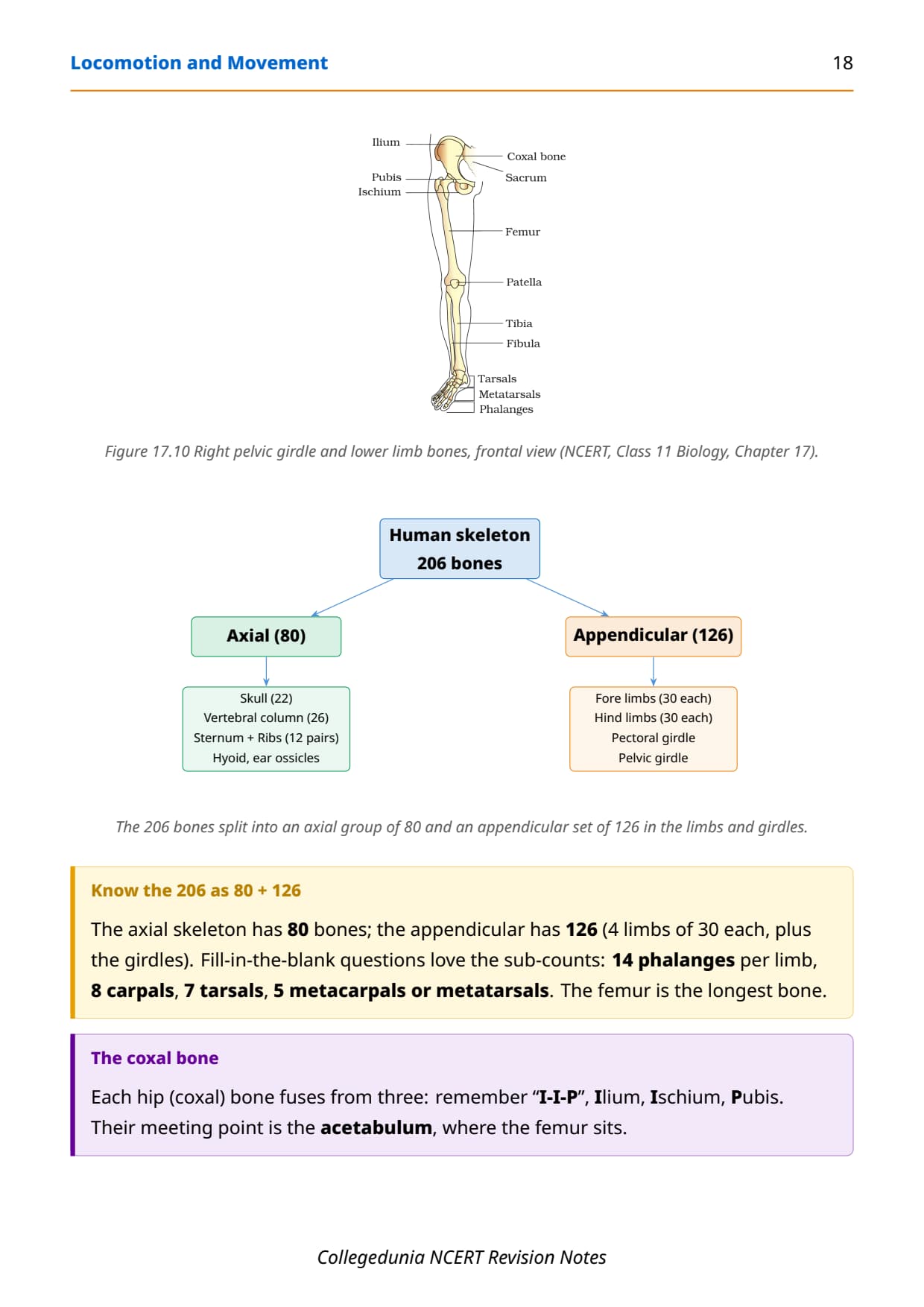
- Axial skeleton (80 bones): the skull (22 bones, 8 cranial and 14 facial), the vertebral column (26 vertebrae), the sternum, and 12 pairs of ribs, plus the hyoid and the ear ossicles.
- Appendicular skeleton (126 bones): the limbs, each with 30 bones, and the pectoral and pelvic girdles that attach them to the axial skeleton.
- Vertebral regions: cervical 7, thoracic 12, lumbar 5, sacral 1 (fused), and coccygeal 1 (fused), adding to 26.
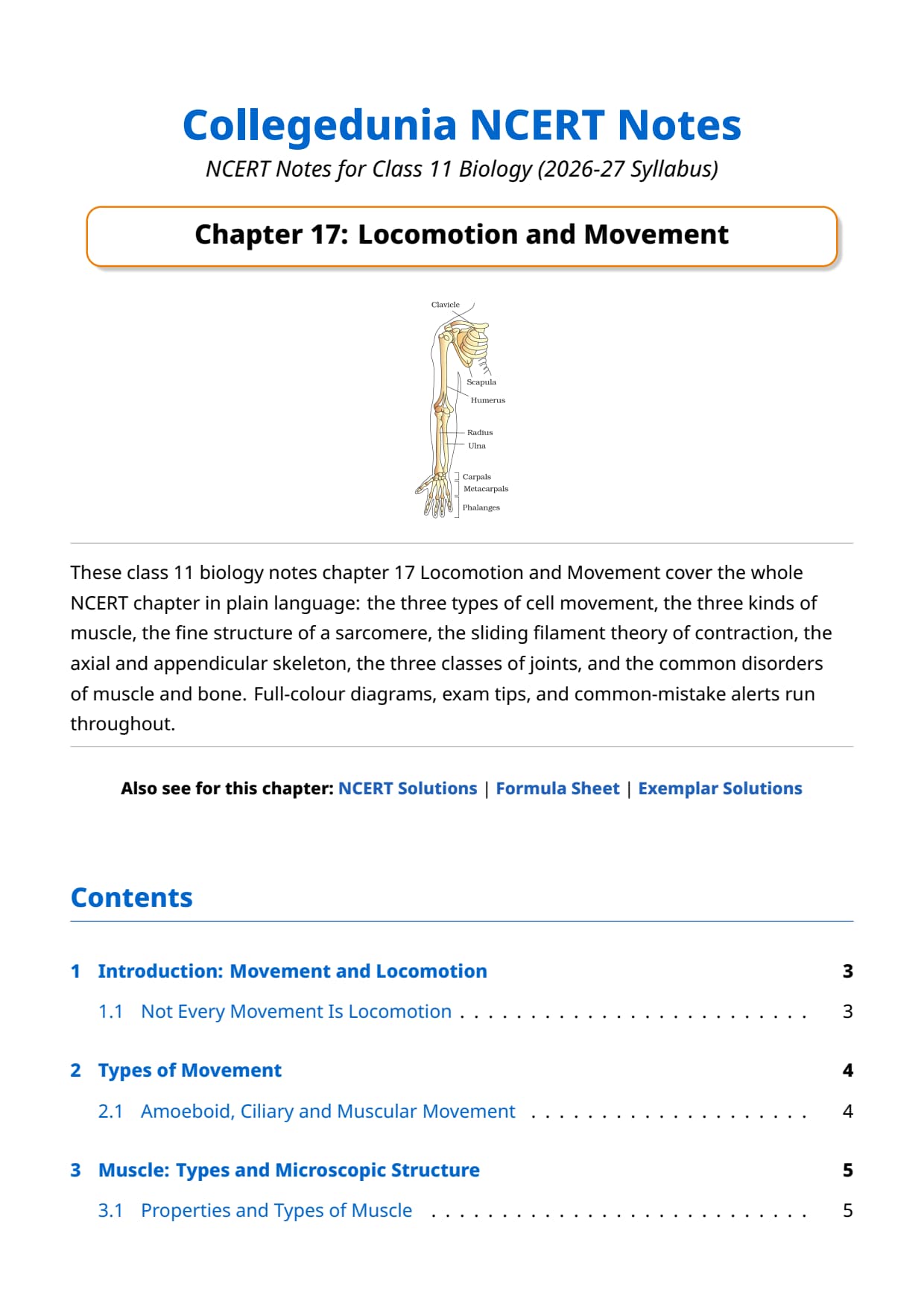
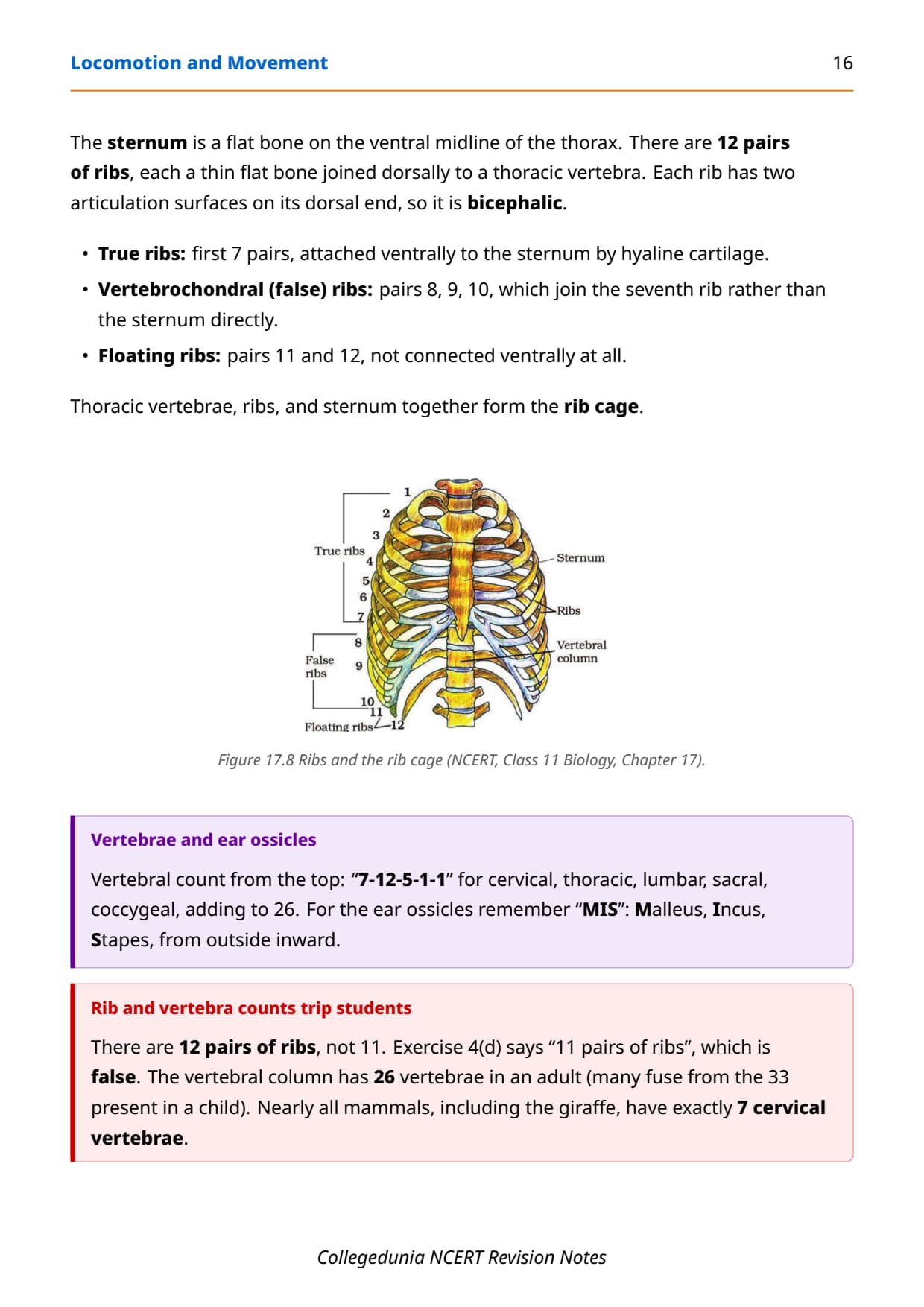
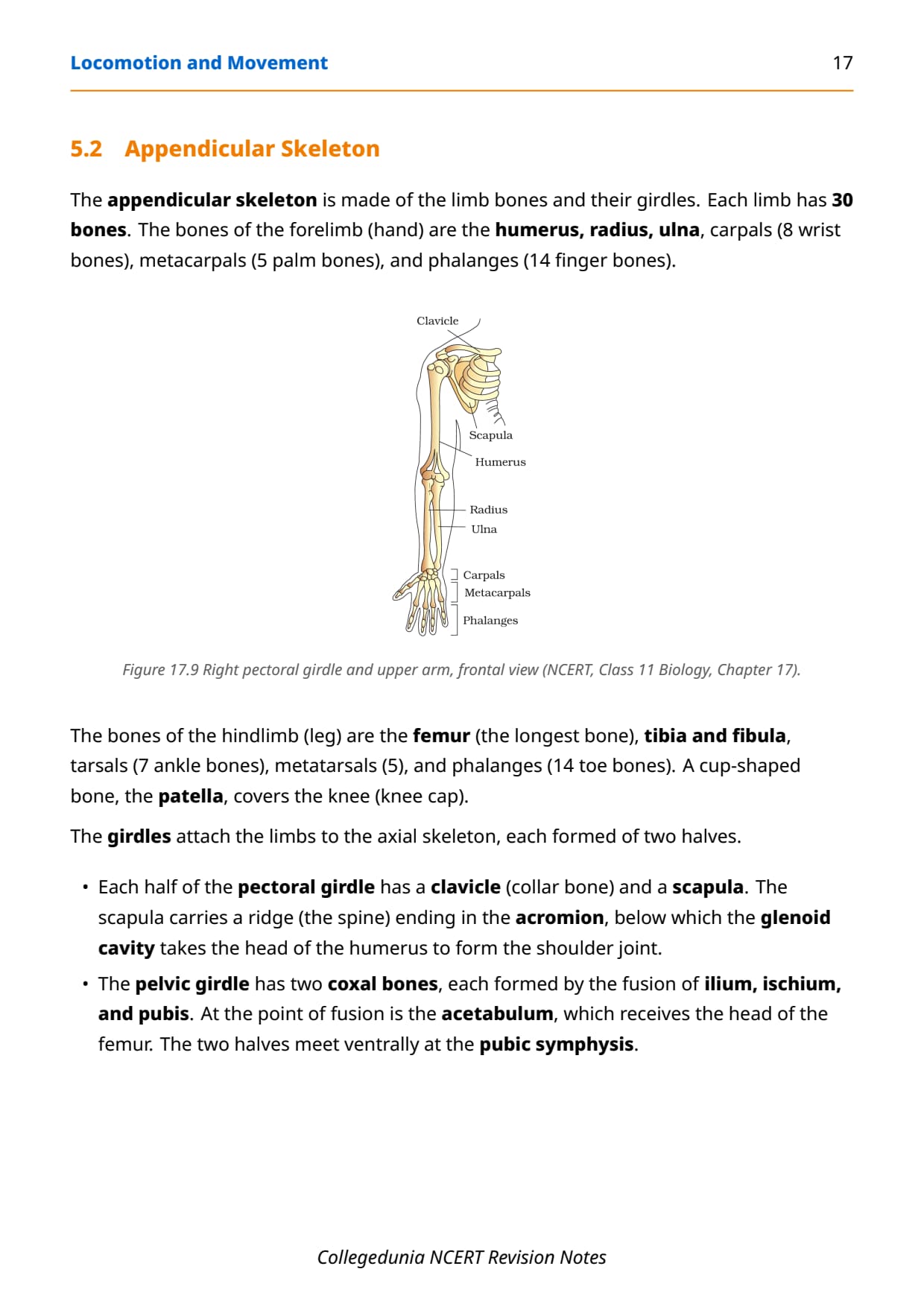
The ribs come in three kinds: the first 7 pairs are true ribs joined to the sternum, pairs 8 to 10 are false (vertebrochondral) ribs that join the seventh rib, and pairs 11 and 12 are floating ribs not connected ventrally. In the limbs, the forelimb has the humerus, radius, ulna, 8 carpals, 5 metacarpals, and 14 phalanges, while the hindlimb has the femur (the longest bone), tibia, fibula, 7 tarsals, 5 metatarsals, and 14 phalanges, with the patella covering the knee. A common trap is writing 11 pairs of ribs, but there are 12 pairs, and the adult column has 26 vertebrae. The pectoral girdle has a clavicle and scapula, while each coxal bone of the pelvic girdle fuses from the ilium, ischium, and pubis, meeting at the acetabulum that holds the head of the femur.
Joints and Disorders of the System
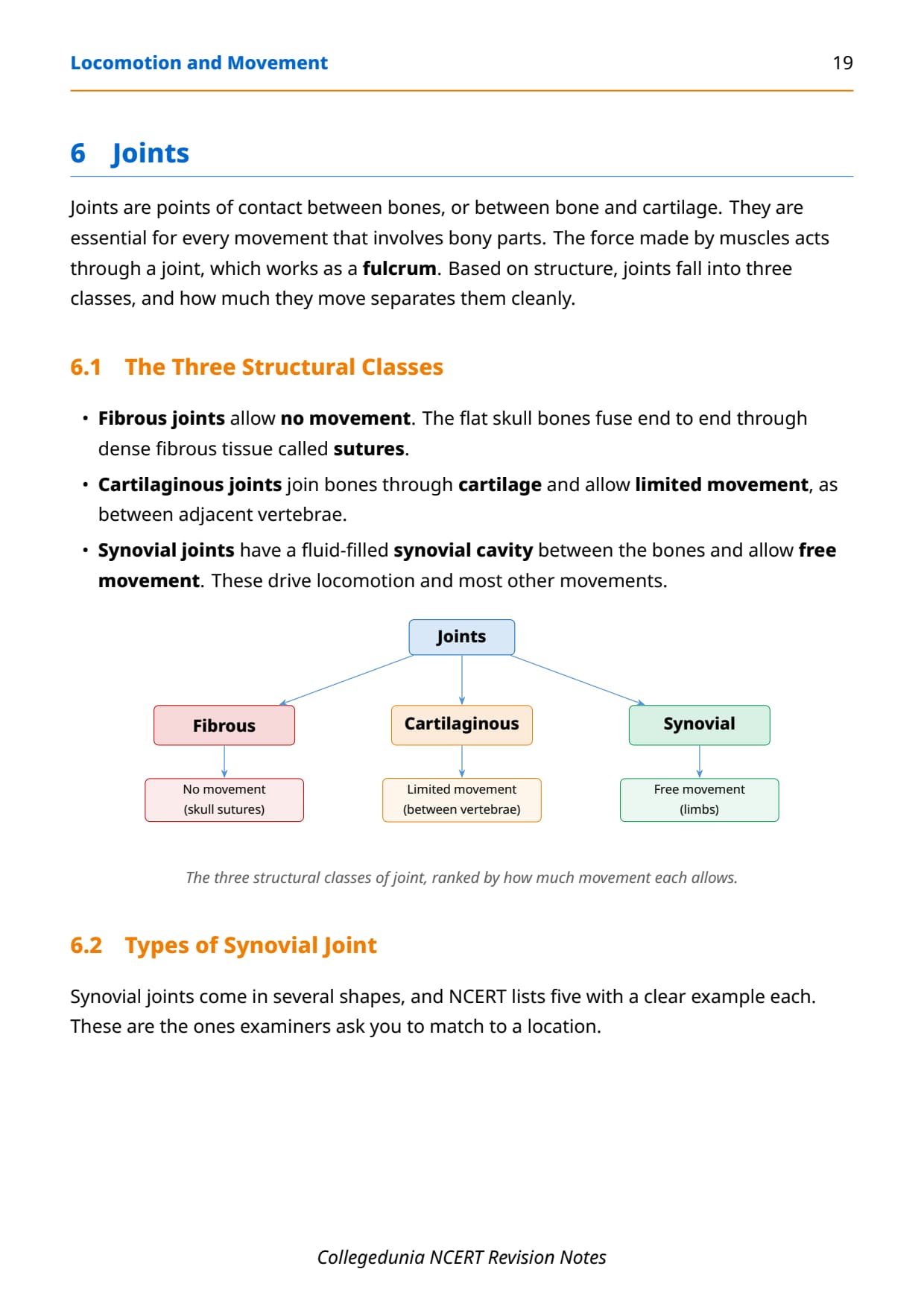
Joints are points of contact between bones, or between bone and cartilage, and every movement of bony parts works through a joint acting as a fulcrum. Based on structure, joints fall into three classes ranked by how much they move. The chapter then closes with six disorders of muscle and bone, each with a one-line cause worth learning exactly.
- Fibrous joints: allow no movement, as in the sutures between the flat skull bones.
- Cartilaginous joints: allow limited movement, as between adjacent vertebrae.
- Synovial joints: have a fluid-filled synovial cavity and allow free movement, which drives locomotion.
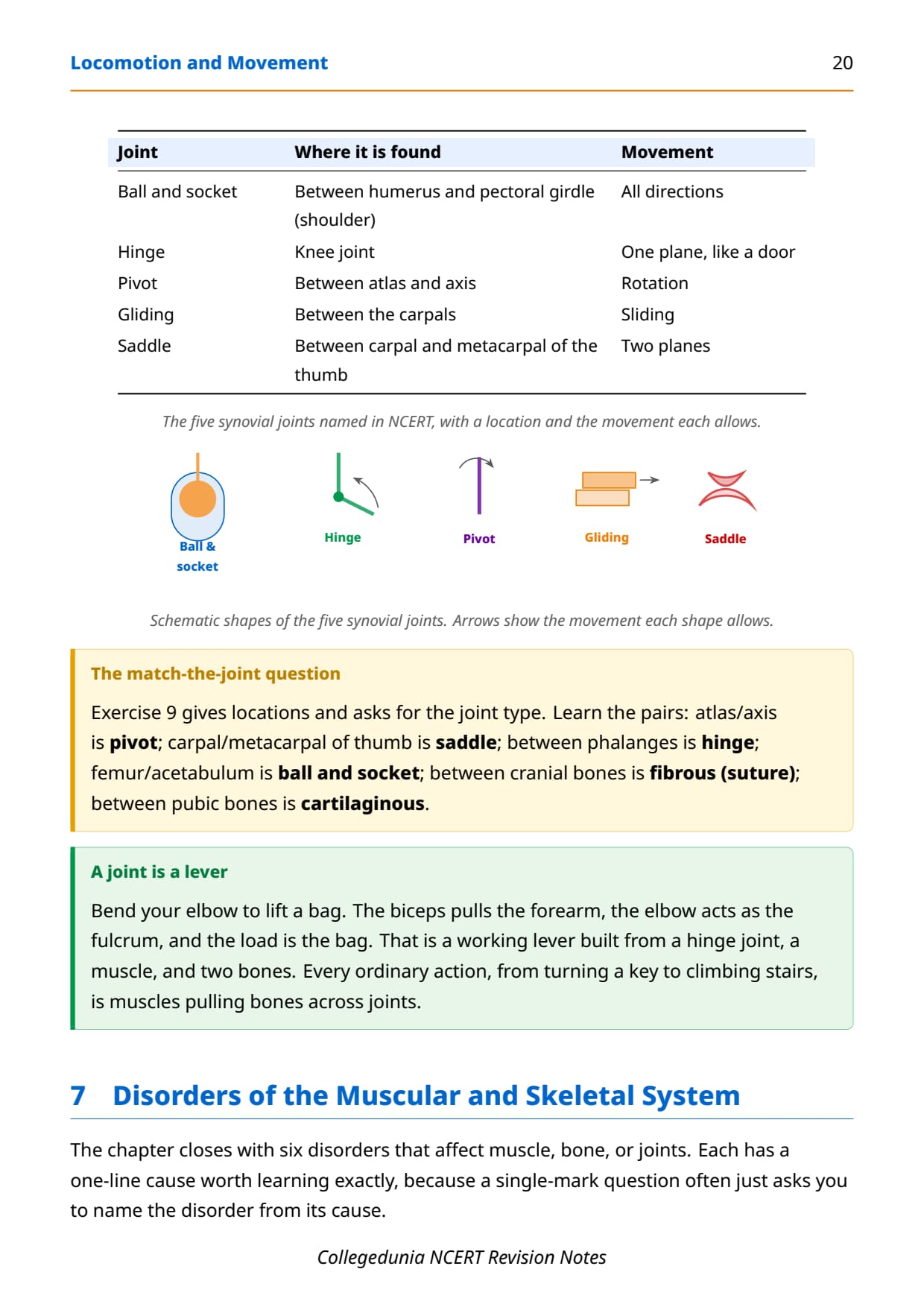
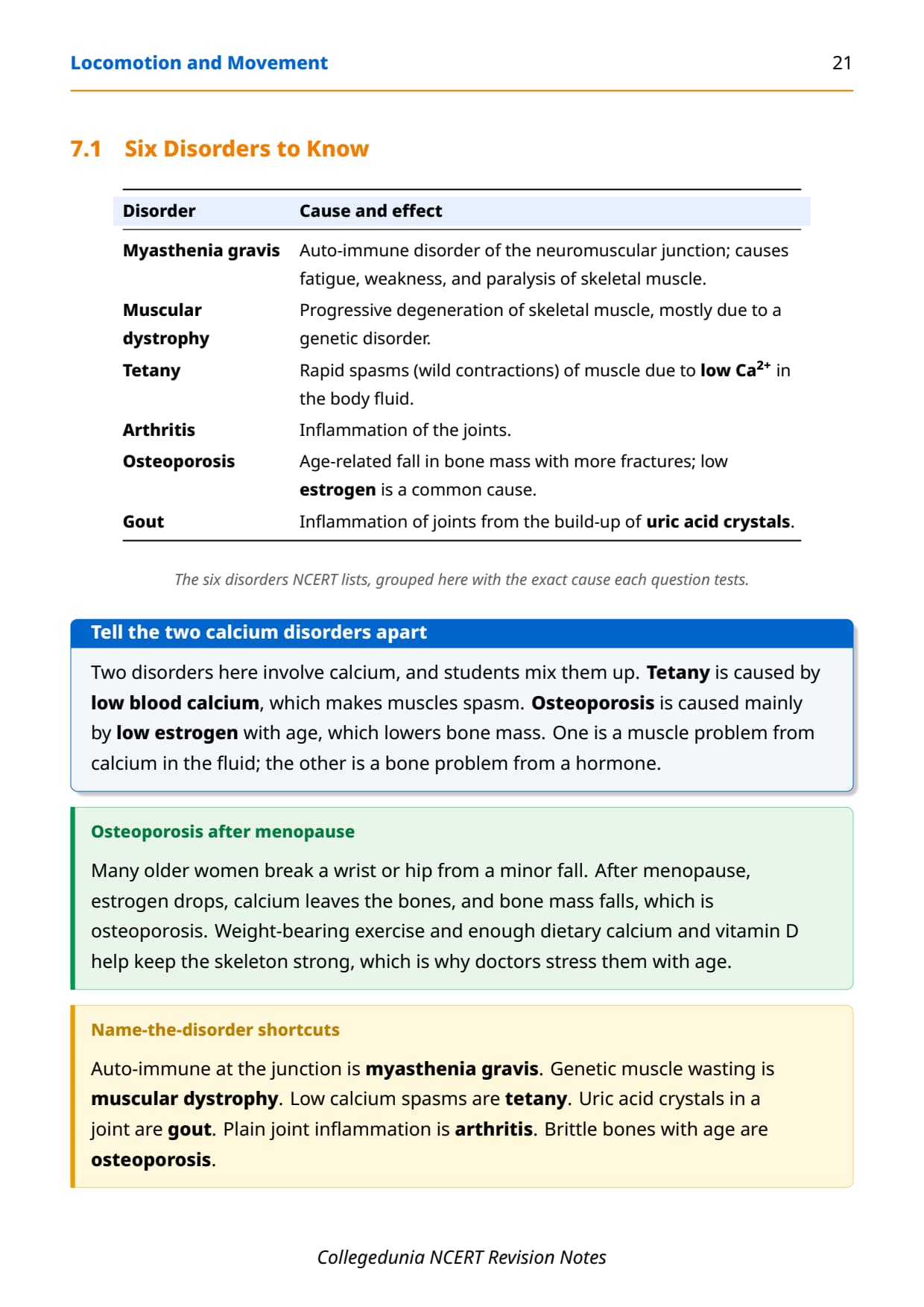
NCERT names five synovial joints with a clear example each: ball and socket at the shoulder (all directions), hinge at the knee (one plane), pivot between atlas and axis (rotation), gliding between the carpals (sliding), and saddle at the thumb carpal and metacarpal (two planes). The disorders are just as testable. Myasthenia gravis is an auto-immune disorder of the neuromuscular junction, muscular dystrophy is genetic muscle degeneration, tetany is muscle spasm from low Ca2+, arthritis is joint inflammation, osteoporosis is age-related bone loss from low estrogen, and gout is joint inflammation from uric acid crystals. Take care with the two calcium-linked disorders, since tetany is a muscle problem from low blood calcium while osteoporosis is a bone problem from low estrogen with age.
Key Definitions in Locomotion and Movement
Board short-answer questions often ask for a clean definition in one or two lines, and a vague answer loses easy marks. Learn these word-for-word, because the wording of the exam question is usually built straight from the NCERT definition. Each term below also connects to a diagram or example you can be asked to explain.
| Term | Definition |
|---|---|
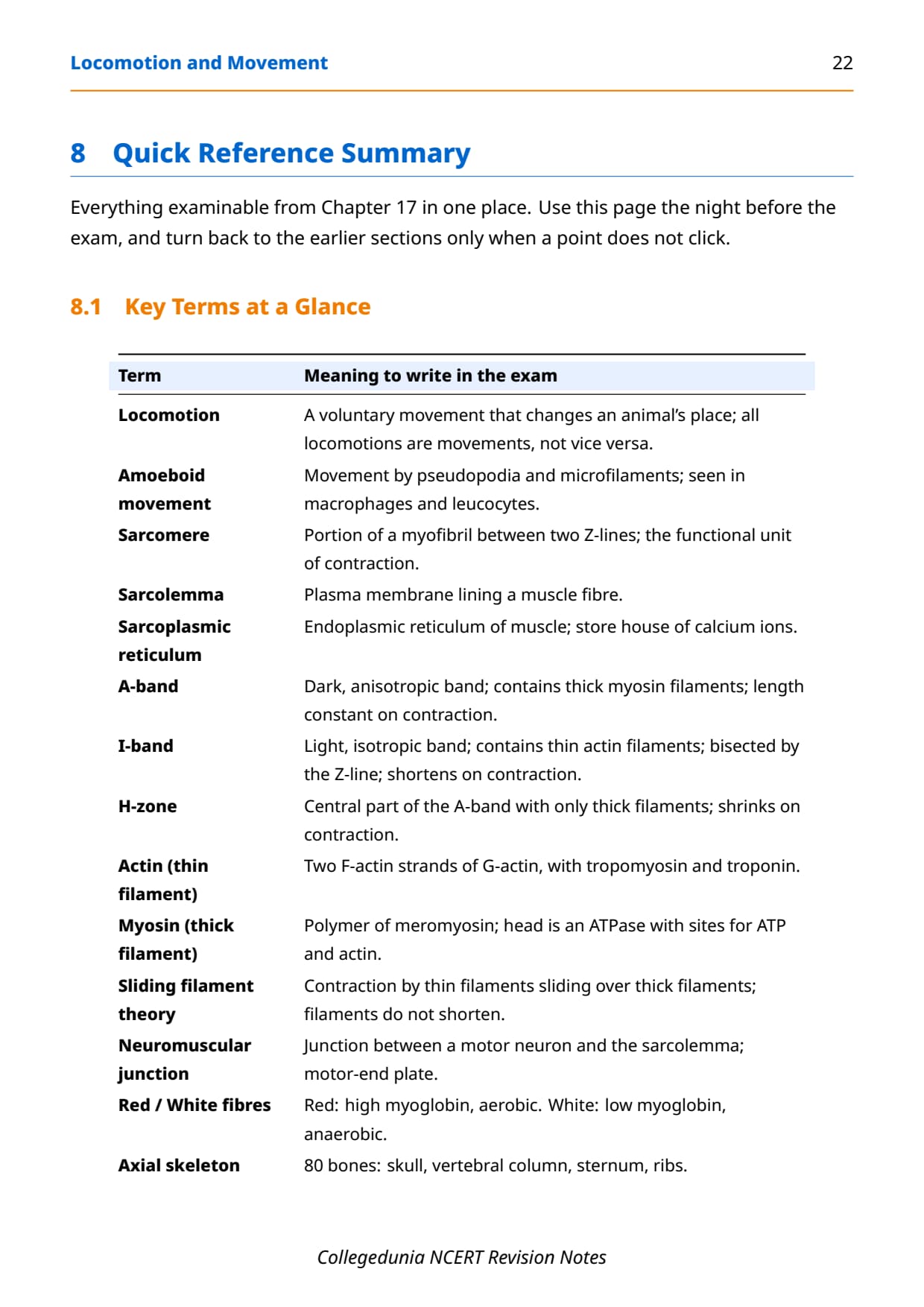
| Locomotion | A voluntary movement that changes an animal's place; all locomotions are movements, not the reverse. |
| Sarcomere | The portion of a myofibril between two Z-lines; the functional unit of contraction. |
| Sarcoplasmic reticulum | The endoplasmic reticulum of a muscle fibre; the store house of calcium ions. |
| Sliding filament theory | Contraction by the thin filaments sliding over the thick filaments; the filaments do not shorten. |
| Neuromuscular junction | The junction between a motor neuron and the sarcolemma; the motor-end plate. |
| Axial skeleton | The 80 bones of the skull, vertebral column, sternum, and ribs. |
| Synovial joint | A joint with a fluid-filled cavity that allows free movement. |
A common board question asks you to define the sarcomere and then name the region that shortens on contraction. State the definition first, then add that the I-band and H-zone shorten while the A-band stays constant to earn the full mark. Learning these definitions makes the wording of almost every one-mark and two-mark question in this chapter familiar.
Common Mistakes Students Make in Locomotion and Movement
These slips happen because two structures look alike, not because the concept is hard. Each one costs 1 to 2 marks in the paper, so watch for them at the exact step where they occur.
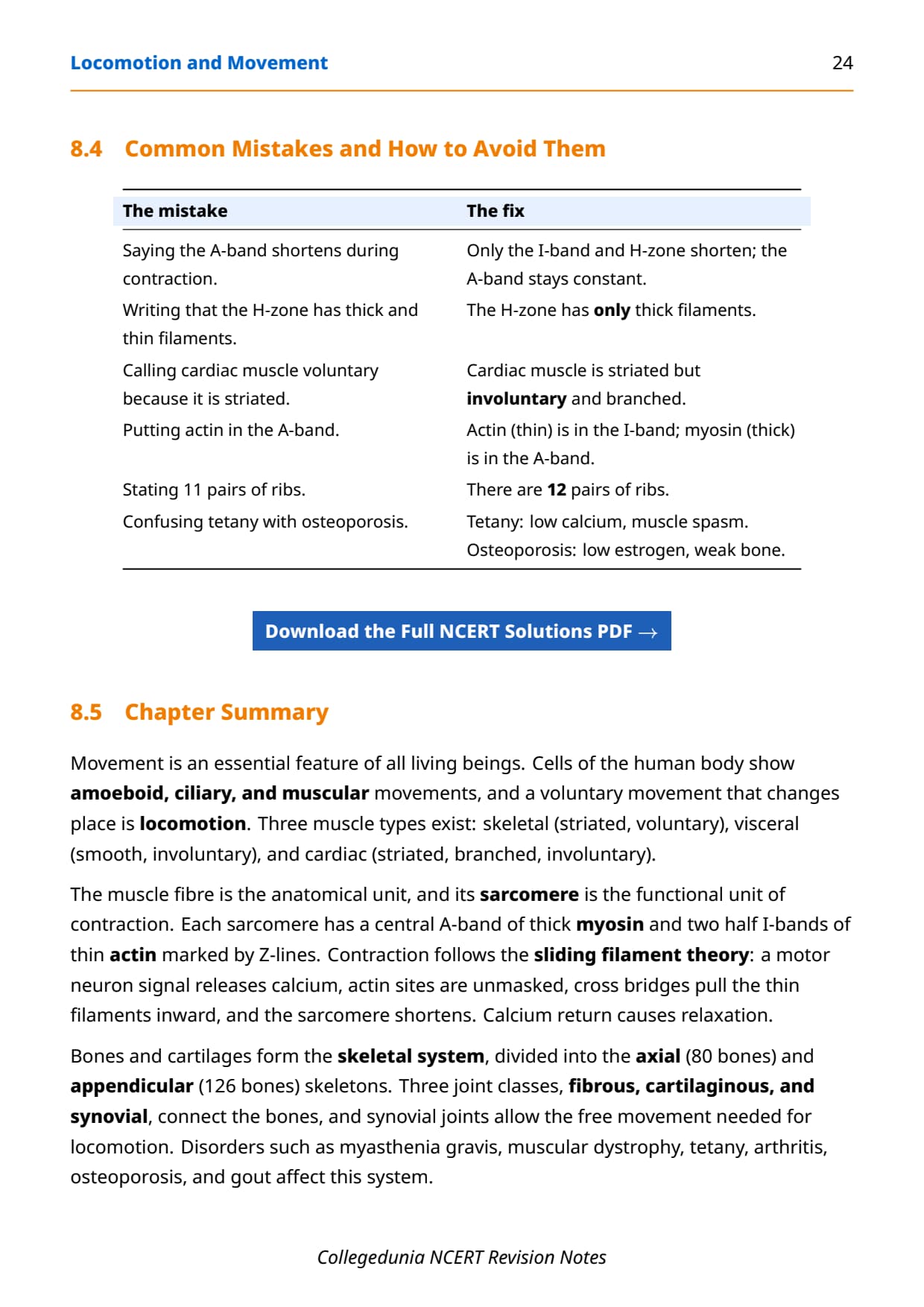
Mistake 1: Saying the A-band shortens during contraction. Only the I-band and H-zone shorten; the A-band keeps its length because the thick filaments never change length.
Mistake 2: Writing that the H-zone has thick and thin filaments. The H-zone contains only thick filaments.
Mistake 3: Calling cardiac muscle voluntary because it is striated. Cardiac muscle is striated but involuntary and branched.
Mistake 4: Putting actin in the A-band. Actin (thin) is in the light I-band; myosin (thick) is in the dark A-band.
Mistake 5: Stating 11 pairs of ribs, or confusing tetany with osteoporosis. There are 12 pairs of ribs; tetany is low calcium with muscle spasm, and osteoporosis is low estrogen with weak bone.
Locomotion and Movement Weightage in CBSE Boards, NEET and CUET
This chapter is diagram-heavy and scoring. It sits inside the Human Physiology unit, which carries the largest share of the Class 11 Biology paper, and its sarcomere and contraction questions repeat every year. Here is how the marks split across the main exams for 2026-27.
| Exam | Typical weightage | What is asked |
|---|---|---|
| CBSE Boards | 3 to 5 marks | The sliding filament mechanism or sarcomere, plus muscle types, the skeleton, or joints |
| NEET | 1 to 2 questions | Sarcomere regions, contraction steps, bone counts, and joint types |
| CUET | 1 to 2 objective questions | Definitions, muscle types, and matching joints to their locations |
The sarcomere and the sliding filament theory are the single most tested ideas from this chapter across all three exams. Master the sarcomere and contraction steps first, then the skeleton bone counts, then the joint types, in that order of return on effort for the 2026-27 session.
How to Revise Locomotion and Movement Quickly
Use these locomotion and movement class 11 notes for a fast, ordered recap the night before a test. The checklist below takes about 25 minutes and hits every marks-heavy idea in the chapter without opening the full textbook.
- First 9 minutes: draw a sarcomere and label the Z-line, A-band, I-band, H-zone, and M-line, then note which regions shorten on contraction.
- Next 8 minutes: write the contraction steps in order from the neural signal to sarcomere shortening, and name the three muscle types.
- Last 8 minutes: recall the bone counts (206, 80 axial, 126 appendicular, 26 vertebrae, 12 rib pairs) and match the five synovial joints to their locations.
Close the loop by naming the joints at the atlas and axis, the thumb, and the femur and acetabulum. If you can do all three blocks without notes, the chapter is exam-ready. Keep the sarcomere diagram beside you for the first pass only, then try the whole checklist closed-book.
Student Feedback on the Locomotion and Movement Notes
What 11,720 students told us about their Locomotion and Movement revision:
- 73% of students rated the sarcomere and the sliding filament theory as the part most worth memorising for the exam.
- Most-confused pair: the A-band versus the I-band and their proteins, mixed up by about 3 in 10 students.
- Students who learnt the contraction steps as an ordered sequence said the 3-mark mechanism question felt easy afterwards.
Source: 2026-27 Class 11 Biology student poll. Sample of 11,720 students from CBSE schools across 15 states, conducted before the 2026 boards.
Other Locomotion and Movement Class 11 Biology Resources
Pair these notes with the solved answers, the formula sheet, the exemplar material, and the textbook PDF for the same chapter.
| Resource | Link |
|---|---|
| NCERT Solutions | Locomotion and Movement Class 11 NCERT Solutions |
| Formula Sheet | Locomotion and Movement Class 11 Formula Sheet |
| Exemplar Solutions | Locomotion and Movement Class 11 Exemplar Solutions |
| NCERT Book PDF | Locomotion and Movement Class 11 Book PDF |
| Exemplar Book PDF | Locomotion and Movement Class 11 Exemplar Book PDF |
NCERT Notes for Class 11 Biology: All Chapters
Jump to the revision notes for any other Class 11 Biology chapter below.
| Chapter | NCERT Notes |
|---|---|
| Chapter 1 | The Living World |
| Chapter 2 | Biological Classification |
| Chapter 3 | Plant Kingdom |
| Chapter 4 | Animal Kingdom |
| Chapter 5 | Morphology of Flowering Plants |
| Chapter 6 | Anatomy of Flowering Plants |
| Chapter 7 | Structural Organisation in Animals |
| Chapter 8 | Cell The Unit of Life |
| Chapter 9 | Biomolecules |
| Chapter 10 | Cell Cycle and Cell Division |
| Chapter 11 | Photosynthesis in Higher Plants |
| Chapter 12 | Respiration in Plants |
| Chapter 13 | Plant Growth and Development |
| Chapter 14 | Breathing and Exchange of Gases |
| Chapter 15 | Body Fluids and Circulation |
| Chapter 16 | Excretory Products and their Elimination |
| Chapter 17 | Locomotion and Movement |
| Chapter 18 | Neural Control and Coordination |
| Chapter 19 | Chemical Coordination and Integration |
FAQs on Locomotion and Movement Class 11 Biology Notes
Locomotion and Movement Notes - Frequently Asked Questions
Ques. What topics do the locomotion and movement class 11 notes cover?
Ans. These locomotion and movement class 11 notes cover the difference between movement and locomotion, the three types of movement (amoeboid, ciliary, and muscular), the four muscle properties, the three muscle types, the structure of a muscle fibre and sarcomere, the structure of actin and myosin, the sliding filament theory and the contraction steps, red and white fibres, the axial and appendicular skeleton with all bone counts, the three joint classes and the synovial joints, and the six muscle and bone disorders.
Ques. What is the sliding filament theory of muscle contraction?
Ans. The sliding filament theory states that a muscle contracts when the thin actin filaments slide over the thick myosin filaments toward the centre of the A-band. The filaments themselves do not shorten. As the thin filaments slide in, the Z-lines are pulled closer, the I-band and H-zone shorten, and the A-band keeps its length. A neural signal releases calcium, which unmasks the actin sites so myosin heads form cross bridges and pull the filaments in the power stroke.
Ques. Which regions of the sarcomere change during contraction?
Ans. During contraction the I-band and the H-zone get shorter, and the H-zone can disappear as the thin filaments approach the centre. The A-band does not change length, because the thick filaments never shorten. The reason is that the thin filaments slide inward over the fixed-length thick filaments, so overlap increases and the un-overlapped H-zone shrinks. Writing that the A-band shortens is a common error that loses the mark.
Ques. What are the three types of muscle?
Ans. Based on location there are three muscle types. Skeletal muscle is attached to bones, is striated, and is voluntary, driving locomotion and posture. Visceral muscle lines hollow organs, is smooth, and is involuntary, moving food through the gut. Cardiac muscle is the muscle of the heart, striated in appearance but involuntary, with branched cells. The key point examiners test is that cardiac muscle is striated yet involuntary, unlike the assumption that striated always means voluntary.
Ques. How many bones are in the human skeleton?
Ans. The adult human skeleton has 206 bones, divided into the axial skeleton of 80 bones and the appendicular skeleton of 126 bones. The axial skeleton includes the skull (22 bones), the vertebral column (26 vertebrae), the sternum, and 12 pairs of ribs, plus the hyoid and ear ossicles. The appendicular skeleton includes the four limbs (30 bones each) and the pectoral and pelvic girdles. Note that there are 12 pairs of ribs, not 11.
Ques. What are the three structural classes of joints?
Ans. Joints fall into three structural classes based on how much they move. Fibrous joints allow no movement, such as the sutures between the flat skull bones. Cartilaginous joints allow limited movement, such as those between adjacent vertebrae. Synovial joints have a fluid-filled synovial cavity and allow free movement, which drives locomotion. The synovial joints include ball and socket, hinge, pivot, gliding, and saddle types, each matched to a location in the body.
Ques. What is the weightage of this chapter in the CBSE board exam?
Ans. Locomotion and Movement carries about 3 to 5 marks in the CBSE Class 11 Biology paper, usually one question on the sliding filament mechanism or the sarcomere plus one on muscle types, the skeleton, or joints. It also appears in NEET and CUET as objective questions on sarcomere regions, contraction steps, bone counts, and joint types, which makes it a scoring chapter for the 2026-27 session.



Comments