




These plant growth and development class 11 notes bring together every definition, growth curve, and hormone effect that the CBSE Boards, NEET and CUET papers actually test in 2026-27. Revise the whole chapter fast, from what growth really means, through the arithmetic and geometric growth patterns, differentiation and plasticity, and the five plant growth regulators with their discovery, effects and uses, all in one place.
This chapter closes the plant-physiology unit of Class 11 Biology, and the ideas of growth, differentiation and hormonal control return in the reproduction and biotechnology chapters of Class 12.
- CBSE Weightage: 5 to 6 marks, usually one long answer on the growth curve or the plant growth regulators plus one short answer on differentiation or plasticity.
- Topics covered: growth, differentiation and development, meristems and open growth, measurable growth parameters, phases of growth, arithmetic and geometric growth rates, absolute and relative growth, conditions for growth, differentiation, dedifferentiation and redifferentiation, plasticity and heterophylly, and the five plant growth regulators.
- Key equations and facts: arithmetic growth Lt = L0 + rt, geometric growth W1 = W0ert, the three-phase sigmoid curve, and the five PGRs auxin, gibberellin, cytokinin, ethylene and ABA.
These plant growth and development class 11 notes are curated by subject experts, based on the 2026-27 NCERT textbook, and checked against the last five years of CBSE Board and NEET papers.
Topic-by-Topic Summary of Plant Growth and Development
The chapter explains how a single cell, the zygote, becomes a whole plant with roots, leaves, flowers and seeds in a fixed order. It starts by separating three easily confused words, then measures and models growth, follows how cells take on special jobs, and ends with the chemical signals that steer the whole process. Here is the quick map of what each topic gives you before you revise the detail.
- Growth, differentiation and development: growth is an irreversible increase in size, differentiation gives cells special jobs, and development is the sum of the two across the life cycle.
- Growth rates and phases: the meristematic, elongation and maturation phases, and the arithmetic versus geometric growth patterns.
- Differentiation and its reversal: differentiation, dedifferentiation and redifferentiation, and why both growth and differentiation are open in plants.
- Development and plasticity: the developmental sequence of a cell, and heterophylly as a clear example of plasticity.
- Plant growth regulators: the five PGRs, their accidental discoveries, and the effects and uses of each.
- Flowering (NEET extension): photoperiodism and vernalisation, kept for NEET and CUET.
Revise the topics in this order, because each one builds on the last. Fix the three words growth, differentiation and development first, and the growth curves and hormones fall into place around them. These plant growth and development class 11 notes follow the same sequence as the NCERT textbook.
Growth, Differentiation and Development
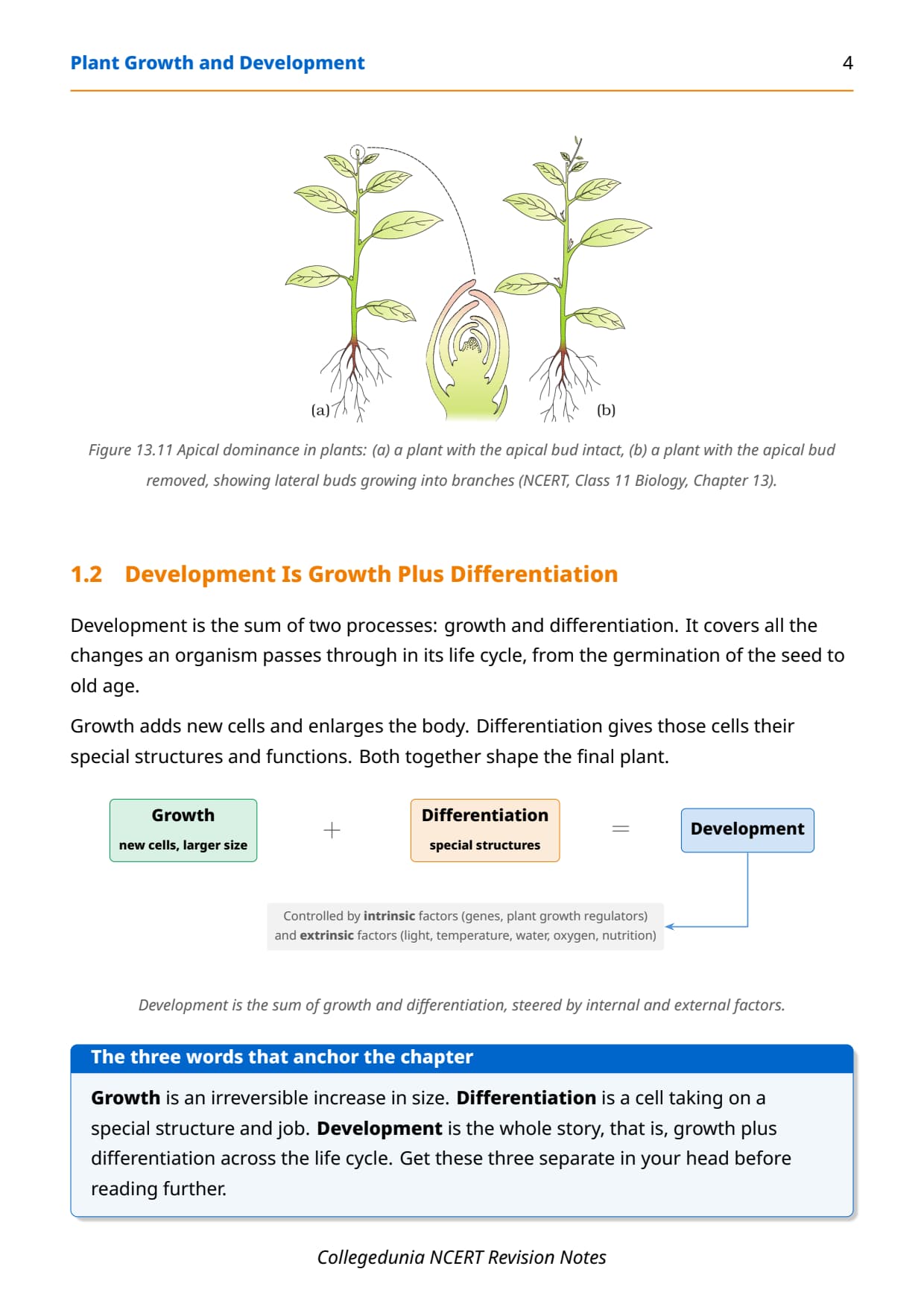
All cells of a plant are descendants of the zygote, yet they end up with very different shapes and jobs. The plant reaches its mature form through a precise, highly ordered sequence, producing roots, leaves, branches, flowers, fruits and seeds before these organs age and die. Development is the sum of two processes, growth and differentiation, and it covers all the changes an organism passes through from the germination of the seed to old age. Getting these three words separate is the first step in the chapter.
- Growth: an irreversible permanent increase in the size of an organ, a part, or even a single cell, accompanied by metabolism.
- Differentiation: a cell taking on a special structure and function, such as a tracheary element losing its protoplasm and building lignified walls.
- Development: the whole story, that is, growth plus differentiation across the entire life cycle.
- Controlling factors: intrinsic factors such as genes and plant growth regulators, and extrinsic factors such as light, temperature, water, oxygen and nutrition.
Seed germination is the first visible step. A seed germinates only when conditions are favourable, taking up water and resuming metabolism, but under poor conditions it stays dormant until conditions return. Development is best written as growth plus differentiation, steered by both internal and external factors. Keep this framework in mind, because the rest of the chapter simply fills in how growth is measured, how differentiation works, and how the plant growth regulators tune the whole sequence.
Growth: Meristems, Measurement and Phases
Growth is one of the most conspicuous features of any living organism, and it is the most heavily examined part of this chapter. Plant growth is unique because plants keep the capacity for unlimited growth all their life, thanks to meristems, groups of cells that can divide and self-perpetuate. Because new cells are always being added, this is called the open form of growth. These plant growth and development class 11 notes separate where growth happens, how it is measured, and the phases it passes through.
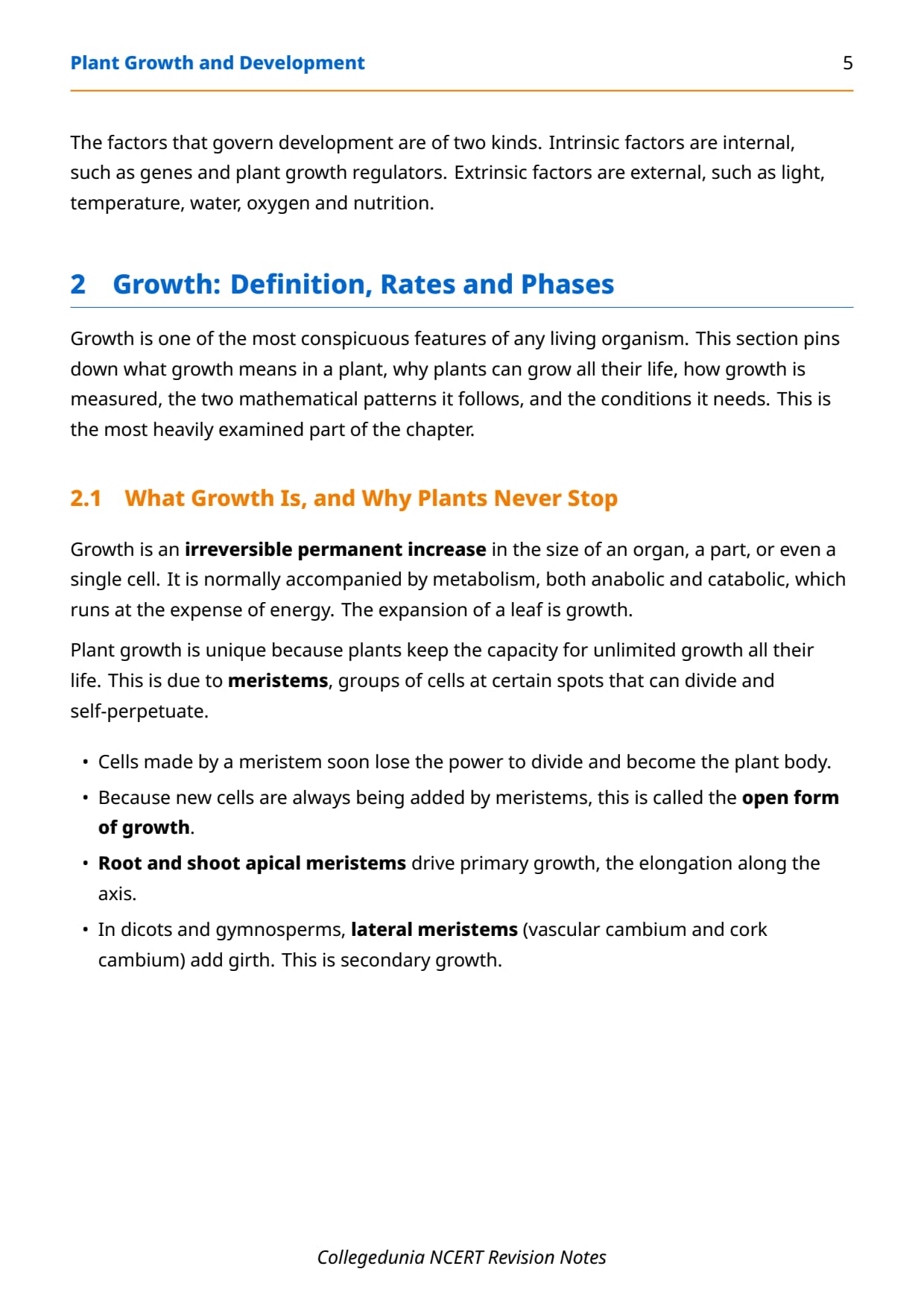
- Apical meristems: root and shoot apical meristems drive primary growth, the elongation along the axis.
- Lateral meristems: in dicots and gymnosperms, the vascular cambium and cork cambium add girth in secondary growth.
- Measurable growth: measured by fresh and dry weight, length, area, volume, or cell number, with the parameter chosen to fit the organ.
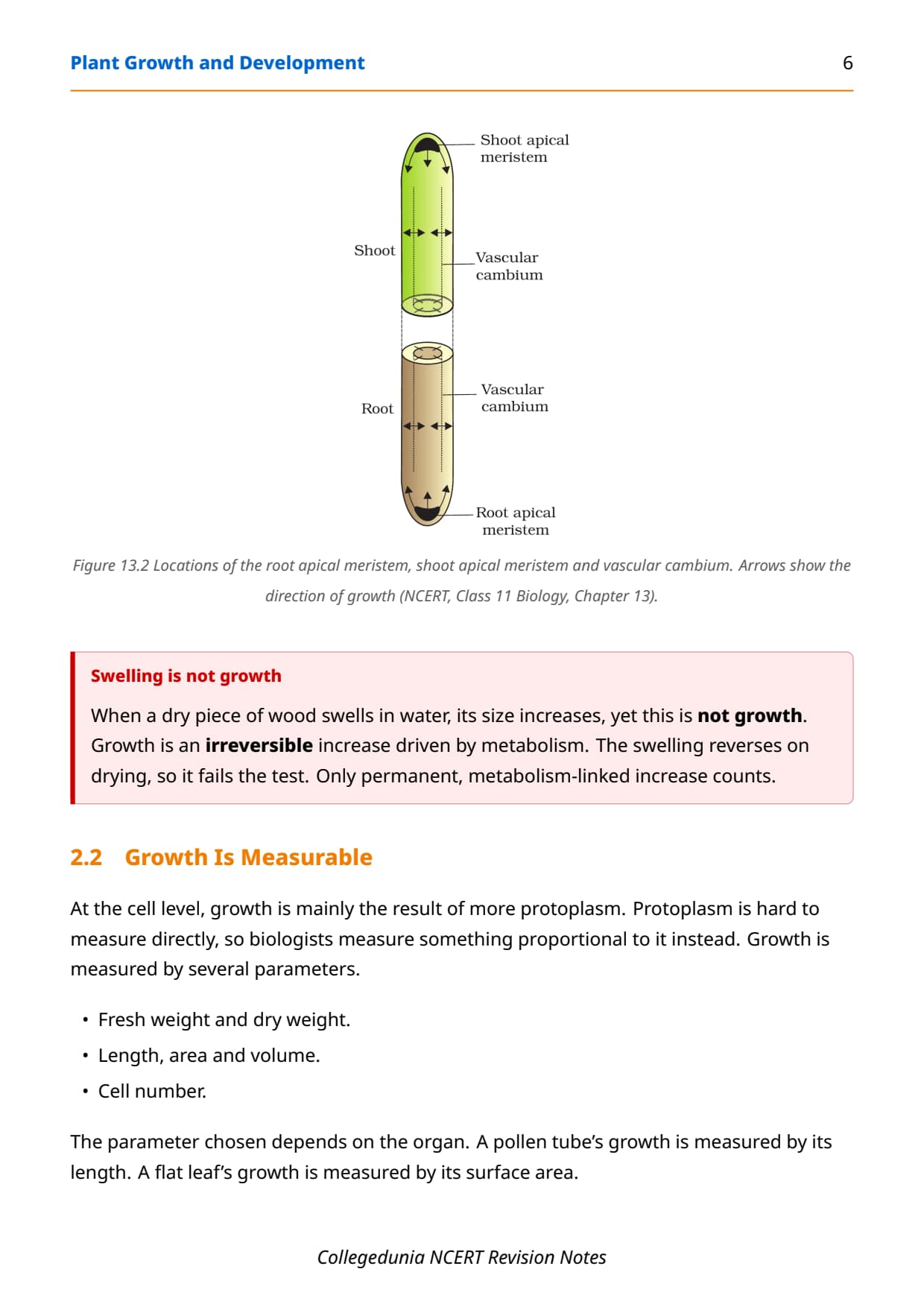
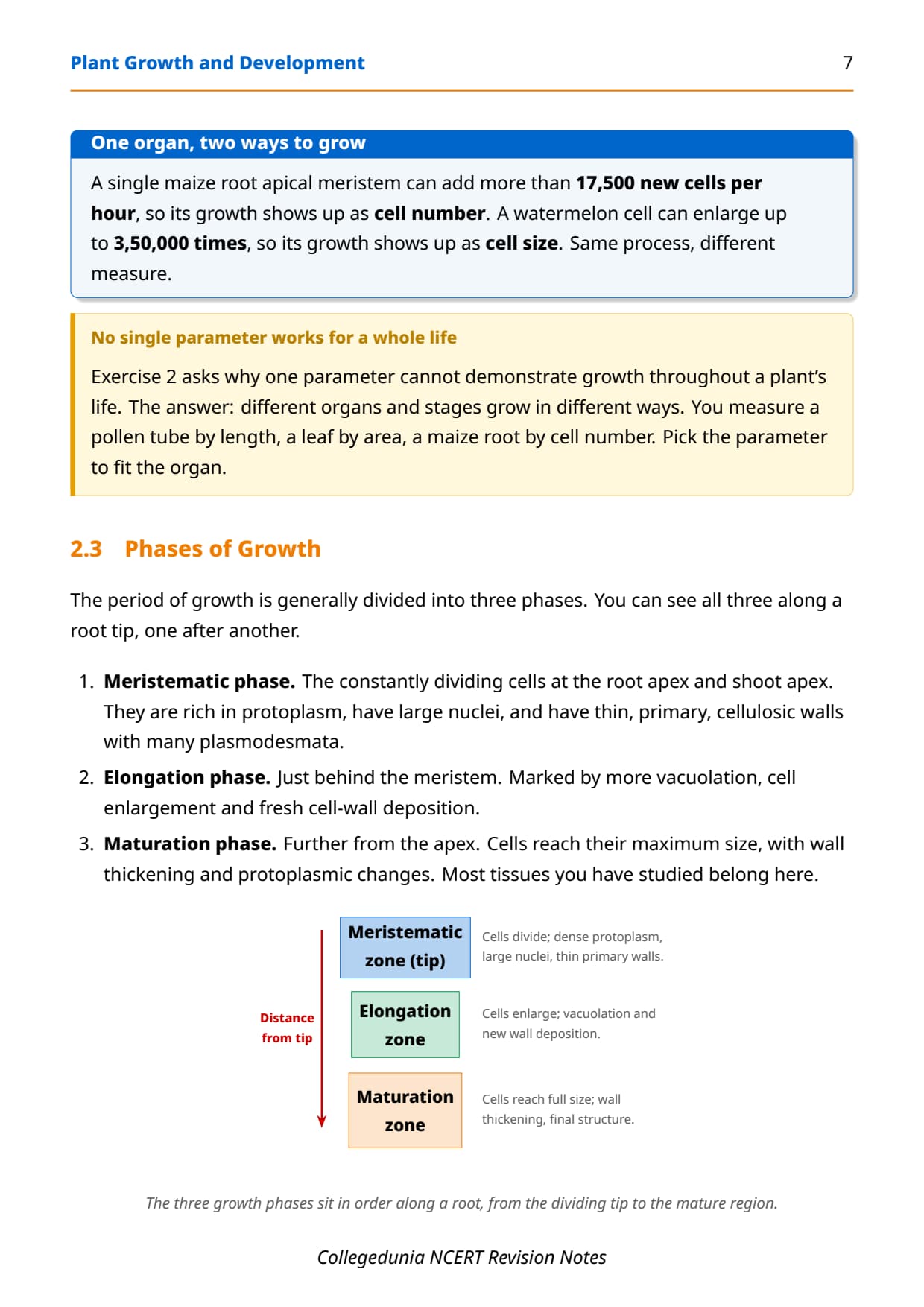
- Three phases: the meristematic phase of dividing cells, the elongation phase of vacuolation and enlargement, and the maturation phase where cells reach full size.
The scale of growth is striking: a single maize root apical meristem can add more than 17,500 new cells per hour, while a watermelon cell can enlarge up to 3,50,000 times. This is why no single parameter can demonstrate growth throughout a plant's life, since a pollen tube is measured by length, a leaf by area, and a maize root by cell number. Remember that swelling of dry wood in water is not growth, because it is reversible and not driven by metabolism. Only permanent, metabolism-linked increase counts as true growth.
Growth Rates: Arithmetic, Geometric and Relative
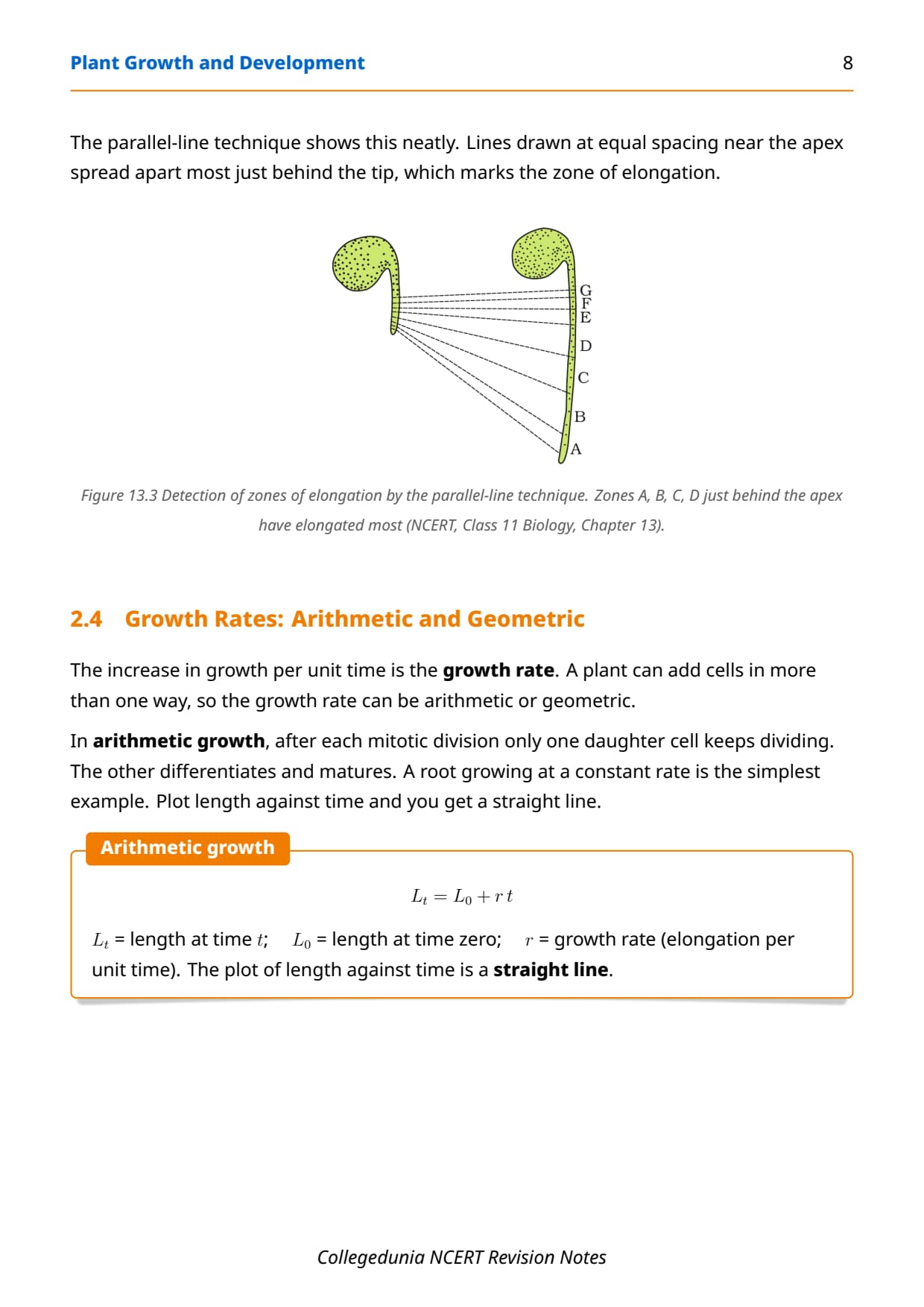
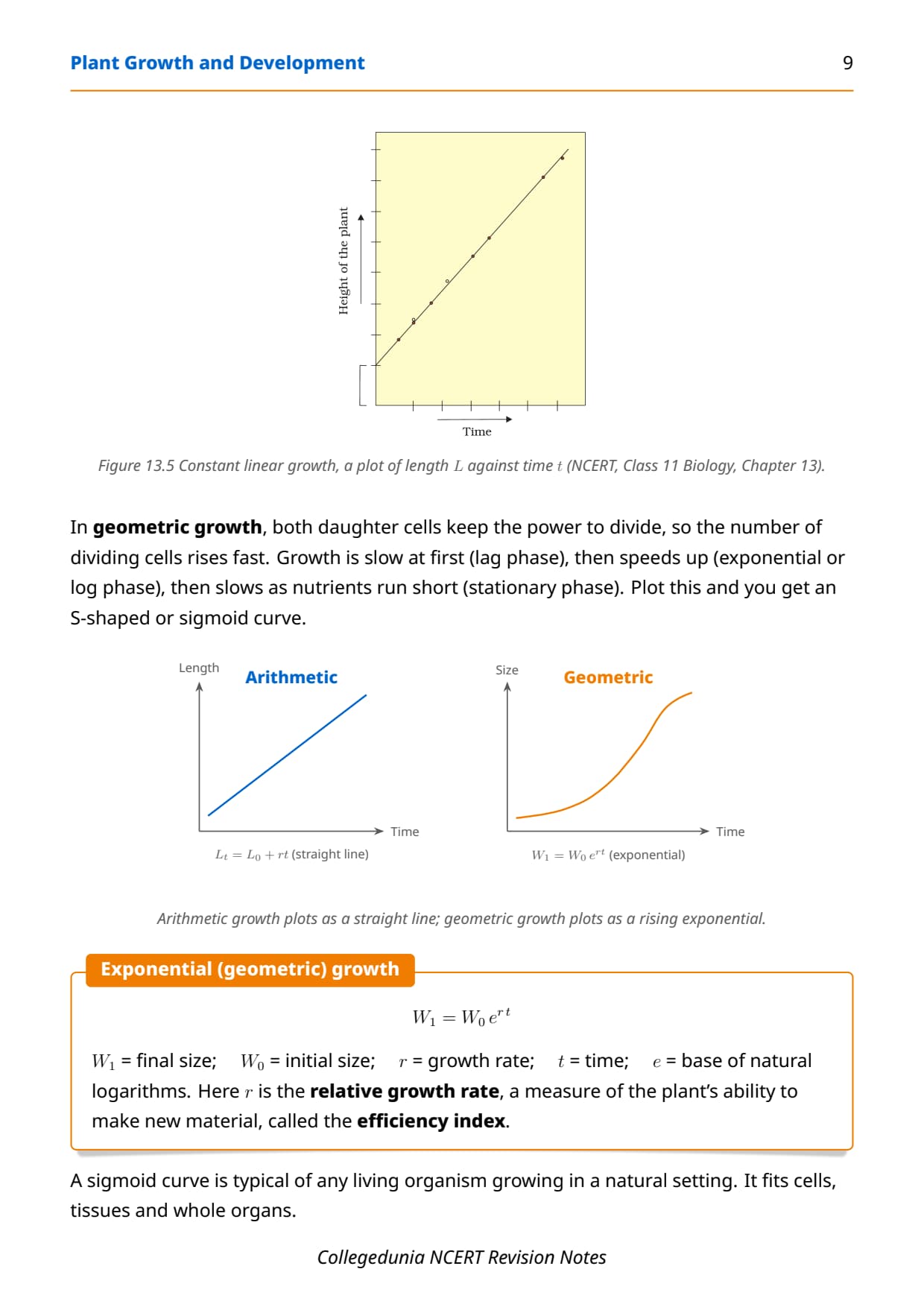
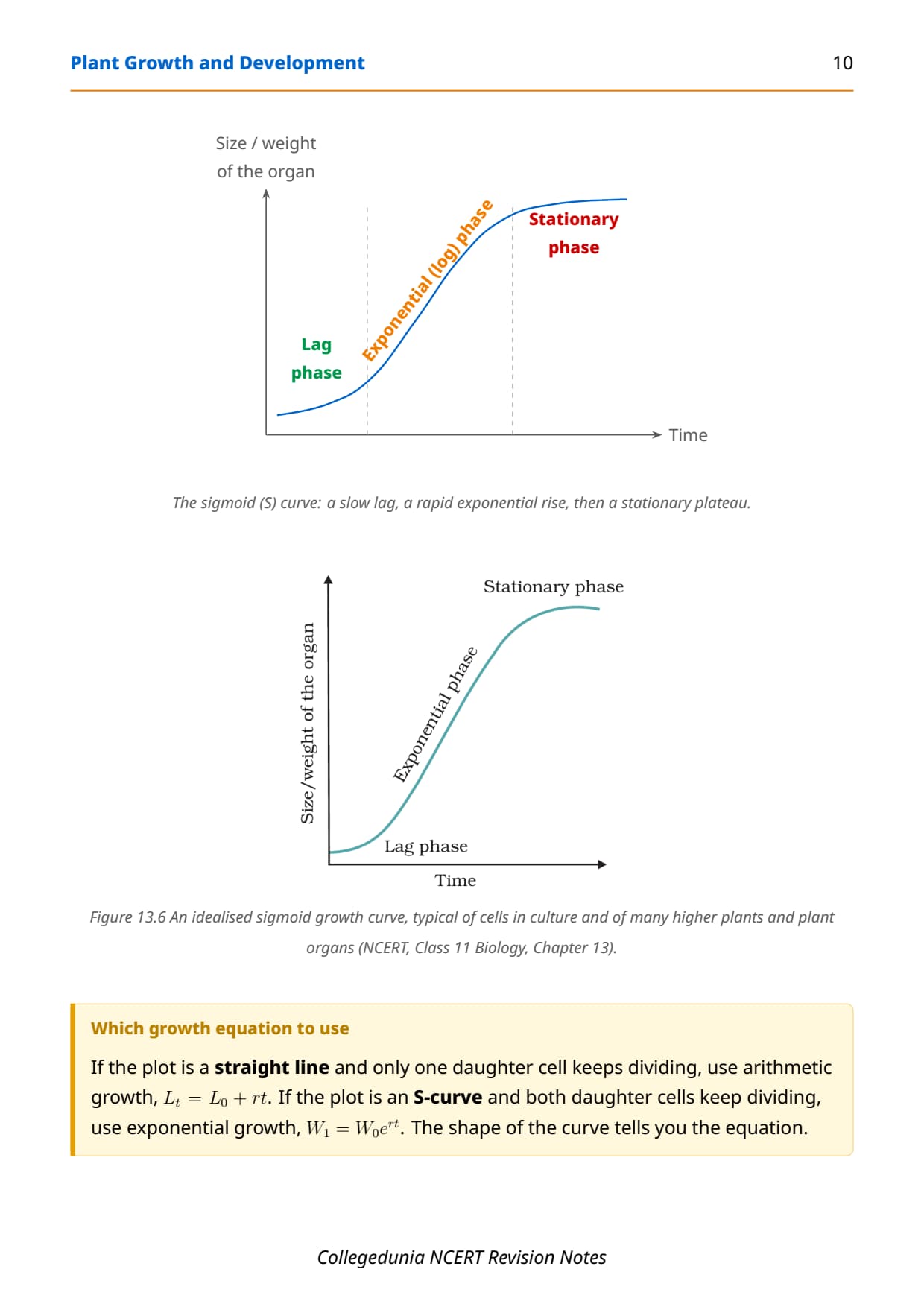
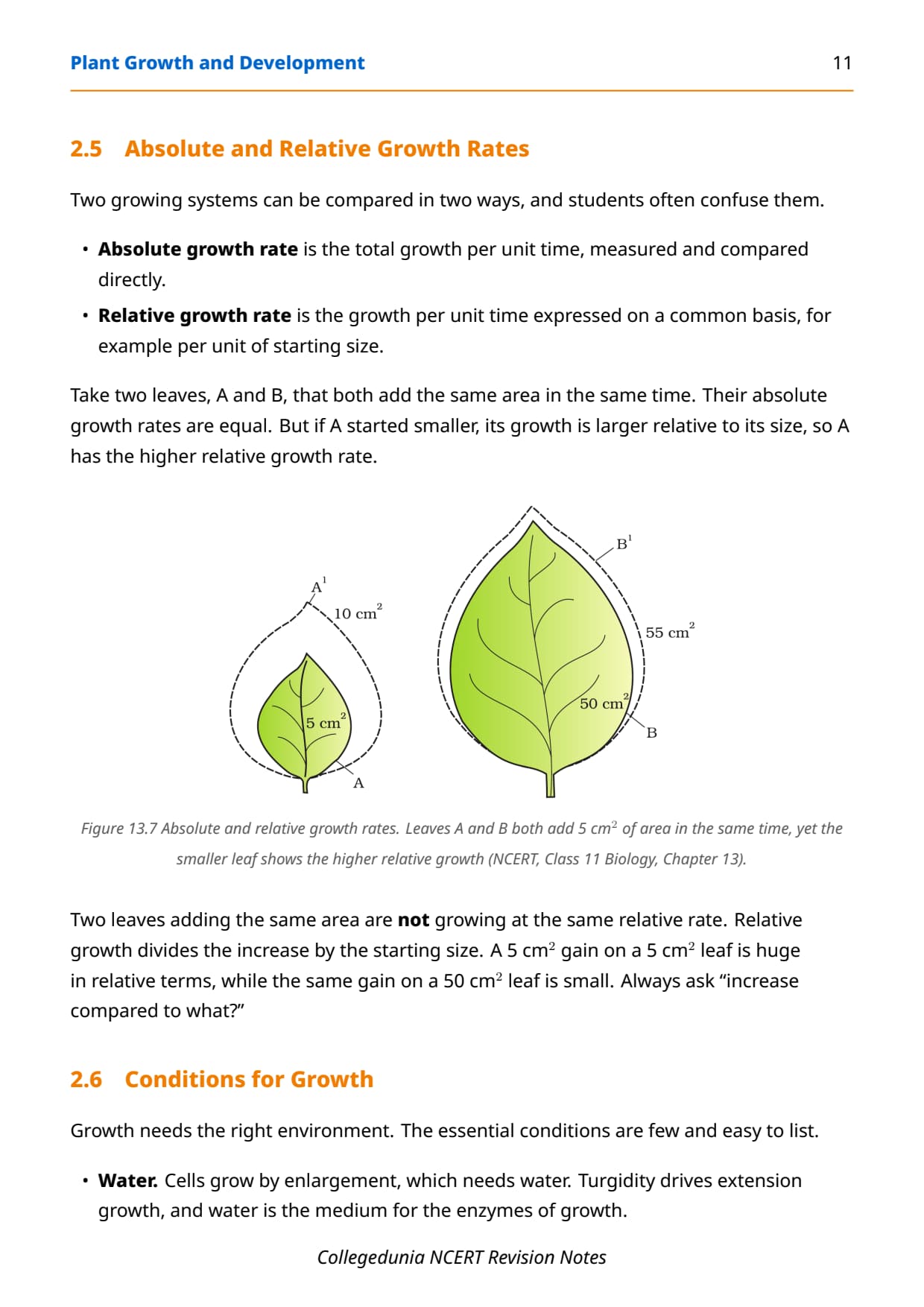
The increase in growth per unit time is the growth rate, and a plant can add cells in more than one way, so the rate can be arithmetic or geometric. In arithmetic growth, only one daughter cell keeps dividing after each mitosis while the other matures, so a plot of length against time is a straight line. In geometric growth, both daughter cells keep dividing, so growth is slow at first, then speeds up, then slows as nutrients run short, giving the classic S-shaped or sigmoid curve.
- Arithmetic growth: Lt = L0 + rt, where Lt is length at time t, L0 the starting length, and r the growth rate. The plot is a straight line.
- Geometric growth: W1 = W0ert, where W1 is final size, W0 initial size, r the growth rate, t the time, and e the base of natural logarithms.
- The sigmoid curve: three phases, a slow lag phase, a rapid exponential or log phase, and a stationary phase, typical of any organism growing in nature.
- Efficiency index: the relative growth rate r measures the plant's ability to make new material.
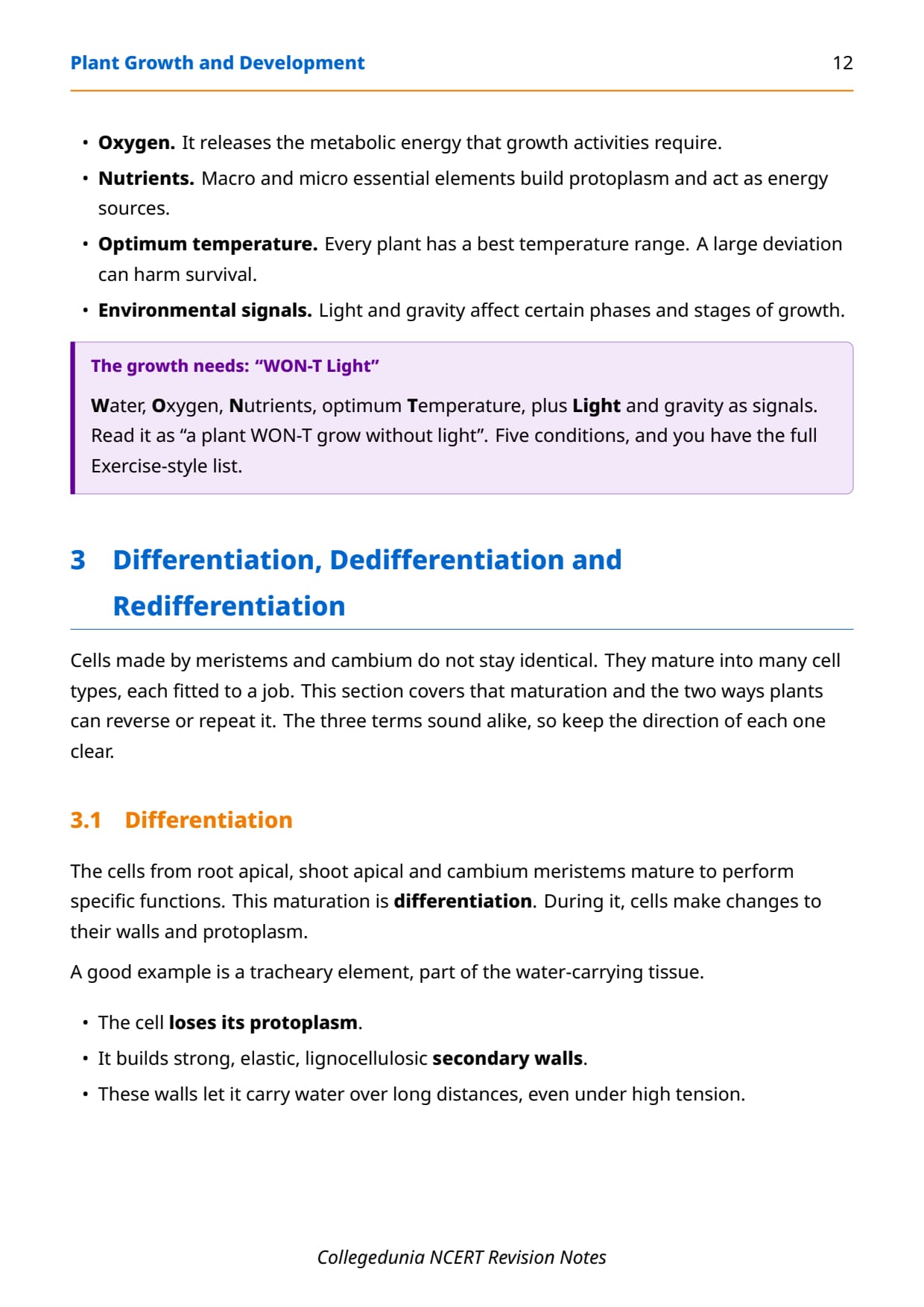
Two growing systems can be compared by absolute or relative growth rate, and students often confuse them. Absolute growth rate is total growth per unit time; relative growth rate divides that increase by the starting size. Take two leaves that both add 5 cm2 in the same time: their absolute rates are equal, but if one started smaller, its growth is larger relative to its size, so it has the higher relative growth rate. Growth also needs the right conditions, that is water, oxygen, nutrients, an optimum temperature, and environmental signals such as light and gravity.
Differentiation, Dedifferentiation and Redifferentiation
Cells made by meristems and cambium do not stay identical; they mature into many cell types, each fitted to a job. This maturation is differentiation, during which cells change their walls and protoplasm. A tracheary element, for example, loses its protoplasm and builds strong, elastic, lignocellulosic secondary walls that let it carry water under high tension. The three related terms sound alike, so keep the direction of each one clear as you revise.
- Differentiation: cells from root apical, shoot apical and cambium meristems mature to perform specific functions.
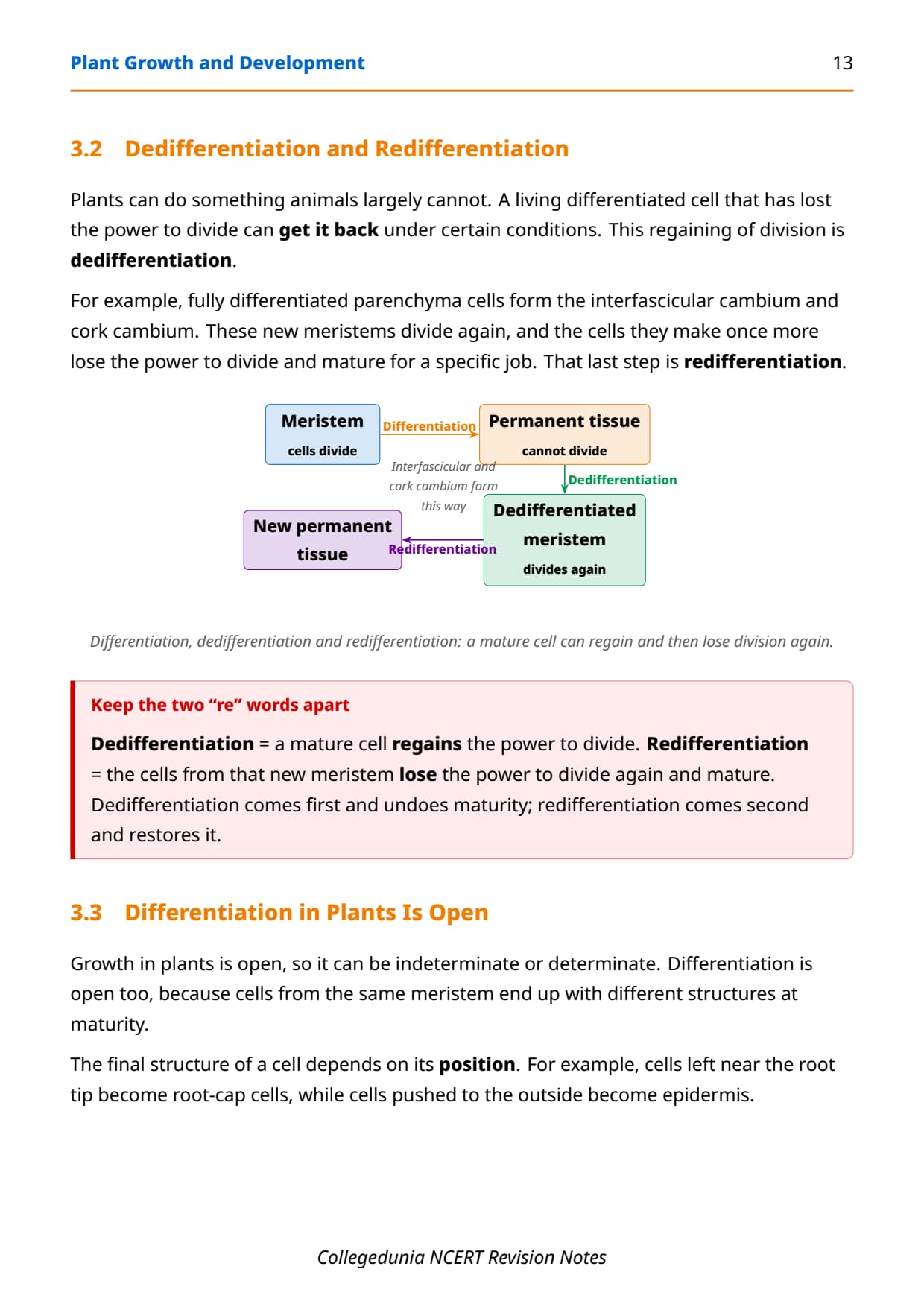
- Dedifferentiation: a living differentiated cell that has lost the power to divide regains it, as when parenchyma forms interfascicular cambium and cork cambium.
- Redifferentiation: the cells from that new meristem again lose the power to divide and mature for a specific job.
- Open differentiation: the same meristem's cells mature into different structures depending on their position, so a cell near the root tip becomes root cap while one pushed outside becomes epidermis.
Plants can do something animals largely cannot, that is reverse the loss of division and then repeat maturation. Dedifferentiation comes first and undoes maturity; redifferentiation comes second and restores it. Because differentiation is open, development in plants stays flexible. When asked for tissues in a woody dicot that come from redifferentiation, name the secondary tissues cut by the cork cambium and interfascicular cambium, such as secondary cork and secondary vascular tissue.
Development and Plasticity
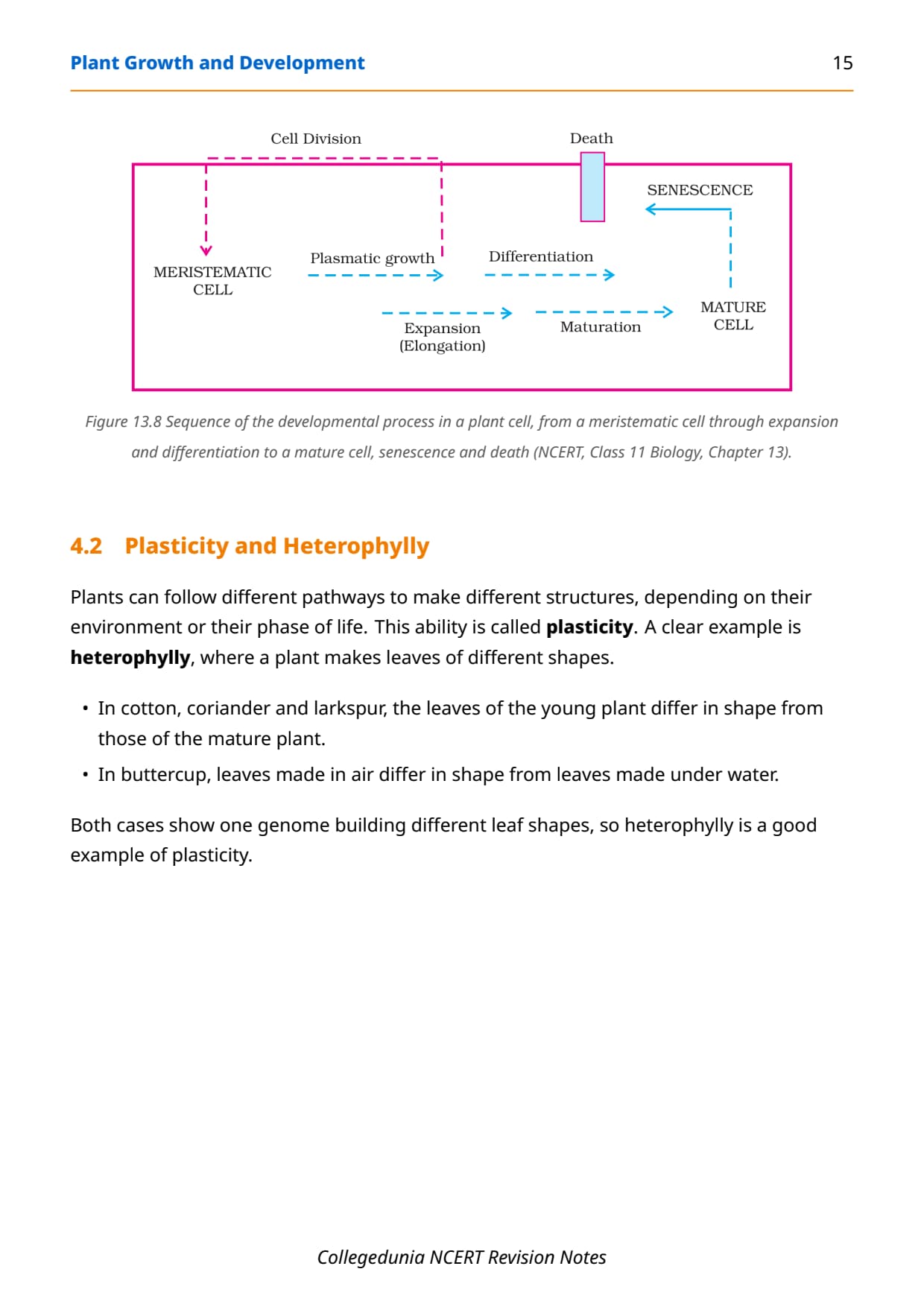
Development ties growth and differentiation together across the whole life of a plant, running from seed germination to old age. The same sequence applies to a single cell, to tissues and to organs: a meristematic cell divides, undergoes plasmatic growth and expansion, differentiates and matures, and in time ages and dies. Alongside this fixed sequence, plants show a striking flexibility in the structures they build, which is where plasticity comes in.
- Developmental sequence: division, then expansion, then differentiation and maturation, then senescence and death.
- Plasticity: the ability to follow different pathways and make different structures in response to environment or phase of life.
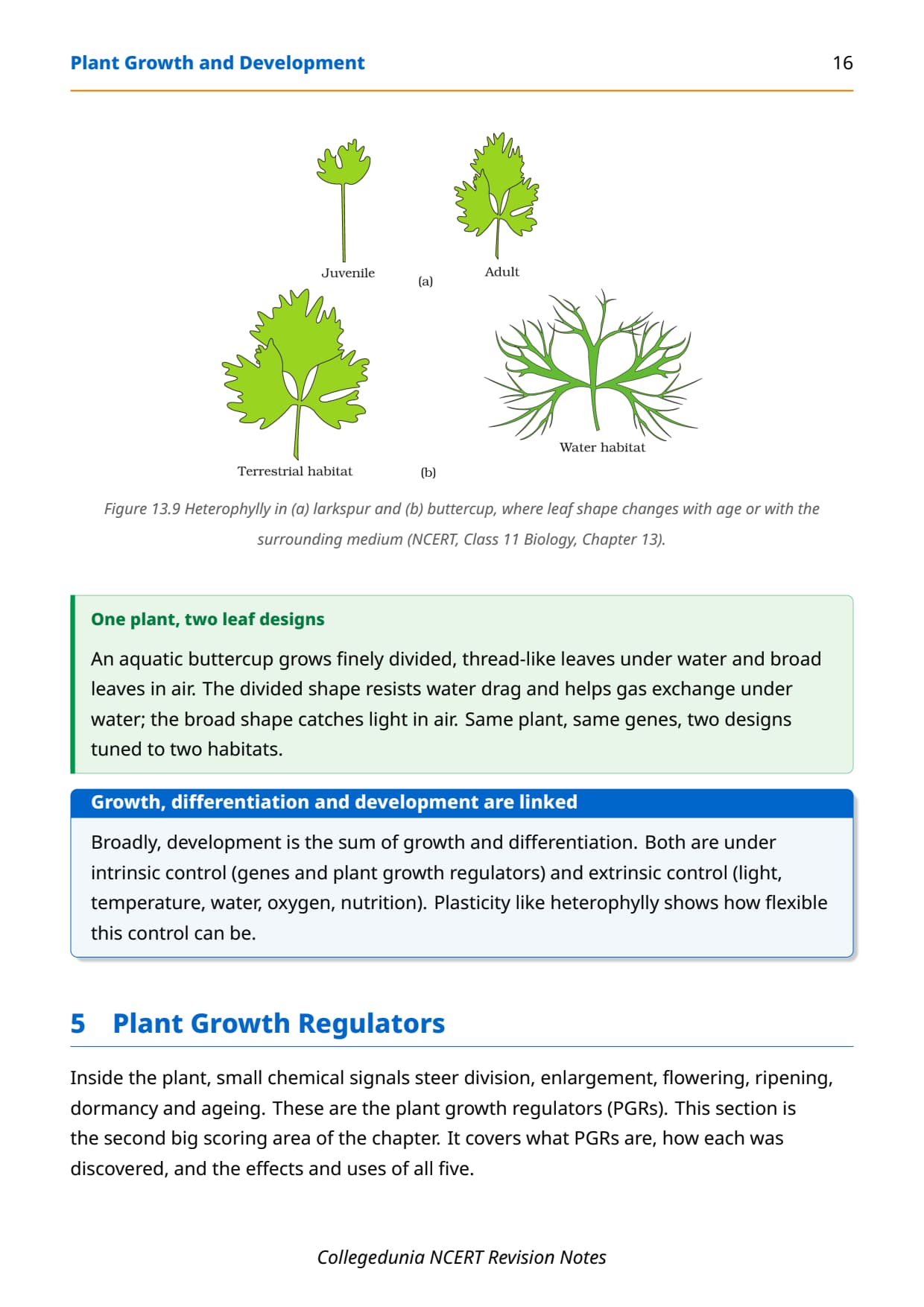
- Heterophylly by age: in cotton, coriander and larkspur, the leaves of the young plant differ in shape from those of the mature plant.
- Heterophylly by medium: in buttercup, leaves formed in air differ in shape from the thread-like leaves formed under water.
Heterophylly is the classic example of plasticity, because one genome builds different leaf shapes. An aquatic buttercup grows finely divided, thread-like leaves under water, which resist water drag and aid gas exchange, and broad leaves in air, which catch light. Same plant, same genes, two designs tuned to two habitats. Both growth and differentiation being open is exactly why development can be this flexible, and all of it is under intrinsic control by genes and PGRs and extrinsic control by light, temperature, water, oxygen and nutrition.
Plant Growth Regulators: The Five Hormones
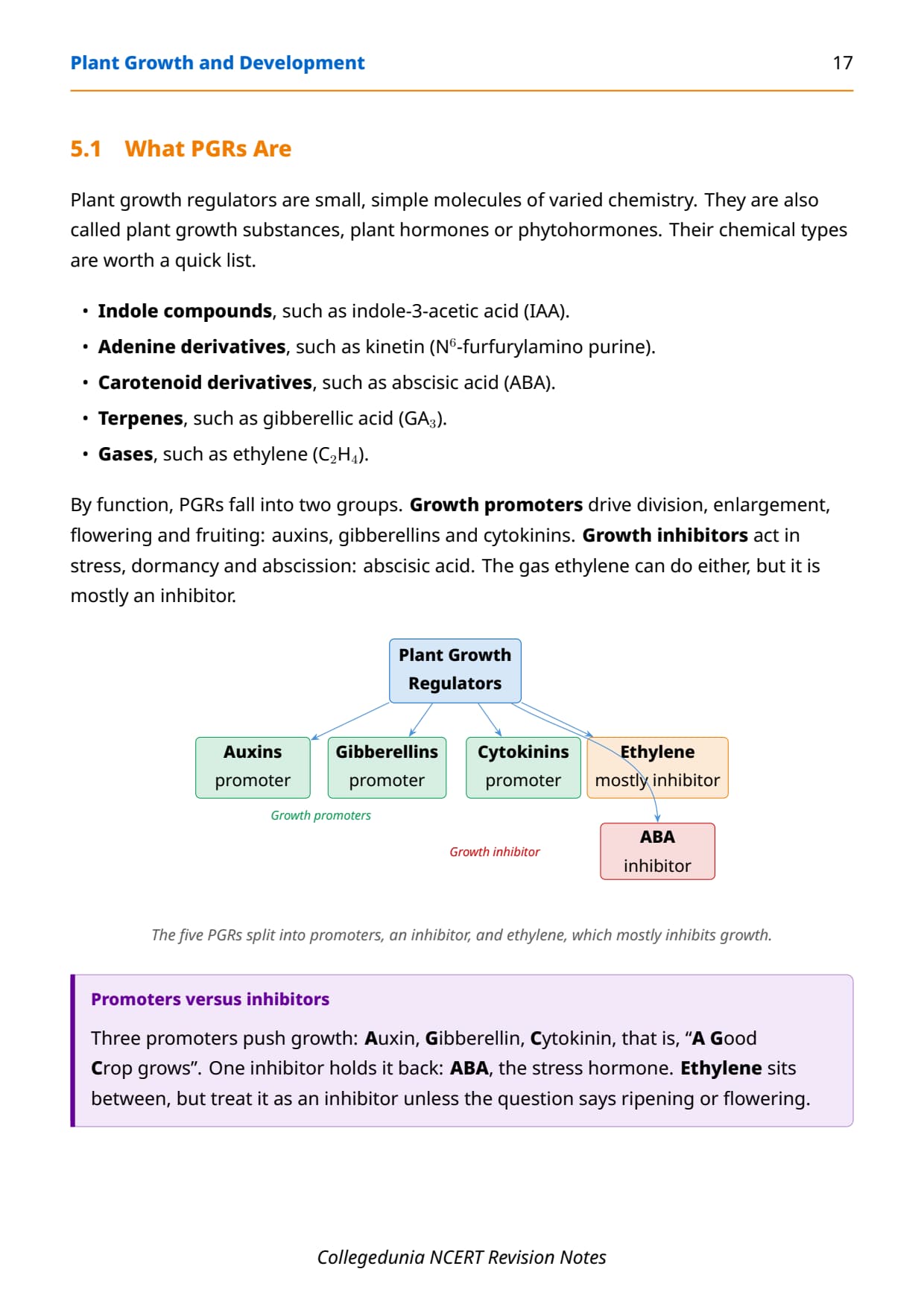
Inside the plant, small chemical signals steer division, enlargement, flowering, ripening, dormancy and ageing. These are the plant growth regulators (PGRs), also called plant hormones or phytohormones, and they are the second big scoring area of the chapter. By function they fall into two groups: growth promoters (auxins, gibberellins and cytokinins) that drive division, enlargement, flowering and fruiting, and growth inhibitors (abscisic acid) that act in stress, dormancy and abscission. Ethylene can do either, but it is mostly an inhibitor.
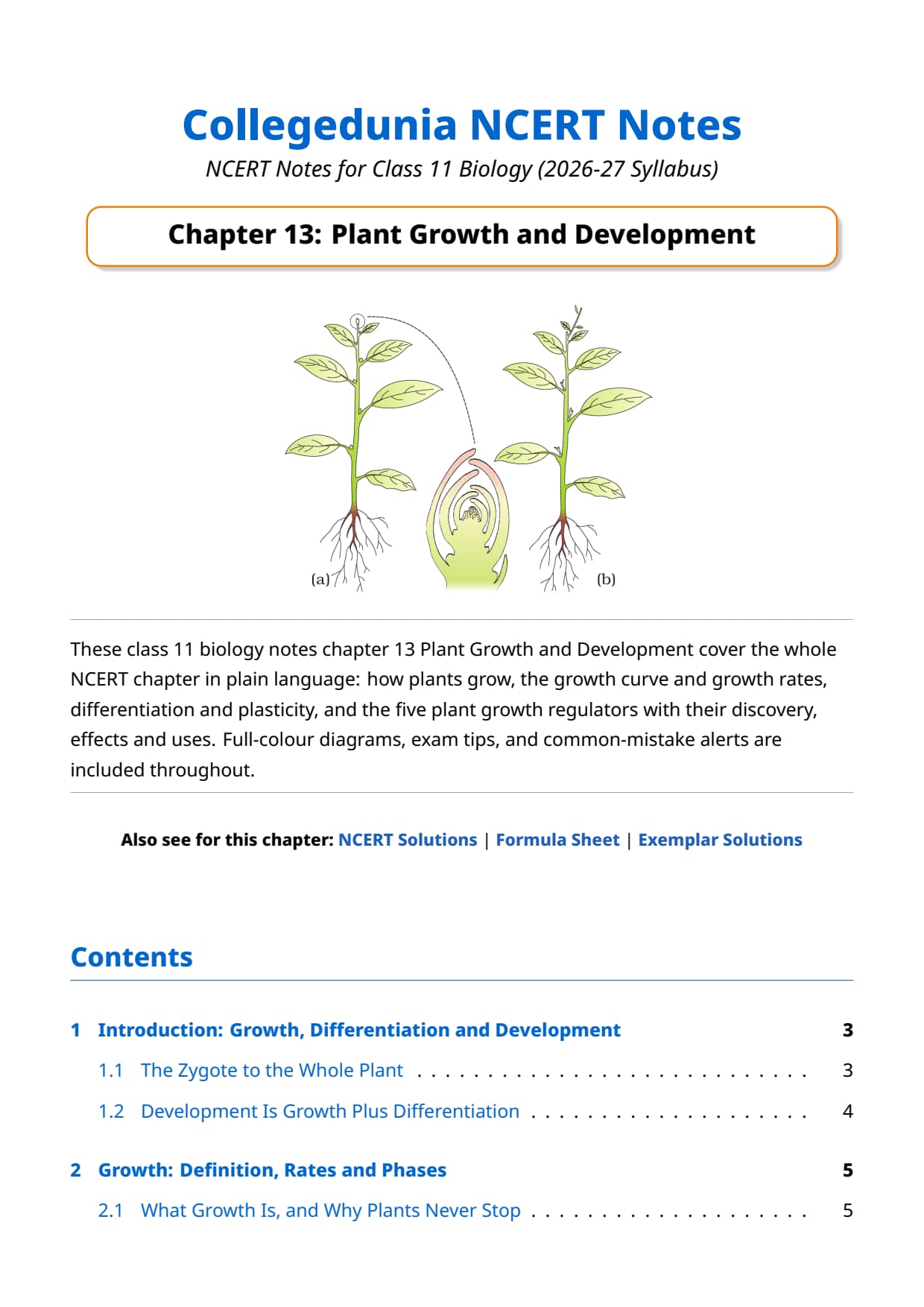
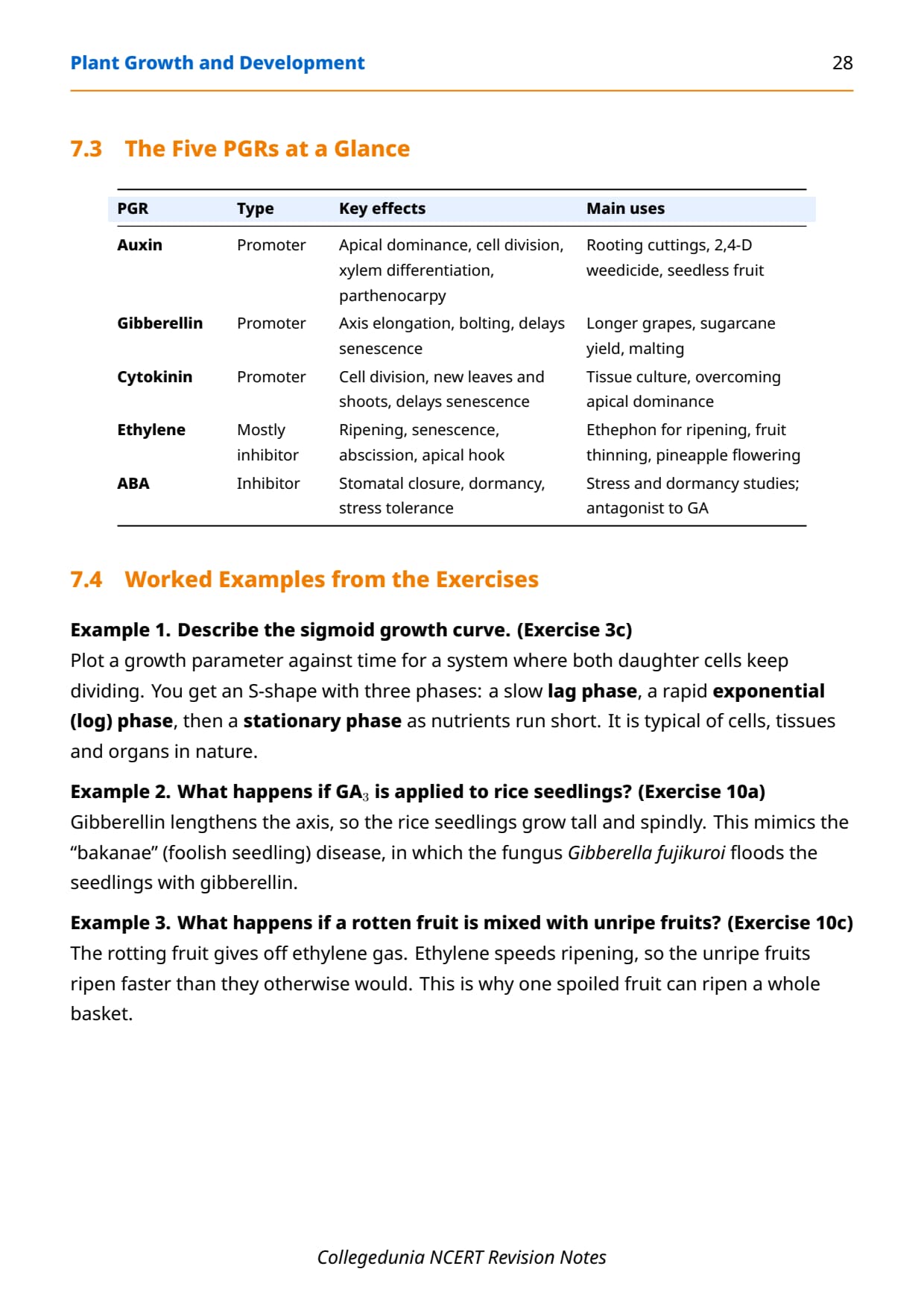
- Auxin: causes apical dominance, promotes rooting in cuttings and parthenocarpy, and controls xylem differentiation. Synthetic 2,4-D is used as a weedicide against broad-leaved dicots.
- Gibberellin: lengthens the axis, causes bolting, delays senescence, speeds malting, and can raise sugarcane yield by up to 20 tonnes per acre.
- Cytokinin: promotes cell division, new leaves and shoots, helps overcome apical dominance, and delays leaf senescence. The natural plant form is zeatin, not kinetin.
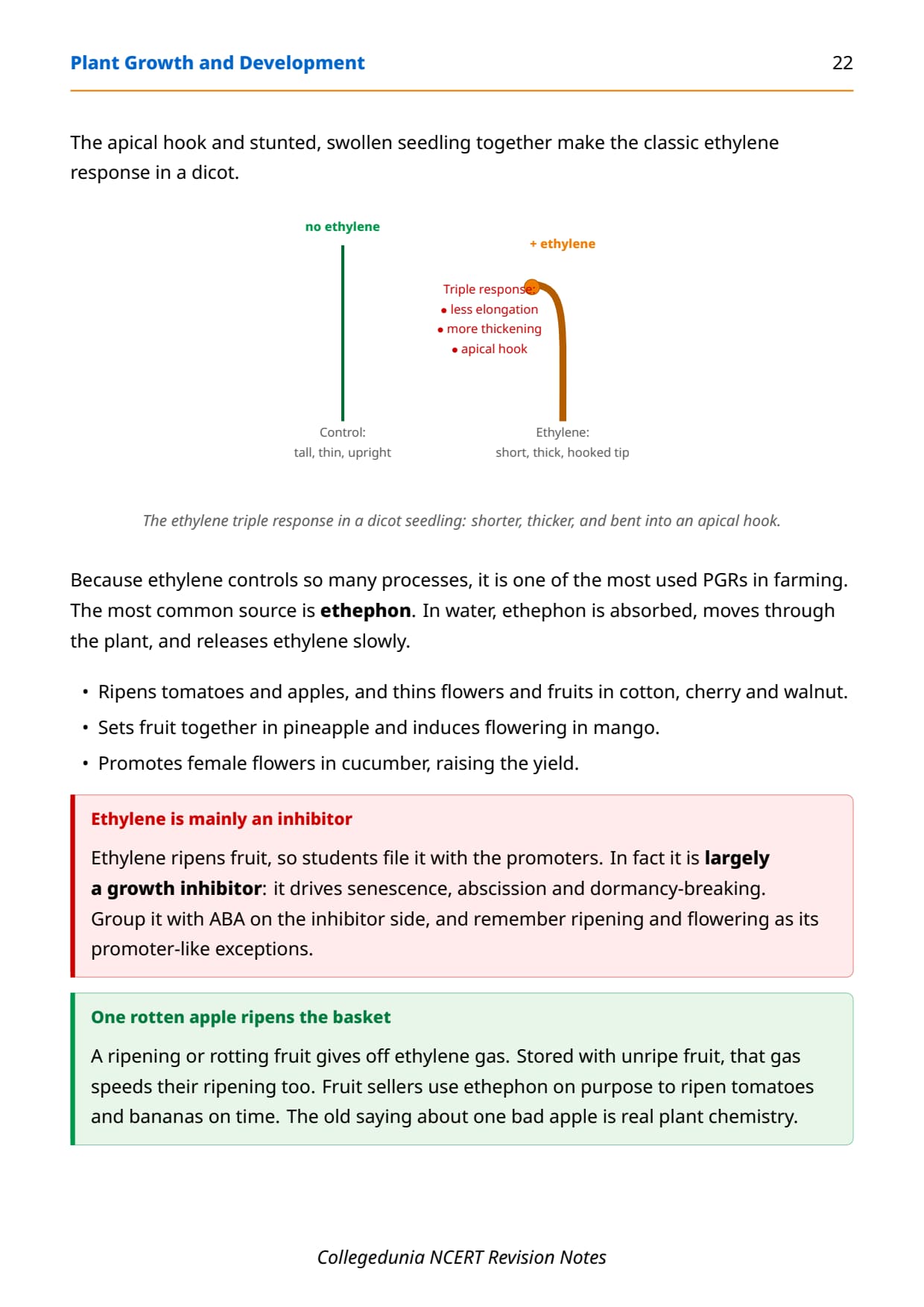
- Ethylene: a gas that speeds fruit ripening, drives senescence and abscission, and gives the apical hook; ethephon is its common commercial source.
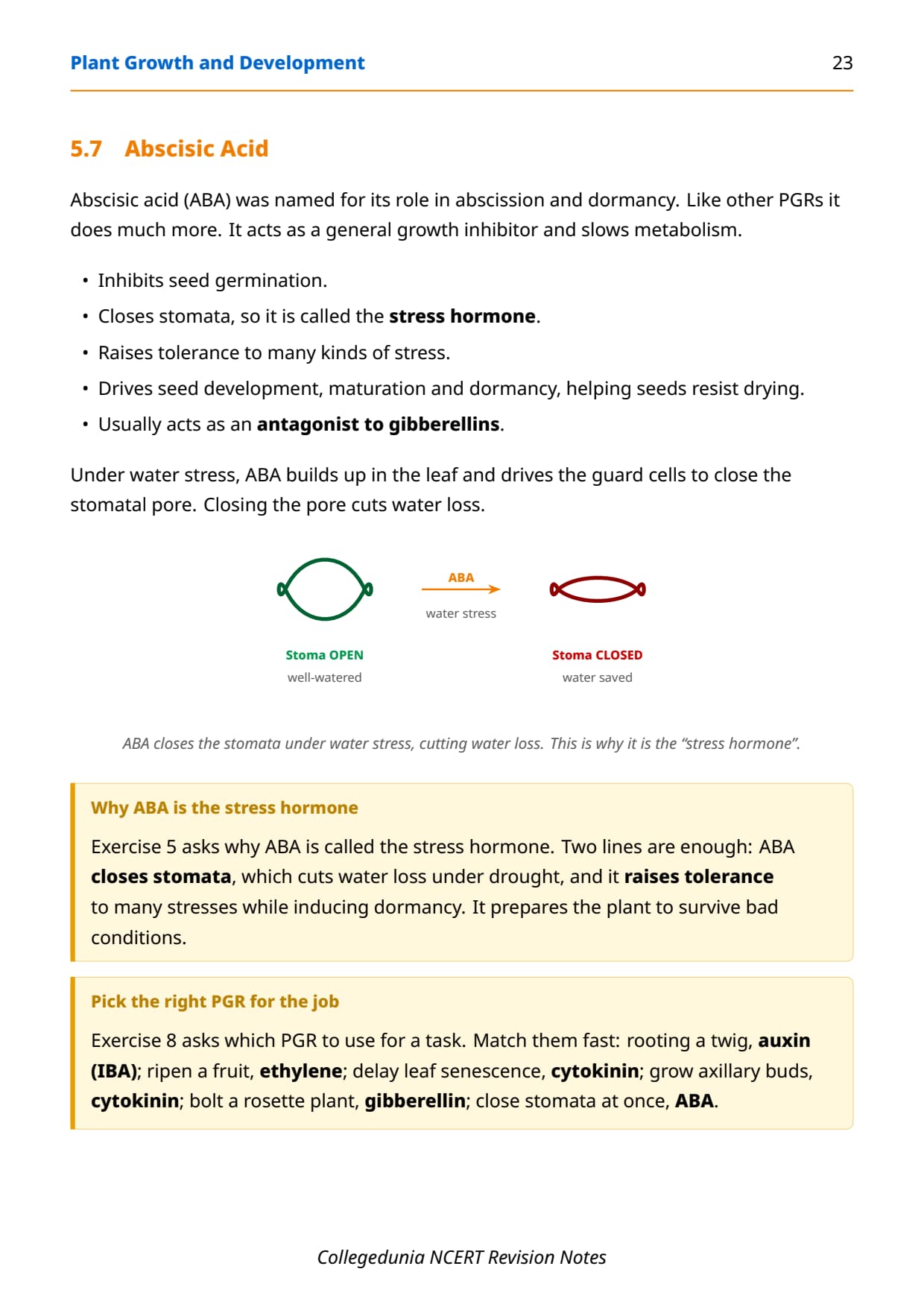
- Abscisic acid (ABA): closes stomata and so is the stress hormone, promotes dormancy, raises stress tolerance, and acts as an antagonist to gibberellins.
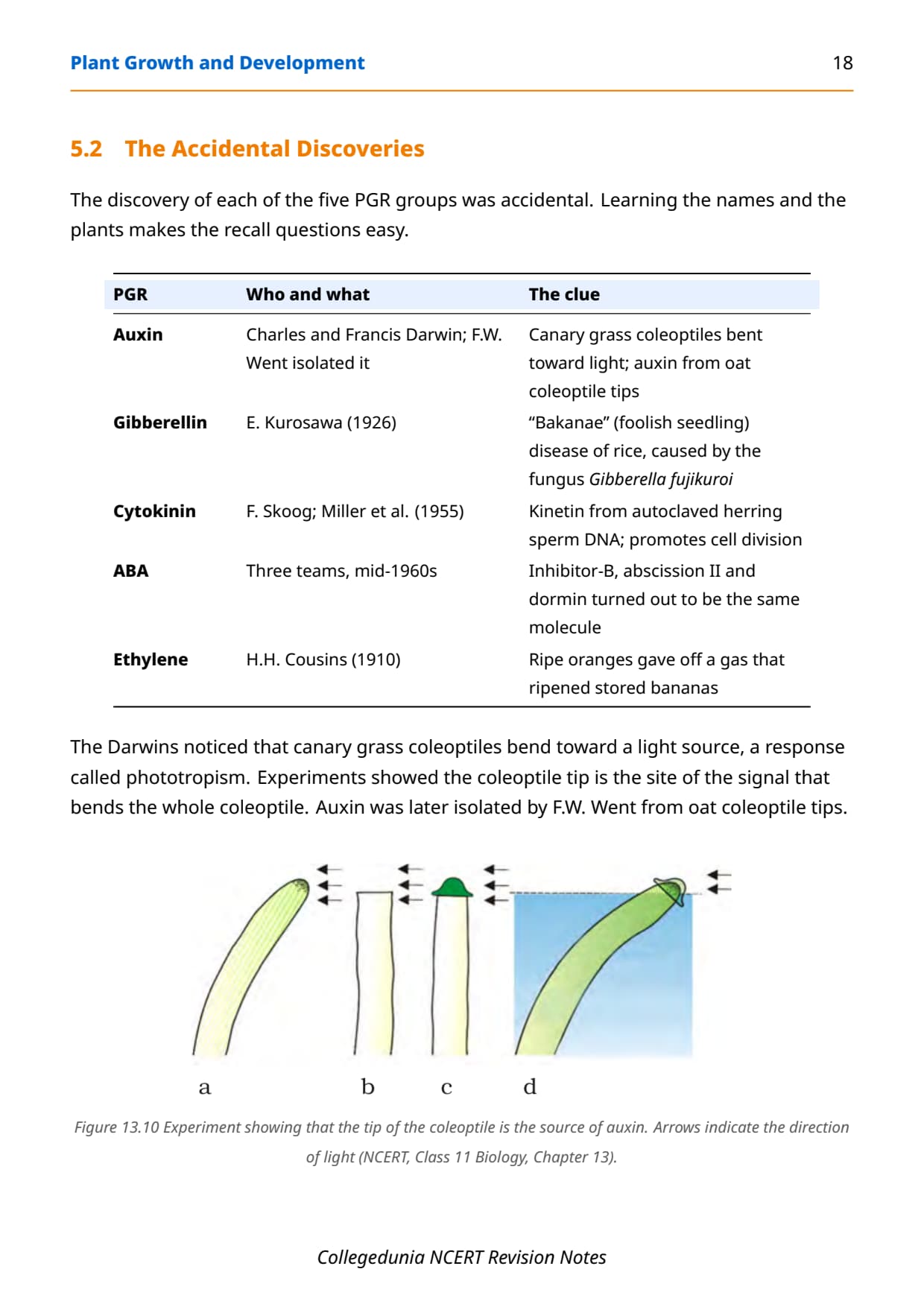
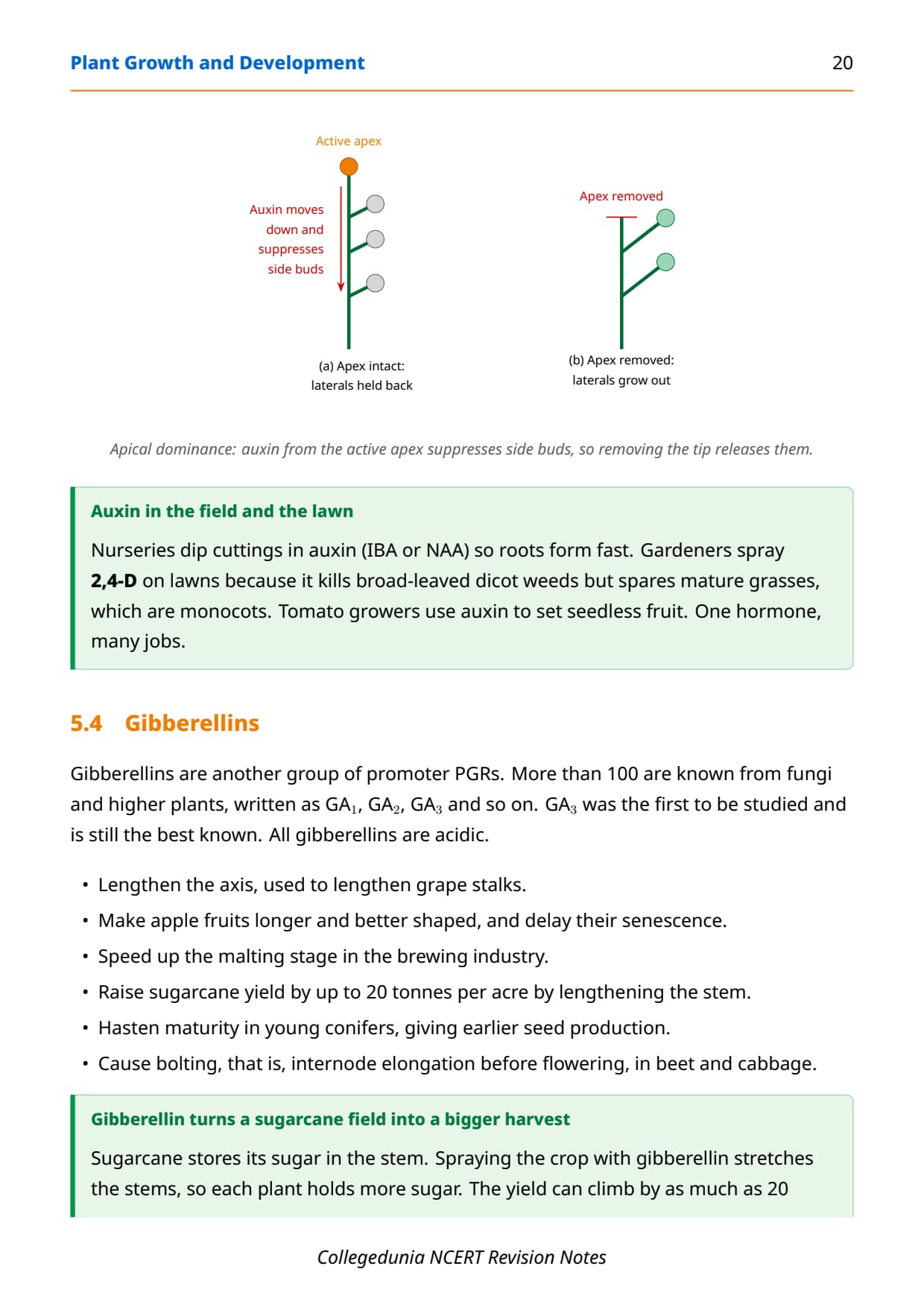
The discovery of each PGR was accidental, and learning the names makes recall questions easy. The Darwins and F.W. Went found auxin, E. Kurosawa found gibberellin from the bakanae disease fungus, Skoog and Miller found cytokinin in autoclaved herring sperm DNA, and H.H. Cousins traced ethylene to ripening oranges. Auxin drives apical dominance, where the growing apical bud holds back the lateral buds, so decapitating the shoot tip lets the laterals grow, a trick tea planters and hedge-makers use for bushy growth. Ethylene ripens fruit, so students file it with the promoters, but it is largely an inhibitor and should be grouped with ABA. To pick the right PGR for a task, match rooting a twig to auxin, ripening a fruit to ethylene, delaying leaf senescence to cytokinin, bolting a rosette plant to gibberellin, and closing stomata to ABA.
Flowering: Photoperiodism and Vernalisation (NEET Extension)
Some plants flower only when the day and night reach the right length, and others only after a spell of cold. The rationalised 2026-27 NCERT reprint drops the detailed photoperiodism and vernalisation prose, so this section is not required for CBSE board answers, but it stays in the NEET and CUET syllabus and still answers two exercise questions, so revise it as a clearly marked extension. Light and temperature reach the flowering switch mostly through PGRs, which is why these responses belong with this chapter.
- Photoperiodism: the response of flowering to the length of day and night, sensed by the leaves.
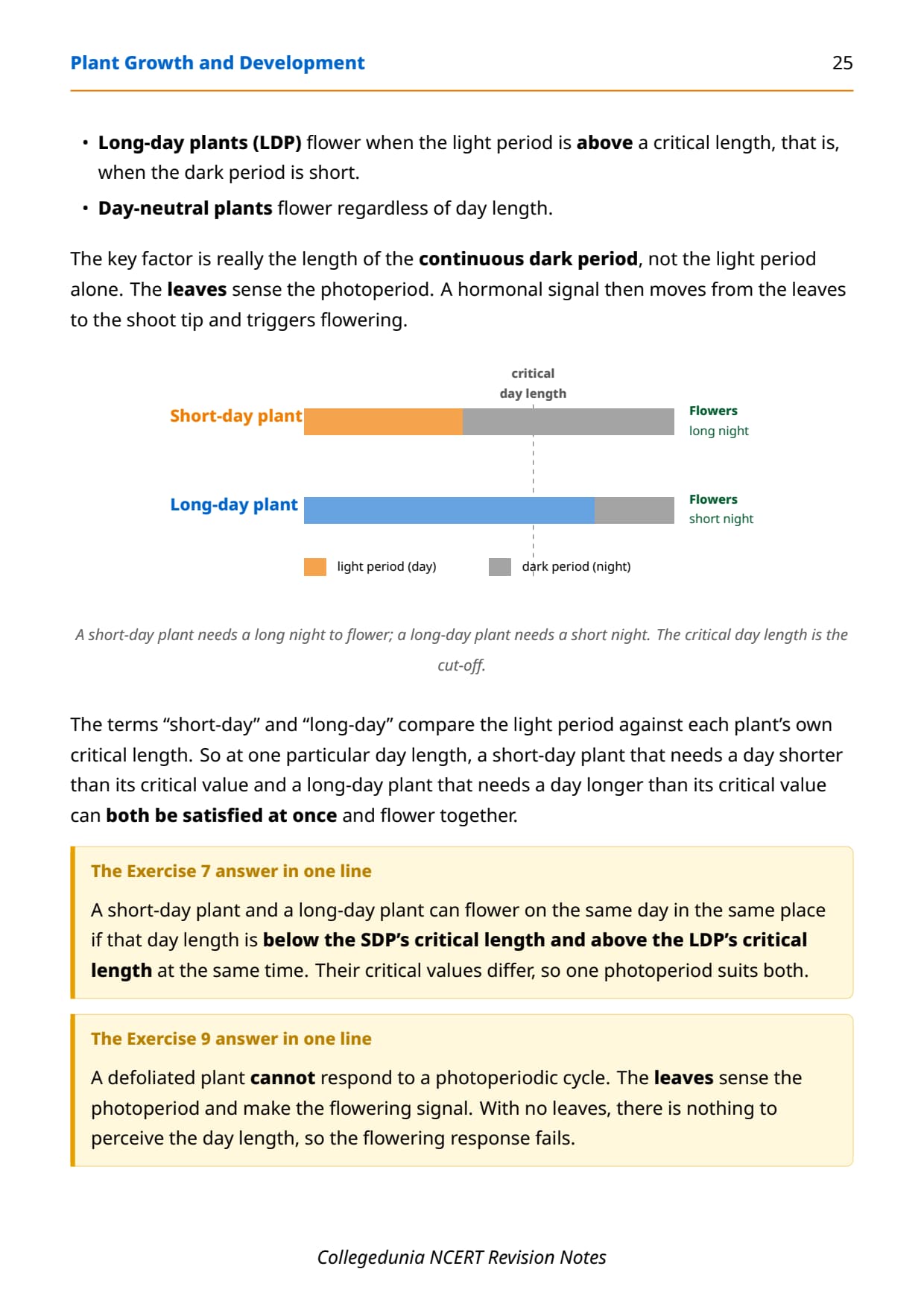
- Short-day plants: flower when the light period is below a critical length, that is, when the continuous dark period is long enough.
- Long-day plants: flower when the light period is above a critical length, when the night is short.
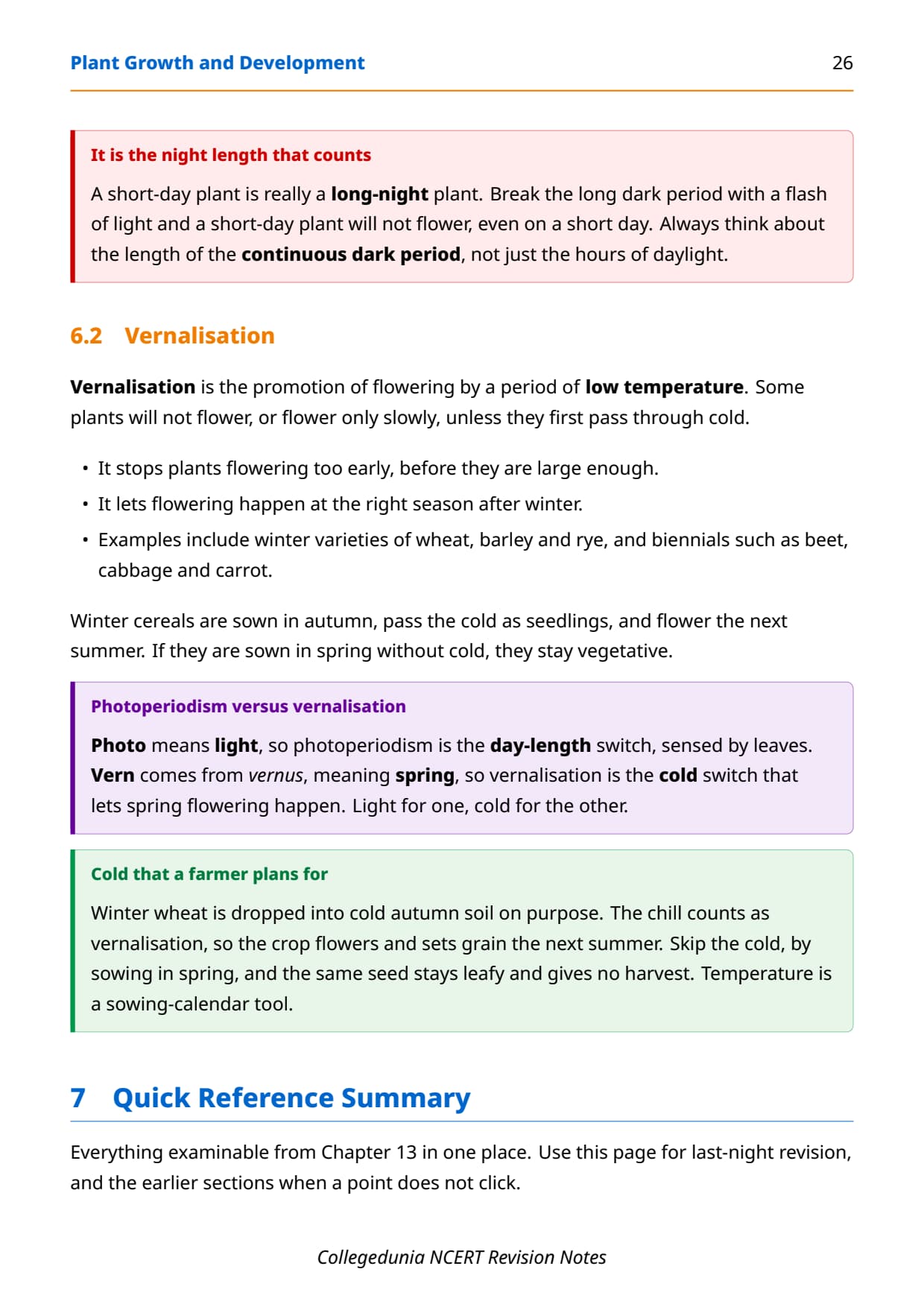
- Vernalisation: the promotion of flowering by a period of low temperature, as in winter wheat, barley and rye and biennials such as beet and cabbage.
The key factor in photoperiodism is really the length of the continuous dark period, not the light period alone, so a short-day plant is really a long-night plant. A short-day plant and a long-day plant can flower together on the same day if that day length is below the SDP's critical length and above the LDP's critical length at once. A defoliated plant cannot respond to a photoperiodic cycle, because the leaves that sense day length are gone. Vernalisation, from the Latin vernus for spring, is the cold switch that lets a plant flower at the right season, which is why winter cereals sown in autumn flower the next summer but stay vegetative if sown in spring without cold.
Key Definitions in Plant Growth and Development
Board short-answer questions often ask for a clean definition in one or two lines, and a vague answer loses easy marks. Learn these word-for-word, because the wording of the exam question is usually built straight from the NCERT definition. Each term below also connects to an example or figure you can be asked to explain.
| Term | Definition |
|---|---|
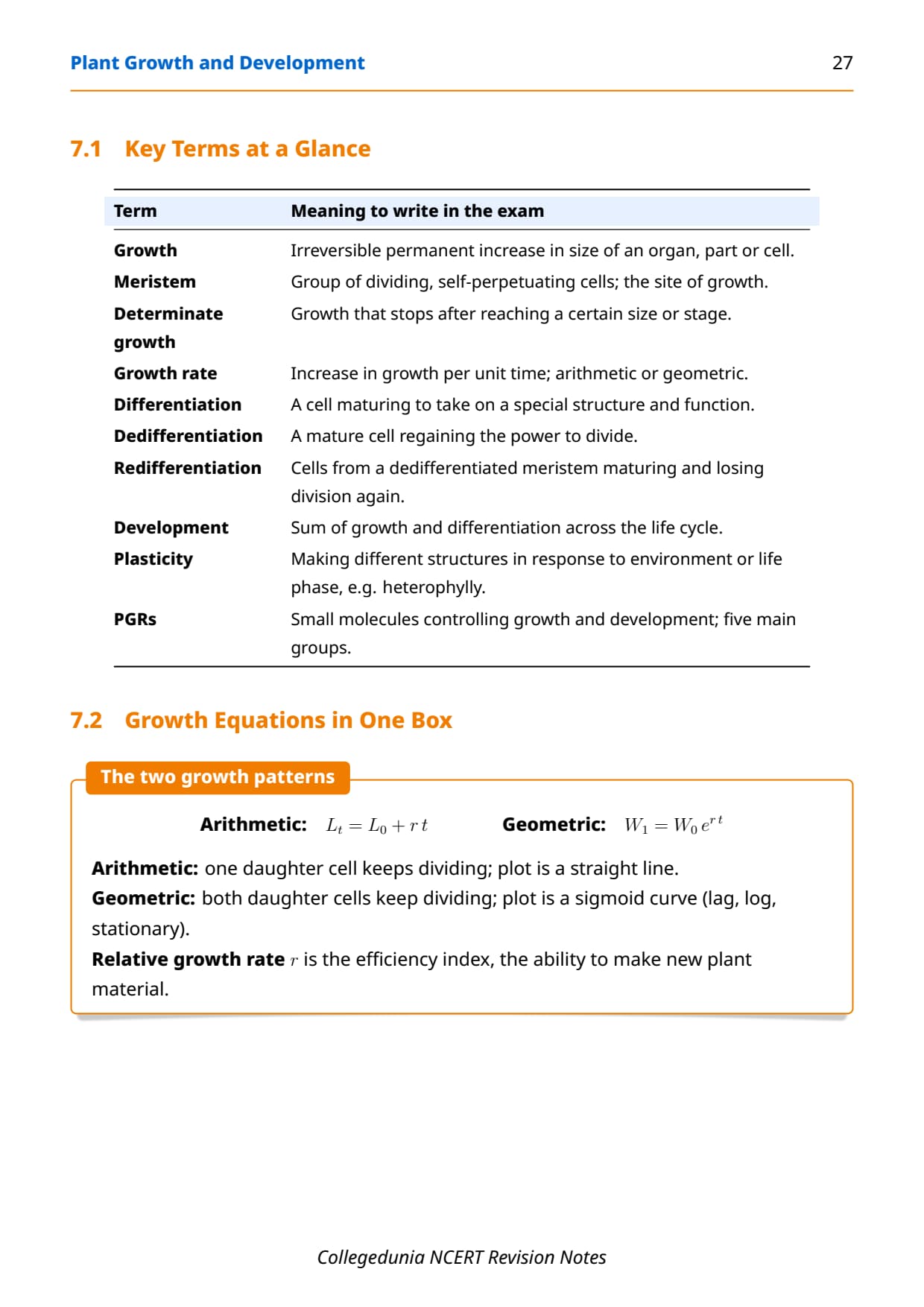
| Growth | An irreversible permanent increase in the size of an organ, part or cell, accompanied by metabolism. |
| Meristem | A group of dividing, self-perpetuating cells at fixed sites; the source of new cells and the seat of growth. |
| Growth rate | The increase in growth per unit time; can be arithmetic (straight line) or geometric (sigmoid). |
| Differentiation | A cell maturing to take on a special structure and function, such as a tracheary element. |
| Dedifferentiation | A mature cell that had lost the power to divide regaining that power. |
| Development | The sum of growth and differentiation, covering all changes across the life cycle. |
| Plasticity | Making different structures in response to environment or life phase, as in heterophylly. |
A common board question asks you to distinguish growth from development, or dedifferentiation from redifferentiation. State the exact definition first, then give the direction, that is, dedifferentiation regains division while redifferentiation loses it again. Learning these definitions makes the wording of almost every one-mark and two-mark question in this chapter familiar.
Common Mistakes Students Make in Plant Growth and Development
These slips happen because two terms look alike, not because the concept is hard. Each one costs 1 to 2 marks in the paper, so watch for them at the exact step where they occur.
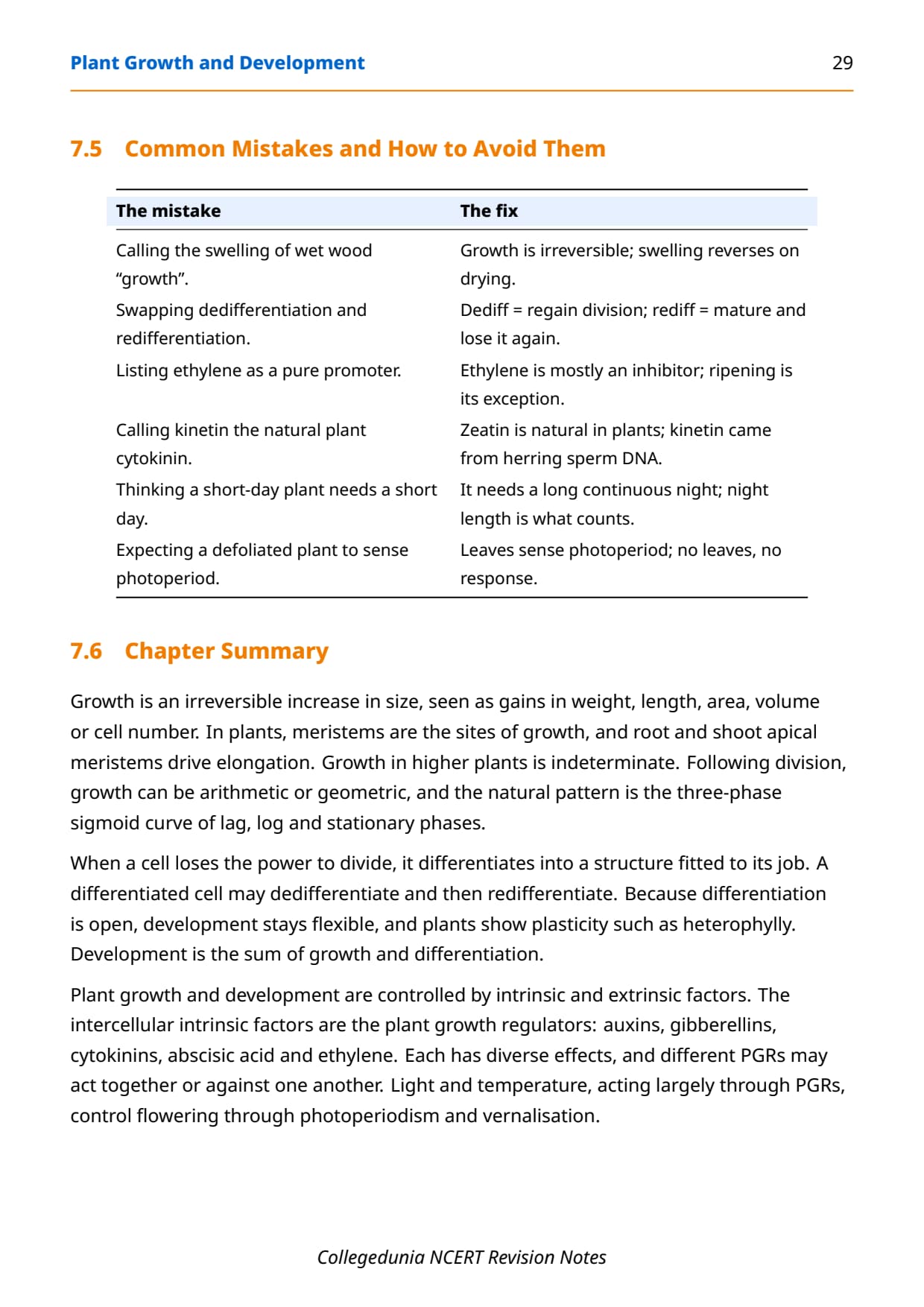
Mistake 1: Calling the swelling of wet wood "growth". Growth is an irreversible, metabolism-linked increase, and swelling reverses on drying, so it fails the test.
Mistake 2: Swapping dedifferentiation and redifferentiation. Dedifferentiation regains the power to divide; redifferentiation matures and loses it again.
Mistake 3: Listing ethylene as a pure promoter. Ethylene is mostly a growth inhibitor, and ripening and flowering are its promoter-like exceptions.
Mistake 4: Calling kinetin the natural plant cytokinin. Zeatin is the natural plant cytokinin; kinetin came from autoclaved herring sperm DNA and does not occur naturally in plants.
Mistake 5: Thinking a short-day plant needs a short day. It needs a long continuous night, so it is really a long-night plant.
Plant Growth and Development Weightage in CBSE Boards, NEET and CUET
This chapter is a reliable scorer, because its definitions, growth curves and hormone tables are fixed and easy to reproduce. It appears every year as a growth-curve question, a PGR match, or a reasoning question on plasticity. Here is how the marks split across the main exams for 2026-27.
| Exam | Typical weightage | What is asked |
|---|---|---|
| CBSE Boards | 5 to 6 marks | One long answer on the growth curve or the plant growth regulators plus a short answer on differentiation or plasticity |
| NEET | 2 to 3 questions | PGR effects and discoveries, growth curves and equations, and photoperiodism and vernalisation |
| CUET | 1 to 2 objective questions | Definitions, matching a PGR to its use, and the phases of the sigmoid growth curve |
The five plant growth regulators and the sigmoid growth curve are the single most tested ideas from this chapter across all three exams. Master the PGR table first, then the two growth equations and the sigmoid curve, then differentiation and plasticity, in that order of return on effort for the 2026-27 session.
How to Revise Plant Growth and Development Quickly
Use these plant growth and development class 11 notes for a fast, ordered recap the night before a test. The checklist below takes about 25 minutes and hits every marks-heavy idea in the chapter without opening the full textbook.
- First 8 minutes: write the three words growth, differentiation and development with one-line definitions, then draw the sigmoid curve and label its three phases.
- Next 8 minutes: write the arithmetic and geometric growth equations, and the difference between absolute and relative growth rate with the two-leaf example.
- Last 9 minutes: fill a five-row PGR table with type, one key effect, and one use for auxin, gibberellin, cytokinin, ethylene and ABA.
Close the loop by explaining why ABA is called the stress hormone and why ethylene is grouped with the inhibitors. If you can do all three blocks without notes, the chapter is exam-ready. Keep the PGR table and the growth equations beside you for the first pass only, then try the whole checklist closed-book.
Student Feedback on the Plant Growth and Development Notes
What 12,470 students told us about their Plant Growth and Development revision:
- 71% of students rated the five plant growth regulators table as the part most worth memorising for the exam.
- Most-confused pair: dedifferentiation versus redifferentiation, mixed up by about 3 in 10 students.
- Students who learnt each PGR with its discovery clue and one real use said the "which hormone" questions felt easy afterwards.
Source: 2026-27 Class 11 Biology student poll. Sample of 12,470 students from CBSE schools across 15 states, conducted before the 2026 boards.
Other Plant Growth and Development Class 11 Biology Resources
Pair these notes with the solved answers, the formula sheet, and the textbook PDFs for the same chapter.
| Resource | Link |
|---|---|
| NCERT Solutions | Plant Growth and Development Class 11 NCERT Solutions |
| Formula Sheet | Plant Growth and Development Class 11 Formula Sheet |
| Exemplar Solutions | Plant Growth and Development Class 11 Exemplar Solutions |
| NCERT Book PDF | Plant Growth and Development Class 11 Book PDF |
| Exemplar Book PDF | Plant Growth and Development Class 11 Exemplar Book PDF |
NCERT Notes for Class 11 Biology: All Chapters
Jump to the revision notes for any other Class 11 Biology chapter below.
| Chapter | NCERT Notes |
|---|---|
| Chapter 1 | The Living World |
| Chapter 2 | Biological Classification |
| Chapter 3 | Plant Kingdom |
| Chapter 4 | Animal Kingdom |
| Chapter 5 | Morphology of Flowering Plants |
| Chapter 6 | Anatomy of Flowering Plants |
| Chapter 7 | Structural Organisation in Animals |
| Chapter 8 | Cell The Unit of Life |
| Chapter 9 | Biomolecules |
| Chapter 10 | Cell Cycle and Cell Division |
| Chapter 11 | Photosynthesis in Higher Plants |
| Chapter 12 | Respiration in Plants |
| Chapter 13 | Plant Growth and Development |
| Chapter 14 | Breathing and Exchange of Gases |
| Chapter 15 | Body Fluids and Circulation |
| Chapter 16 | Excretory Products and their Elimination |
| Chapter 17 | Locomotion and Movement |
| Chapter 18 | Neural Control and Coordination |
| Chapter 19 | Chemical Coordination and Integration |
FAQs on Plant Growth and Development Class 11 Biology Notes
Plant Growth and Development Notes - Frequently Asked Questions
Ques. What topics do the plant growth and development class 11 notes cover?
Ans. These plant growth and development class 11 notes cover growth, differentiation and development, meristems and the open form of growth, how growth is measured, the meristematic, elongation and maturation phases, arithmetic and geometric growth rates, absolute and relative growth, conditions for growth, differentiation, dedifferentiation and redifferentiation, plasticity and heterophylly, and the five plant growth regulators. Photoperiodism and vernalisation are added as a NEET extension. Every key definition, equation and example is included for fast revision.
Ques. What is the difference between growth and development?
Ans. Growth is an irreversible permanent increase in the size of an organ, part or cell, accompanied by metabolism. Development is broader: it is the sum of growth and differentiation, covering all the changes an organism passes through from the germination of the seed to old age. So growth is one component of development, while differentiation, which gives cells their special structures and functions, is the other.
Ques. What is the difference between arithmetic and geometric growth?
Ans. In arithmetic growth, only one daughter cell continues to divide after each mitosis while the other matures, so a plot of length against time is a straight line, given by Lt = L0 + rt. In geometric growth, both daughter cells keep dividing, so growth is slow at first, then speeds up, then slows, giving an S-shaped or sigmoid curve, described by W1 = W0ert. The sigmoid curve has three phases: a lag phase, an exponential or log phase, and a stationary phase.
Ques. What are the five plant growth regulators?
Ans. The five plant growth regulators are auxins, gibberellins, cytokinins, ethylene and abscisic acid. Auxins, gibberellins and cytokinins are growth promoters that drive division, enlargement, flowering and fruiting. Abscisic acid is a growth inhibitor active in stress and dormancy, which is why it is called the stress hormone. Ethylene is a gas that can do either but is mostly an inhibitor, driving ripening, senescence and abscission.
Ques. What is the difference between dedifferentiation and redifferentiation?
Ans. Dedifferentiation is when a living, fully differentiated cell that had lost the power to divide regains it, as when parenchyma cells form the interfascicular cambium and cork cambium. Redifferentiation is when the cells produced by that new meristem again lose the power to divide and mature for a specific job. Dedifferentiation comes first and undoes maturity, while redifferentiation comes second and restores it.
Ques. Why is abscisic acid called the stress hormone?
Ans. Abscisic acid is called the stress hormone because it helps a plant survive unfavourable conditions. Under water stress, ABA builds up in the leaf and drives the guard cells to close the stomatal pore, which cuts water loss. It also raises tolerance to many kinds of stress and induces seed and bud dormancy, and it generally acts as an antagonist to gibberellins. In short, ABA prepares the plant to endure drought and other stresses.
Ques. What is the weightage of this chapter in the CBSE board exam?
Ans. Plant Growth and Development carries about 5 to 6 marks in the CBSE Class 11 Biology paper, usually one long answer on the growth curve or the plant growth regulators plus a short answer on differentiation or plasticity. It also appears in NEET and CUET as objective questions on PGR effects and discoveries, growth equations and curves, and photoperiodism and vernalisation, which makes it a reliable scoring chapter for the 2026-27 session.



Comments