




These neural control and coordination class 11 notes pull together every definition, structure, and mechanism that the CBSE Boards, NEET and CUET papers actually test in 2026-27. Revise the whole chapter fast, with the neuron and its parts, how a nerve impulse is generated and conducted, transmission across a synapse, and the three parts of the human brain in one place.
This is the first chapter of the Human Physiology unit on coordination, and the neuron, impulse, and brain vocabulary you learn here carries straight into the next chapter on chemical coordination.
- CBSE Weightage: 4 to 6 marks, usually one short answer on the nerve impulse plus one question on neuron structure or the parts of the brain.
- Topics covered: coordination, the neural system across animals, the central and peripheral neural systems, the neuron as the structural and functional unit, resting and action potentials, conduction along the axon, synaptic transmission, and the human brain.
- Key facts: the sodium-potassium pump moves 3 Na+ out for every 2 K+ in, depolarisation is caused by Na+ influx and repolarisation by K+ efflux, and the brain has a forebrain, midbrain, and hindbrain.
These neural control and coordination class 11 notes are curated by subject experts, based on the 2026-27 NCERT textbook, and checked against the last five years of CBSE Board and NEET papers.
Topic-by-Topic Summary of Neural Control and Coordination
The chapter builds up from a single nerve cell to the whole brain. It starts with why organs must work in step, moves to how one neuron carries an electrical message, then how that message crosses to the next neuron, and ends with the brain that sits at the top of the control system. Here is the quick map of what each topic gives you before you revise the detail.
- Coordination and the neural system: how two or more organs interact and complement each other, handled jointly by the fast neural system and the slower endocrine system.
- Central and peripheral neural systems: the split into brain and spinal cord (CNS) versus all associated nerves (PNS), with afferent and efferent fibres.
- The neuron: the structural and functional unit, with its cell body, dendrites, and axon, and the myelinated versus non-myelinated types.
- Nerve impulse: the resting potential, the action potential, and how a local current conducts the impulse along the axon.
- Synaptic transmission: how the impulse jumps from one neuron to the next across an electrical or a chemical synapse.
- The human brain: the forebrain, midbrain, and hindbrain, and the clear job of each region.
Revise the topics in this order, because each one uses the one before it. Master the resting and action potential first, and both synaptic transmission and the brain functions fall into place around it. These neural control and coordination class 11 notes follow the same sequence as the NCERT textbook.
Coordination and the Neural System: CNS and PNS
Your body has many organs, and they cannot each act on their own. When you run, the muscles, lungs, heart, and kidneys must all change together, which is why coordination is defined as the process through which two or more organs interact and complement the functions of one another. The body runs this jointly through two systems: the neural system gives a fast, point-to-point network using electrical impulses, and the endocrine system gives slower chemical integration through hormones. This chapter deals only with the neural system.
- Neural system across animals: a simple network of neurons in Hydra, a brain with ganglia in insects, and a well-developed brain and spinal cord in vertebrates.
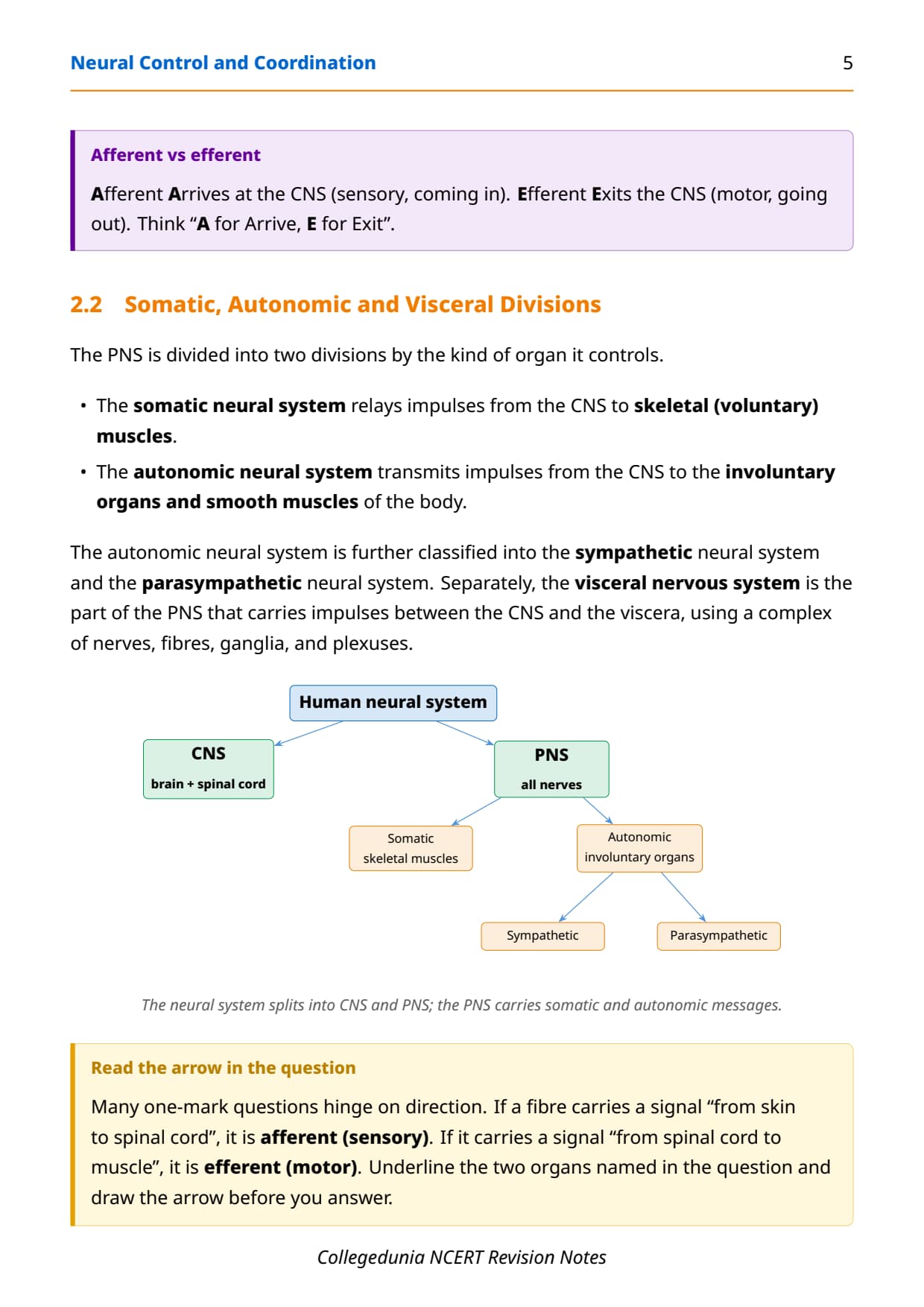
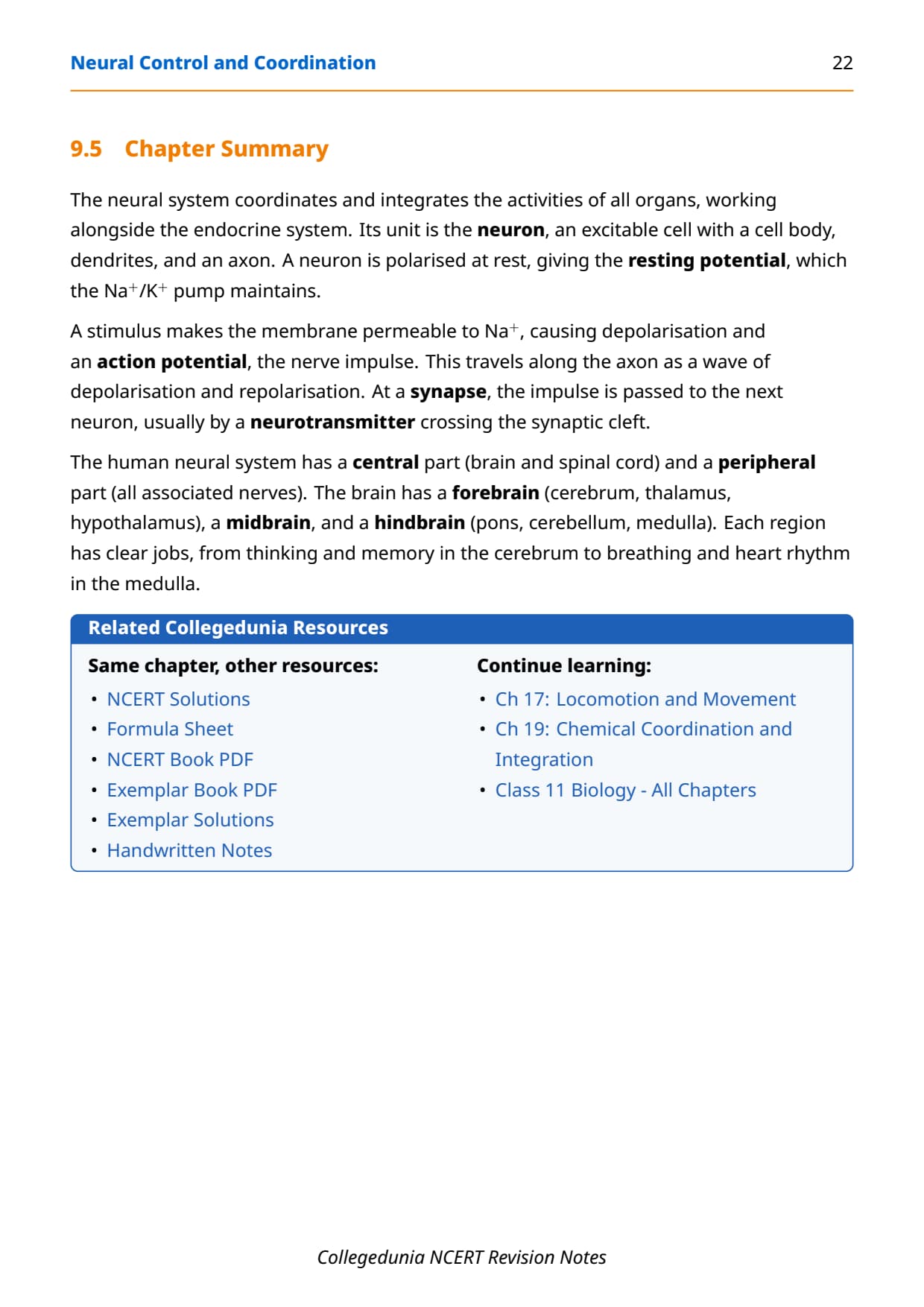
- Central neural system (CNS): the brain and the spinal cord, the site of information processing and control.
- Peripheral neural system (PNS): all the nerves of the body associated with the CNS, carrying signals in and out.
- Afferent fibres: transmit impulses from tissues and organs to the CNS, so they are sensory.
- Efferent fibres: transmit regulatory impulses from the CNS to peripheral tissues and organs, so they are motor.
The PNS is split by the kind of organ it controls. The somatic neural system relays impulses from the CNS to skeletal (voluntary) muscles, while the autonomic neural system transmits impulses to the involuntary organs and smooth muscles, and is further divided into the sympathetic and parasympathetic systems. A simple way to hold the direction rules is "A for Arrive, E for Exit": afferent fibres arrive at the CNS, efferent fibres exit it. Many one-mark questions test only this direction, so read the two organs named in the question before you answer.
The Neuron: Structural and Functional Unit
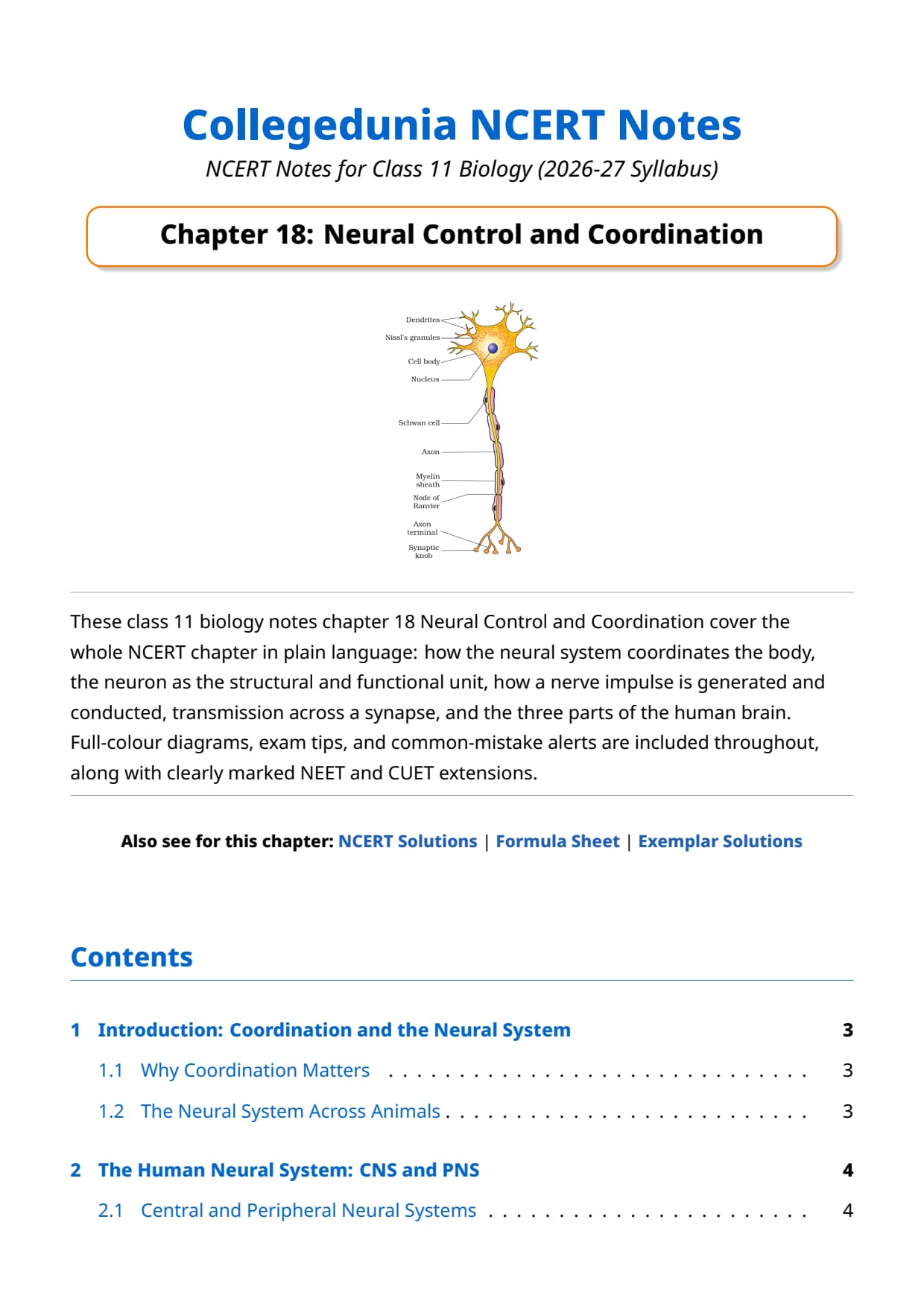
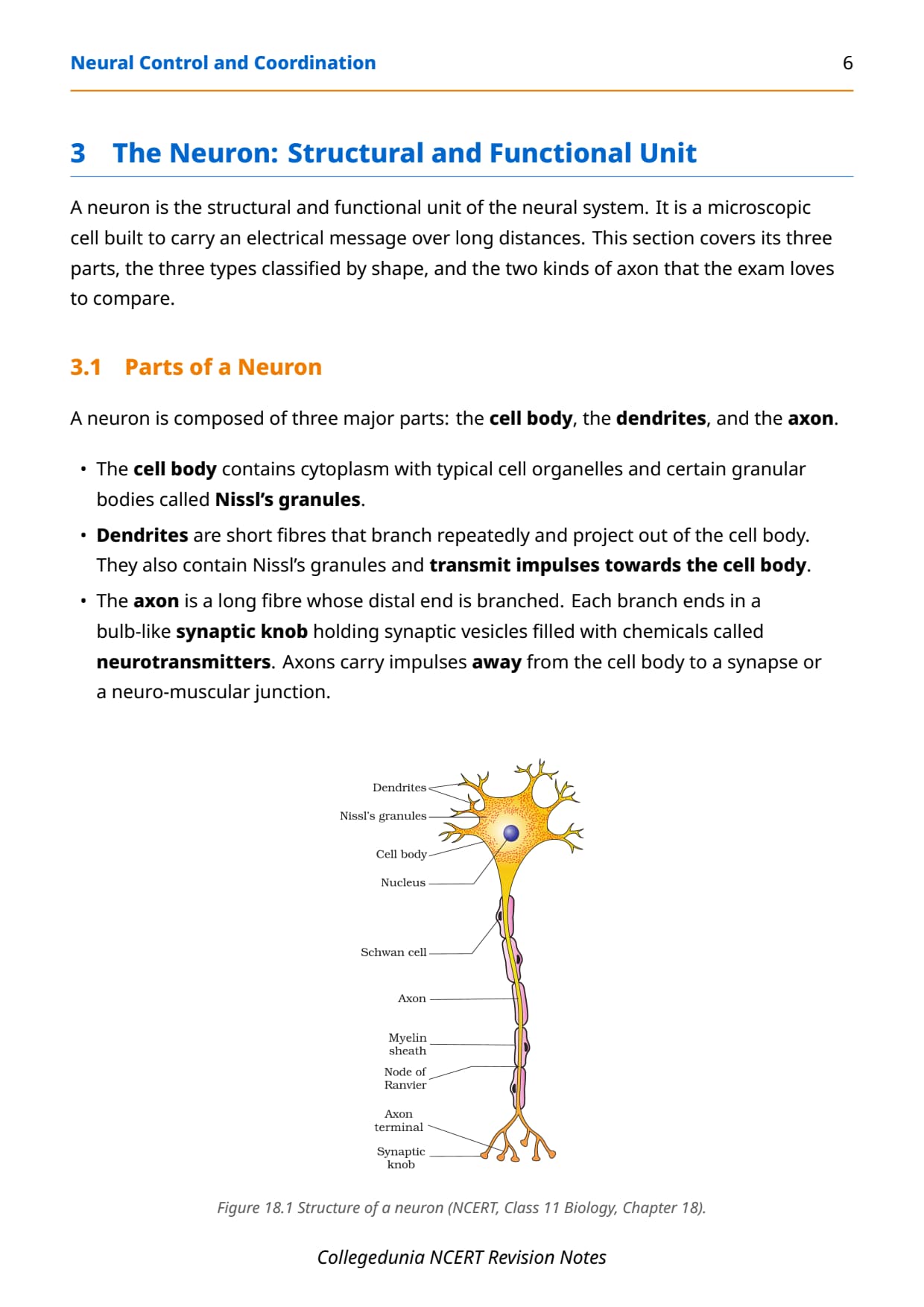
A neuron is the structural and functional unit of the neural system. It is a microscopic cell built to carry an electrical message over long distances, and it is made of three major parts. Learning these parts and the direction the impulse travels through them answers a large share of the short-answer questions in this chapter.
- Cell body: contains cytoplasm with typical cell organelles and granular bodies called Nissl's granules.
- Dendrites: short, repeatedly branched fibres that also hold Nissl's granules and transmit impulses towards the cell body.
- Axon: a long fibre whose branched distal ends carry a bulb-like synaptic knob holding vesicles of neurotransmitters, carrying impulses away from the cell body.
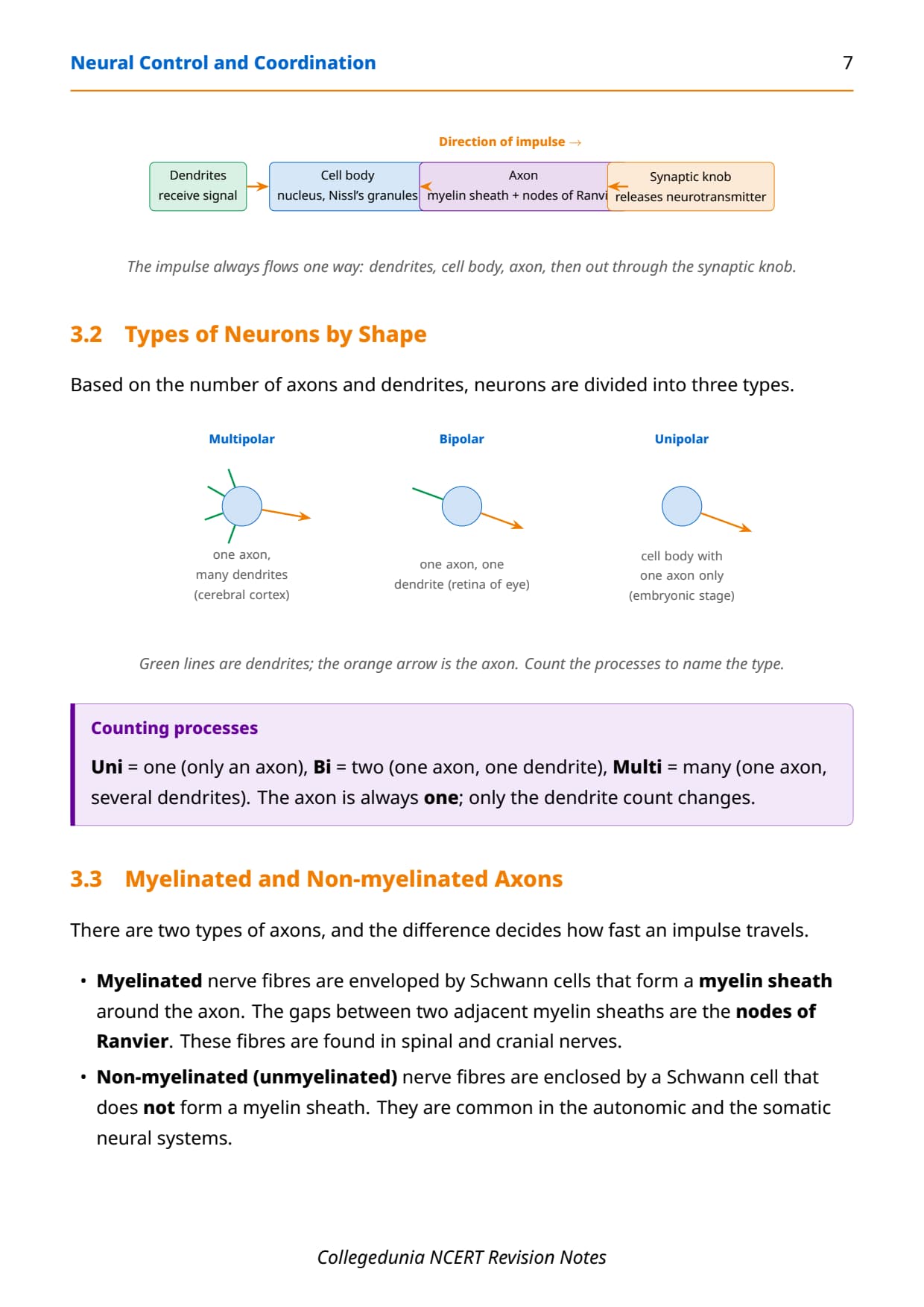
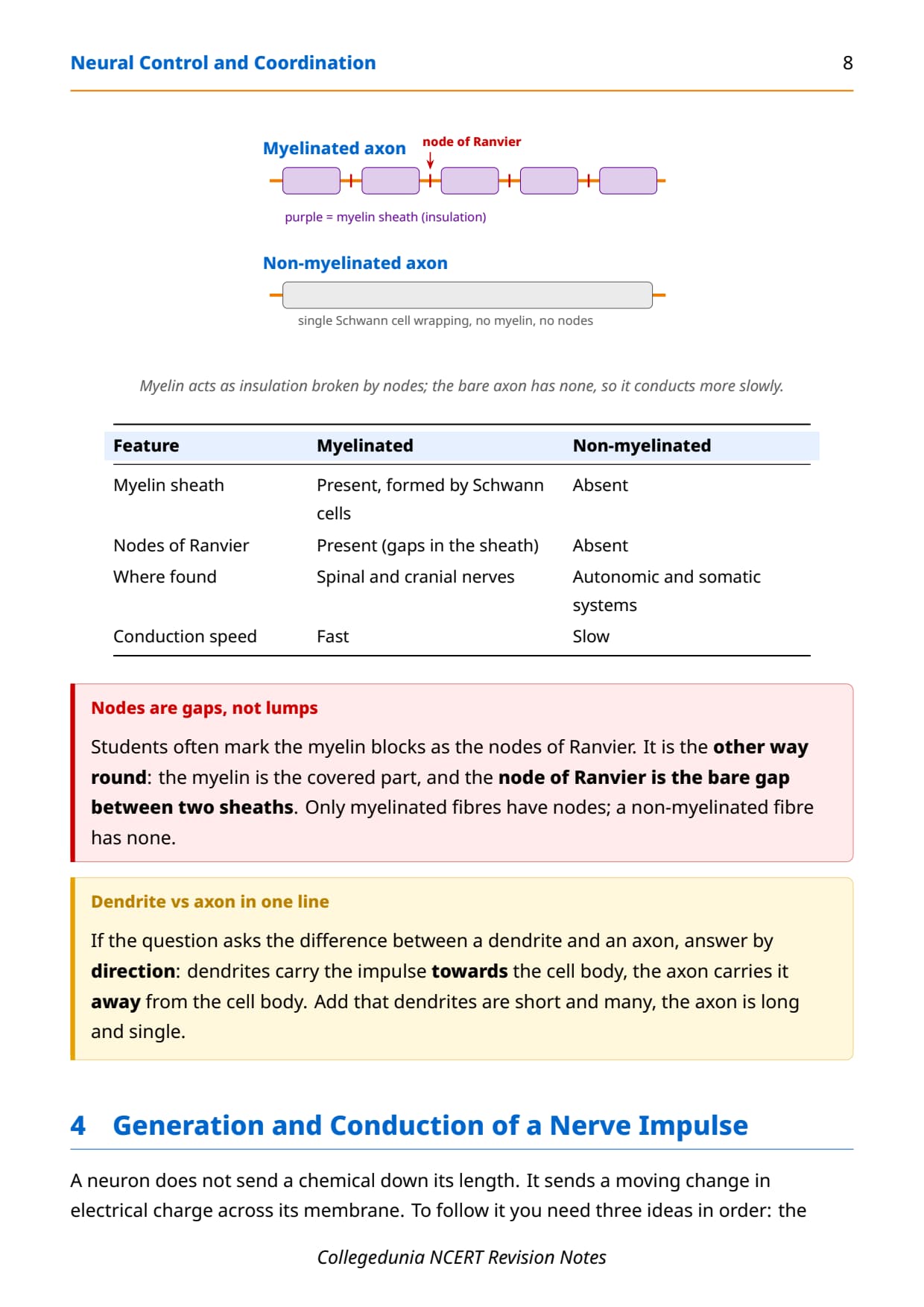
Based on shape, neurons are multipolar (one axon, many dendrites, in the cerebral cortex), bipolar (one axon, one dendrite, in the retina), and unipolar (cell body with one axon only, in the embryonic stage). Based on the axon, there are two types that decide impulse speed. Myelinated fibres are wrapped by Schwann cells that form a myelin sheath, with gaps called nodes of Ranvier, and conduct fast; non-myelinated fibres have no sheath and conduct slowly. The table below compares the two axon types that the exam most often asks you to distinguish.
| Feature | Myelinated axon | Non-myelinated axon |
|---|---|---|
| Myelin sheath | Present, formed by Schwann cells | Absent |
| Nodes of Ranvier | Present (gaps in the sheath) | Absent |
| Where found | Spinal and cranial nerves | Autonomic and somatic systems |
| Conduction speed | Fast | Slow |
Generation and Conduction of a Nerve Impulse
A neuron does not send a chemical down its length. It sends a moving change in electrical charge across its membrane, and to follow it you need three ideas in order: the resting state, the action potential, and how that action potential moves along the axon. This is the most quantitative part of the chapter and the most heavily tested, so learn the ion movements exactly.
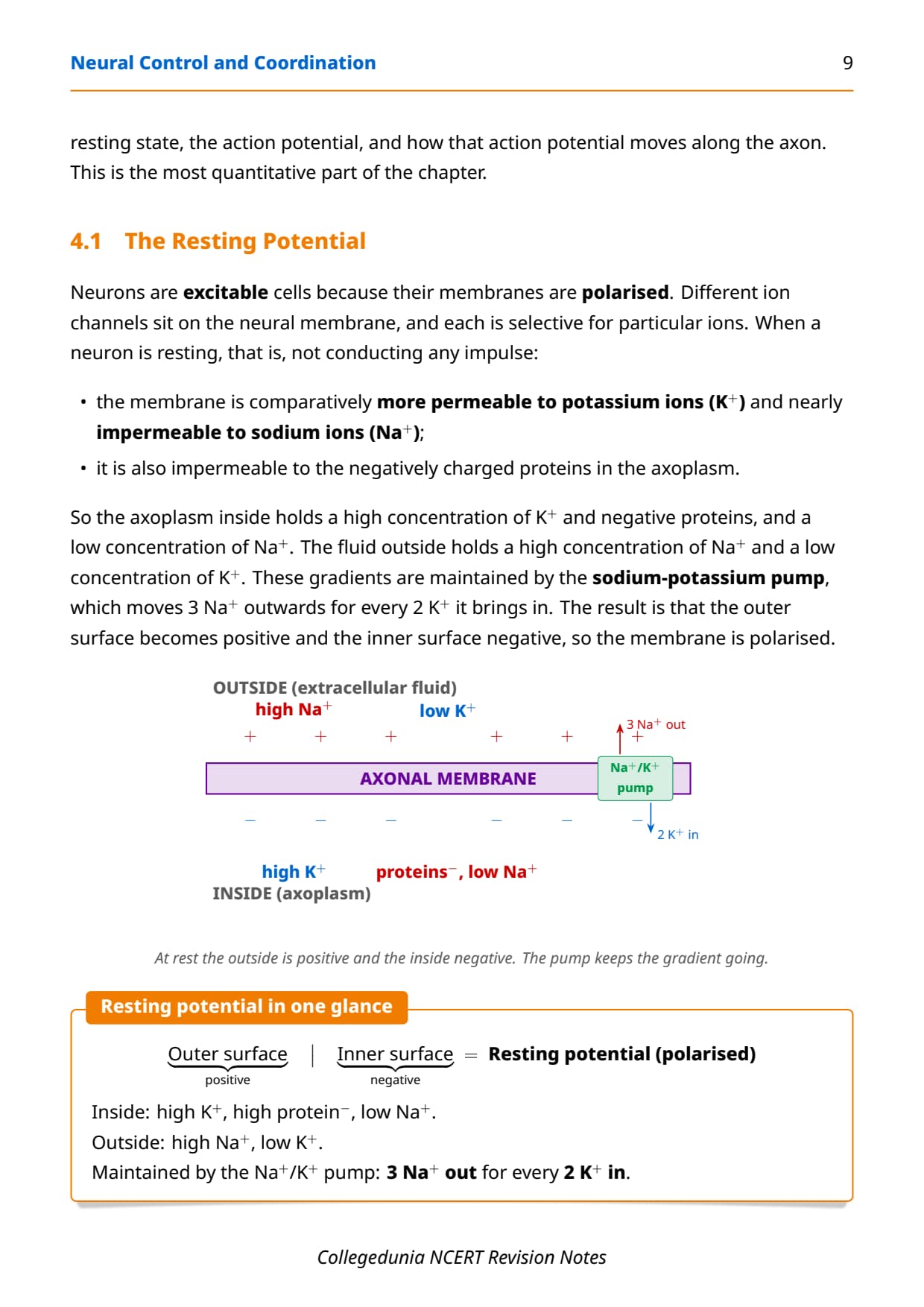
- Resting potential: the resting membrane is more permeable to K+ and nearly impermeable to Na+, so the outer surface is positive and the inner surface negative. The membrane is polarised.
- Sodium-potassium pump: maintains the gradients by moving 3 Na+ outwards for every 2 K+ it brings in, which is why the resting state still costs energy.
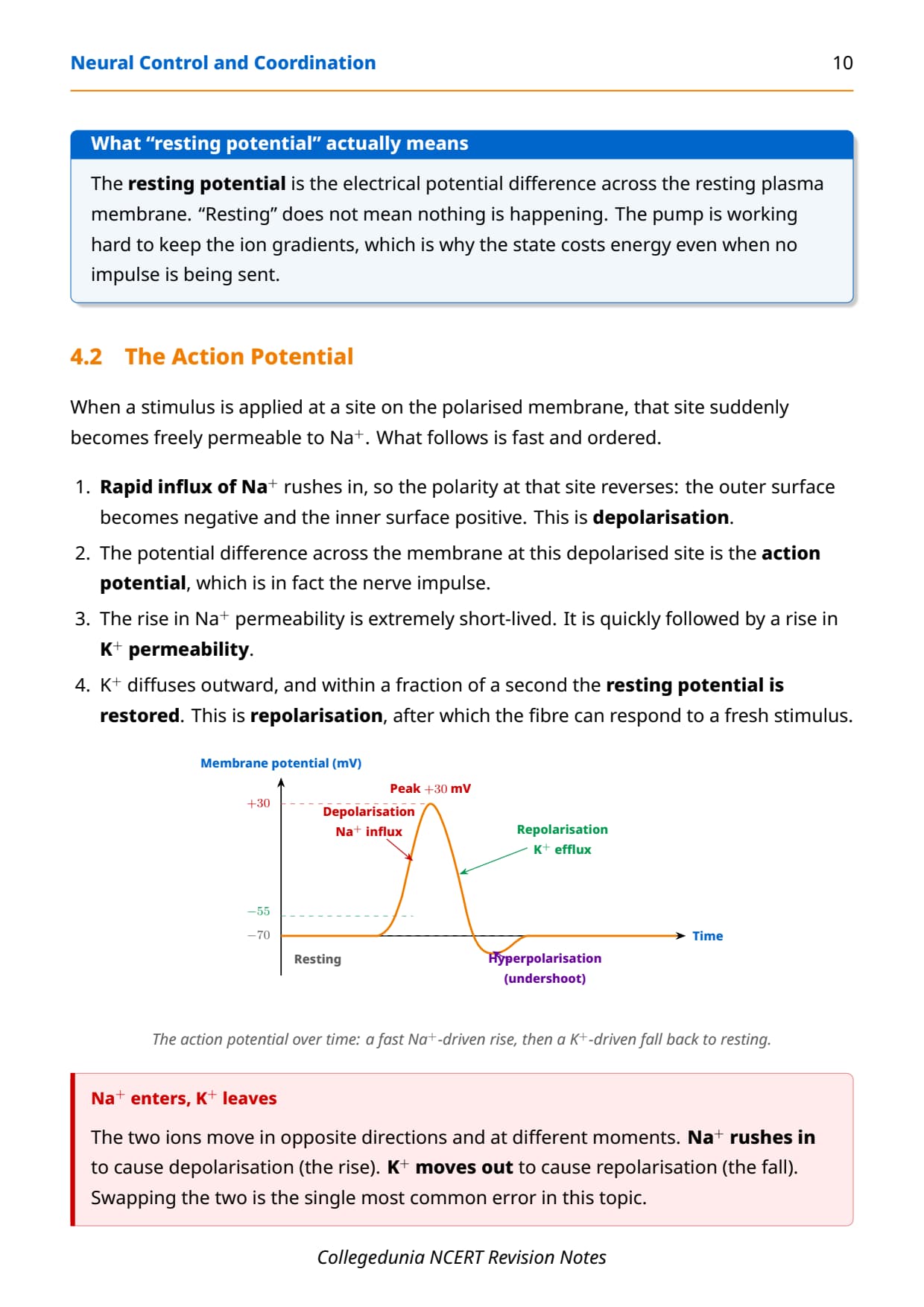
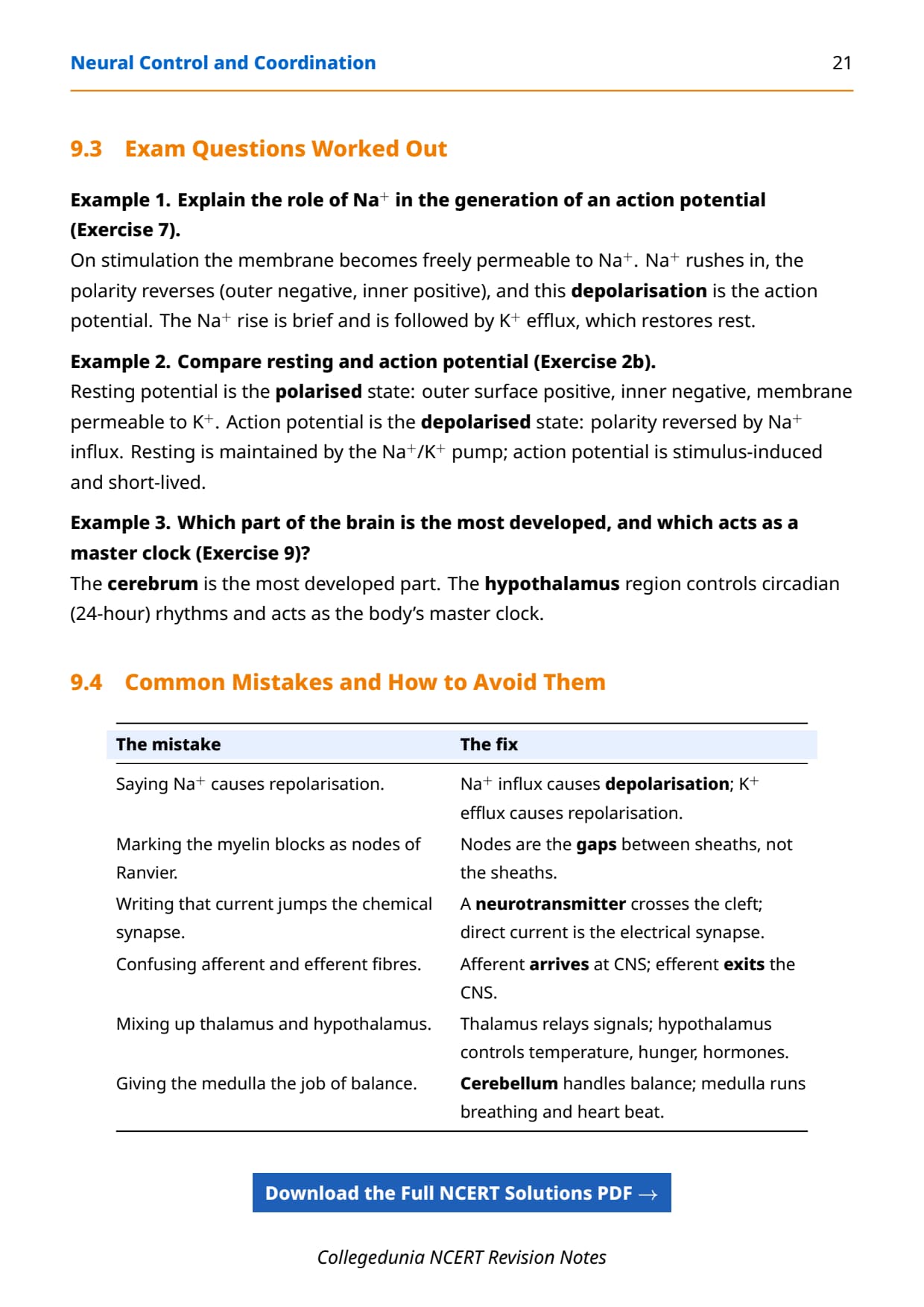
- Depolarisation: a stimulus makes the site freely permeable to Na+, Na+ rushes in, and the polarity reverses. This potential difference is the action potential, the nerve impulse itself.
- Repolarisation: the Na+ rise is short-lived and is followed by K+ moving outward, which restores the resting potential within a fraction of a second.
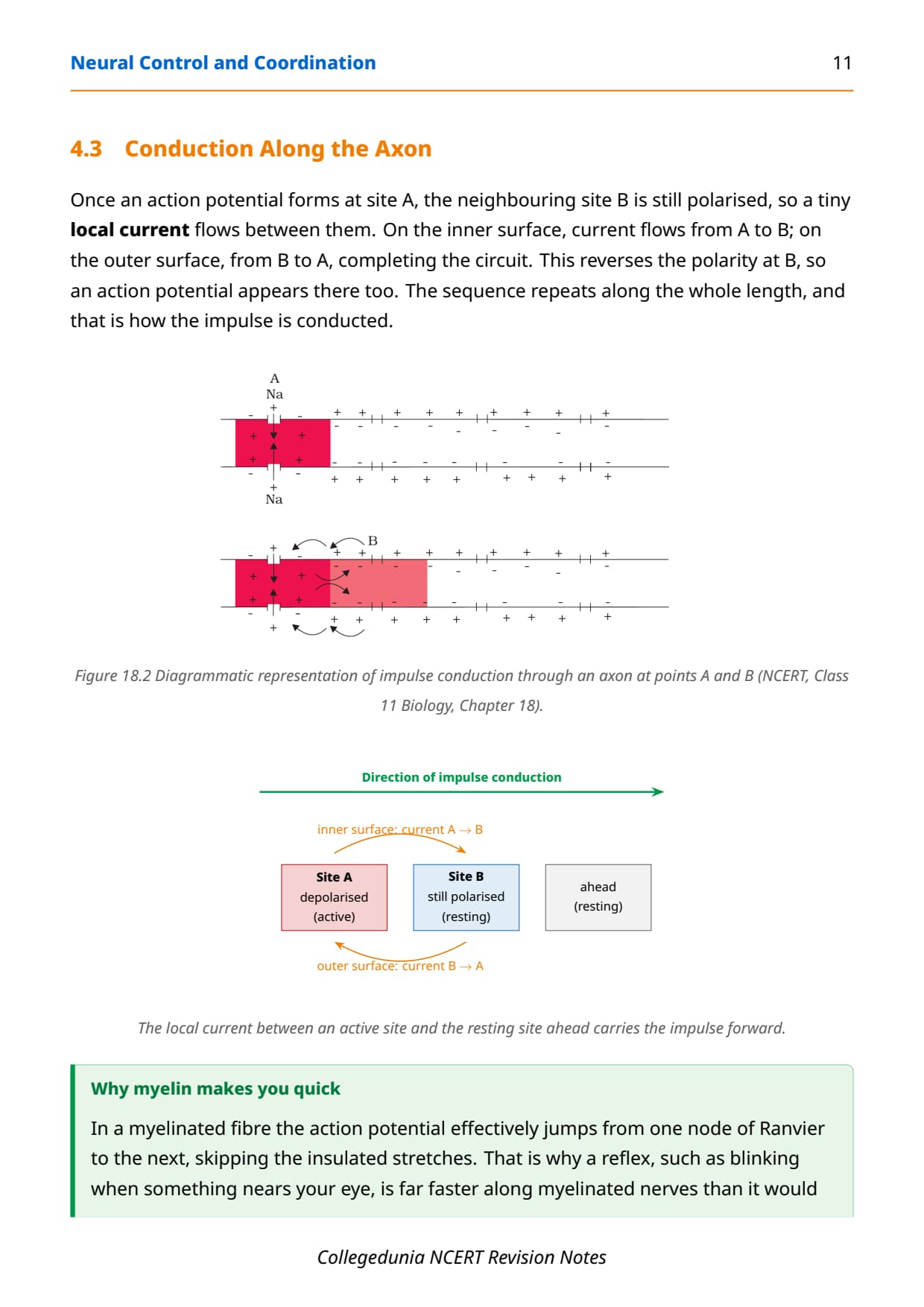
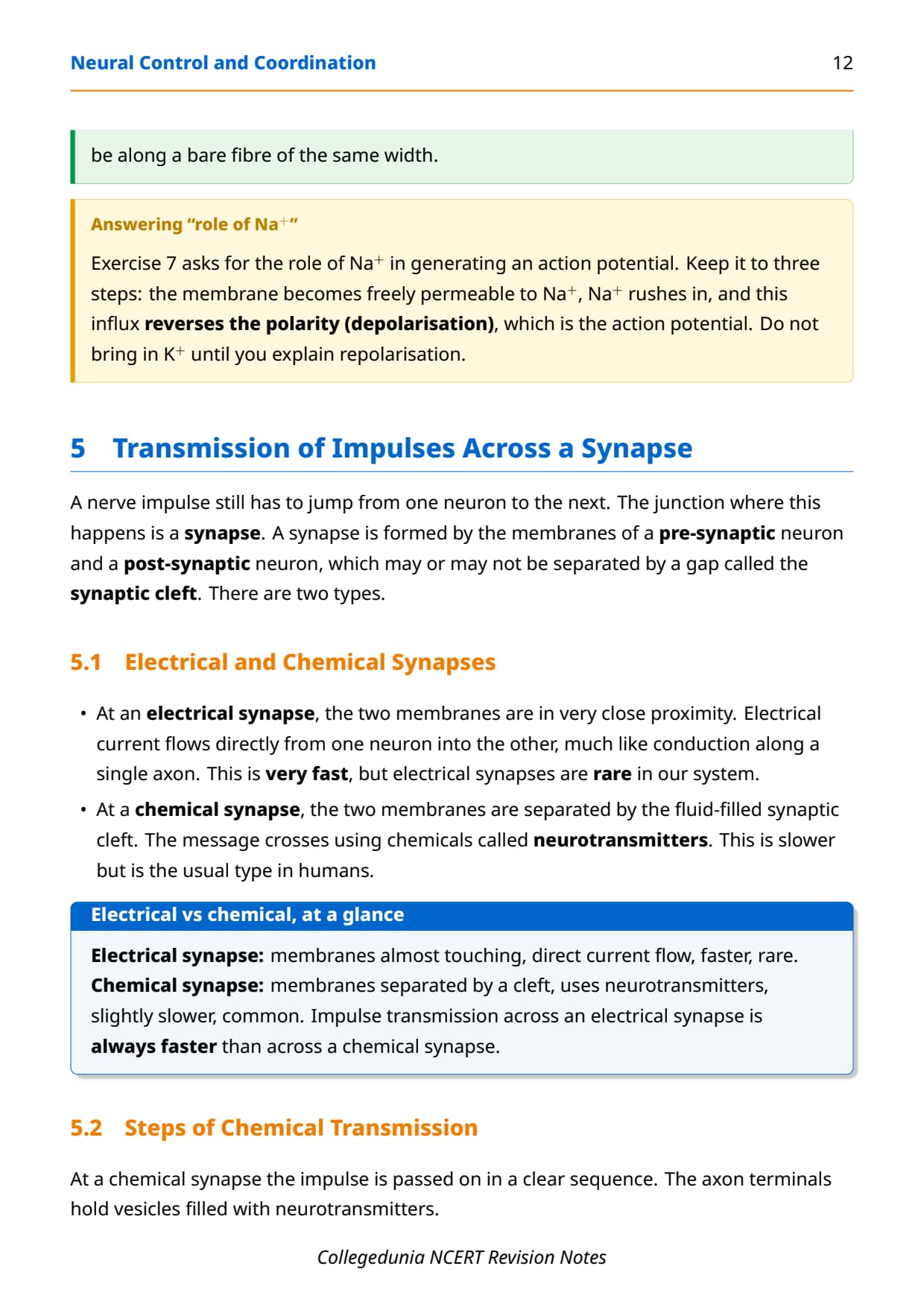
Once an action potential forms at site A, the neighbouring site B is still polarised, so a tiny local current flows between them. This reverses the polarity at B, an action potential appears there too, and the sequence repeats along the whole axon. That is how the impulse is conducted. Na+ rushes in to cause depolarisation, the rise, and K+ moves out to cause repolarisation, the fall. Swapping these two ions is the single most common error in this topic, and Exercise 7 asks specifically for the role of Na+, so keep the influx tied only to depolarisation.
Transmission of Impulses Across a Synapse
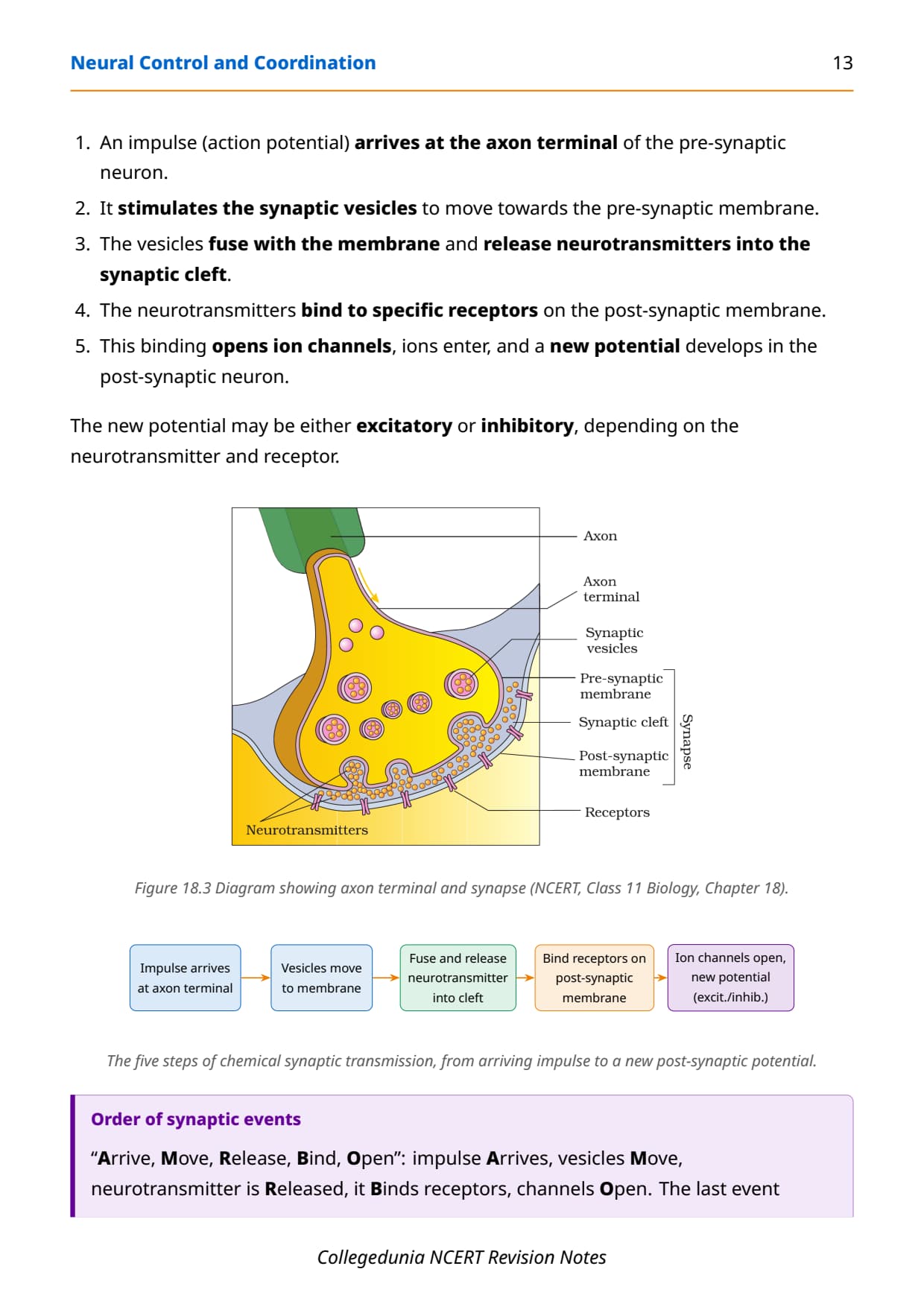
A nerve impulse still has to jump from one neuron to the next, and the junction where this happens is a synapse. A synapse is formed by the membranes of a pre-synaptic neuron and a post-synaptic neuron, which may or may not be separated by a gap called the synaptic cleft. There are two types, and the exam wants the difference between them clearly stated.
- Electrical synapse: the two membranes are in very close proximity and electrical current flows directly from one neuron to the other. This is very fast but rare in our system.
- Chemical synapse: the membranes are separated by the fluid-filled cleft, and the message crosses using chemicals called neurotransmitters. This is slower but is the usual type in humans.
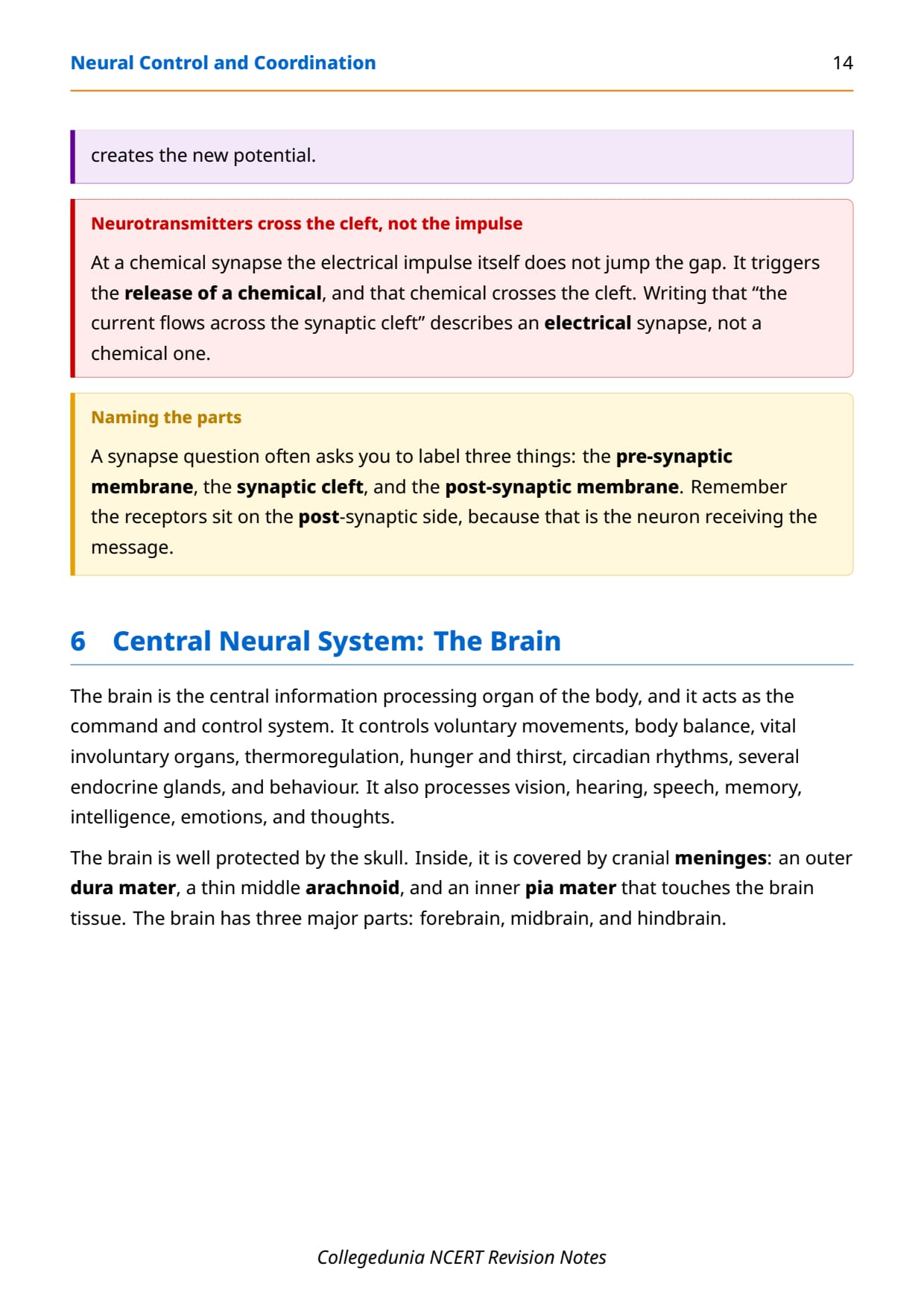
At a chemical synapse the impulse is passed on in a clear sequence: the impulse arrives at the axon terminal, the synaptic vesicles move to and fuse with the pre-synaptic membrane, neurotransmitters are released into the cleft, they bind specific receptors on the post-synaptic membrane, and this opens ion channels so a new potential develops that may be excitatory or inhibitory. Remember it as "Arrive, Move, Release, Bind, Open". The commonest mistake is to write that the electrical current itself jumps the cleft, but at a chemical synapse it is the neurotransmitter that crosses, while the receptors always sit on the post-synaptic side.
The Human Brain: Forebrain, Midbrain and Hindbrain
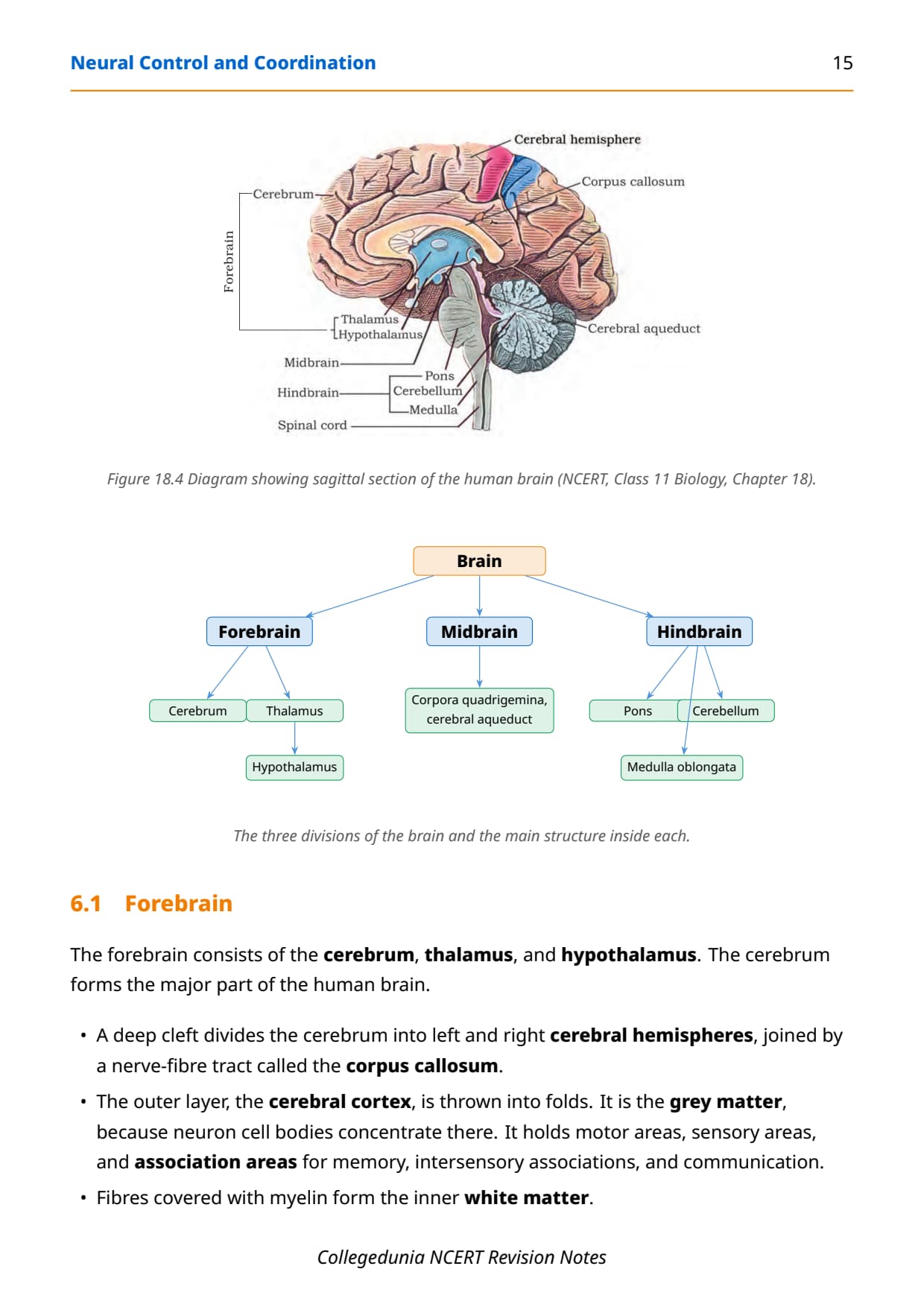
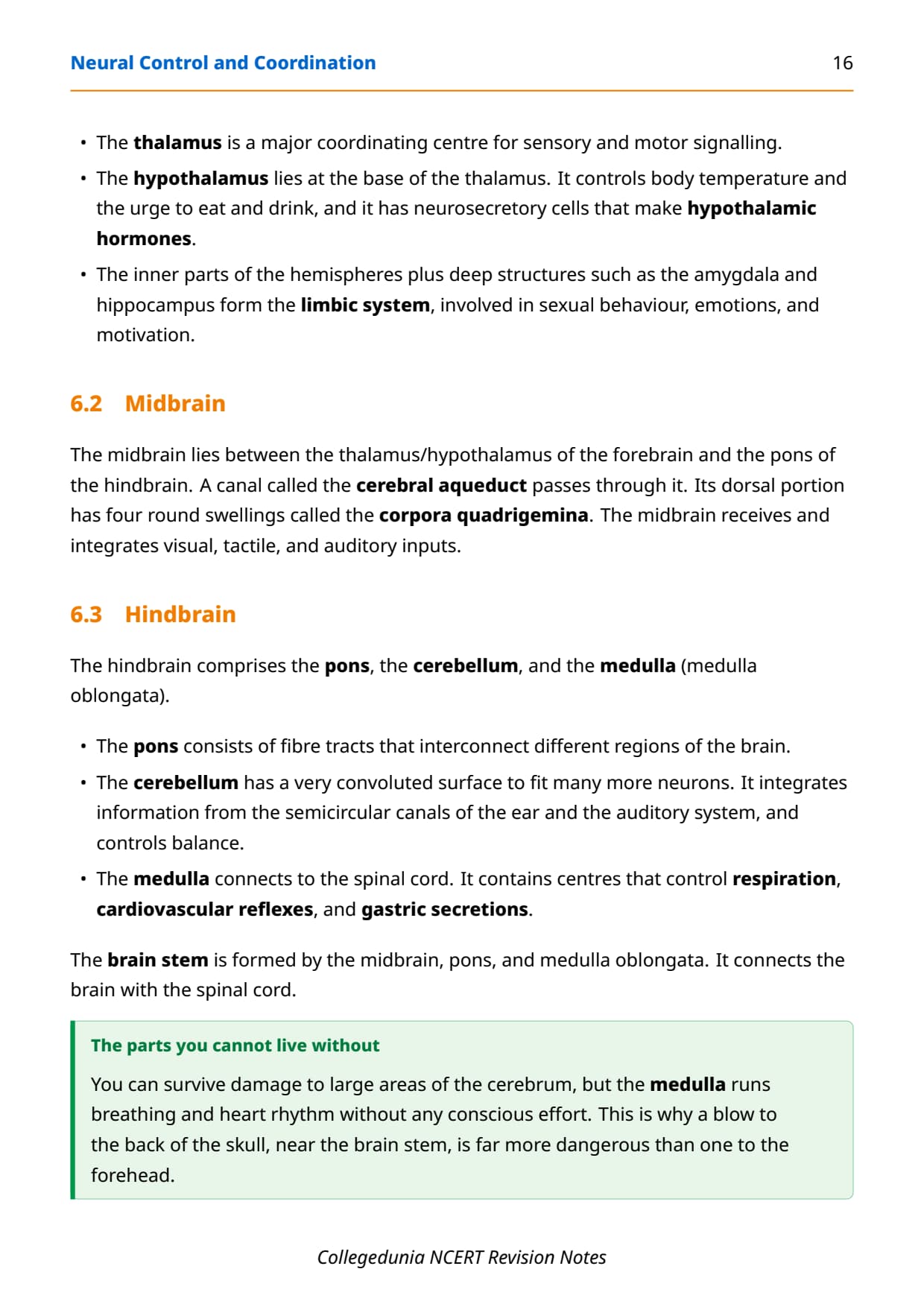
The brain is the central information processing organ of the body, and it acts as the command and control system for voluntary movement, balance, vital involuntary organs, thermoregulation, hunger and thirst, and behaviour. It is protected by the skull and covered by three cranial meninges: the outer dura mater, the middle arachnoid, and the inner pia mater. The brain has three major parts, and matching each region to its job is a common exam task.
- Forebrain: the cerebrum (thinking, memory, motor and sensory areas), the thalamus (a coordinating centre for sensory and motor signalling), and the hypothalamus (controls temperature, hunger, thirst, and makes hypothalamic hormones).
- Midbrain: carries the cerebral aqueduct and the four corpora quadrigemina, and integrates visual, tactile, and auditory inputs.
- Hindbrain: the pons (fibre tracts linking brain regions), the cerebellum (balance), and the medulla (respiration, cardiovascular reflexes, and gastric secretions).
The two cerebral hemispheres are joined by a fibre tract called the corpus callosum, the outer folded cerebral cortex is grey matter, and the brain stem is formed by the midbrain, pons, and medulla. Fix four anchors: cerebrum for thinking and memory, hypothalamus for temperature and hunger, cerebellum for balance, and medulla for breathing and heart beat. The thalamus and hypothalamus sound alike and sit next to each other, so name the function carefully when a question asks you to compare them.
Reflex Action and the Reflex Arc (NEET Extension)
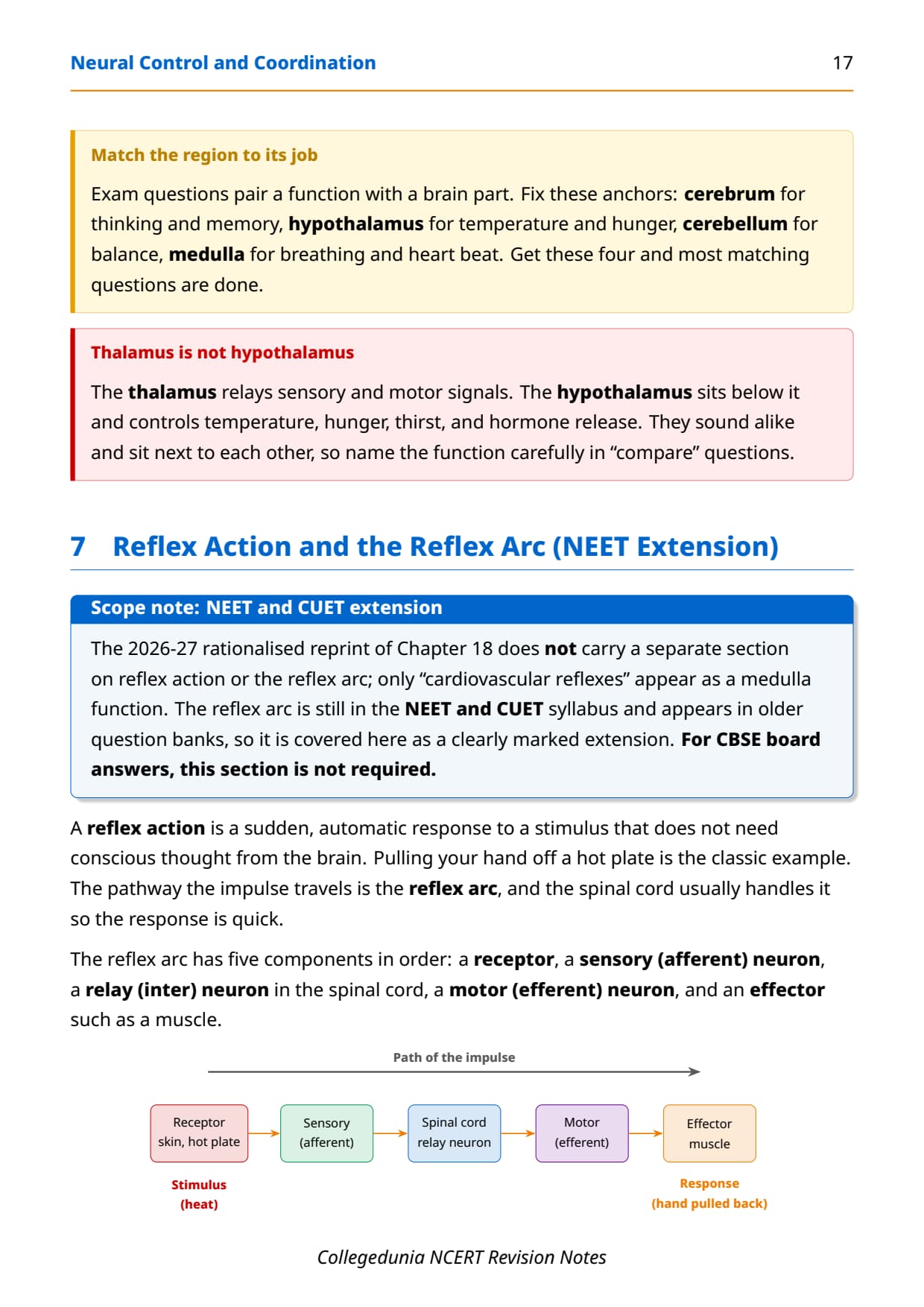
A reflex action is a sudden, automatic response to a stimulus that does not need conscious thought, such as pulling your hand off a hot plate. The pathway the impulse travels is the reflex arc, and the spinal cord usually handles it so the response is quick. The 2026-27 rationalised reprint does not carry a separate section on the reflex arc, keeping only "cardiovascular reflexes" as a medulla function, but it stays in the NEET and CUET syllabus, so revise it as a clearly marked extension and skip it only for CBSE board answers.
- Receptor: detects the stimulus, such as heat on the skin.
- Sensory (afferent) neuron: carries the impulse to the spinal cord.
- Relay (inter) neuron: connects the incoming and outgoing neurons inside the spinal cord.
- Motor (efferent) neuron: carries the response impulse back out.
- Effector: the muscle that acts, pulling the hand back.
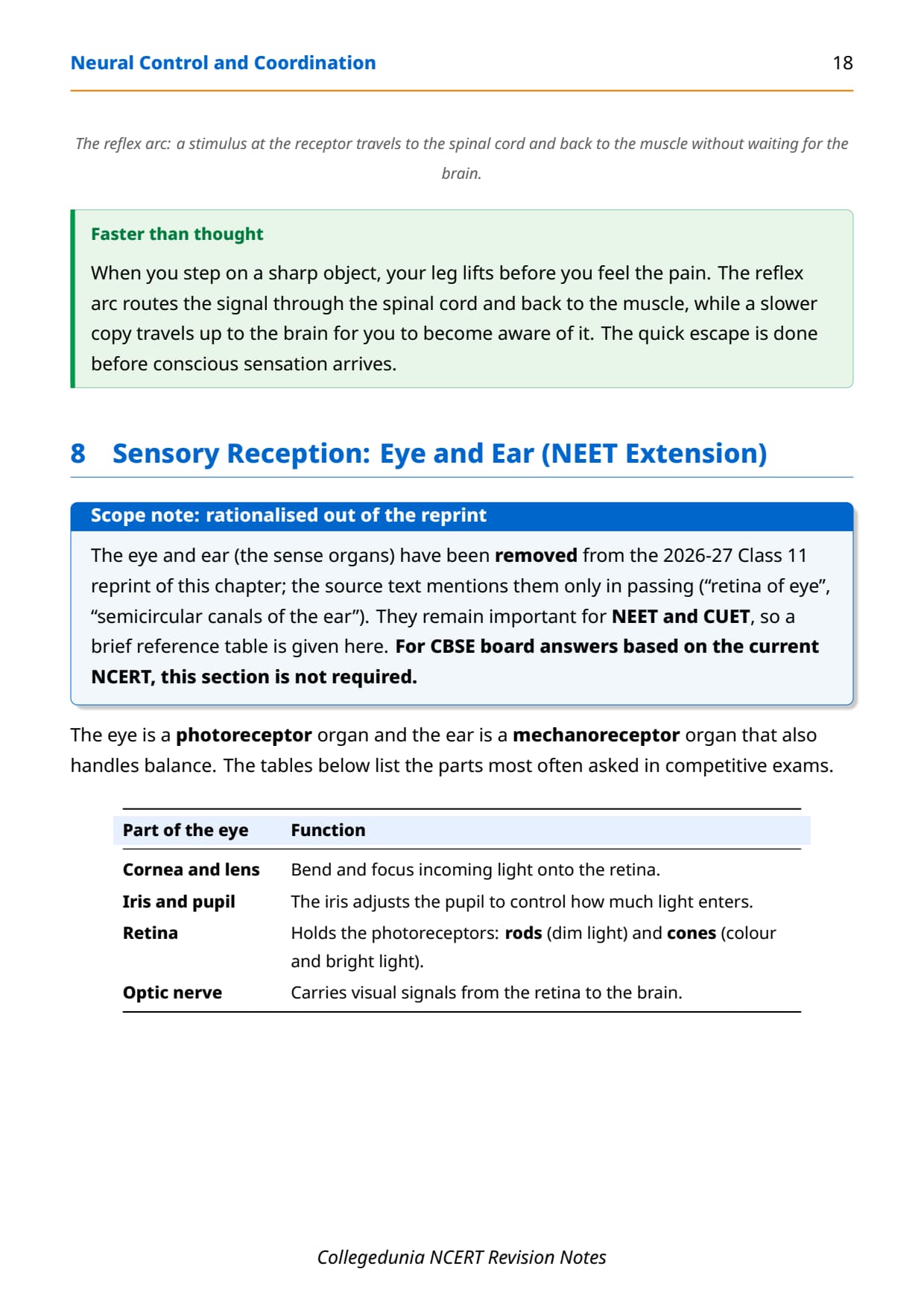
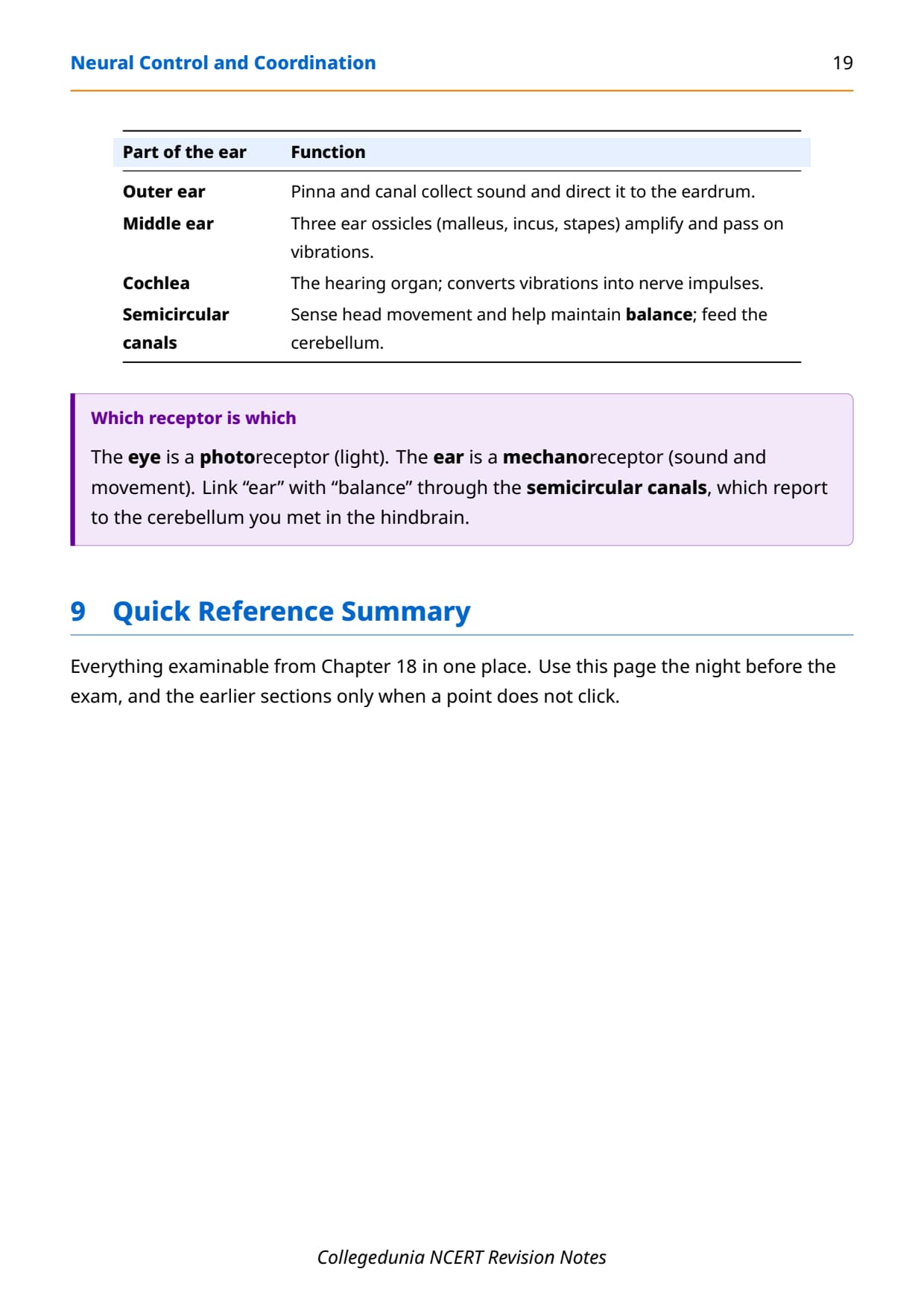
The eye and ear, the sense organs, have also been removed from the current reprint and are mentioned only in passing, as "retina of eye" and "semicircular canals of the ear", yet they remain important for competitive exams. The eye is a photoreceptor and the ear is a mechanoreceptor that also handles balance through its semicircular canals, which feed the cerebellum. When you step on something sharp, the reflex arc routes the signal through the spinal cord and back to the muscle before the slower copy reaches the brain, so the escape happens before you feel the pain.
Key Definitions in Neural Control and Coordination
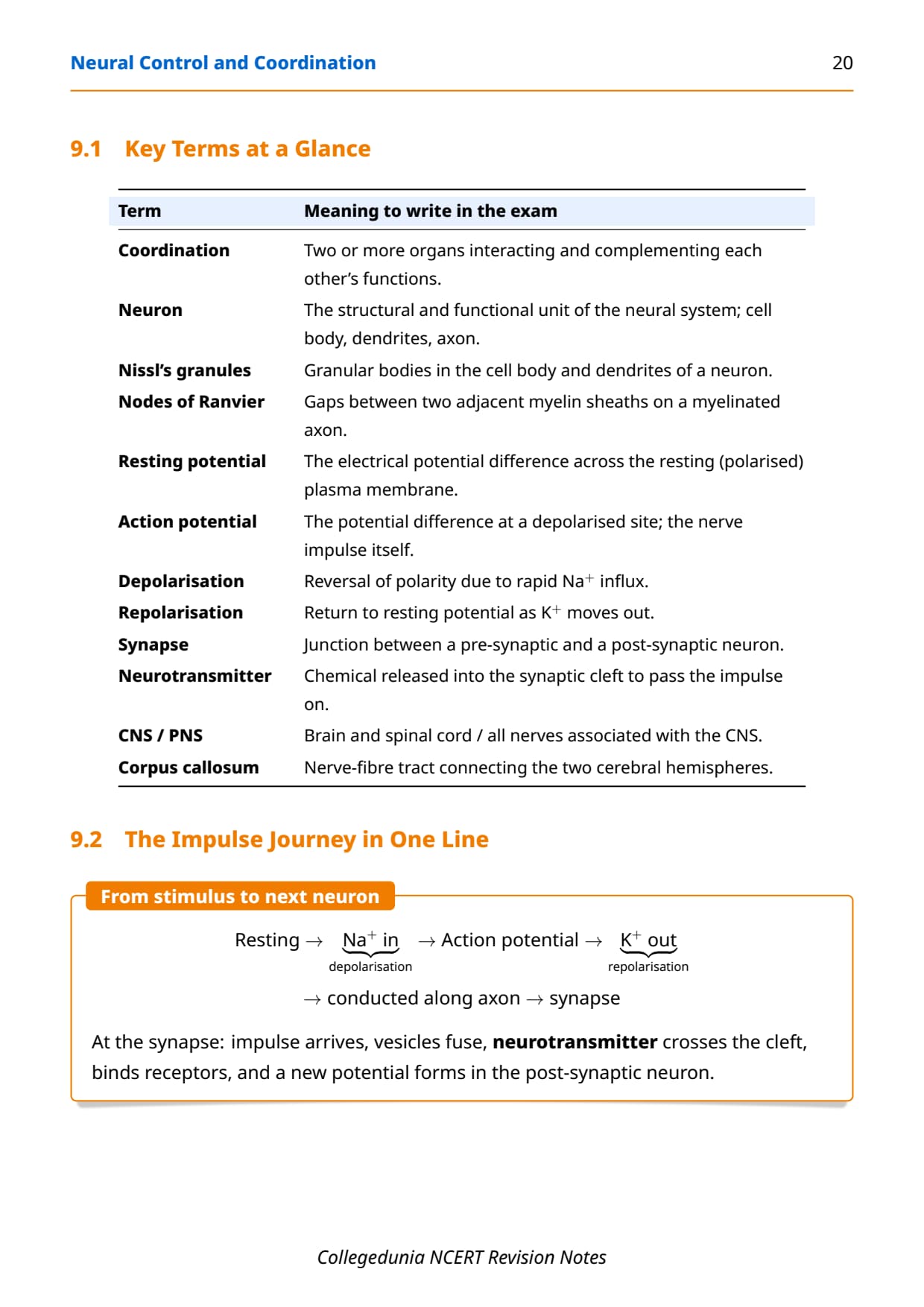
Board short-answer questions often ask for a clean definition in one or two lines, and a vague answer loses easy marks. Learn these word-for-word, because the wording of the exam question is usually built straight from the NCERT definition. Each term below also connects to a diagram or step you can be asked to explain.
| Term | Definition |
|---|---|
| Coordination | The process through which two or more organs interact and complement the functions of one another. |
| Neuron | The structural and functional unit of the neural system, with a cell body, dendrites, and an axon. |
| Nodes of Ranvier | The gaps between two adjacent myelin sheaths on a myelinated axon. |
| Resting potential | The electrical potential difference across the resting, polarised plasma membrane. |
| Action potential | The potential difference at a depolarised site; the nerve impulse itself. |
| Synapse | The junction between a pre-synaptic and a post-synaptic neuron. |
| Neurotransmitter | A chemical released into the synaptic cleft to pass the impulse to the next neuron. |
A common board question asks you to define the resting potential and then explain how the sodium-potassium pump maintains it. State the definition first, then add that the pump moves 3 Na+ out for every 2 K+ in to earn the full mark. Learning these definitions makes the wording of almost every one-mark and two-mark question in this chapter familiar.
Common Mistakes Students Make in Neural Control and Coordination
These slips happen because two terms look alike, not because the concept is hard. Each one costs 1 to 2 marks in the paper, so watch for them at the exact step where they occur.
Mistake 1: Saying Na+ causes repolarisation. Na+ influx causes depolarisation, the rise, while K+ efflux causes repolarisation, the fall.
Mistake 2: Marking the myelin blocks as the nodes of Ranvier. The nodes are the bare gaps between two sheaths, not the sheaths themselves.
Mistake 3: Writing that the current jumps the chemical synapse. A neurotransmitter crosses the cleft; direct current flow is the electrical synapse.
Mistake 4: Confusing afferent and efferent fibres. Afferent fibres arrive at the CNS (sensory); efferent fibres exit the CNS (motor).
Mistake 5: Giving the medulla the job of balance. The cerebellum controls balance, while the medulla runs breathing and heart beat.
Neural Control and Coordination Weightage in CBSE Boards, NEET and CUET
This chapter is diagram-heavy and scoring. It reliably carries a short answer on the nerve impulse or the neuron, and it is a favourite source of NEET questions because the ion movements and brain functions are easy to frame as objective items. Here is how the marks split across the main exams for 2026-27.
| Exam | Typical weightage | What is asked |
|---|---|---|
| CBSE Boards | 4 to 6 marks | One short answer on the nerve impulse or synapse plus one on neuron structure or the brain |
| NEET | 2 to 3 questions | Resting and action potentials, synaptic transmission, and brain functions |
| CUET | 1 to 2 objective questions | Neuron parts, the CNS and PNS split, and matching brain regions to their jobs |
The generation and conduction of the nerve impulse is the single most tested idea from this chapter across all three exams. Master the resting and action potential first, then the five steps of synaptic transmission, then the parts of the brain, in that order of return on effort for the 2026-27 session.
How to Revise Neural Control and Coordination Quickly
Use these neural control and coordination class 11 notes for a fast, ordered recap the night before a test. The checklist below takes about 25 minutes and hits every marks-heavy idea in the chapter without opening the full textbook.
- First 8 minutes: draw a neuron and label the cell body, dendrites, axon, myelin sheath, and nodes of Ranvier, then write the direction the impulse travels through it.
- Next 9 minutes: write the ion movements of the resting potential, depolarisation, and repolarisation, and the 3 Na+ out for 2 K+ in rule of the pump.
- Last 8 minutes: list the five steps of chemical synaptic transmission and match cerebrum, hypothalamus, cerebellum, and medulla to their jobs.
Close the loop by explaining why an impulse travels faster along a myelinated fibre than a non-myelinated one. If you can do all three blocks without notes, the chapter is exam-ready. Keep the neuron diagram and the ion table beside you for the first pass only, then try the whole checklist closed-book.
Student Feedback on the Neural Control and Coordination Notes
What 12,140 students told us about their Neural Control and Coordination revision:
- 71% of students rated the resting and action potential as the part most worth mastering for the exam.
- Most-confused pair: depolarisation versus repolarisation, mixed up by about 3 in 10 students.
- Students who learnt the synapse steps with the "Arrive, Move, Release, Bind, Open" order said the five-step questions felt easy afterwards.
Source: 2026-27 Class 11 Biology student poll. Sample of 12,140 students from CBSE schools across 15 states, conducted before the 2026 boards.
Other Neural Control and Coordination Class 11 Biology Resources
Pair these notes with the solved answers, the formula sheet, the exemplar material, and the textbook PDF for the same chapter.
| Resource | Link |
|---|---|
| NCERT Solutions | Neural Control and Coordination Class 11 NCERT Solutions |
| Formula Sheet | Neural Control and Coordination Class 11 Formula Sheet |
| Exemplar Solutions | Neural Control and Coordination Class 11 Exemplar Solutions |
| NCERT Book PDF | Neural Control and Coordination Class 11 Book PDF |
| Exemplar Book PDF | Neural Control and Coordination Class 11 Exemplar Book PDF |
NCERT Notes for Class 11 Biology: All Chapters
Jump to the revision notes for any other Class 11 Biology chapter below.
| Chapter | NCERT Notes |
|---|---|
| Chapter 1 | The Living World |
| Chapter 2 | Biological Classification |
| Chapter 3 | Plant Kingdom |
| Chapter 4 | Animal Kingdom |
| Chapter 5 | Morphology of Flowering Plants |
| Chapter 6 | Anatomy of Flowering Plants |
| Chapter 7 | Structural Organisation in Animals |
| Chapter 8 | Cell The Unit of Life |
| Chapter 9 | Biomolecules |
| Chapter 10 | Cell Cycle and Cell Division |
| Chapter 11 | Photosynthesis in Higher Plants |
| Chapter 12 | Respiration in Plants |
| Chapter 13 | Plant Growth and Development |
| Chapter 14 | Breathing and Exchange of Gases |
| Chapter 15 | Body Fluids and Circulation |
| Chapter 16 | Excretory Products and their Elimination |
| Chapter 17 | Locomotion and Movement |
| Chapter 18 | Neural Control and Coordination |
| Chapter 19 | Chemical Coordination and Integration |
FAQs on Neural Control and Coordination Class 11 Biology Notes
Neural Control and Coordination Notes - Frequently Asked Questions
Ques. What topics do the neural control and coordination class 11 notes cover?
Ans. These neural control and coordination class 11 notes cover coordination and the two coordinating systems, the neural system across animals, the central and peripheral neural systems with afferent and efferent fibres, the neuron as the structural and functional unit, the resting and action potentials, conduction of the impulse along the axon, transmission across electrical and chemical synapses, and the three parts of the human brain. Every key definition and example is included for fast revision.
Ques. What is the structural and functional unit of the neural system?
Ans. The neuron is the structural and functional unit of the neural system. It has three major parts: a cell body with Nissl's granules, short branched dendrites that carry impulses towards the cell body, and a long axon that carries impulses away from the cell body to a synaptic knob. Based on shape, neurons are multipolar, bipolar, or unipolar, and based on the axon they are myelinated or non-myelinated.
Ques. How is a nerve impulse generated?
Ans. At rest the membrane is polarised, with the outer surface positive and the inner surface negative, maintained by the sodium-potassium pump. When a stimulus is applied, the site becomes freely permeable to Na+, Na+ rushes in, and the polarity reverses. This depolarisation is the action potential, the nerve impulse. The Na+ rise is brief and is followed by K+ moving out, which restores the resting potential in a process called repolarisation.
Ques. What is the difference between an electrical and a chemical synapse?
Ans. At an electrical synapse the pre-synaptic and post-synaptic membranes are in very close proximity, so electrical current flows directly from one neuron to the other. This is very fast but rare. At a chemical synapse the membranes are separated by a fluid-filled synaptic cleft, and the impulse is carried across by chemicals called neurotransmitters that bind receptors on the post-synaptic membrane. Impulse transmission across an electrical synapse is always faster than across a chemical synapse.
Ques. What are the three parts of the human brain?
Ans. The human brain has three major parts. The forebrain has the cerebrum, thalamus, and hypothalamus, controlling thinking, memory, temperature, and hunger. The midbrain carries the cerebral aqueduct and corpora quadrigemina and integrates visual and auditory inputs. The hindbrain has the pons, the cerebellum for balance, and the medulla, which controls respiration, cardiovascular reflexes, and gastric secretions. The midbrain, pons, and medulla together form the brain stem.
Ques. What is the weightage of this chapter in the CBSE board exam?
Ans. Neural Control and Coordination carries about 4 to 6 marks in the CBSE Class 11 Biology paper, usually one short answer on the nerve impulse or synapse plus one question on neuron structure or the parts of the brain. It also appears strongly in NEET and CUET as objective questions on the resting and action potentials, synaptic transmission, and brain functions, which makes it a high-value chapter for the 2026-27 session.
Ques. What is a reflex arc and is it in the CBSE syllabus?
Ans. A reflex arc is the pathway an impulse travels during a reflex action, made of a receptor, a sensory neuron, a relay neuron in the spinal cord, a motor neuron, and an effector muscle. The 2026-27 rationalised NCERT reprint does not carry a separate section on the reflex arc, keeping only cardiovascular reflexes as a medulla function, so it is not needed for CBSE board answers, but it remains in the NEET and CUET syllabus and should be revised for those exams.



Comments