




These morphology of flowering plants class 11 notes pull together every part, term, and floral rule that the CBSE Boards, NEET and CUET papers actually test in 2026-27. Revise the whole chapter fast, with the root and shoot systems, the leaf and its venation, inflorescence, all four floral whorls, the fruit, both seed types, and the floral formula gathered in one place.
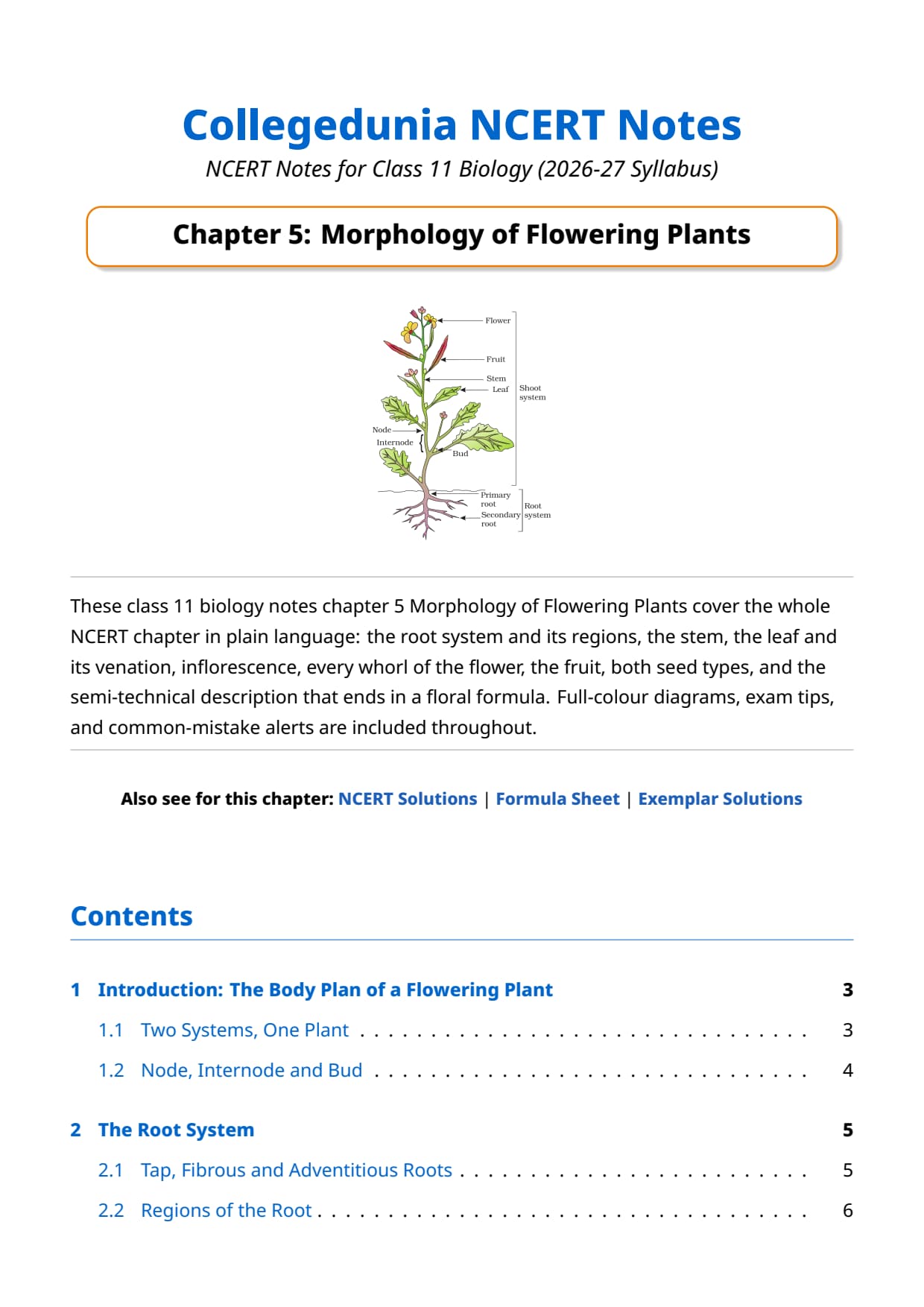
This is the vocabulary chapter of Class 11 Biology, and its terms return in Anatomy of Flowering Plants, in Sexual Reproduction in Flowering Plants, and in every plant taxonomy question that follows.
- CBSE Weightage: 5 to 7 marks, usually one question on floral parts or seed structure plus a diagram or the semi-technical description.
- Topics covered: root, stem and leaf, venation and phyllotaxy, inflorescence, the four whorls, symmetry, ovary position, aestivation, placentation, fruit, dicot and monocot seeds, the floral formula, and family Solanaceae.
- Key rules: an organ's identity is set by its origin not its shape, the racemose versus cymose test, and reading the symbols of a floral formula.
These morphology of flowering plants class 11 notes are curated by subject experts, based on the 2026-27 NCERT textbook, and checked against the last five years of CBSE Board and NEET papers.
Topic-by-Topic Summary of Morphology of Flowering Plants
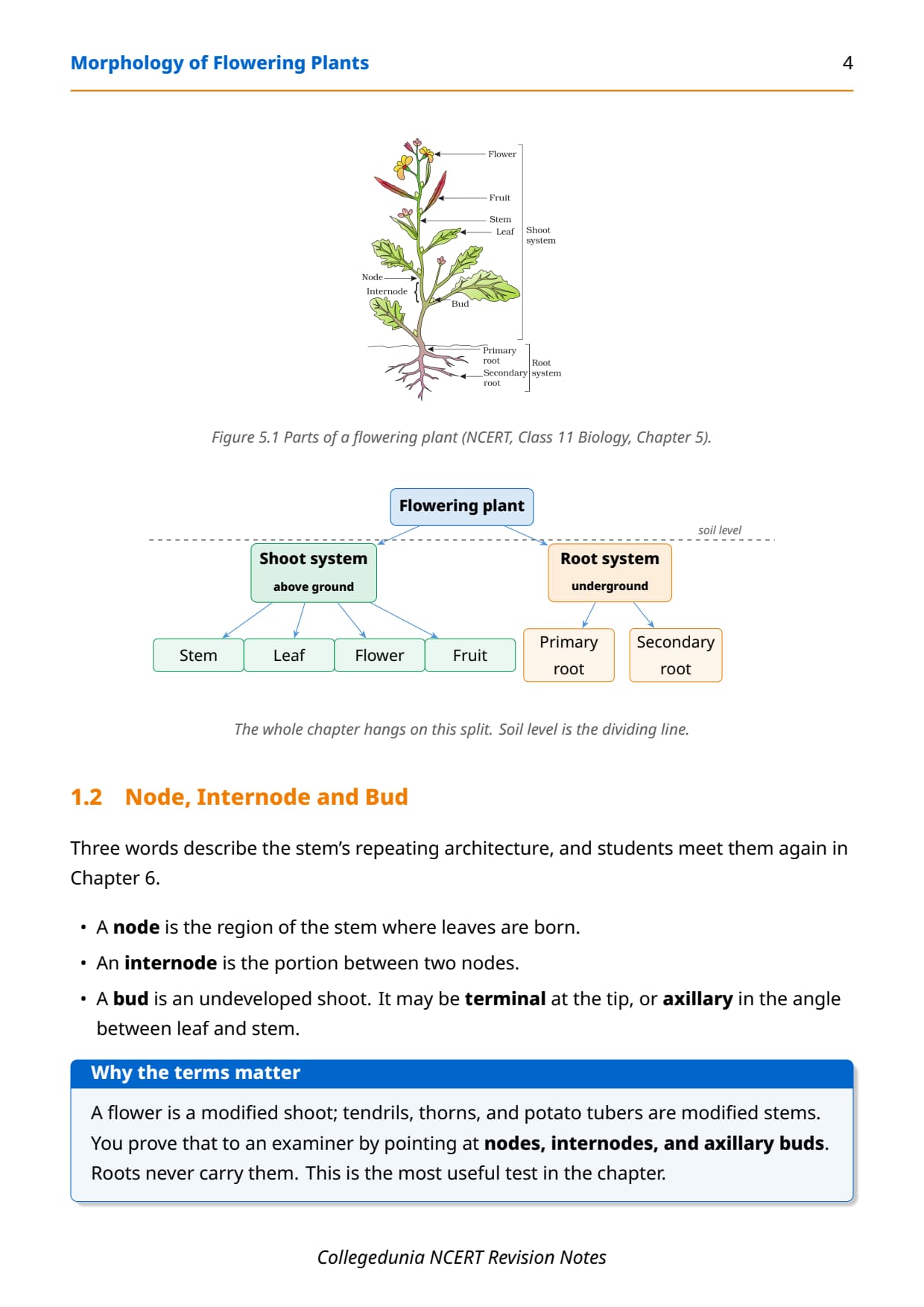
Angiosperms look wildly different, yet every one is built from the same five parts: roots, stems, leaves, flowers, and fruits. The chapter names each part and each of its variations, then teaches you to describe a plant in a fixed sequence that ends in a floral formula. Here is the quick map of what each topic gives you before you revise the detail.
- Root system: tap, fibrous, and adventitious roots, the four regions of a root tip, and the four functions of the root.
- Stem and leaf: how nodes and buds separate a stem from a root, the three parts of a leaf, venation, and phyllotaxy.
- Inflorescence and the flower: racemose versus cymose axes, the four whorls, symmetry, ovary position, aestivation, and placentation.
- Fruit and seed: the pericarp layers, the drupe, and the structure of dicot and monocot seeds.
- Semi-technical description: the fixed description sequence, the floral formula symbols, and the family Solanaceae.
Revise the topics in this order, because each one uses the vocabulary of the one before it. Fix the root-versus-shoot split first, and every later term slots into one system or the other. These morphology of flowering plants class 11 notes follow the same sequence as the NCERT textbook.
The Root System
The root is the part students see least and are examined on most. This section covers how the three root types arise, what the four zones of a root tip do, and the four jobs the root system performs. The rationalised 2026-27 reprint keeps this short, so every line is examinable. The key idea is that a root type is defined by where it comes from, not by how it looks.
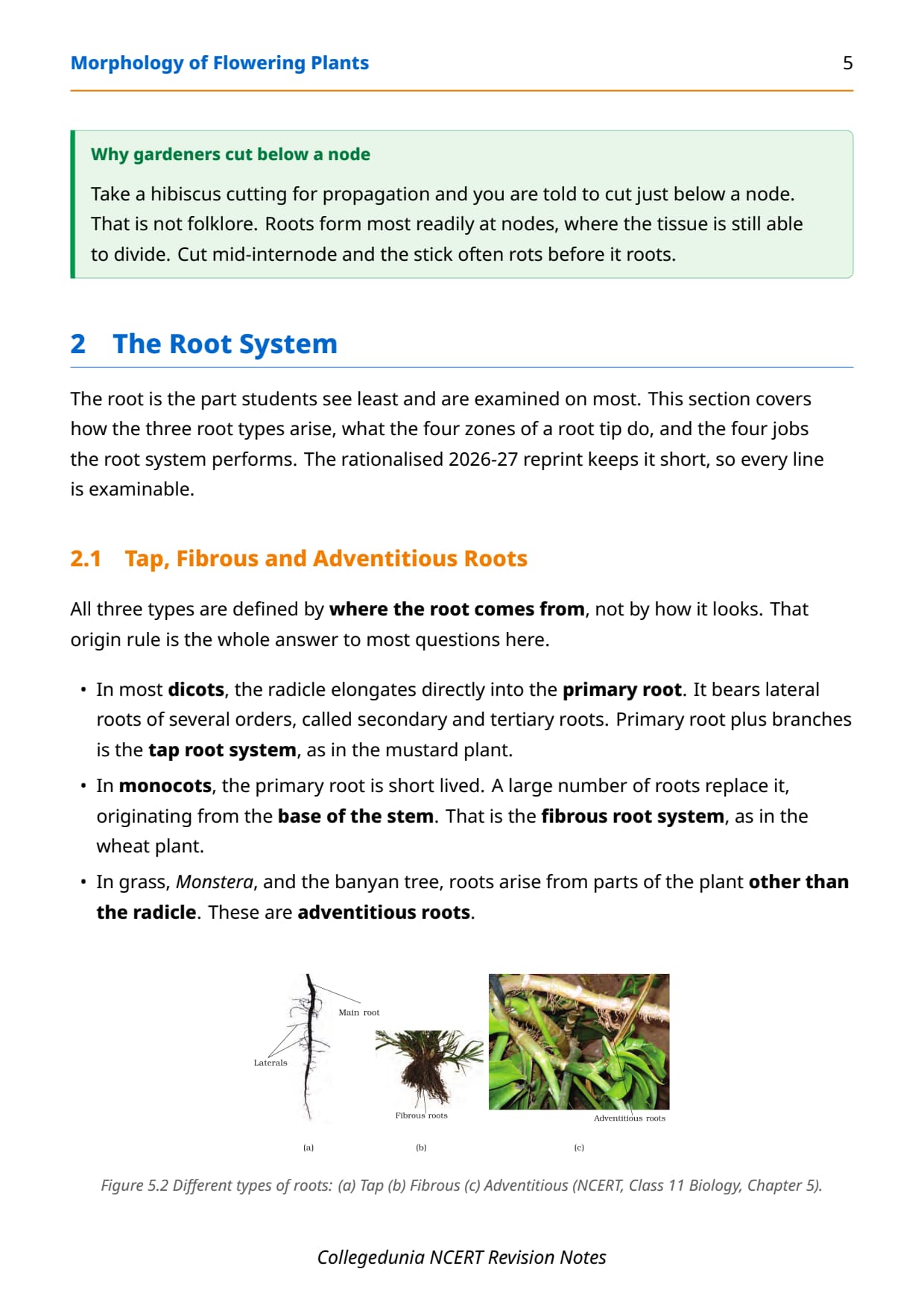
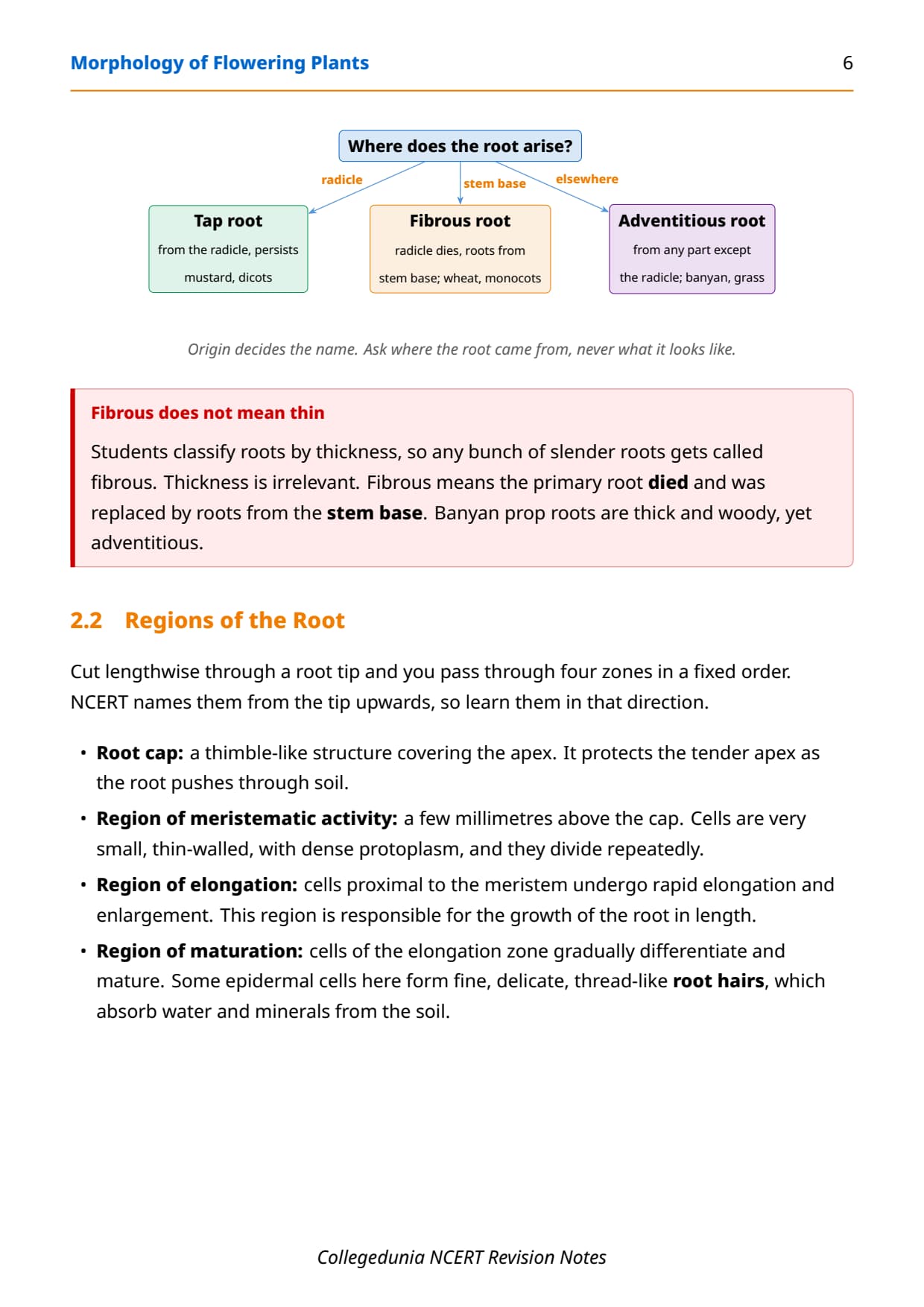
- Tap root: the radicle elongates into the primary root, which persists and bears lateral roots, as in mustard and most dicots.
- Fibrous root: the primary root is short lived and is replaced by many roots from the base of the stem, as in wheat and monocots.
- Adventitious root: roots arise from parts of the plant other than the radicle, as in grass, Monstera, and the banyan tree.
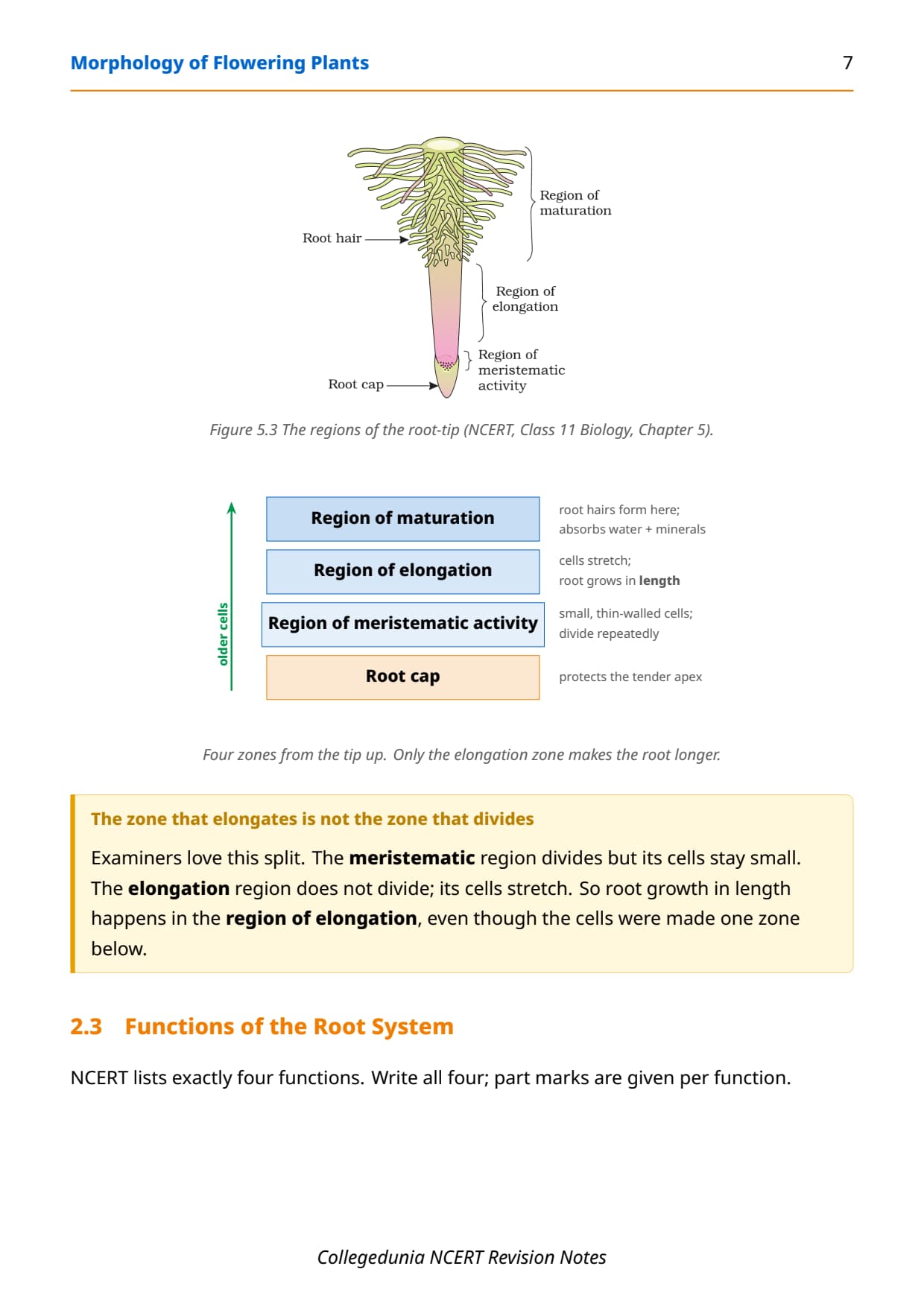
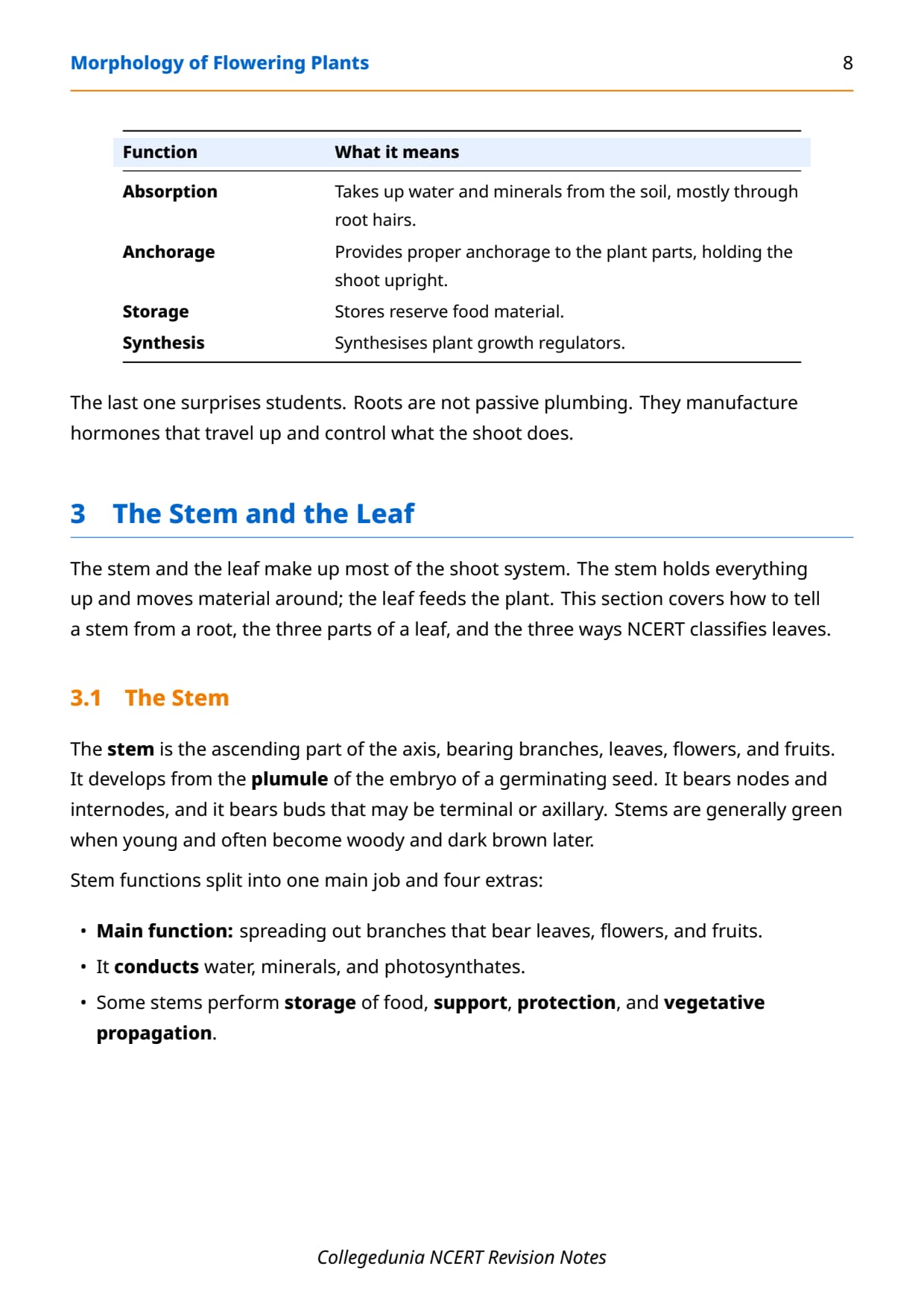
- Four root regions: the root cap protects the apex, the meristematic region divides, the region of elongation lengthens the root, and the region of maturation bears the root hairs that absorb water and minerals.
The four functions of the root are absorption, anchorage, storage of reserve food, and synthesis of plant growth regulators. The region that divides is not the region that elongates: cells are made in the meristematic zone but the root grows in length in the region of elongation. Do not classify roots by thickness either, since banyan prop roots are thick and woody yet adventitious. That single origin rule answers most questions in this section.
The Stem and the Leaf
The stem and the leaf make up most of the shoot system. The stem holds everything up and moves material around, while the leaf feeds the plant. This section covers how to tell a stem from a root, the three parts of a leaf, and the three ways NCERT classifies leaves. The decisive test throughout is the presence of nodes, internodes, and buds.
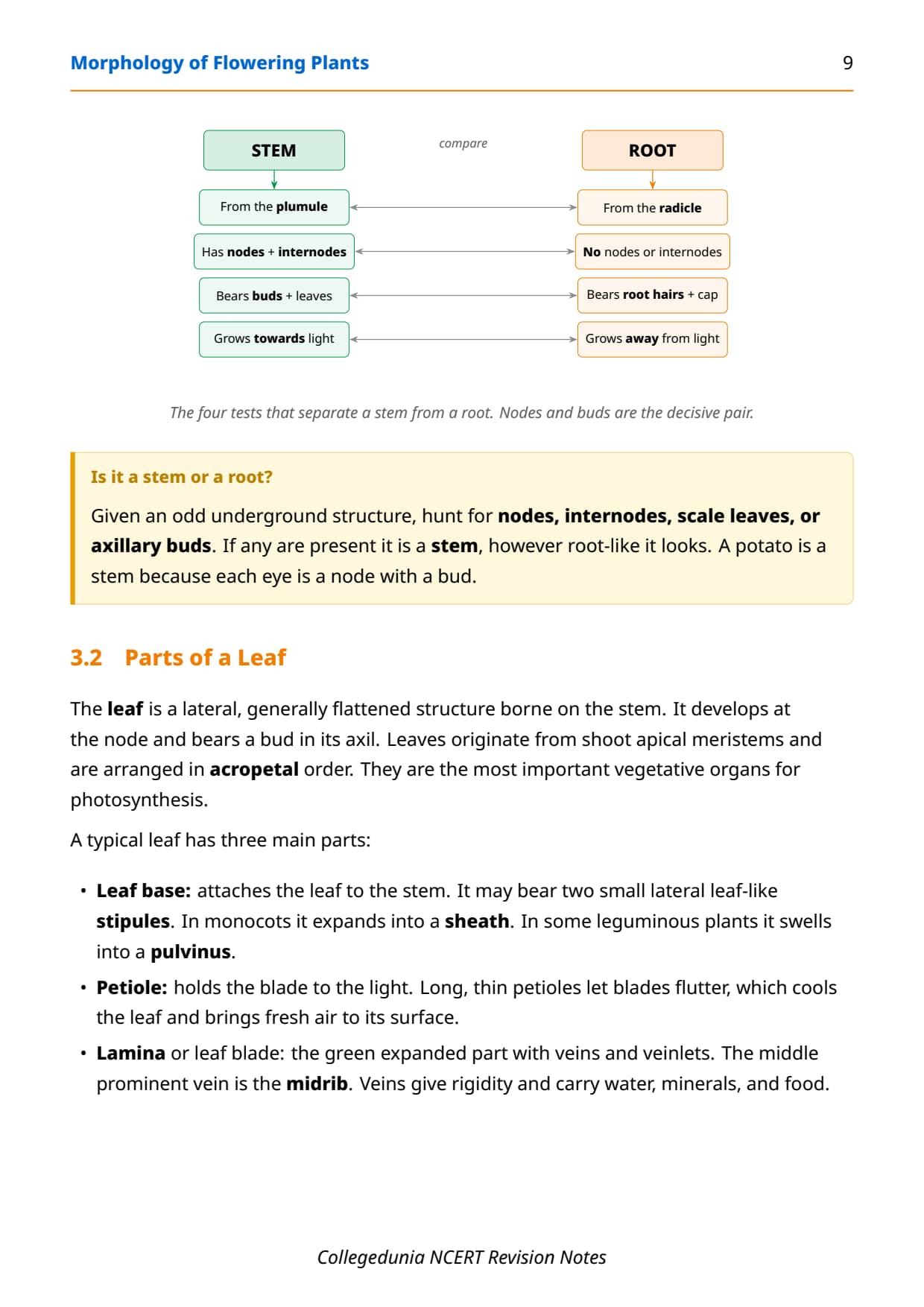
- Stem: the ascending axis that develops from the plumule, bears nodes and internodes, and carries terminal or axillary buds. Roots never carry nodes or buds, which is the fastest stem-versus-root test.
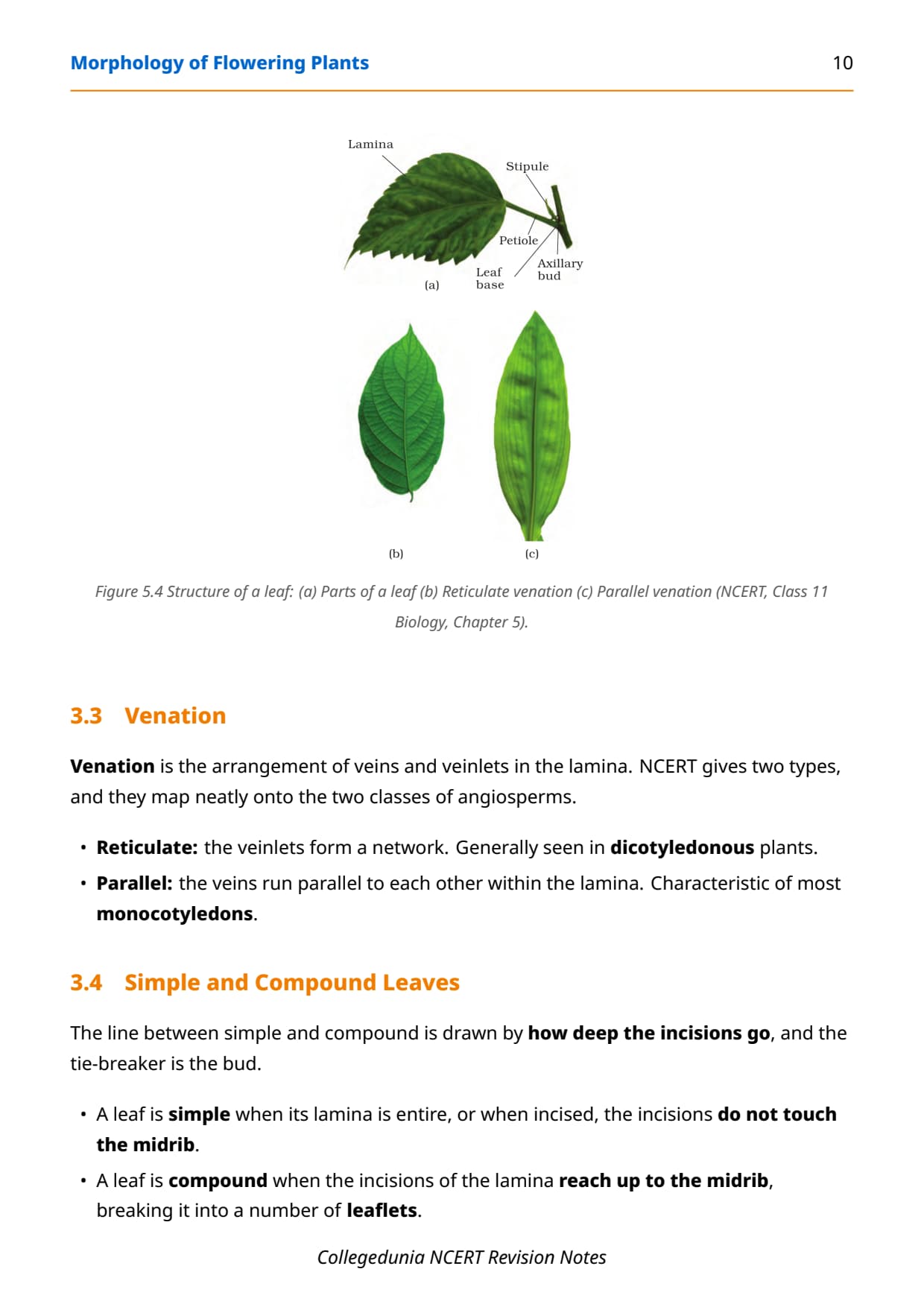
- Parts of a leaf: the leaf base (which may bear stipules or a sheath), the petiole, and the lamina with its midrib and veins.
- Venation: reticulate venation forms a network in most dicots, while parallel venation is characteristic of most monocots.
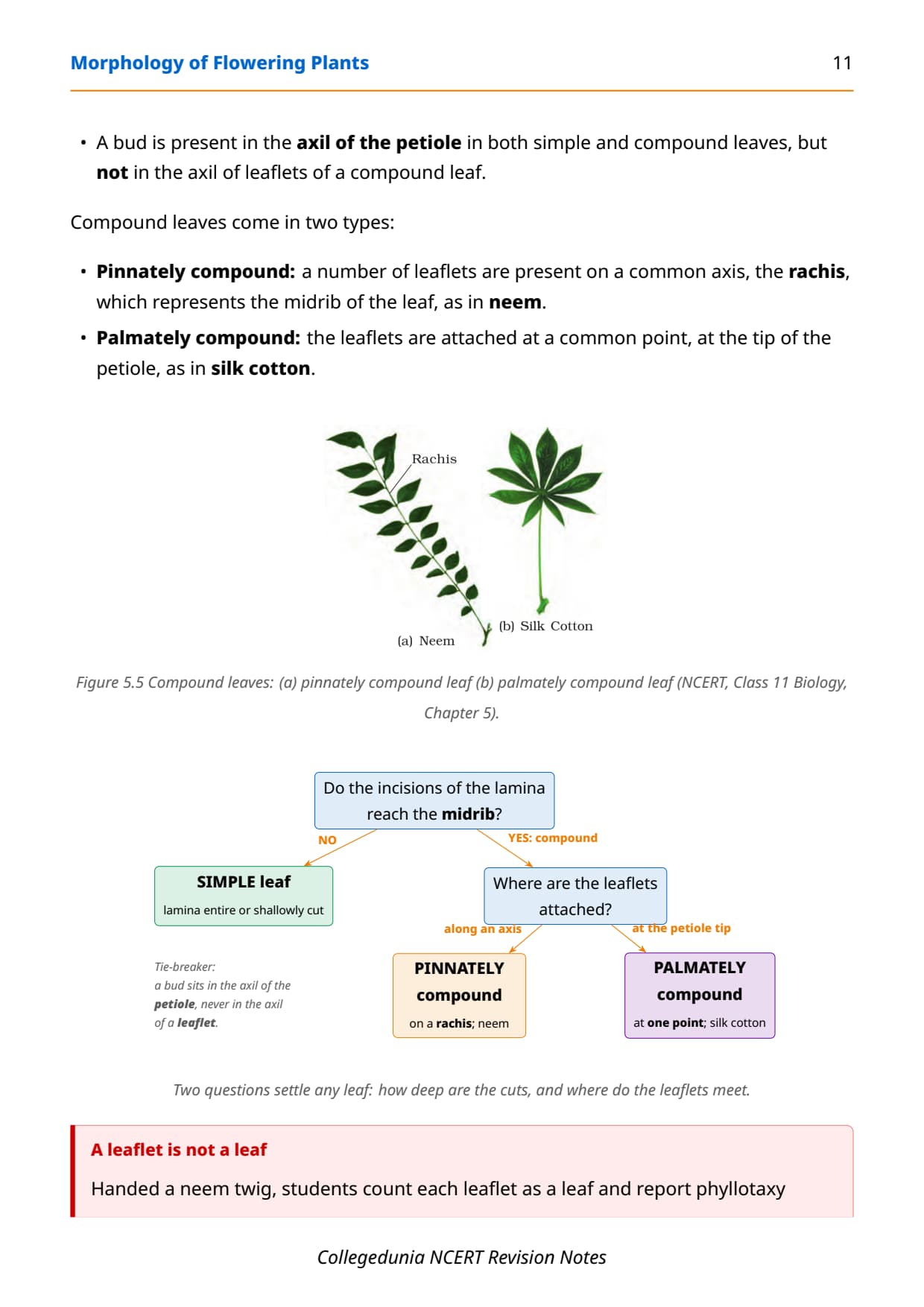
- Simple and compound leaves: a leaf is simple when incisions do not reach the midrib and compound when they do, giving pinnately compound leaves (neem) or palmately compound leaves (silk cotton).
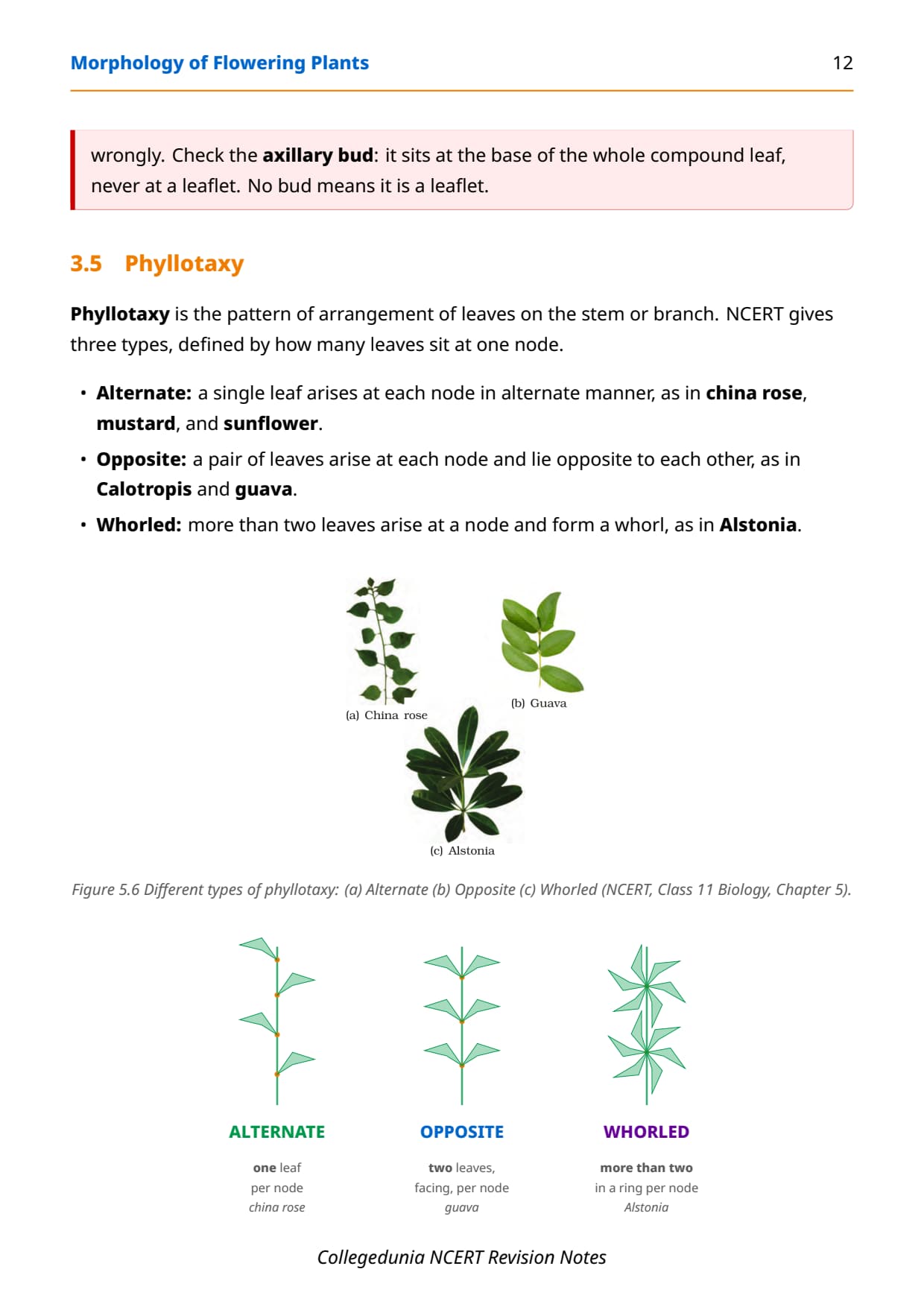
- Phyllotaxy: the arrangement of leaves is alternate (china rose), opposite (guava), or whorled (Alstonia).
A leaflet is not a leaf, and the tie-breaker is the bud. An axillary bud sits at the base of the whole compound leaf, never in the axil of a leaflet, so counting each neem leaflet as a leaf gives a wrong phyllotaxy. For phyllotaxy, put your finger on one node and count the leaves there: one is alternate, two is opposite, and three or more is whorled.
The Inflorescence
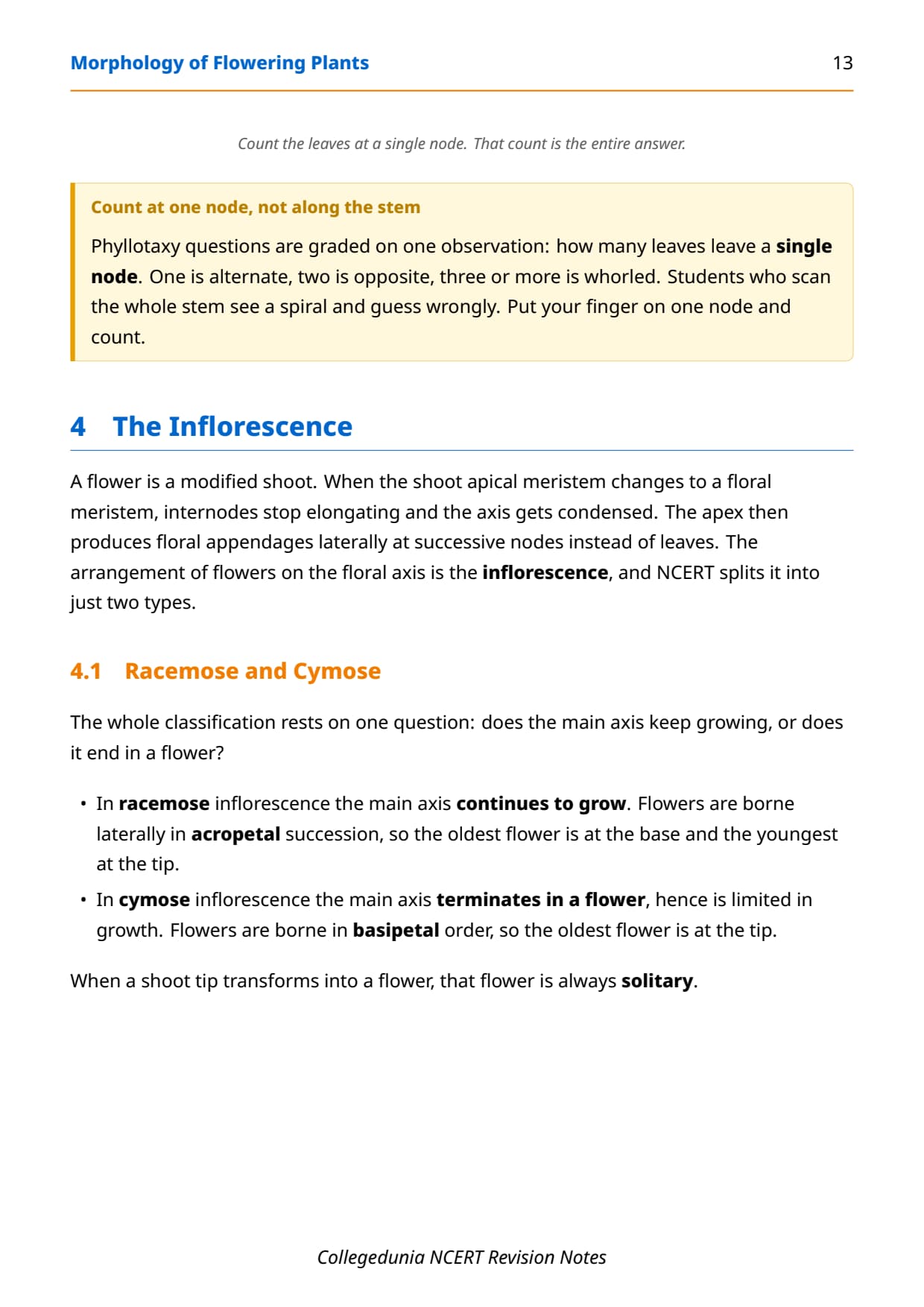
A flower is a modified shoot. When the shoot apical meristem changes to a floral meristem, the internodes stop elongating and the axis condenses, producing floral appendages at successive nodes instead of leaves. The arrangement of flowers on the floral axis is the inflorescence, and NCERT splits it into just two types on one question: does the main axis keep growing, or does it end in a flower?
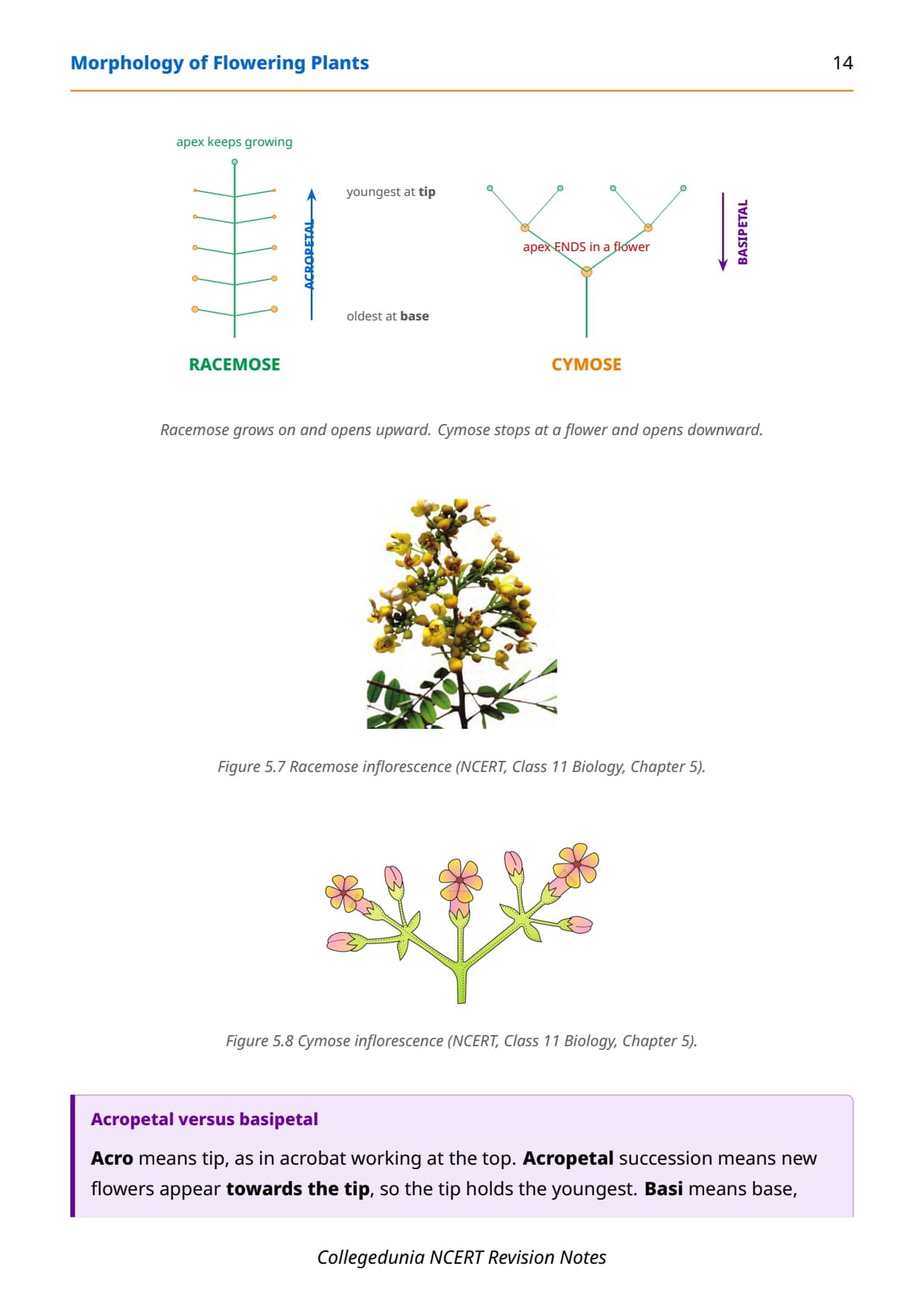
- Racemose: the main axis continues to grow and flowers are borne laterally in acropetal succession, so the oldest flower is at the base and the youngest at the tip.
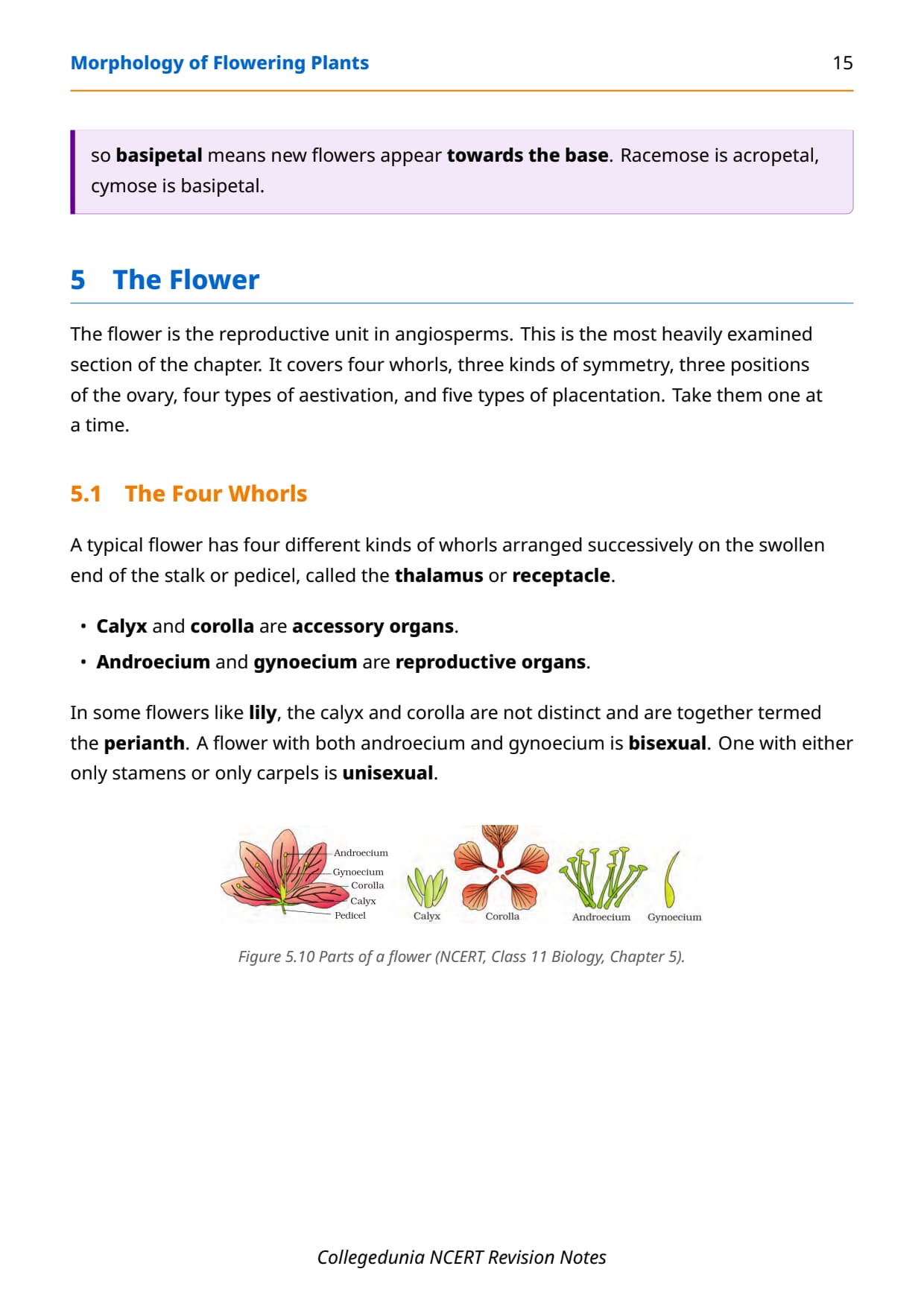
- Cymose: the main axis terminates in a flower and so is limited in growth, with flowers borne in basipetal order, so the oldest flower is at the tip.
- Solitary flower: when a shoot tip itself transforms into a flower, that flower is always solitary.
The direction words carry the marks, and they are easy to reverse. Acropetal means new flowers form towards the tip, so the tip holds the youngest, while basipetal means new flowers form towards the base. A useful hook is that "acro" means tip, as in acrobat working at the top, so racemose is acropetal and cymose is basipetal. Get this pair right and every inflorescence question resolves.
The Flower: Whorls, Symmetry, Aestivation and Placentation
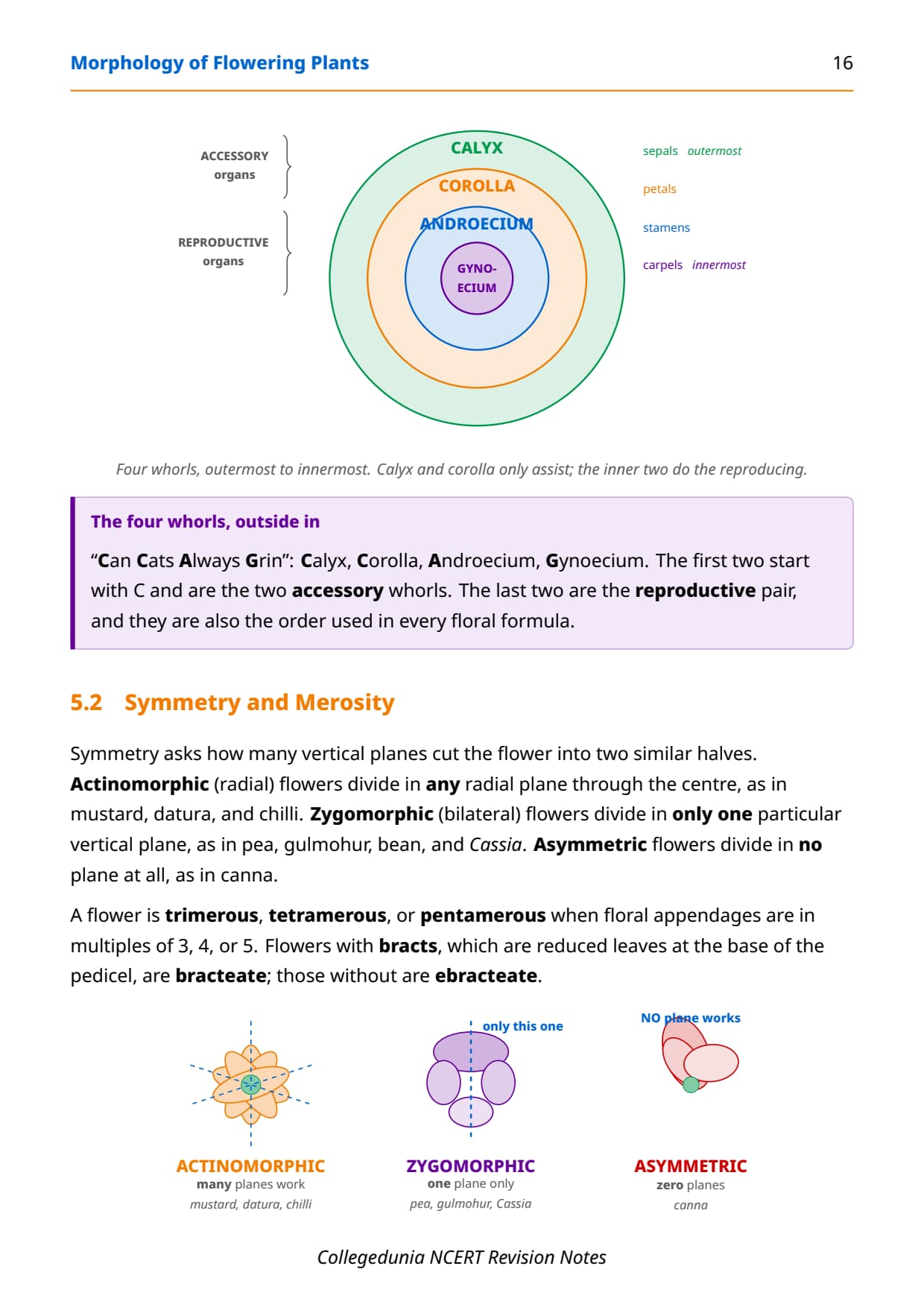
The flower is the reproductive unit in angiosperms and the most heavily examined section of the chapter. It covers four whorls, three kinds of symmetry, three positions of the ovary, four types of aestivation, and five types of placentation. Take them one at a time, and note that the flower name and the ovary name are often different words.
- The four whorls: calyx (sepals) and corolla (petals) are accessory organs, while androecium (stamens) and gynoecium (carpels) are reproductive organs, all borne on the thalamus. When calyx and corolla are alike, as in lily, they form a perianth.
- Symmetry: actinomorphic flowers divide in any radial plane (mustard, chilli), zygomorphic flowers in only one plane (pea, Cassia), and asymmetric flowers in no plane (canna).
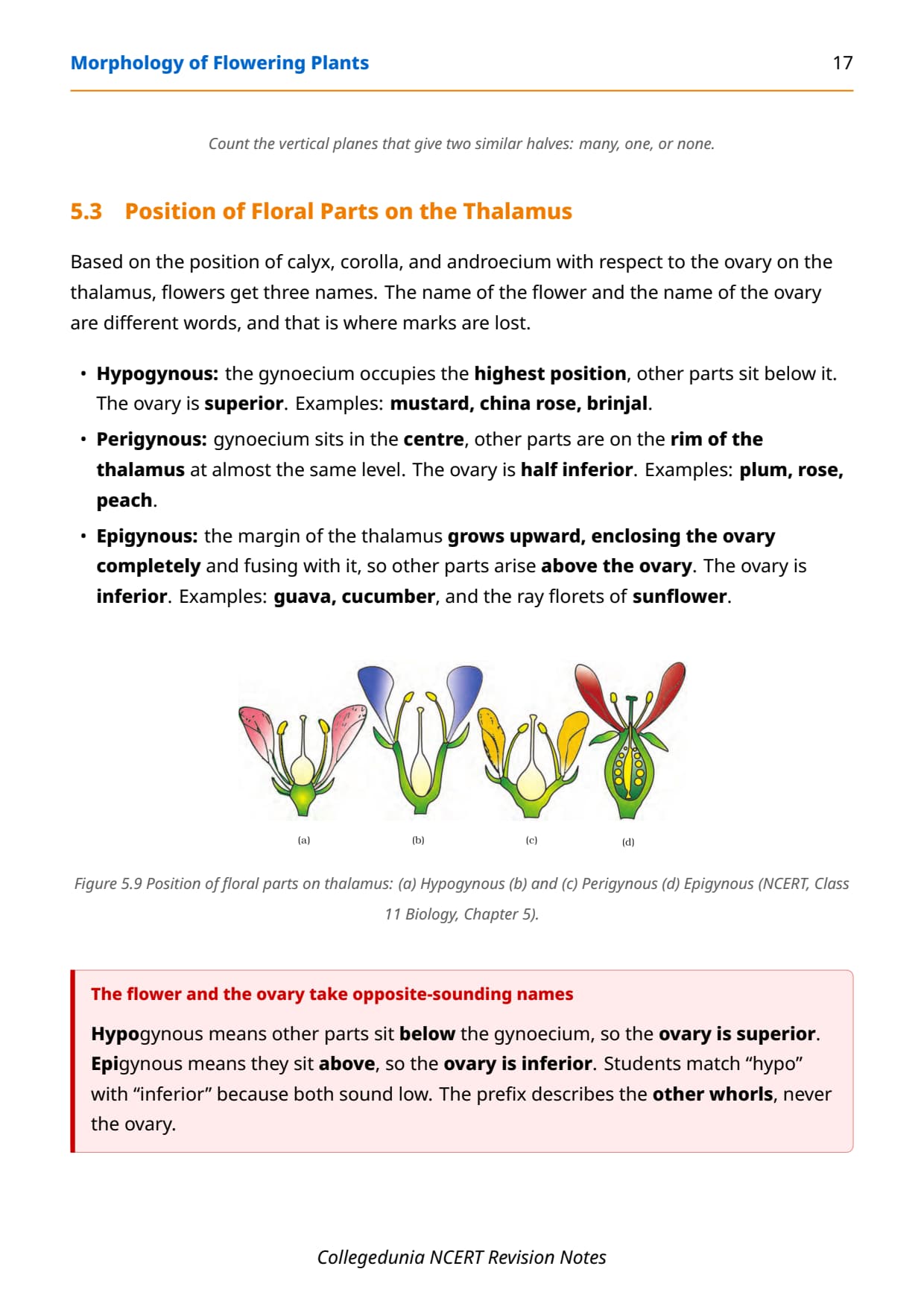
- Ovary position: hypogynous gives a superior ovary (mustard), perigynous a half-inferior ovary (rose, plum), and epigynous an inferior ovary (guava, cucumber).
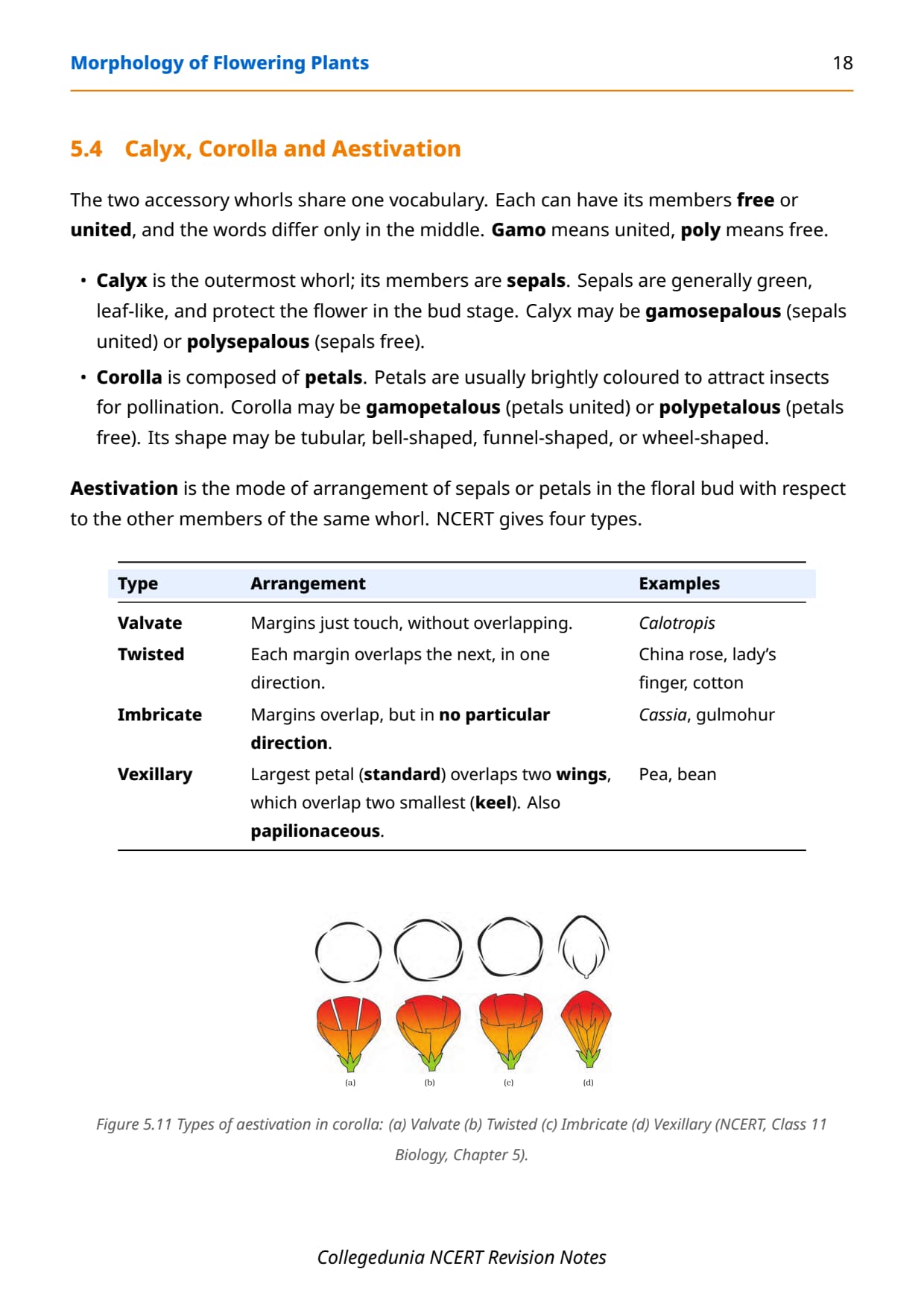
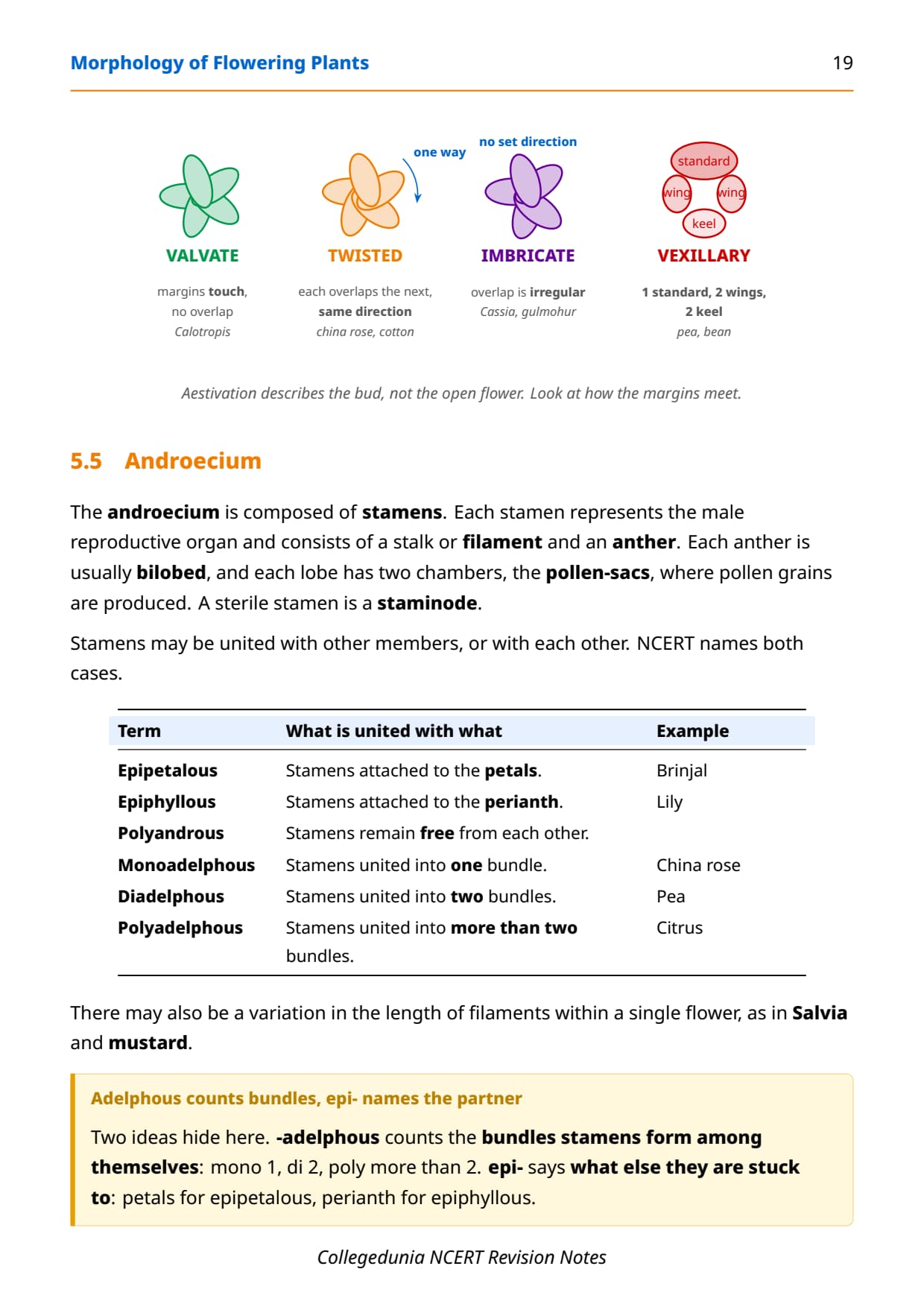
- Aestivation: the arrangement of sepals or petals in the bud is valvate, twisted, imbricate, or vexillary (papilionaceous, as in pea).
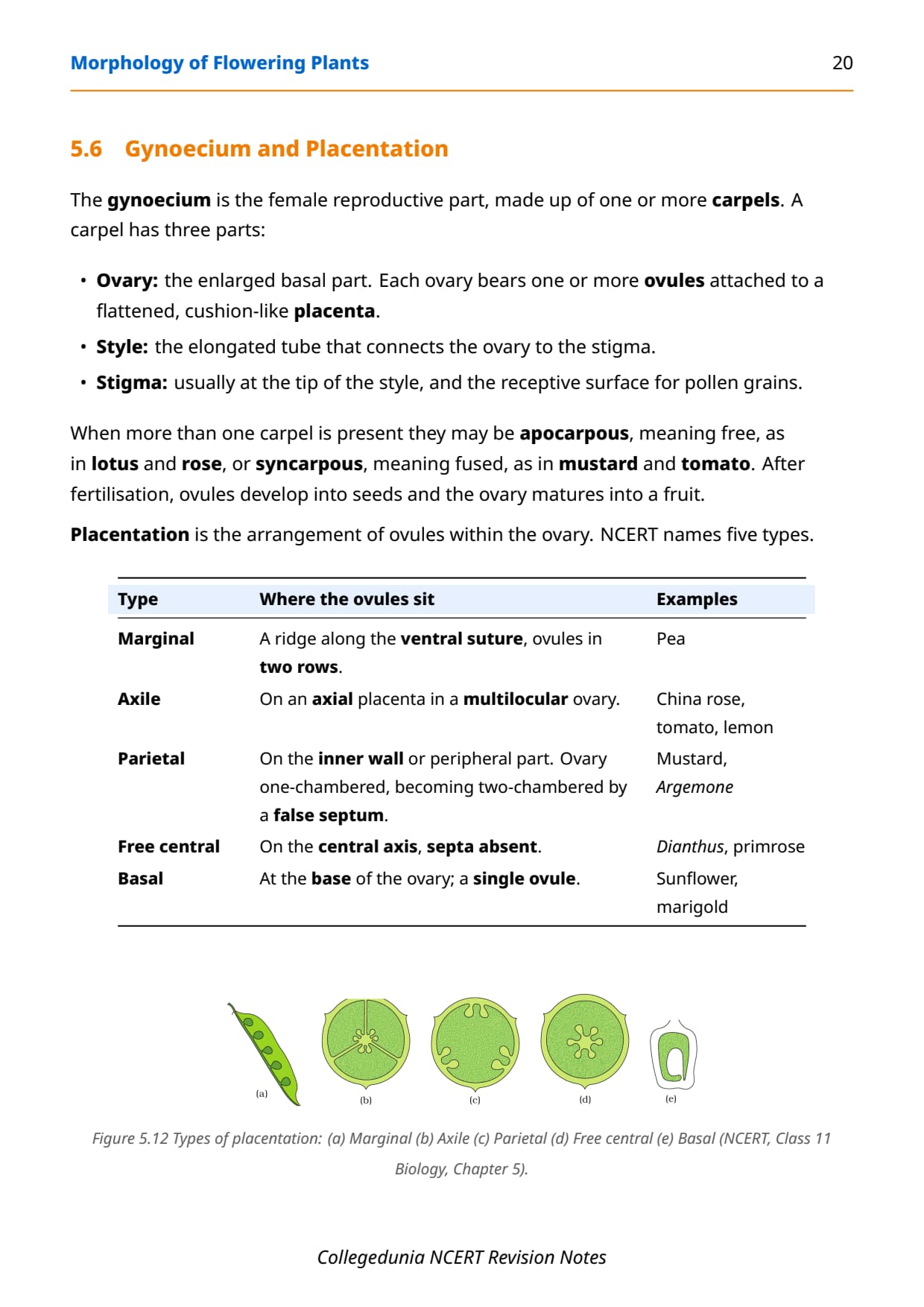
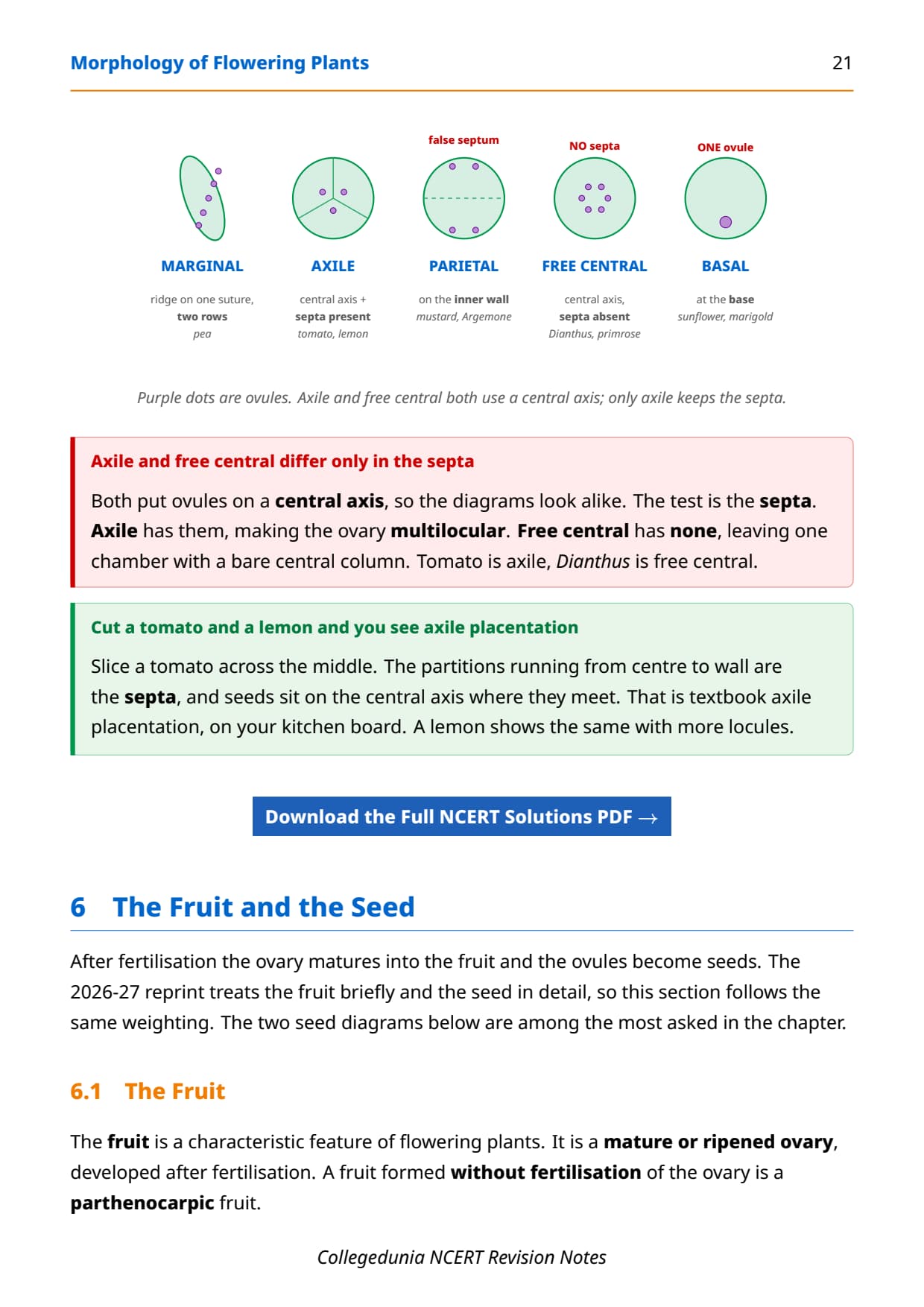
The androecium terms split into two ideas: -adelphous counts the bundles stamens form among themselves (monoadelphous one, diadelphous two, polyadelphous more than two), while epi- names what else they are attached to (epipetalous to petals, epiphyllous to the perianth). The gynoecium may be apocarpous (free carpels, as in lotus) or syncarpous (fused, as in tomato). Placentation, the arrangement of ovules in the ovary, has five NCERT types set out below.
| Placentation | Where the ovules sit | Examples |
|---|---|---|
| Marginal | On a ridge along the ventral suture, in two rows | Pea |
| Axile | On a central axis in a multilocular ovary, septa present | China rose, tomato, lemon |
| Parietal | On the inner wall, ovary one-chambered with a false septum | Mustard, Argemone |
| Free central | On the central axis, septa absent | Dianthus, primrose |
| Basal | At the base of the ovary, a single ovule | Sunflower, marigold |
Axile and free central both use a central axis, and the septa are the only difference: axile keeps them, free central has none. Watch the ovary-position trap too, since the prefix describes the other whorls, not the ovary. Hypogynous puts the other parts below, so the ovary is superior, which feels backwards to most students.
The Fruit and the Seed
After fertilisation the ovary matures into the fruit and the ovules become seeds. The 2026-27 reprint treats the fruit briefly and the seed in detail, and the two seed diagrams are among the most asked in the chapter. Learn the pericarp layers, then the dicot and monocot seed structures side by side.
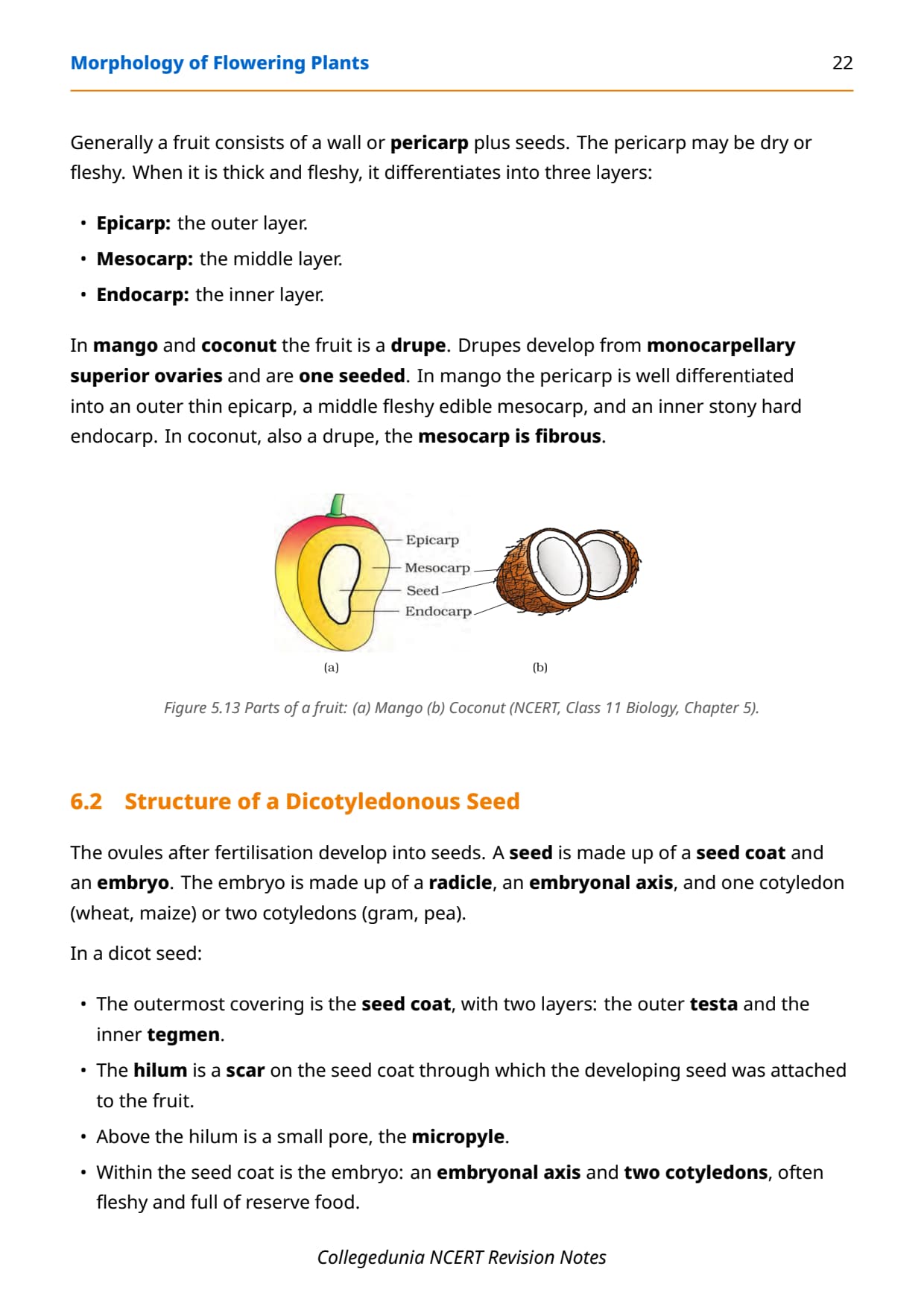
- Fruit: a mature or ripened ovary, formed after fertilisation. A fruit formed without fertilisation is parthenocarpic. The wall, or pericarp, differentiates into epicarp, mesocarp, and endocarp when fleshy.
- Drupe: a one-seeded fruit from a monocarpellary superior ovary, as in mango (stony endocarp) and coconut (fibrous mesocarp).
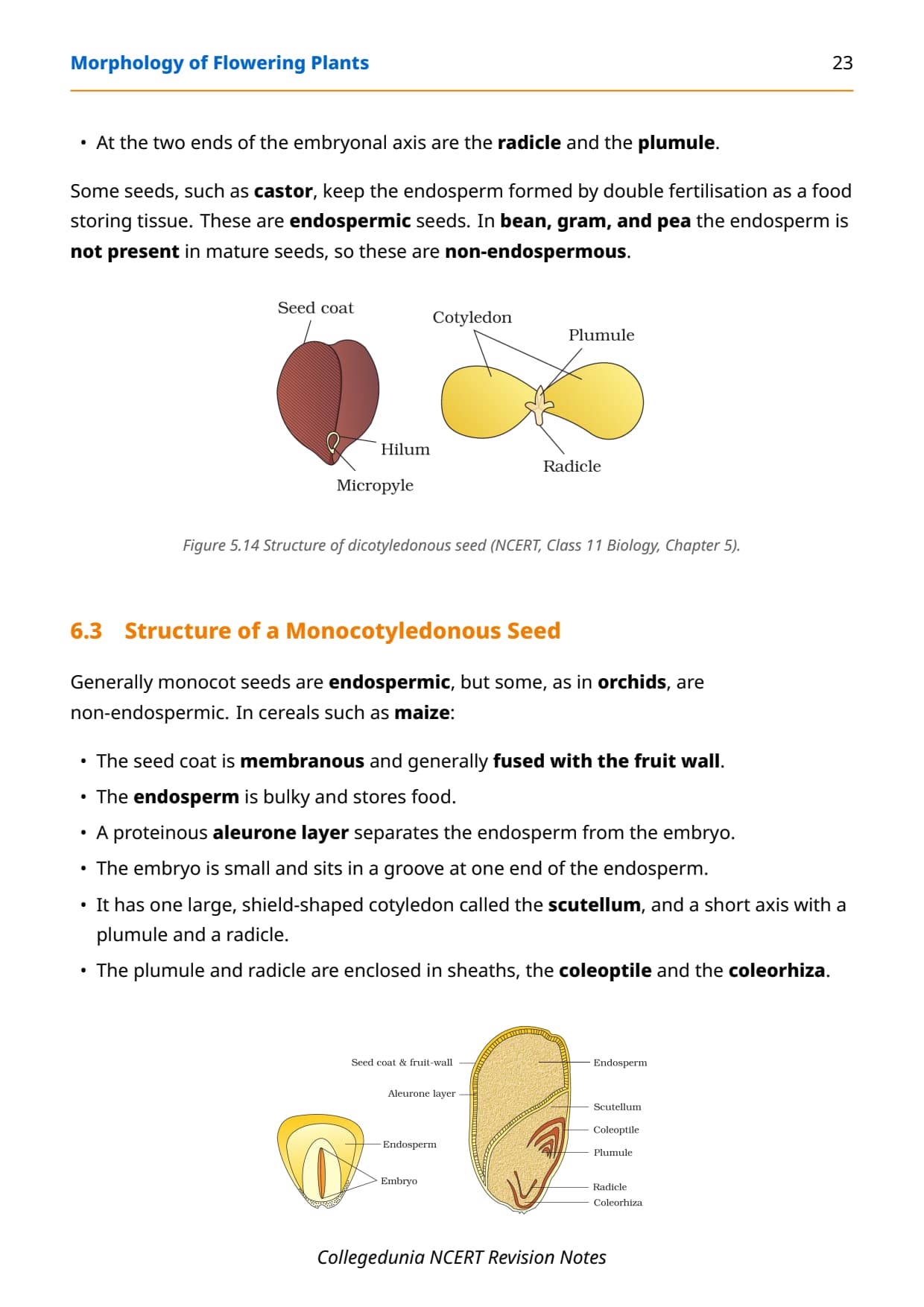
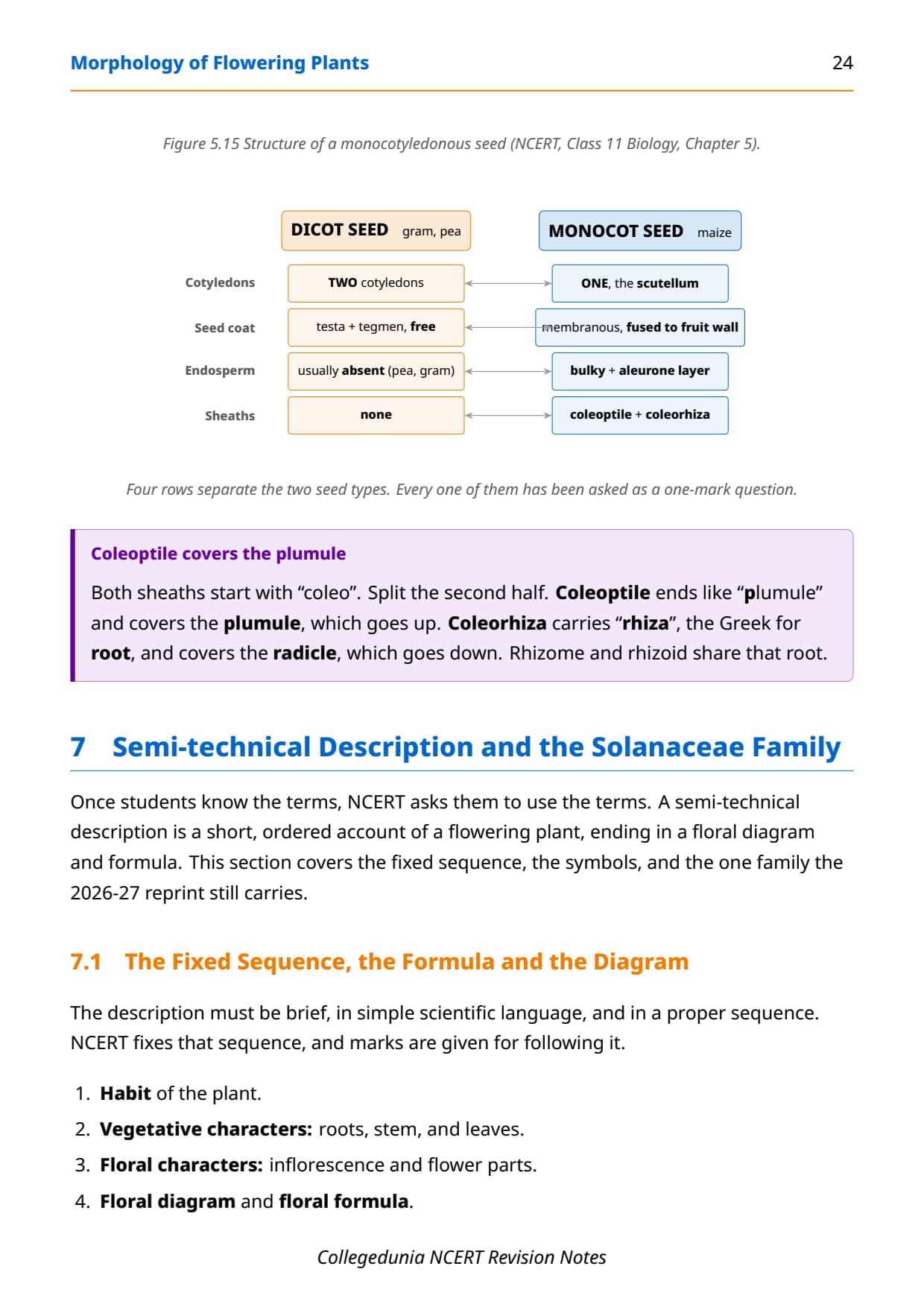
- Dicot seed: a seed coat of testa and tegmen, a hilum scar with a micropyle above it, and an embryo with two cotyledons, a radicle, and a plumule. Bean, gram, and pea are non-endospermous.
- Monocot seed: generally endospermic, with a bulky endosperm, a proteinous aleurone layer, one shield-shaped cotyledon called the scutellum, and the sheaths coleoptile and coleorhiza.
The coleoptile covers the plumule and the coleorhiza covers the radicle, and the second half of each word gives it away, since "rhiza" is Greek for root. Do not swap the hilum and the micropyle either: the hilum is a scar where the seed was attached to the fruit, while the micropyle is a small pore above it. These four seed rows are each a standard one-mark question.
Semi-technical Description and the Solanaceae Family
Once students know the terms, NCERT asks them to use the terms. A semi-technical description is a short, ordered account of a flowering plant that ends in a floral diagram and a floral formula. This section covers the fixed sequence, the formula symbols, and the one family the 2026-27 reprint still carries, which is Solanaceae.
- The fixed sequence: describe the habit, then vegetative characters (roots, stem, leaves), then floral characters (inflorescence and flower parts), and finish with the floral diagram and formula.
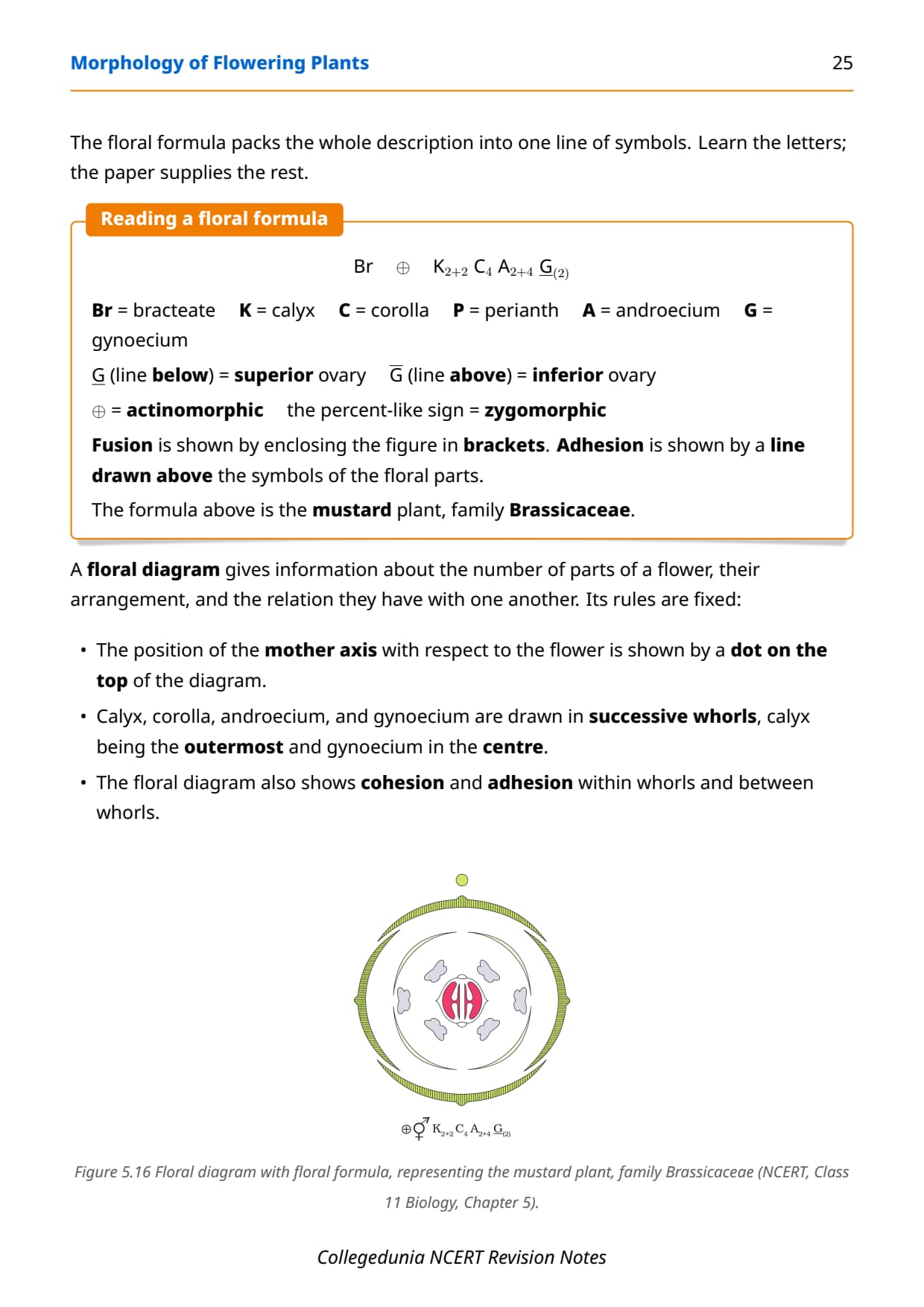
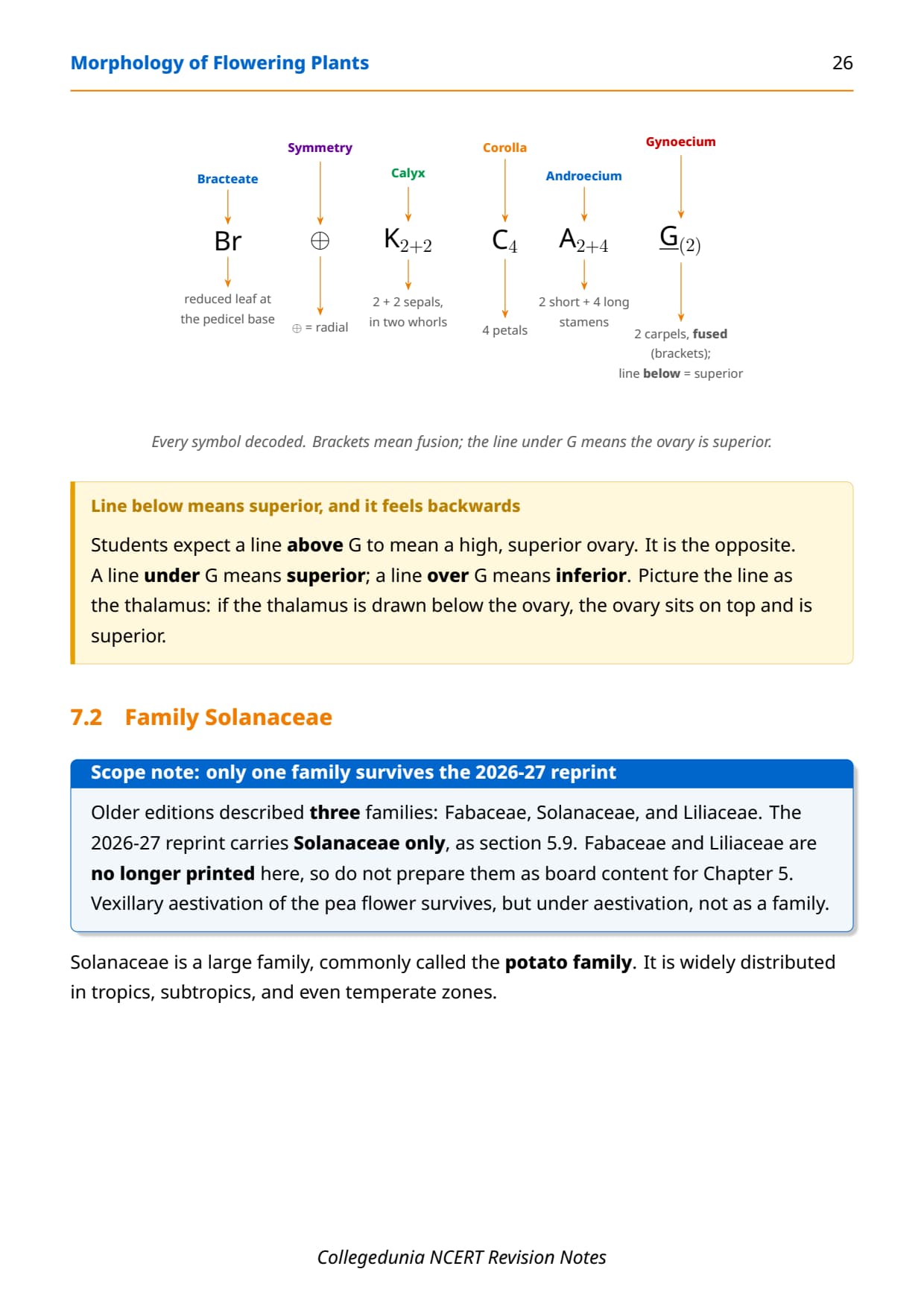
- Formula symbols: Br bracteate, K calyx, C corolla, P perianth, A androecium, G gynoecium. A line below G means a superior ovary and a line above G means an inferior ovary.
- Symmetry and fusion signs: the plus-in-circle sign marks an actinomorphic flower, brackets around a figure show fusion, and a line above the symbols shows adhesion between whorls.
- Floral diagram: the mother axis is a dot at the top, and the four whorls are drawn in successive circles with calyx outermost and gynoecium in the centre.
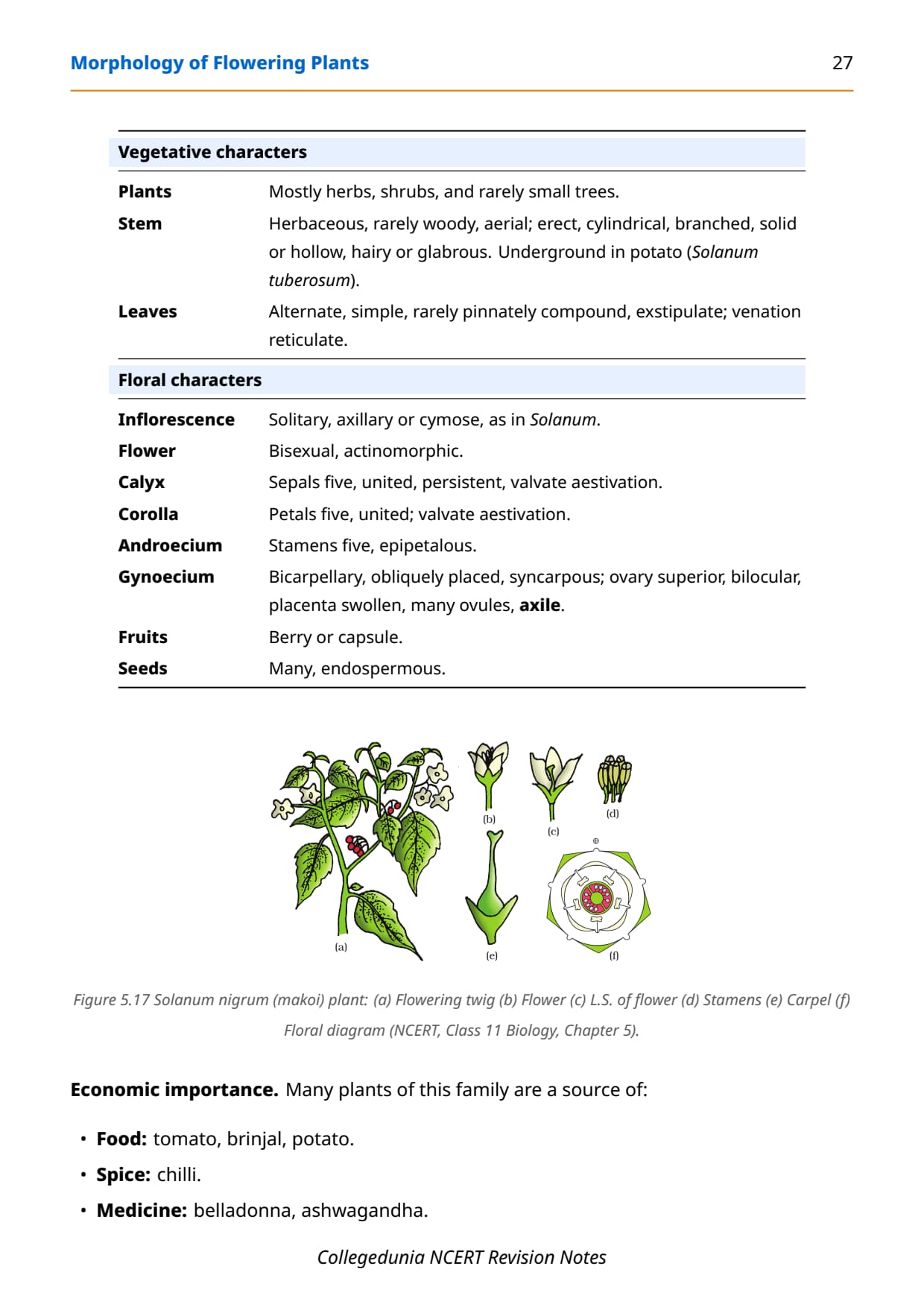
Family Solanaceae, the potato family, is described in one memorable line: everything is five and united, that is, 5 sepals united, 5 petals united, and 5 epipetalous stamens, then the gynoecium breaks the pattern with 2 obliquely placed carpels, a superior ovary, and axile placentation. Older editions described Fabaceae, Solanaceae, and Liliaceae, but the 2026-27 reprint carries Solanaceae only, so do not prepare the other two families as board content for this chapter. Solanaceae plants give food (tomato, brinjal, potato), spice (chilli), medicine (belladonna), and ornamentals (petunia).
Modifications of Root, Stem and Leaf (NEET Extension)
Plants adapt their standard organs to their environment, and a structure keeps its identity as root, stem, or leaf no matter how strange it looks, because identity is set by origin. The 2026-27 rationalised reprint of Chapter 5 does not carry the modifications sections, so they are not required for CBSE board answers, but they remain in the NEET and CUET syllabus and appear in older question banks, so revise them as a clearly marked extension.
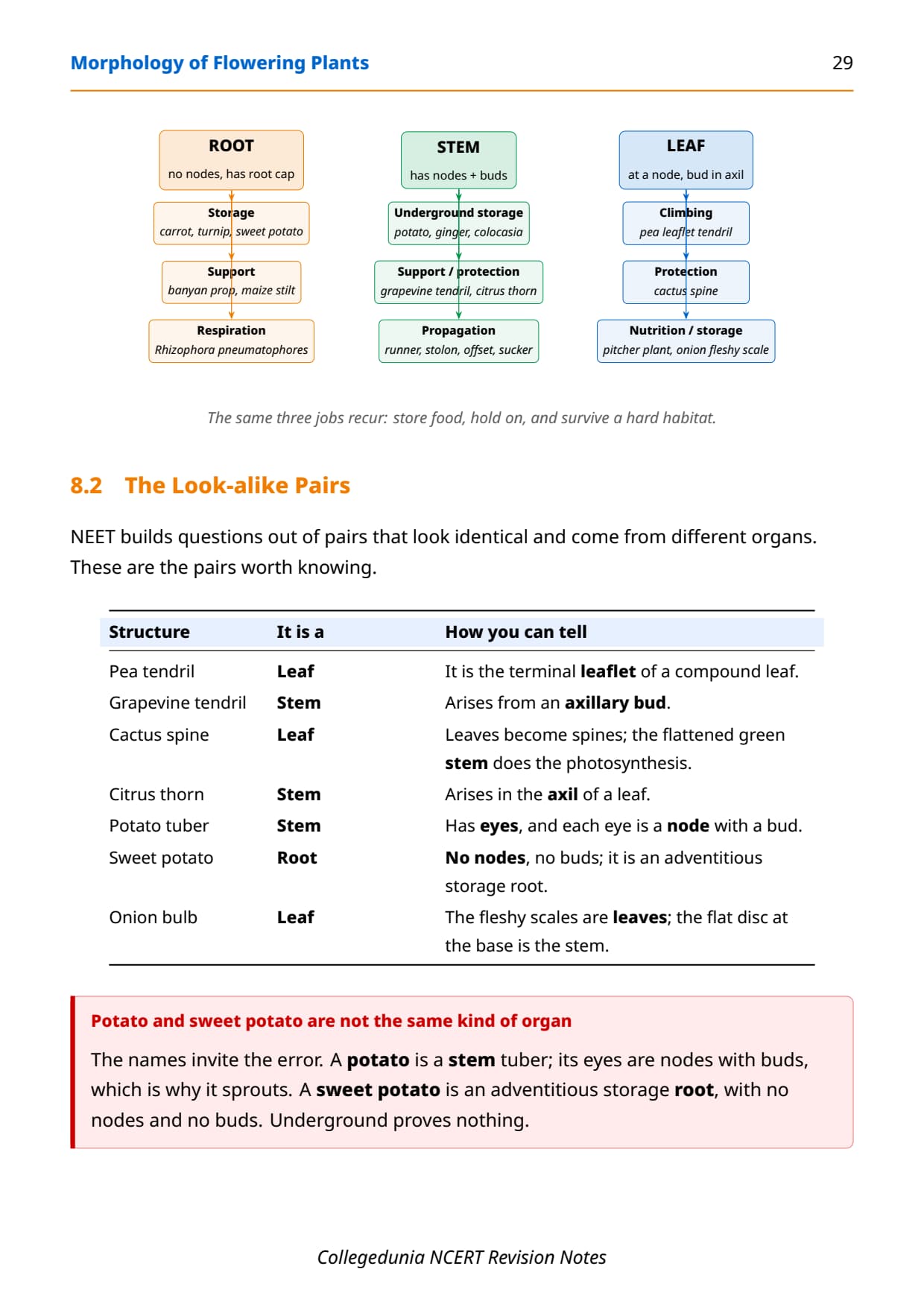
- Root modifications: storage (carrot, turnip, sweet potato), support (banyan prop roots, maize stilt roots), and respiration (Rhizophora pneumatophores).
- Stem modifications: underground storage (potato, ginger), support and protection (grapevine tendril, citrus thorn), and vegetative propagation (runner, stolon, offset, sucker).
- Leaf modifications: climbing (pea leaflet tendril), protection (cactus spine), and nutrition or storage (pitcher plant, onion fleshy scales).
Every modification question is really one question: is this thing a root, a stem, or a leaf? Stems carry nodes and axillary buds wherever they grow, roots carry a root cap but never nodes, and leaves arise at a node with a bud in the axil. That is why a potato is a stem, since each eye is a node with a bud, while a sweet potato is an adventitious storage root with no nodes. A grapevine tendril arises from an axillary bud and is a stem, while a pea tendril is the terminal leaflet of a leaf. Being underground proves nothing about identity.
Key Definitions in Morphology of Flowering Plants
Board short-answer questions often ask for a clean definition in one or two lines, and a vague answer loses easy marks. Learn these word-for-word, because the wording of the exam question is usually built straight from the NCERT definition. Each term below also connects to a diagram or example you can be asked to explain.
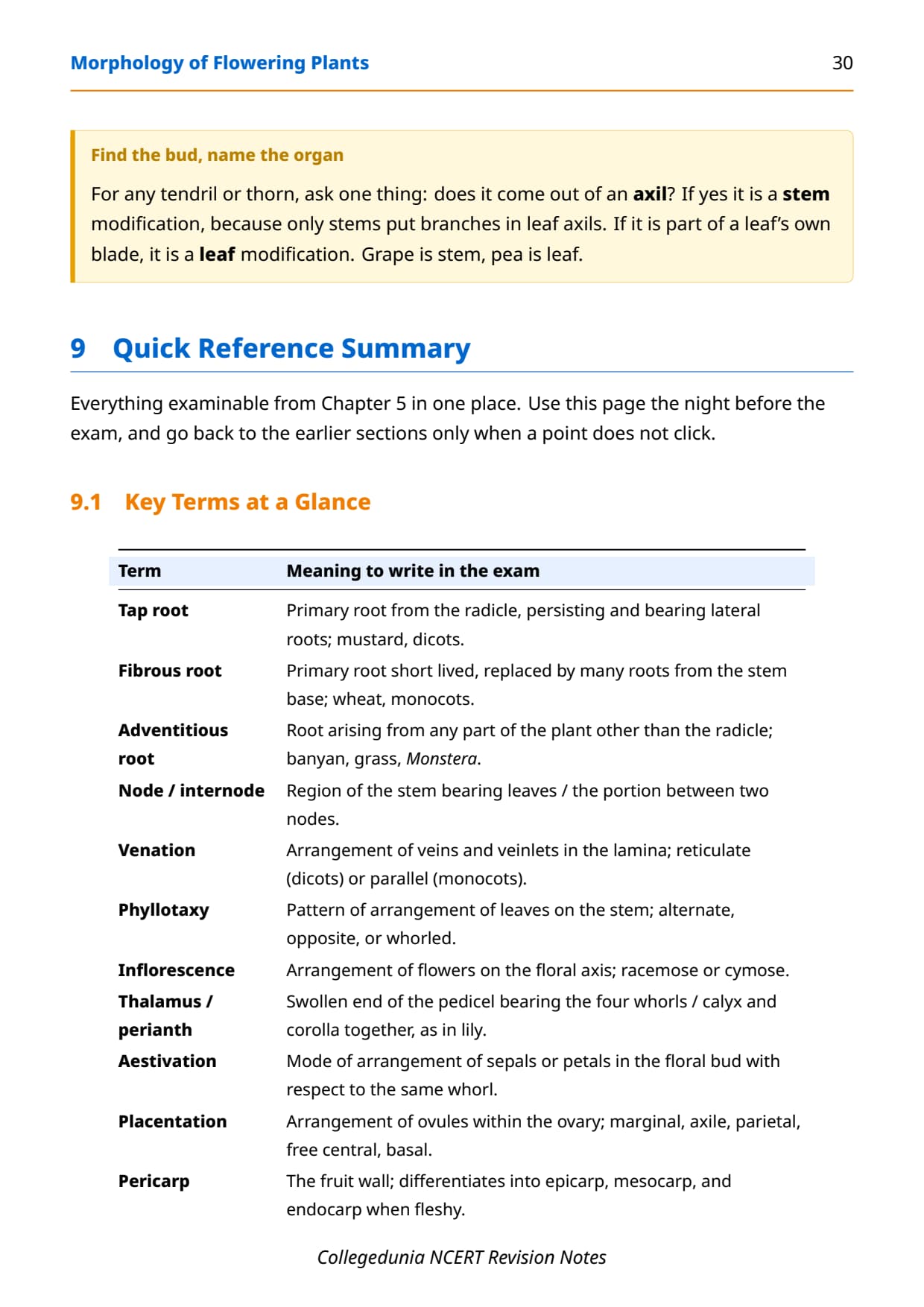
| Term | Definition |
|---|---|
| Adventitious root | A root arising from any part of the plant other than the radicle; banyan, grass, Monstera. |
| Venation | The arrangement of veins and veinlets in the lamina; reticulate in dicots, parallel in monocots. |
| Phyllotaxy | The pattern of arrangement of leaves on the stem; alternate, opposite, or whorled. |
| Inflorescence | The arrangement of flowers on the floral axis; racemose or cymose. |
| Aestivation | The mode of arrangement of sepals or petals in the floral bud with respect to the same whorl. |
| Placentation | The arrangement of ovules within the ovary; marginal, axile, parietal, free central, or basal. |
| Scutellum | The single, large, shield-shaped cotyledon of a monocot seed such as maize. |
A common board question asks you to distinguish racemose from cymose inflorescence. State whether the main axis keeps growing or ends in a flower, then give the acropetal or basipetal order to earn the full mark. Learning these definitions makes the wording of almost every one-mark and two-mark question in this chapter familiar.
Common Mistakes Students Make in Morphology of Flowering Plants
These slips happen because two terms look alike, not because the concept is hard. Each one costs 1 to 2 marks in the paper, so watch for them at the exact step where they occur.
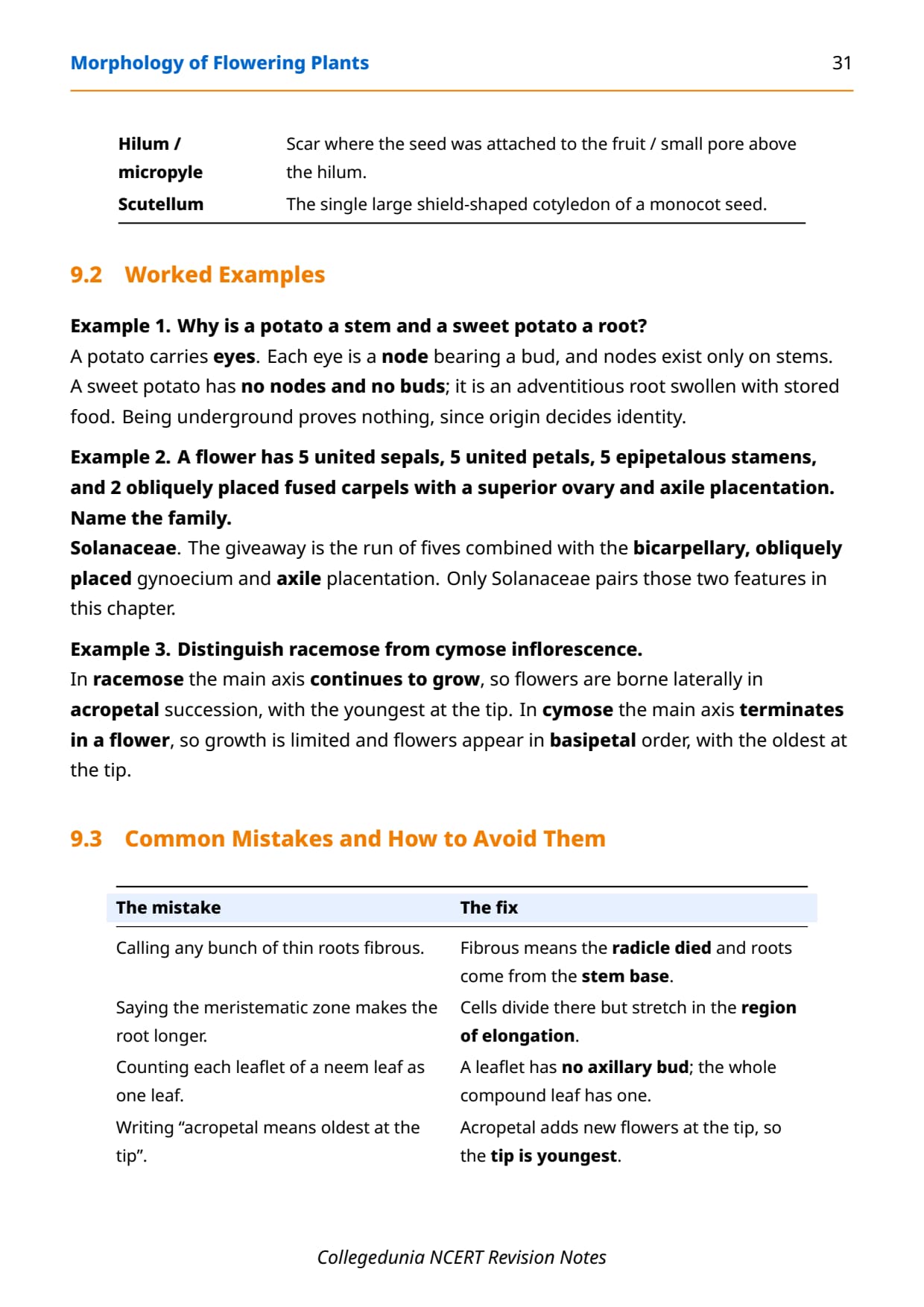
Mistake 1: Calling any bunch of thin roots fibrous. Fibrous means the radicle died and roots come from the stem base, whatever their thickness.
Mistake 2: Saying the meristematic zone makes the root longer. Cells divide there but stretch in the region of elongation.
Mistake 3: Writing that acropetal means oldest at the tip. Acropetal adds new flowers at the tip, so the tip is youngest.
Mistake 4: Matching hypogynous with an inferior ovary. Hypogynous puts other parts below, so the ovary is superior.
Mistake 5: Mixing axile with free central placentation, or preparing Fabaceae and Liliaceae. Axile has septa, free central has none, and the 2026-27 reprint carries Solanaceae only.
Morphology of Flowering Plants Weightage in CBSE Boards, NEET and CUET
This chapter is term-dense and consistently high-yield. It rewards clean diagrams and exact definitions, and it appears every year as a floral or seed question in the boards and as multiple objective questions in NEET. Here is how the marks split across the main exams for 2026-27.
| Exam | Typical weightage | What is asked |
|---|---|---|
| CBSE Boards | 5 to 7 marks | One question on floral parts or seed structure plus a diagram or the semi-technical description |
| NEET | 2 to 4 questions | Placentation, aestivation, root regions, and the Solanaceae floral formula |
| CUET | 1 to 3 objective questions | Matching terms to examples, venation and phyllotaxy, and seed structure |
Placentation, aestivation, and the seed diagrams are the three most tested ideas from this chapter across all three exams. Master the flower whorls and the two seed structures first, then placentation and aestivation, then the Solanaceae description, in that order of return on effort for the 2026-27 session.
How to Revise Morphology of Flowering Plants Quickly
Use these morphology of flowering plants class 11 notes for a fast, ordered recap the night before a test. The checklist below takes about 25 minutes and hits every marks-heavy idea in the chapter without opening the full textbook.
- First 9 minutes: write the three root types by origin, the four root regions in order, and the three parts of a leaf with venation and phyllotaxy.
- Next 8 minutes: list the four whorls, the three symmetries, the three ovary positions, the four aestivations, and the five placentations with one example each.
- Last 8 minutes: draw the dicot and monocot seeds, then write the Solanaceae floral formula from memory.
Close the loop by explaining why a potato is a stem while a sweet potato is a root. If you can reach the answer through nodes and buds, the identity idea has landed and the chapter is exam-ready. Keep the placentation table and the two seed diagrams beside you for the first pass only, then try the whole checklist closed-book.
Student Feedback on the Morphology of Flowering Plants Notes
What 12,110 students told us about their Morphology of Flowering Plants revision:
- 69% of students rated the placentation types and the two seed diagrams as the part most worth practising for the exam.
- Most-confused pair: axile versus free central placentation, mixed up by about 4 in 10 students.
- Students who learnt the floral formula with the mustard and Solanaceae examples said the semi-technical description questions felt easy afterwards.
Source: 2026-27 Class 11 Biology student poll. Sample of 12,110 students from CBSE schools across 15 states, conducted before the 2026 boards.
Other Morphology of Flowering Plants Class 11 Biology Resources
Pair these notes with the solved answers, the formula sheet, and the textbook PDF for the same chapter.
| Resource | Link |
|---|---|
| NCERT Solutions | Morphology of Flowering Plants Class 11 NCERT Solutions |
| Formula Sheet | Morphology of Flowering Plants Class 11 Formula Sheet |
| Exemplar Solutions | Morphology of Flowering Plants Class 11 Exemplar Solutions |
| NCERT Book PDF | Morphology of Flowering Plants Class 11 Book PDF |
| Exemplar Book PDF | Morphology of Flowering Plants Class 11 Exemplar Book PDF |
NCERT Notes for Class 11 Biology: All Chapters
Jump to the revision notes for any other Class 11 Biology chapter below.
| Chapter | NCERT Notes |
|---|---|
| Chapter 1 | The Living World |
| Chapter 2 | Biological Classification |
| Chapter 3 | Plant Kingdom |
| Chapter 4 | Animal Kingdom |
| Chapter 5 | Morphology of Flowering Plants |
| Chapter 6 | Anatomy of Flowering Plants |
| Chapter 7 | Structural Organisation in Animals |
| Chapter 8 | Cell The Unit of Life |
| Chapter 9 | Biomolecules |
| Chapter 10 | Cell Cycle and Cell Division |
| Chapter 11 | Photosynthesis in Higher Plants |
| Chapter 12 | Respiration in Plants |
| Chapter 13 | Plant Growth and Development |
| Chapter 14 | Breathing and Exchange of Gases |
| Chapter 15 | Body Fluids and Circulation |
| Chapter 16 | Excretory Products and their Elimination |
| Chapter 17 | Locomotion and Movement |
| Chapter 18 | Neural Control and Coordination |
| Chapter 19 | Chemical Coordination and Integration |
FAQs on Morphology of Flowering Plants Class 11 Biology Notes
Morphology of Flowering Plants Notes - Frequently Asked Questions
Ques. What topics do the morphology of flowering plants class 11 notes cover?
Ans. These morphology of flowering plants class 11 notes cover the root system and its regions, the stem and leaf with venation and phyllotaxy, racemose and cymose inflorescence, the four floral whorls, symmetry, ovary position, aestivation, placentation, the fruit and its pericarp, the dicot and monocot seed structures, the semi-technical description with the floral formula, and the family Solanaceae. The NEET extension on modifications of root, stem, and leaf is also included.
Ques. What is the difference between racemose and cymose inflorescence?
Ans. In a racemose inflorescence the main axis continues to grow and flowers are borne laterally in acropetal succession, so the oldest flower is at the base and the youngest at the tip. In a cymose inflorescence the main axis terminates in a flower and is limited in growth, so flowers are borne in basipetal order, with the oldest at the tip. The one test is whether the main axis keeps growing or ends in a flower.
Ques. What are the five types of placentation?
Ans. Placentation is the arrangement of ovules within the ovary, and NCERT names five types. Marginal has ovules in two rows on the ventral suture (pea). Axile has them on a central axis in a multilocular ovary (tomato). Parietal has them on the inner wall of a one-chambered ovary (mustard). Free central has them on a central axis with no septa (Dianthus). Basal has a single ovule at the base (sunflower). Axile and free central differ only in the presence of septa.
Ques. How do you tell a stem modification from a root or leaf modification?
Ans. An organ's identity is set by its origin, not its shape. Stems carry nodes, internodes, scale leaves, and axillary buds wherever they grow, so a potato with eyes is a stem. Roots have a root cap and root hairs but never nodes or buds, so a sweet potato is a root. A leaf arises at a node with a bud in its axil. A grapevine tendril arises from an axillary bud and is a stem, while a pea tendril is a modified leaflet.
Ques. What is the floral formula of family Solanaceae?
Ans. The Solanaceae flower is bisexual and actinomorphic. The calyx has five united, persistent sepals, the corolla has five united petals, and the androecium has five epipetalous stamens. The gynoecium is bicarpellary, obliquely placed, and syncarpous, with a superior, bilocular ovary and axile placentation bearing many ovules. The one-line memory hook is five, five, five, then two carpels on a slant.
Ques. What is the difference between a dicot and a monocot seed?
Ans. A dicotyledonous seed, as in gram or pea, has a seed coat of testa and tegmen, two cotyledons, and is usually non-endospermous, with a hilum and micropyle on the coat. A monocotyledonous seed, as in maize, has a membranous seed coat fused to the fruit wall, a bulky endosperm with an aleurone layer, a single shield-shaped cotyledon called the scutellum, and the sheaths coleoptile over the plumule and coleorhiza over the radicle.
Ques. What is the weightage of Morphology of Flowering Plants in CBSE and NEET?
Ans. Morphology of Flowering Plants carries about 5 to 7 marks in the CBSE Class 11 Biology paper, usually one question on floral parts or seed structure plus a diagram or the semi-technical description. It is a high-yield NEET chapter, contributing 2 to 4 questions on placentation, aestivation, root regions, and the Solanaceae floral formula, and it also appears in CUET as objective questions for the 2026-27 session.



Comments