




These cell cycle and cell division class 11 notes pull together every phase, stage, and rule that the CBSE Boards, NEET and CUET papers actually test in 2026-27. Revise the whole chapter fast, with the phases of the cell cycle, the four stages of mitosis, cytokinesis in plant and animal cells, and the long prophase I of meiosis in one place.
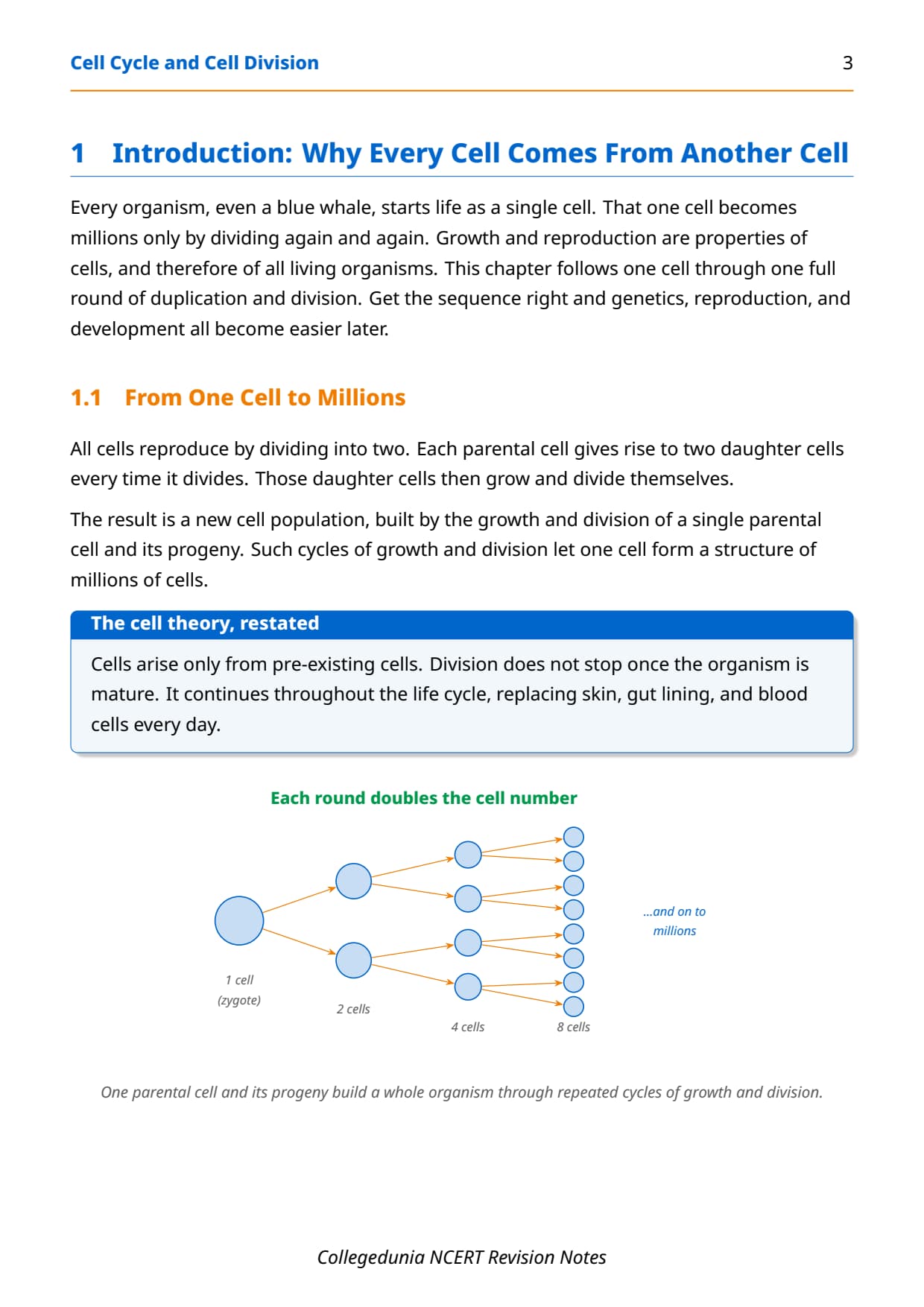
Every organism starts as a single cell that becomes millions only by dividing again and again, so the sequence you learn here underpins genetics, reproduction, and development in the chapters that follow.
- CBSE Weightage: 5 to 6 marks, usually one question on the phases of mitosis or cytokinesis plus one on the substages of prophase I.
- Topics covered: the cell cycle and its phases, interphase G1, S and G2, the quiescent G0 stage, the four stages of mitosis, cytokinesis, the significance of mitosis, meiosis I and II, prophase I with its five substages, and the significance of meiosis.
- Key rules: DNA doubles in S phase while chromosome number stays the same, mitosis is equational and meiosis is reductional, and crossing over occurs in pachytene of prophase I.
These cell cycle and cell division class 11 notes are curated by subject experts, based on the 2026-27 NCERT textbook, and checked against the last five years of CBSE Board and NEET papers.
Topic-by-Topic Summary of Cell Cycle and Cell Division
The chapter follows one cell through a full round of duplication and division, then contrasts the two kinds of division that build and reproduce a body. It starts with the timetable of the cell cycle, moves to mitosis that keeps the chromosome number the same, and ends with meiosis that halves it for gametes. Here is the quick map of what each topic gives you before you revise the detail.
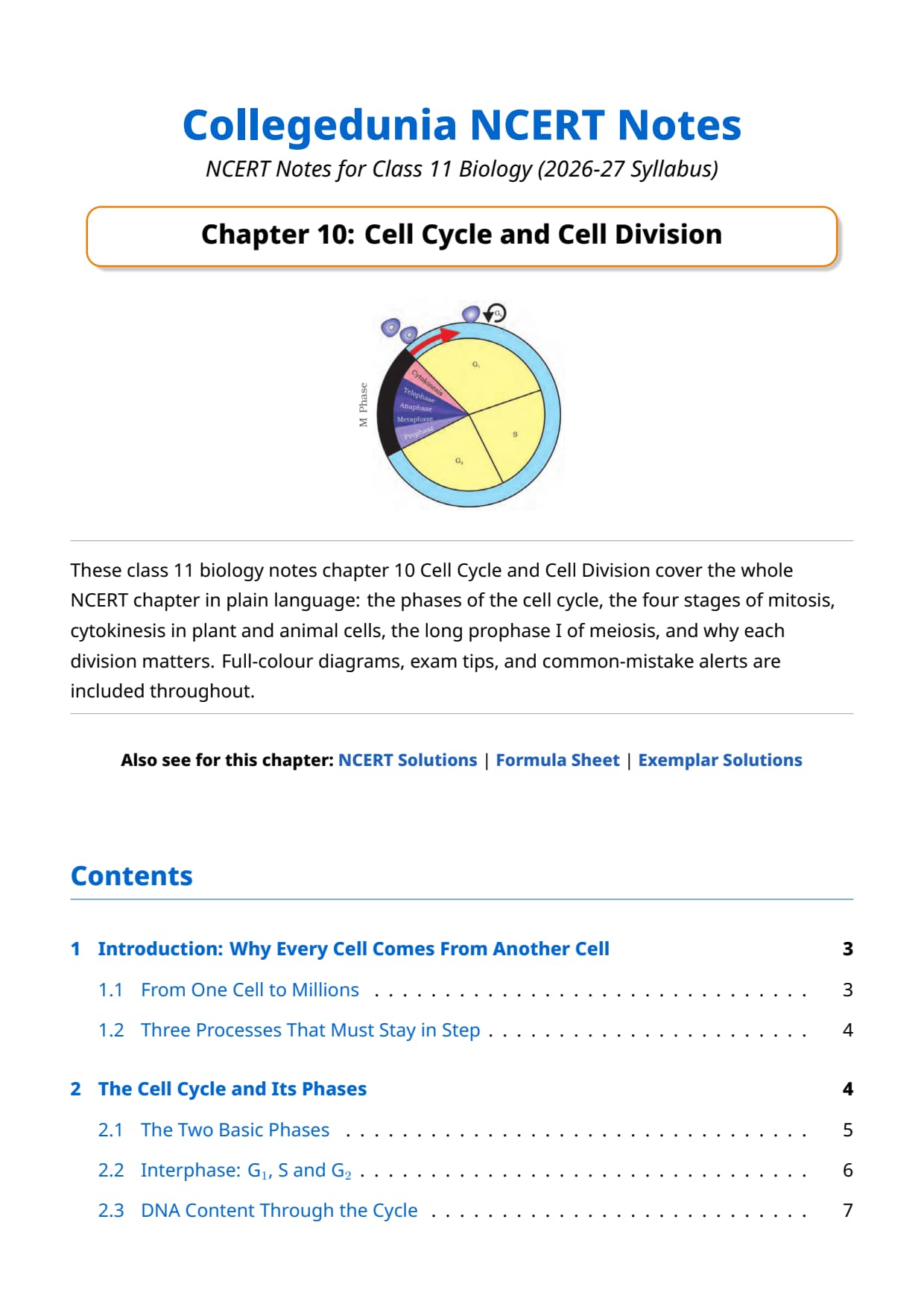
- The cell cycle: the ordered sequence in which a cell copies its genome and divides, split into a long interphase and a short M phase.
- Interphase: the G1, S and G2 phases where the cell grows and replicates its DNA, taking more than 95% of the cycle.
- Mitosis: the equational division with four stages, prophase, metaphase, anaphase, and telophase, followed by cytokinesis.
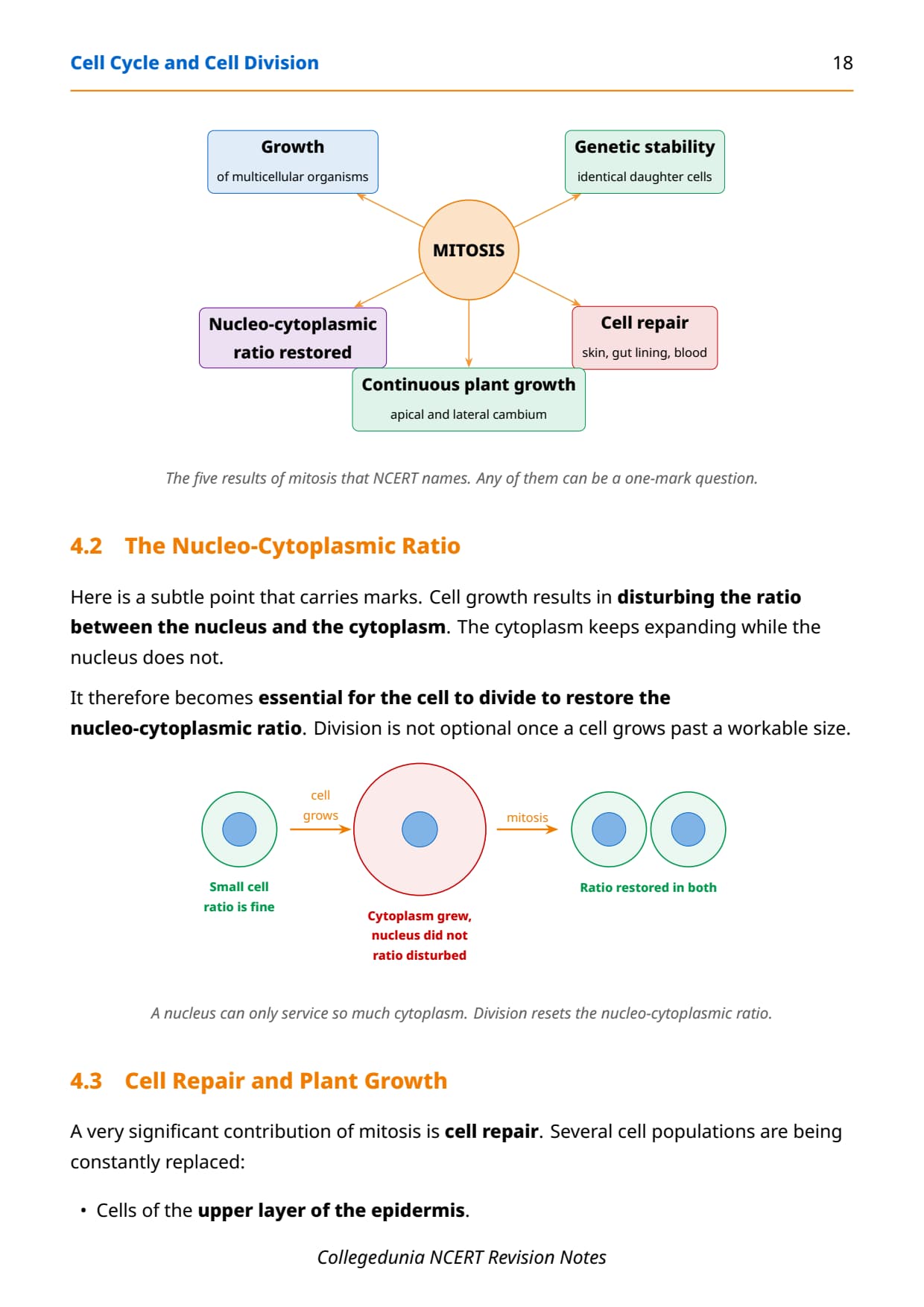
- Significance of mitosis: growth, repair, genetic stability, and restoring the nucleo-cytoplasmic ratio.
- Meiosis: two divisions but one round of DNA replication, giving four haploid cells for sexual reproduction.
- Prophase I: the long first prophase with five substages where synapsis and crossing over occur.
Revise the topics in this order, because each one builds on the last. Fix the cell cycle timetable first, then mitosis, and meiosis becomes easy because it is mitosis with a twist. These cell cycle and cell division class 11 notes follow the same sequence as the NCERT textbook.
The Cell Cycle and Its Phases
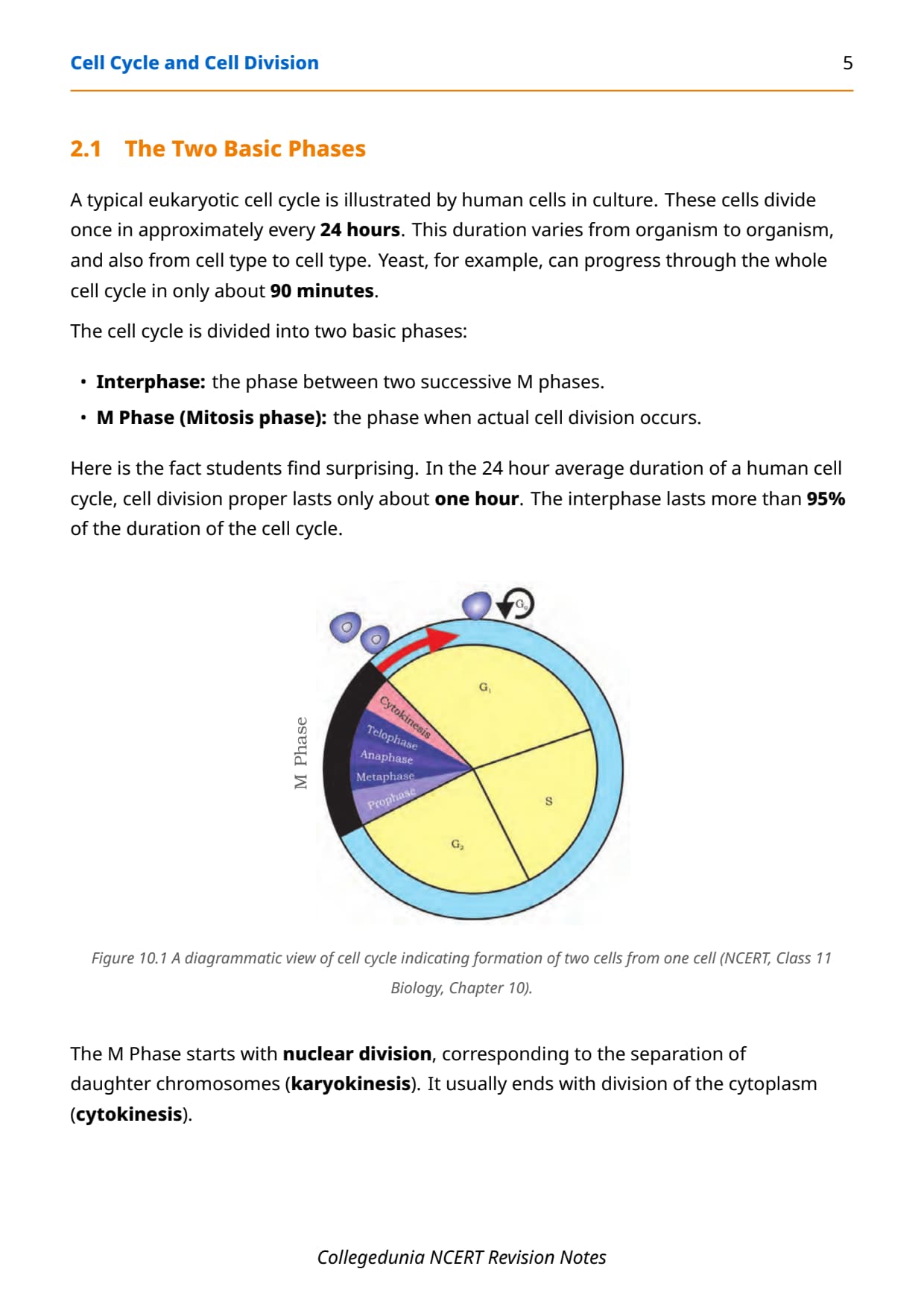
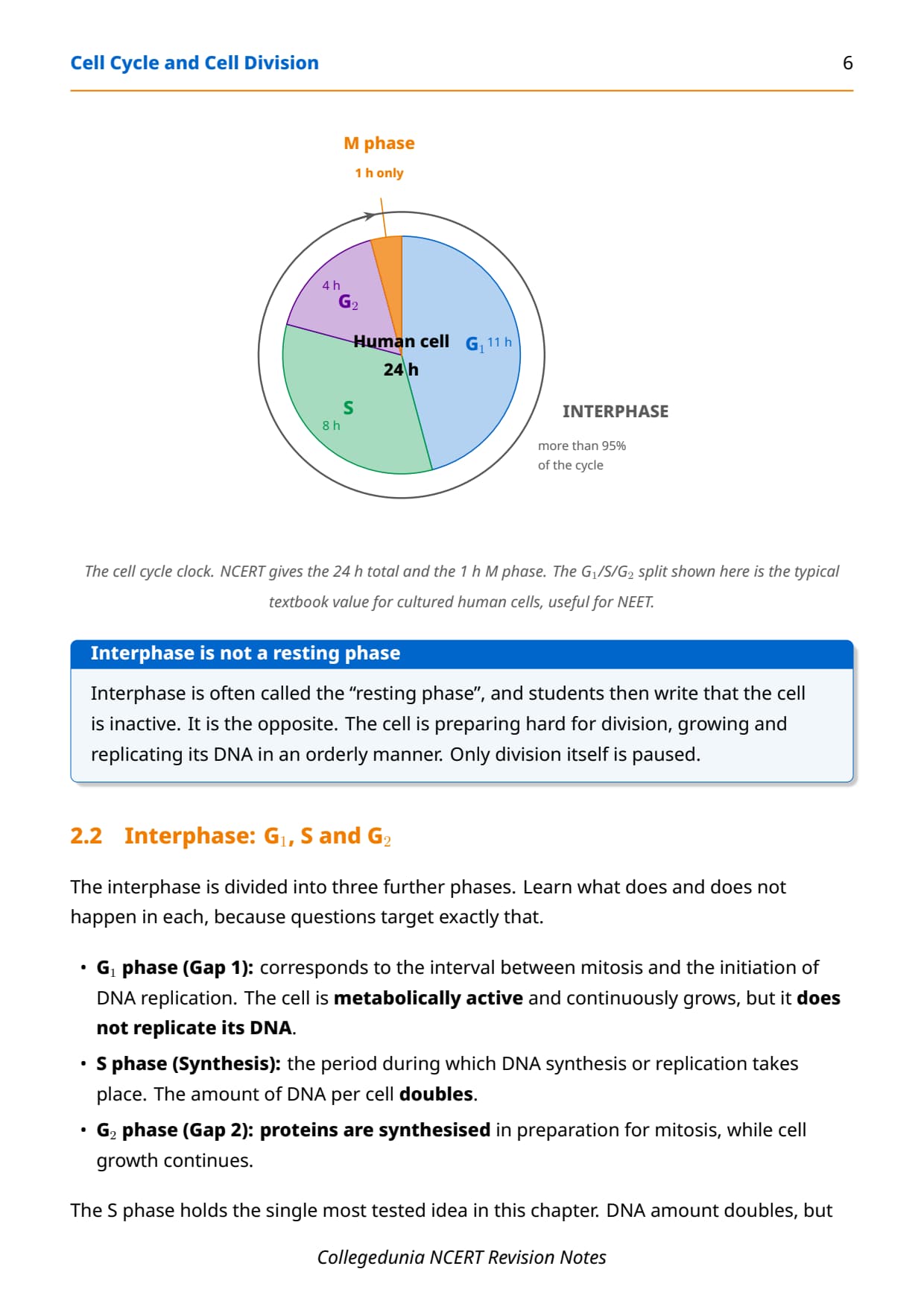
The sequence of events by which a cell duplicates its genome, synthesises the other constituents of the cell, and eventually divides into two daughter cells is termed the cell cycle. A typical human cell in culture divides once in about 24 hours, while yeast can complete the whole cycle in about 90 minutes, so the duration varies from organism to organism. This is the most heavily examined part of the chapter, so learn the two basic phases and the three sub-phases of interphase cold.
- Interphase (G1, S, G2): the phase between two successive M phases, lasting more than 95% of the cycle. It is often called the resting phase, but the cell is preparing hard for division, not inactive.
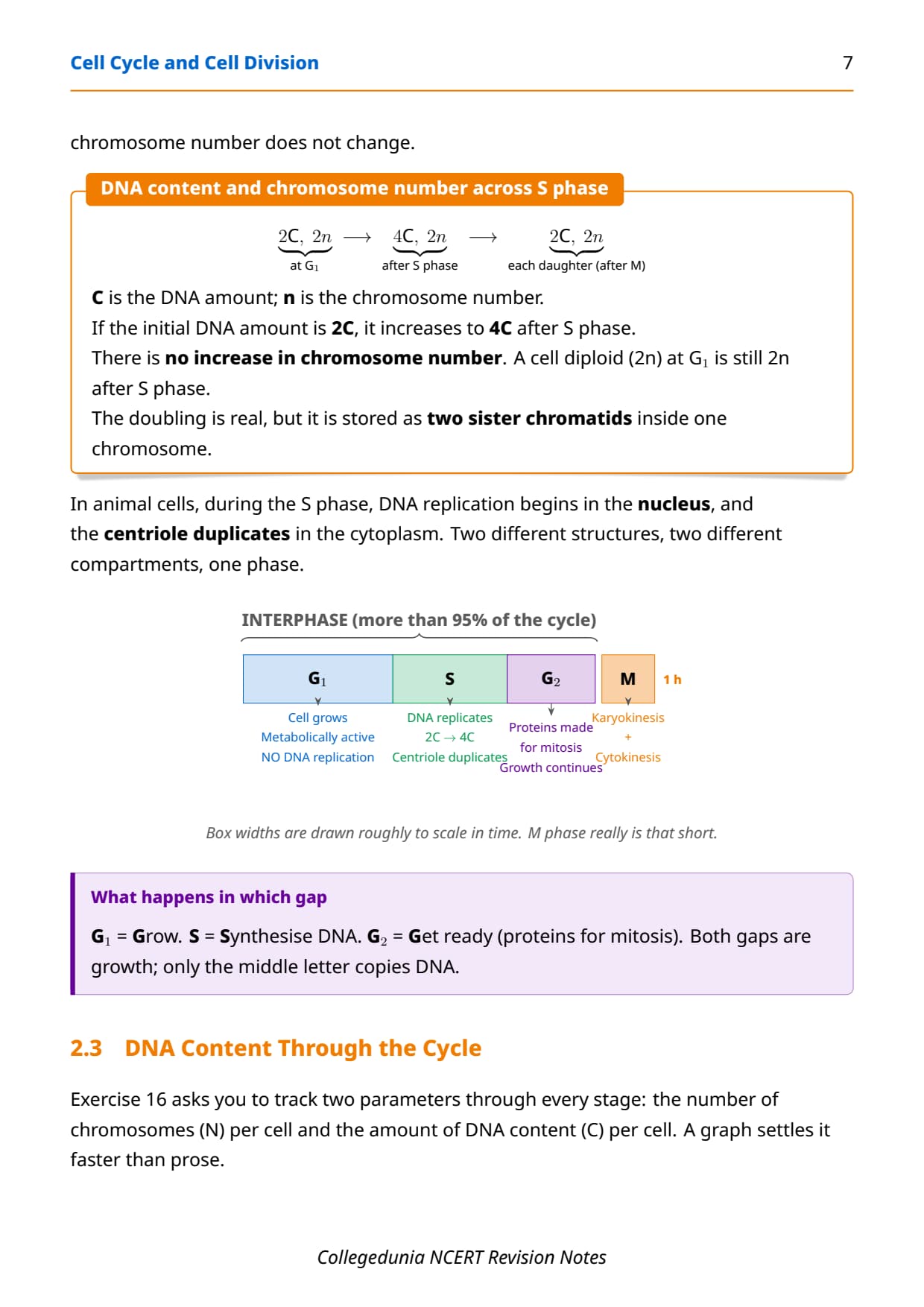
- G1 phase: the cell is metabolically active and grows continuously but does not replicate its DNA.
- S phase: DNA synthesis takes place and the amount of DNA per cell doubles. In animal cells the centriole also duplicates in the cytoplasm.
- G2 phase: proteins are synthesised in preparation for mitosis while growth continues.
- M phase (mitosis): actual cell division, lasting only about one hour in the 24 hour human cycle.
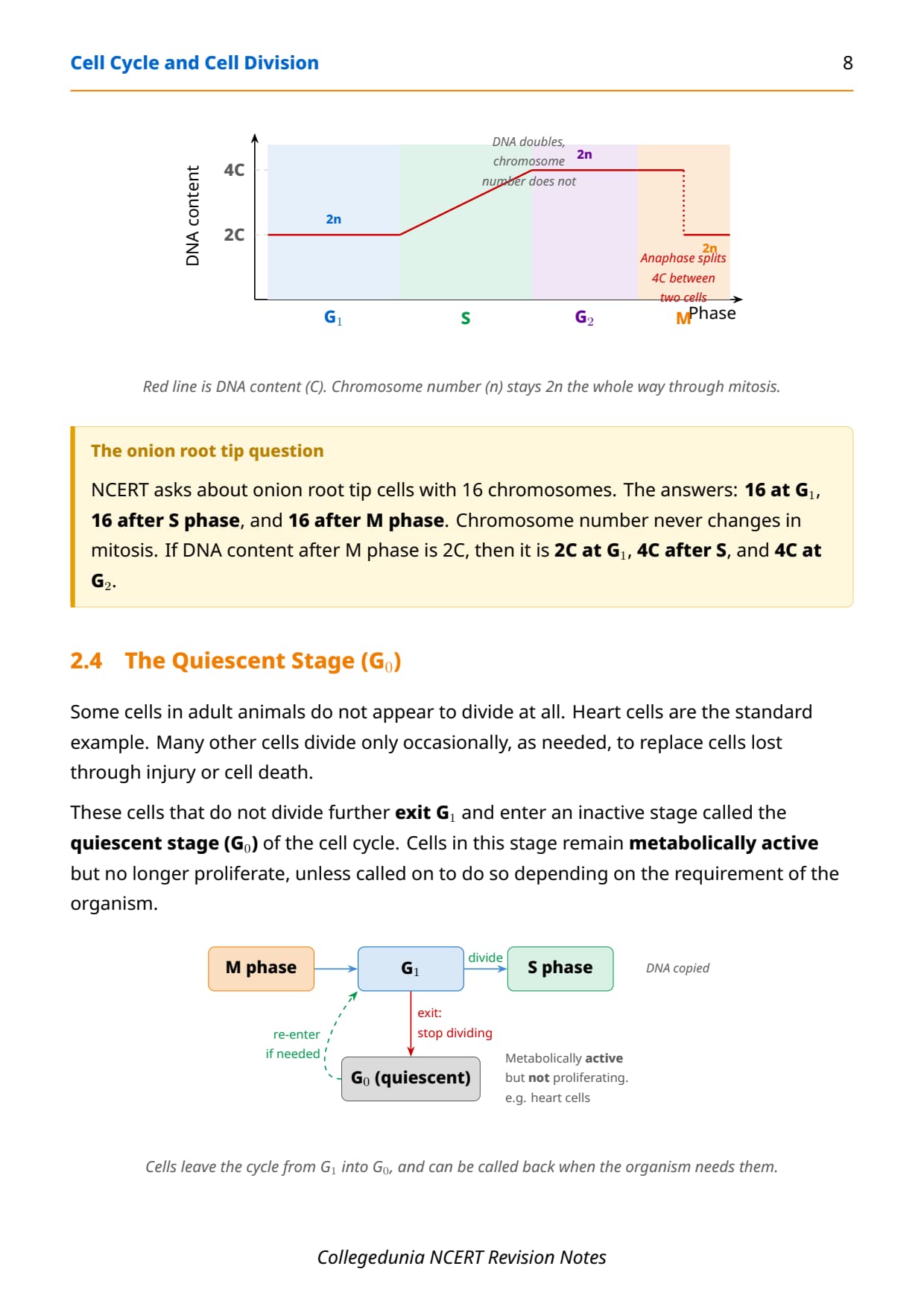
The single most tested idea here is the S phase. If the initial DNA amount is 2C it increases to 4C after S phase, yet there is no increase in chromosome number, because the extra DNA is stored as two sister chromatids inside one chromosome. A cell diploid (2n) at G1 is still 2n after S phase. Some cells, such as heart cells, exit from G1 into a quiescent stage called G0, where they remain metabolically active but do not proliferate unless the organism needs them. For an onion root tip cell with 16 chromosomes, the count stays 16 at G1, after S phase, and after M phase.
M Phase: Mitosis Stage by Stage
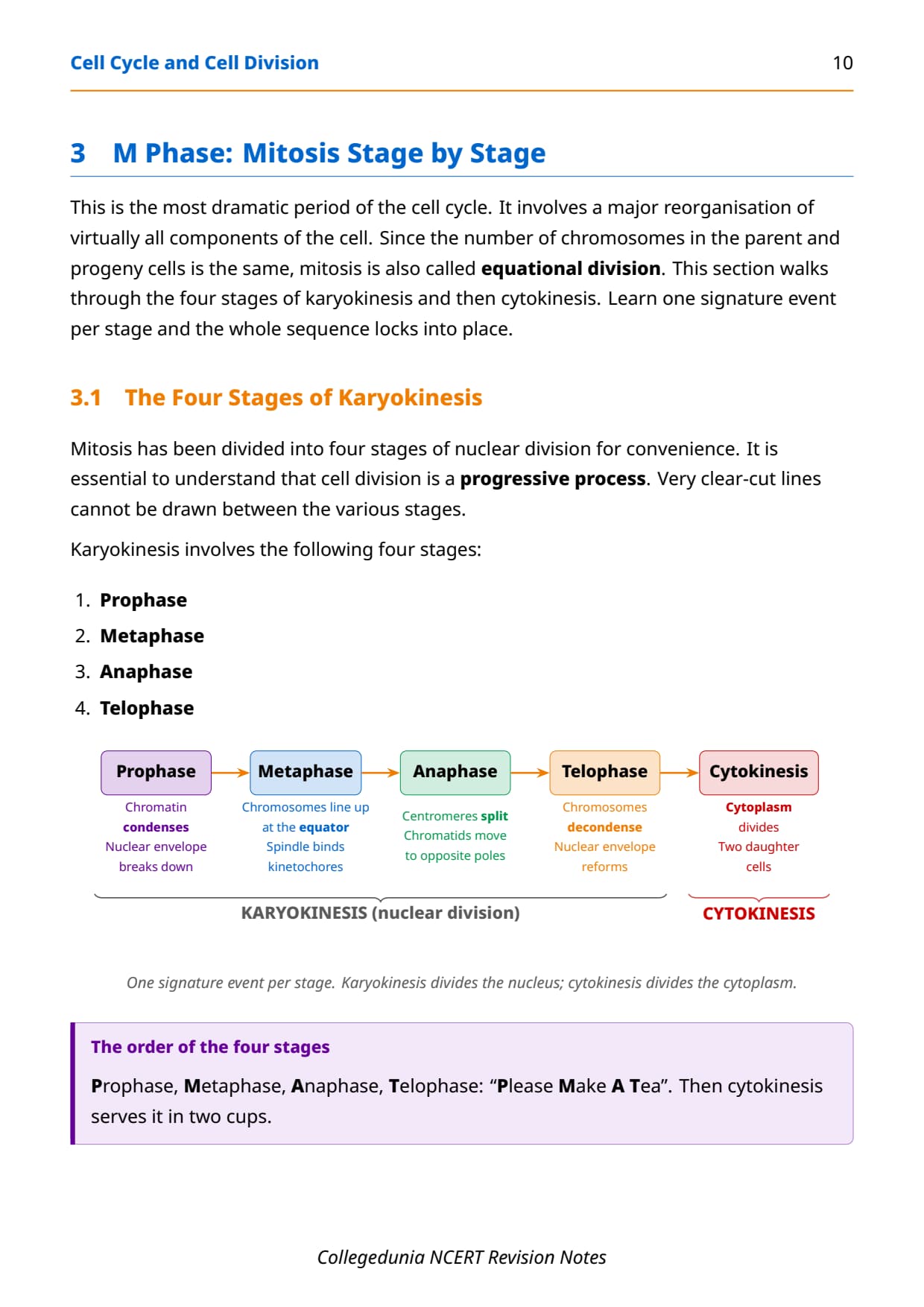
Mitosis is the most dramatic period of the cell cycle and involves a major reorganisation of almost all cell components. Since the number of chromosomes in the parent and progeny cells is the same, mitosis is also called equational division. It is divided into four stages of karyokinesis, which is division of the nucleus, followed by cytokinesis, which is division of the cytoplasm. Learn one signature event per stage and the whole sequence locks into place.
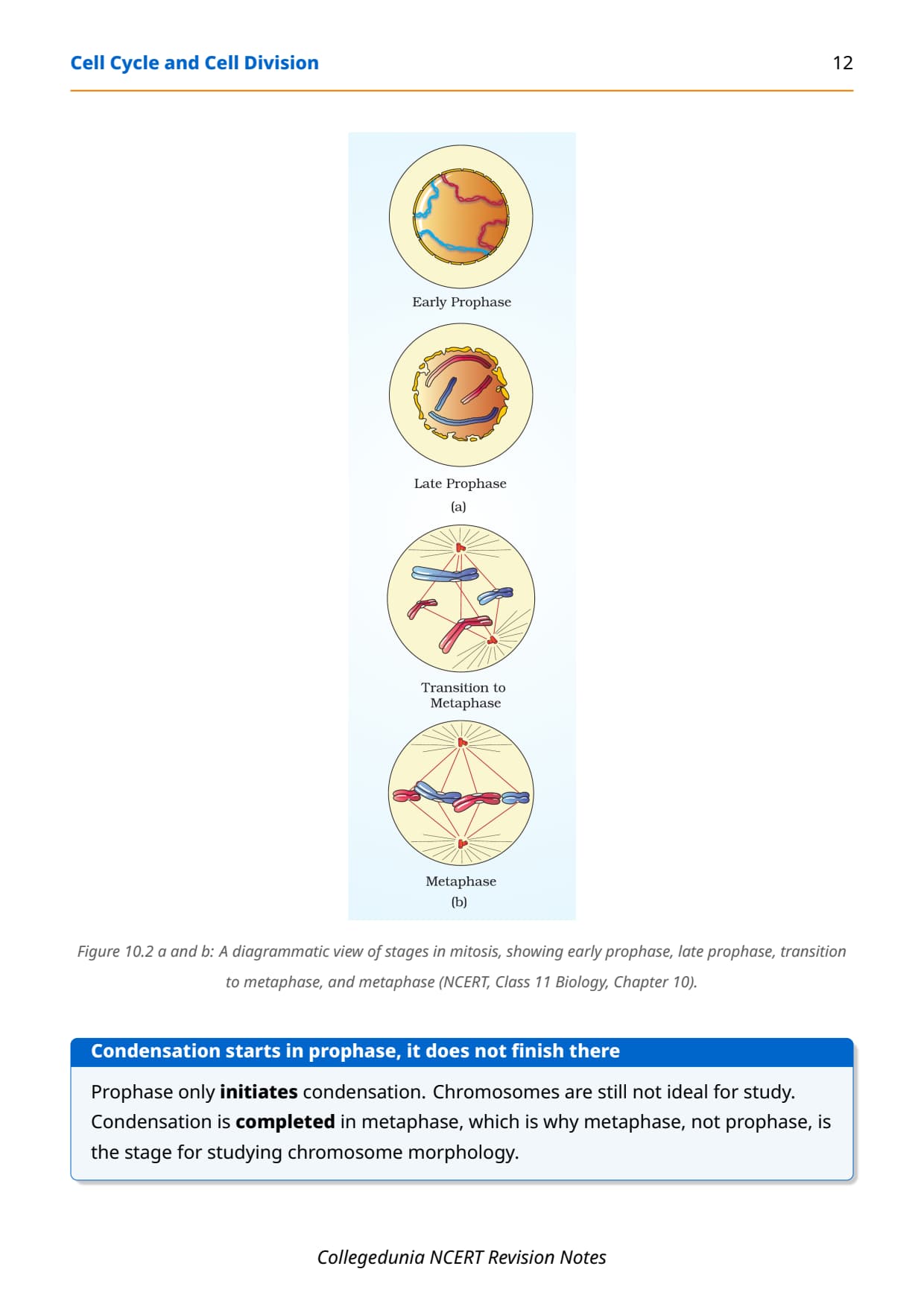
- Prophase: chromosomal material condenses into compact chromosomes, each seen as two chromatids joined at the centromere. The centrosome moves to opposite poles and forms the spindle, while the nuclear envelope, nucleolus, golgi complex, and ER disappear.
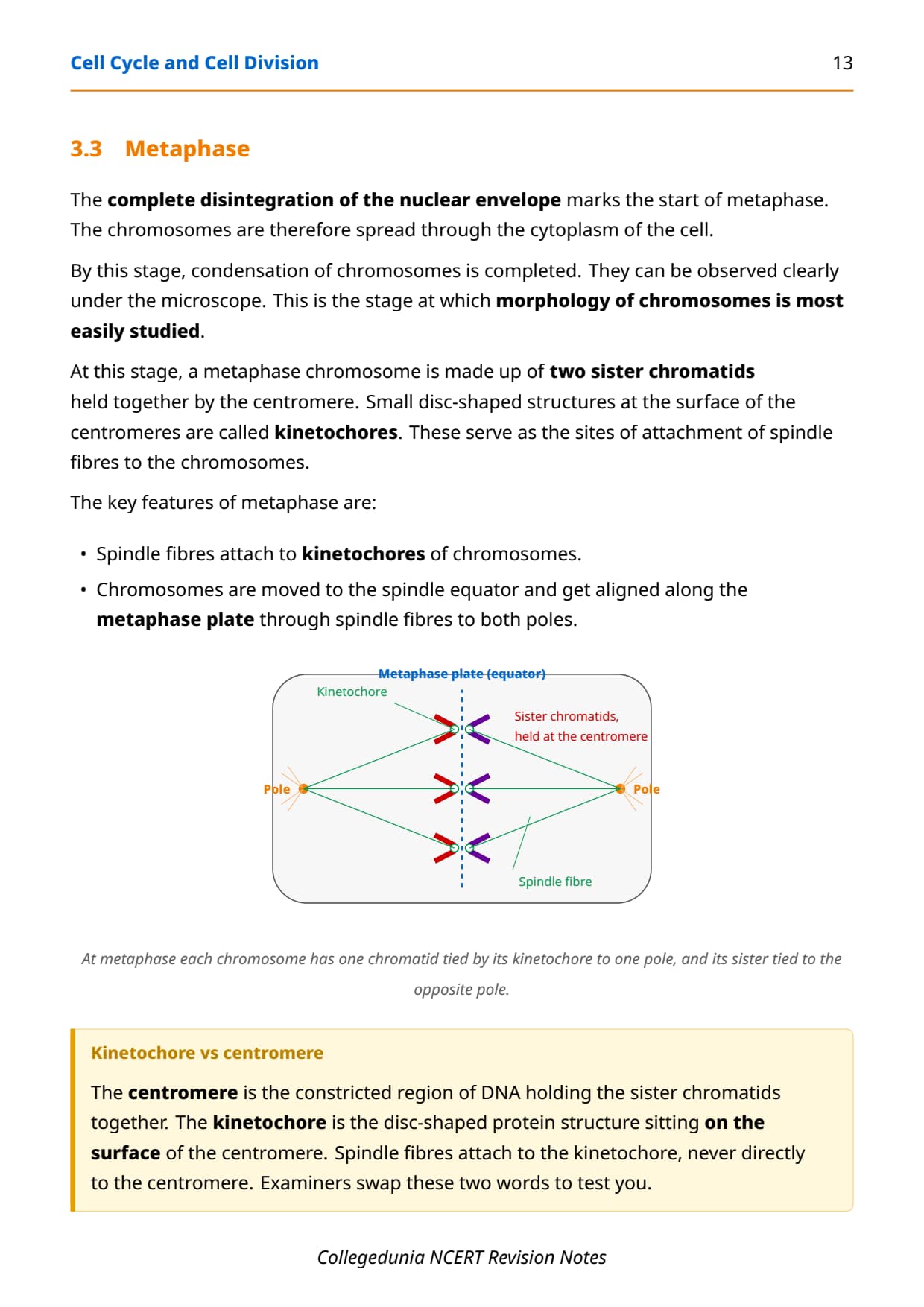
- Metaphase: the nuclear envelope disintegrates completely, chromosome condensation is complete, and chromosomes align at the metaphase plate. Spindle fibres attach to the kinetochores, disc-shaped structures on the surface of the centromere. This is the best stage to study chromosome morphology.
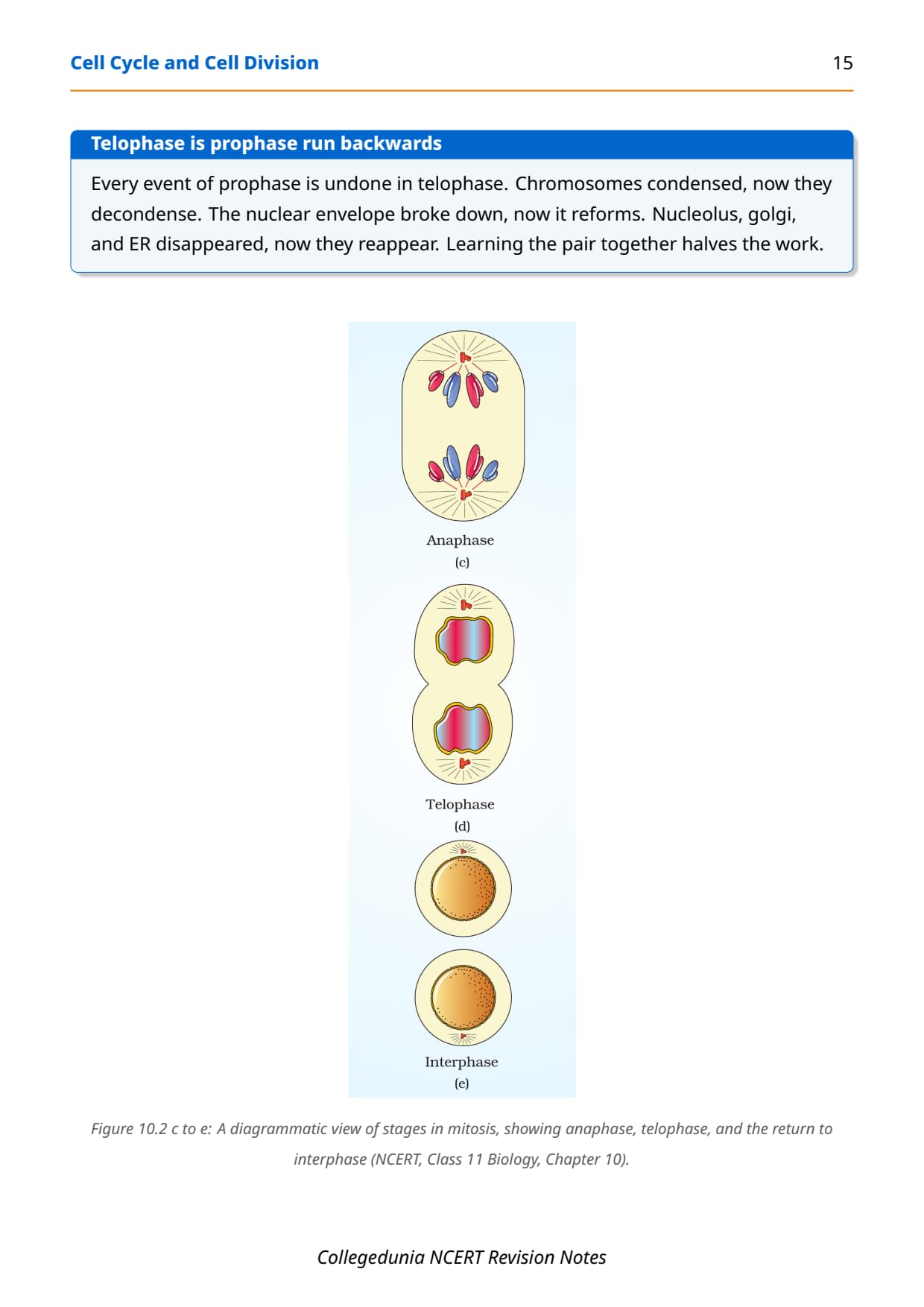
- Anaphase: centromeres split simultaneously, and the daughter chromosomes move to opposite poles with the centromere leading and the arms trailing.
- Telophase: chromosomes decondense and lose their identity, the nuclear envelope reforms around each cluster as two daughter nuclei, and the nucleolus, golgi, and ER reappear.
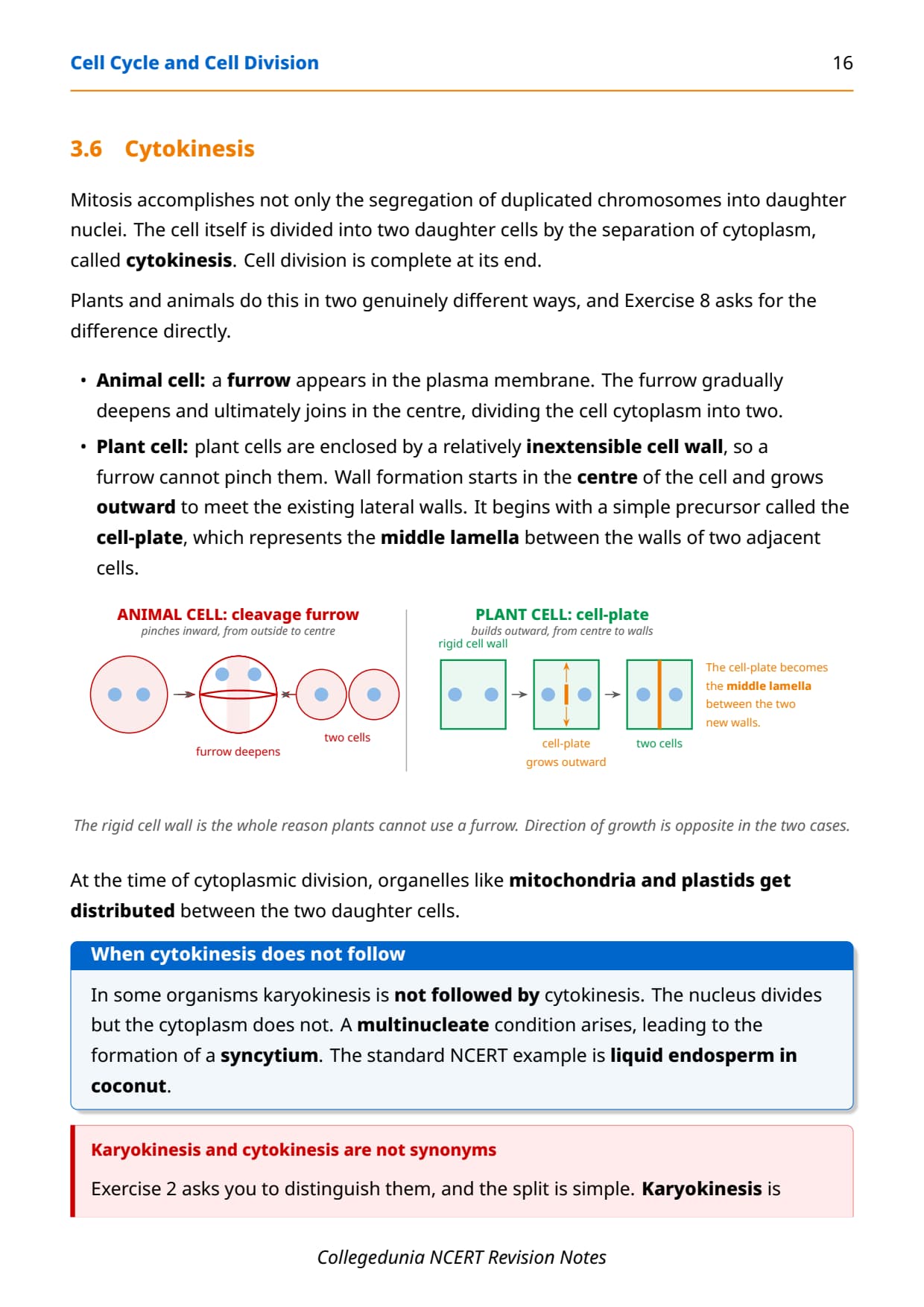
Cytokinesis then divides the cytoplasm, and it works differently in the two kingdoms. In an animal cell a furrow appears in the plasma membrane and deepens inward until it splits the cell. In a plant cell the rigid cell wall cannot pinch, so a cell-plate forms in the centre and grows outward to the walls, becoming the middle lamella. Sometimes karyokinesis is not followed by cytokinesis, giving a multinucleate syncytium, as in the liquid endosperm of coconut. Remember that telophase simply undoes every event of prophase, which halves the work of learning both.
Significance of Mitosis
It is essential to understand what mitosis actually achieves in the life of an organism, because NCERT asks you to name its results directly. Mitosis usually produces diploid daughter cells with an identical genetic complement, and that genetic stability is the whole point of the division. Every cell in your body carries the same genome because mitosis copied it faithfully round after round.
- Growth: the growth of all multicellular organisms is due to mitosis, turning a single zygote into a body of millions of cells.
- Genetic stability: the daughter cells are genetically identical to the parent cell.
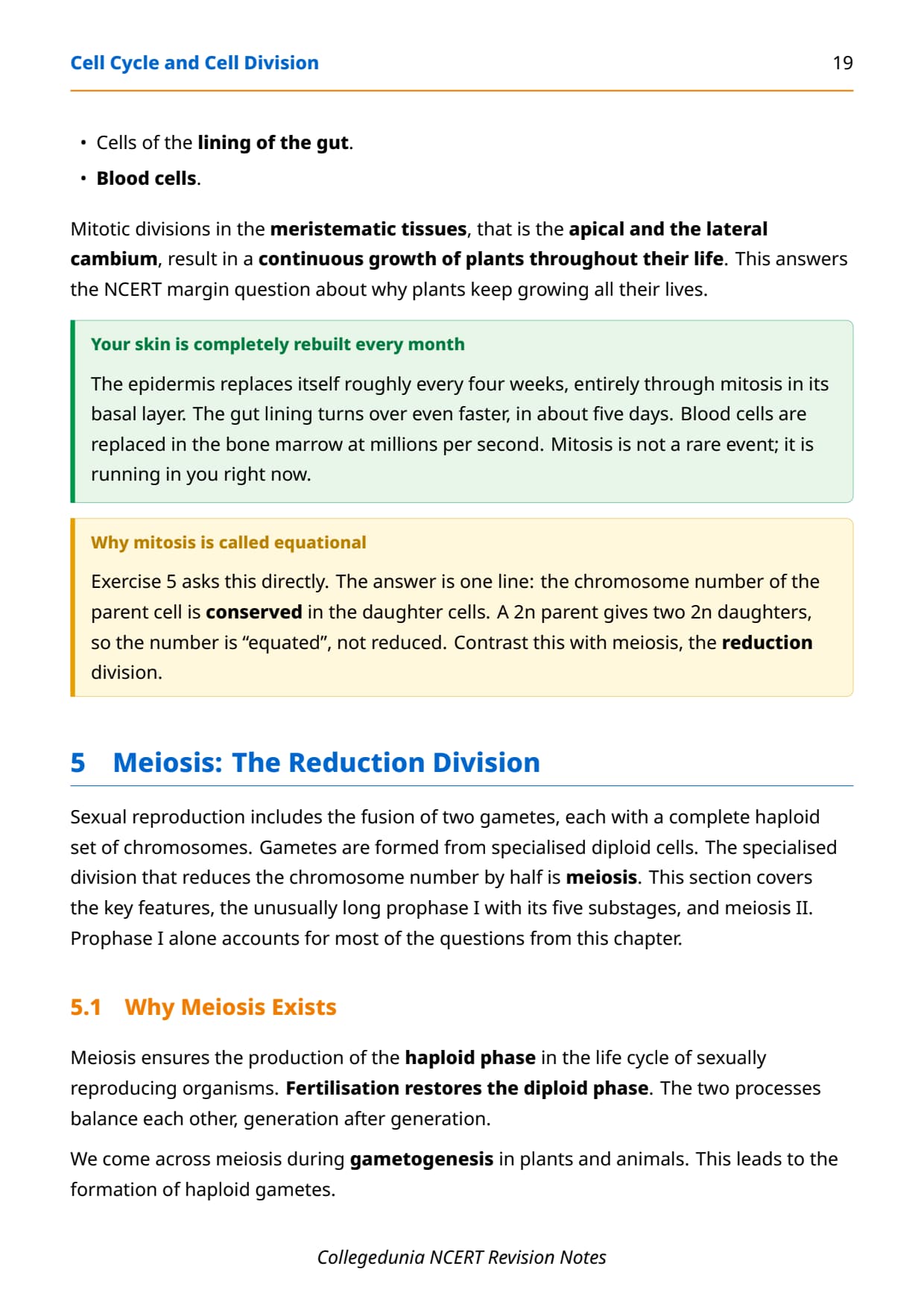
- Nucleo-cytoplasmic ratio: cell growth disturbs the ratio between the nucleus and the cytoplasm, so division becomes essential to restore the nucleo-cytoplasmic ratio.
- Cell repair: cells of the upper epidermis, the gut lining, and the blood are constantly replaced by mitosis.
- Continuous plant growth: mitosis in the meristematic tissues, the apical and lateral cambium, lets plants grow throughout their life.
A common short question asks why mitosis is called equational, and the one-line answer is that the chromosome number of the parent cell is conserved in the daughter cells, so a 2n parent gives two 2n daughters. Mitosis is not a rare event; your skin is rebuilt roughly every four weeks and the gut lining every five days, entirely through mitosis. In animals mitosis is usually restricted to diploid somatic cells, but plants divide by mitosis in both haploid and diploid cells, and the haploid male honey bee is the standard exception among animals.
Meiosis: The Reduction Division
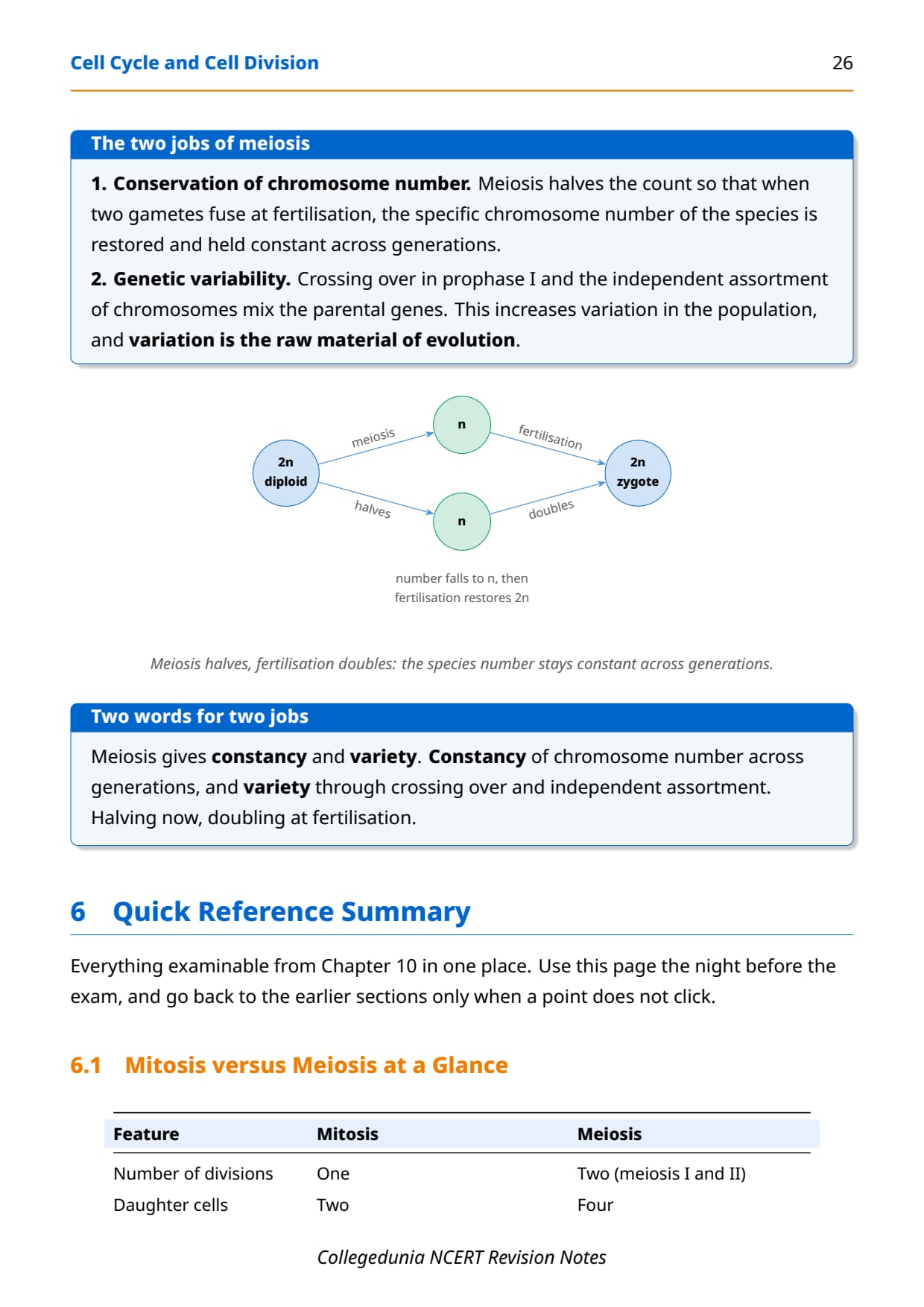
Sexual reproduction fuses two gametes, each with a haploid set of chromosomes, so a division that halves the chromosome number is needed to make those gametes. That specialised division is meiosis, and it happens during gametogenesis in plants and animals. Meiosis both keeps the species chromosome number constant across generations and generates the variation that evolution needs, which is why it is one of the most important events in a living organism.
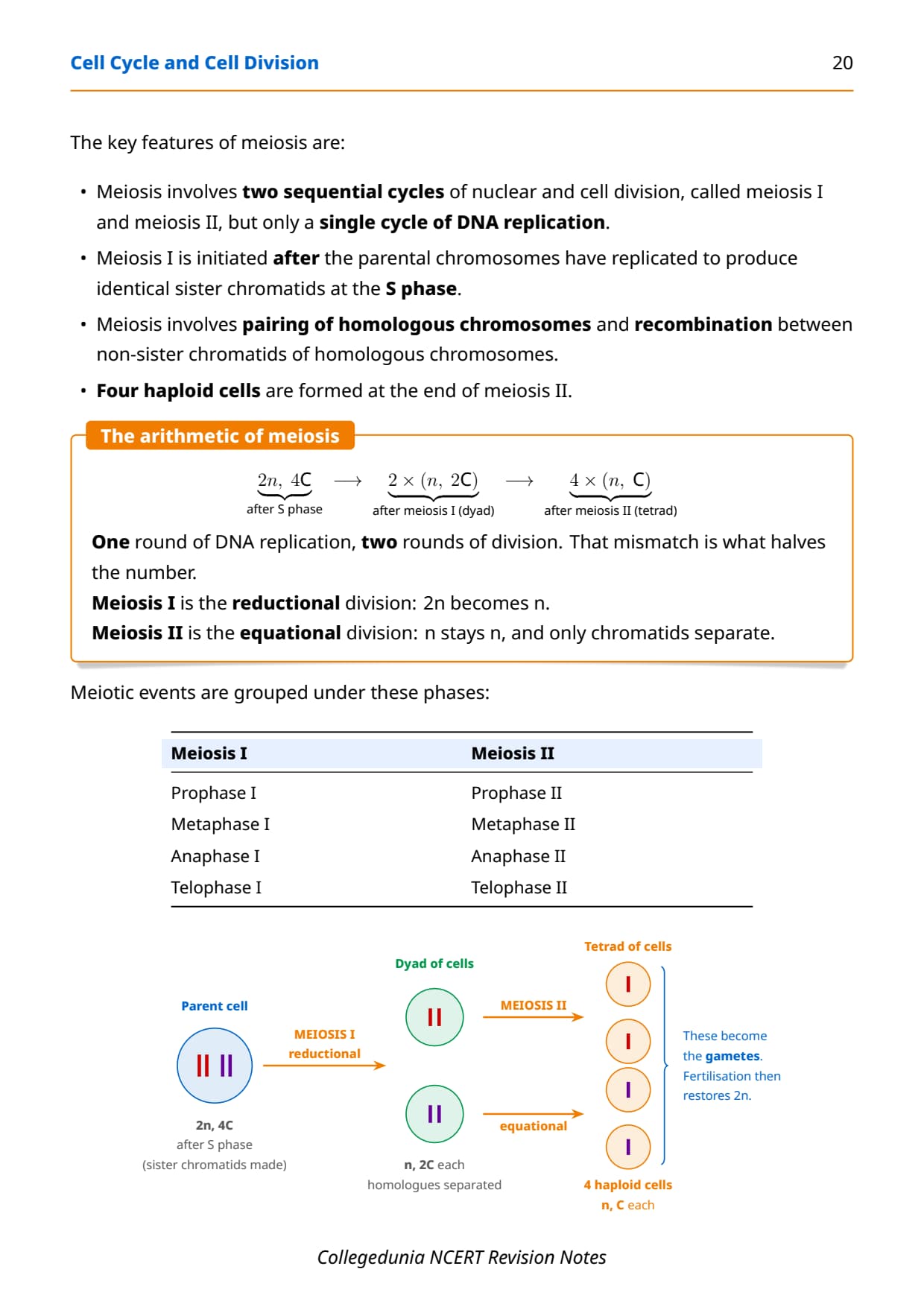
- Two divisions, one replication: meiosis has two sequential cycles of nuclear and cell division, meiosis I and meiosis II, but only a single round of DNA replication in the S phase before meiosis I.
- Pairing and recombination: homologous chromosomes pair, and crossing over occurs between non-sister chromatids.
- Four haploid cells: the end product of meiosis II is four haploid cells.
- Meiosis I is reductional: the chromosome number drops from 2n to n as homologous chromosomes separate.
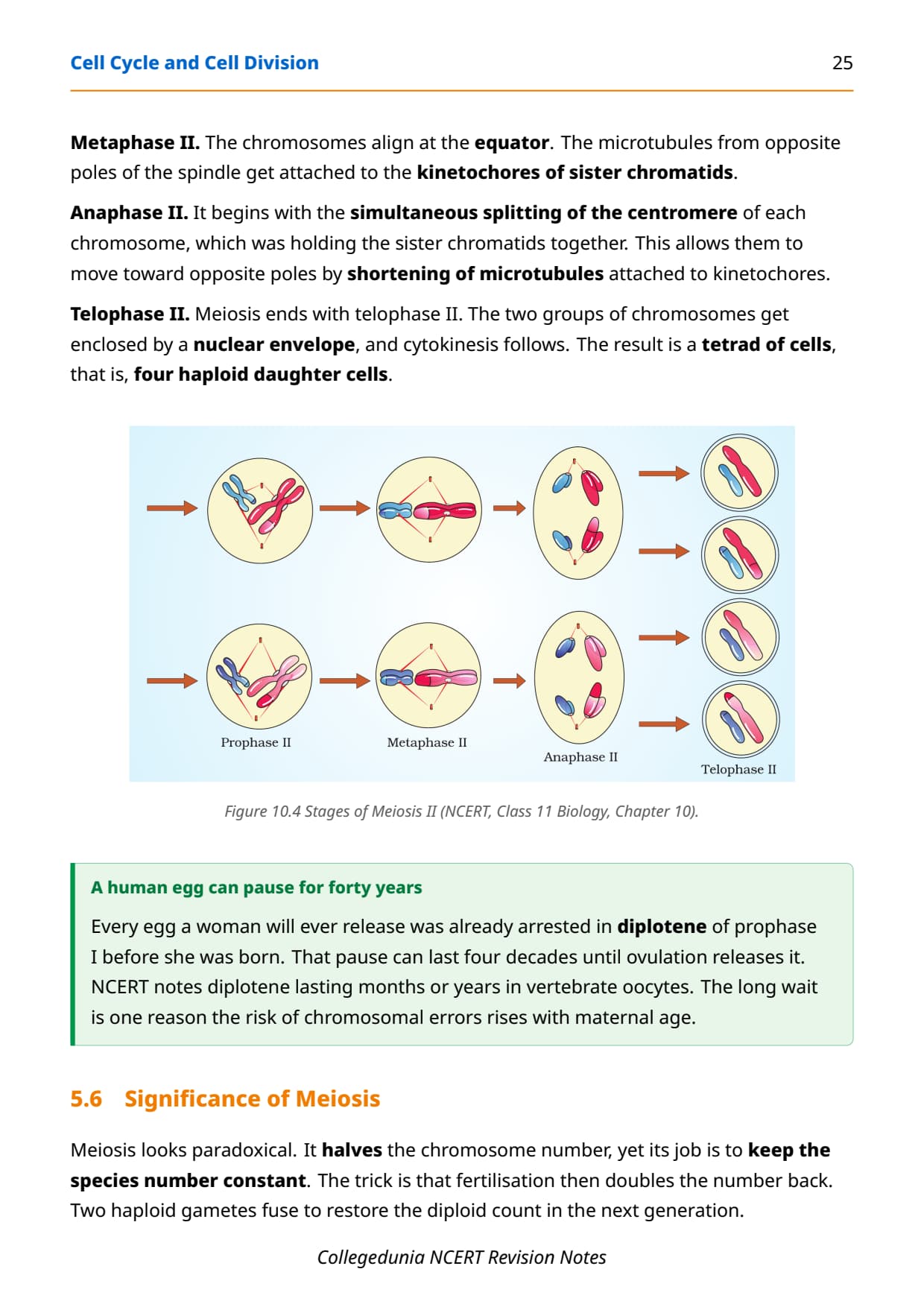
- Meiosis II is equational: it resembles a normal mitosis and only separates the sister chromatids.
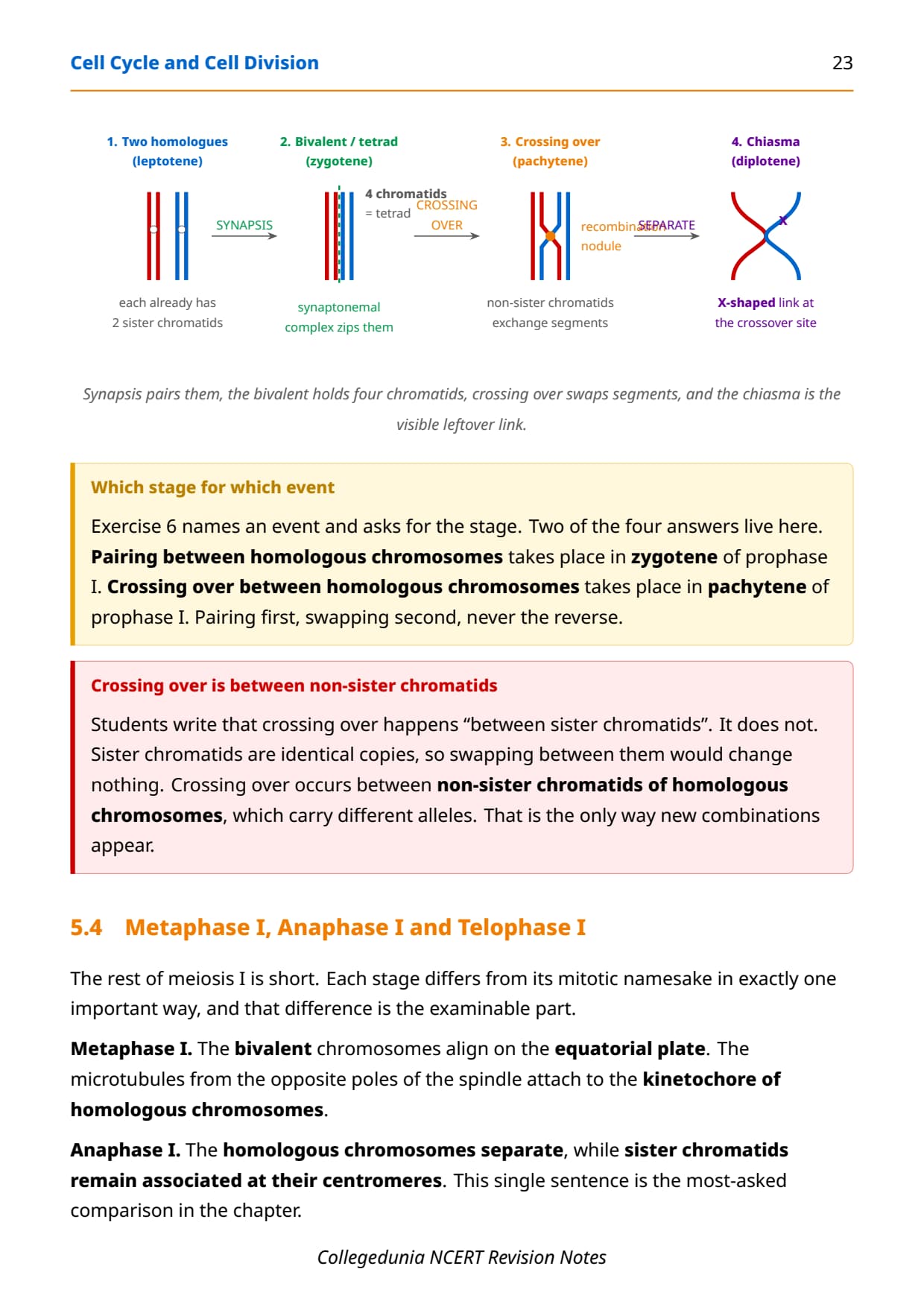
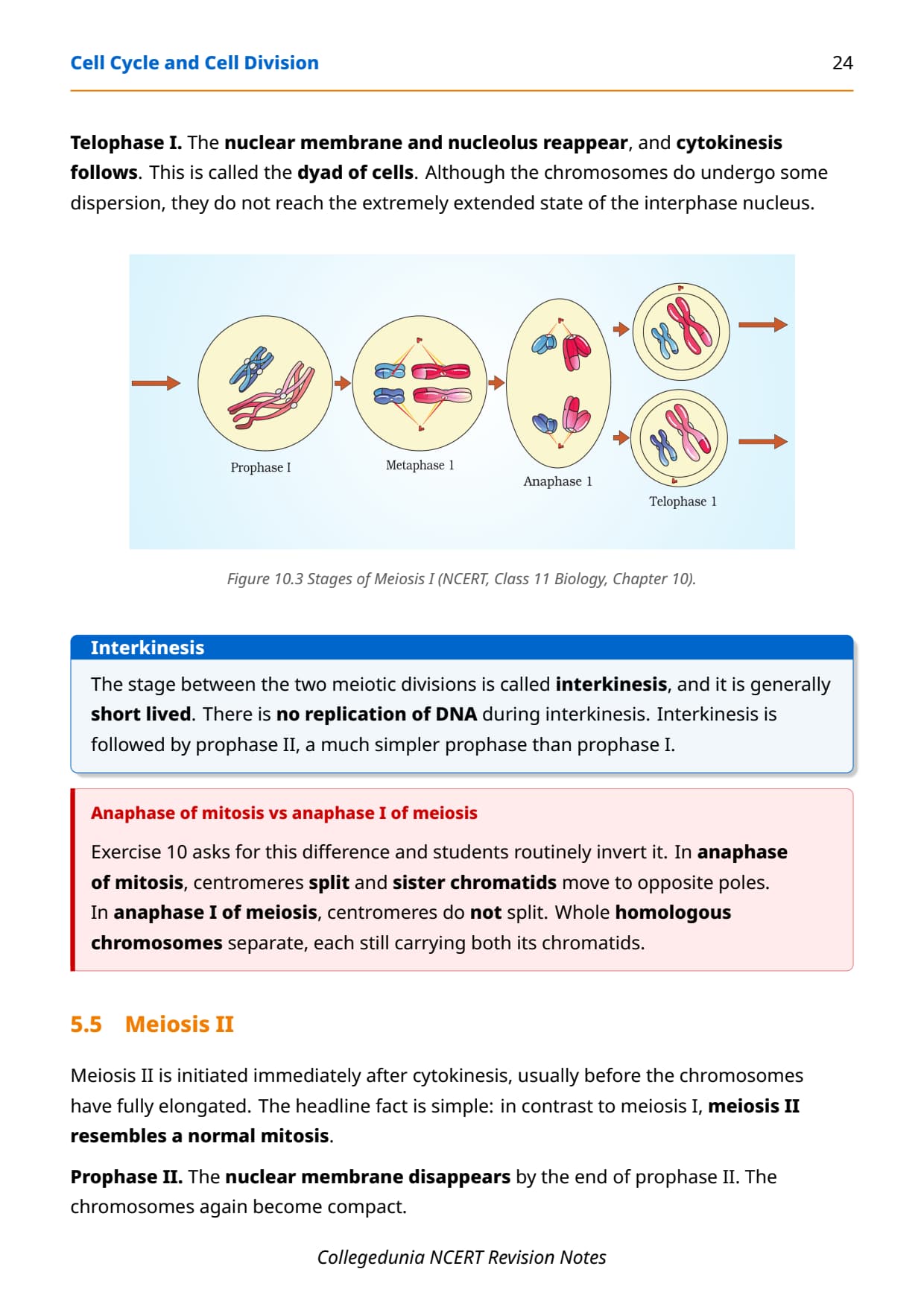
The arithmetic settles the commonest error in the chapter. A parent cell that is 2n, 4C after S phase gives two cells of n, 2C after meiosis I, then four cells of n, C after meiosis II. There is no DNA replication during interkinesis, the short gap between the two meiotic divisions. If DNA replicated twice, the number would never halve. Metaphase I aligns bivalents so spindle fibres attach to the kinetochore of whole homologous chromosomes, and in anaphase I the homologues separate while sister chromatids stay joined at their centromeres. This last sentence is the most-asked comparison against anaphase of mitosis, where centromeres split and sister chromatids separate.
Prophase I and Its Five Substages
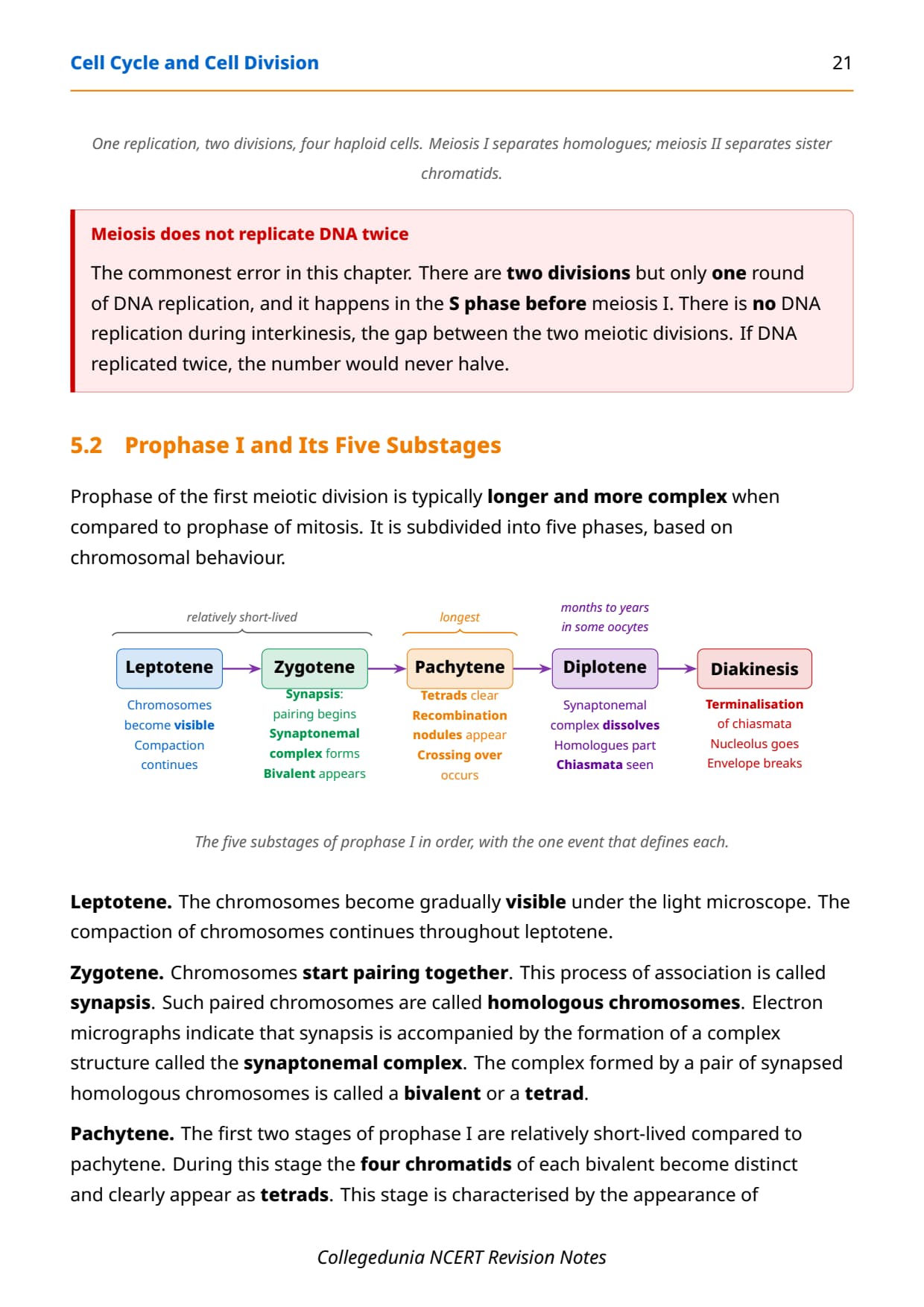
Prophase of the first meiotic division is much longer and more complex than the prophase of mitosis, and it accounts for most of the questions from this chapter. It is subdivided into five substages based on chromosomal behaviour, and each substage carries one defining event that examiners target. Learn the substages in order and attach that single event to each one.
- Leptotene: the chromosomes become gradually visible under the microscope, and their compaction continues.
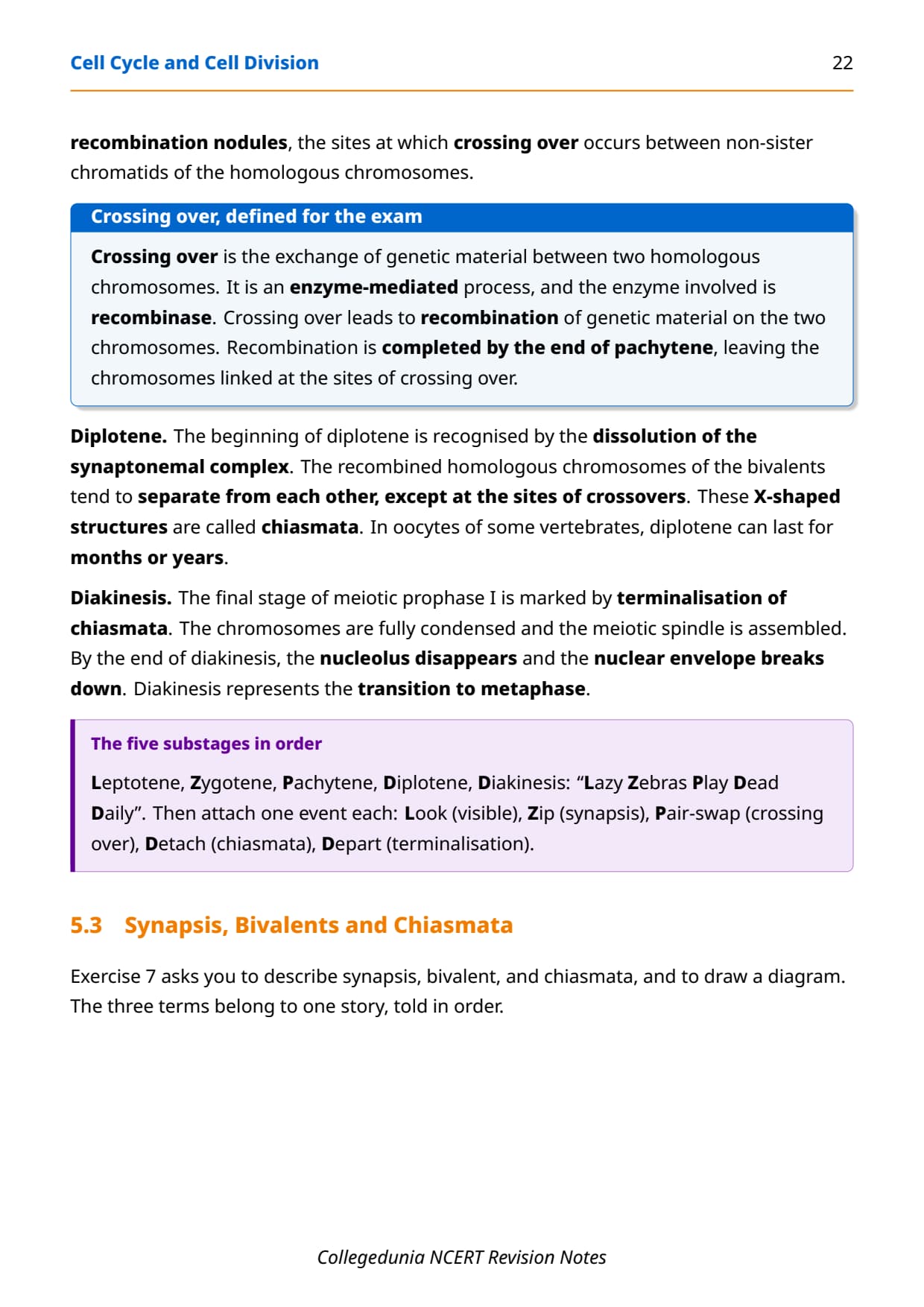
- Zygotene: chromosomes start pairing, a process called synapsis, and the synaptonemal complex forms. A paired set of homologous chromosomes is called a bivalent or tetrad.
- Pachytene: the four chromatids of each bivalent appear as clear tetrads, recombination nodules appear, and crossing over occurs between non-sister chromatids.
- Diplotene: the synaptonemal complex dissolves, and the homologues separate except at the crossover sites, which appear as X-shaped chiasmata.
- Diakinesis: chiasmata undergo terminalisation, the nucleolus disappears, and the nuclear envelope breaks down, marking the transition to metaphase I.
Crossing over is the exchange of genetic material between non-sister chromatids of homologous chromosomes, and it is an enzyme-mediated process using the enzyme recombinase. A common trap is writing that crossing over happens between sister chromatids, but they are identical copies, so swapping between them would change nothing. After a much shorter meiosis II that resembles mitosis, telophase II gives a tetrad of four haploid daughter cells. In some vertebrate oocytes diplotene can last months or even years, and every human egg is arrested in diplotene of prophase I before birth, which is why chromosomal errors rise with maternal age.
Key Definitions in Cell Cycle and Cell Division
Board short-answer questions often ask for a clean definition in one or two lines, and a vague answer loses easy marks. Learn these word-for-word, because the wording of the exam question is usually built straight from the NCERT definition. Each term below also links to a stage or diagram you can be asked to explain.
| Term | Definition |
|---|---|
| Cell cycle | The sequence of events by which a cell duplicates its genome, synthesises its other constituents, and divides into two daughter cells. |
| Interphase | The phase between two M phases, made of G1, S and G2; more than 95% of the cycle. |
| Karyokinesis | Division of the nucleus, corresponding to the separation of daughter chromosomes. |
| Cytokinesis | Division of the cytoplasm that completes cell division. |
| Synapsis | The pairing of homologous chromosomes during zygotene of prophase I. |
| Crossing over | The enzyme-mediated exchange of segments between non-sister chromatids of homologous chromosomes, in pachytene. |
| Bivalent | A pair of synapsed homologous chromosomes, holding four chromatids; also called a tetrad. |
A common board question asks you to distinguish karyokinesis from cytokinesis, or to define synapsis, bivalent, and chiasmata together. State the definition first, then give the example, such as coconut water for a syncytium made without cytokinesis. Learning these definitions makes the wording of almost every one-mark and two-mark question in this chapter familiar.
Common Mistakes Students Make in Cell Cycle and Cell Division
These slips happen because two terms look alike or two stages resemble each other, not because the concept is hard. Each one costs 1 to 2 marks in the paper, so watch for them at the exact step where they occur.
Mistake 1: Writing that DNA amount and chromosome number both double in S phase. Only the DNA amount doubles from 2C to 4C, and the chromosome number stays the same because the copies are held as sister chromatids.
Mistake 2: Calling G0 cells inactive or dying. G0 cells remain metabolically active; only proliferation stops, and cells exit into G0 from G1, never from S or G2.
Mistake 3: Saying spindle fibres attach to the centromere. They attach to the kinetochore, a protein disc on the surface of the centromere.
Mistake 4: Claiming meiosis has two rounds of DNA replication. There are two divisions but only one replication, before meiosis I, with none during interkinesis.
Mistake 5: Writing that crossing over is between sister chromatids. It is between non-sister chromatids of homologous chromosomes, which is the only way new combinations appear.
Cell Cycle and Cell Division Weightage in CBSE Boards, NEET and CUET
This chapter is short but scoring, and it feeds directly into reproduction and genetics later in the syllabus. It appears every year as a stage-identification question, a distinguish-between question, or a diagram, so the return on revising it is high. Here is how the marks split across the main exams for 2026-27.
| Exam | Typical weightage | What is asked |
|---|---|---|
| CBSE Boards | 5 to 6 marks | One question on the stages of mitosis or cytokinesis plus one on prophase I substages or mitosis versus meiosis |
| NEET | 2 to 3 questions | S phase DNA and chromosome counts, prophase I substages, crossing over stage, and mitosis versus meiosis |
| CUET | 1 to 2 objective questions | Phase order, kinetochore versus centromere, and the significance of meiosis |
The five substages of prophase I and the mitosis versus meiosis comparison are the single most tested ideas from this chapter across all three exams. Master the cell cycle timetable first, then the four stages of mitosis, then prophase I, in that order of return on effort for the 2026-27 session.
How to Revise Cell Cycle and Cell Division Quickly
Use these cell cycle and cell division class 11 notes for a fast, ordered recap the night before a test. The checklist below takes about 25 minutes and hits every marks-heavy idea in the chapter without opening the full textbook.
- First 8 minutes: write the phases of the cell cycle and track DNA content from 2C at G1 to 4C after S, then note that chromosome number never changes.
- Next 8 minutes: write the four stages of mitosis with one signature event each, then the two ways cytokinesis happens in plant and animal cells.
- Last 9 minutes: write the five substages of prophase I in order and mark where synapsis and crossing over occur.
Close the loop by explaining why meiosis needs two divisions but only one round of DNA replication. If you can do all three blocks without notes, the chapter is exam-ready. Keep the mitosis-versus-meiosis table beside you for the first pass only, then try the whole checklist closed-book.
Student Feedback on the Cell Cycle and Cell Division Notes
What 12,140 students told us about their Cell Cycle and Cell Division revision:
- 71% of students rated the five substages of prophase I as the part most worth memorising for the exam.
- Most-confused pair: anaphase of mitosis versus anaphase I of meiosis, mixed up by about 4 in 10 students.
- Students who learnt the S phase rule that DNA doubles but chromosome number does not said the numerical questions felt easy afterwards.
Source: 2026-27 Class 11 Biology student poll. Sample of 12,140 students from CBSE schools across 15 states, conducted before the 2026 boards.
Other Cell Cycle and Cell Division Class 11 Biology Resources
Pair these notes with the solved answers, the formula sheet, and the textbook PDFs for the same chapter.
| Resource | Link |
|---|---|
| NCERT Solutions | Cell Cycle and Cell Division Class 11 NCERT Solutions |
| Formula Sheet | Cell Cycle and Cell Division Class 11 Formula Sheet |
| Exemplar Solutions | Cell Cycle and Cell Division Class 11 Exemplar Solutions |
| NCERT Book PDF | Cell Cycle and Cell Division Class 11 Book PDF |
| Exemplar Book PDF | Cell Cycle and Cell Division Class 11 Exemplar Book PDF |
NCERT Notes for Class 11 Biology: All Chapters
Jump to the revision notes for any other Class 11 Biology chapter below.
| Chapter | NCERT Notes |
|---|---|
| Chapter 1 | The Living World |
| Chapter 2 | Biological Classification |
| Chapter 3 | Plant Kingdom |
| Chapter 4 | Animal Kingdom |
| Chapter 5 | Morphology of Flowering Plants |
| Chapter 6 | Anatomy of Flowering Plants |
| Chapter 7 | Structural Organisation in Animals |
| Chapter 8 | Cell The Unit of Life |
| Chapter 9 | Biomolecules |
| Chapter 10 | Cell Cycle and Cell Division |
| Chapter 11 | Photosynthesis in Higher Plants |
| Chapter 12 | Respiration in Plants |
| Chapter 13 | Plant Growth and Development |
| Chapter 14 | Breathing and Exchange of Gases |
| Chapter 15 | Body Fluids and Circulation |
| Chapter 16 | Excretory Products and their Elimination |
| Chapter 17 | Locomotion and Movement |
| Chapter 18 | Neural Control and Coordination |
| Chapter 19 | Chemical Coordination and Integration |
FAQs on Cell Cycle and Cell Division Class 11 Biology Notes
Cell Cycle and Cell Division Notes - Frequently Asked Questions
Ques. What topics do the cell cycle and cell division class 11 notes cover?
Ans. These cell cycle and cell division class 11 notes cover the cell cycle and its two basic phases, the interphase sub-phases G1, S and G2, the quiescent G0 stage, the four stages of mitosis with cytokinesis, the significance of mitosis, and meiosis I and II including the five substages of prophase I. Every key definition and example is included for fast revision.
Ques. What happens to DNA content and chromosome number in the S phase?
Ans. During the S phase, DNA synthesis takes place and the amount of DNA per cell doubles, so an initial 2C becomes 4C. However, there is no increase in chromosome number, because the newly copied DNA is held as two sister chromatids inside each chromosome. A cell that is diploid (2n) at G1 is still 2n after the S phase, and an onion root tip cell with 16 chromosomes stays at 16 throughout.
Ques. How does cytokinesis differ in plant and animal cells?
Ans. In an animal cell a furrow appears in the plasma membrane and deepens from the outside toward the centre until it divides the cytoplasm into two. In a plant cell the rigid, inextensible cell wall cannot be pinched, so a cell-plate forms in the centre of the cell and grows outward to meet the existing lateral walls. The cell-plate represents the middle lamella between the walls of the two new cells.
Ques. What is the difference between mitosis and meiosis?
Ans. Mitosis is a single equational division that produces two genetically identical diploid daughter cells, and it drives growth, repair, and replacement in somatic cells. Meiosis has two sequential divisions but only one round of DNA replication, and it produces four genetically different haploid cells for gamete formation. Meiosis I is reductional, halving the number from 2n to n, while meiosis II resembles mitosis and separates sister chromatids. Crossing over occurs only in meiosis.
Ques. In which substage of prophase I does crossing over occur?
Ans. Crossing over takes place in pachytene, the third substage of prophase I, at the recombination nodules. It is the enzyme-mediated exchange of segments between non-sister chromatids of homologous chromosomes, using the enzyme recombinase. Pairing of homologous chromosomes, called synapsis, happens earlier in zygotene, so pairing comes first and crossing over second. The five substages in order are leptotene, zygotene, pachytene, diplotene, and diakinesis.
Ques. Why is meiosis called a reduction division?
Ans. Meiosis is called a reduction division because meiosis I reduces the chromosome number from the diploid 2n to the haploid n, as homologous chromosomes separate. This halving is essential so that when two haploid gametes fuse at fertilisation, the specific chromosome number of the species is restored and held constant across generations. Meiosis also generates variation through crossing over and independent assortment, which is the raw material for evolution.
Ques. What is the weightage of this chapter in the CBSE board exam?
Ans. Cell Cycle and Cell Division carries about 5 to 6 marks in the CBSE Class 11 Biology paper, usually one question on the stages of mitosis or cytokinesis plus one on the substages of prophase I or the mitosis versus meiosis comparison. It also appears in NEET and CUET as objective questions on S phase counts, the prophase I substages, and the significance of meiosis, which makes it a high-return chapter for the 2026-27 session.



Comments