




These anatomy of flowering plants class 11 notes pull together every tissue, layer, and transverse-section detail that the CBSE Boards, NEET and CUET papers actually test in 2026-27. Revise the whole chapter fast, with the three tissue systems, the types of vascular bundles, and the internal structure of dicot and monocot roots, stems and leaves in one place.
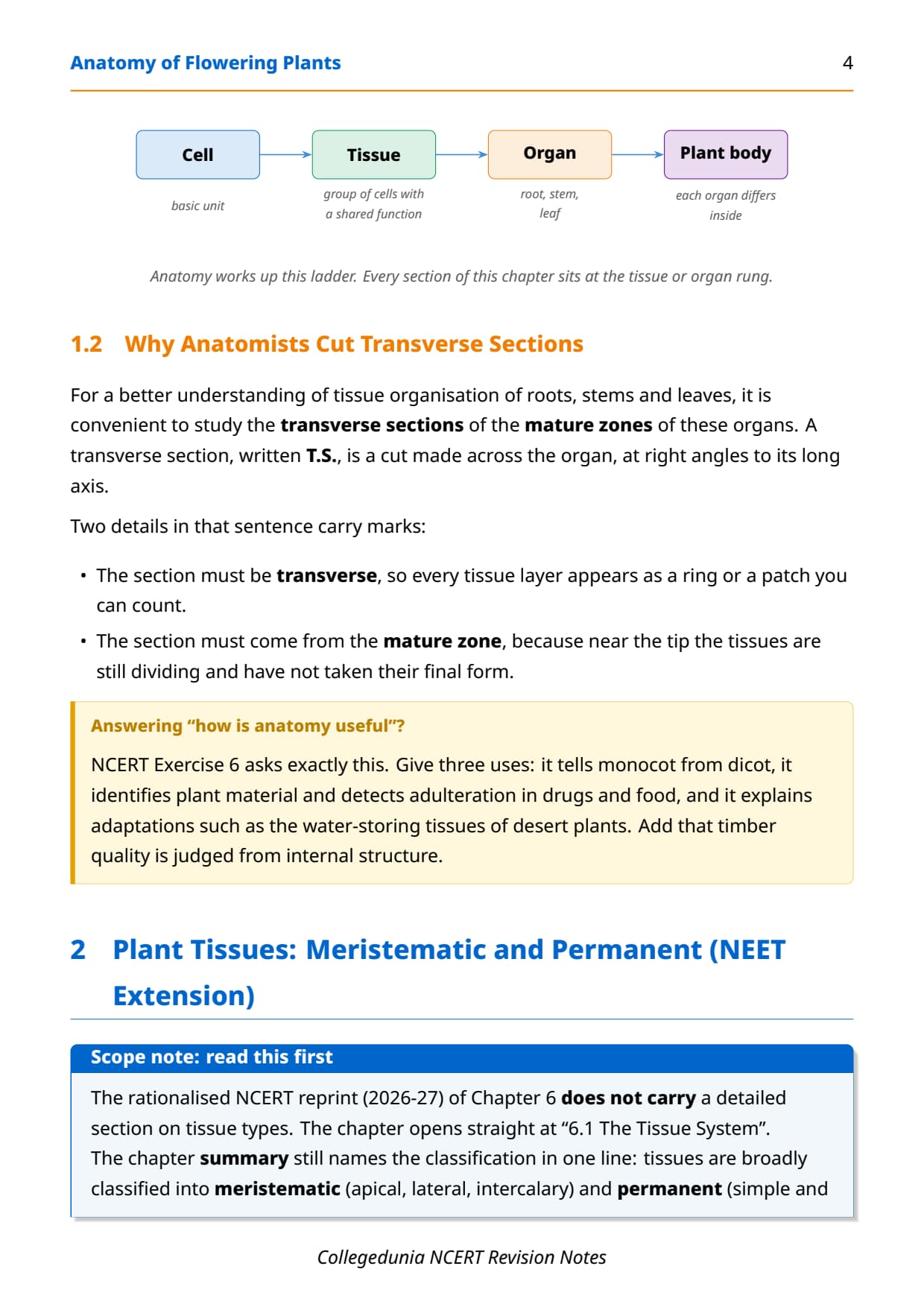
This chapter cuts the plant open. Where Chapter 5 showed the plant from outside, anatomy explains why a sunflower stem thickens with age while a maize stem does not, and the tissue vocabulary you learn here returns in the transport and growth chapters later.
- CBSE Weightage: 4 to 6 marks, usually one diagram-based question on a root, stem, or leaf section plus one short answer on tissues or stomata.
- Topics covered: anatomy and the cell-tissue-organ ladder, meristematic and permanent tissues, the epidermal, ground and vascular tissue systems, types of vascular bundles, and the T.S. anatomy of dicot and monocot roots, stems and leaves.
- Key rules: open versus closed bundles depend on cambium, radial versus conjoint depend on arrangement, the root has no cuticle, and one annual ring is one spring band plus one autumn band.
These anatomy of flowering plants class 11 notes are curated by subject experts, based on the 2026-27 NCERT textbook, and checked against the last five years of CBSE Board and NEET papers.
Topic-by-Topic Summary of Anatomy of Flowering Plants
The chapter builds from the smallest unit outward: single cells group into tissues, tissues group by location into three tissue systems, and those systems are packed differently in each organ. Once you can read a transverse section, every identification question becomes a checklist. Here is the quick map of what each topic gives you before you revise the detail.
- Tissues: the split between meristematic cells that still divide and permanent cells that have taken their final shape, kept as a NEET extension.
- The tissue system: epidermal, ground, and vascular, sorted by where a tissue sits rather than by cell type.
- Vascular bundles: classified on two independent questions, that is cambium present or not, and xylem and phloem on the same radius or not.
- Root anatomy: the sunflower and maize root read outside in, differing in only three points.
- Stem anatomy: the tidy ring of a dicot stem against the scattered bundles of a monocot stem.
- Leaf anatomy: the two-faced dorsiventral leaf against the identical-faced isobilateral leaf.
Revise in this order, because each topic uses the one before it. Fix the three tissue systems and the two-axis rule for vascular bundles first, and every root, stem, and leaf section falls into place around them. These anatomy of flowering plants class 11 notes follow the same sequence as the NCERT textbook.
Plant Tissues: Meristematic and Permanent (NEET Extension)
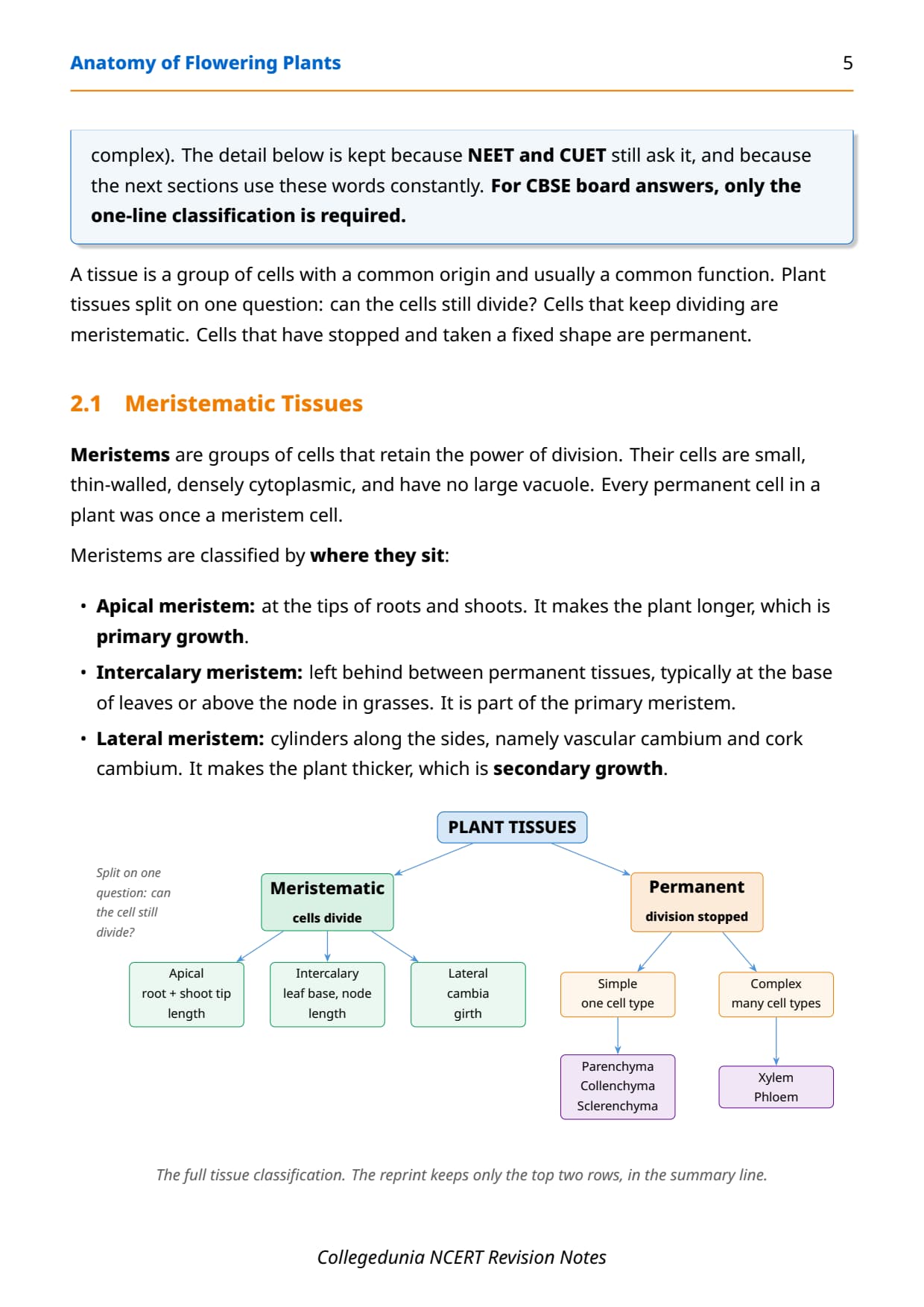
A tissue is a group of cells with a common origin and usually a common function. Plant tissues split on one question: can the cells still divide? The 2026-27 rationalised NCERT reprint does not carry a detailed tissue section and opens straight at the tissue system, but the summary still names the classification in one line, and NEET and CUET test it fully, so revise it as a clearly marked extension. For CBSE board answers, only the one-line classification is required.
- Meristematic tissues: small, thin-walled, densely cytoplasmic cells that retain the power of division. Apical meristem at root and shoot tips adds length, intercalary meristem at leaf bases and nodes also adds length, and lateral meristem (the cambia) adds girth.
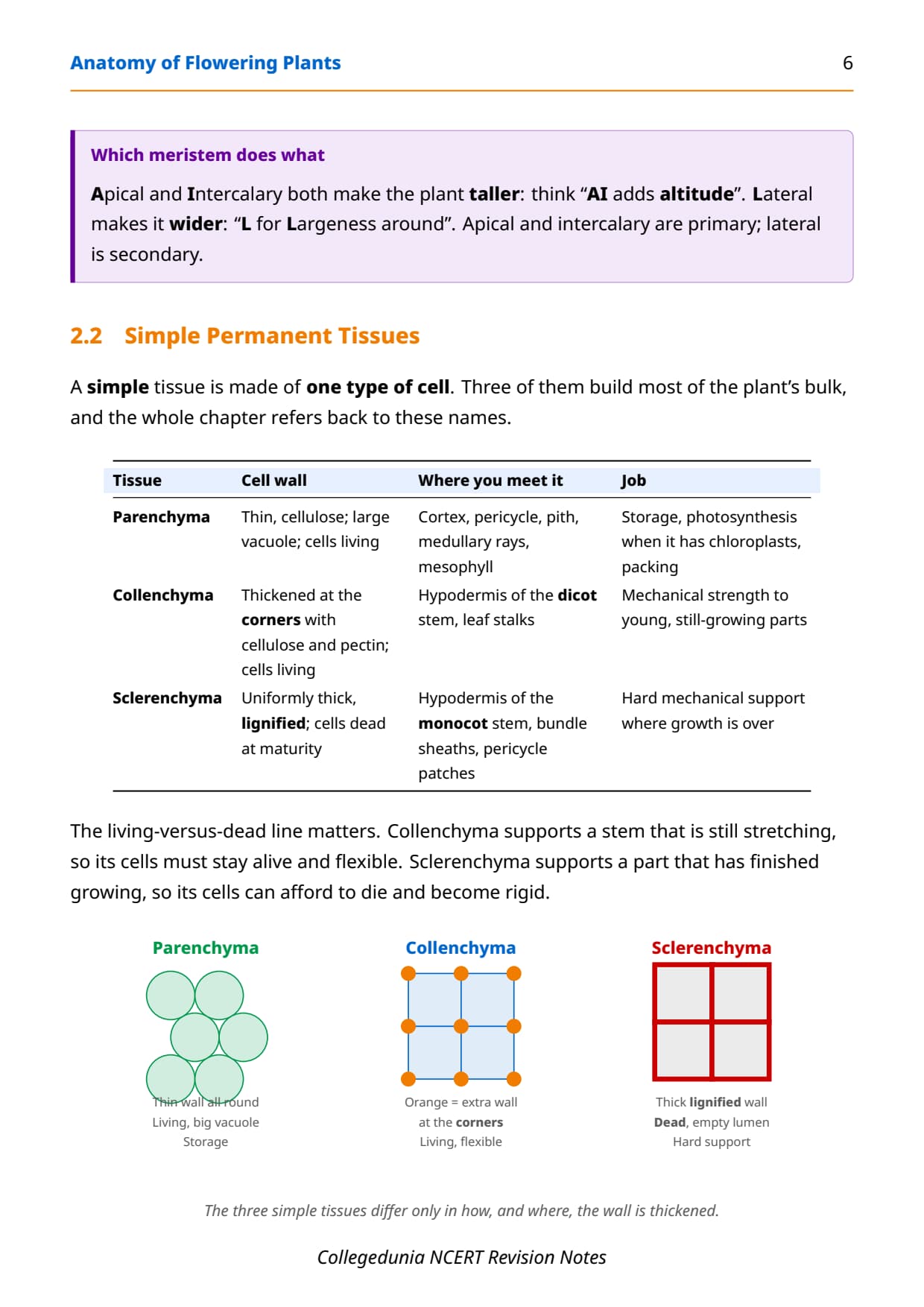
- Simple permanent tissues: one cell type each. Parenchyma is thin-walled and living for storage, collenchyma is corner-thickened and living for support of growing parts, and sclerenchyma is uniformly lignified and dead for hard support.
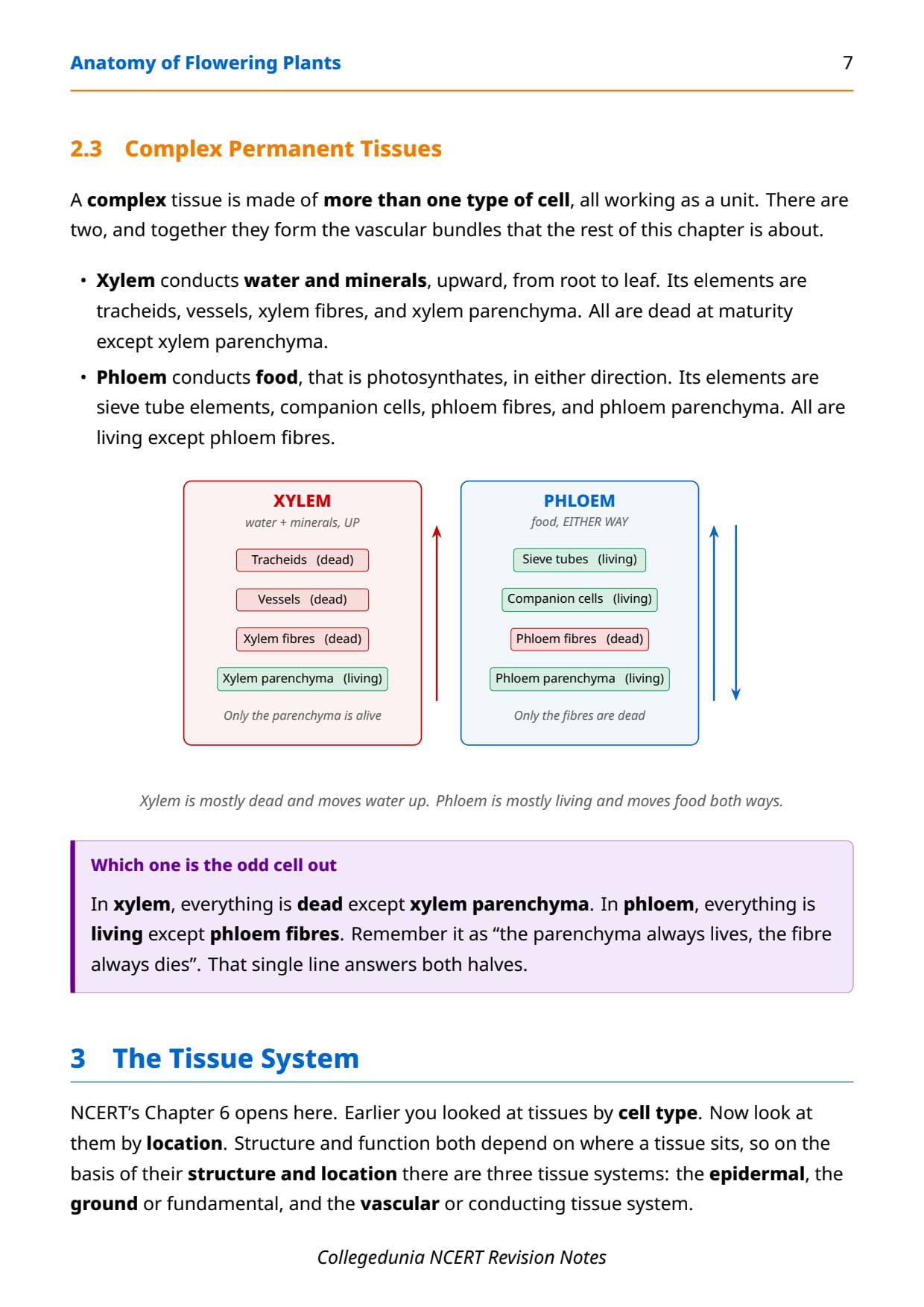
- Complex permanent tissues: many cell types working as a unit. Xylem carries water and minerals upward, and phloem carries food both ways.
Two memory hooks settle most questions here. Apical and intercalary meristems both add height, while lateral adds width. In xylem everything is dead except xylem parenchyma; in phloem everything is living except phloem fibres. The living-versus-dead line explains the jobs: collenchyma stays alive to support a still-stretching stem, while sclerenchyma can die and turn rigid once growth is over.
The Tissue System: Epidermal, Ground and Vascular
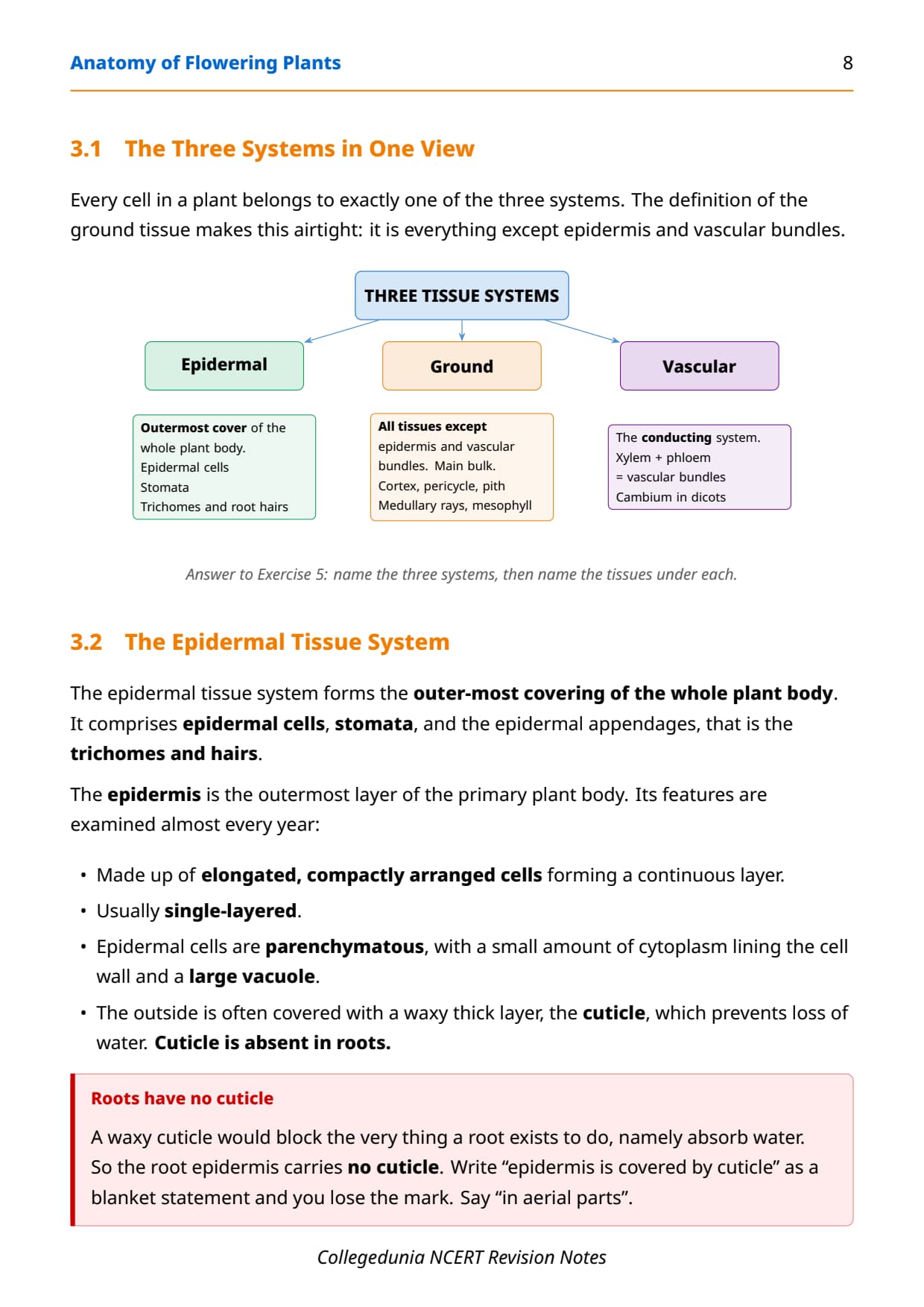
NCERT's Chapter 6 opens here. Instead of sorting tissues by cell type, you now sort them by location, because on the basis of their structure and location there are three tissue systems, and every cell in a plant belongs to exactly one of them. The definition of ground tissue makes this airtight, since it is everything left after you remove the epidermis and the vascular bundles.
- Epidermal tissue system: the outermost cover of the whole plant body, made of a usually single layer of parenchymatous epidermal cells, the stomata, and epidermal appendages, that is trichomes and root hairs. A waxy cuticle coats the aerial parts but is absent in roots.
- Ground tissue system: all tissues except epidermis and vascular bundles, made of parenchyma, collenchyma and sclerenchyma, forming the main bulk as cortex, pericycle and pith, and as mesophyll in the leaf.
- Vascular tissue system: the conducting system of xylem and phloem, which together form the vascular bundles, with cambium in dicots.
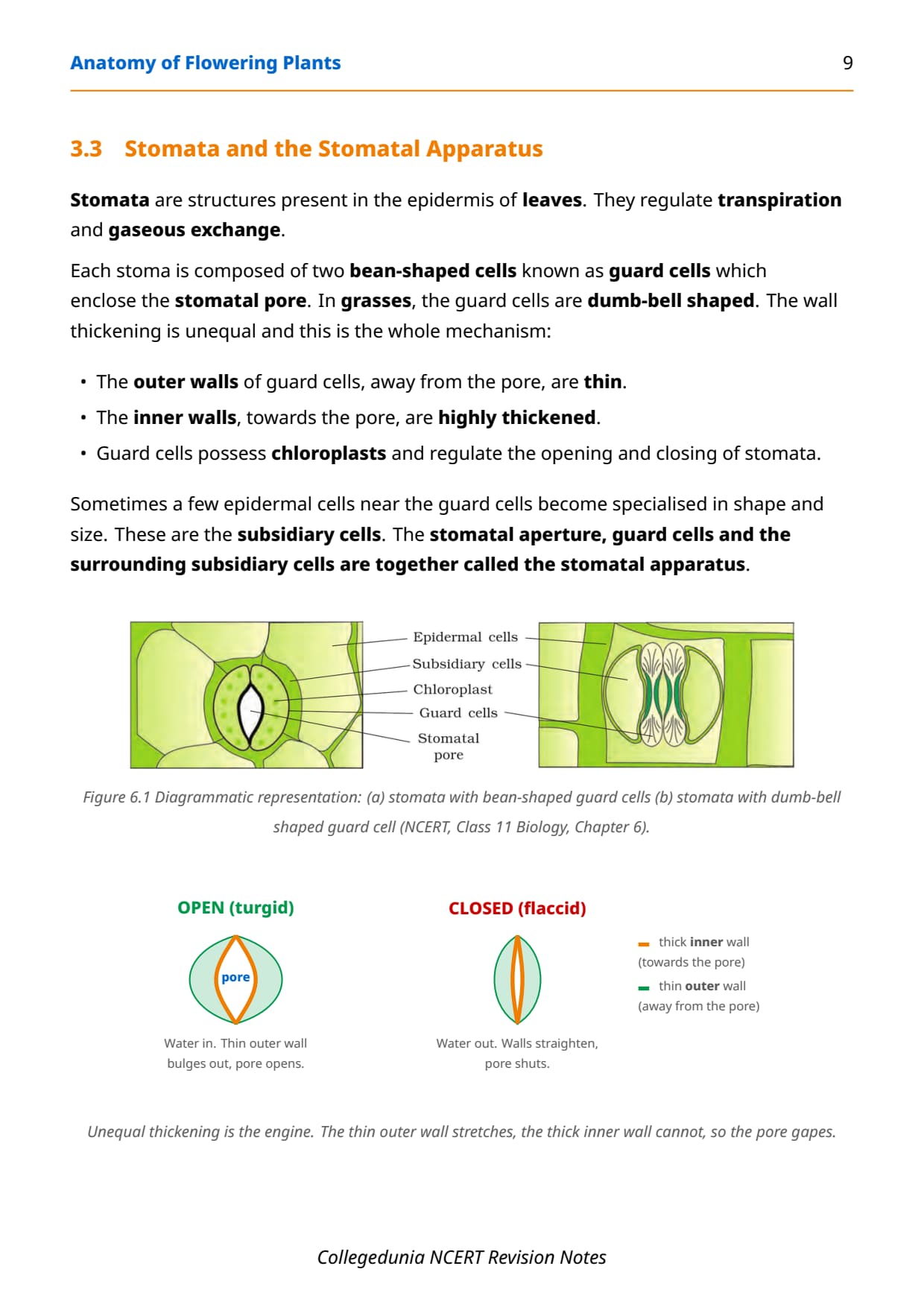
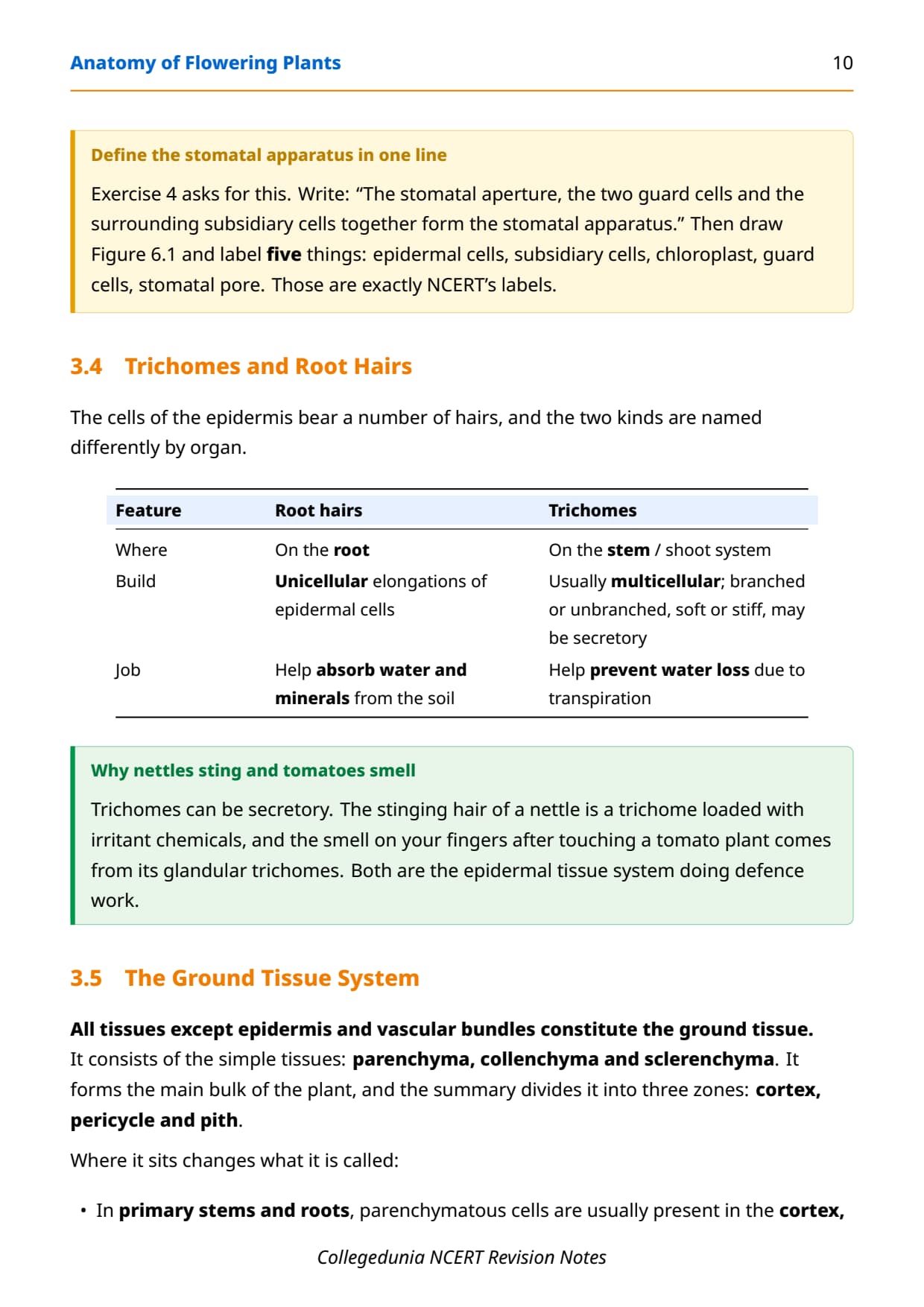
Stomata deserve their own line because they are examined almost every year. Each stoma is two bean-shaped guard cells, or dumb-bell shaped in grasses, enclosing a pore, with a thin outer wall and a highly thickened inner wall that drives opening and closing. The stomatal aperture, the two guard cells and the surrounding subsidiary cells together form the stomatal apparatus. Root hairs are unicellular and absorb water, while trichomes are usually multicellular and check water loss.
Types of Vascular Bundles
Vascular bundles are classified on two independent questions, and examiners love combining them into one label. Getting both axes right lets you name any bundle from a section, or work backwards from a label to the organ. This is the single idea that ties the root, stem, and leaf sections together, so learn the two questions cold before moving on.
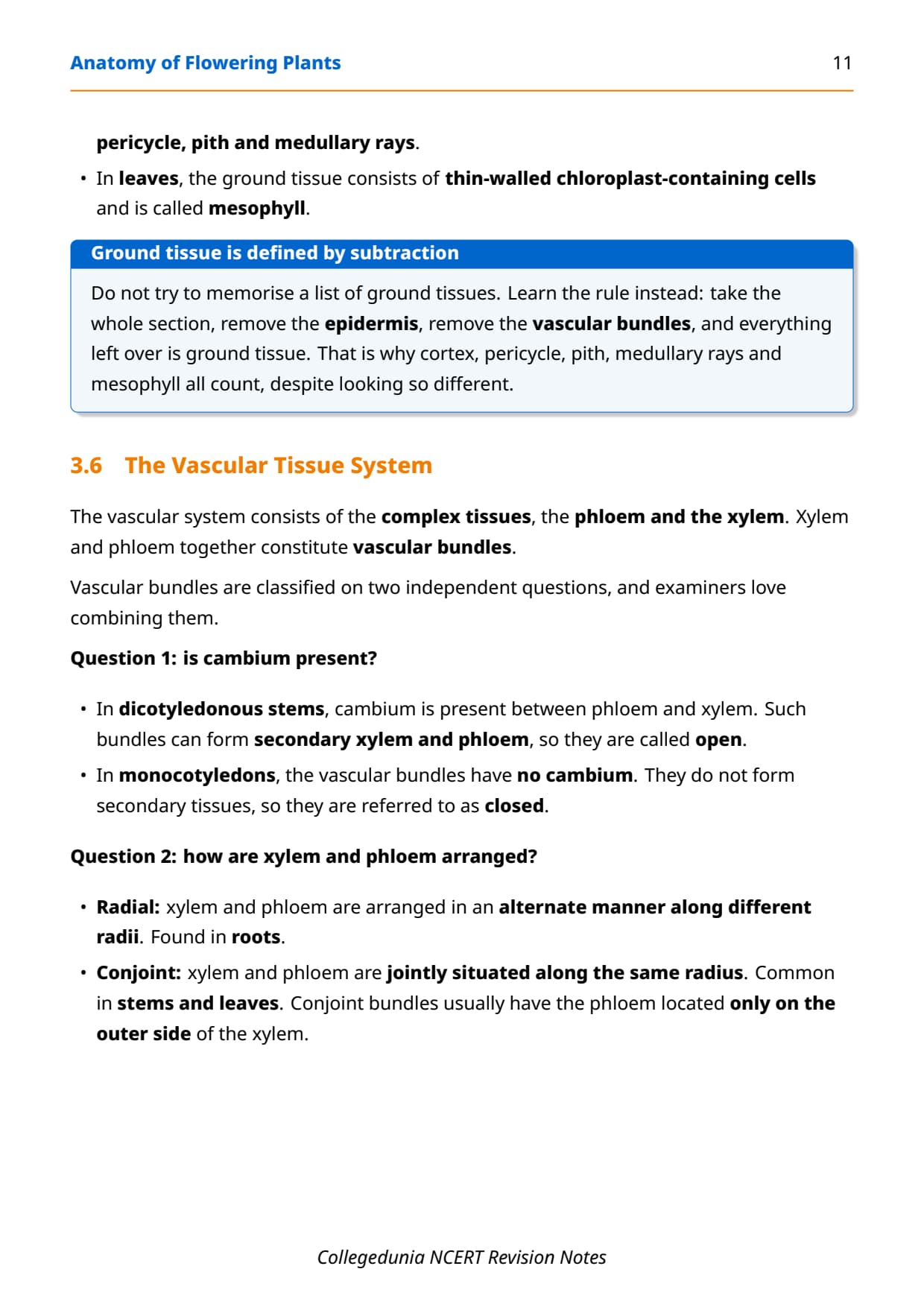
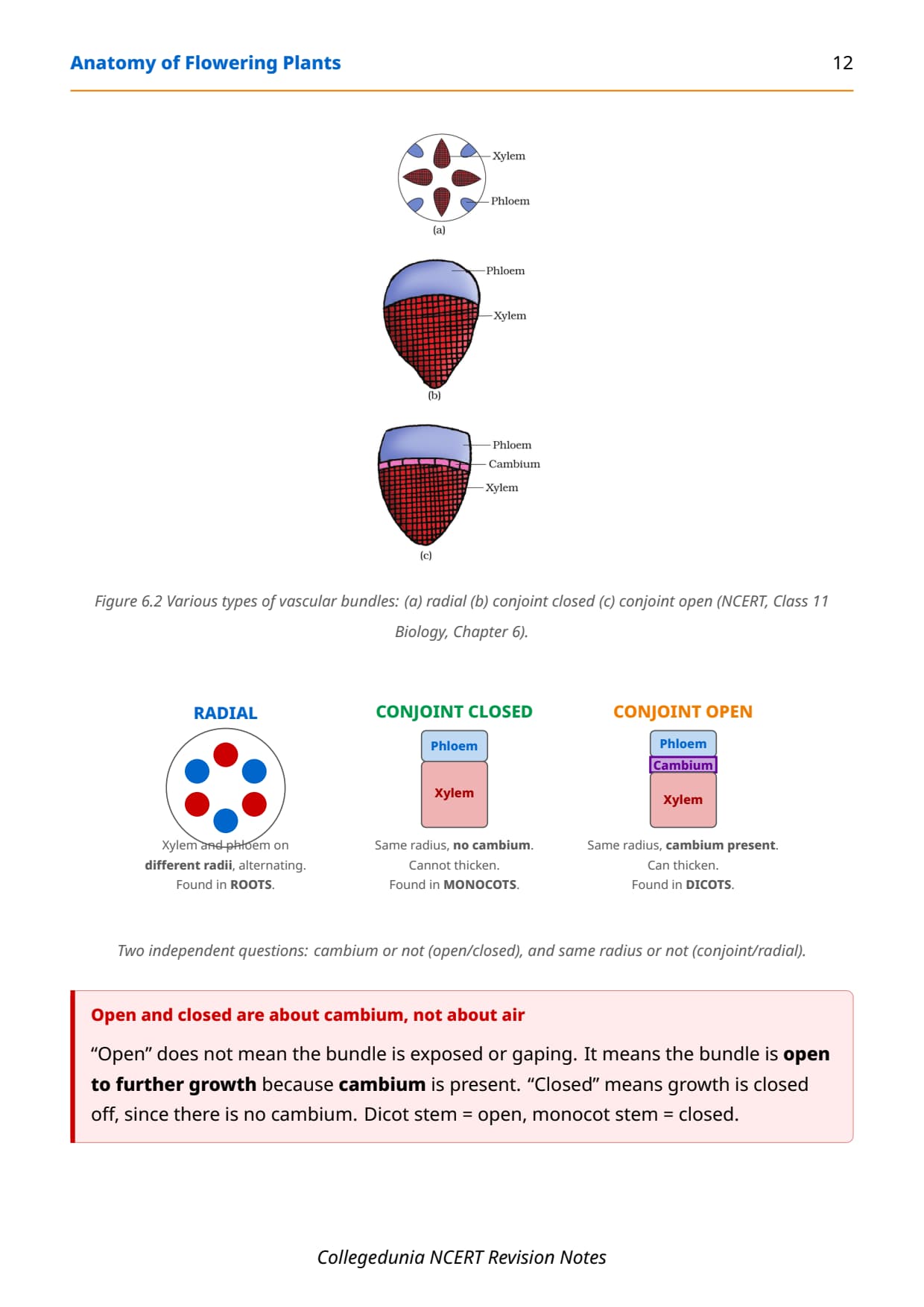
- Question one, is cambium present? In dicot stems cambium lies between phloem and xylem, so the bundle can form secondary tissue and is called open. In monocots there is no cambium, so the bundle is closed.
- Question two, how are xylem and phloem arranged? Radial bundles have xylem and phloem on different radii, alternating, and are found in roots. Conjoint bundles have both on the same radius and are found in stems and leaves, usually with phloem only on the outer side.
Put the two axes together for a full answer. A dicot stem bundle is conjoint, open, and endarch, a monocot stem bundle is conjoint and closed, and a root bundle is radial. The common trap is reading open as exposed. Open means the bundle stays open to further growth because cambium is present, and closed means growth is shut off with no cambium.
Anatomy of the Root: Dicot and Monocot
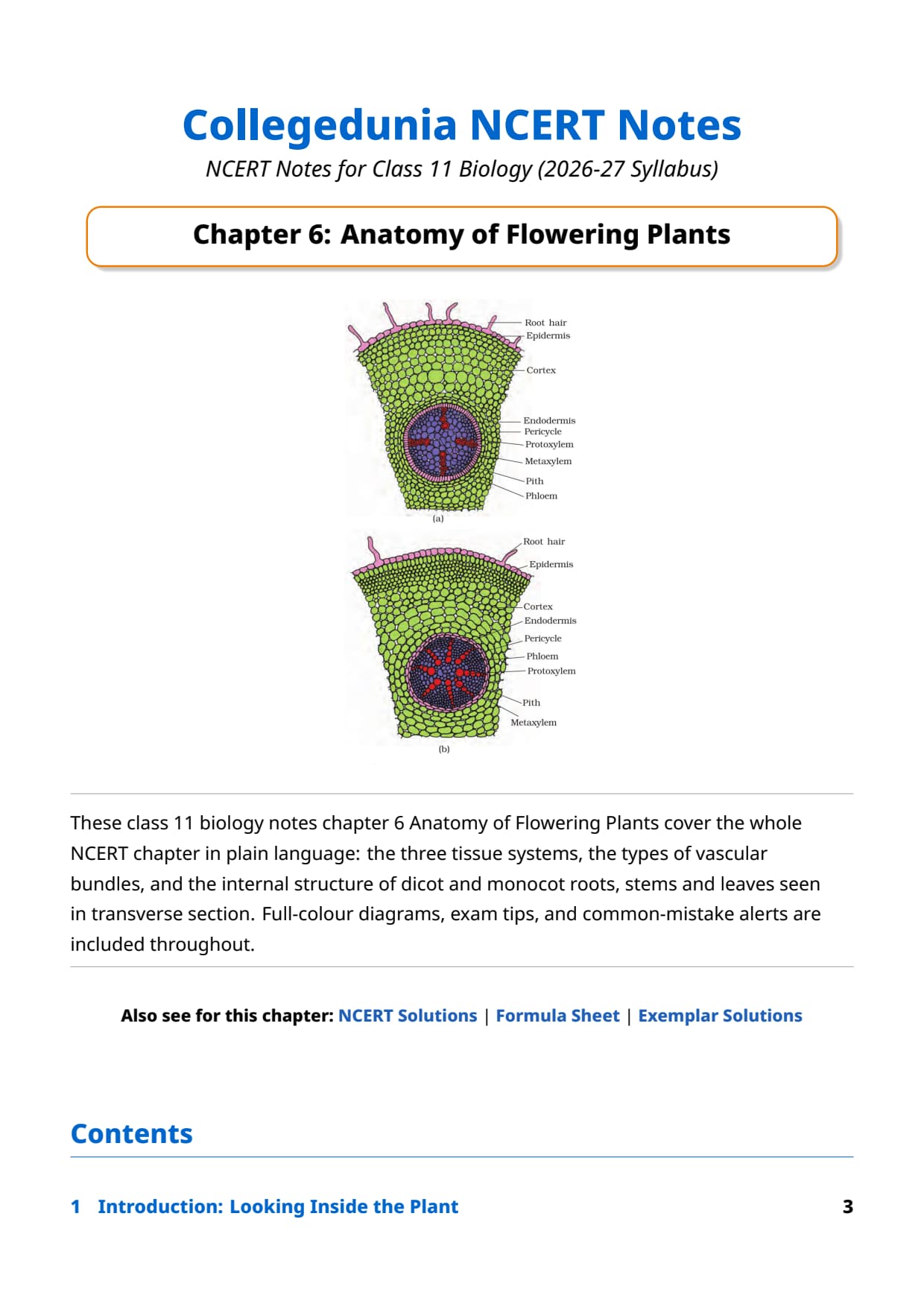
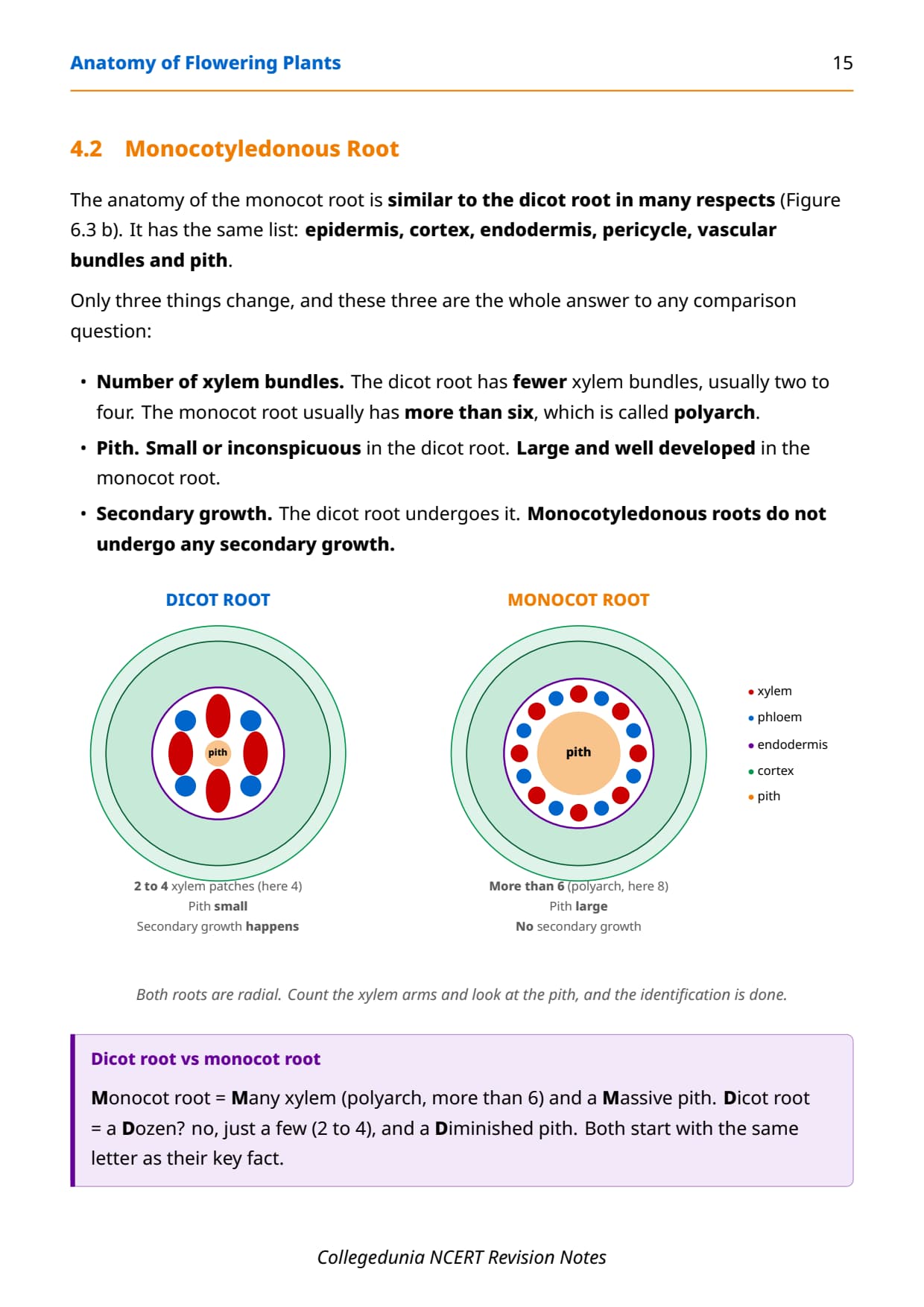
Start with the root, because it has the simplest section. The dicot root, shown by the sunflower, and the monocot root, shown by maize, share most of their layers and differ in only three memorable points. Read the layers outside in, since the exam asks them in order, and note that all tissues inside the endodermis, that is pericycle, vascular bundles and pith, together make the stele.
- Epiblema: the outermost layer, many of whose cells protrude as unicellular root hairs. NCERT labels it epidermis in the figure; older books call it the piliferous layer.
- Cortex and endodermis: thin-walled parenchyma with intercellular spaces, ending in a single barrel-shaped endodermis whose walls carry water-impermeable casparian strips of suberin.
- Pericycle and vascular bundles: thick-walled parenchyma that starts lateral roots and the vascular cambium, wrapping the radial xylem and phloem patches.
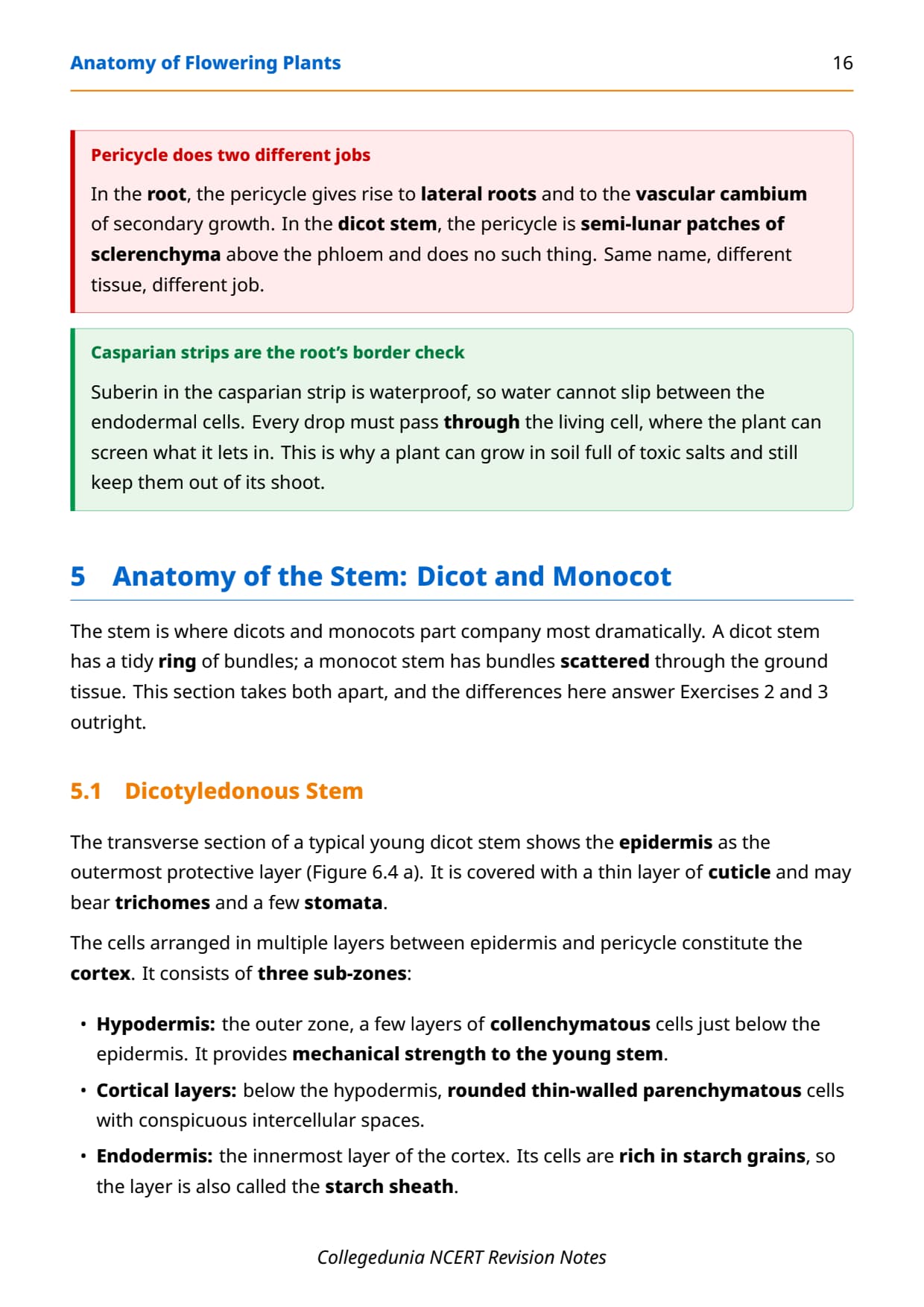
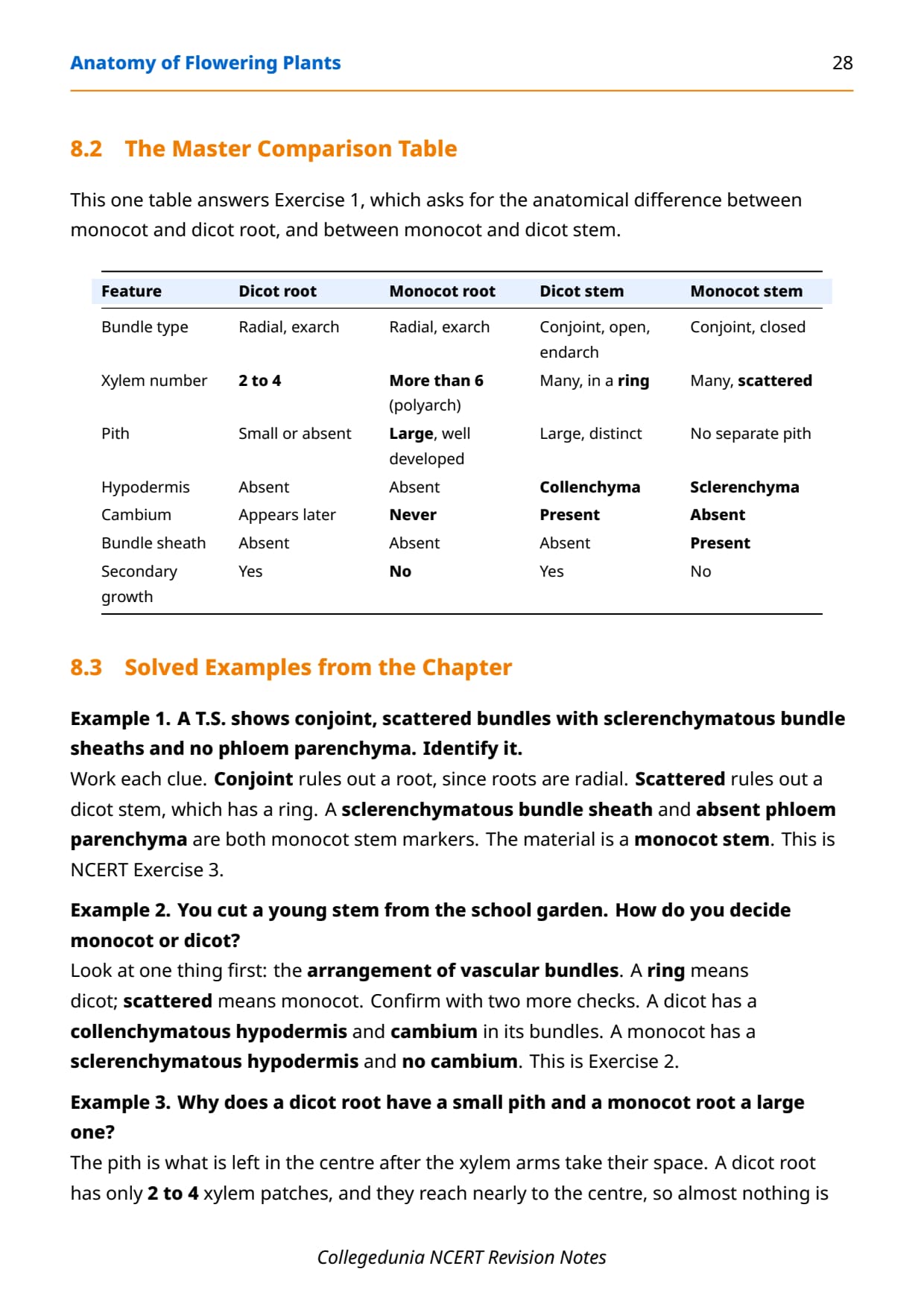
Only three things separate the two roots, and these three answer any comparison question. The dicot root has two to four xylem patches, a small pith, and does undergo secondary growth, while the monocot root has more than six xylem patches (polyarch), a large pith, and never undergoes secondary growth. A useful hook is that the Monocot root has Many xylem and a Massive pith, both starting with M.
Anatomy of the Stem: Dicot and Monocot
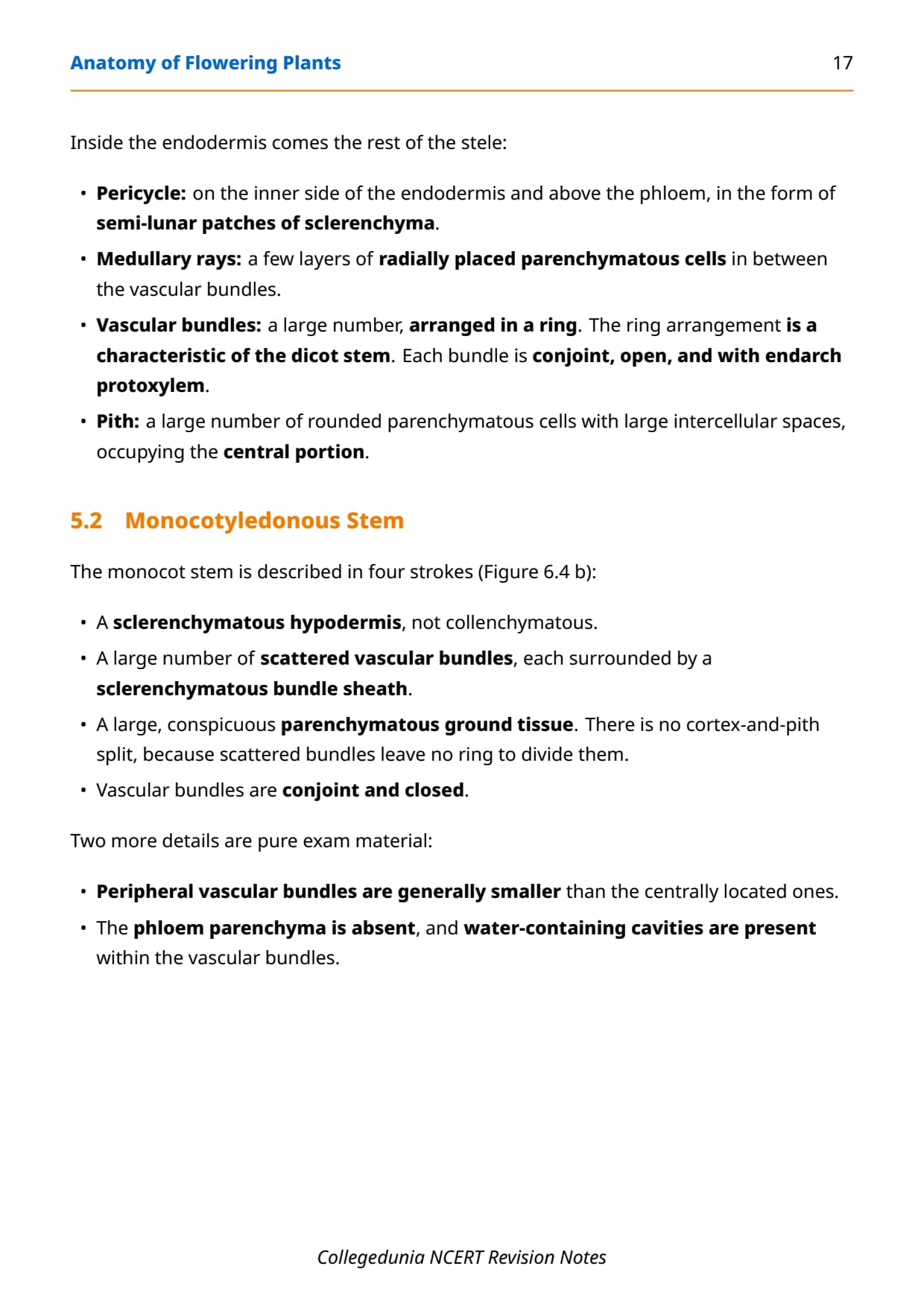
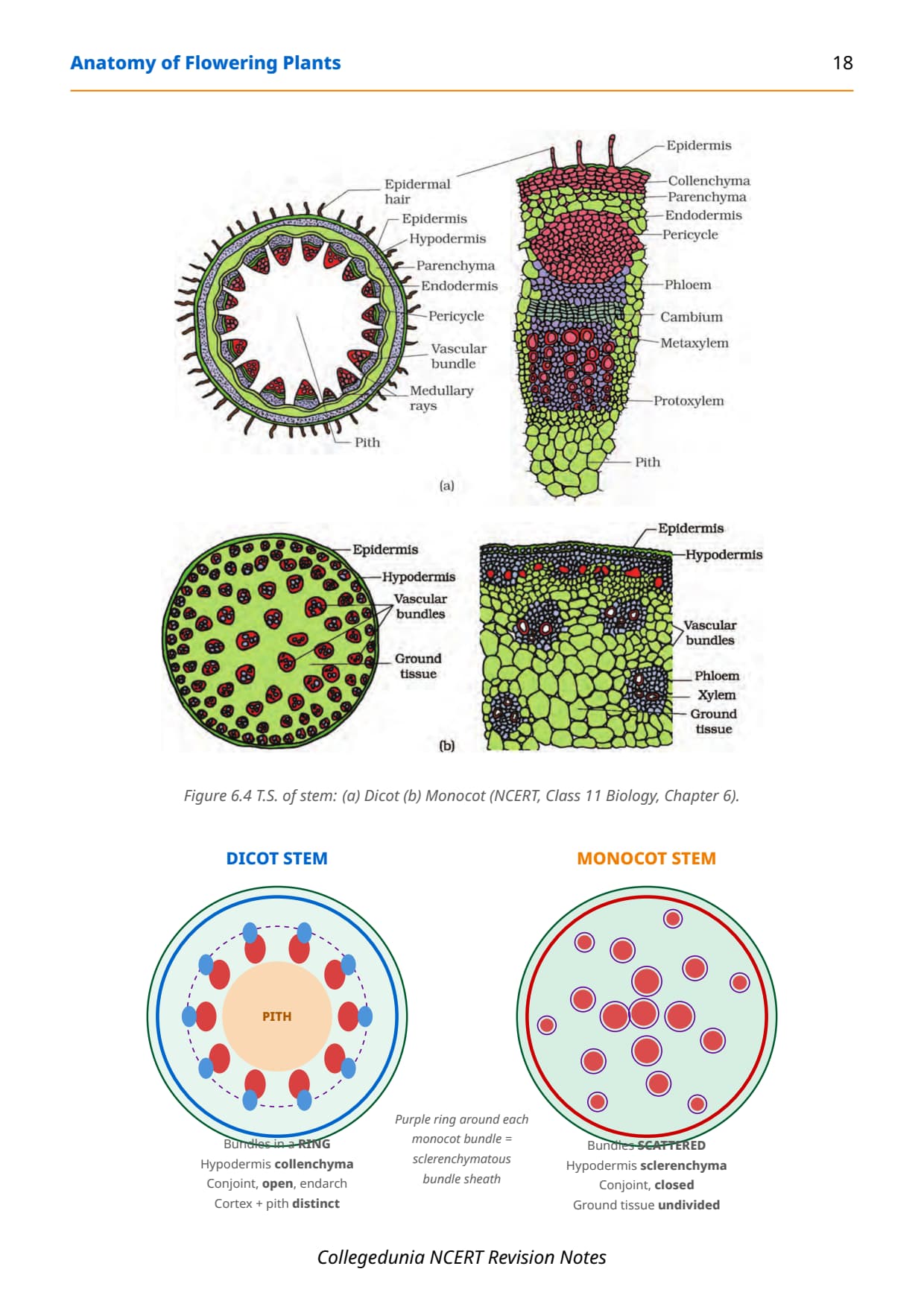
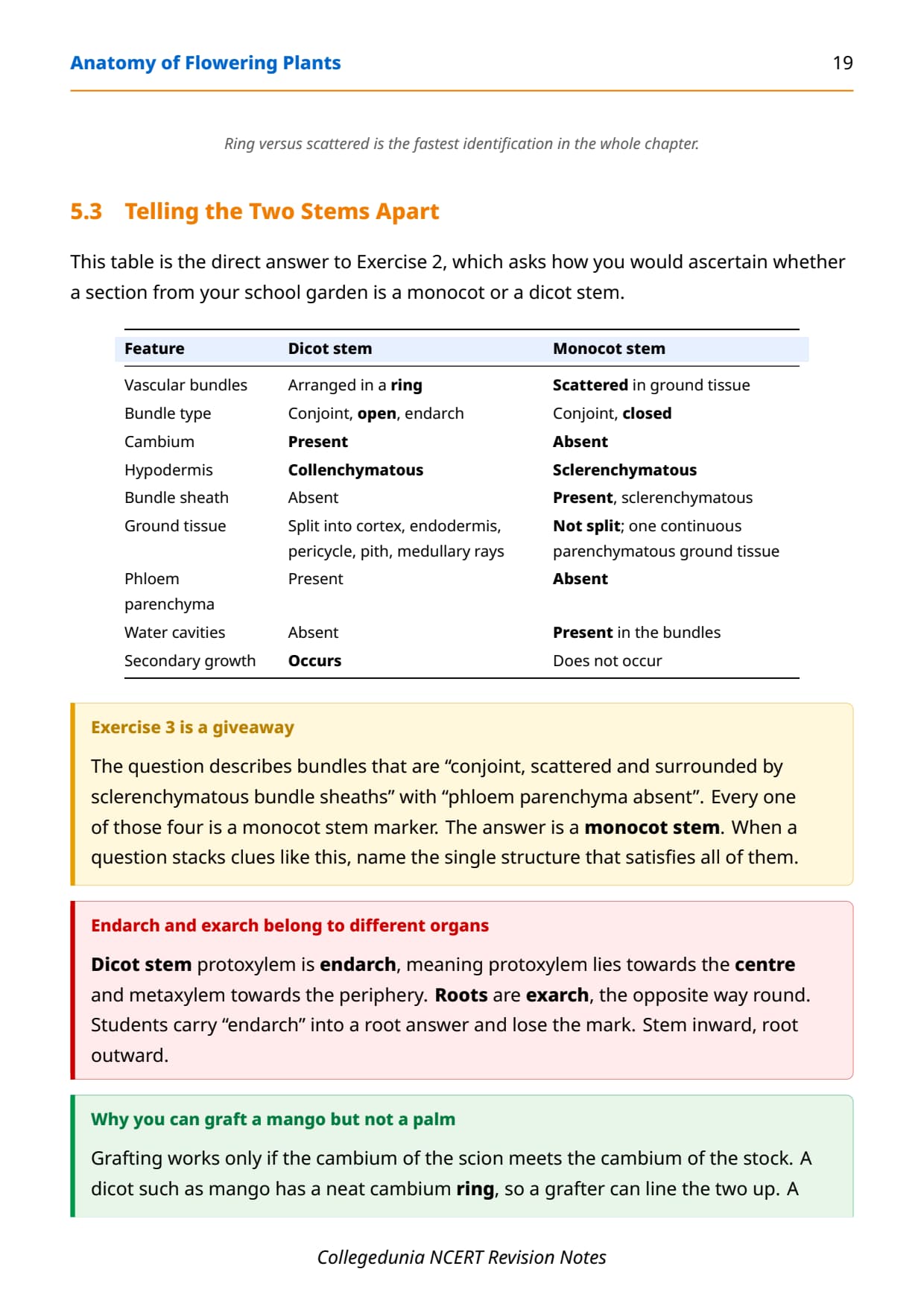
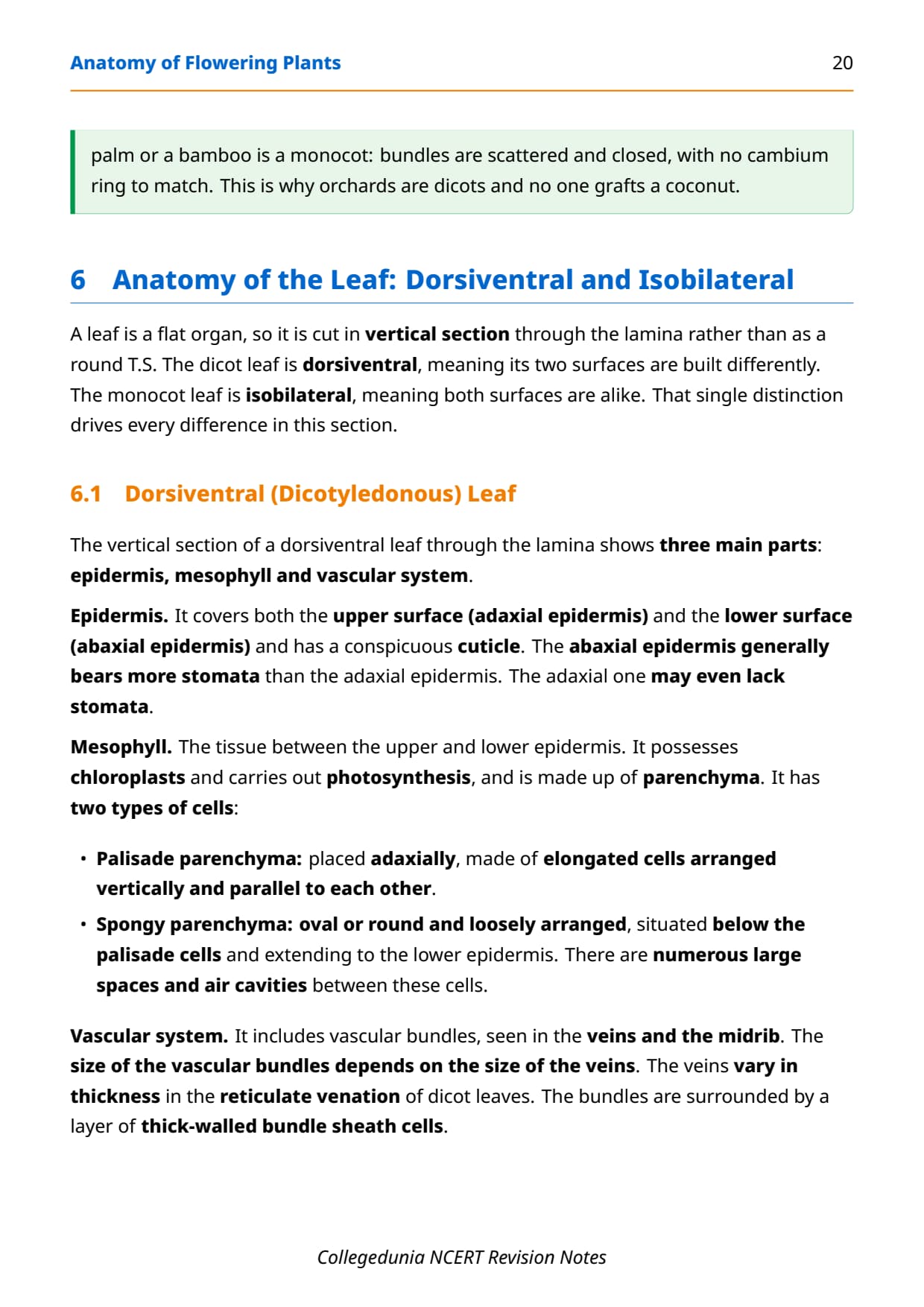
The stem is where dicots and monocots part company most dramatically. A dicot stem has a tidy ring of bundles, while a monocot stem has bundles scattered through a single continuous ground tissue. This one difference, ring versus scattered, is the fastest identification in the whole chapter, and it answers the two exercises that ask you to tell a garden section apart.
| Feature | Dicot stem | Monocot stem |
|---|---|---|
| Vascular bundles | Arranged in a ring | Scattered in ground tissue |
| Bundle type | Conjoint, open, endarch | Conjoint, closed |
| Cambium | Present | Absent |
| Hypodermis | Collenchymatous | Sclerenchymatous |
| Bundle sheath | Absent | Present, sclerenchymatous |
| Ground tissue | Split into cortex, endodermis, pericycle, pith, rays | Not split; one continuous parenchyma |
| Phloem parenchyma | Present | Absent |
| Secondary growth | Occurs | Does not occur |
The dicot stem endodermis is rich in starch grains, so it is also called the starch sheath, and its pericycle sits as semi-lunar patches of sclerenchyma above the phloem. When a question stacks clues such as conjoint, scattered, sclerenchymatous bundle sheath, and phloem parenchyma absent, every one is a monocot stem marker, so the answer is a monocot stem. Remember also that the dicot stem is endarch while roots are exarch.
Anatomy of the Leaf: Dorsiventral and Isobilateral
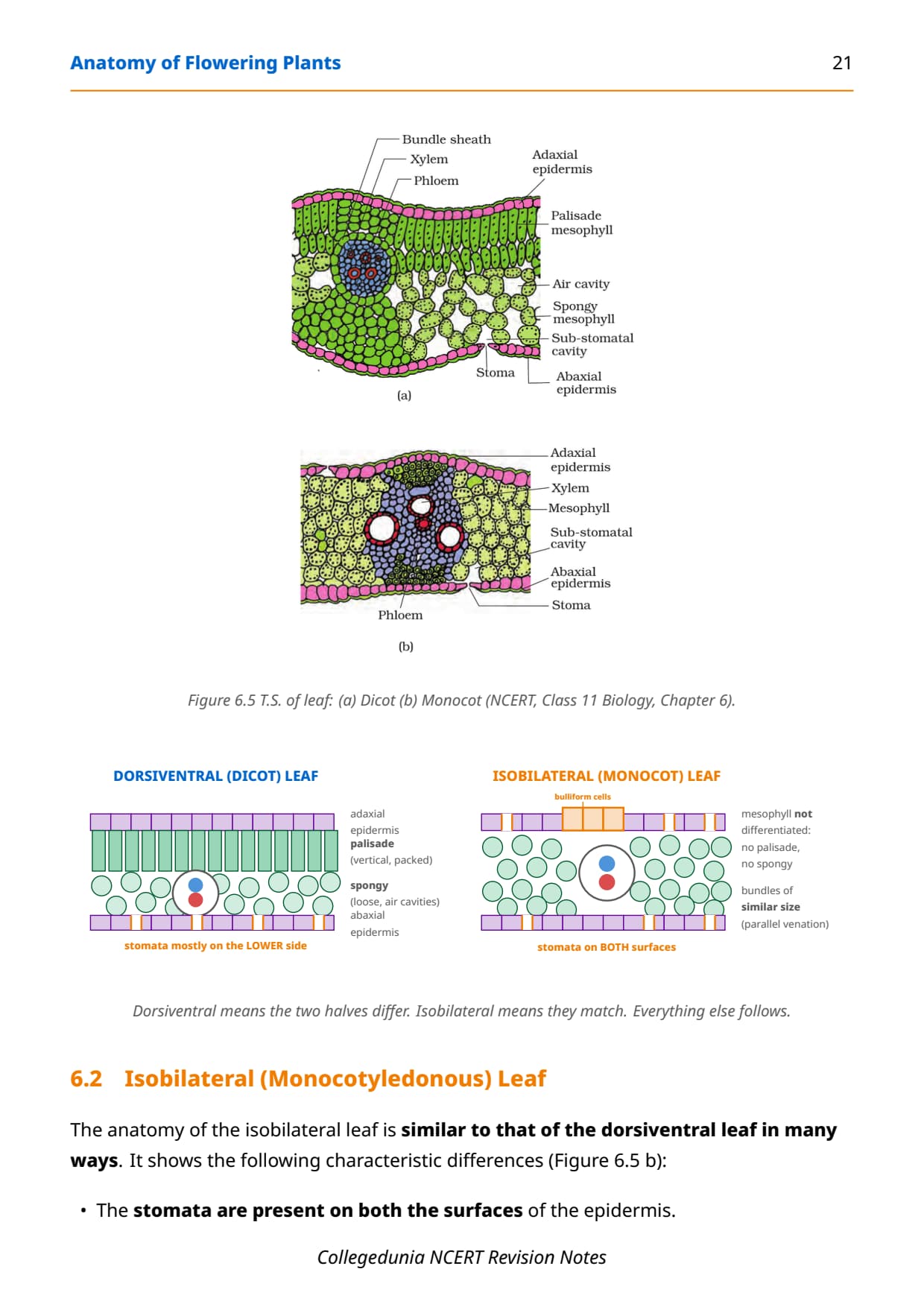
A leaf is flat, so it is cut in vertical section through the lamina. The dicot leaf is dorsiventral, meaning its two surfaces are built differently, while the monocot leaf is isobilateral, meaning both surfaces are alike. That single distinction drives every difference below, from stomata position to mesophyll layout, and it is the theme of the leaf section.
- Dorsiventral leaf: an upper (adaxial) and lower (abaxial) epidermis with cuticle, stomata mostly on the lower surface, and a mesophyll split into palisade parenchyma (elongated cells, adaxial) and spongy parenchyma (loose, round cells with air cavities, below).
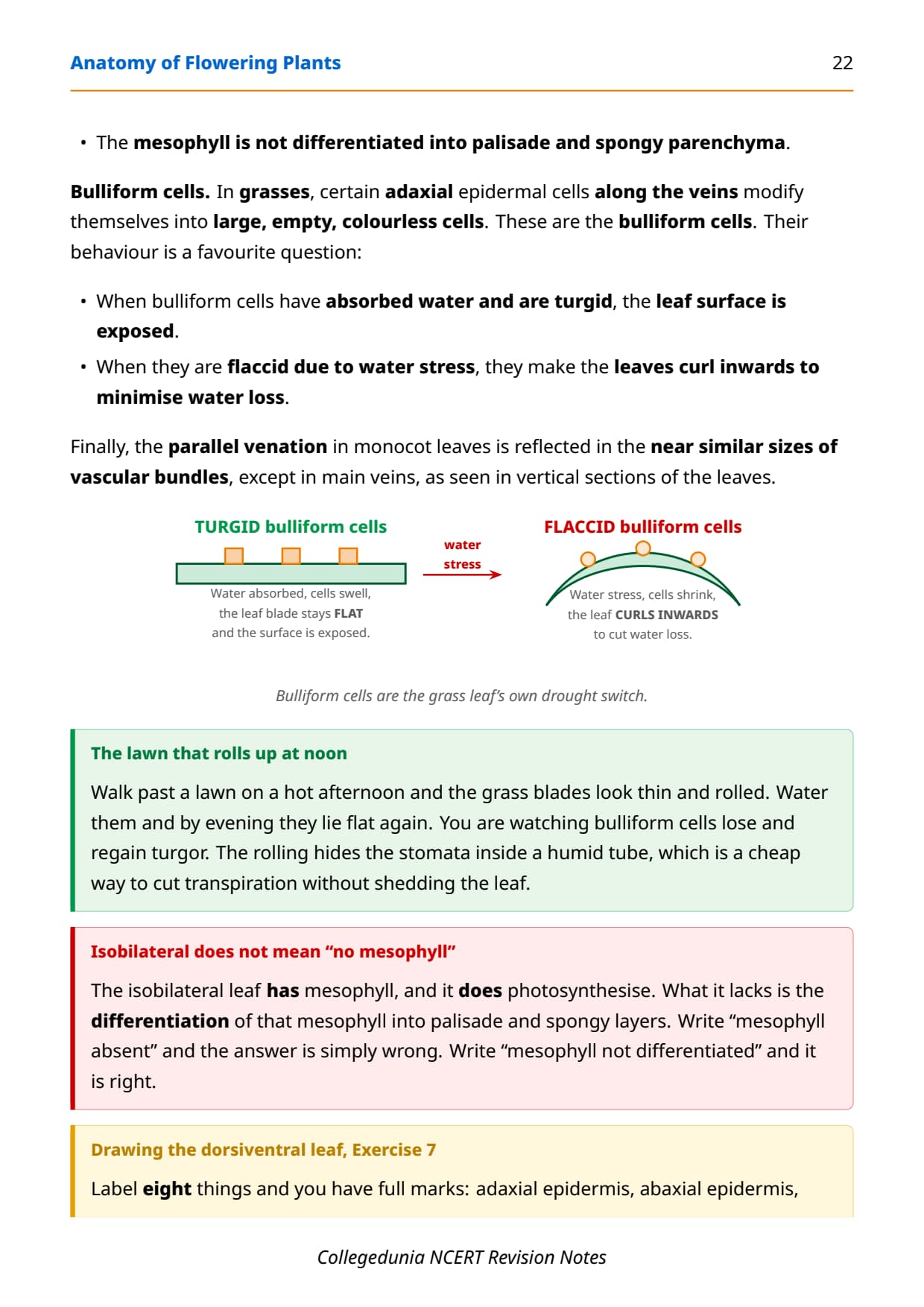
- Isobilateral leaf: stomata on both surfaces, and a mesophyll that is not differentiated into palisade and spongy. In grasses, large empty adaxial bulliform cells curl the leaf inward when flaccid to cut water loss.
- Vascular bundles: reticulate venation gives dicot veins of varying thickness, while parallel venation gives monocot bundles of near-similar size.
The classic trap is writing that the monocot leaf has no mesophyll. It has mesophyll and it does photosynthesise; what it lacks is the differentiation of that mesophyll into palisade and spongy layers. Write mesophyll not differentiated, never mesophyll absent. Bulliform cells are the grass leaf's own drought switch, which is why a lawn looks rolled at noon and lies flat again by evening.
Secondary Growth (NEET Extension)
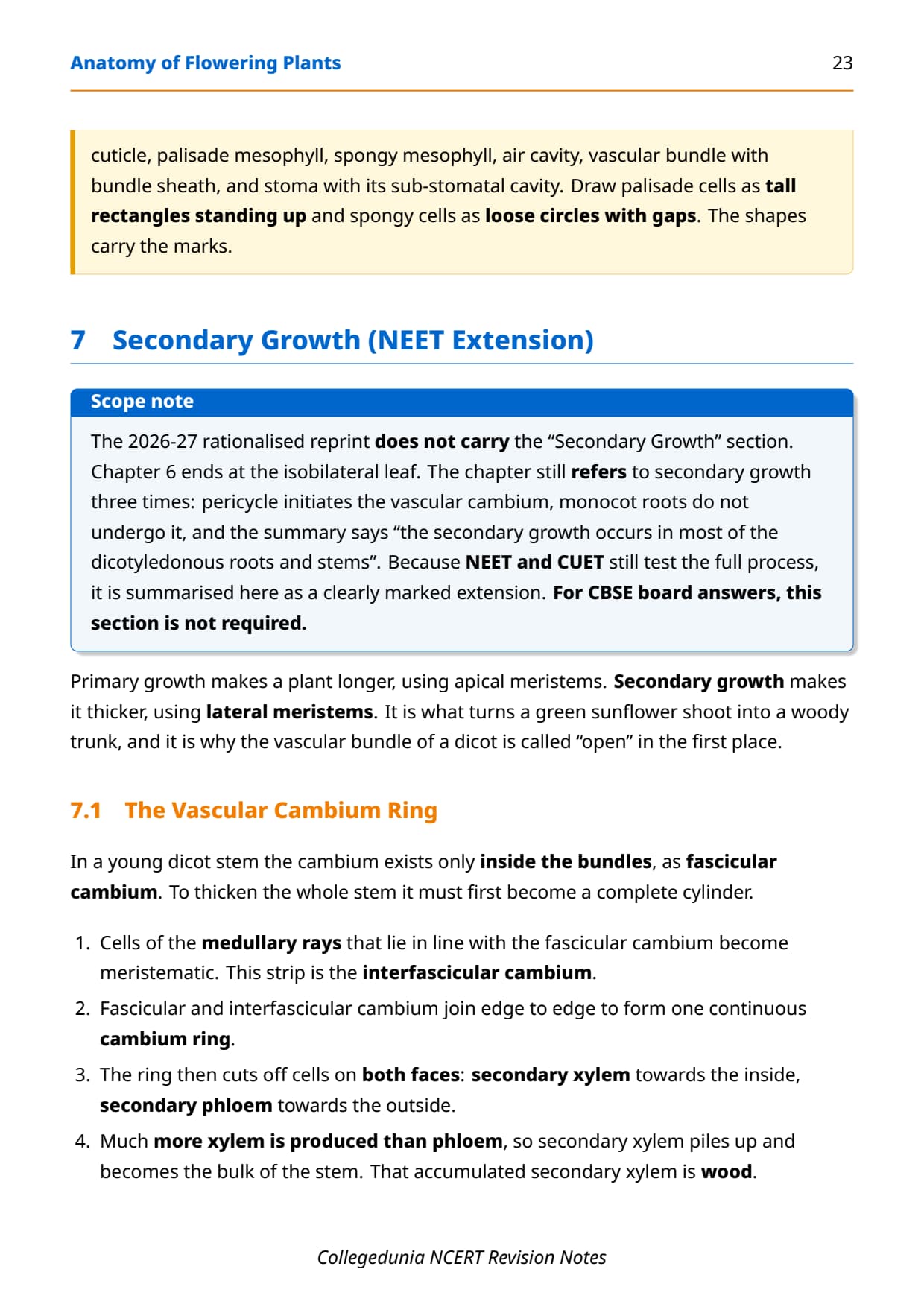
Primary growth makes a plant longer using apical meristems; secondary growth makes it thicker using lateral meristems, and it is what turns a green sunflower shoot into a woody trunk. The 2026-27 rationalised reprint does not carry this section, and Chapter 6 ends at the isobilateral leaf, but NEET and CUET still test the full process, so it is summarised here as a clearly marked extension not required for CBSE board answers.
- The vascular cambium ring: fascicular cambium inside the bundles joins the newly meristematic interfascicular cambium to form one ring, which cuts secondary xylem inward and secondary phloem outward. Far more xylem is made, and this accumulated secondary xylem is wood.
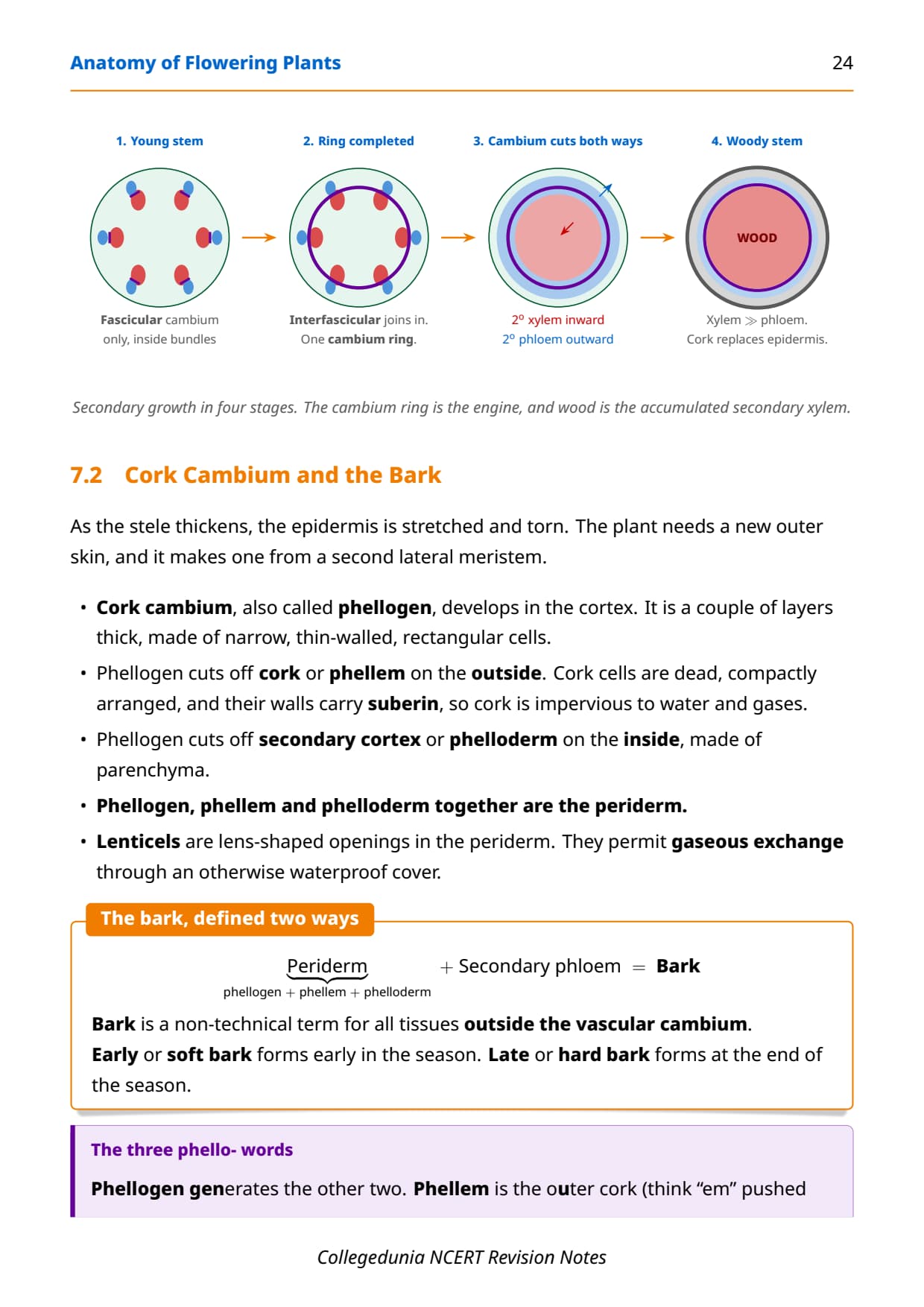
- Cork cambium and bark: the phellogen makes cork (phellem) outside and secondary cortex (phelloderm) inside. Together phellogen, phellem and phelloderm form the periderm, and lenticels allow gas exchange through it.
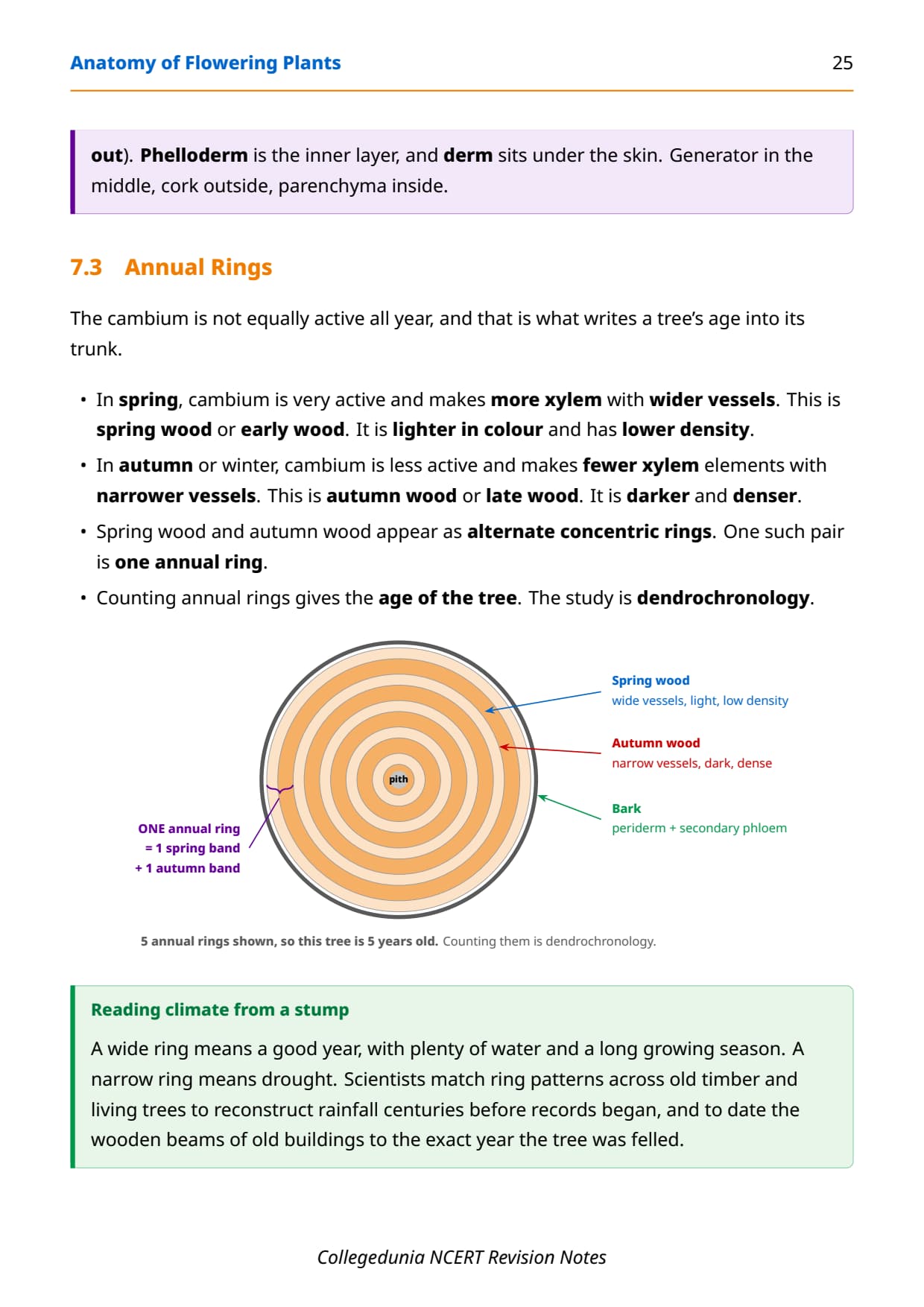
- Annual rings: light, wide-vesselled spring wood and dark, dense autumn wood together make one annual ring, and counting the rings (dendrochronology) gives the age of the tree.
Two definitions are worth memorising exactly. Bark is all the tissue outside the vascular cambium, that is periderm plus secondary phloem. One annual ring is one spring band plus one autumn band, so count the pairs, not every wood line. Grafting works only between dicots because a matched cambium ring is needed, which is why orchards are dicots and no one grafts a coconut palm.
Key Definitions in Anatomy of Flowering Plants
Board short-answer questions often ask for a clean definition in one or two lines, and a vague answer loses easy marks. Learn these word-for-word, because the wording of the exam question is usually built straight from the NCERT definition. Each term below also connects to a section or diagram you can be asked to explain.
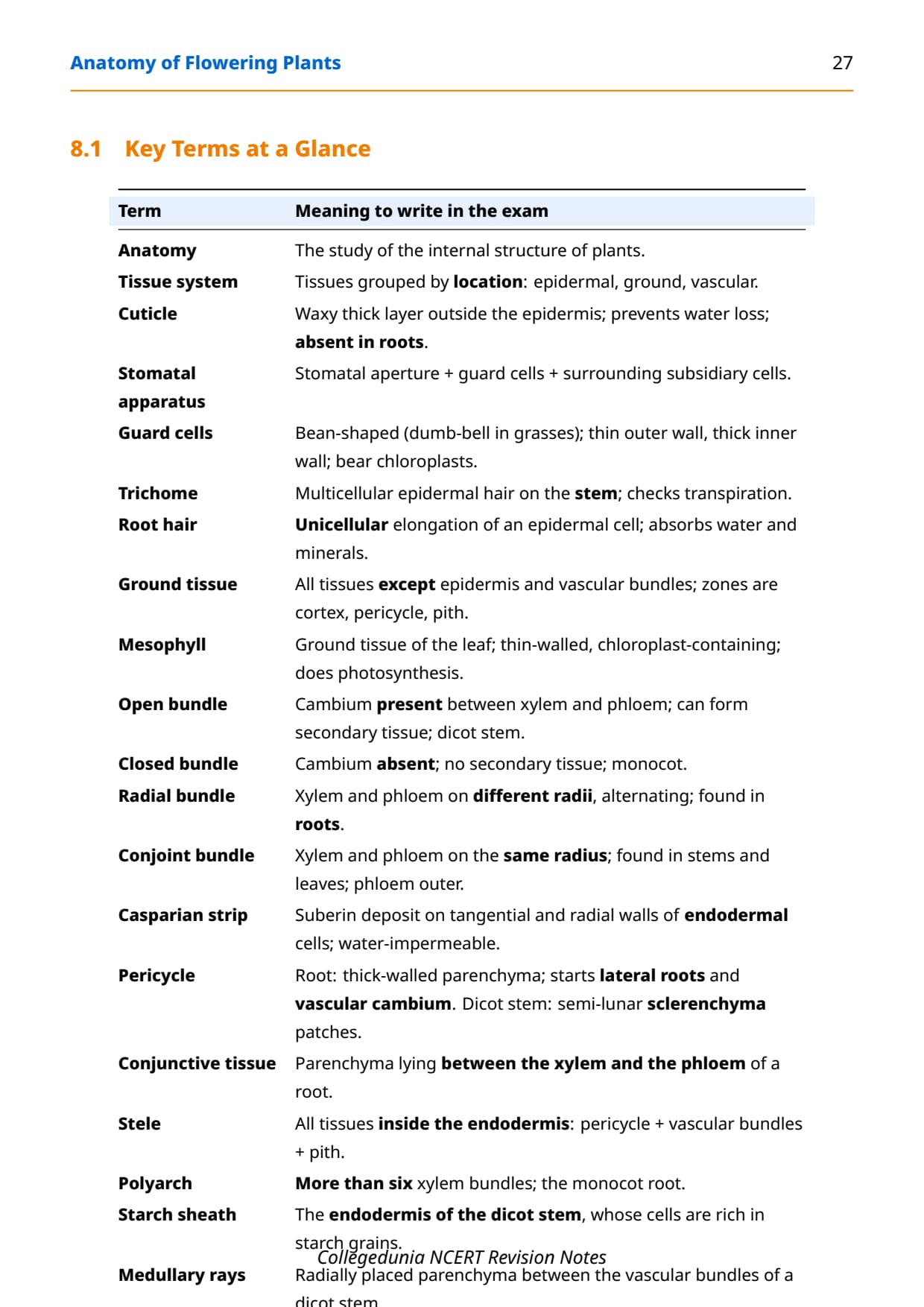
| Term | Definition |
|---|---|
| Anatomy | The study of the internal structure of plants. |
| Cuticle | Waxy thick layer outside the epidermis that prevents water loss; absent in roots. |
| Stomatal apparatus | The stomatal aperture, the two guard cells, and the surrounding subsidiary cells together. |
| Casparian strip | A water-impermeable suberin deposit on the walls of endodermal cells of the root. |
| Open bundle | A vascular bundle with cambium present, able to form secondary tissue; the dicot stem. |
| Radial bundle | Xylem and phloem on different radii, alternating; found in roots. |
| Bulliform cells | Large, empty, colourless adaxial cells in grasses that curl the leaf when flaccid. |
A common board question asks you to define the stomatal apparatus and then label it on a diagram. State the definition first, then label epidermal cells, subsidiary cells, chloroplast, guard cells, and the stomatal pore. Learning these definitions makes the wording of almost every one-mark and two-mark question in this chapter familiar.
Common Mistakes Students Make in Anatomy of Flowering Plants
These slips happen because two tissues or two organs look alike, not because the concept is hard. Each one costs 1 to 2 marks in the paper, so watch for them at the exact step where they occur.
Mistake 1: Saying the root epidermis has a cuticle. The cuticle is absent in roots, because it would block the absorption of water.
Mistake 2: Reading "open bundle" as an exposed bundle. Open means cambium is present, so growth stays open; closed means no cambium.
Mistake 3: Giving the dicot stem a sclerenchymatous hypodermis. The dicot stem has a collenchymatous hypodermis; the monocot stem has a sclerenchymatous one.
Mistake 4: Calling a root bundle endarch. Roots are exarch; only the dicot stem is endarch.
Mistake 5: Writing "mesophyll absent" for a monocot leaf. The mesophyll is present but not differentiated into palisade and spongy.
Anatomy of Flowering Plants Weightage in CBSE Boards, NEET and CUET
This chapter is diagram-heavy and reliably scoring. It often carries a labelled T.S. question and a short answer on tissues or stomata, and it feeds directly into transport and secondary growth ideas later. Here is how the marks split across the main exams for 2026-27.
| Exam | Typical weightage | What is asked |
|---|---|---|
| CBSE Boards | 4 to 6 marks | A labelled T.S. of a root, stem, or leaf plus a short answer on tissues or the stomatal apparatus |
| NEET | 2 to 3 questions | Vascular bundle types, meristems, dicot versus monocot anatomy, and secondary growth |
| CUET | 1 to 2 objective questions | Tissue systems, stomata, and identification of a named section |
The dicot versus monocot comparison across root, stem, and leaf is the single most tested idea from this chapter across all three exams. Master the master comparison table first, then the two-axis rule for vascular bundles, then secondary growth, in that order of return on effort for the 2026-27 session.
How to Revise Anatomy of Flowering Plants Quickly
Use these anatomy of flowering plants class 11 notes for a fast, ordered recap the night before a test. The checklist below takes about 25 minutes and hits every marks-heavy idea in the chapter without opening the full textbook.
- First 9 minutes: draw the dicot root and dicot stem in section and label the endodermis, pericycle, and vascular bundles, then note ring versus scattered for the two stems.
- Next 8 minutes: write the two-axis rule for vascular bundles and label a dorsiventral leaf with palisade, spongy, and stomata on the lower side.
- Last 8 minutes: list the three tissue systems, define the stomatal apparatus, and sketch the four stages of secondary growth ending in wood.
Close the loop by explaining why a monocot root has a large pith while a dicot root has a small one. If you can do all three blocks without notes, the chapter is exam-ready. Keep the master comparison table beside you for the first pass only, then try the whole checklist closed-book.
Student Feedback on the Anatomy of Flowering Plants Notes
What 12,140 students told us about their Anatomy of Flowering Plants revision:
- 71% of students rated the dicot versus monocot comparison table as the part most worth memorising for the exam.
- Most-confused pair: collenchyma versus sclerenchyma, mixed up by about 3 in 10 students.
- Students who drew each transverse section once from memory said the labelling questions felt easy afterwards.
Source: 2026-27 Class 11 Biology student poll. Sample of 12,140 students from CBSE schools across 15 states, conducted before the 2026 boards.
Other Anatomy of Flowering Plants Class 11 Biology Resources
Pair these notes with the solved answers, the formula sheet, and the textbook PDF for the same chapter.
| Resource | Link |
|---|---|
| NCERT Solutions | Anatomy of Flowering Plants Class 11 NCERT Solutions |
| Formula Sheet | Anatomy of Flowering Plants Class 11 Formula Sheet |
| Exemplar Solutions | Anatomy of Flowering Plants Class 11 Exemplar Solutions |
| NCERT Book PDF | Anatomy of Flowering Plants Class 11 Book PDF |
| Exemplar Book PDF | Anatomy of Flowering Plants Class 11 Exemplar Book PDF |
NCERT Notes for Class 11 Biology: All Chapters
Jump to the revision notes for any other Class 11 Biology chapter below.
| Chapter | NCERT Notes |
|---|---|
| Chapter 1 | The Living World |
| Chapter 2 | Biological Classification |
| Chapter 3 | Plant Kingdom |
| Chapter 4 | Animal Kingdom |
| Chapter 5 | Morphology of Flowering Plants |
| Chapter 6 | Anatomy of Flowering Plants |
| Chapter 7 | Structural Organisation in Animals |
| Chapter 8 | Cell The Unit of Life |
| Chapter 9 | Biomolecules |
| Chapter 10 | Cell Cycle and Cell Division |
| Chapter 11 | Photosynthesis in Higher Plants |
| Chapter 12 | Respiration in Plants |
| Chapter 13 | Plant Growth and Development |
| Chapter 14 | Breathing and Exchange of Gases |
| Chapter 15 | Body Fluids and Circulation |
| Chapter 16 | Excretory Products and their Elimination |
| Chapter 17 | Locomotion and Movement |
| Chapter 18 | Neural Control and Coordination |
| Chapter 19 | Chemical Coordination and Integration |
FAQs on Anatomy of Flowering Plants Class 11 Biology Notes
Anatomy of Flowering Plants Notes - Frequently Asked Questions
Ques. What topics do the anatomy of flowering plants class 11 notes cover?
Ans. These anatomy of flowering plants class 11 notes cover the cell-tissue-organ ladder, meristematic and permanent tissues, the epidermal, ground and vascular tissue systems, the stomatal apparatus, the types of vascular bundles, the transverse-section anatomy of dicot and monocot roots, stems and leaves, and secondary growth as a NEET extension. Every key definition, comparison table and example is included for fast revision.
Ques. What is the difference between an open and a closed vascular bundle?
Ans. An open vascular bundle has a cambium present between the xylem and the phloem, so it can form secondary xylem and secondary phloem and thicken over time. This is seen in the dicot stem. A closed vascular bundle has no cambium, so it cannot form secondary tissue, and this is seen in monocots. Open does not mean exposed; it means open to further growth.
Ques. How do you tell a monocot stem from a dicot stem in section?
Ans. The fastest check is the arrangement of vascular bundles. A dicot stem has them in a neat ring, a collenchymatous hypodermis, and cambium in the bundles. A monocot stem has scattered bundles, a sclerenchymatous hypodermis, no cambium, sclerenchymatous bundle sheaths, and no separate cortex and pith. Ring versus scattered is the single quickest identification in the chapter.
Ques. What is the stomatal apparatus?
Ans. The stomatal apparatus is made of the stomatal aperture, the two bean-shaped guard cells that enclose it, and the specialised subsidiary cells around them. In grasses the guard cells are dumb-bell shaped. The guard cells have a thin outer wall and a highly thickened inner wall and contain chloroplasts, and this unequal thickening drives the opening and closing of the pore.
Ques. Why does a root have no cuticle?
Ans. The epidermis of aerial parts carries a waxy cuticle to prevent water loss, but the root epidermis has no cuticle. A waterproof layer would block the very function of the root, which is to absorb water and minerals from the soil through its unicellular root hairs. So when you describe the epidermis, say the cuticle is present in aerial parts and absent in roots.
Ques. What is one annual ring and how does it show the age of a tree?
Ans. In spring the cambium is very active and makes light, wide-vesselled spring wood, while in autumn it is less active and makes dark, dense autumn wood. Together one spring band and one autumn band make a single annual ring. Counting the annual rings gives the age of the tree, and this study is called dendrochronology. A common error is to count every wood line, so count the pairs instead.
Ques. What is the weightage of this chapter in the CBSE board exam?
Ans. Anatomy of Flowering Plants carries about 4 to 6 marks in the CBSE Class 11 Biology paper, usually a labelled transverse-section diagram plus a short answer on tissues or the stomatal apparatus. It also appears in NEET and CUET as objective questions on vascular bundle types, dicot versus monocot anatomy, and secondary growth, which makes it a reliably scoring chapter for the 2026-27 session.



Comments