




The class 11 biology NCERT solutions chapter 4 Animal Kingdom cover every back-exercise question, according to the latest 2026-27 CBSE syllabus, and help students prepare for the CBSE Boards, NEET and CUET. Each answer is worked step by step, from the fundamental features used to classify animals to the coelom, the nine major phyla, the chordate and vertebrate classes, and the adaptations that let fish float and birds fly.
This is the second-longest chapter of the diversity unit, and it rewards students who learn a small set of tests rather than a long list of animals.
- CBSE Weightage: 4 to 5 marks, one of the heaviest chapters in the Diversity of Living Organisms unit that opens Class 11.
- Topics covered: basis of classification, levels of organisation, symmetry, germinal layers, coelom, segmentation, notochord, the nine non-chordate phyla, Chordata and its subphyla, the vertebrate classes, and patterns of digestion, development and reproduction.
- Exercise count: 15 back-exercise questions, a mix of descriptive answers, two objective questions, one match-the-column and one list-making task.
These class 11 biology NCERT solutions chapter 4 Animal Kingdom are curated by subject experts, based on the 2026-27 NCERT textbook, and checked against the last five years of CBSE Board and NEET papers.
Why the Animal Kingdom Chapter Matters and What It Covers
Chapter 4 sorts every animal on earth into a handful of phyla using shared features rather than outward looks. The chapter matters because it teaches a method: classify by fundamental features, not by appearance. Once students understand that a whale and a shark look alike only because both swim, the whole animal kingdom collapses into a short branching key. This is exactly the skill NEET tests when it asks students to place a named animal in its phylum.
- Everyday role: the same features that classify animals also explain them, telling students why a tapeworm has no gut and why an insect can colonise land.
- Core skill: reading an animal's level of organisation, symmetry, germ layers, coelom, segmentation and notochord, then reading off its phylum.
- Why it is high-yield: the phyla and the vertebrate classes are among the most frequently asked NEET topics, and the same tables reappear in later units.
Almost every animal-kingdom question in the Boards and NEET is a test of one fundamental feature applied to one animal. That is why students who learn the six features first find the rest of the chapter mechanical. The class 11 biology NCERT solutions chapter 4 Animal Kingdom below follow the NCERT order so students can check their working line by line.
The Basis of Classification: Fundamental Features
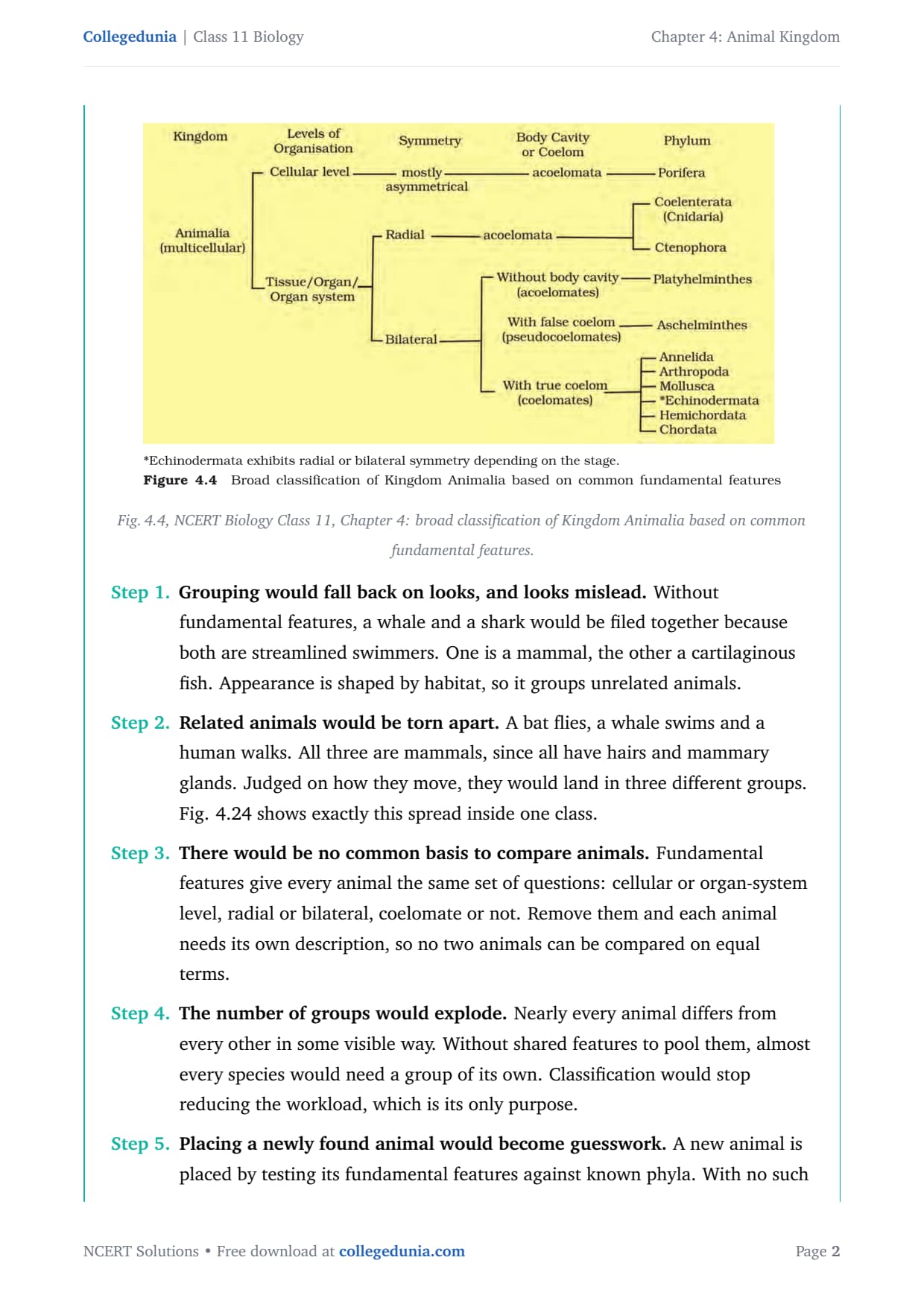
The first two exercise questions ask what would go wrong without fundamental features and how to classify a specimen step by step. Both answers rest on the same idea: classification of animals is based on common fundamental features, characters that are inherited and stay constant across habitats. NCERT lists these features in a fixed order that runs from the coarsest split to the finest, so applying them in sequence works like a key drawn in Figure 4.4.
| Feature | What it decides |
|---|---|
| Level of organisation | Cellular (sponges), tissue (coelenterates), organ, or organ-system level; separates Porifera at once. |
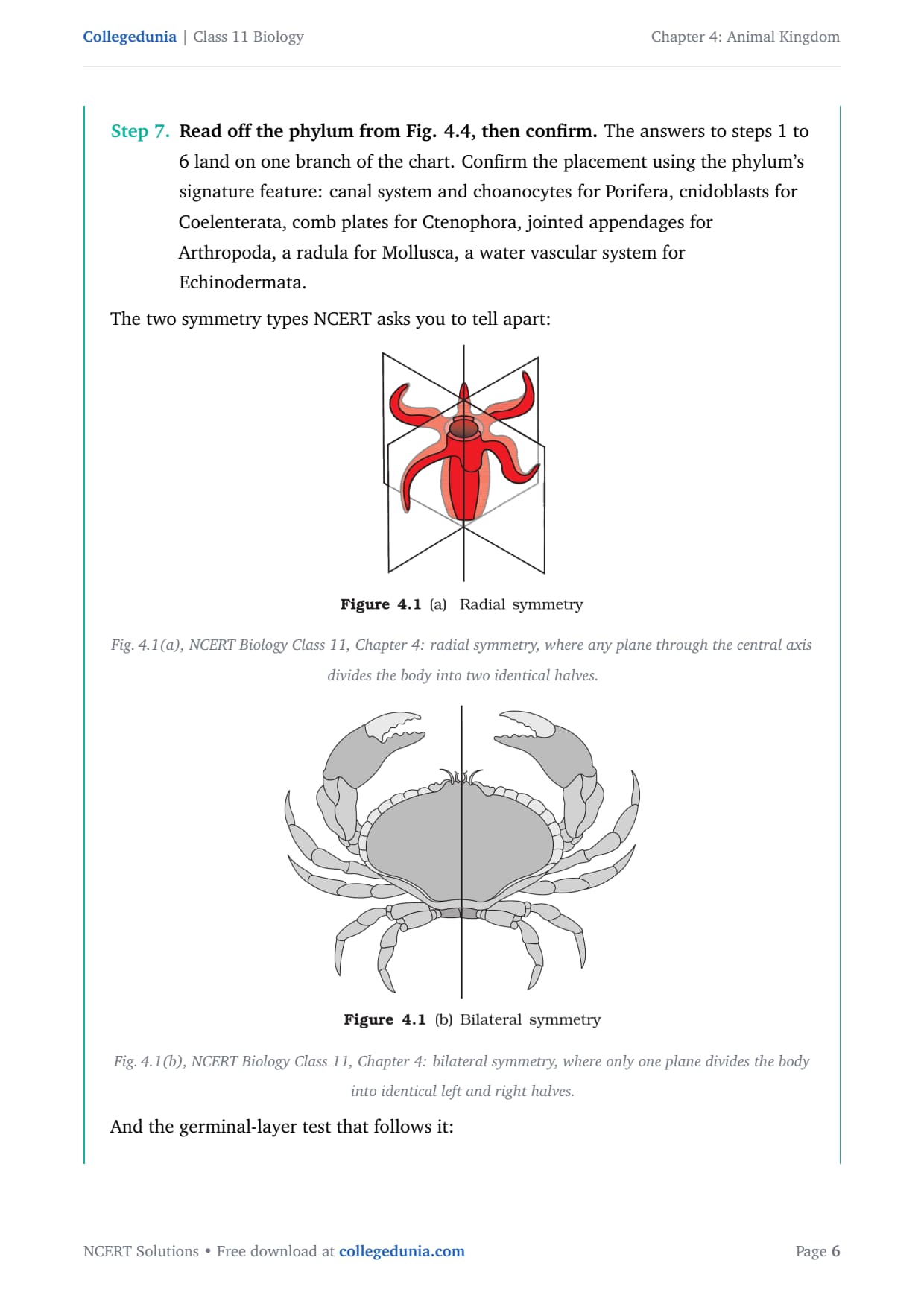
| Symmetry | Asymmetrical (sponges), radial (coelenterates), or bilateral (flatworms upward). |
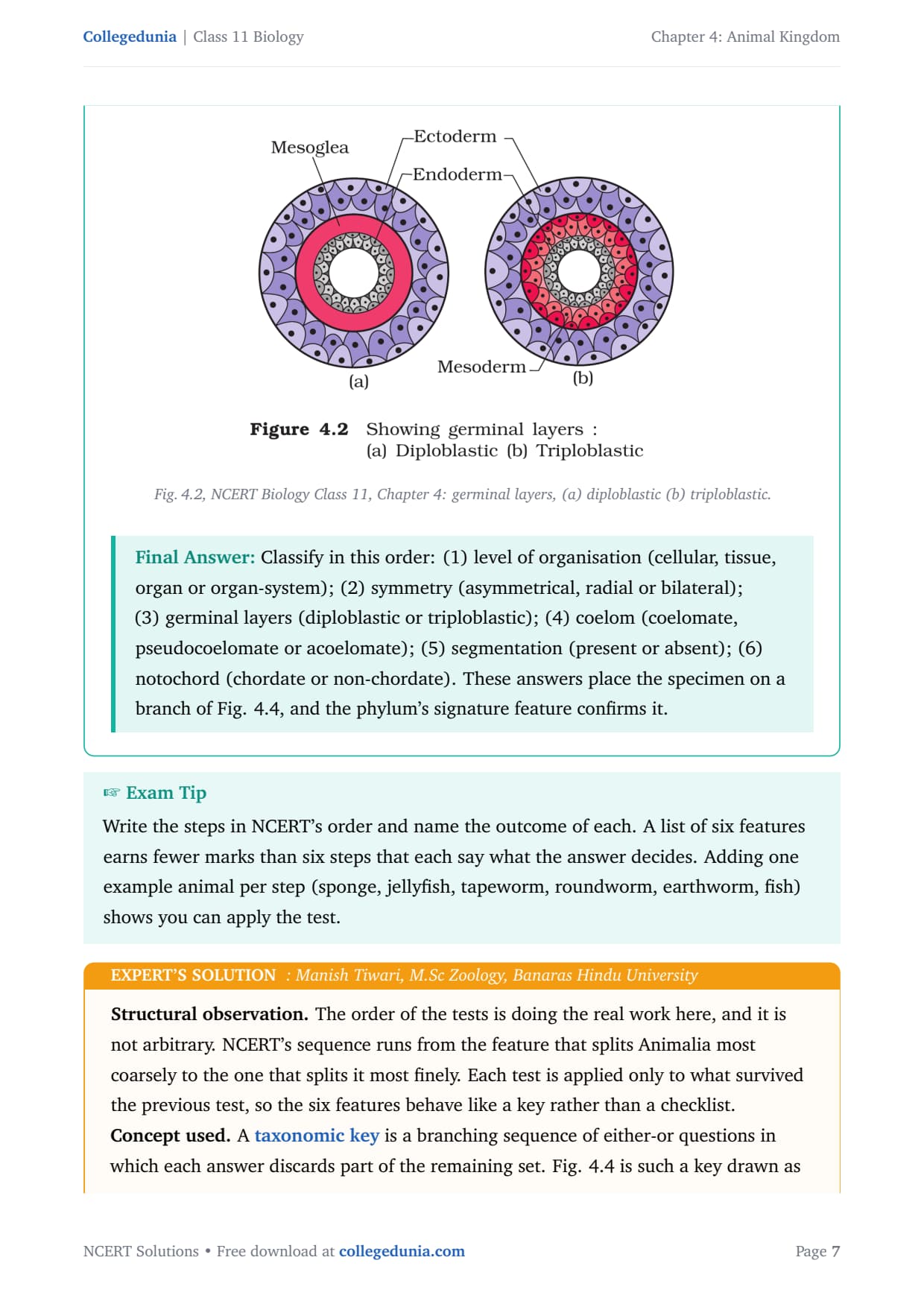
| Germinal layers | Diploblastic (two layers with mesoglea between) or triploblastic (a third layer, mesoderm). |
| Coelom | Coelomate, pseudocoelomate or acoelomate, according to how the body cavity is lined. |
| Segmentation | Body divided into serially repeated segments (metamerism), as in the earthworm. |
| Notochord | Present (chordate) or absent (non-chordate); the final split of the coelomates. |
To classify a given specimen, students apply these tests in order and let each answer discard part of the kingdom, then confirm the result with the phylum's signature feature. Without fundamental features, animals could only be grouped by looks, so a whale and a shark would sit together while a bat, a whale and a human, all mammals, would be split apart. Refer to Exercise Q1 and Q2 for the full step-by-step reasoning behind the classification method.
Body Cavity and Coelom: Three Grades of Body Plan
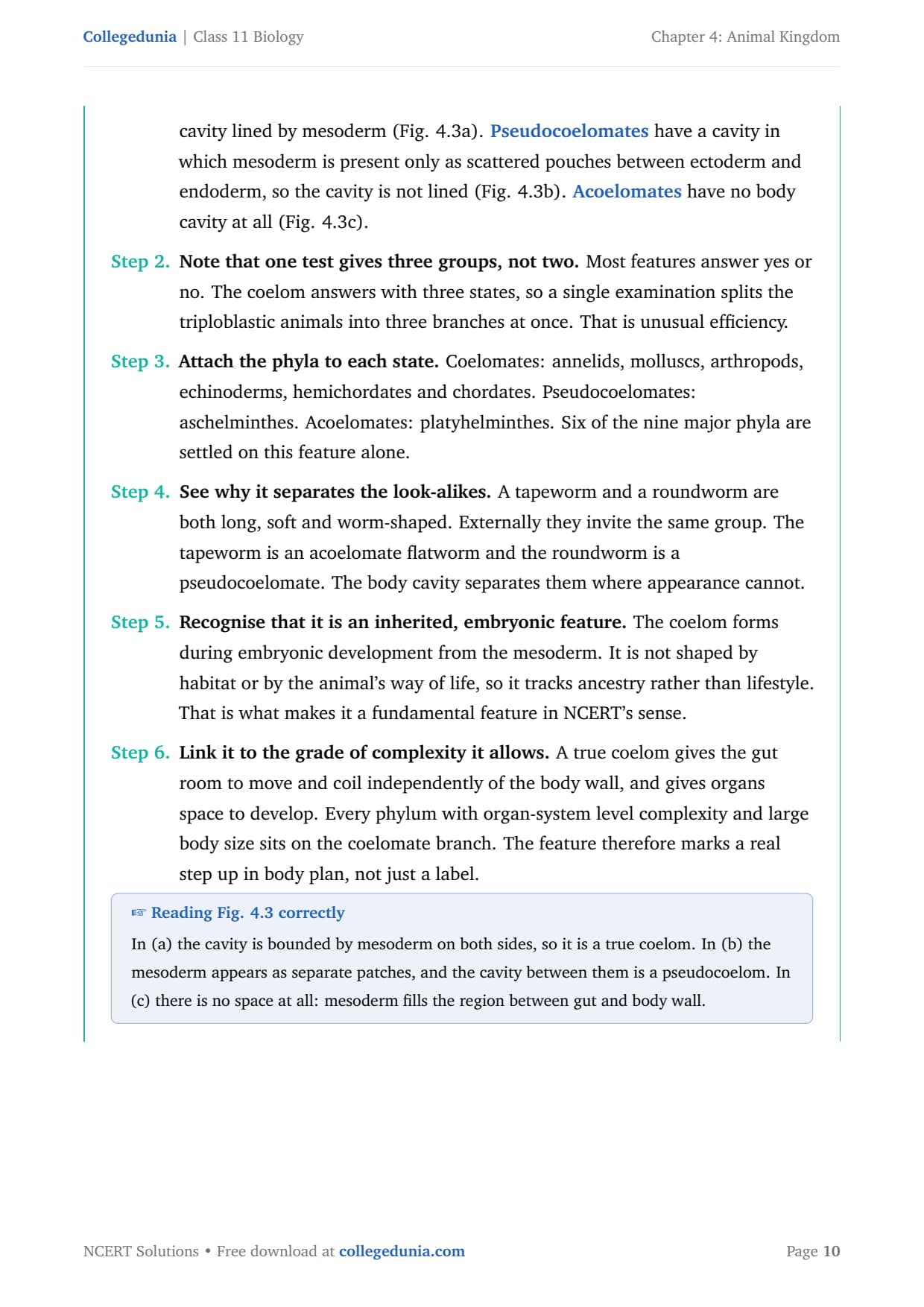
Question 3 asks how useful the coelom is in classification, and the answer is that it is among the most productive features in the whole chapter. The coelom is a body cavity between the body wall and the gut wall that is lined by mesoderm. A single examination of the cavity splits the triploblastic animals into three mutually exclusive groups, which is unusual, because most features give only a two-way split. Figure 4.3 draws all three grades side by side.
| Grade | Body cavity | Examples |
|---|---|---|
| Coelomate | Cavity lined by mesoderm on both sides (a true coelom). | Annelids, molluscs, arthropods, echinoderms, hemichordates, chordates. |
| Pseudocoelomate | Cavity present, but mesoderm lies only as scattered pouches, so it is not lined. | Aschelminthes (roundworms). |
| Acoelomate | No body cavity at all; mesoderm fills the space between gut and body wall. | Platyhelminthes (flatworms). |
The coelom is so useful because it applies to every triploblastic animal, gives three clean states from one observation, and is laid down in the embryo from mesoderm, so it tracks ancestry rather than lifestyle. It also separates worm-shaped animals that appearance would wrongly group: a tapeworm is acoelomate, a roundworm is pseudocoelomate and an earthworm is coelomate, though all three are long and soft. A true coelom also gives the gut room to move and organs space to grow, which is why organ-system complexity and large size sit on the coelomate branch. This is the single feature that places six of the nine major phyla.
The Major Animal Phyla and Their Signature Features
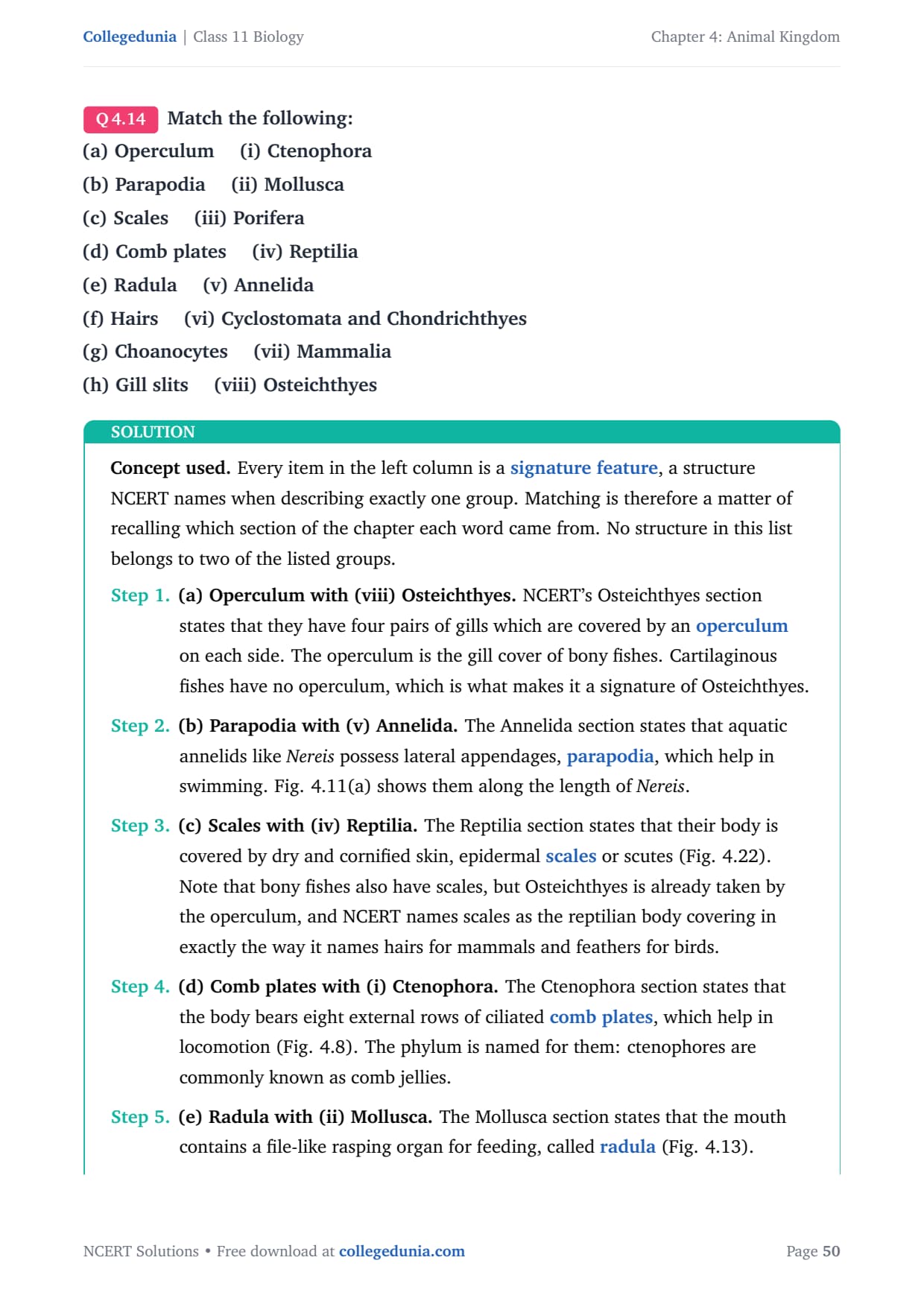
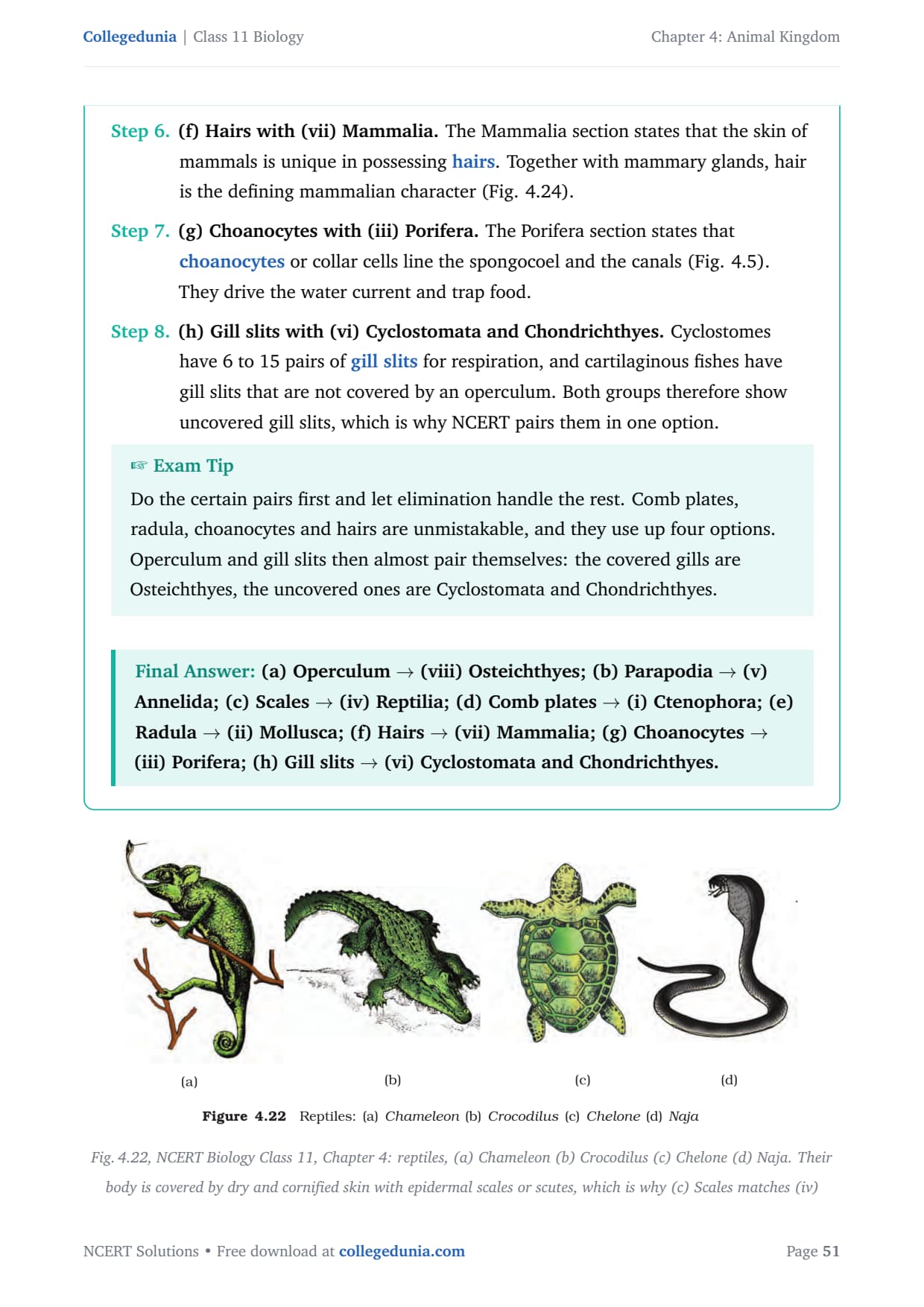
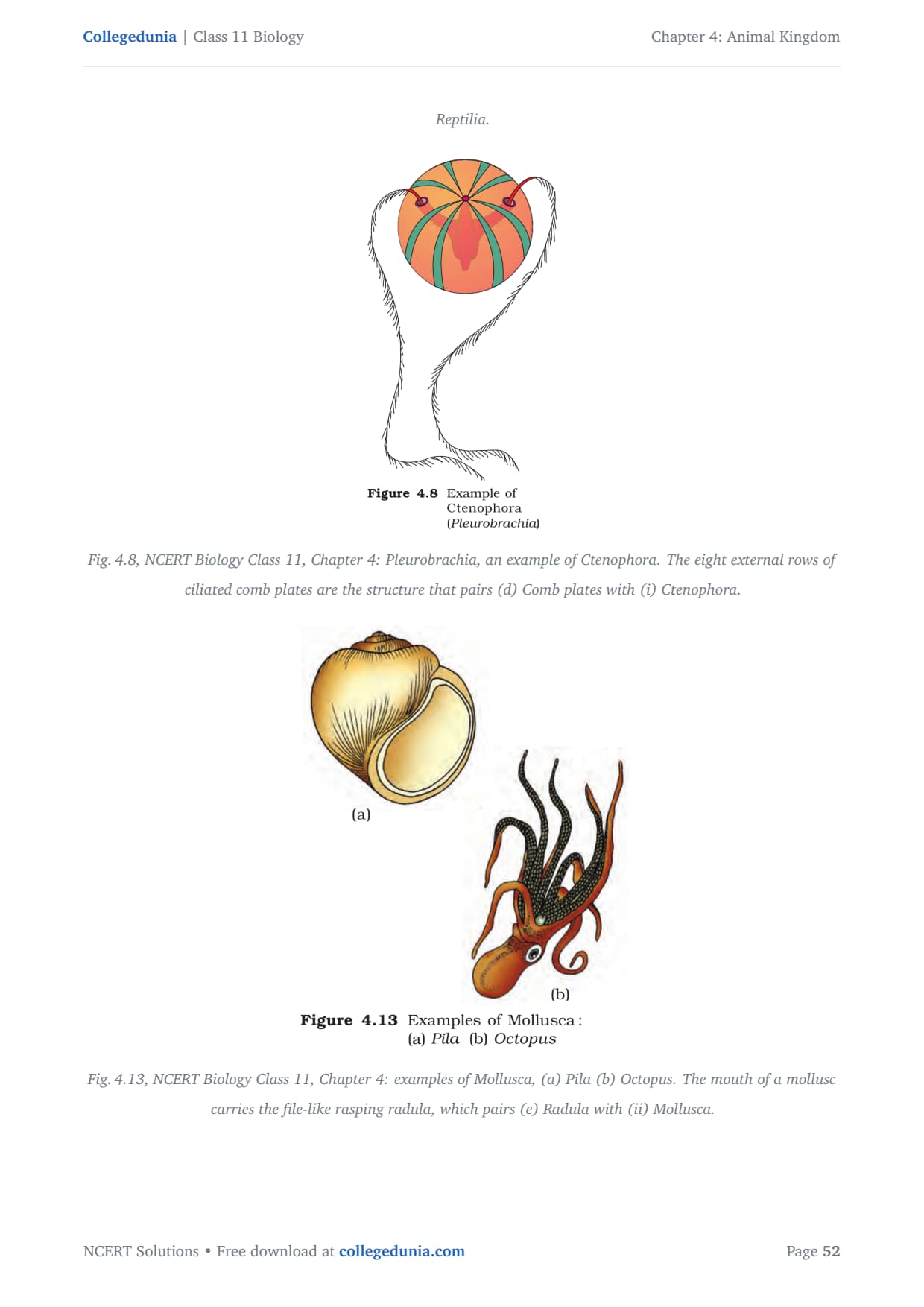
Much of the exercise turns on knowing each phylum by one unique feature, the character no other phylum shares. Question 8 identifies the water vascular system with Echinodermata, Question 13 fixes segmentation as first appearing in Annelida, and Question 14 matches structures such as radula and choanocytes to their phyla. The table below is the spine of the chapter, and students who memorise the signature column can answer most objective questions on sight.
| Phylum | Signature feature | Example |
|---|---|---|
| Porifera | Canal system with choanocytes; cellular level; intracellular digestion. | Sycon, Spongilla |
| Coelenterata (Cnidaria) | Cnidoblasts (stinging cells); tissue level; diploblastic. | Hydra, jellyfish |
| Ctenophora | Eight rows of comb plates; bioluminescence. | Pleurobrachia |
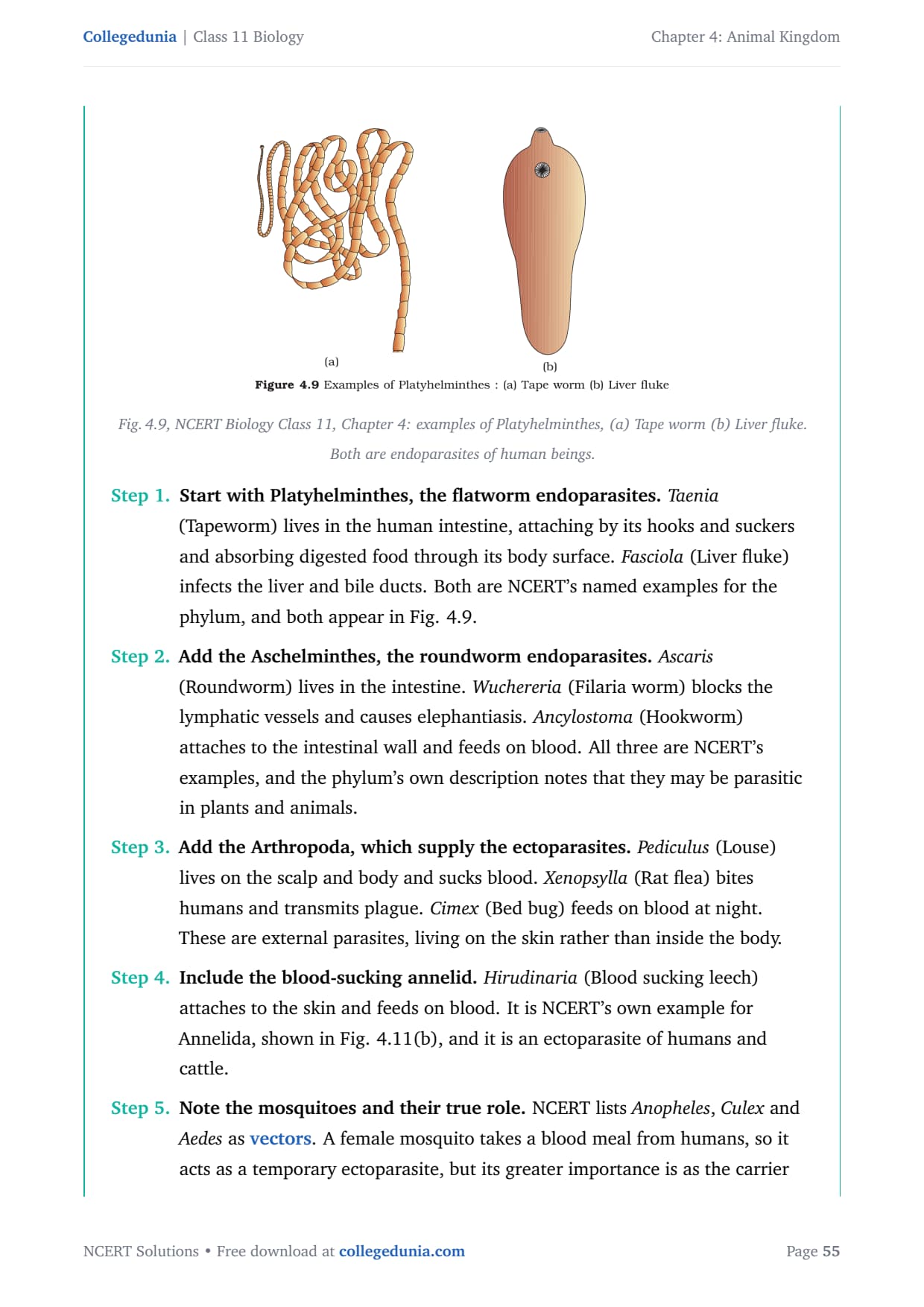
| Platyhelminthes | Dorso-ventrally flattened body; flame cells; acoelomate. | Taenia, Fasciola |
| Aschelminthes | Cylindrical, unsegmented body; pseudocoelom. | Ascaris, Wuchereria |
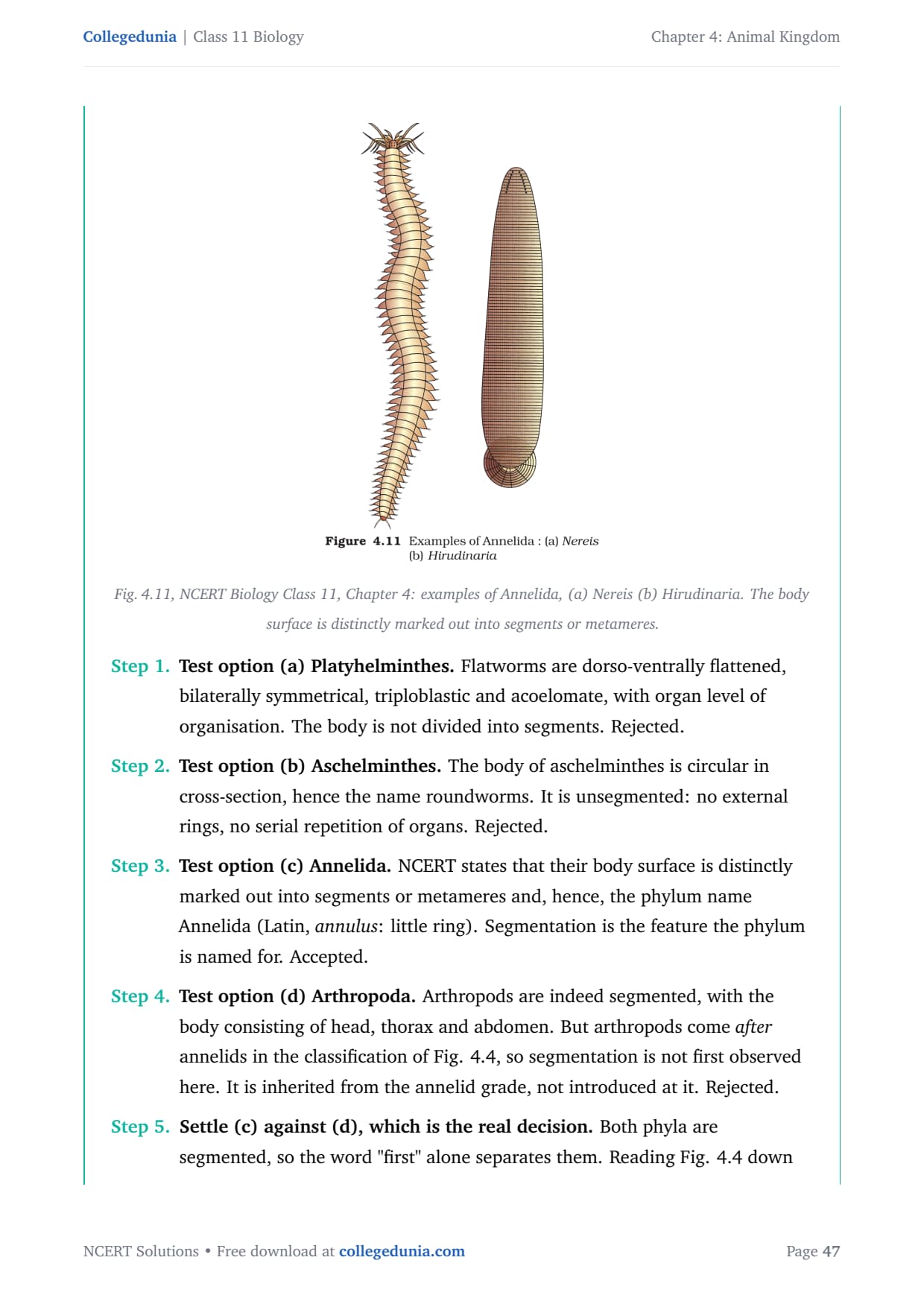
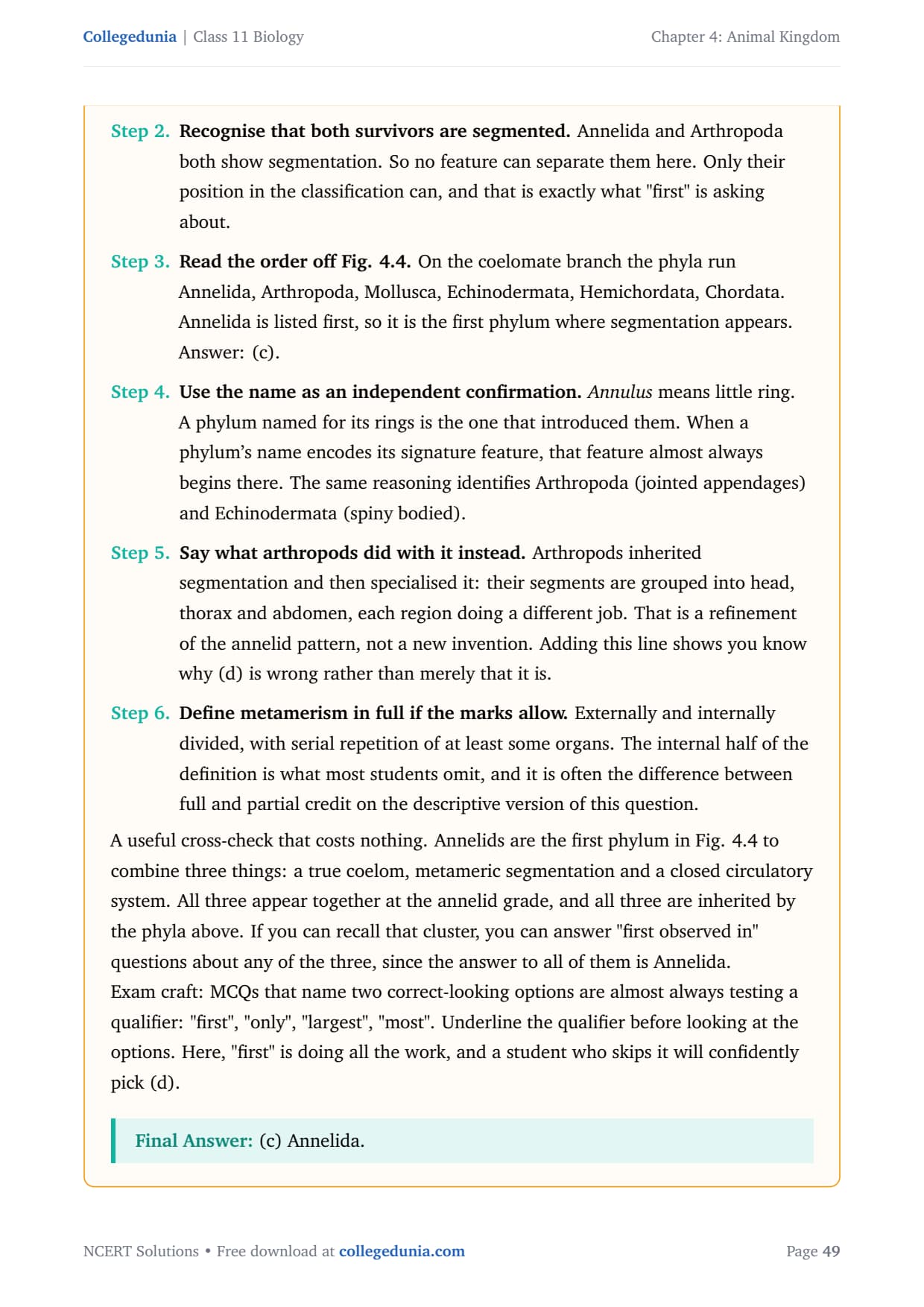
| Annelida | Metameric segmentation; parapodia; closed circulation. | Earthworm, Hirudinaria |
| Arthropoda | Jointed appendages; chitinous exoskeleton; largest phylum. | Locust, prawn, scorpion |
| Mollusca | Radula; muscular foot; calcareous shell. | Pila, Octopus |
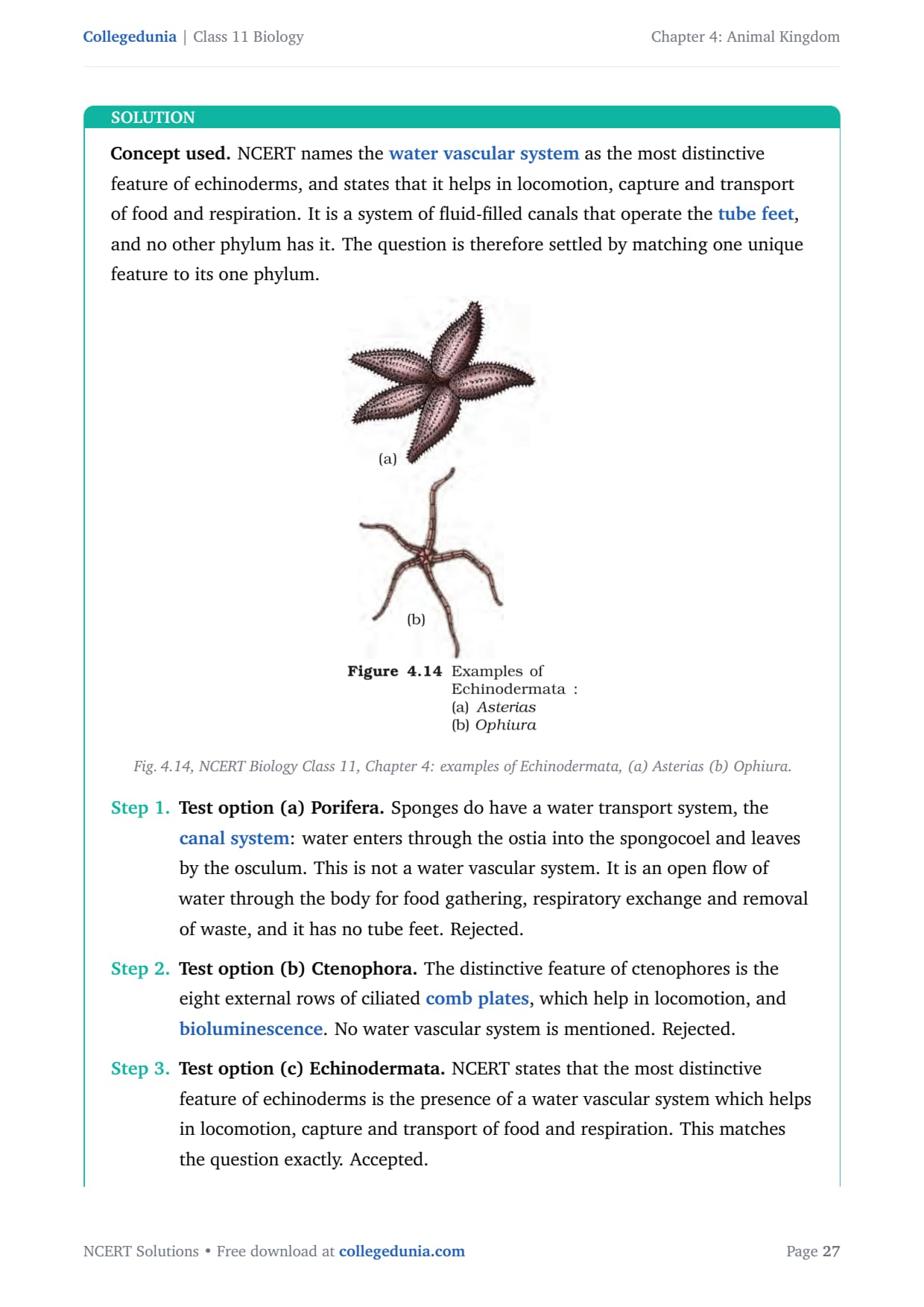
| Echinodermata | Water vascular system; tube feet; calcareous ossicles. | Asterias, Ophiura |
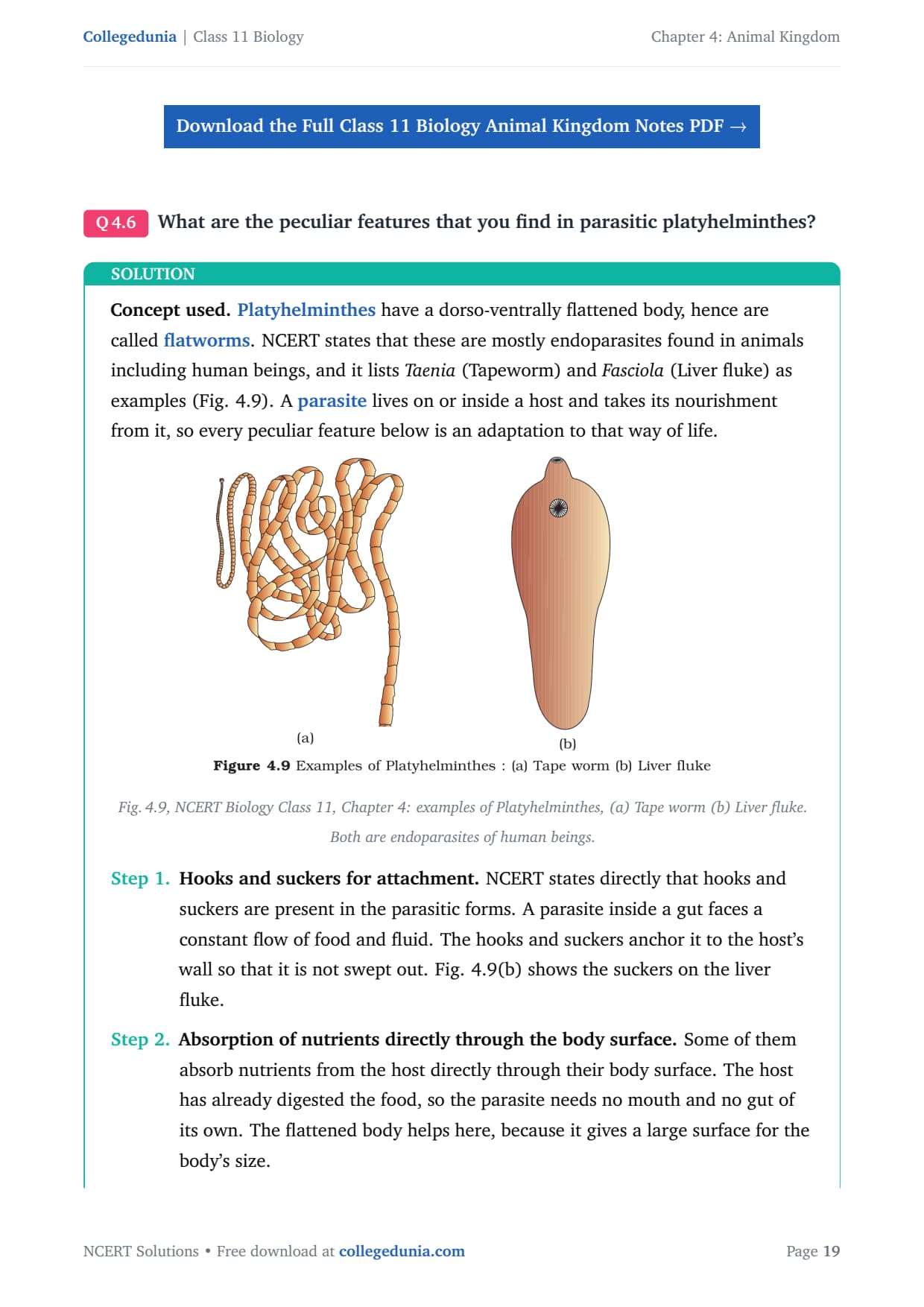
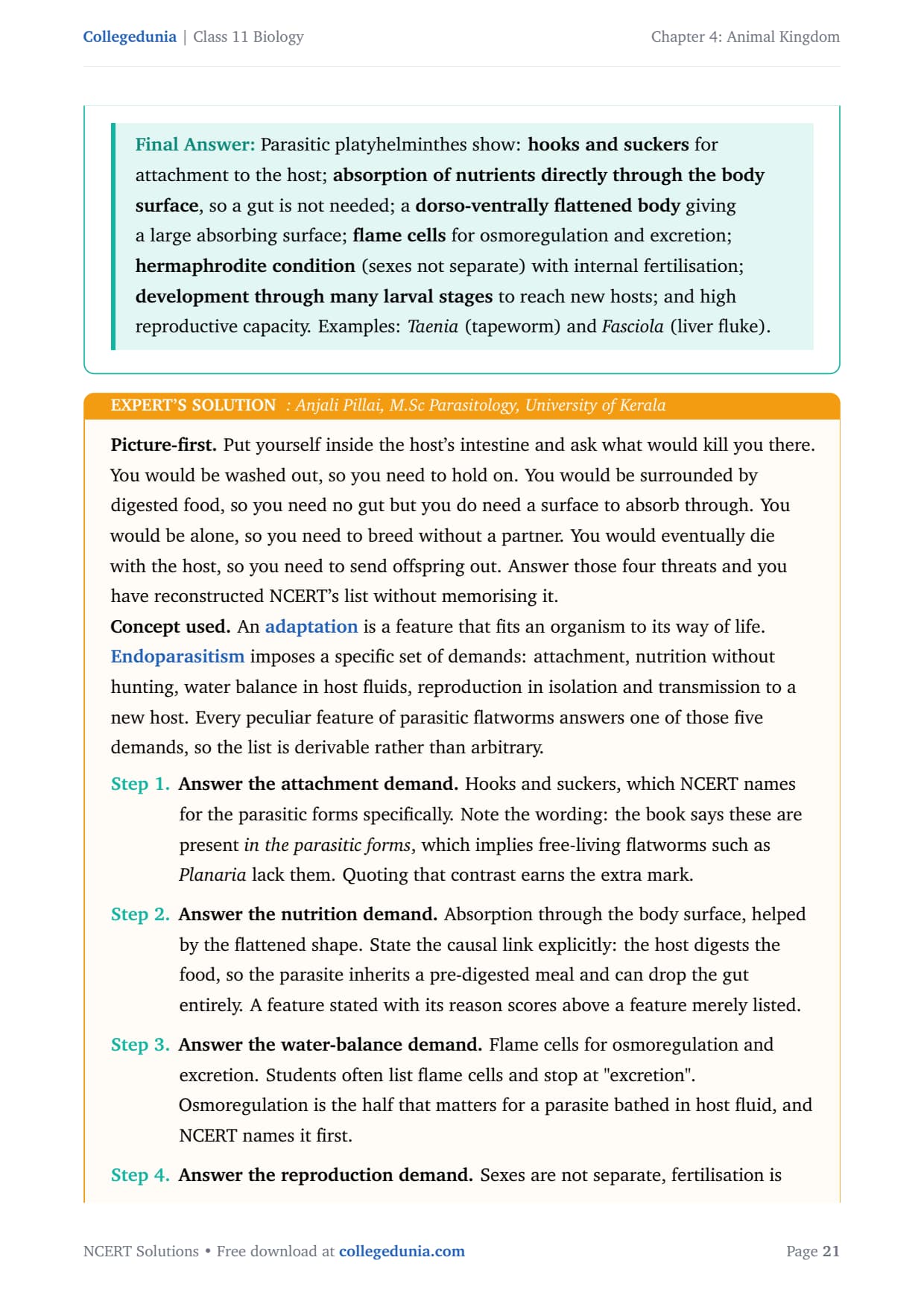
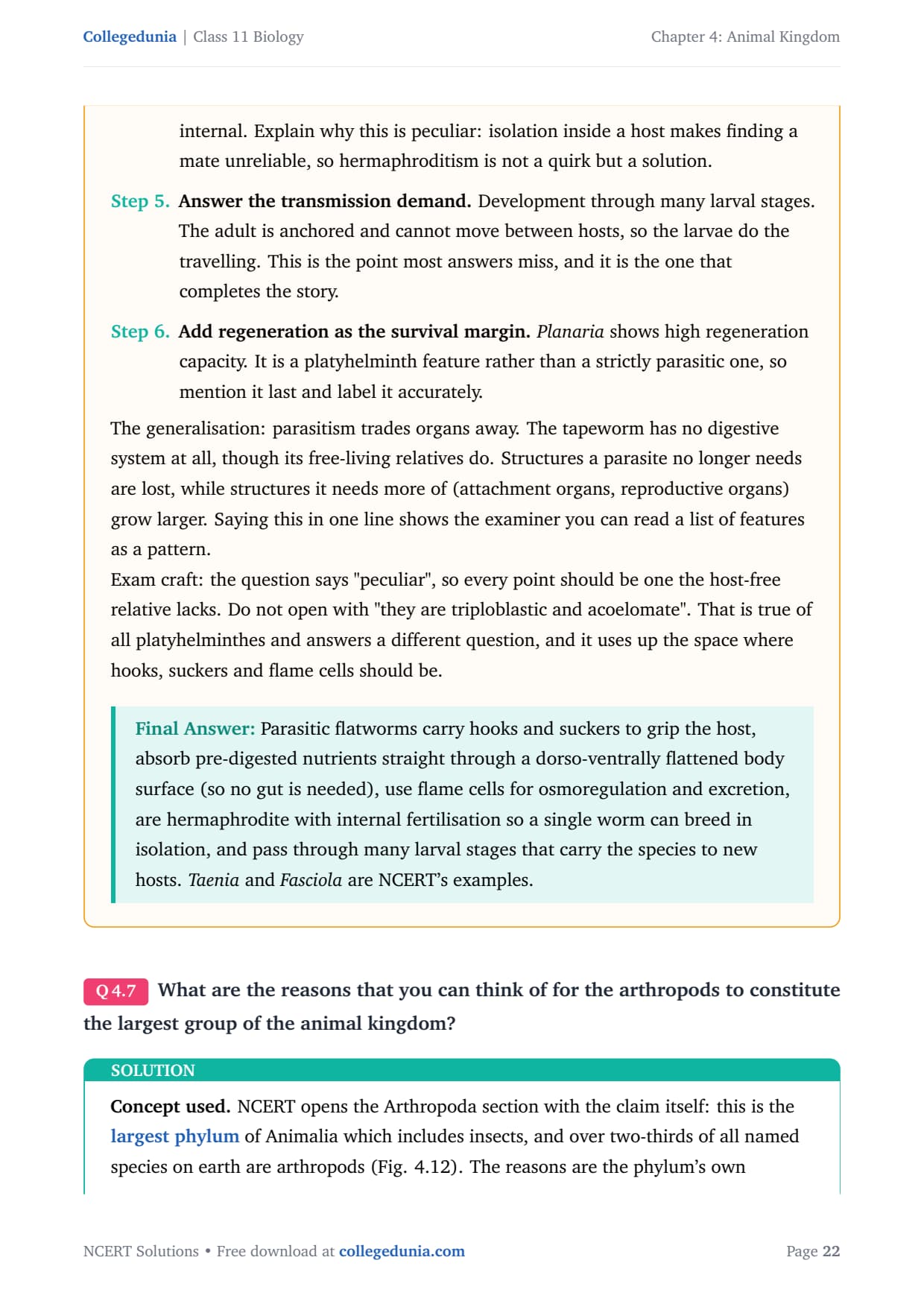
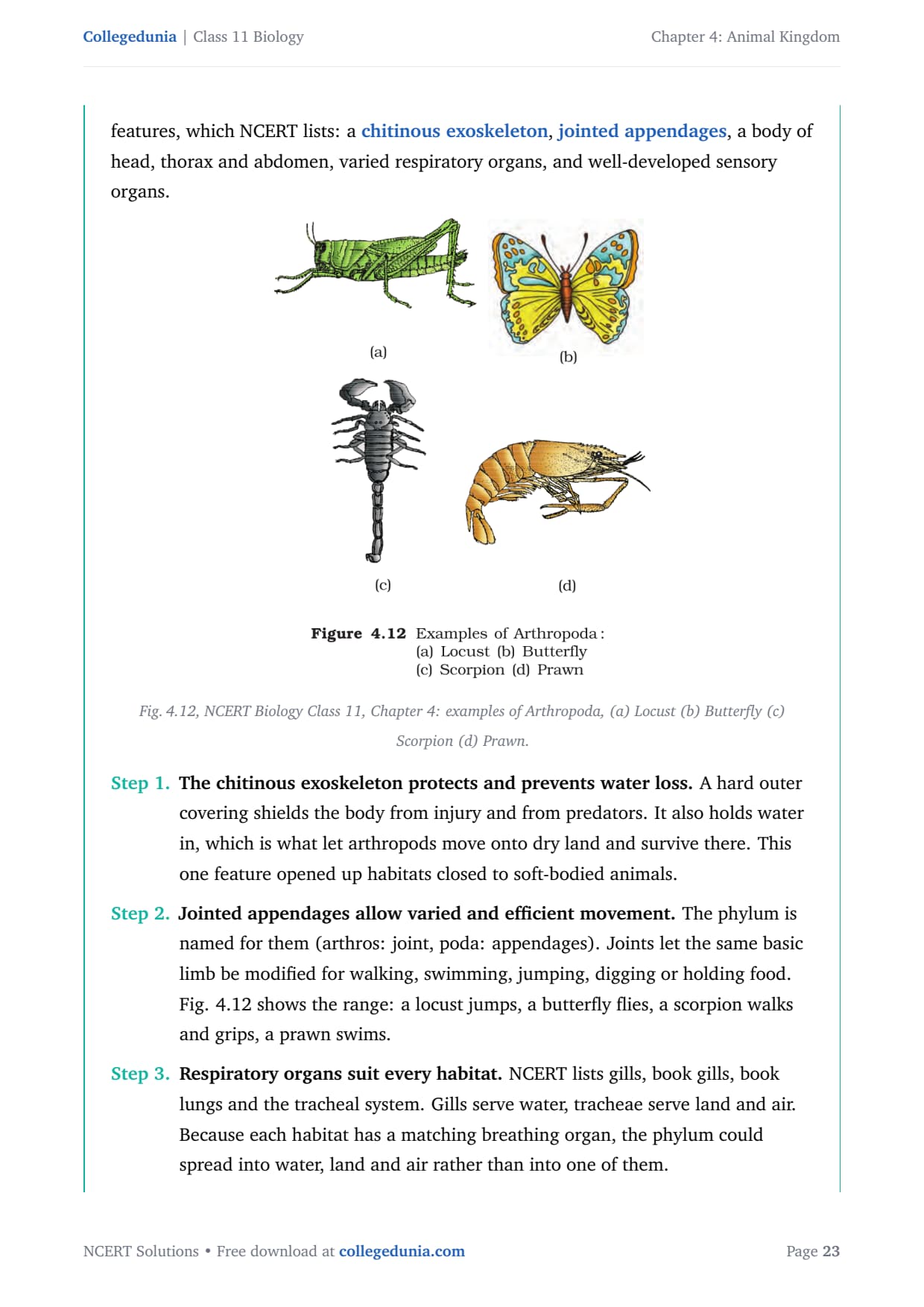
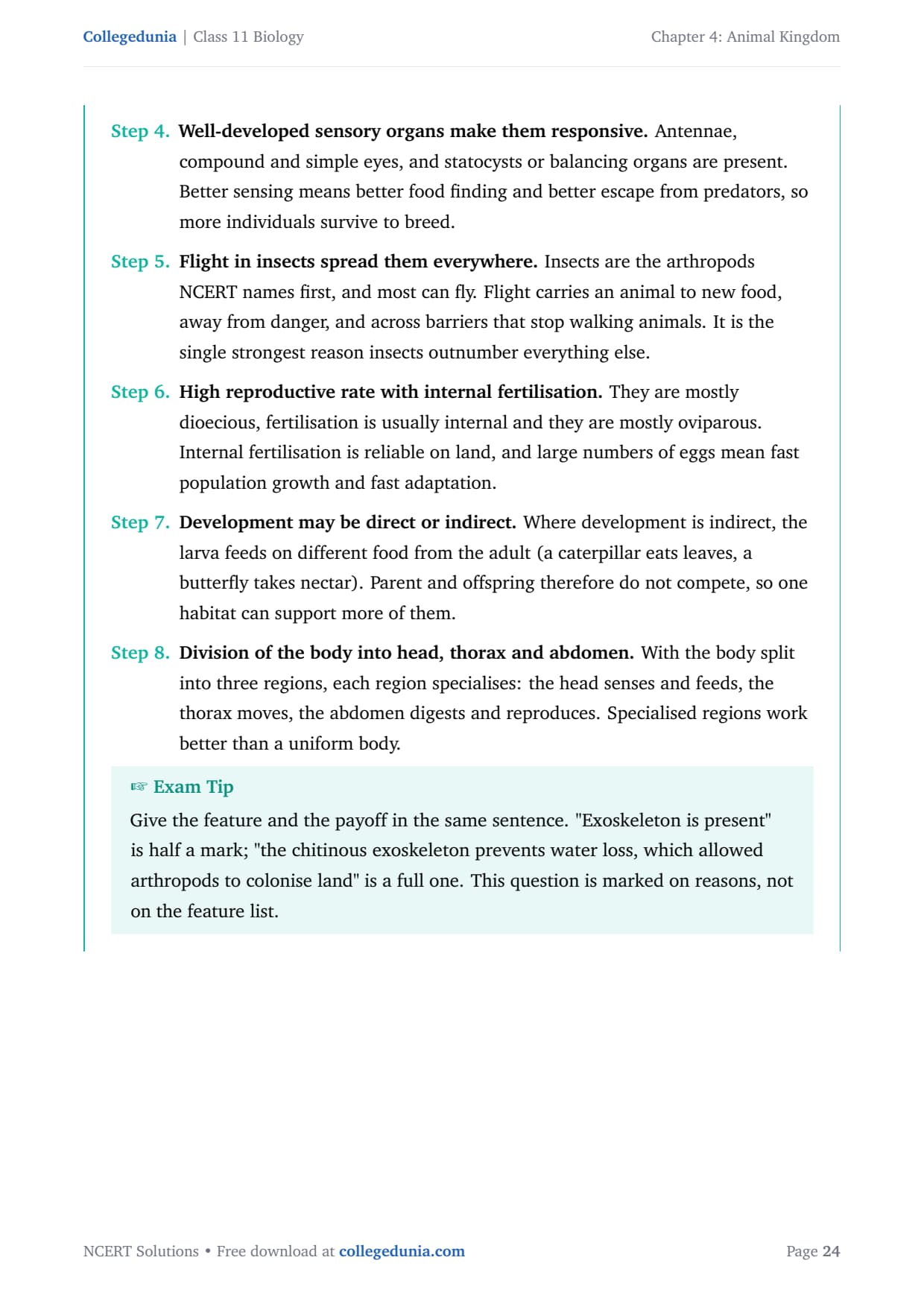
Arthropoda is the largest phylum, and over two-thirds of all named species on earth are arthropods. Question 7 asks why, and the reasons are its own features working together: a chitinous exoskeleton that prevents water loss and let arthropods colonise land, jointed appendages modifiable for walking, swimming, jumping and feeding, four kinds of respiratory organ (gills, book gills, book lungs and tracheae) matching water, land and air, flight in insects, and a high reproductive rate. Question 6 similarly explains parasitic flatworms through their way of life: hooks and suckers for attachment, absorption through the flattened body surface, flame cells for osmoregulation, a hermaphrodite body, and many larval stages to reach new hosts.
Chordates and Vertebrates: Justifying the Overlap
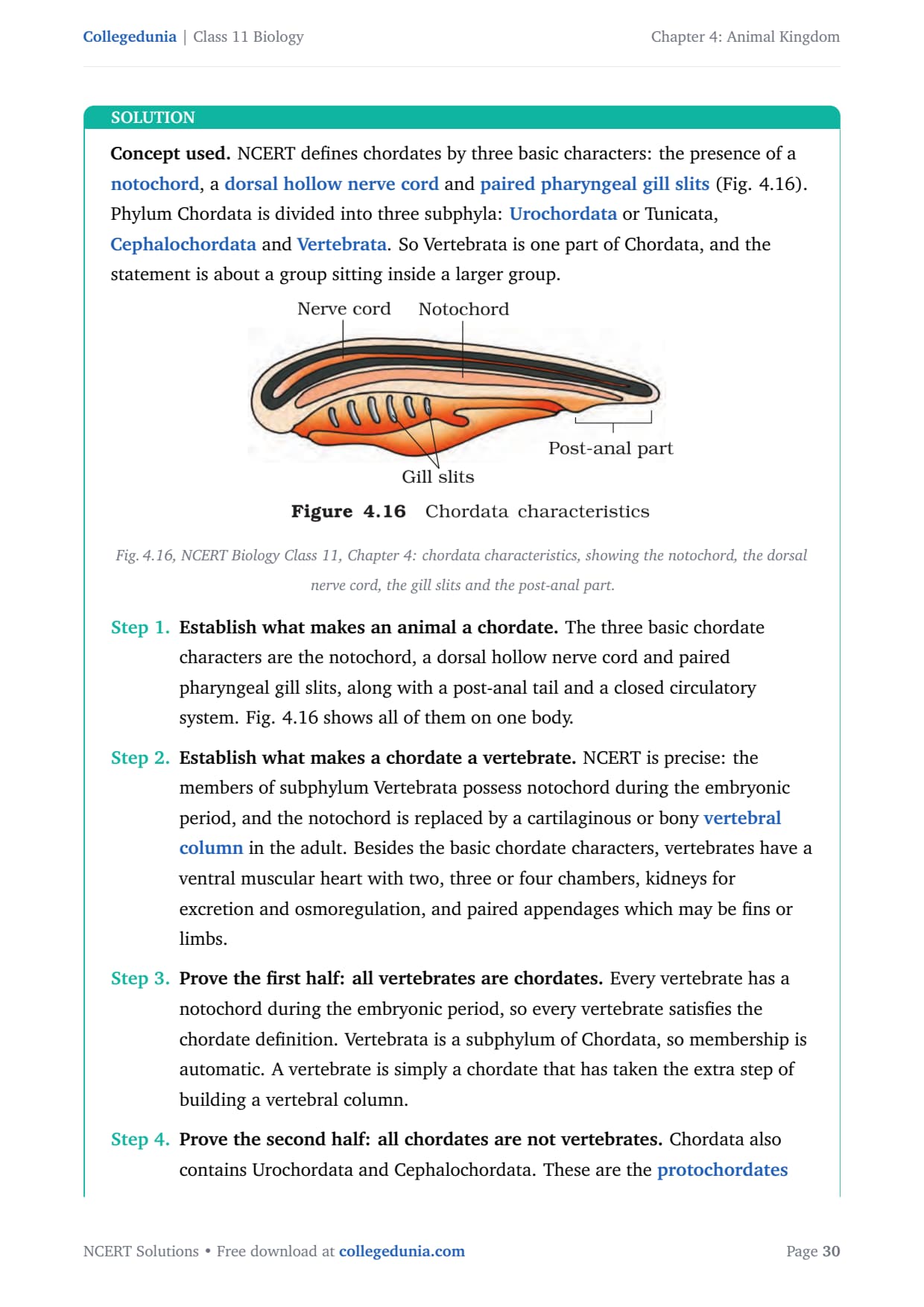
Question 9 asks students to justify the statement that all vertebrates are chordates but all chordates are not vertebrates. The answer rests on the definition of Phylum Chordata and its three subphyla. Every chordate shows four defining features at some stage of life: a notochord, a dorsal hollow nerve cord, paired pharyngeal gill slits and a post-anal tail. Vertebrata is only one subphylum inside Chordata, so it is a smaller circle drawn inside a larger one.
- All vertebrates are chordates: every vertebrate possesses the notochord during the embryonic period and shows the basic chordate characters, because Vertebrata is a subphylum of Chordata.
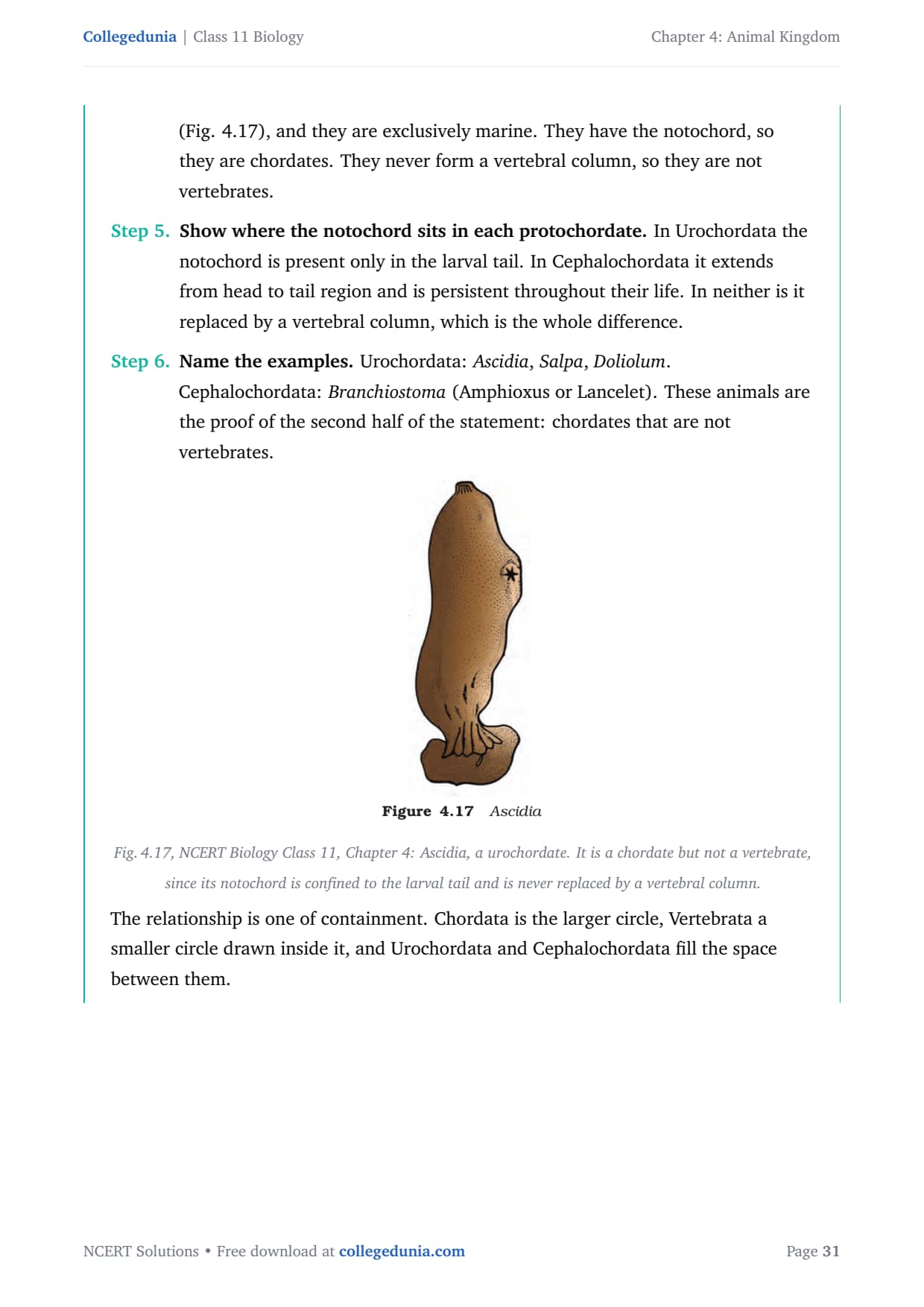
- Not all chordates are vertebrates: Chordata also contains the protochordates, Urochordata and Cephalochordata, which never form a vertebral column.
- The deciding character: in vertebrates the notochord is replaced by a cartilaginous or bony vertebral column, whereas in protochordates it is not.
In Urochordata the notochord is confined to the larval tail, and in Cephalochordata it persists from head to tail throughout life, yet neither is ever replaced by vertebrae. Examples of protochordates include Ascidia, Salpa, Doliolum and Branchiostoma. This is why the two statements are not a contradiction but a description of a subphylum sitting inside a phylum, and it is one of the most reliably asked reasoning questions in the chapter.
Adaptations in Vertebrate Classes: Air Bladder and Flight
Two exercise questions test how structure fits function in the vertebrate classes. Question 10 asks about the air bladder in Pisces, and Question 11 asks about the modifications that help birds fly. Both are best answered by naming a structure and stating exactly what it buys the animal, since these questions are marked on reasons rather than on lists.
| Adaptation | Function |
|---|---|
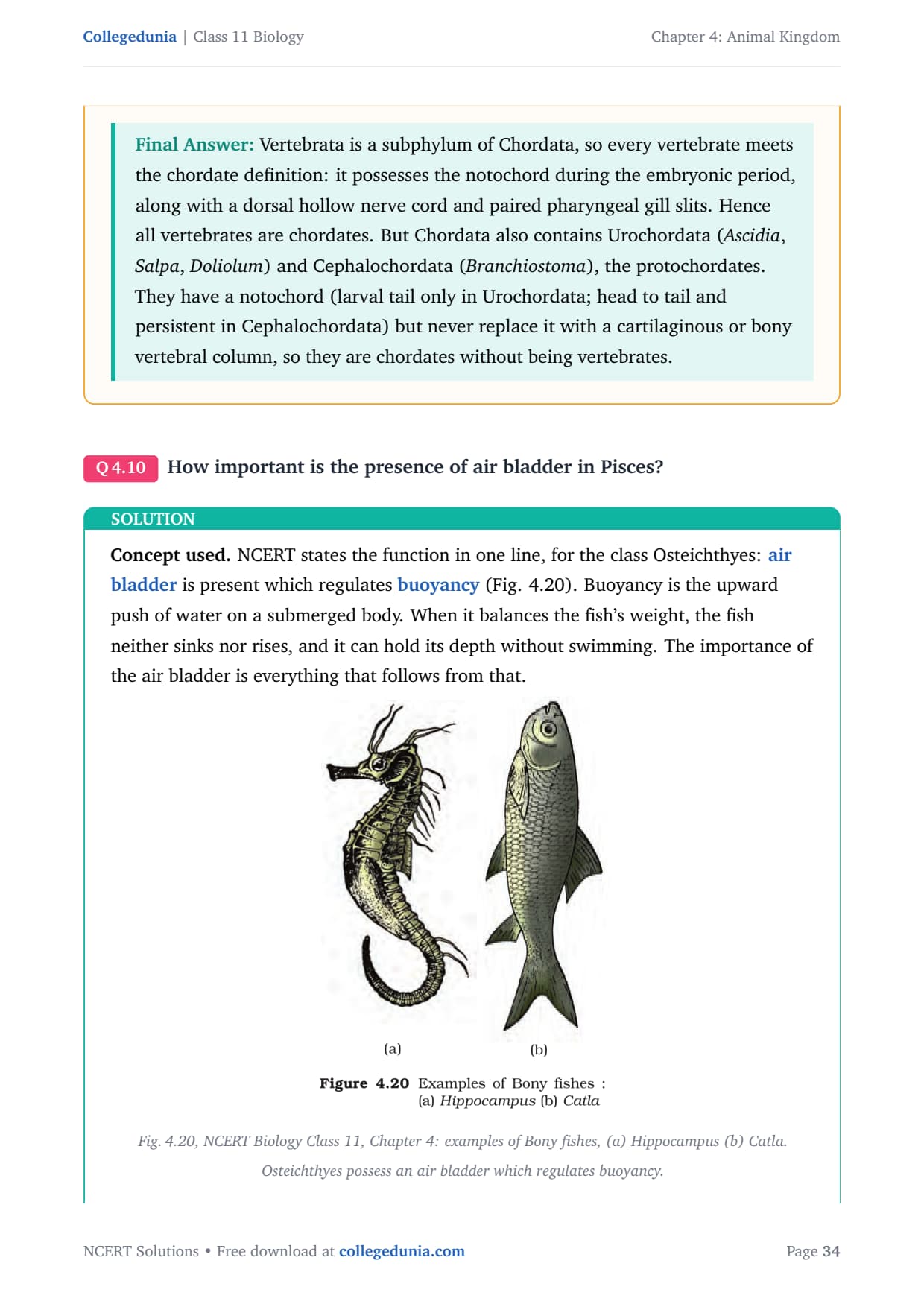
| Air bladder (bony fishes) | Gas-filled sac that regulates buoyancy, letting the fish stay at any depth without swimming; cartilaginous fishes lack it and must swim constantly to avoid sinking. |
| Forelimbs into wings | Provide the surface that generates lift for flight. |
| Feathers and streamlining | Give a lift surface and reduce drag through the air. |
| Hollow pneumatic bones | Air cavities in the long bones cut body weight. |
| Air sacs with lungs | Supplement respiration and further reduce density. |
| Four-chambered heart | Supplies fully oxygenated blood to power flight muscles; homoiothermy keeps them at working temperature. |
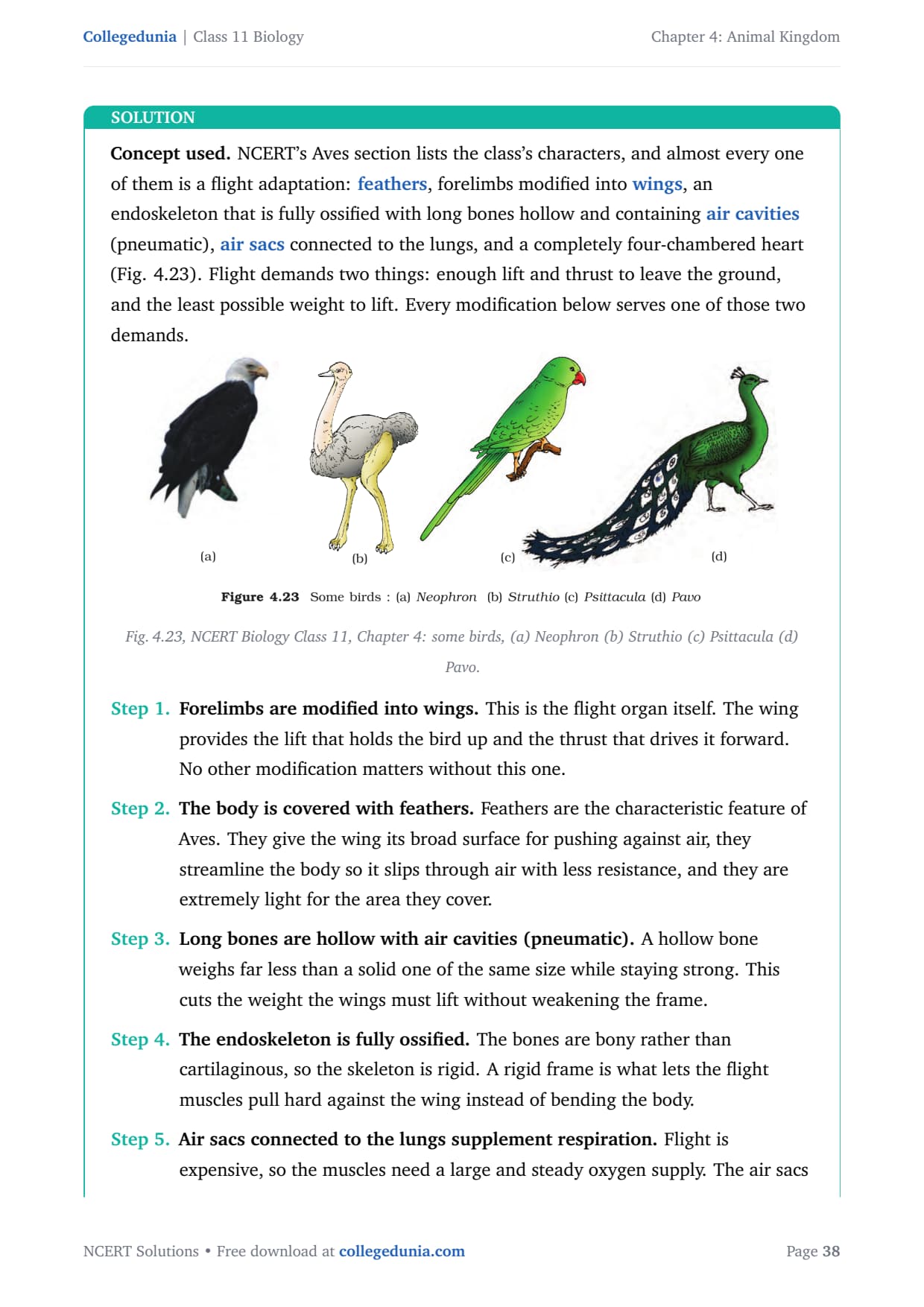
The air bladder lowers a bony fish's overall density to match the water, so the animal saves the energy it would otherwise spend fighting to avoid sinking, and it can rise or sink by adjusting the gas inside. Birds go further, combining pneumatic bones, air sacs, a light toothless skull with a crop and gizzard, and a single oil gland at the tail base to waterproof the feathers. Every one of these features either reduces weight or raises the oxygen supply, which is exactly what powered flight demands.
Digestion, Development and Reproductive Strategies
Several exercise questions compare the ways animals feed, develop and reproduce across the phyla. Question 4 distinguishes intracellular from extracellular digestion, Question 5 distinguishes direct from indirect development, and Question 12 asks whether an oviparous and a viviparous mother could produce equal numbers of young. Each of these is a paired comparison, so the marks sit in matching one axis against the other rather than in loose sentences.
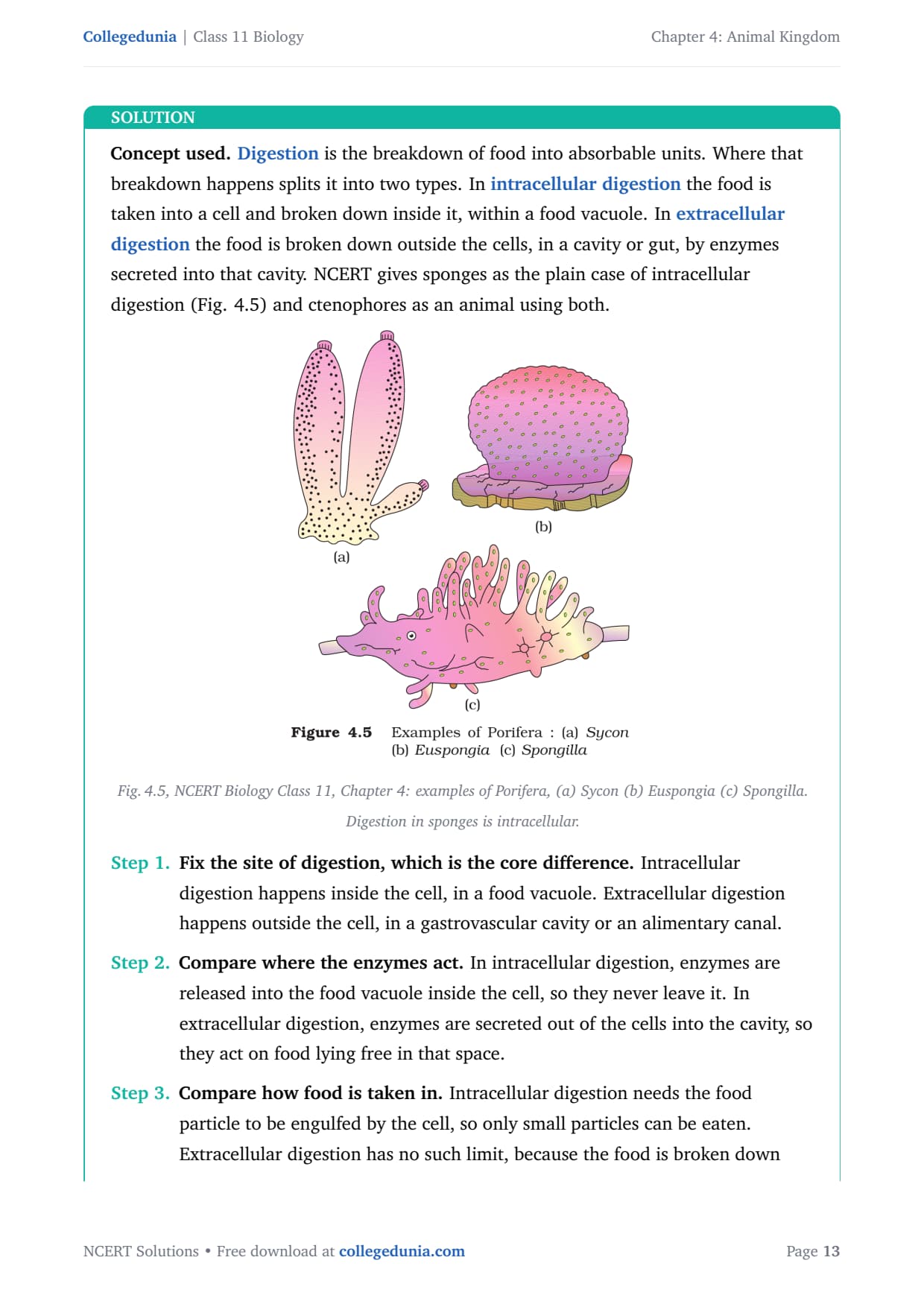
- Digestion: intracellular digestion happens inside a cell in a food vacuole and suits sponges, which have no gut; extracellular digestion happens in a gastrovascular cavity or gut by secreted enzymes and runs from coelenterates upward, letting large food be used.
- Development: direct development has no larval stage, so the young resembles the adult (Ascaris, reptiles, birds); indirect development passes through a larva that is morphologically distinct and must undergo metamorphosis (sponges, echinoderms, the frog with its tadpole).
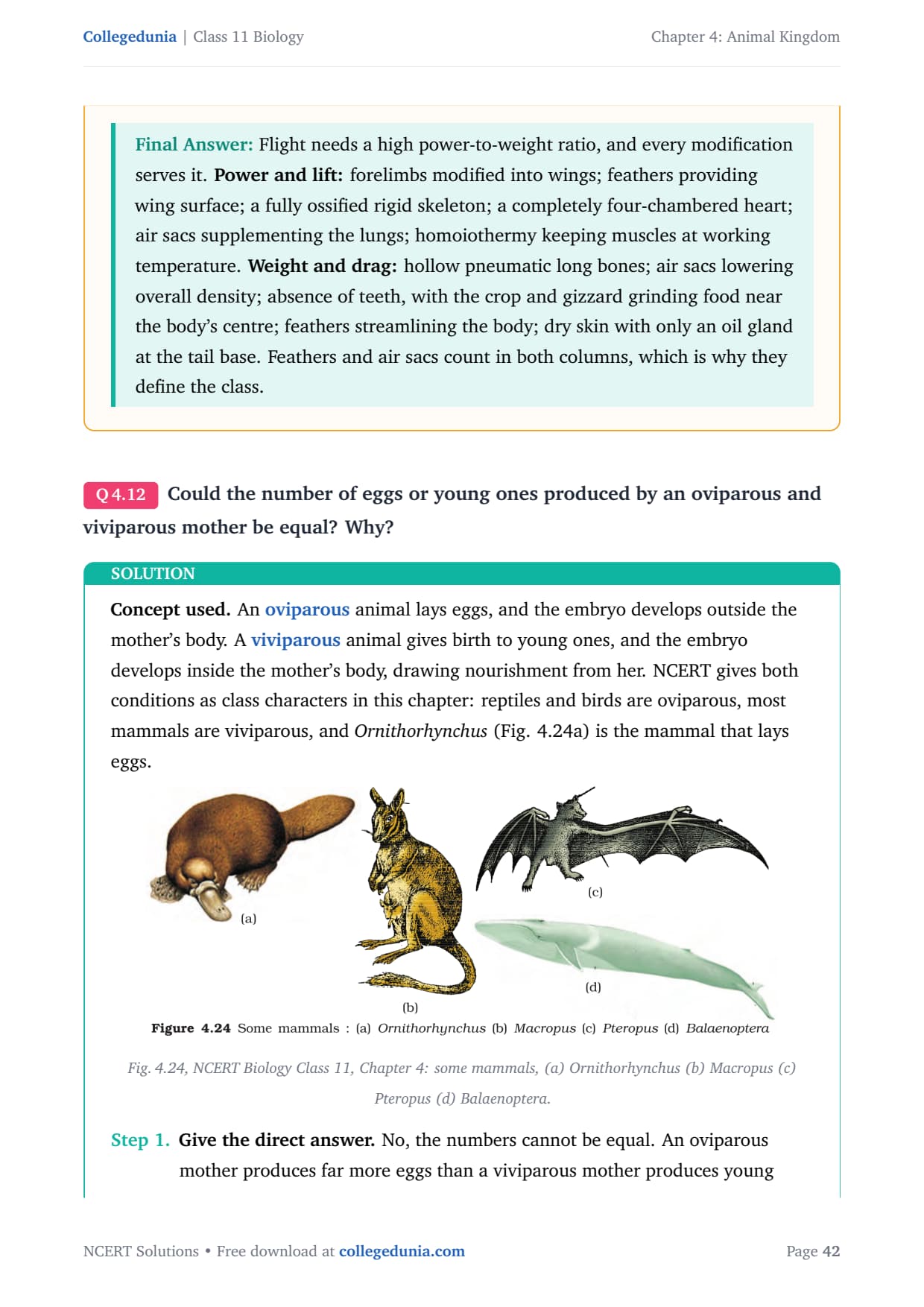
- Reproduction: an oviparous mother lays eggs that face predators and drying with little protection, so most are lost and she must lay many; a viviparous mother protects and nourishes the embryo inside her, so almost all survive and she needs to produce far fewer.
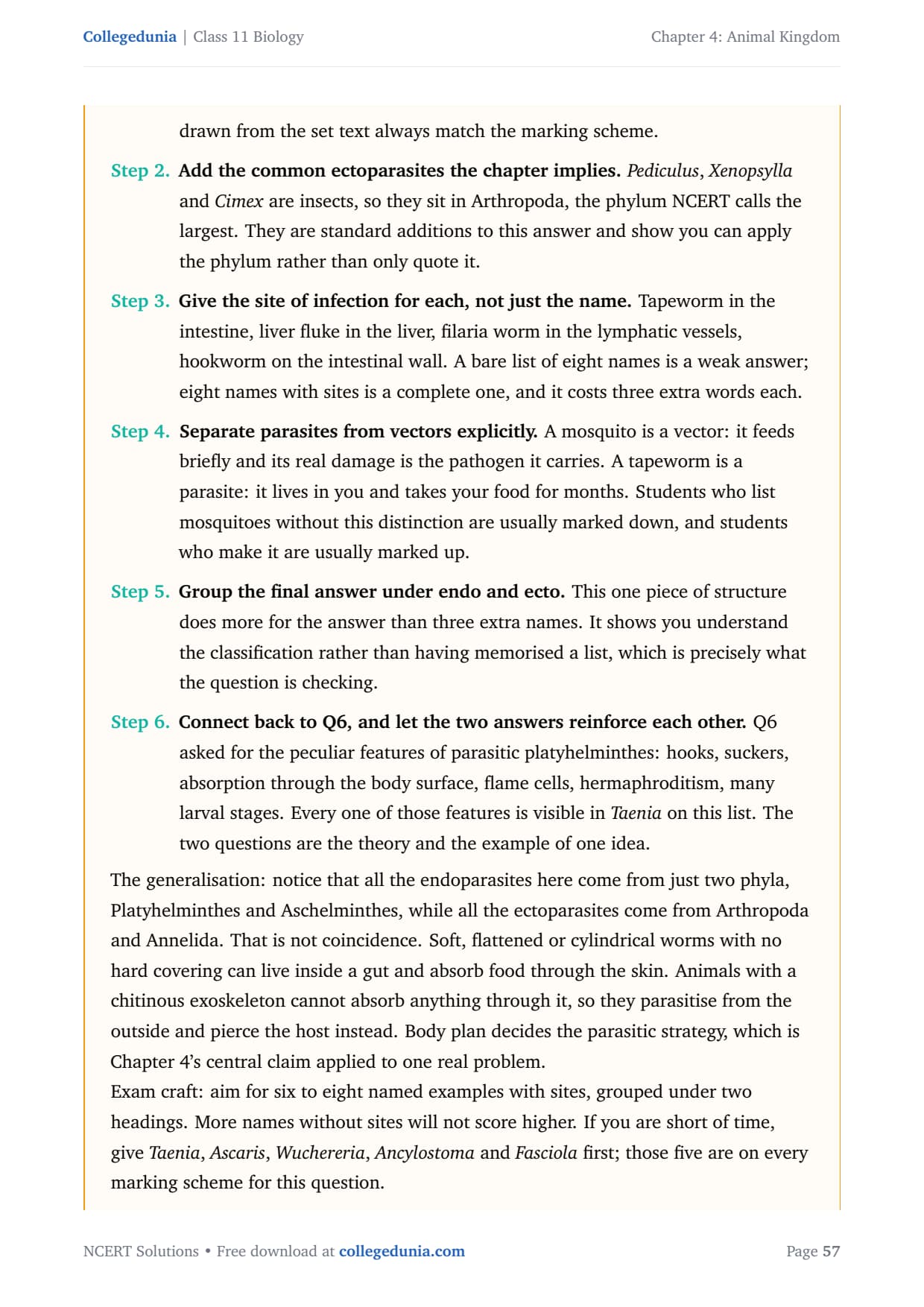
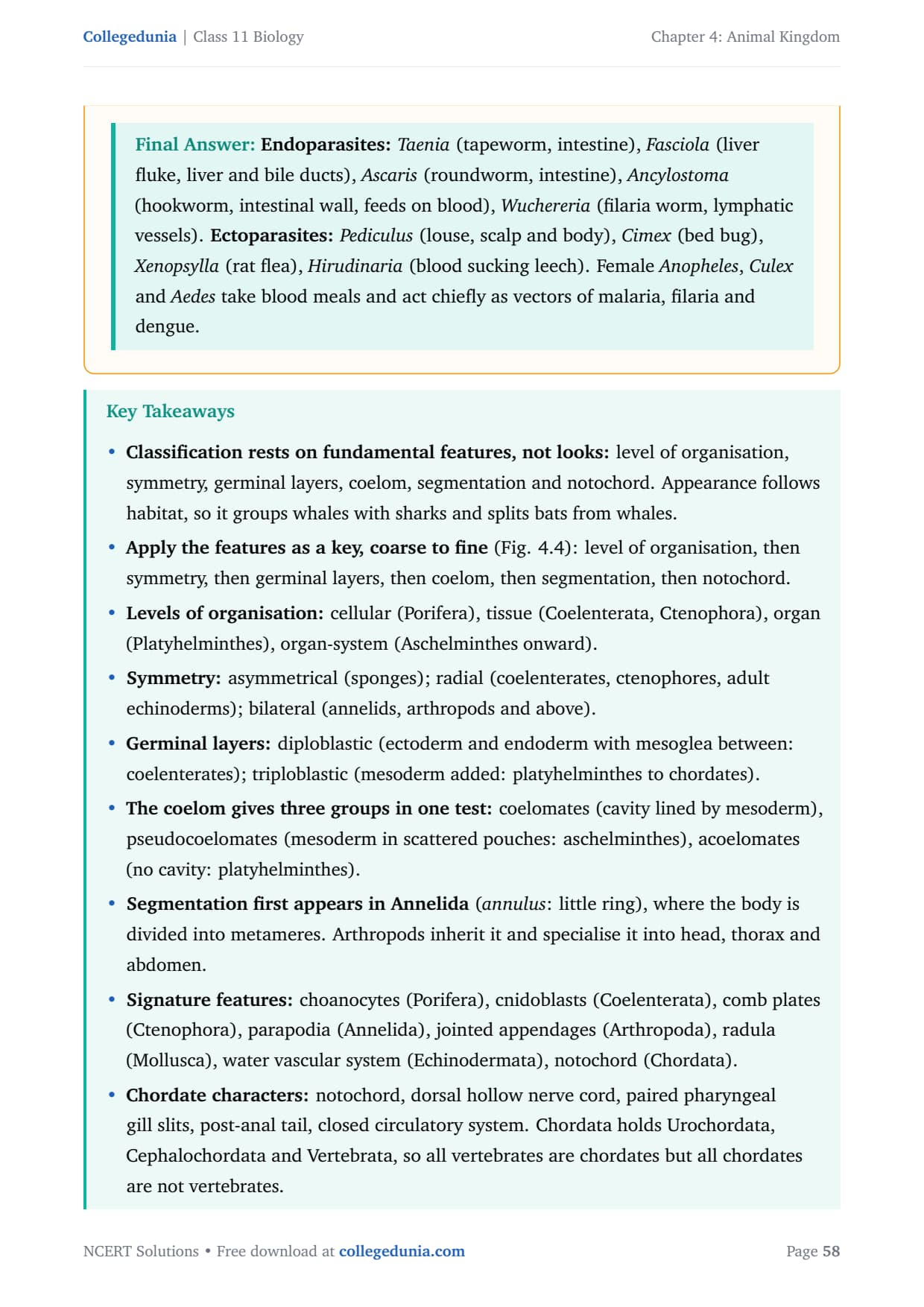
Question 15 rounds off the chapter by asking for animals parasitic on human beings, which pulls examples from across the phyla. Endoparasites include Taenia, Fasciola, Ascaris, Wuchereria and Ancylostoma, while ectoparasites include Pediculus, Xenopsylla, Cimex and blood-sucking female mosquitoes. Keeping fertilisation site, birth mode and development type as three separate questions is the habit that makes the class tables in this chapter stop being confusing.
Animal Kingdom Exercise-wise Breakdown
The NCERT back exercise has 15 questions covering the full sweep of the chapter, from the logic of classification to the vertebrate classes. The table below maps the question blocks to their topics so students can plan their practice and revise by theme.
| Question block | What it tests |
|---|---|
| Q 1 to Q 3 | Why fundamental features are needed, the steps to classify a specimen, and the usefulness of the coelom. |
| Q 4 to Q 5 | Intracellular versus extracellular digestion, and direct versus indirect development. |
| Q 6 to Q 7 | Adaptations of parasitic flatworms and why arthropods are the largest group. |
| Q 8 and Q 13 | Objective questions on the water vascular system and on where segmentation first appears. |
| Q 9 to Q 12 | Chordate and vertebrate overlap, the air bladder, flight modifications, and oviparous versus viviparous numbers. |
| Q 14 to Q 15 | Matching structures to their phyla, and listing human parasites. |
The chapter mixes reasoning questions with pure recall, so a good revision plan learns the phylum table by heart and then practises the reasoning answers out loud. Name a structure and state what it does in the same sentence, because most marks here are for the function, not the feature. Every question in the class 11 biology NCERT solutions chapter 4 Animal Kingdom PDF is solved with each step of reasoning shown, so students can compare their answers against the model working.
Practice the solved questions: Work through the full question bank with step-by-step answers and expert tips.
Common Mistakes Students Make in the Animal Kingdom Chapter
Most marks in this chapter are lost on mixing up features and phyla, not on hard ideas. Each mistake below costs 1 to 2 marks, so watch for it at the exact step.
Mistake 1: Calling the sponge's canal system a water vascular system. The water vascular system with tube feet belongs only to Echinodermata; sponges have a canal system of ostia, spongocoel and osculum.
Mistake 2: Saying segmentation first appears in Arthropoda. Arthropods are segmented, but segmentation is first observed in Annelida, which comes earlier in the classification.
Mistake 3: Confusing indirect development with viviparity, or direct development with internal fertilisation. Fertilisation site, birth mode and development type are three independent axes.
Mistake 4: Listing arthropod features without their payoff. The exoskeleton scores a mark only when the answer adds that it prevents water loss and allowed life on land.
Student Feedback on Animal Kingdom Solutions
What 12,540 students told us about their Animal Kingdom preparation:
- 64% of students said matching the signature feature to the correct phylum was the part they got wrong most often.
- Most-skipped detail: the protochordate examples in the chordate-versus-vertebrate answer, missed by about 4 in 10 students.
- Students who learned the nine-phylum table before attempting the reasoning questions said the objective and match questions became automatic.
Source: 2026-27 Class 11 Biology student poll. Sample of 12,540 students from CBSE schools across 16 states, conducted before the 2026 boards.
Other Animal Kingdom Class 11 Biology Resources
Pair these solutions with the revision notes, formula sheet and NCERT textbook PDF for the same chapter.
| Resource | Link |
|---|---|
| NCERT Notes | Animal Kingdom Class 11 Notes |
| Formula Sheet | Animal Kingdom Class 11 Formula Sheet |
| NCERT Book PDF | Animal Kingdom Class 11 Book PDF |
NCERT Solutions for Class 11 Biology: All Chapters
Jump to the step-by-step solutions for any other Class 11 Biology chapter below.
| Chapter | NCERT Solutions |
|---|---|
| Chapter 1 | The Living World |
| Chapter 2 | Biological Classification |
| Chapter 3 | Plant Kingdom |
| Chapter 4 | Animal Kingdom |
| Chapter 5 | Morphology of Flowering Plants |
| Chapter 6 | Anatomy of Flowering Plants |
| Chapter 7 | Structural Organisation in Animals |
| Chapter 8 | Cell: The Unit of Life |
| Chapter 9 | Biomolecules |
| Chapter 10 | Cell Cycle and Cell Division |
| Chapter 11 | Photosynthesis in Higher Plants |
| Chapter 12 | Respiration in Plants |
| Chapter 13 | Plant Growth and Development |
| Chapter 14 | Breathing and Exchange of Gases |
| Chapter 15 | Body Fluids and Circulation |
| Chapter 16 | Excretory Products and their Elimination |
| Chapter 17 | Locomotion and Movement |
| Chapter 18 | Neural Control and Coordination |
| Chapter 19 | Chemical Coordination and Integration |
FAQs on Animal Kingdom Class 11 NCERT Solutions
Animal Kingdom NCERT Solutions - Frequently Asked Questions
Ques. What do the class 11 biology NCERT solutions chapter 4 Animal Kingdom cover?
Ans. These solutions cover the basis of classification and its fundamental features, the steps to classify a specimen, the usefulness of the coelom, intracellular versus extracellular digestion, direct versus indirect development, parasitic flatworms, why arthropods dominate, the water vascular system, the chordate and vertebrate overlap, the air bladder, flight modifications in birds, oviparous versus viviparous numbers, segmentation, the match-the-column question and human parasites. Every question is solved step by step.
Ques. What are the fundamental features used to classify animals in Class 11 Biology?
Ans. NCERT classifies animals using six inherited features applied in order: level of organisation (cellular to organ-system), symmetry (asymmetrical, radial or bilateral), number of germinal layers (diploblastic or triploblastic), the nature of the coelom (coelomate, pseudocoelomate or acoelomate), segmentation, and the presence or absence of the notochord. Applied as a key, these place any animal in its phylum.
Ques. Why are all vertebrates chordates but not all chordates vertebrates?
Ans. Every vertebrate possesses a notochord in the embryo and the basic chordate characters, so all vertebrates are chordates. But Chordata also includes Urochordata and Cephalochordata, the protochordates, whose notochord is never replaced by a vertebral column. Examples are Ascidia, Salpa and Branchiostoma, so not all chordates are vertebrates.
Ques. Which animal group has the water vascular system?
Ans. The water vascular system, made of radiating canals, tube feet and a madreporite, is the most distinctive feature of Echinodermata and helps in locomotion, capture and transport of food, and respiration. Sponges have a canal system of ostia, spongocoel and osculum, which is a water transport system but not a water vascular system.
Ques. Why are arthropods the largest group in the animal kingdom?
Ans. Arthropods dominate because a chitinous exoskeleton prevents water loss and allowed life on land, jointed appendages can be modified for walking, swimming, jumping and feeding, four kinds of respiratory organ suit water, land and air, insects can fly, and their high reproductive rate speeds adaptation. Over two-thirds of all named species on earth are arthropods.
Ques. What is the weightage of Animal Kingdom in CBSE Class 11 Biology?
Ans. Animal Kingdom is one of the heavier chapters of the Diversity of Living Organisms unit, carrying about 4 to 5 marks in the CBSE Class 11 Biology paper, with the phyla, vertebrate classes and their features asked most often. It is also a high-yield NEET topic, where the signature features and the classification of named animals appear every year.



Comments