




The class 11 biology NCERT solutions chapter 13 Plant Growth and Development cover every back-exercise question, according to the latest 2026-27 CBSE syllabus, and help students prepare for the CBSE Boards, NEET and CUET. Each answer is worked step by step, from defining growth and differentiation to the sigmoid growth curve, the five plant growth regulators, photoperiodism and the flexible development that makes plant tissue culture possible.
This is the closing chapter of the Plant Physiology unit, and the hormone and growth ideas it introduces are tested heavily in both the Boards and NEET.
- CBSE Weightage: 4 to 5 marks, part of the Plant Physiology unit alongside photosynthesis and respiration.
- Topics covered: growth and its parameters, arithmetic and geometric growth, the sigmoid curve, absolute and relative growth rates, differentiation and dedifferentiation, the five plant growth regulators, apical dominance, abscisic acid, plasticity and photoperiodism.
- Exercise count: 10 back-exercise questions, mixing definitions, one numerical on relative growth rate and several applied hormone questions.
These class 11 biology NCERT solutions chapter 13 Plant Growth and Development are curated by subject experts, based on the 2026-27 NCERT textbook, and checked against the last five years of CBSE Board and NEET papers.
Why Plant Growth and Development Matters and What the Chapter Covers
Plant growth and development is the story of how a single germinating seed becomes a flowering adult. The chapter explains why growth is measured in so many different ways, how cells specialise and sometimes despecialise, and how five small hormone molecules split the work of building a plant between them. Understanding this chapter ties together everything students have learned about cells, tissues and physiology.
- Everyday role: rooting a cutting, ripening a fruit, keeping a hedge bushy and growing a weed-free lawn are all this chapter in action.
- Core skill: defining growth precisely, choosing the right parameter to measure it, and matching each of the five plant growth regulators to the job it does.
- Why it is central: the ideas of open growth and open differentiation introduced here explain why plant tissue culture works and are revisited in the reproduction and biotechnology chapters.
Almost every applied question in this chapter comes down to knowing which hormone owns which effect. That is why students who learn the five regulators and their signature actions early find the exercise straightforward. The class 11 biology NCERT solutions chapter 13 Plant Growth and Development below follow the NCERT order so students can check their working line by line.
Growth, Differentiation and the Eight Key Definitions
The first exercise question asks students to define eight terms taken straight from Sections 13.1 to 13.3. They describe one story in order: a cell divides, enlarges, takes on a job, and sometimes changes its mind. Each term should be defined by what happens to the cell, not by a synonym, and the single keyword in each definition is what the marker looks for.
| Term | Definition |
|---|---|
| Growth | Irreversible permanent increase in size of an organ, its parts or a cell, at the expense of energy. |
| Differentiation | Maturation of meristem-derived cells to perform specific functions. |
| Development | All changes an organism passes through from germination to senescence; the sum of growth and differentiation. |
| Dedifferentiation | A mature, differentiated cell regaining the capacity to divide, as in interfascicular and cork cambium. |
| Redifferentiation | Products of dedifferentiated cells losing division capacity again and maturing, as in secondary xylem. |
| Determinate growth | Growth that stops once a fixed size is reached, as in leaves and flowers. |
| Meristem | A group of cells able to divide and self-perpetuate, found at root and shoot apices and in the cambia. |
| Growth rate | The increased growth per unit time. |
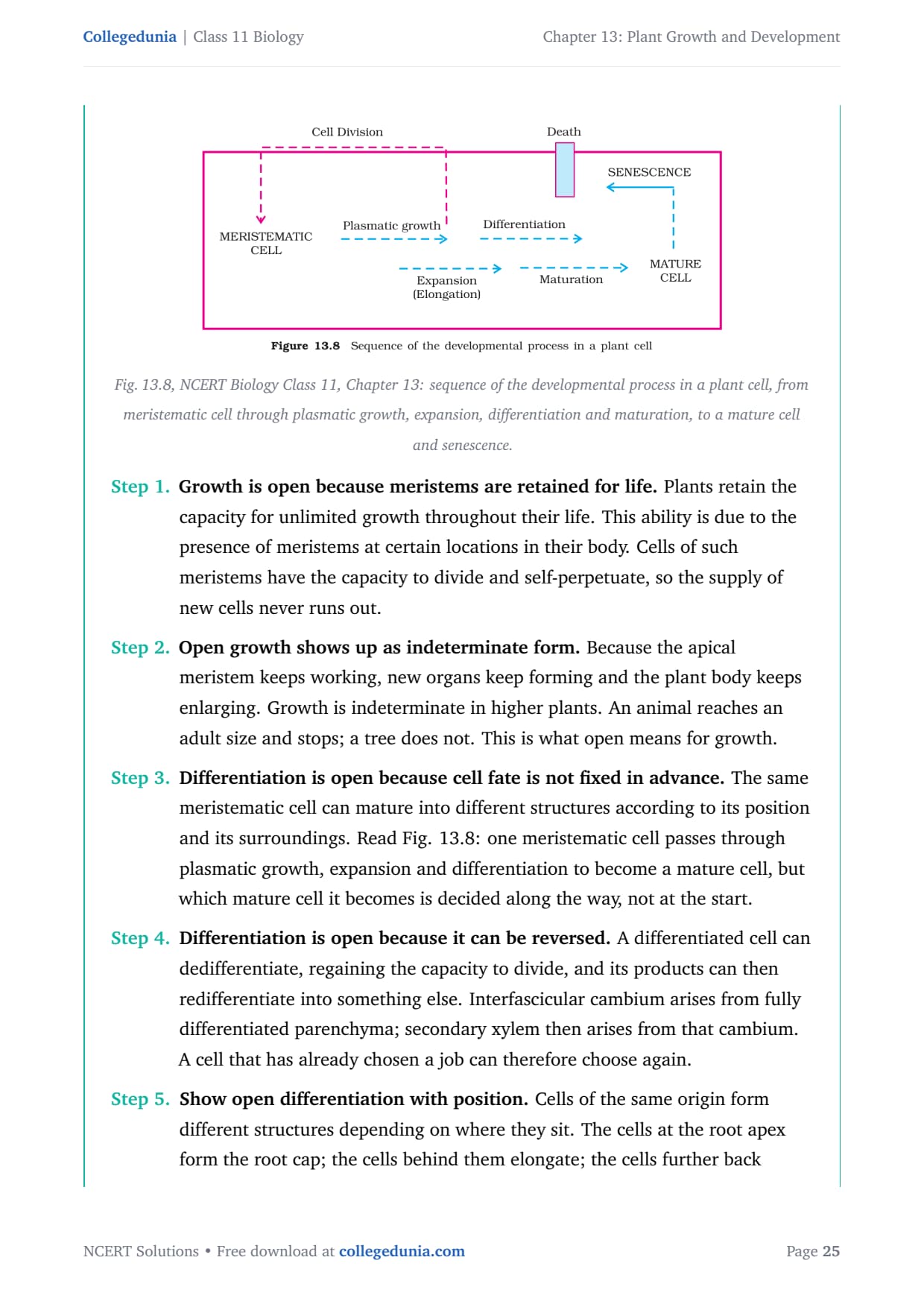
The three-step chain runs in order: a meristematic cell divides, then differentiates into a mature cell; if that cell dedifferentiates it divides again, and its products then redifferentiate. The word irreversible is the whole definition of growth, since a wilted leaf that swells again after watering has not grown. Writing the chain in order proves students know the terms are related rather than three lookalike words, which is exactly what Q1 rewards.
Why No Single Parameter Can Measure Growth
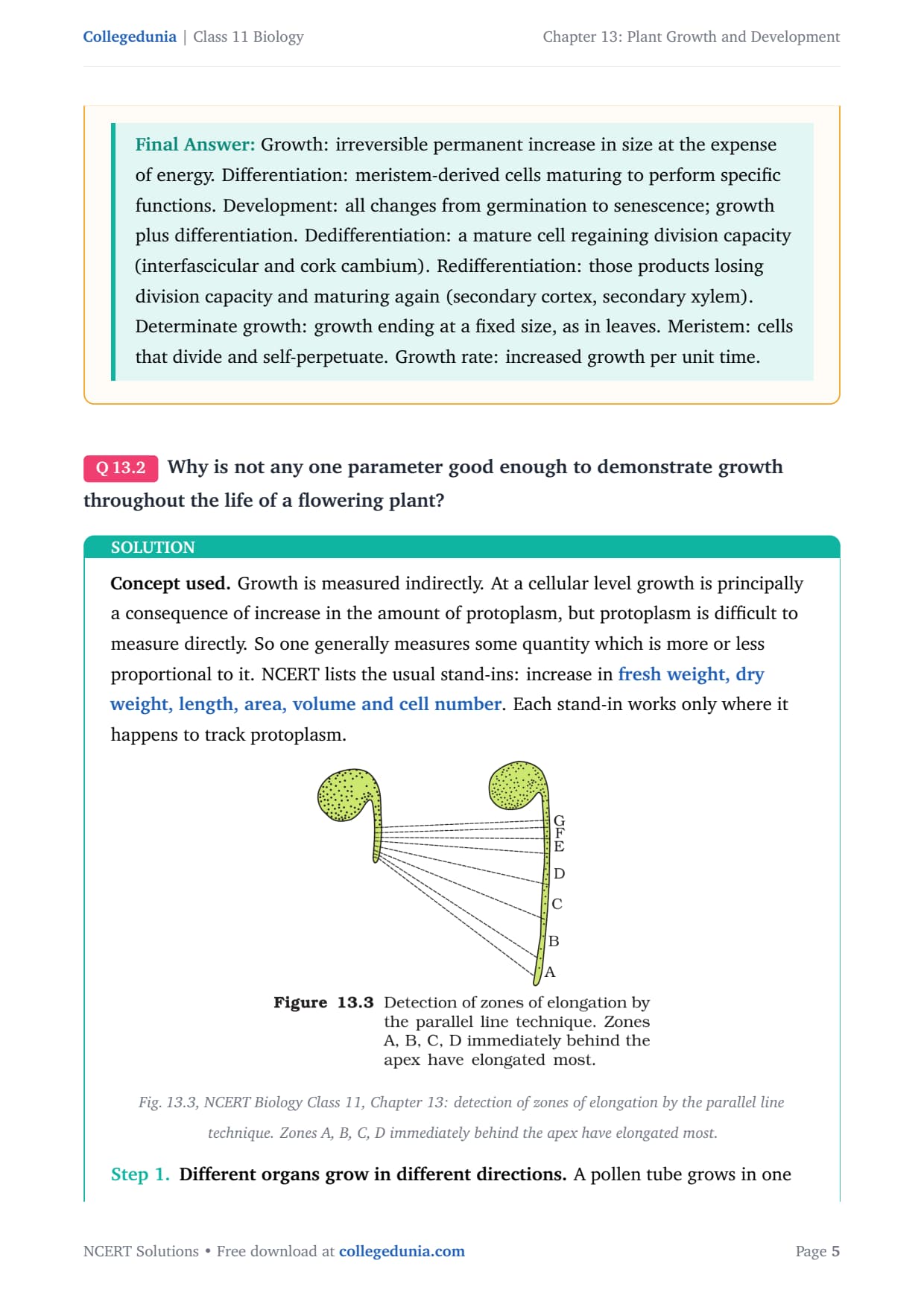
Growth is measured indirectly. At the cellular level it is principally a consequence of an increase in the amount of protoplasm, but protoplasm cannot be measured directly, so every parameter is a proxy. NCERT lists the usual stand-ins: increase in fresh weight, dry weight, length, area, volume and cell number. The point of Q2 is to notice that this is a list, and to see why it has to be.
- Different directions: a pollen tube grows in one dimension, so length works; a dorsiventral leaf spreads in two, so surface area works and length fails.
- Different mechanisms: a single maize root apex can make more than 17,500 new cells per hour, so cell number fits, while a watermelon may swell up to 3,50,000 times by cell enlargement, where cell number records almost nothing.
- Some parameters mislead: fresh weight rises and falls with water status, and a germinating seed loses dry weight while it grows fast, because stored food is respired away.
The question phrasing carries two signals: throughout the life is a time signal, and of a flowering plant is an organ signal. No single measurable quantity stays proportional to protoplasm across root, leaf, pollen tube, fruit and whole plant, over germination, elongation and maturation. Growth is therefore demonstrated by a variety of parameters, each chosen to suit the organ and the stage being measured. Answering with three concrete pairings scores higher than a paragraph saying growth is complex.
Arithmetic, Geometric and the Sigmoid Growth Curve
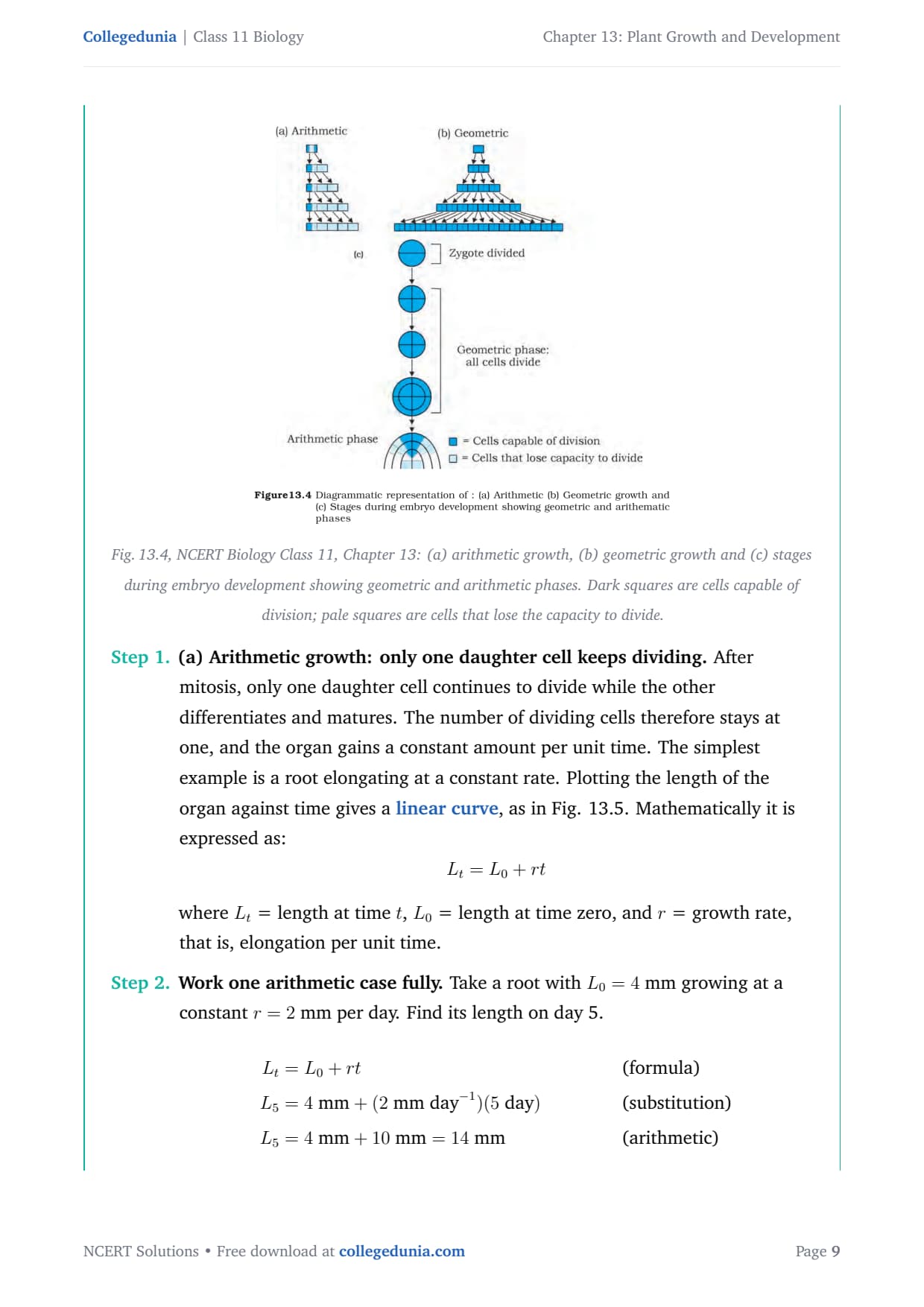
Following mitotic division in a root or shoot apical meristem, growth can be arithmetic or geometric, depending on how many daughter cells keep the ability to divide. The difference between the two is a single question: how many daughters keep dividing? That one question sets both the formula and the shape of the curve.
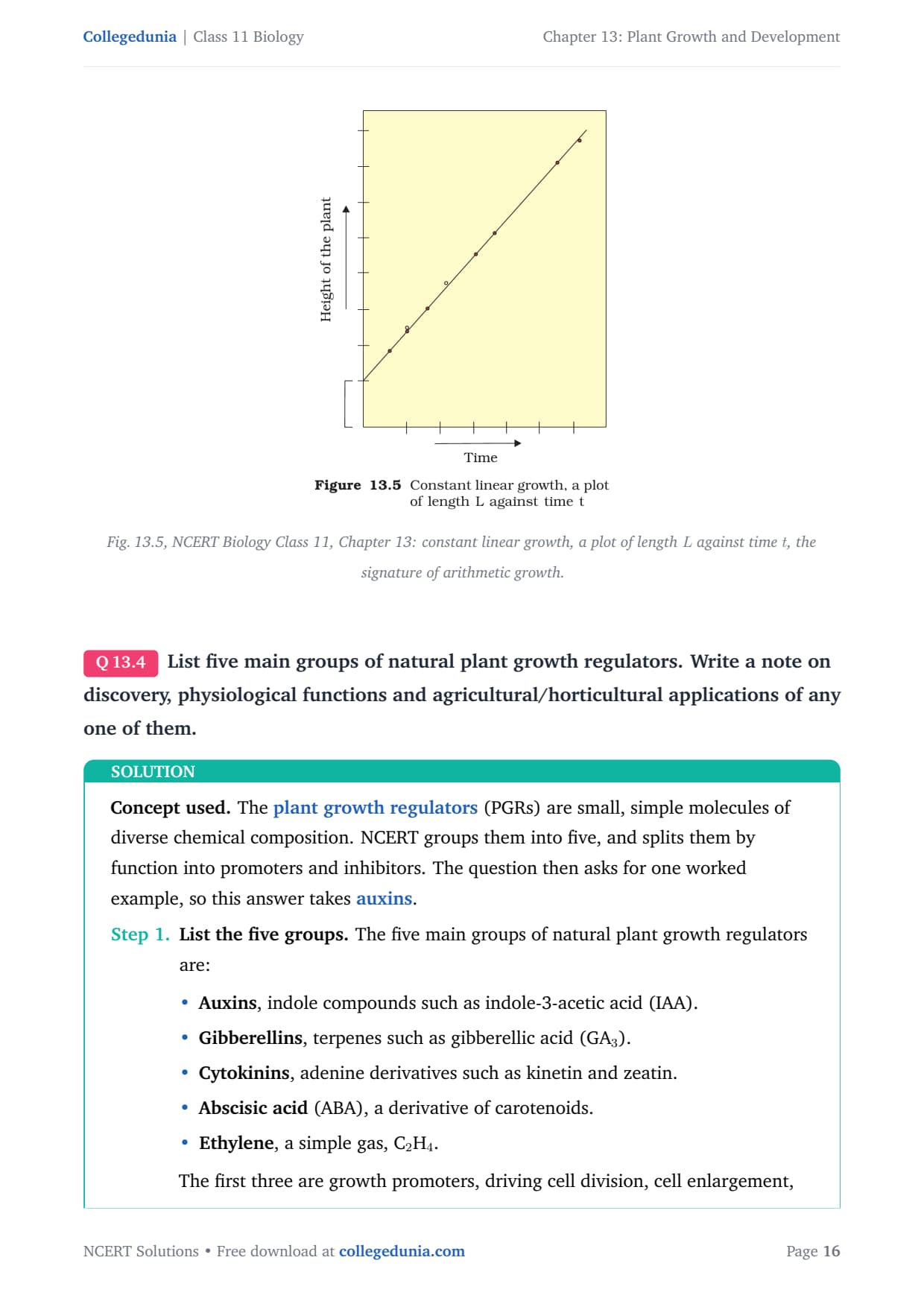
- Arithmetic growth: only one daughter cell keeps dividing while the other matures, so the increment per unit time is constant. It follows Lt = L0 + rt, the equation of a straight line, as a root elongating at a constant rate.
- Geometric growth: both daughter cells keep dividing, so the population doubles and the increment itself grows. It follows W1 = W0ert, an exponential, where r is the relative growth rate, also called the efficiency index.
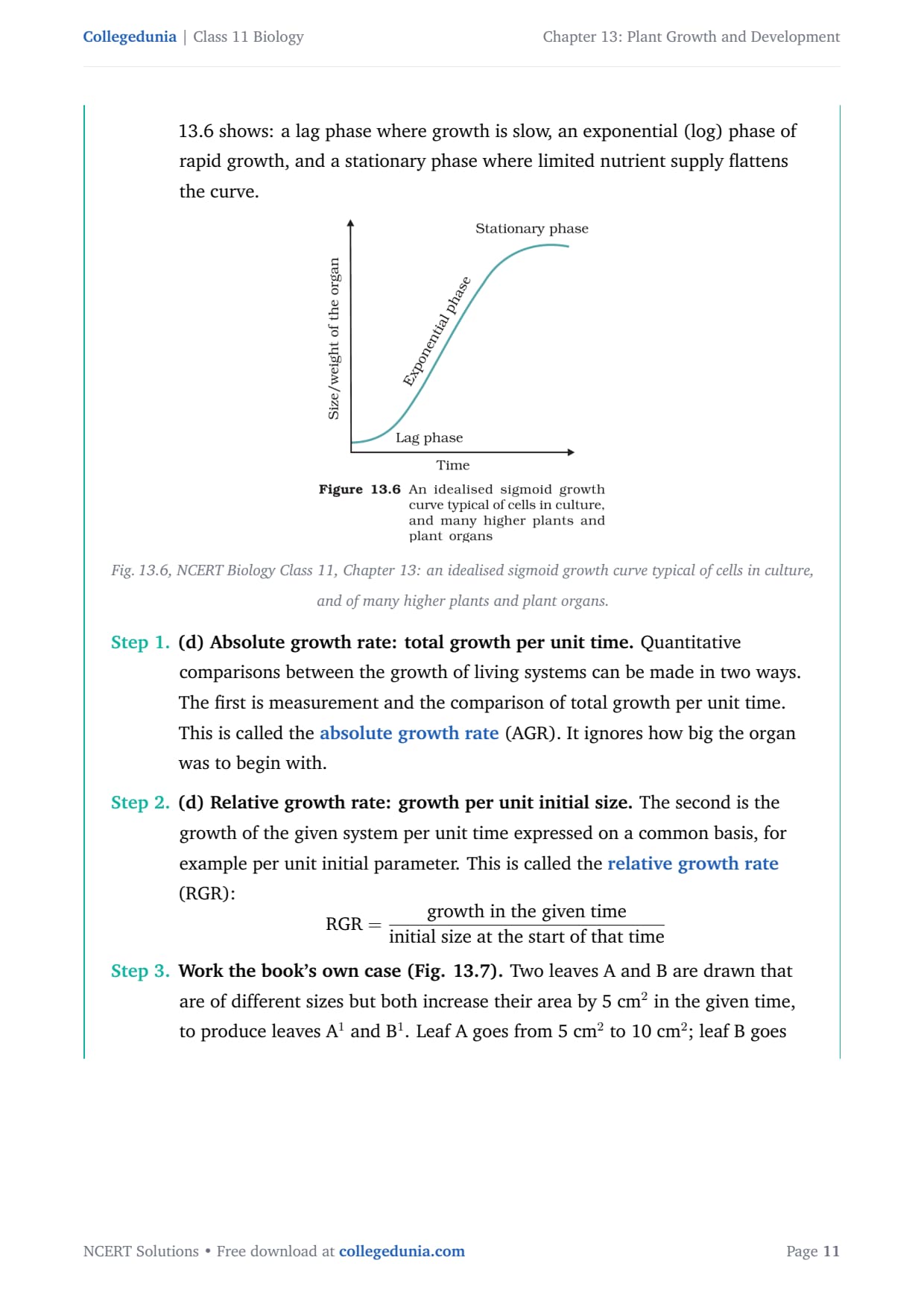
- Sigmoid curve: plotting any growth parameter against time gives a typical S-curve with three phases, a slow lag phase, a rapid exponential (log) phase, and a stationary phase where limited nutrients flatten the curve.
The gap between the two is dramatic: over ten divisions, geometric growth from one cell gives 210 = 1024 cells, while arithmetic growth over the same ten steps gives only 1 + 10 = 11 cells. The sigmoid curve is simply geometric growth meeting the real world, where nutrients eventually run short. It is characteristic of all cells, tissues and organs of a plant growing in a natural environment, which is why students should be able to label its lag, log and stationary phases from memory.
Absolute and Relative Growth Rates Worked Out
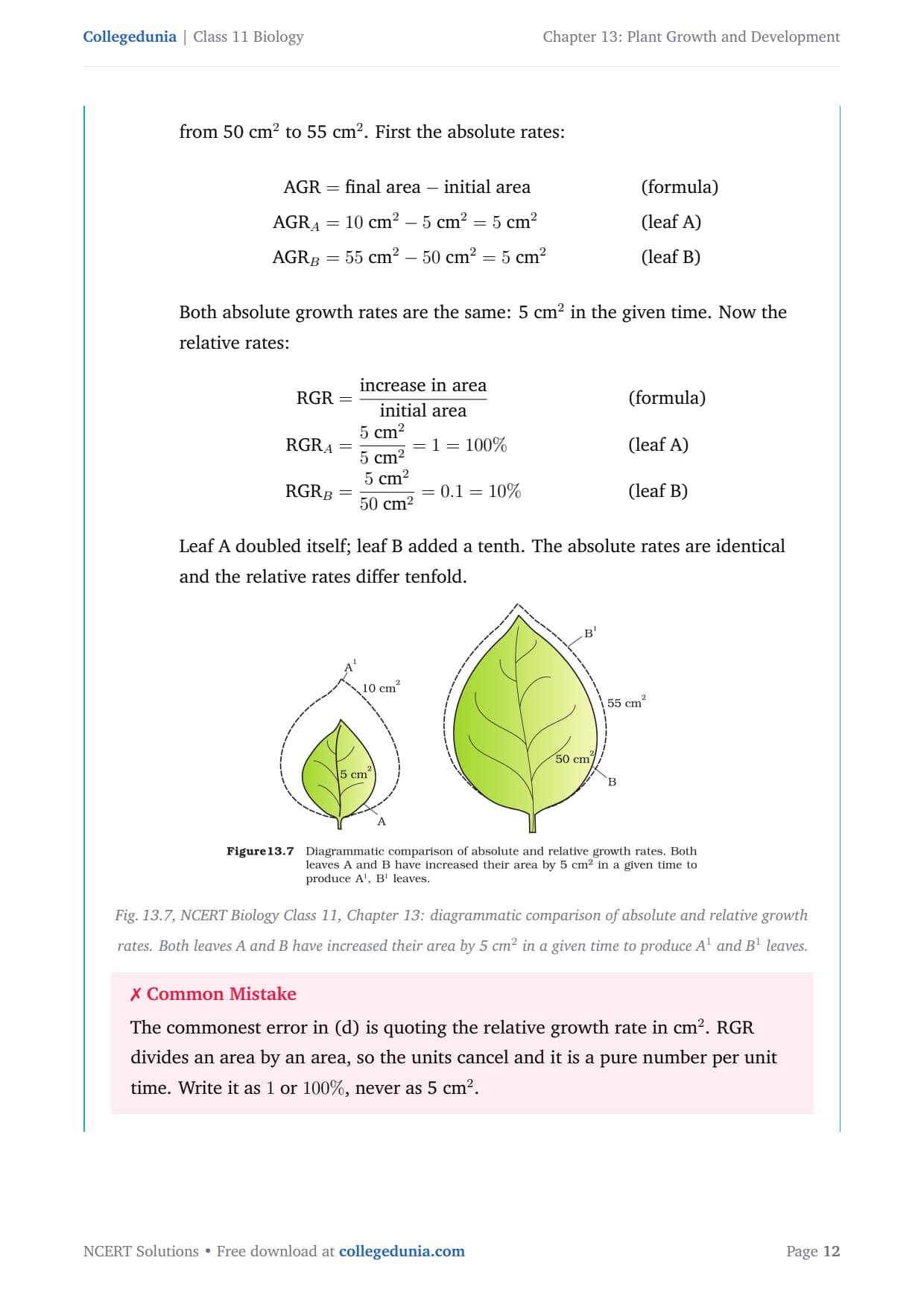
Quantitative comparisons between growing systems can be made in two ways, and part (d) of Q3 asks students to tell them apart. The absolute growth rate (AGR) is the total growth per unit time and ignores how big the organ was to begin with. The relative growth rate (RGR) is the growth per unit time expressed per unit initial size, so it compares the machinery rather than the stock.
| Leaf | Area change | AGR | RGR |
|---|---|---|---|
| Leaf A | 5 cm2 → 10 cm2 | 5 cm2 | 5/5 = 1 (100%) |
| Leaf B | 50 cm2 → 55 cm2 | 5 cm2 | 5/50 = 0.1 (10%) |
Both leaves add the same 5 cm2, so their absolute growth rates are identical, yet leaf A doubles itself while leaf B adds only a tenth, so their relative rates differ tenfold. Leaf A has the higher relative growth rate because the same absolute gain is divided by a much smaller initial area. The commonest error is quoting RGR in cm2: because RGR divides an area by an area, the units cancel and it is a pure number, written as 1 or 100%, never as 5 cm2. Full working for Fig. 13.7 is shown in Exercise Q3.
The Five Plant Growth Regulators
The plant growth regulators (PGRs) are small, simple molecules of diverse chemical composition. NCERT groups them into five and splits them by function into promoters and inhibitors. Q4 asks students to list the five and then write a full note on any one, and the table below fixes the names, chemical classes and roles that every applied question later depends on.
| Regulator | Chemical class | Main role |
|---|---|---|
| Auxins (IAA) | Indole compounds | Rooting, apical dominance, cell elongation; promoter |
| Gibberellins (GA3) | Terpenes | Stem elongation, bolting, seed germination; promoter |
| Cytokinins | Adenine derivatives | Cell division, delaying senescence, lateral buds; promoter |
| Abscisic acid (ABA) | Carotenoid derivative | Stomatal closure, dormancy, stress; inhibitor |
| Ethylene | Gas, C2H4 | Fruit ripening, abscission; largely an inhibitor |
The first three are growth promoters, driving cell division, enlargement, pattern formation, tropic growth, flowering and fruiting. Abscisic acid is an inhibitor, and ethylene sits across both groups but is largely an inhibitor of growth activities. Splitting the five this way shows the list is organised rather than memorised, and it sets up the applied questions Q8 and Q10, where each PGR must be matched to a specific effect.
Auxins and Abscisic Acid: Discovery and Roles
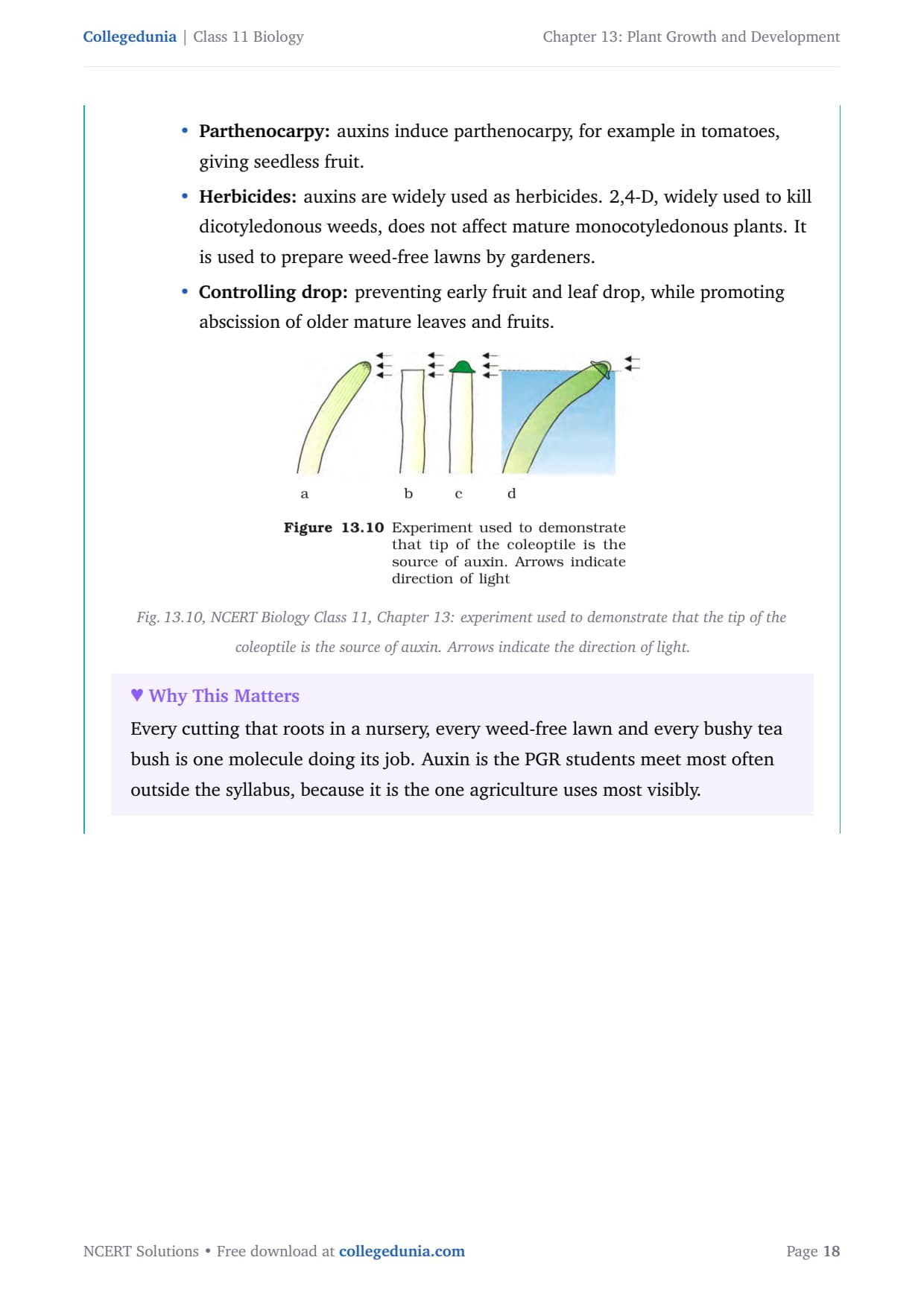
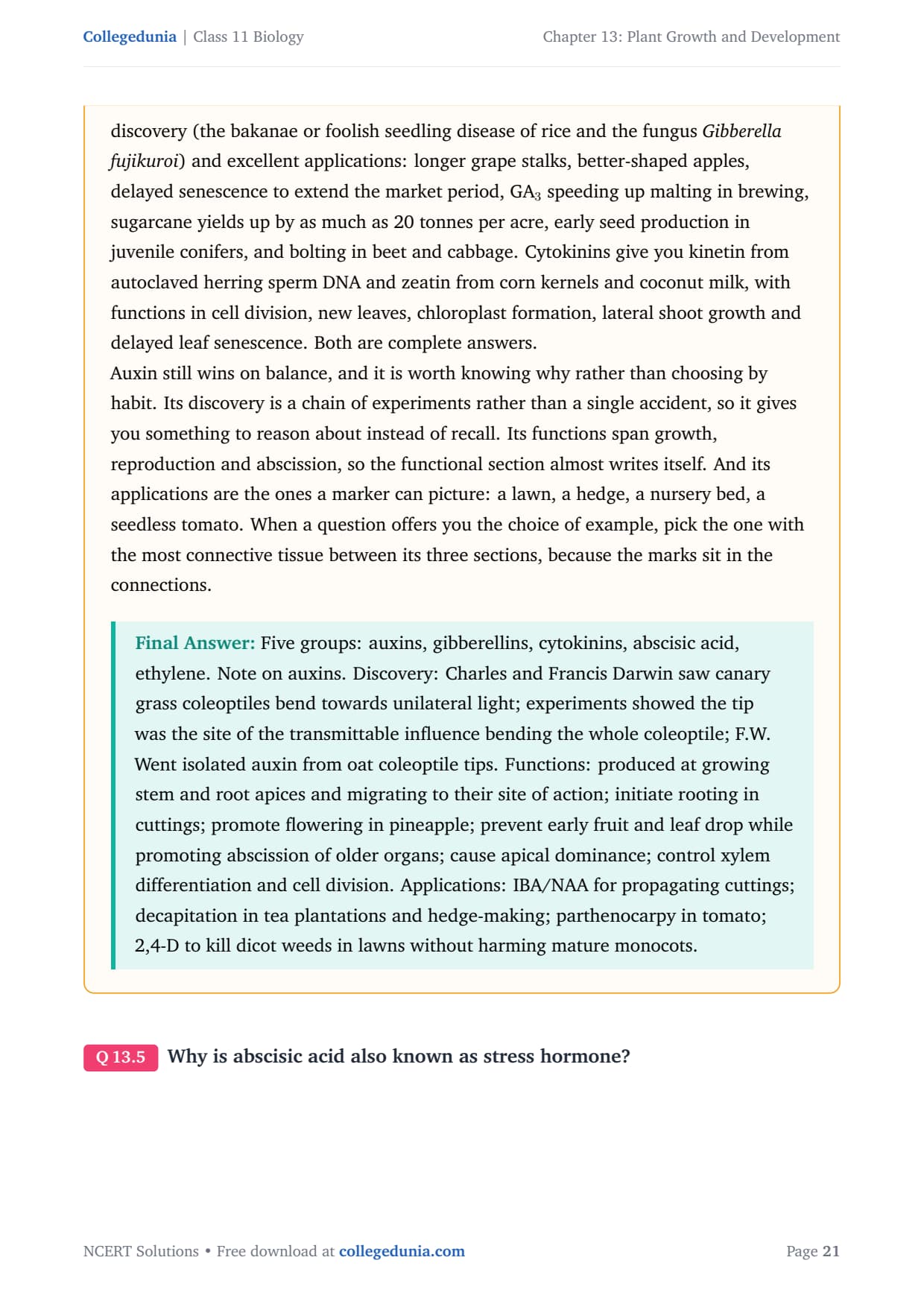
Auxin has the richest discovery story of the five. It started with Charles Darwin and his son Francis Darwin, who observed that canary grass coleoptiles bend towards a unilateral light source, a response called phototropism. Later experiments showed the tip of the coleoptile was the site of the transmittable influence that caused the bending, and F.W. Went finally isolated auxin from the tips of oat coleoptiles.
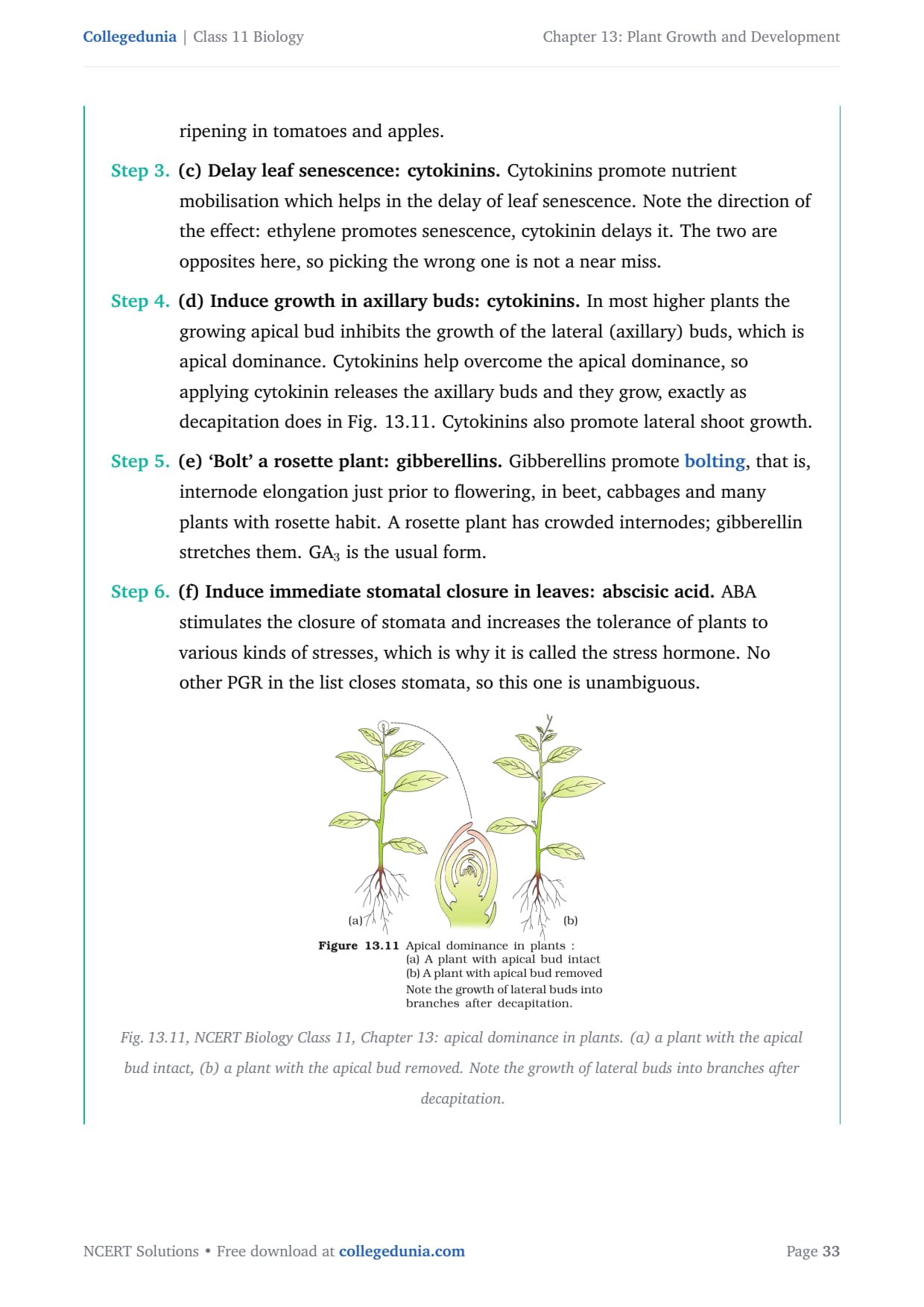
- Where auxin acts: made at growing stem and root apices, it migrates to its site of action, initiates rooting in cuttings, promotes flowering in pineapple, and enforces apical dominance, where the apical bud suppresses the lateral buds.
- Auxin applications: IBA and NAA root cuttings, 2,4-D kills dicot weeds in lawns without harming mature monocots, decapitation removes apical dominance in tea and hedges, and auxins induce parthenocarpy in tomato.
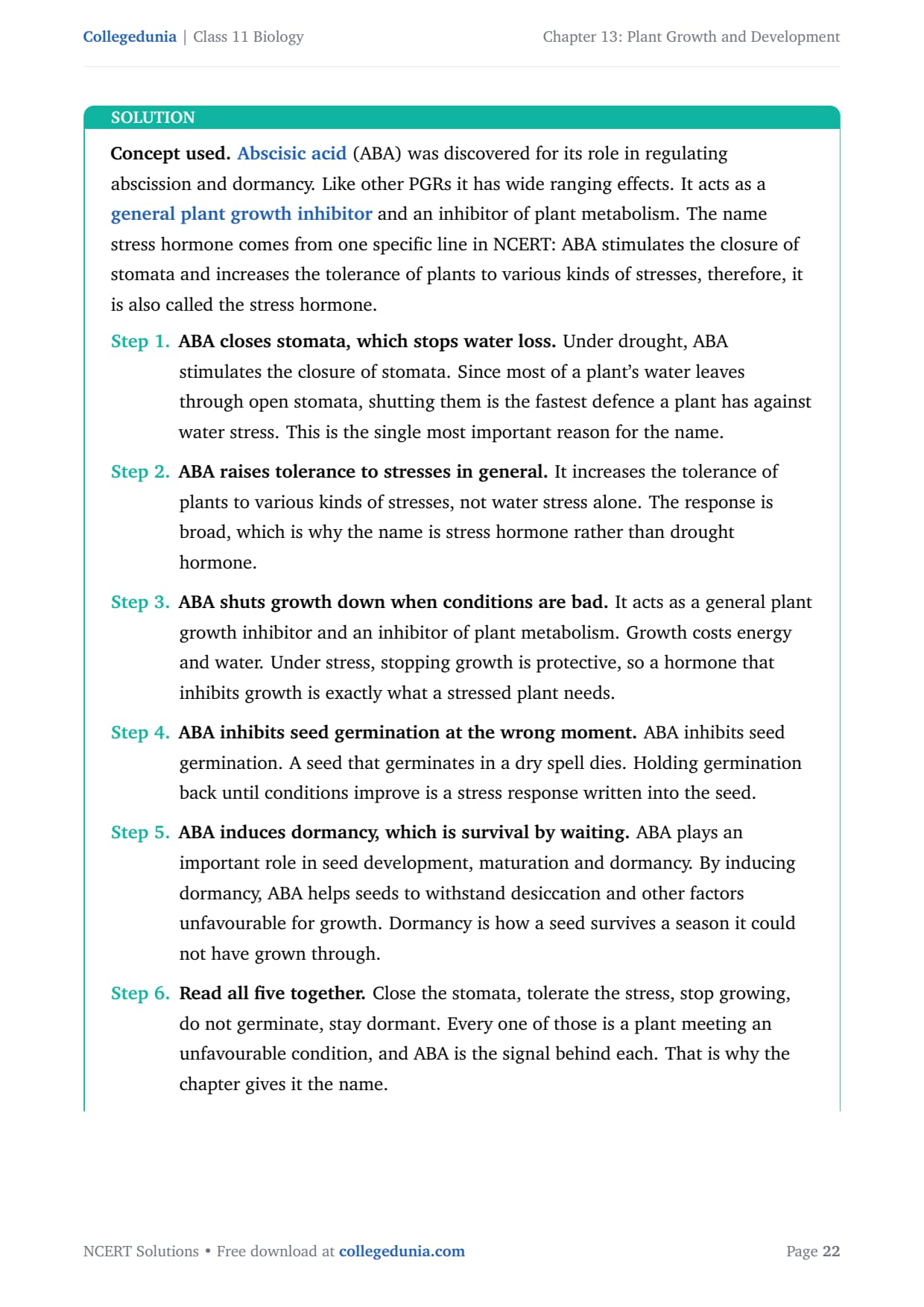
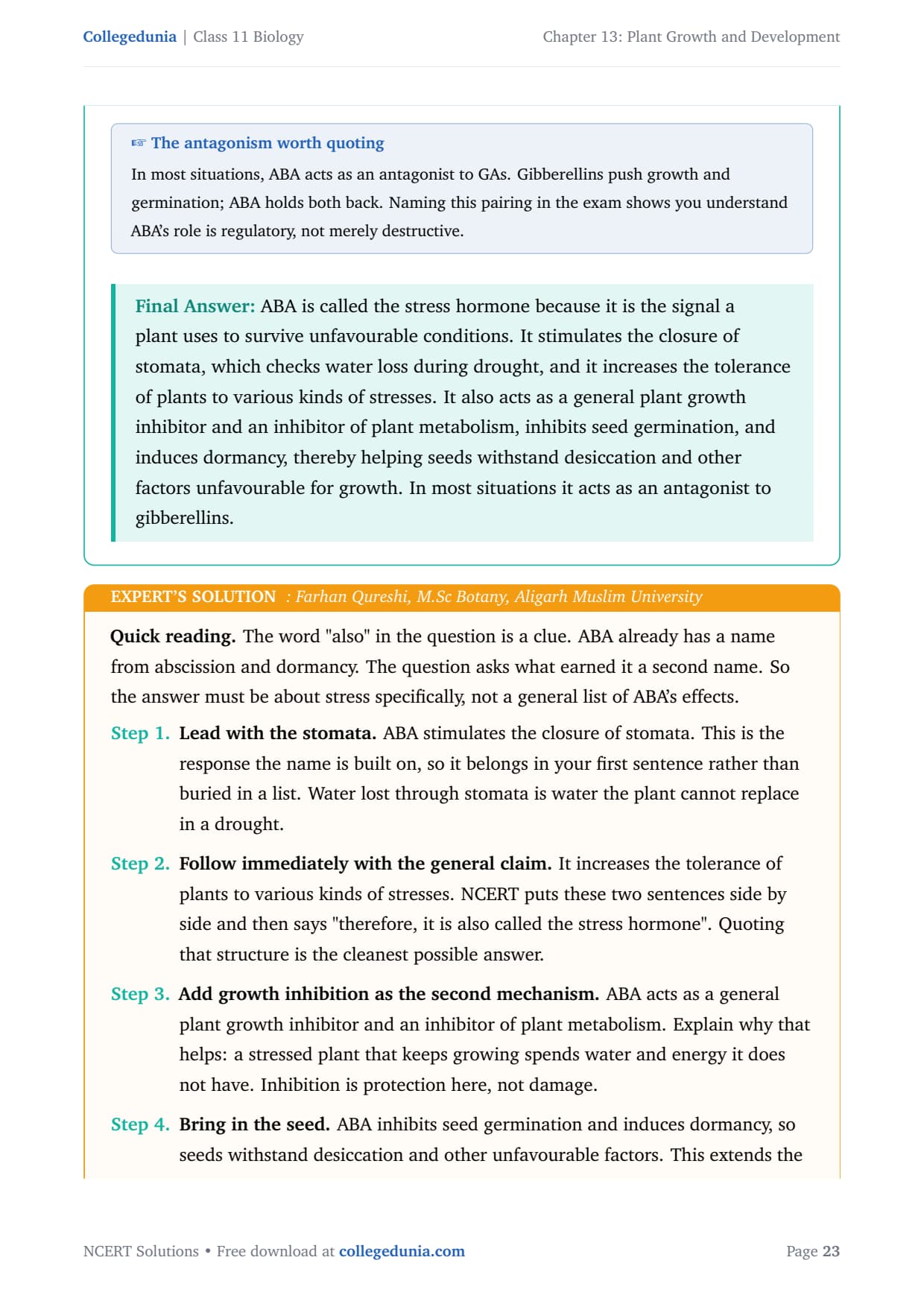
- Abscisic acid, the stress hormone: ABA stimulates the closure of stomata, cutting water loss during drought, and increases the tolerance of plants to various kinds of stresses, which is precisely why NCERT calls it the stress hormone.
ABA also acts as a general growth and metabolism inhibitor, inhibits seed germination, and induces dormancy so seeds withstand desiccation and other unfavourable factors. In most situations ABA acts as an antagonist to gibberellins: gibberellins say grow and germinate, while ABA says wait. Every other PGR is defined by what it builds, but ABA is defined by what it stops, and stopping is exactly what survival under stress requires. Students answering Q5 should lead with the stomata and stress tolerance, not with abscission, which explains ABA's first name and not its second.
Open Growth, Open Differentiation and Plasticity
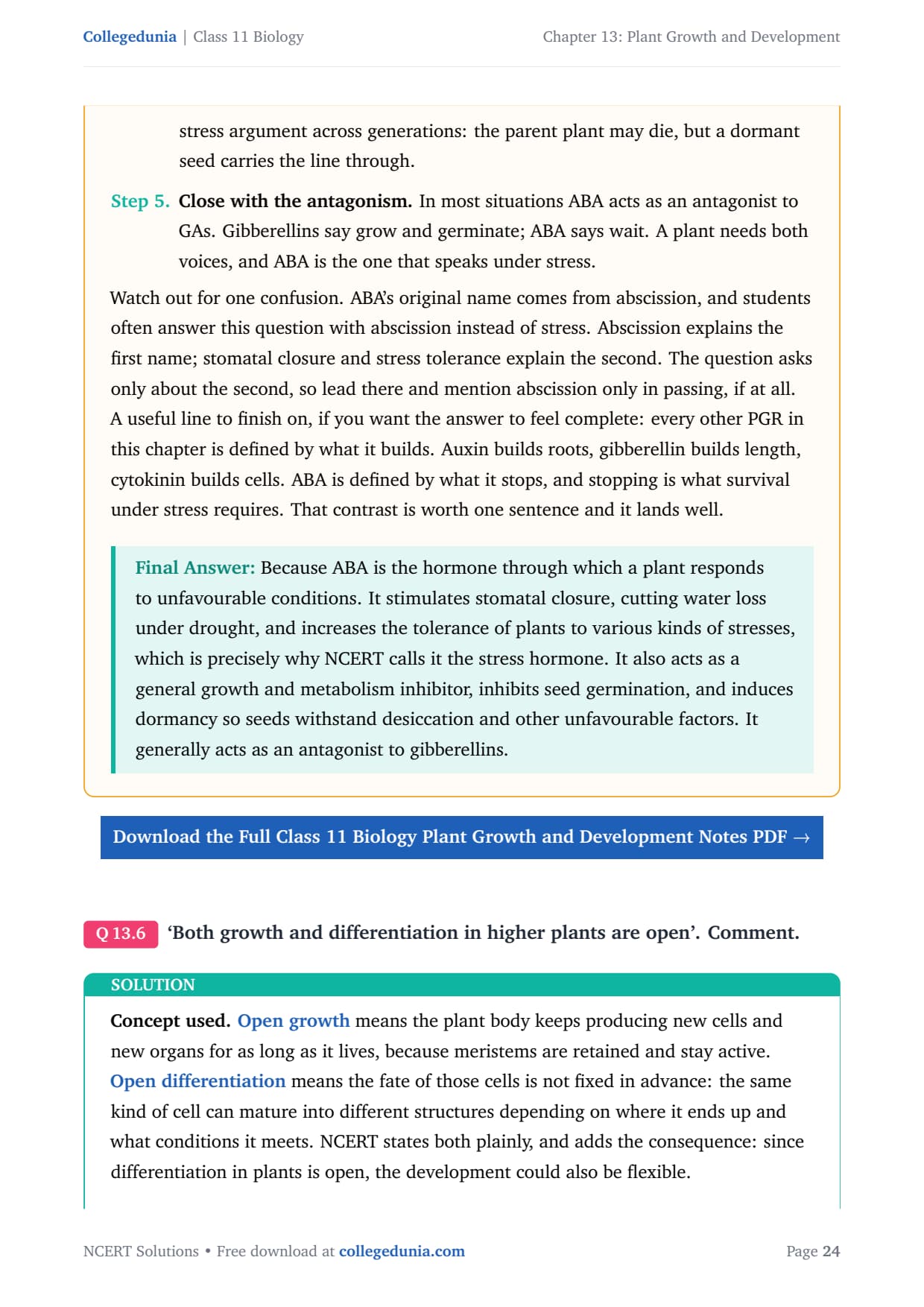
Q6 asks students to comment on the statement that both growth and differentiation in higher plants are open. Open growth means the plant keeps producing new cells and organs for as long as it lives, because meristems are retained and stay active. Open differentiation means the fate of those cells is not fixed in advance, so the same kind of cell can mature into different structures depending on where it ends up.
- Growth is open: higher plants retain meristems that divide and self-perpetuate, so new cells never run out and growth stays indeterminate, unlike an animal that reaches a fixed adult size and stops.
- Differentiation is open by position: cells of the same origin form different structures depending on where they sit, so cells at the root apex form the root cap while cells behind them elongate and mature into vascular tissue.
- Differentiation is open by reversal: a differentiated cell can dedifferentiate and its products can redifferentiate, so interfascicular cambium arises from parenchyma and secondary xylem then arises from that cambium.
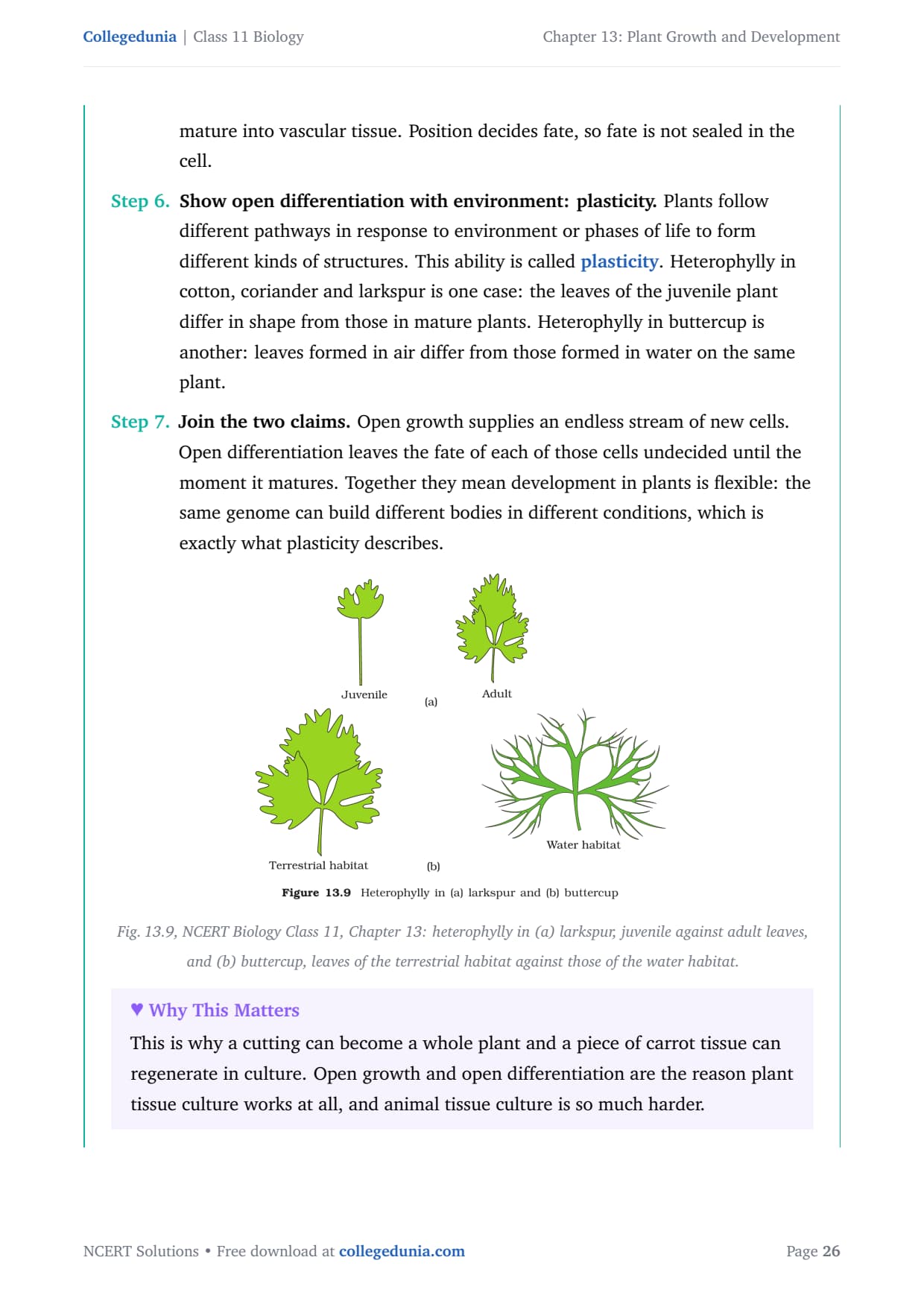
Plants also follow different pathways in response to environment or phase of life to form different structures, an ability called plasticity. Heterophylly in cotton, coriander and larkspur shows juvenile leaves differing in shape from adult leaves, while heterophylly in buttercup shows leaves formed in air differing from those formed in water on the same plant. Because differentiation is open, development in plants is flexible, which is exactly why a cutting can regenerate a whole plant and why plant tissue culture works while animal tissue culture is far harder.
Photoperiodism and the Site of Flowering
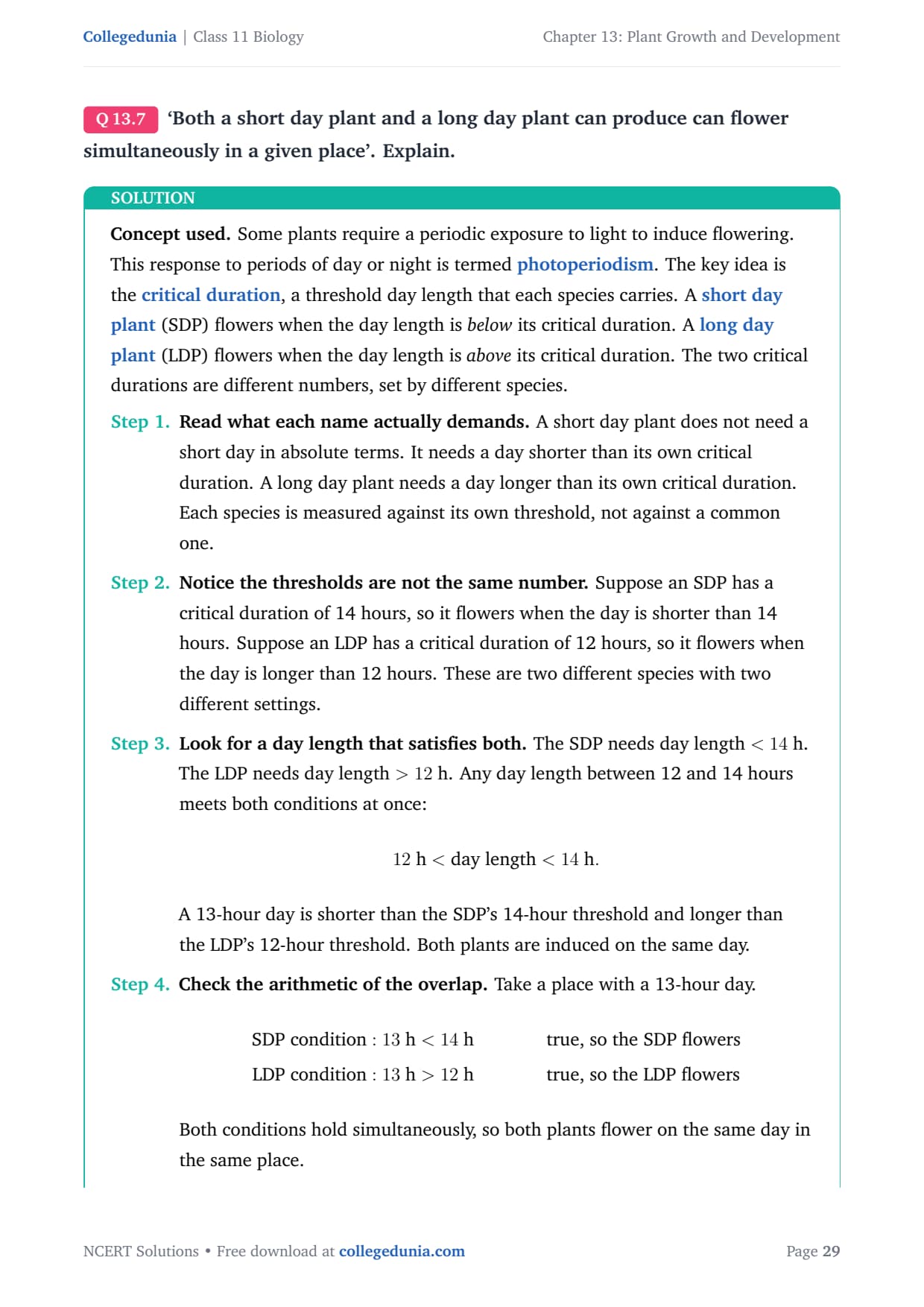
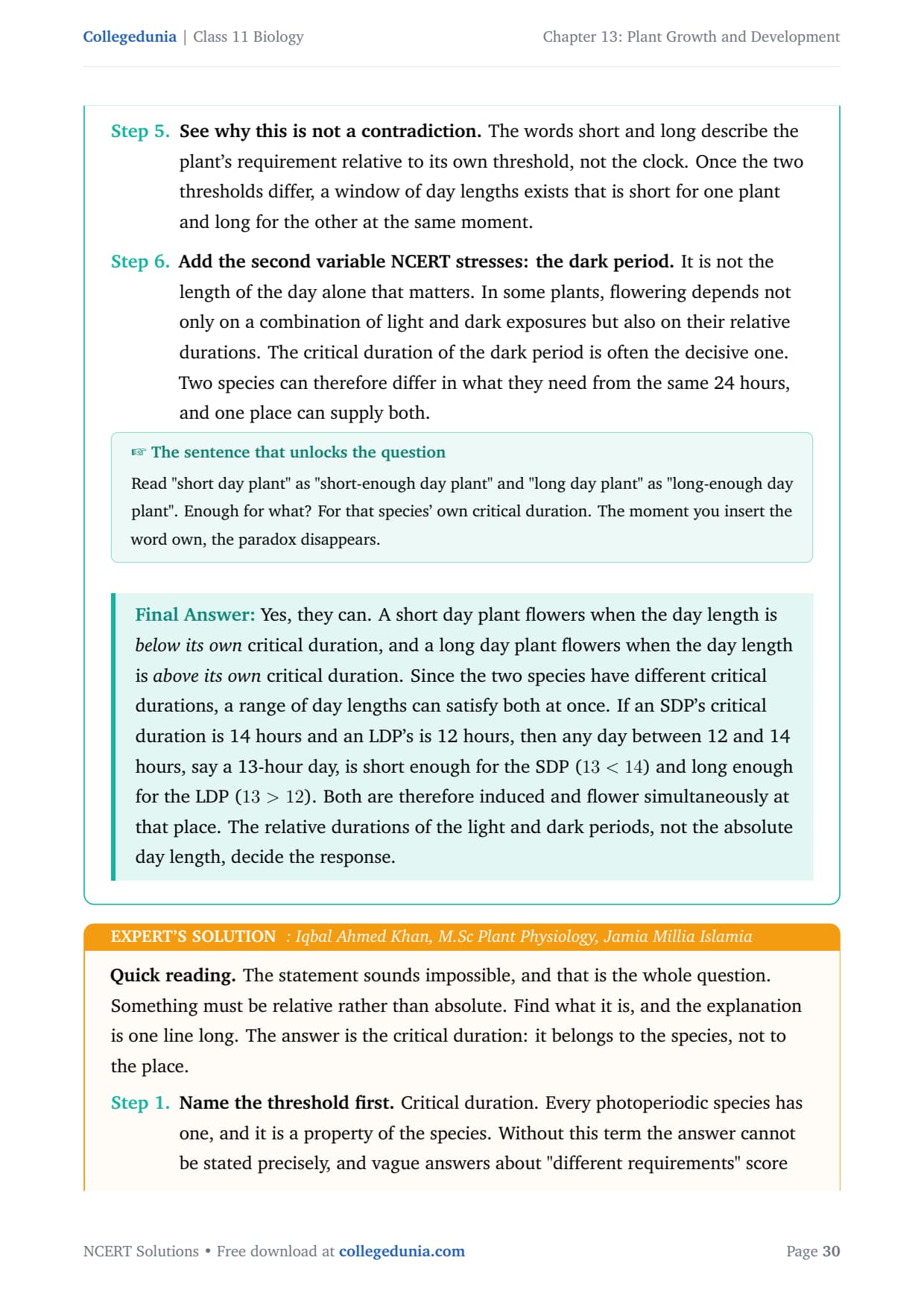
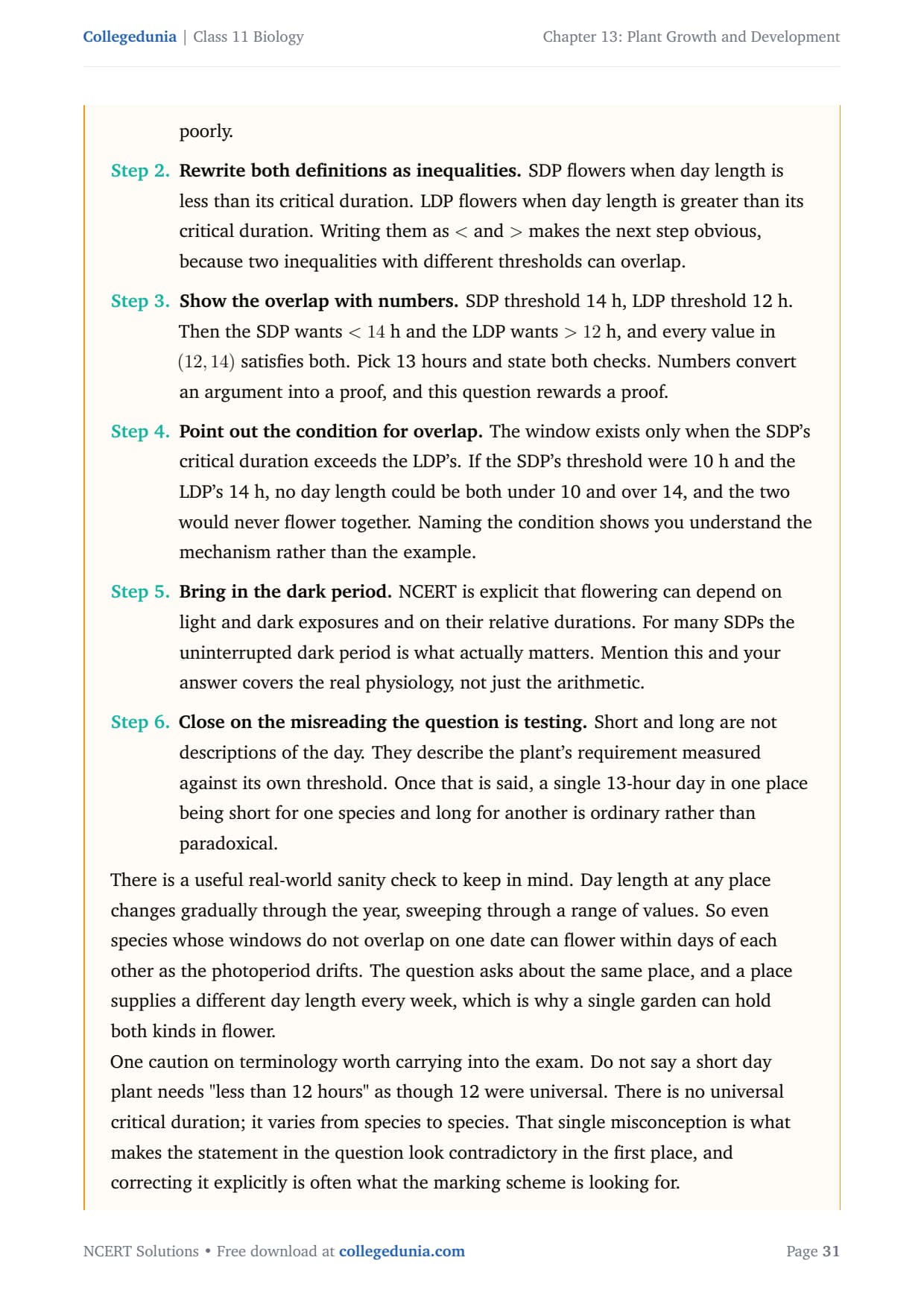
Some plants require a periodic exposure to light to induce flowering, a response called photoperiodism. The key idea is the critical duration, a threshold day length each species carries. A short day plant (SDP) flowers when the day length falls below its critical duration, while a long day plant (LDP) flowers when the day length rises above its critical duration. Q7 asks how both can flower together in one place, and Q9 asks whether a defoliated plant can respond at all.
- Flowering together: because the two species have different critical durations, a single day length can lie below the SDP's threshold and above the LDP's at the same time, so both flower simultaneously in the same place.
- Worked example: if an SDP has a critical duration of 14 hours and an LDP has one of 12 hours, a 13-hour day satisfies both, so the two flower together.
- Site of perception: the leaf, not the shoot apex, perceives the light and dark stimulus, and a hormonal substance then migrates from the leaves to the shoot apices where flowers form.
This is why a defoliated plant does not respond to a photoperiodic cycle: with its leaves removed, there is no organ left to perceive the inductive photoperiod, so the flowering signal is never produced or exported. The critical duration belongs to the species, not to a universal clock, and there is no single threshold that fits all plants. Students should note that it is really the length of the dark period that matters, and that the leaf is the receiver even though the shoot apex is where the flower appears.
Choosing the Right PGR for the Job
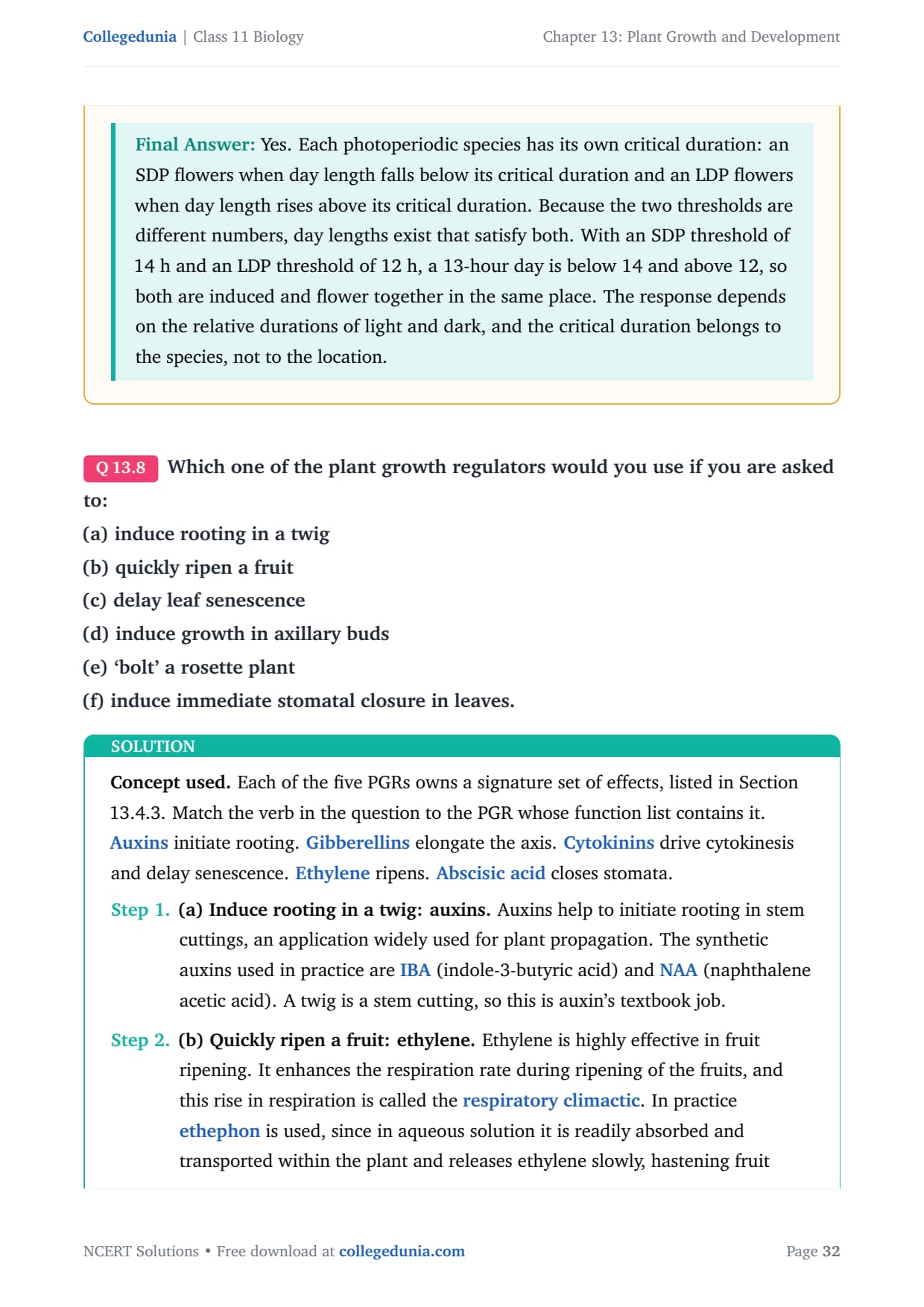
Questions 8 and 10 are applied: they name a task and ask which regulator does it, or name a change and ask what would follow. Each PGR owns a signature set of effects, so the trick is to name the function first and then apply it. The table below pairs each job in Q8 with its regulator.
| Task | Regulator |
|---|---|
| Induce rooting in a twig | Auxins (IBA or NAA) |
| Quickly ripen a fruit | Ethylene |
| Delay leaf senescence | Cytokinins |
| Induce growth in axillary buds | Cytokinins |
| Bolt a rosette plant | Gibberellins |
| Induce immediate stomatal closure | Abscisic acid |
The same logic answers Q10. Applying GA3 to rice seedlings makes them grow abnormally tall, because gibberellins increase the length of the axis. If dividing cells stop differentiating, no specialised tissues form and the plant stays a mass of dividing cells. A rotten fruit mixed with unripe fruits ripens them fast, because the rotten fruit releases ethylene that hastens ripening. Forgetting to add cytokinin to a culture medium means cytokinesis and cell division fail, so the tissue does not proliferate. Naming the function before the outcome is what turns a guess into a full-mark answer.
Plant Growth and Development Exercise-wise Breakdown
The NCERT back exercise has 10 questions, mixing definitions, one numerical on relative growth rate, and several applied hormone questions. The table below maps the question blocks to their topics so students can revise by theme.
| Question block | What it tests |
|---|---|
| Q 1 and Q 2 | Defining eight growth terms, and why no single parameter measures growth. |
| Q 3 | Arithmetic, geometric, sigmoid growth, and absolute versus relative growth rate with a numerical. |
| Q 4 and Q 5 | The five plant growth regulators, a note on one, and why ABA is the stress hormone. |
| Q 6 | Commenting on open growth and open differentiation in higher plants. |
| Q 7 and Q 9 | Photoperiodism, critical duration, and whether a defoliated plant responds. |
| Q 8 and Q 10 | Matching regulators to tasks, and predicting the effect of adding or removing a PGR. |
The definitions and the applied hormone questions carry most of the marks, and the one numerical on relative growth rate is a reliable scorer if students remember to cancel units. Learn the single keyword in each definition and the signature effect of each of the five regulators, then attach a real example. Every question in the class 11 biology NCERT solutions chapter 13 Plant Growth and Development PDF is solved with each step of reasoning shown, so students can compare their answers against the model working.
Practice the solved questions: Work through the full question bank with step-by-step answers and expert tips.
Plant Growth and Development Class 11 Solved Practice Questions
Common Mistakes Students Make in Plant Growth and Development
Most marks in this chapter are lost on loose definitions and swapped hormones, not on hard ideas. Each mistake below costs 1 to 2 marks, so watch for it at the exact step.
Mistake 1: Defining growth as merely an increase in size. NCERT wants irreversible permanent increase at the expense of energy, since a swollen wilted leaf also increases in size.
Mistake 2: Quoting the relative growth rate in cm2. RGR divides an area by an area, so it is a pure number, written as 1 or 100%, never as 5 cm2.
Mistake 3: Crediting F.W. Went with discovering auxin outright. The Darwins observed the bending, later experiments localised it to the tip, and Went isolated the chemical.
Mistake 4: Answering the stress hormone question with abscission. Abscission explains ABA's first name; stomatal closure and stress tolerance explain the second, which is what Q5 asks.
Student Feedback on Plant Growth and Development Solutions
What 10,420 students told us about their Plant Growth and Development preparation:
- 57% of students said matching the five regulators to their functions was the part they most needed to revise before the exam.
- Most-skipped detail: writing the single keyword in each of the eight definitions, missed by about 3 in 10 students in Q1.
- Students who learned the auxin discovery sequence and the ABA stress role together said the hormone questions became automatic.
Source: 2026-27 Class 11 Biology student poll. Sample of 10,420 students from CBSE schools across 15 states, conducted before the 2026 boards.
Other Plant Growth and Development Class 11 Biology Resources
Pair these solutions with the revision notes, formula sheet, exemplar solutions and NCERT textbook PDF for the same chapter.
| Resource | Link |
|---|---|
| NCERT Notes | Plant Growth and Development Class 11 Notes |
| Formula Sheet | Plant Growth and Development Class 11 Formula Sheet |
| Exemplar Solutions | Plant Growth and Development Class 11 Exemplar Solutions |
| NCERT Book PDF | Plant Growth and Development Class 11 Book PDF |
NCERT Solutions for Class 11 Biology: All Chapters
Jump to the step-by-step solutions for any other Class 11 Biology chapter below.
| Chapter | NCERT Solutions |
|---|---|
| Chapter 1 | The Living World |
| Chapter 2 | Biological Classification |
| Chapter 3 | Plant Kingdom |
| Chapter 4 | Animal Kingdom |
| Chapter 5 | Morphology of Flowering Plants |
| Chapter 6 | Anatomy of Flowering Plants |
| Chapter 7 | Structural Organisation in Animals |
| Chapter 8 | Cell: The Unit of Life |
| Chapter 9 | Biomolecules |
| Chapter 10 | Cell Cycle and Cell Division |
| Chapter 11 | Photosynthesis in Higher Plants |
| Chapter 12 | Respiration in Plants |
| Chapter 13 | Plant Growth and Development |
| Chapter 14 | Breathing and Exchange of Gases |
| Chapter 15 | Body Fluids and Circulation |
| Chapter 16 | Excretory Products and their Elimination |
| Chapter 17 | Locomotion and Movement |
| Chapter 18 | Neural Control and Coordination |
| Chapter 19 | Chemical Coordination and Integration |
FAQs on Plant Growth and Development Class 11 NCERT Solutions
Plant Growth and Development NCERT Solutions - Frequently Asked Questions
Ques. What do the class 11 biology NCERT solutions chapter 13 Plant Growth and Development cover?
Ans. These solutions cover all 10 back-exercise questions, including the eight growth terms, why no single parameter measures growth, arithmetic and geometric growth with the sigmoid curve, absolute and relative growth rates, the five plant growth regulators, why ABA is the stress hormone, open growth and differentiation, photoperiodism, and matching regulators to tasks. Every question is solved step by step.
Ques. What are the five main plant growth regulators?
Ans. The five natural plant growth regulators are auxins (indole compounds such as IAA), gibberellins (terpenes such as GA3), cytokinins (adenine derivatives), abscisic acid (a carotenoid derivative) and ethylene (a gas, C2H4). Auxins, gibberellins and cytokinins are growth promoters, abscisic acid is an inhibitor, and ethylene is largely an inhibitor of growth activities.
Ques. Why is abscisic acid called the stress hormone?
Ans. Abscisic acid stimulates the closure of stomata, cutting water loss during drought, and increases the tolerance of plants to various kinds of stresses, which is why NCERT calls it the stress hormone. It also acts as a general growth and metabolism inhibitor, inhibits seed germination, and induces dormancy so seeds withstand desiccation. In most situations it acts as an antagonist to gibberellins.
Ques. How do you calculate the relative growth rate of a leaf?
Ans. Relative growth rate is the growth in a given time divided by the initial size at the start of that time. For a leaf that grows from 5 cm2 to 10 cm2, RGR = 5/5 = 1, that is 100%, while a leaf that grows from 50 cm2 to 55 cm2 has RGR = 5/50 = 0.1, that is 10%. The units cancel, so RGR is always a pure number, never cm2.
Ques. Would a defoliated plant respond to a photoperiodic cycle?
Ans. A defoliated plant would not respond to a photoperiodic cycle. The leaf, not the shoot apex, perceives the inductive photoperiod, and a hormonal substance then travels from the leaves to the shoot apices to induce flowering. With its leaves removed, the plant has no organ to sense day length, so the flowering signal is never produced or exported.
Ques. What is the weightage of Plant Growth and Development in CBSE Class 11 Biology?
Ans. Plant Growth and Development carries about 4 to 5 marks in the CBSE Class 11 Biology paper, tested through definitions, the growth-rate numerical and applied hormone questions. It is also high-yield for NEET, where the five plant growth regulators, apical dominance, photoperiodism and the sigmoid growth curve appear regularly.



Comments