




The class 11 biology NCERT solutions chapter 6 Anatomy of Flowering Plants cover every back-exercise question, according to the latest 2026-27 CBSE syllabus, and help students prepare for the CBSE Boards, NEET and CUET. Each answer is worked step by step, from telling a monocot section apart from a dicot section to naming the three tissue systems, describing the stomatal apparatus and reading the internal structure of a dorsiventral leaf.
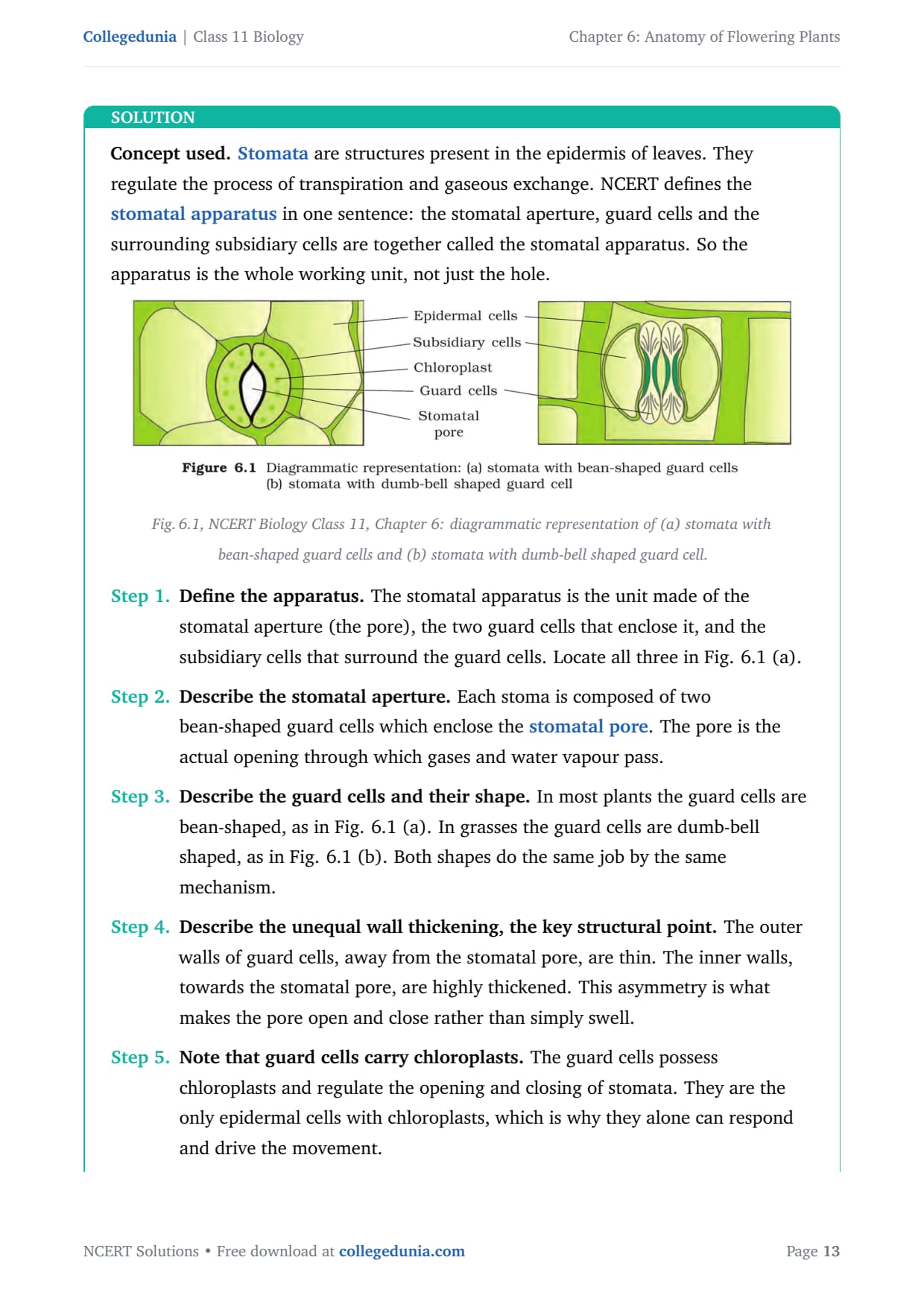
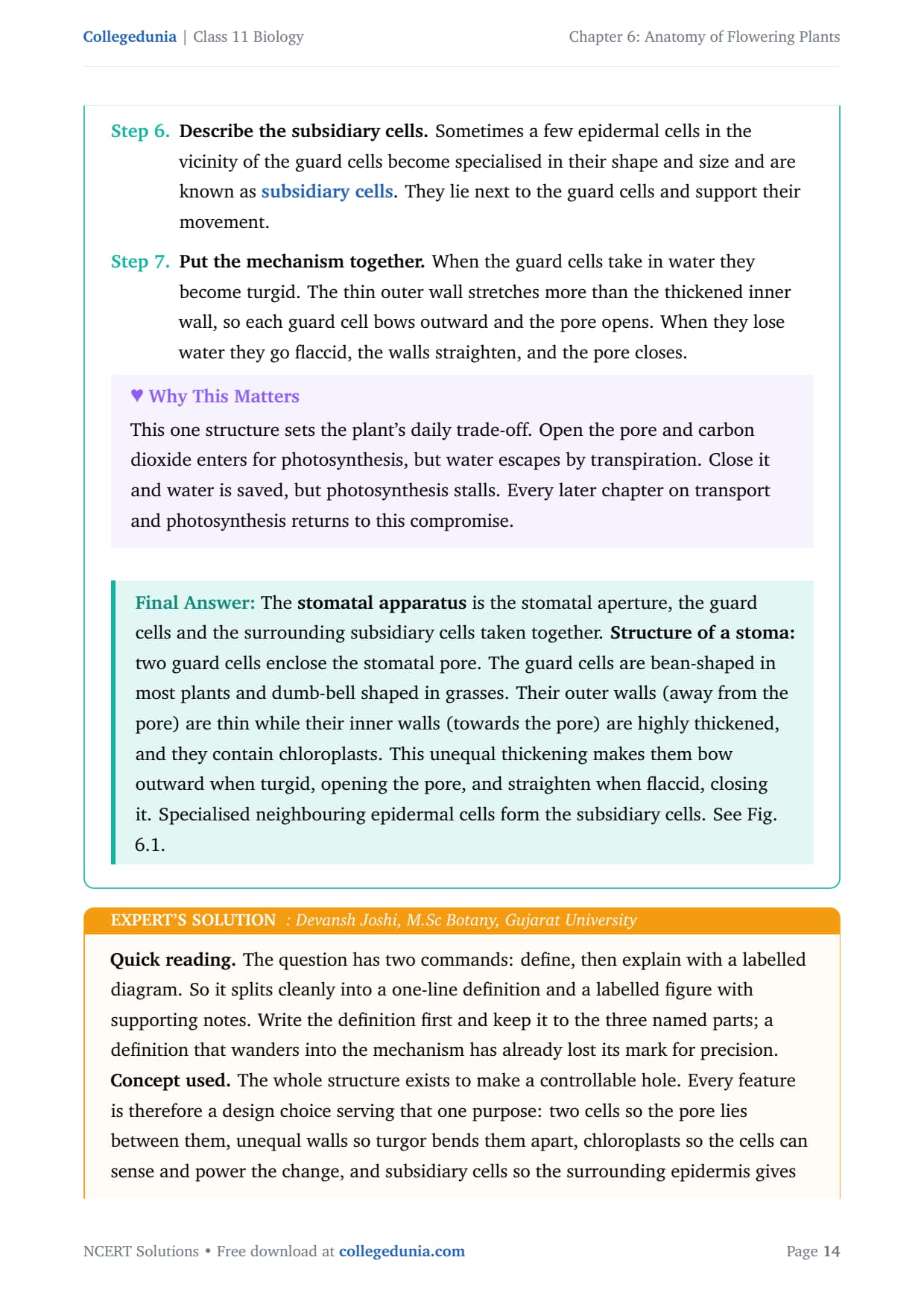
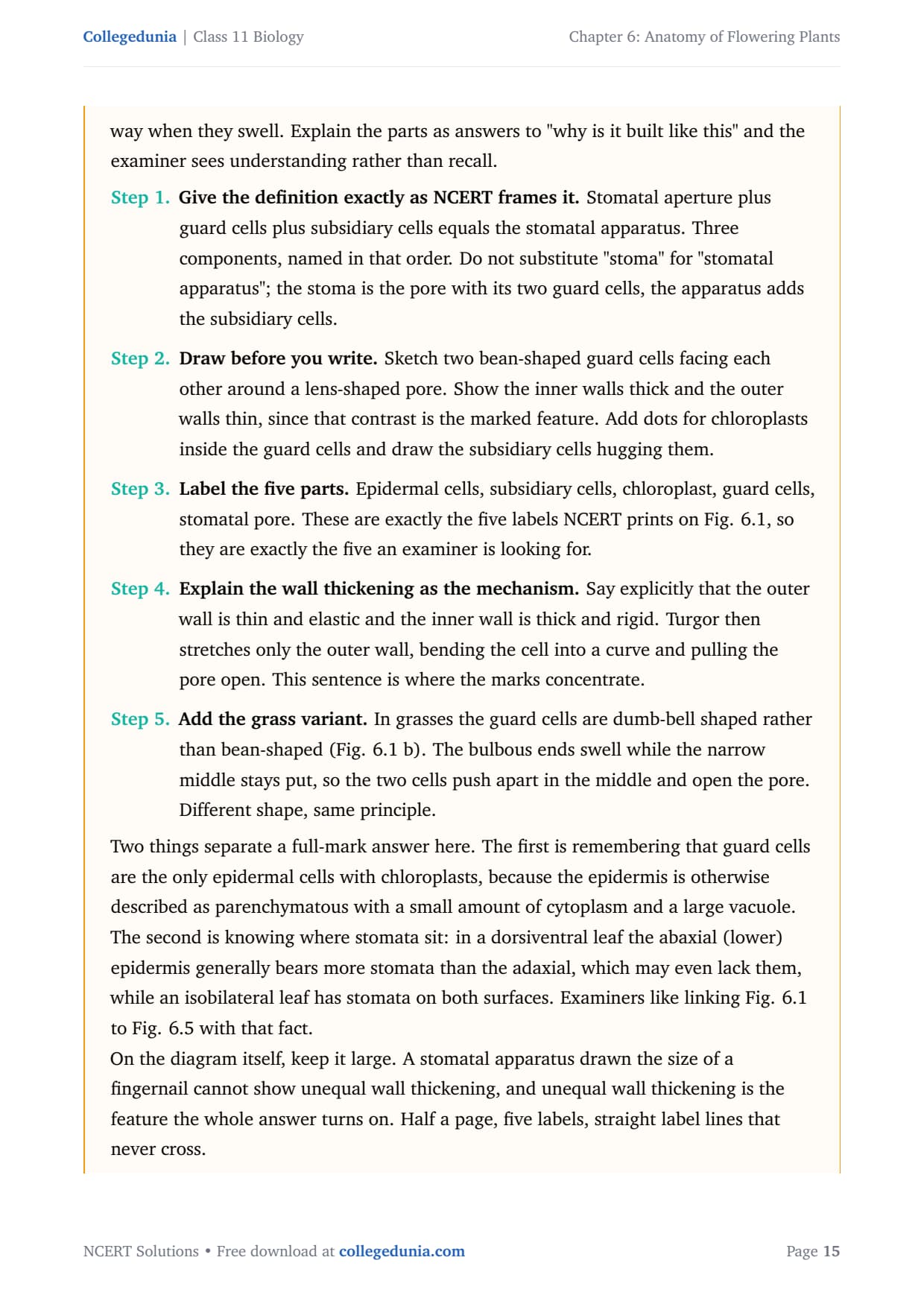
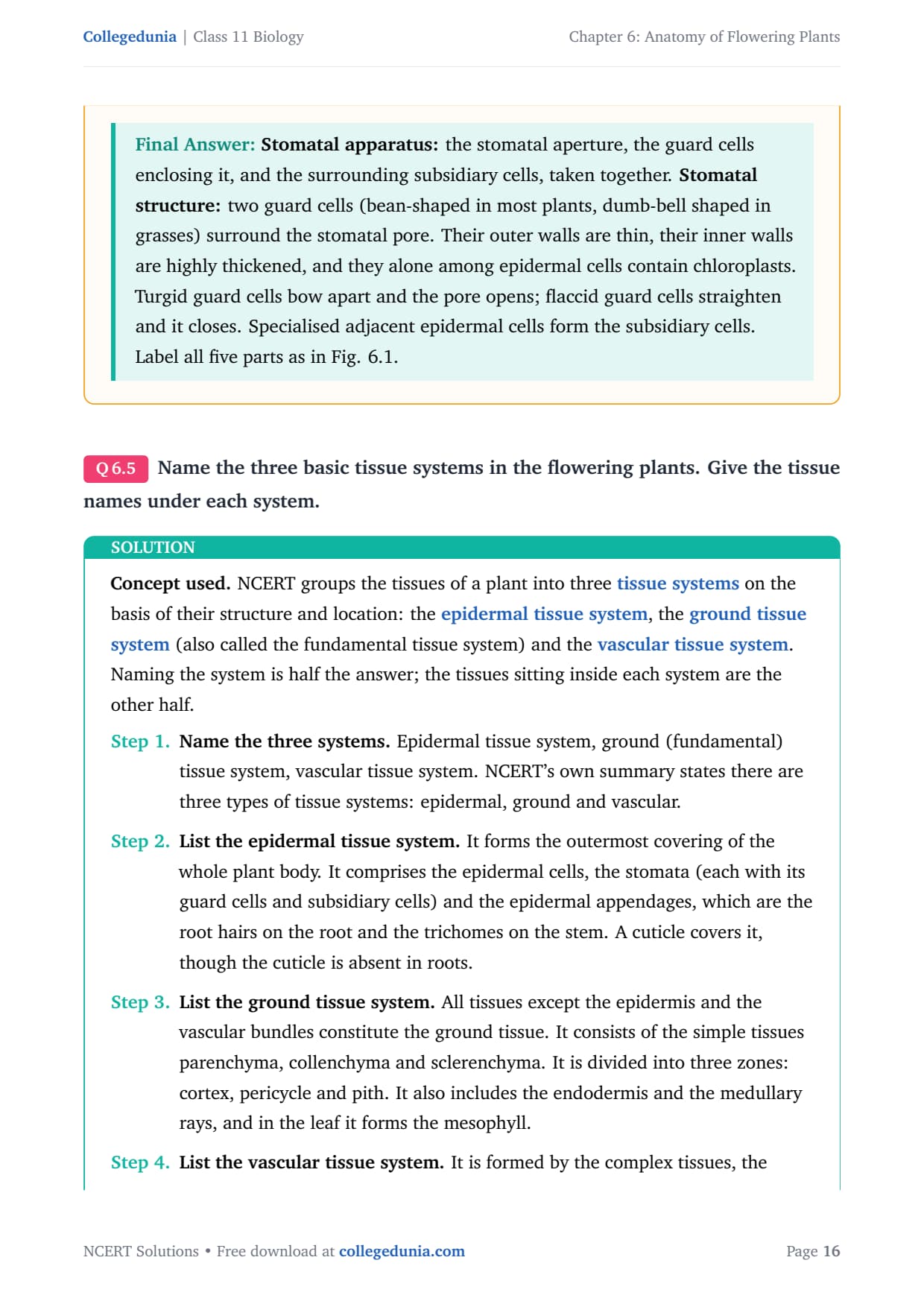
This chapter cuts the plant open and reads its tissues, so the anatomy vocabulary you fix here is exactly what NEET tests in every section-identification question.
- CBSE Weightage: 3 to 4 marks, part of the Structural Organisation in Plants and Animals unit alongside Morphology and the animal chapter.
- Topics covered: meristematic and permanent tissues, the three tissue systems, the stomatal apparatus, monocot versus dicot root and stem, dorsiventral leaf structure, and the uses of plant anatomy.
- Exercise count: 7 back-exercise questions, a mix of labelled-diagram, description and section-identification tasks.
These class 11 biology NCERT solutions chapter 6 Anatomy of Flowering Plants are curated by subject experts, based on the 2026-27 NCERT textbook, and checked against the last five years of CBSE Board and NEET papers.
Why Anatomy of Flowering Plants Matters and What the Chapter Covers
Where the previous chapter looked at a plant from the outside, this one cuts a section and reads what is inside. Plant anatomy is the study of internal structure, and NCERT opens the chapter with the reason it exists: the outward appearance of plants can mislead, because two plants can look alike outside yet differ inside, and plants that look different can share the same internal plan. Learning to read a transverse section is therefore a skill the whole classification and physiology course leans on.
- Core skill: identifying a plant part as root, stem or leaf, and as monocot or dicot, from the type, number and position of its vascular bundles.
- Building blocks: two tissue classes (meristematic and permanent) organised into three tissue systems (epidermal, ground and vascular).
- Why it recurs: the words radial, conjoint, open and closed introduced here return in transport, photosynthesis and every anatomy-based NEET item.
Almost every section-identification question in the exam traces back to one idea in this chapter: dicots keep a vascular cambium and monocots do not. Everything else, from the ring arrangement of dicot-stem bundles to the sclerenchymatous sheath of monocot-stem bundles, follows from that single fact. The class 11 biology NCERT solutions chapter 6 Anatomy of Flowering Plants below follow the same order as the NCERT textbook so students can check their working line by line.
Plant Tissues: Meristematic and Permanent
Before the chapter compares roots and stems, it sorts every plant cell into one of two classes by whether it can still divide. This tissue classification is the base that the three tissue systems and every section drawing are built on, so it is worth fixing first.
| Tissue class | What it is |
|---|---|
| Meristematic (apical) | Dividing cells at root and shoot tips that add length (primary growth). |
| Meristematic (lateral) | Cambium and cork cambium along the sides that add girth (secondary growth). |
| Meristematic (intercalary) | Dividing cells at the base of internodes or leaves, as in grasses. |
| Simple permanent | Parenchyma, collenchyma and sclerenchyma; one cell type each. |
| Complex permanent | Xylem and phloem; several cell types working as one conducting tissue. |
Permanent tissues are formed when meristematic cells lose the power to divide and take on a fixed shape and job. Parenchyma stores and assimilates, collenchyma gives flexible support, and sclerenchyma gives rigid mechanical strength, while xylem conducts water and minerals and phloem conducts food. Getting these labels right early means the later questions on tissue systems and vascular bundles become naming exercises rather than fresh learning. Students should be able to place any named tissue into simple or complex, and meristematic or permanent, without hesitation.
The Three Basic Tissue Systems in Flowering Plants
Exercise Q5 asks students to name the three tissue systems and list the tissues under each. NCERT groups all the tissues of a plant into three tissue systems by their structure and location, and the trick to a full-mark answer is to give the tissues inside each system, not just the three names. Refer to Exercise Q5 for the complete worked answer.
| Tissue system | Tissues under it |
|---|---|
| Epidermal | Epidermal cells, stomata (guard cells and subsidiary cells) and epidermal appendages (root hairs, trichomes), with a cuticle that is absent in roots. |
| Ground (fundamental) | The simple tissues parenchyma, collenchyma and sclerenchyma, arranged as cortex, pericycle and pith, plus endodermis, medullary rays and the mesophyll of leaves. |
| Vascular | The complex tissues xylem (tracheids, vessels, xylem fibres, xylem parenchyma) and phloem (sieve tube elements, companion cells, phloem parenchyma, phloem fibres). |
A clean way to remember the split is outside, middle, plumbing: the epidermis is the skin, the ground tissue is everything in between, and the vascular tissue is the pipework running through it. Any tissue you can name belongs to exactly one of these three systems. The classification is by position and role, not by cell type, which is why parenchyma can appear in several places while the ground tissue system stays well defined as everything that is not epidermis and not a vascular bundle. Naming the system is half the answer and the tissues inside it are the other half, and students who list tissues for only two of the three systems lose the easiest marks in this exercise.
The Stomatal Apparatus and the Structure of Stomata
Exercise Q4 asks students to define the stomatal apparatus and explain the structure of stomata with a labelled diagram. Stomata are pores in the leaf epidermis that regulate transpiration and gaseous exchange, and NCERT defines the stomatal apparatus in one sentence: the stomatal aperture, the guard cells and the surrounding subsidiary cells taken together. The apparatus is the whole working unit, not just the hole.
- Guard cells: two cells that enclose the stomatal pore, bean-shaped in most plants and dumb-bell shaped in grasses, and the only epidermal cells that carry chloroplasts.
- Unequal wall thickening: the outer wall away from the pore is thin while the inner wall towards the pore is highly thickened, which is the feature that makes the pore open and close.
- Subsidiary cells: specialised epidermal cells around the guard cells that give way and support their movement.
The mechanism follows from the wall thickening. When the guard cells take in water and become turgid, the thin outer wall stretches more than the thick inner wall, so each cell bows outward and the pore opens; when they lose water and go flaccid, the walls straighten and the pore closes. This one structure sets the plant's daily trade-off, because an open pore lets carbon dioxide in for photosynthesis but lets water escape by transpiration. Students should draw the section large with five labels (epidermal cells, subsidiary cells, chloroplast, guard cells, stomatal pore), since a fingernail-sized sketch cannot show the unequal wall thickening the whole answer turns on.
Monocot versus Dicot Root and Stem Anatomy
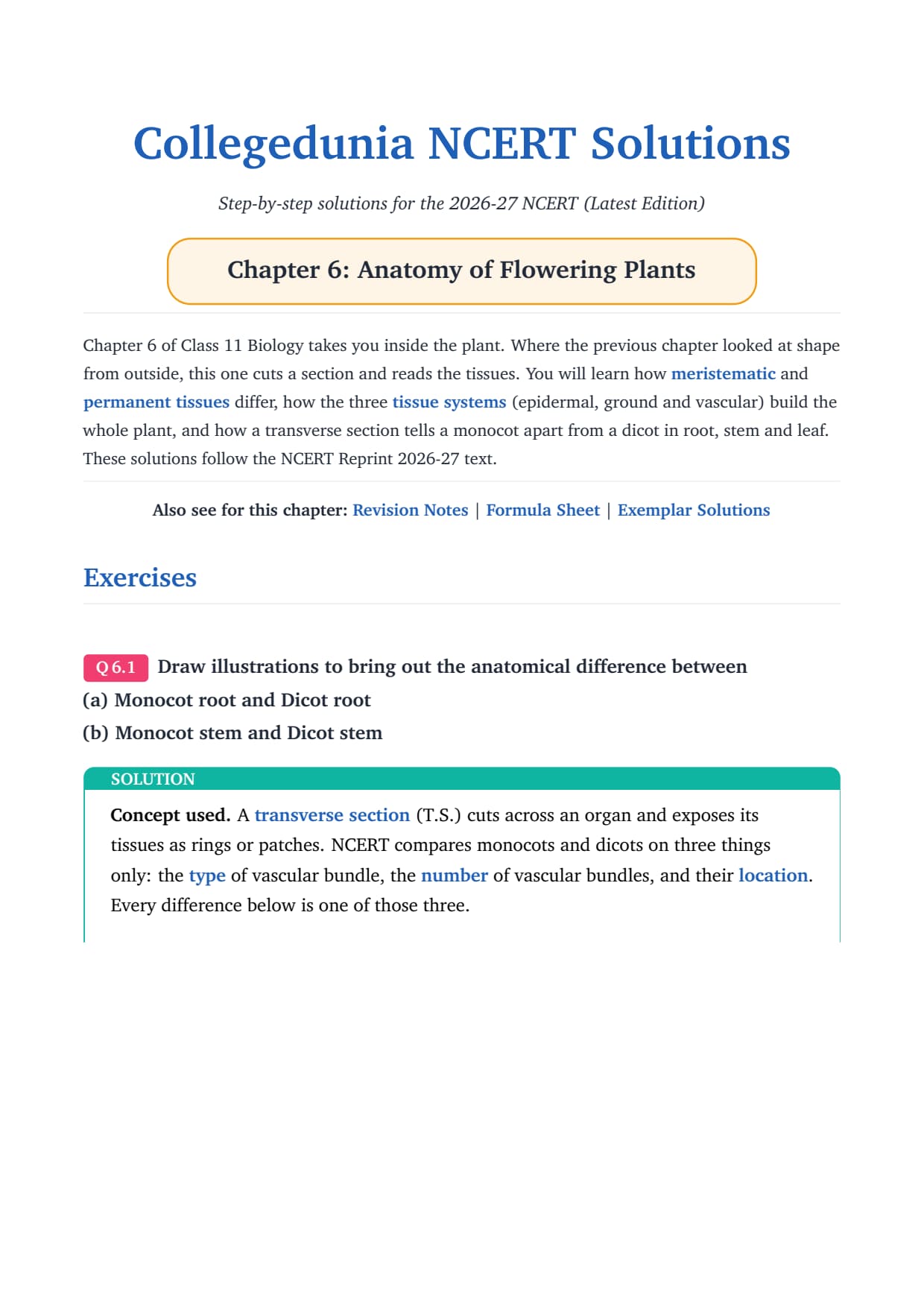
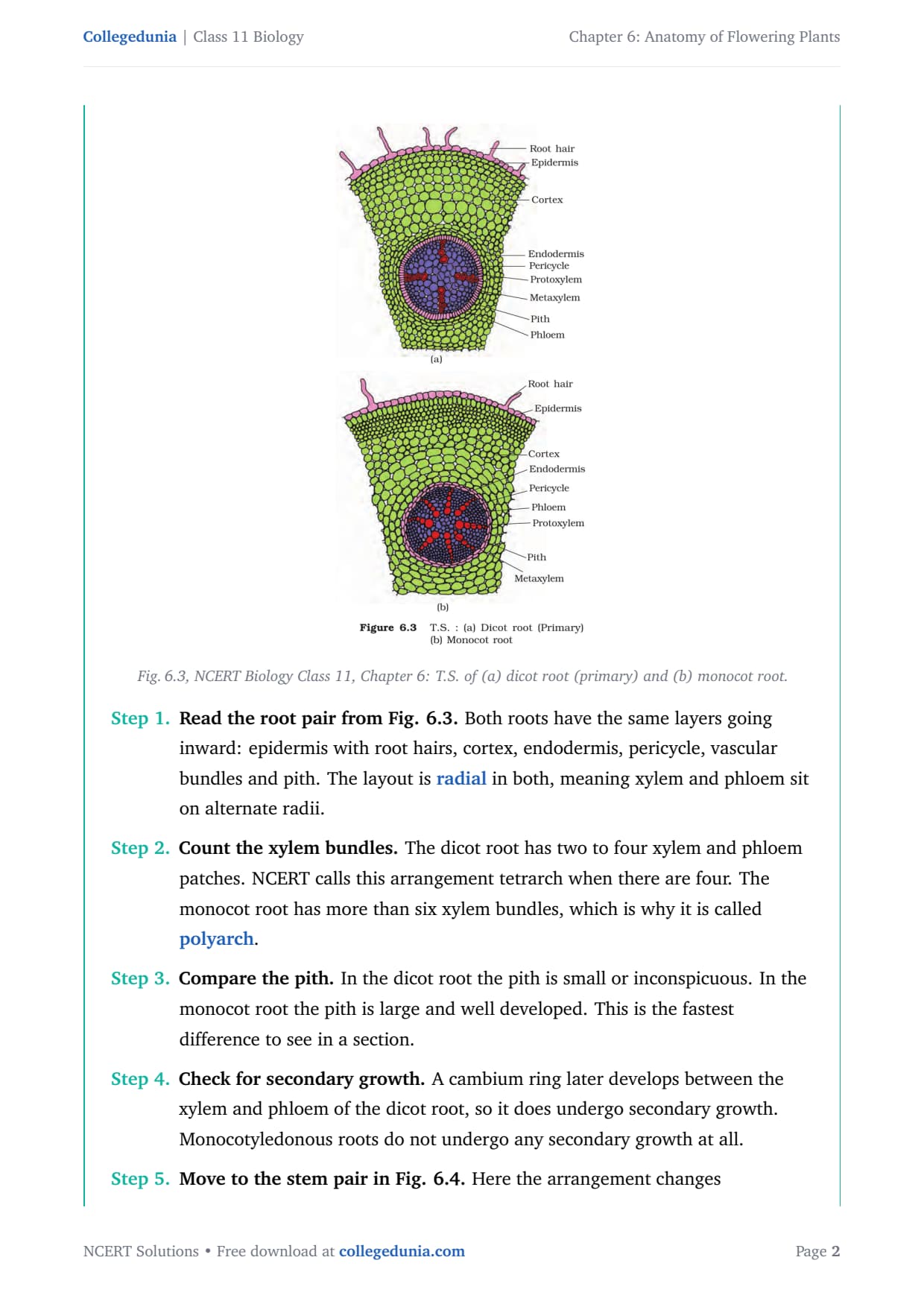
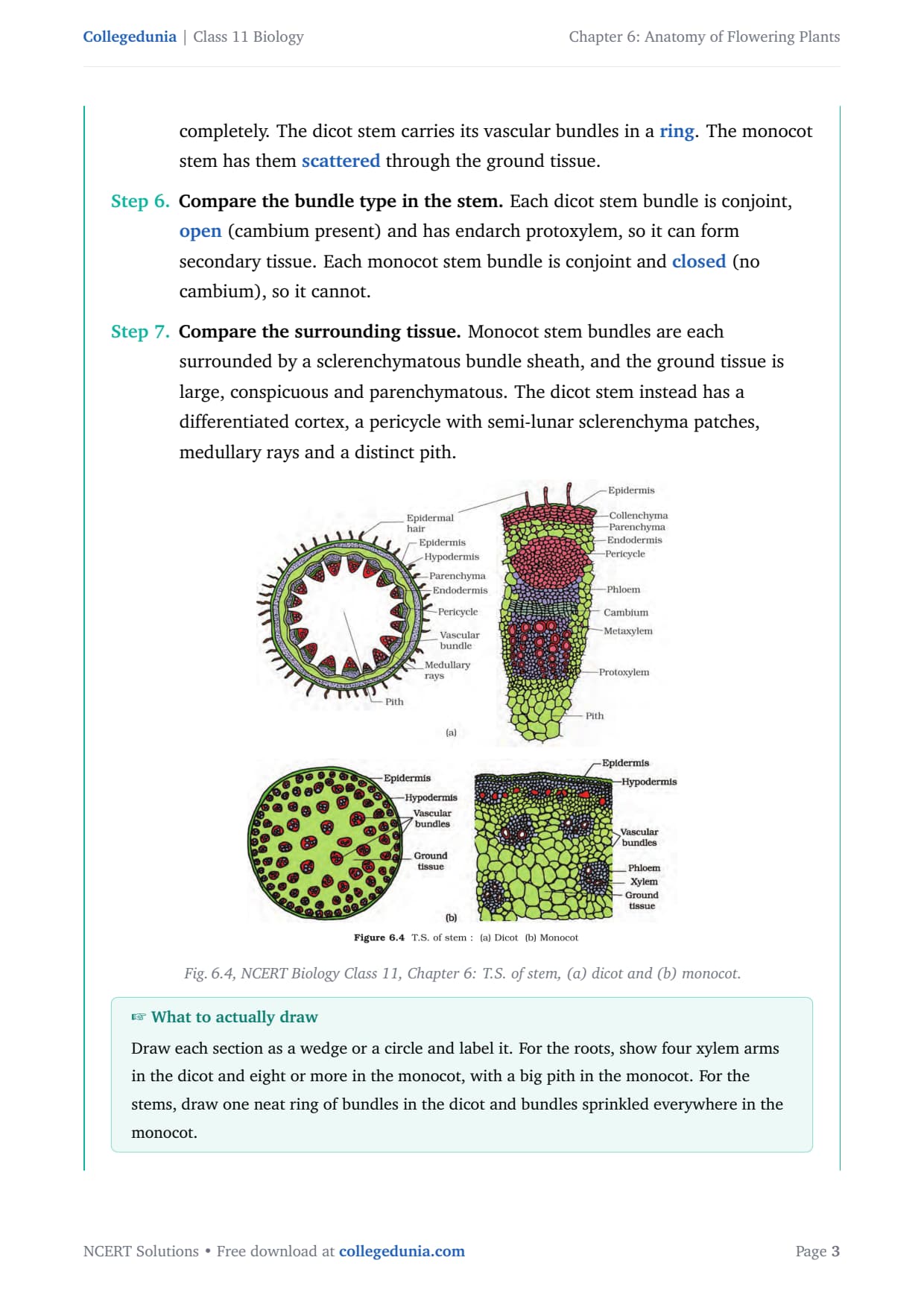
Exercise Q1 asks students to draw illustrations that bring out the anatomical difference between a monocot and dicot root, and between a monocot and dicot stem. This is a drawing question, so the diagram is the answer and the prose only labels it. NCERT compares the two groups on just three things: the type, number and location of the vascular bundles, and every difference below is one of those three. See Exercise Q1 for the labelled diagrams.
| Feature | Dicot | Monocot |
|---|---|---|
| Root xylem | 2 to 4 bundles, usually tetrarch | More than six bundles, polyarch |
| Root pith | Small or inconspicuous | Large and well developed |
| Root secondary growth | Present (cambium ring forms later) | Absent |
| Stem bundle type | Conjoint and open (cambium present) | Conjoint and closed (no cambium) |
| Stem bundle arrangement | In a ring around the pith | Scattered in the ground tissue |
| Stem bundle sheath | Absent | Sclerenchymatous sheath present |
Both roots are radial, with xylem and phloem on alternate radii, and both stems are conjoint, with phloem outside the xylem. A quick way to keep roots and stems straight is protoxylem position: roots are exarch (protoxylem towards the periphery) and stems are endarch (protoxylem towards the centre), regardless of monocot or dicot. Students should draw four sections, not two, keep them the same size so differences read as differences and not scale, and label the mark-earning parts: epidermis, cortex, endodermis, pericycle, protoxylem, metaxylem, phloem and pith on the roots, and hypodermis, vascular bundle, ground tissue, medullary ray and pith on the stems.
How to Ascertain a Monocot Stem from a Dicot Stem
Exercise Q2 asks how students would ascertain whether a young stem cut from the school garden is a monocot or a dicot stem, with reasons. A young stem has not yet begun secondary growth, so what you see is its primary structure, and the key is to rank the tests by how quickly they decide rather than list eight differences in random order. The phrase "how would you ascertain" is asking for the order a real observer follows.
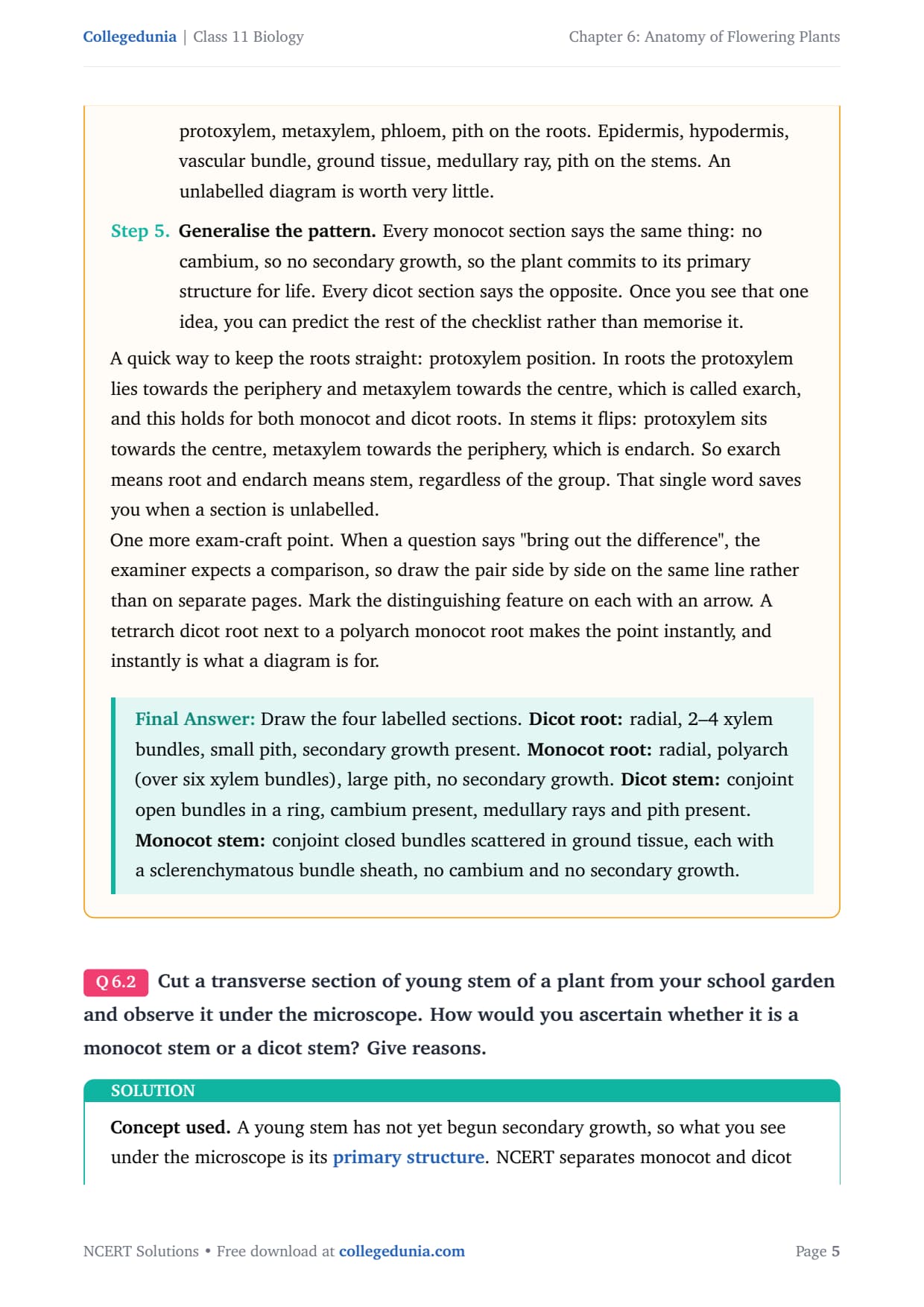
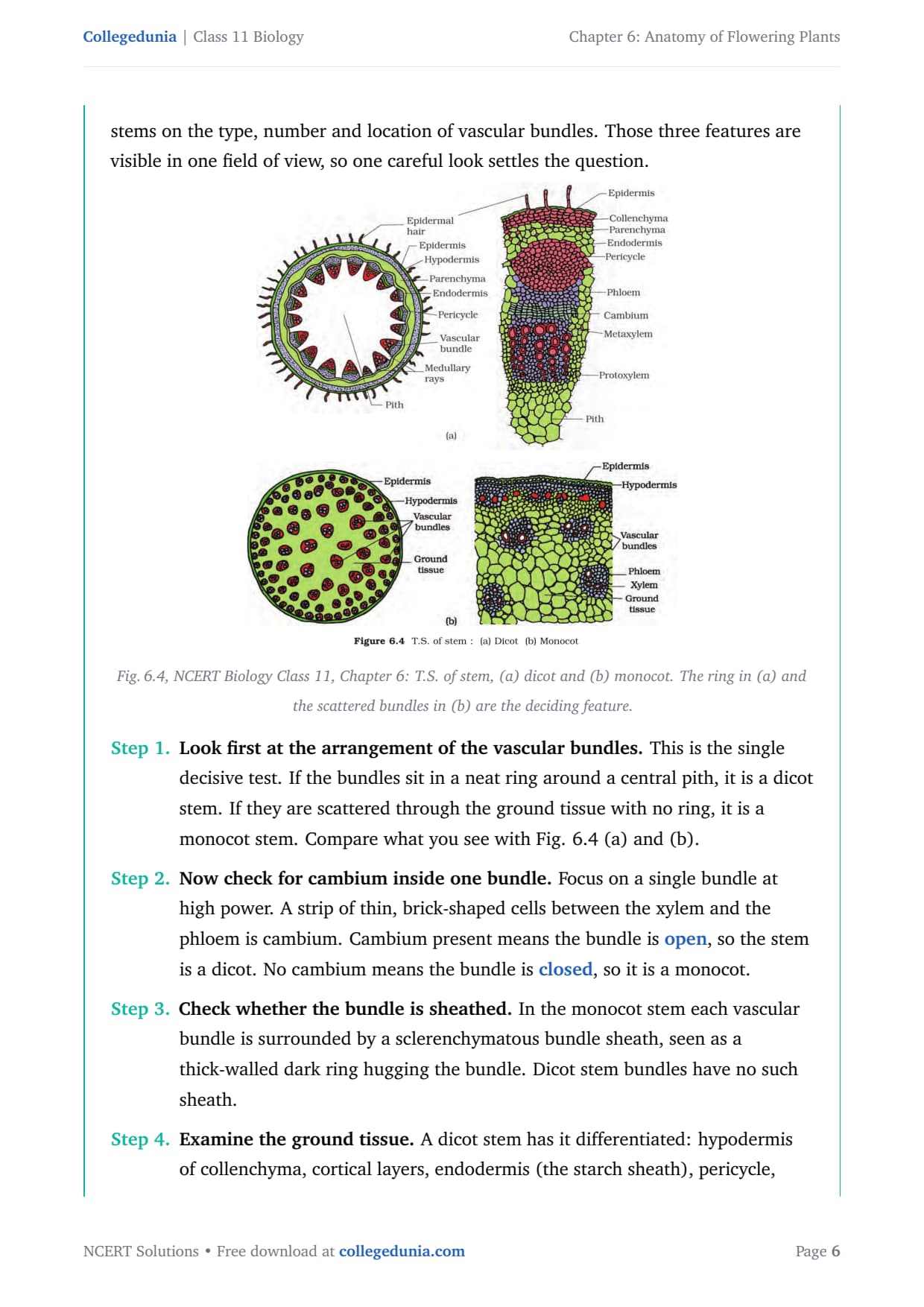
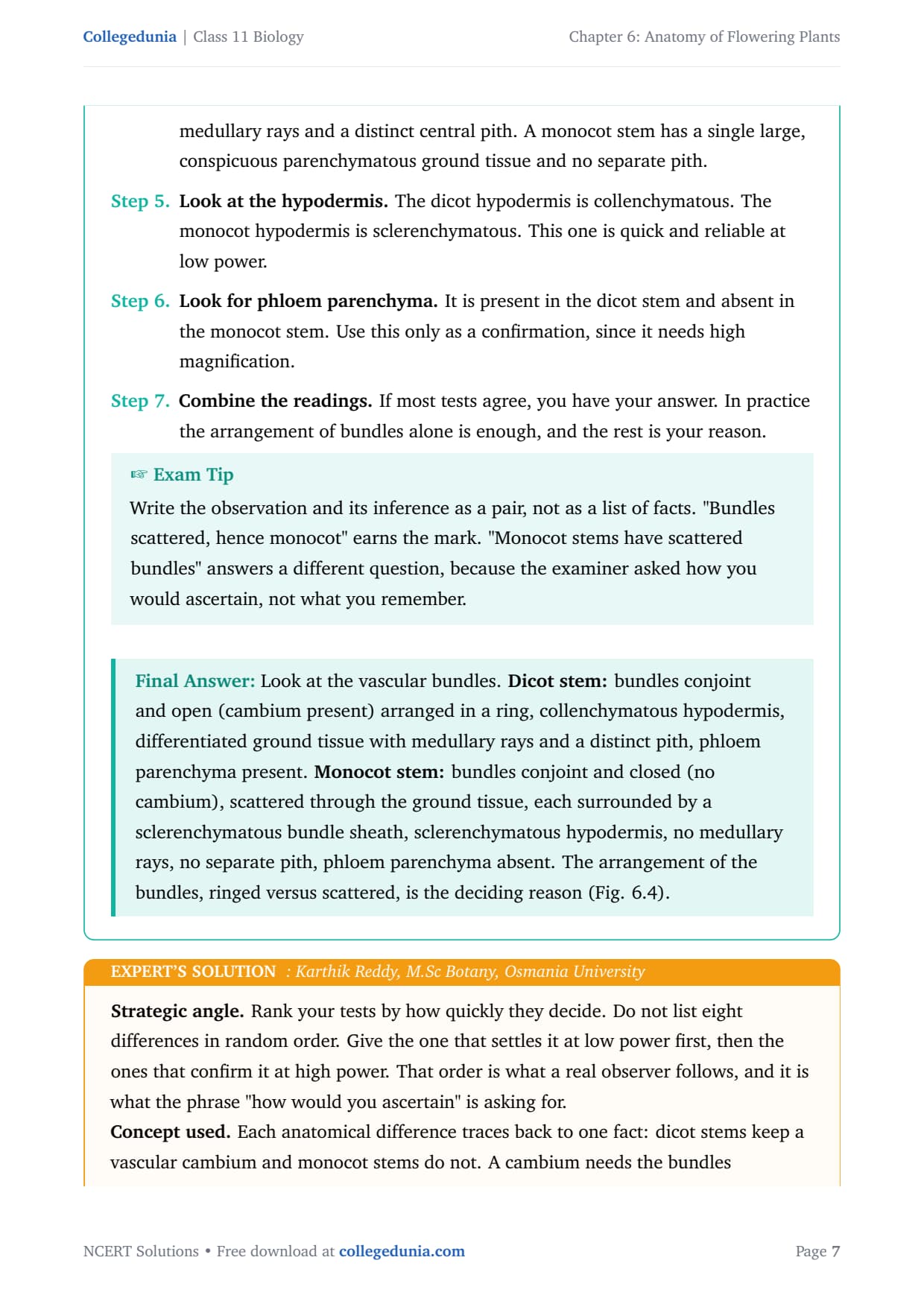
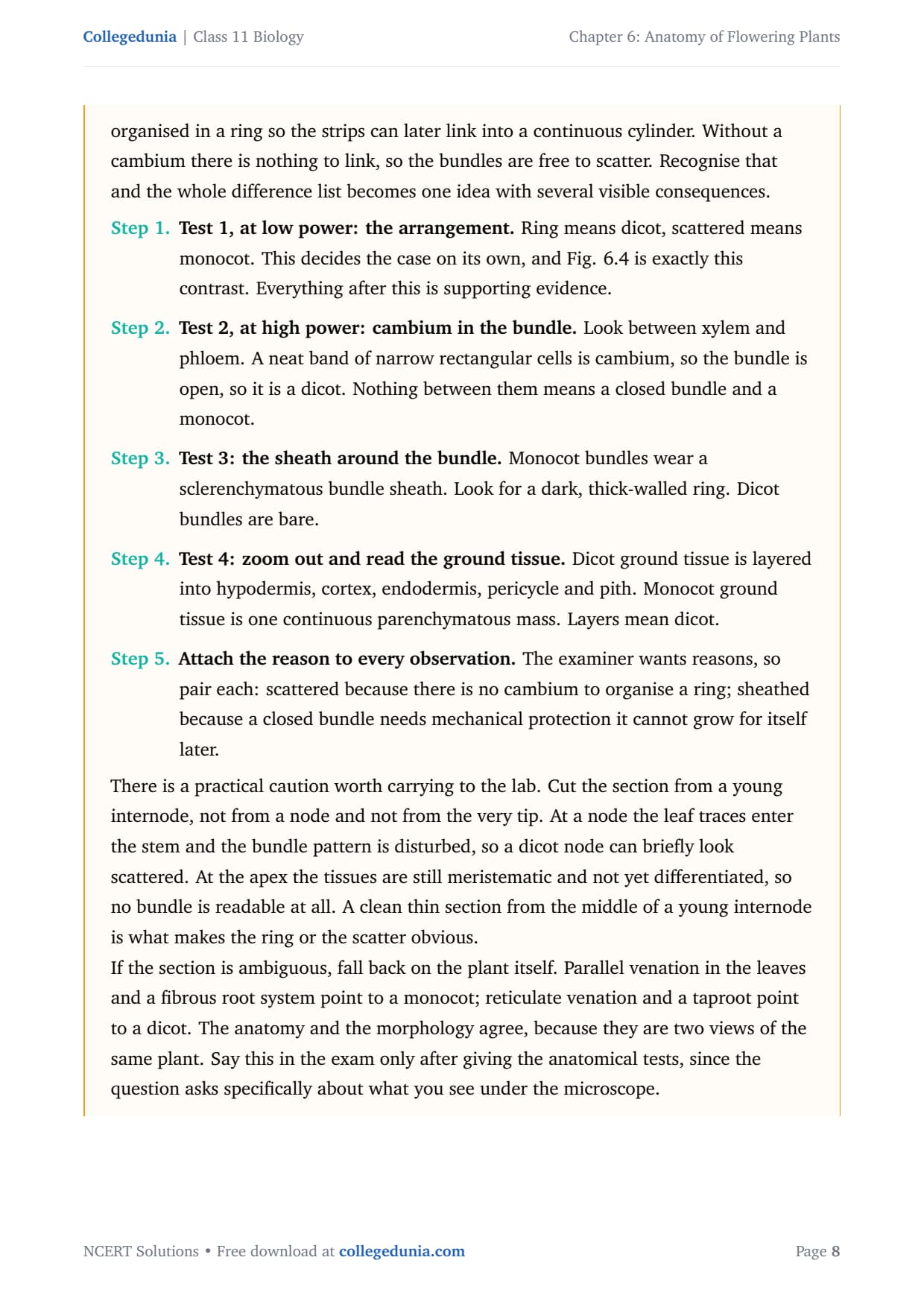
- Test 1, at low power: the arrangement of bundles. A neat ring around a central pith means dicot; bundles scattered through the ground tissue mean monocot. This single test settles the case.
- Test 2, at high power: cambium inside one bundle. A strip of thin brick-shaped cells between xylem and phloem means an open bundle and a dicot; no cambium means a closed bundle and a monocot.
- Test 3: the sheath. Monocot bundles wear a sclerenchymatous bundle sheath seen as a dark thick-walled ring; dicot bundles are bare.
The reason behind every difference is that only dicot stems keep a vascular cambium, and a cambium needs the bundles organised in a ring so the strips can later link into a continuous cylinder. Write each observation and its inference as a pair, because "bundles scattered, hence monocot" earns the mark while "monocot stems have scattered bundles" answers a different question. A practical caution carries to the lab too: cut the section from the middle of a young internode, not from a node where leaf traces disturb the pattern, nor from the tip where the tissues are still meristematic and unreadable.
Identifying a Section from Its Anatomical Clues
Exercise Q3 gives four internal characters and no picture, and asks what the material is: the vascular bundles are conjoint, scattered and surrounded by a sclerenchymatous bundle sheath, and the phloem parenchyma is absent. This is an elimination question dressed as a description, and the method is to treat the five candidates (dicot root, monocot root, dicot stem, monocot stem, leaf) as a list and strike them off one clue at a time.
| Clue | What it eliminates |
|---|---|
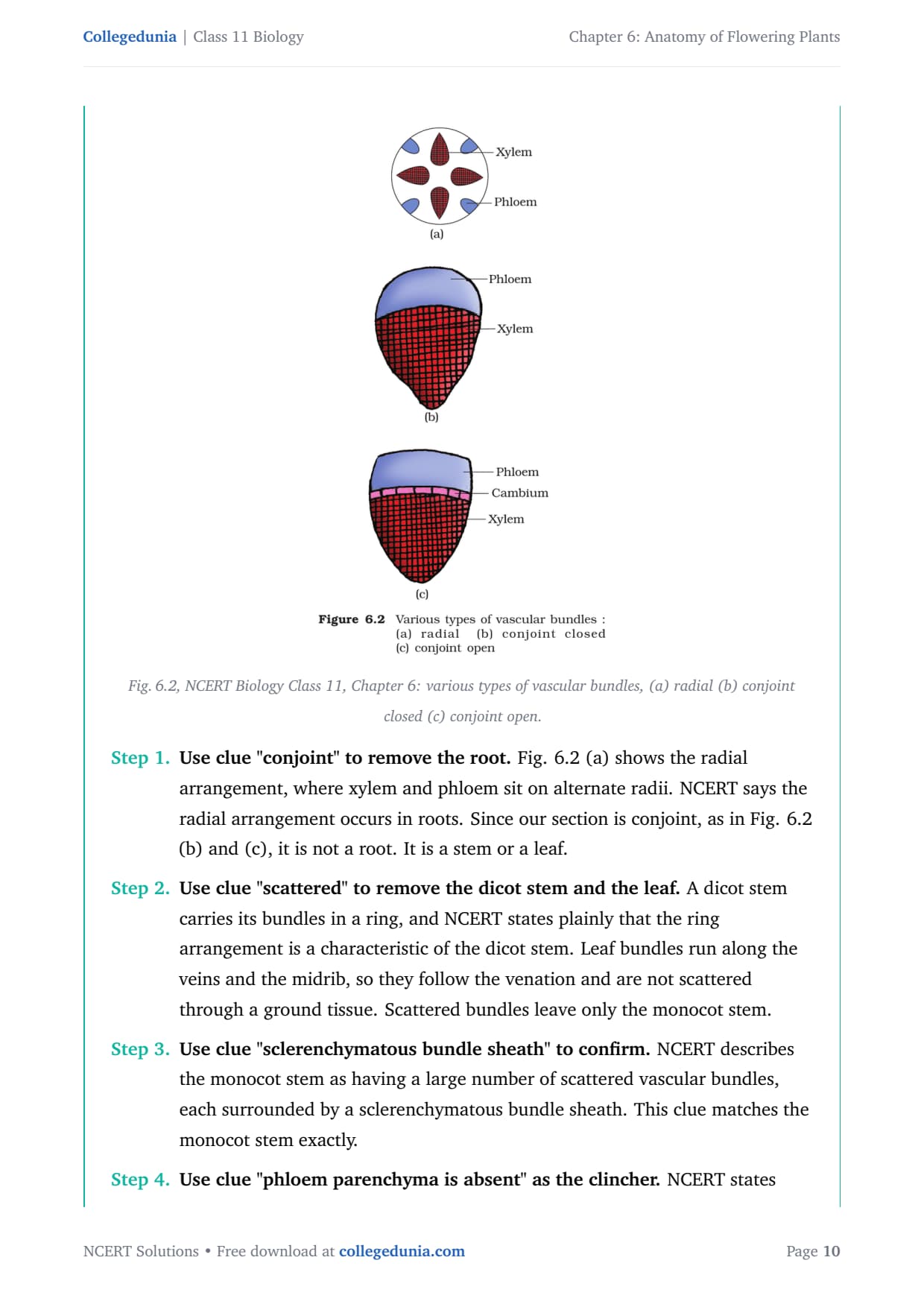
| Conjoint | Both roots die, because roots are radial (xylem and phloem on alternate radii). |
| Scattered | The dicot stem dies (its bundles form a ring), and the leaf dies (its bundles follow the veins). |
| Sclerenchymatous bundle sheath | Confirms the monocot stem, whose scattered bundles are each sheathed. |
| Phloem parenchyma absent | Clincher: NCERT lists this specifically for the monocot stem. |
All four clues point the same way, so the material is a monocotyledonous (monocot) stem. Any "identify this section" question can be cracked with two questions in order: radial or conjoint (root or shoot?), then ring or scattered (dicot or monocot?). A common slip is to see "scattered", write "monocot" and stop, but the question asks what the material is, so the answer needs the organ too: monocot stem, not just monocot. The sclerenchymatous sheath is no arbitrary label either, it is the structural consequence of having no cambium, since a monocot stem must build all its mechanical strength during primary growth.
Internal Structure of a Dorsiventral Leaf
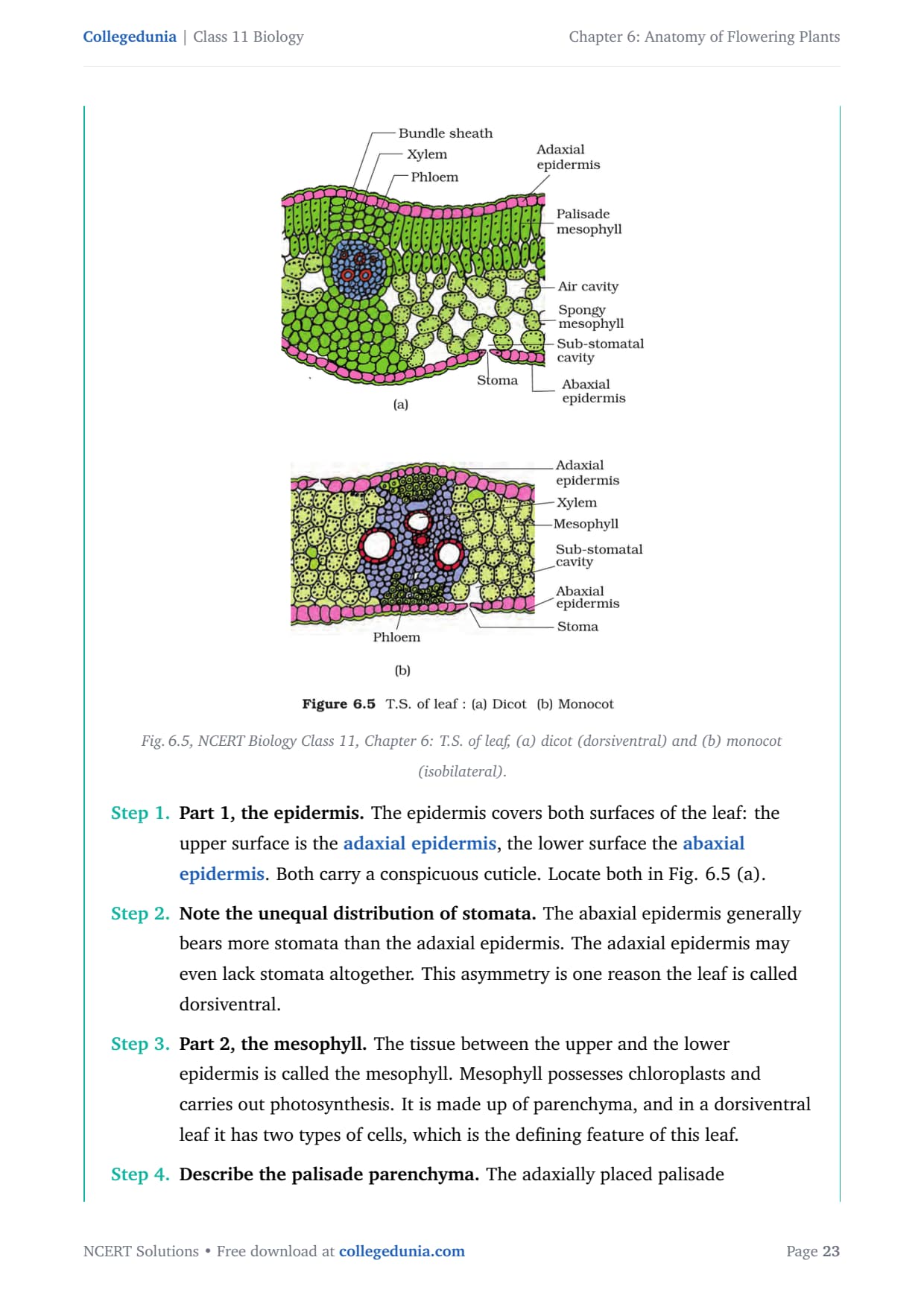
Exercise Q7 asks students to describe the internal structure of a dorsiventral leaf with labelled diagrams. A dorsiventral leaf is the dicot leaf, so called because its two surfaces are not alike, and NCERT gives the plan in one line: a vertical section through the lamina shows three parts, the epidermis, the mesophyll and the vascular system. Describe those three in order and the answer is complete. See Exercise Q7 for the labelled section.
- Epidermis: an adaxial (upper) and an abaxial (lower) layer, both with a conspicuous cuticle; the abaxial surface bears more stomata, and the adaxial may lack them entirely.
- Mesophyll: chloroplast-bearing parenchyma between the two epidermal layers, split into an adaxial palisade parenchyma of elongated cells packed vertically and a spongy parenchyma of loose oval cells with large air cavities.
- Vascular system: conjoint closed bundles in the veins and midrib, xylem towards the adaxial side and phloem towards the abaxial side, each wrapped in a thick-walled bundle sheath.
The differentiation of the mesophyll into palisade and spongy parenchyma is the defining feature of a dorsiventral leaf, because light arrives from one side only: the photosynthetic machinery packs against the lit upper surface while gas exchange moves to the shaded lower surface. A frequent slip is on xylem position, but in the leaf bundle the xylem lies towards the upper side because the leaf is a lateral outgrowth of the stem, so it keeps the same inner position as the stem's endarch bundle. Contrast it in one line with the isobilateral (monocot) leaf, which has stomata on both surfaces and an undifferentiated mesophyll, to prove you know what dorsiventral excludes.
How the Study of Plant Anatomy Is Useful
Exercise Q6 asks how the study of plant anatomy is useful to us. This is an open question scored on range, not depth, so the trick is to give distinct kinds of use rather than four versions of one idea. Sort the uses into two families, academic and applied, and the range comes automatically. The value of anatomy is exactly that internal structure carries information the outside of a plant cannot give.
- Identification and classification: whether bundles are radial or conjoint, open or closed, ringed or scattered tells you at once whether a specimen is a root or a shoot, and a monocot or a dicot.
- Structure explains function: once you see xylem as a hollow pipe of dead thick-walled cells and phloem as a living tube with sieve plates, the direction of transport stops being a fact to memorise.
- Applied work: anatomy guides plant breeding, forestry and timber grading, identifies fibres such as jute and plant drugs, and detects adulteration.
Anatomy also reveals adaptations to habitat, and NCERT gives the bulliform-cell example directly: in grasses these cells go flaccid under water stress and roll the leaf inward, cutting water loss. Anchor each use to a real anatomical feature rather than writing "helps in adaptation", because one named example turns a vague claim into a creditable one. There is a neat way to see the value of anatomy in this chapter itself: Exercise Q3 hands you four internal characters and no picture of the plant, yet the plant part is identifiable beyond doubt. That single exercise, where nothing about the plant's outward appearance is needed, is the argument for the whole subject.
Anatomy of Flowering Plants Exercise-wise Breakdown
The NCERT back exercise has 7 questions, a mix of labelled-diagram, description and section-identification tasks. The table below maps the questions to their topics so students can plan practice and revise by theme.
| Question | What it tests |
|---|---|
| Q1 | Labelled diagrams of the anatomical difference between monocot and dicot root and stem. |
| Q2 | How to ascertain, under the microscope, whether a young stem is monocot or dicot, with reasons. |
| Q3 | Identifying a section from four anatomical clues (answer: monocot stem). |
| Q4 | Defining the stomatal apparatus and explaining stomatal structure with a labelled diagram. |
| Q5 | Naming the three tissue systems and the tissues under each. |
| Q6 to Q7 | The uses of plant anatomy, and the internal structure of a dorsiventral leaf. |
Most questions here reward a labelled diagram over prose, so the marks sit in clean sections with correct labels and paired observation-and-reason statements. Draw four sections for the comparison question, label five parts on the stoma and eight on the leaf, and always add the organ name when you identify a section. Every question in the class 11 biology NCERT solutions chapter 6 Anatomy of Flowering Plants PDF is solved with each step of reasoning shown, so students can compare their answers and diagrams against the model working.
Practice the solved questions: Work through the full question bank with step-by-step answers, labelled figures and expert tips.
Anatomy of Flowering Plants Class 11 Solved Practice Questions
Common Mistakes Students Make in Anatomy of Flowering Plants
Most marks in this chapter are lost on small slips of vocabulary and diagram detail, not on hard ideas. Each mistake below costs 1 to 2 marks, so watch for it at the exact step.
Mistake 1: Answering "monocot" instead of "monocot stem" in the identification question. The question asks what the material is, so the answer needs the organ, since a monocot root is radial and polyarch, a completely different picture.
Mistake 2: Confusing radial with conjoint. Radial (xylem and phloem on alternate radii) occurs in roots; conjoint (both on the same radius) occurs in stems and leaves. Mixing these up wrecks every section answer.
Mistake 3: Drawing the leaf-bundle xylem towards the lower side. In the leaf the xylem lies towards the upper (adaxial) side and the phloem towards the lower (abaxial) side.
Mistake 4: Naming all three tissue systems but listing tissues for only two of them, or calling mesophyll or cortex a separate system. Mesophyll is the ground tissue inside a leaf and cortex is a zone of the ground tissue, not systems.
Student Feedback on Anatomy of Flowering Plants Solutions
What 12,940 students told us about their Anatomy of Flowering Plants preparation:
- 64% of students said drawing and labelling the four monocot and dicot sections was the part they practised most before the exam.
- Most-skipped detail: the exarch root versus endarch stem rule, missed by about 4 in 10 students until it was pointed out.
- Students who learned the "ring versus scattered, then cambium present versus absent" test said section-identification questions became automatic.
Source: 2026-27 Class 11 Biology student poll. Sample of 12,940 students from CBSE schools across 16 states, conducted before the 2026 boards.
Other Anatomy of Flowering Plants Class 11 Biology Resources
Pair these solutions with the revision notes, formula sheet, exemplar solutions and NCERT textbook PDF for the same chapter.
| Resource | Link |
|---|---|
| NCERT Notes | Anatomy of Flowering Plants Class 11 Notes |
| Formula Sheet | Anatomy of Flowering Plants Class 11 Formula Sheet |
| Exemplar Solutions | Anatomy of Flowering Plants Class 11 Exemplar Solutions |
| NCERT Book PDF | Anatomy of Flowering Plants Class 11 Book PDF |
NCERT Solutions for Class 11 Biology: All Chapters
Jump to the step-by-step solutions for any other Class 11 Biology chapter below.
| Chapter | NCERT Solutions |
|---|---|
| Chapter 1 | The Living World |
| Chapter 2 | Biological Classification |
| Chapter 3 | Plant Kingdom |
| Chapter 4 | Animal Kingdom |
| Chapter 5 | Morphology of Flowering Plants |
| Chapter 6 | Anatomy of Flowering Plants |
| Chapter 7 | Structural Organisation in Animals |
| Chapter 8 | Cell: The Unit of Life |
| Chapter 9 | Biomolecules |
| Chapter 10 | Cell Cycle and Cell Division |
| Chapter 11 | Photosynthesis in Higher Plants |
| Chapter 12 | Respiration in Plants |
| Chapter 13 | Plant Growth and Development |
| Chapter 14 | Breathing and Exchange of Gases |
| Chapter 15 | Body Fluids and Circulation |
| Chapter 16 | Excretory Products and their Elimination |
| Chapter 17 | Locomotion and Movement |
| Chapter 18 | Neural Control and Coordination |
| Chapter 19 | Chemical Coordination and Integration |
FAQs on Anatomy of Flowering Plants Class 11 NCERT Solutions
Anatomy of Flowering Plants NCERT Solutions - Frequently Asked Questions
Ques. What do the class 11 biology NCERT solutions chapter 6 Anatomy of Flowering Plants cover?
Ans. These solutions cover all 7 back-exercise questions, including labelled diagrams of the monocot and dicot root and stem, how to ascertain a monocot stem from a dicot stem, identifying a section from anatomical clues, the stomatal apparatus and structure of stomata, the three tissue systems, the uses of plant anatomy, and the internal structure of a dorsiventral leaf. Every question is solved step by step with figures.
Ques. What are the three tissue systems in flowering plants?
Ans. The three tissue systems are the epidermal system (epidermal cells, stomata and appendages), the ground or fundamental system (parenchyma, collenchyma and sclerenchyma arranged as cortex, pericycle and pith) and the vascular system (the complex tissues xylem and phloem). Remember them as outside, middle and plumbing, since every tissue belongs to exactly one of the three.
Ques. How do you tell a monocot stem from a dicot stem?
Ans. Look at the vascular bundles first. In a dicot stem they lie in a ring around a central pith and each bundle is open, with a cambium between the xylem and phloem. In a monocot stem the bundles are scattered through the ground tissue, each is closed with no cambium, and each is wrapped in a sclerenchymatous bundle sheath. The reason is that only dicot stems keep a vascular cambium.
Ques. What is the stomatal apparatus?
Ans. The stomatal apparatus is the whole working unit of a stoma: the stomatal aperture (the pore), the two guard cells that enclose it, and the specialised subsidiary cells around them. The guard cells are bean-shaped in most plants and dumb-bell shaped in grasses, have thin outer walls and thick inner walls, and carry chloroplasts, so they bow apart to open the pore when turgid.
Ques. What is a dorsiventral leaf and how is it structured?
Ans. A dorsiventral leaf is the dicot leaf, whose two surfaces differ. A vertical section shows three parts: the epidermis (adaxial and abaxial, both cuticularised, with more stomata below), the mesophyll (differentiated into adaxial palisade parenchyma and spongy parenchyma), and the vascular system (conjoint closed bundles with xylem adaxial and phloem abaxial, each in a bundle sheath).
Ques. What is the weightage of Anatomy of Flowering Plants in CBSE Class 11 Biology?
Ans. Anatomy of Flowering Plants carries about 3 to 4 marks in the CBSE Class 11 Biology paper, usually through labelled-diagram and section-identification questions within the Structural Organisation in Plants and Animals unit. It is also heavily tested in NEET, where monocot versus dicot anatomy and the stomatal apparatus appear almost every year.



Comments