




The class 11 biology NCERT solutions chapter 14 Breathing and Exchange of Gases cover every back-exercise question, according to the latest 2026-27 CBSE syllabus, and help students prepare for the CBSE Boards, NEET and CUET. Each answer is worked step by step, from how breathing moves air using pressure gradients to how the respiratory volumes add up, how gases cross the diffusion membrane at the alveoli, and how oxygen and carbon dioxide are carried in the blood.
This chapter opens the Human Physiology unit, and the ideas of partial pressure and diffusion you meet here return in circulation, excretion and every organ-system chapter that follows.
- CBSE Weightage: about 3 to 4 marks, part of the Human Physiology unit that carries the largest share of the Class 11 Biology paper.
- Topics covered: respiratory organs, mechanism of breathing, respiratory volumes and capacities, exchange and transport of O2 and CO2, the oxygen dissociation curve, and the regulation of respiration.
- Exercise count: 14 back-exercise questions, a mix of definitions, numericals on lung volumes, and reasoning on diffusion and transport.
These class 11 biology NCERT solutions chapter 14 Breathing and Exchange of Gases are curated by subject experts, based on the 2026-27 NCERT textbook, and checked against the last five years of CBSE Board and NEET papers.
Why Breathing and Exchange of Gases Matters and What the Chapter Covers
Every cell in the body needs a steady supply of oxygen to release energy from food, and it must get rid of the carbon dioxide that the process produces. This chapter follows a single molecule of oxygen from the air outside to a working cell, and carbon dioxide on the return trip. Master the four base volumes and the partial-pressure table here, and most of the chapter becomes arithmetic and reasoning rather than memory.
- Everyday role: the same physiology explains why a swimmer trains lung volume, why climbers acclimatise, and why a doctor reads a spirometry report.
- Core skill: using a partial pressure gradient to predict which way a gas will diffuse across the alveolar membrane.
- Why it is central: the gradients and transport chemistry introduced here are used again in Body Fluids and Circulation, where blood carries these very gases.
Nearly every numerical in this chapter is built from just four measured volumes and one short table of partial pressures. Students who learn those two data sets first tend to answer the rest by substitution. The class 11 biology NCERT solutions chapter 14 Breathing and Exchange of Gases below follow the same order as the NCERT textbook so students can check their working line by line.
Respiratory Volumes and Capacities Explained
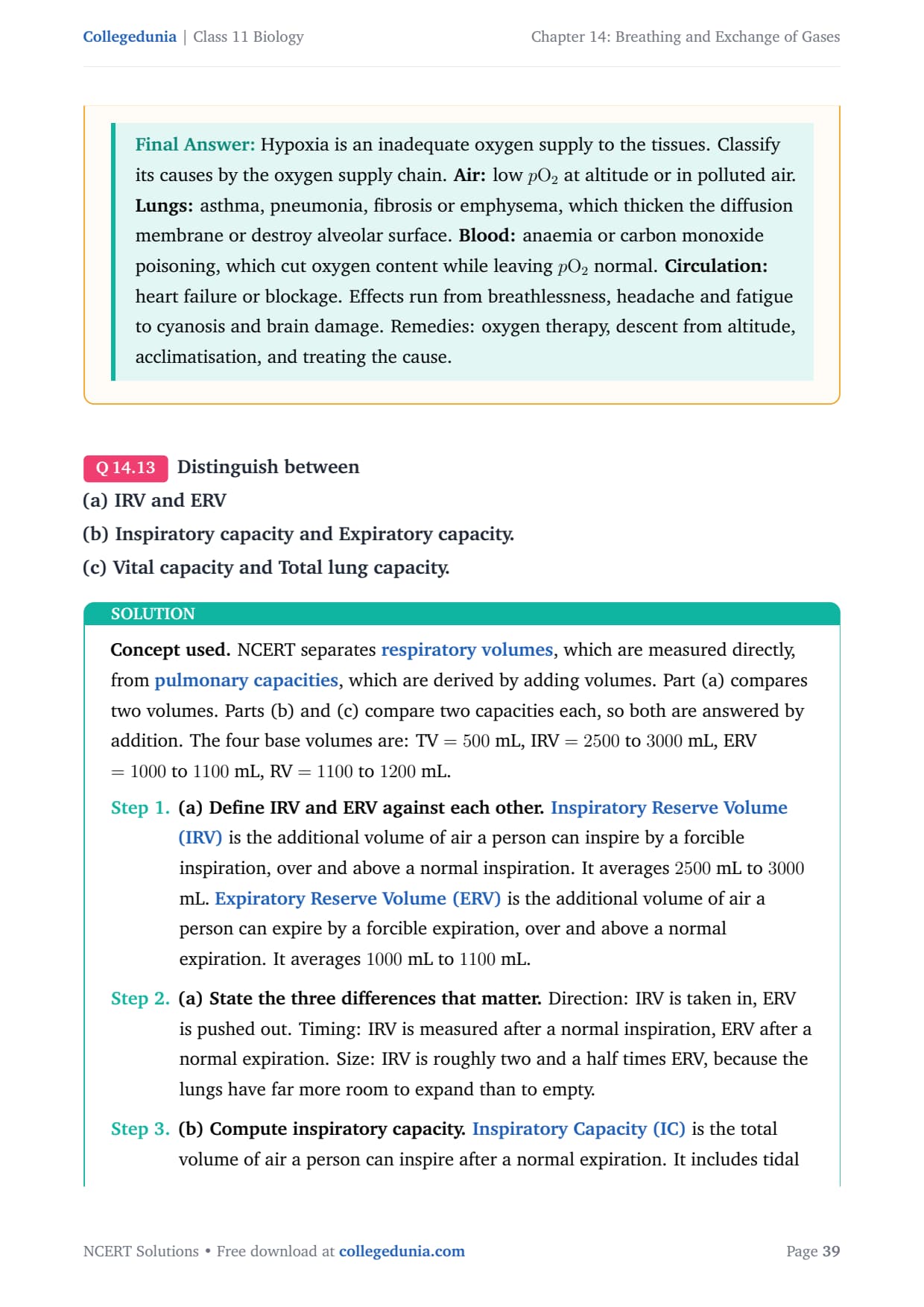
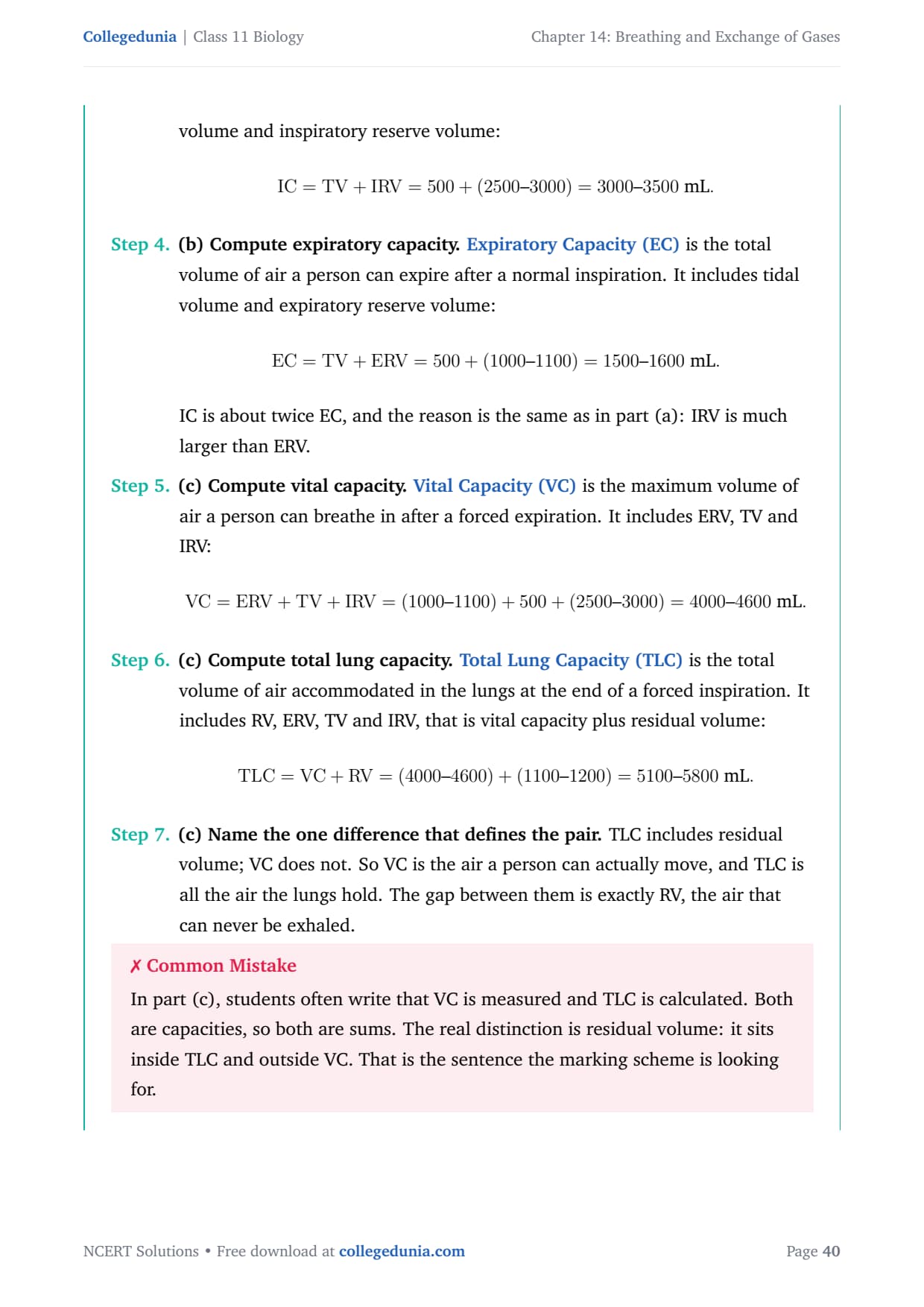
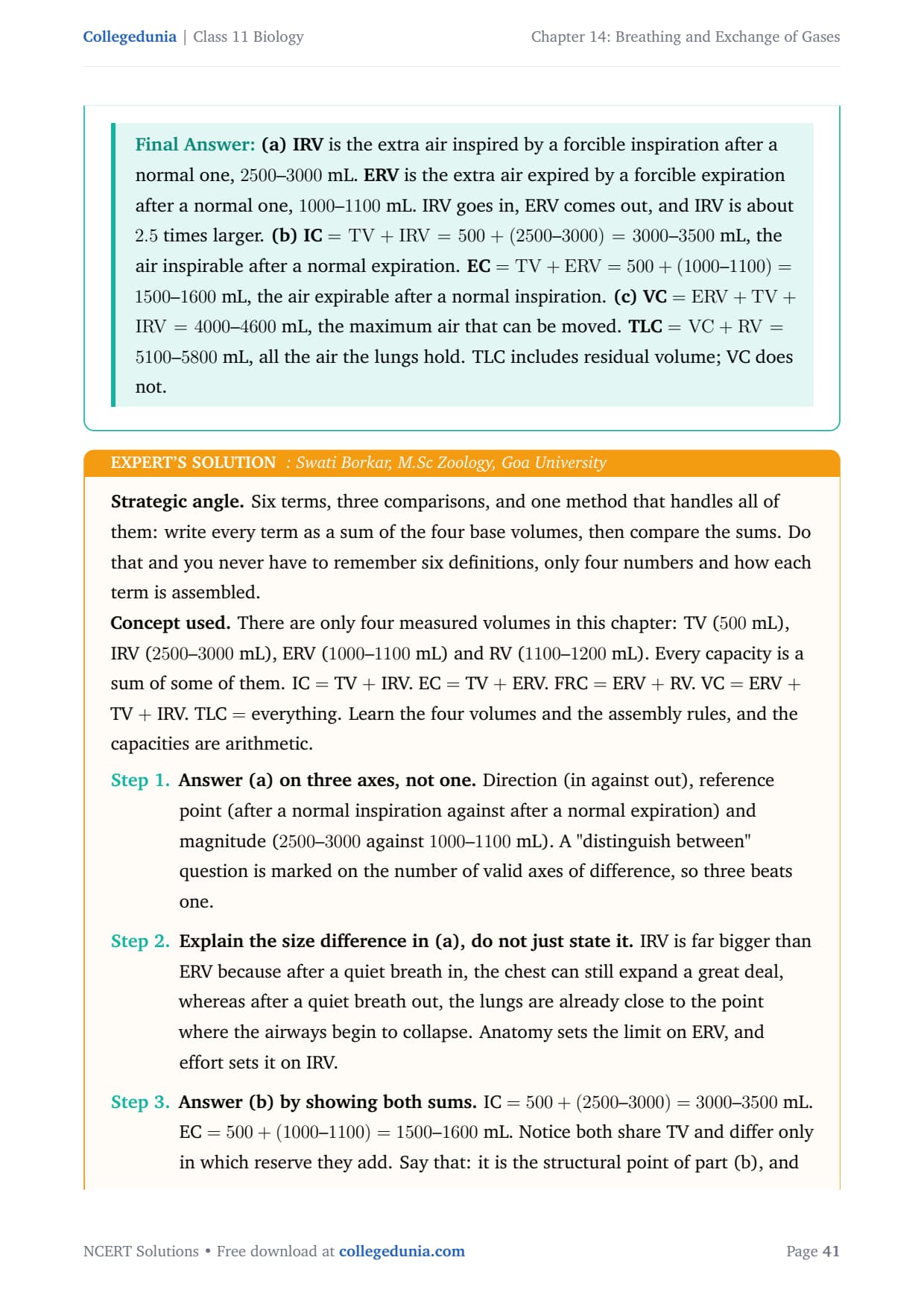
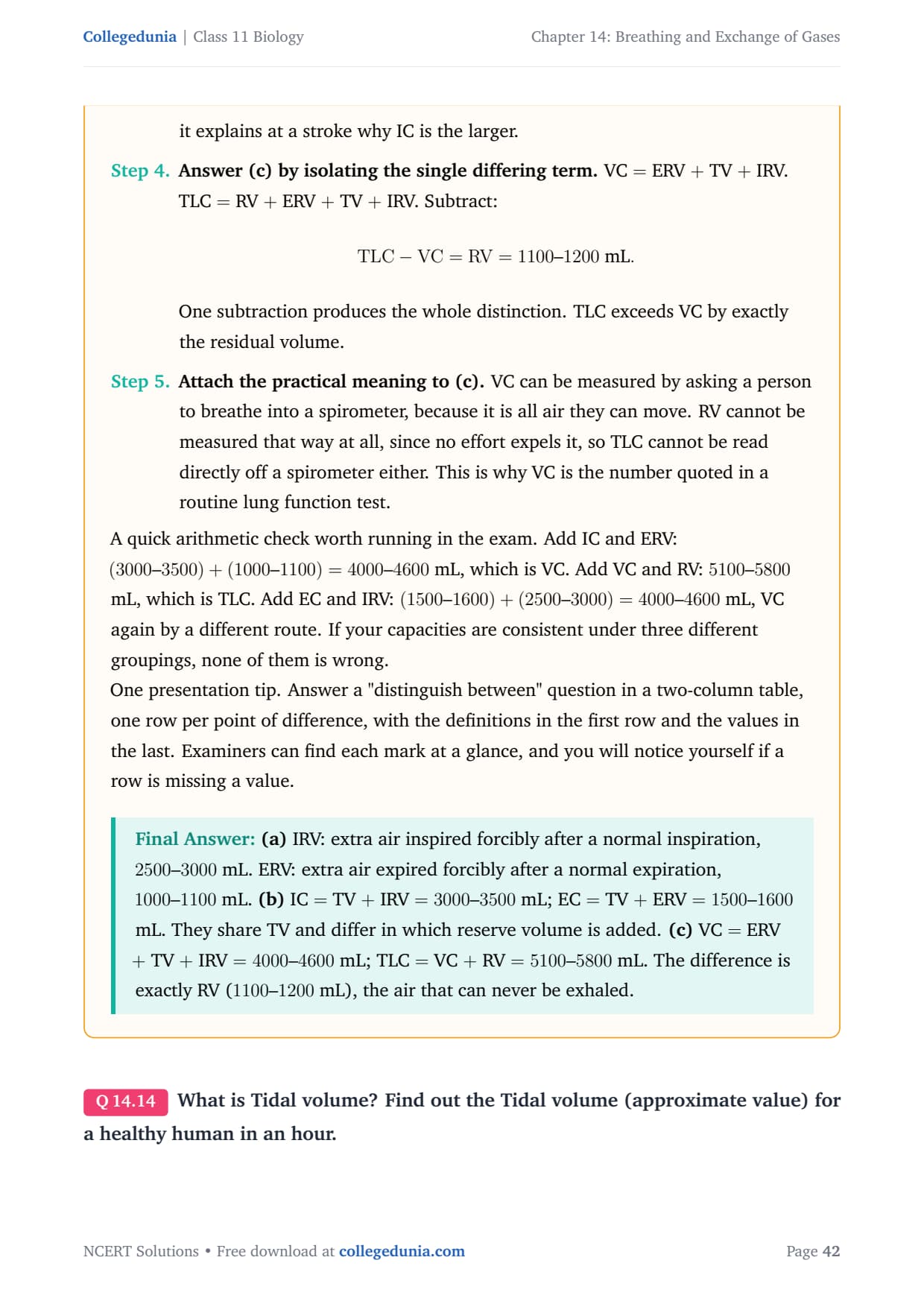
NCERT separates respiratory volumes, which are measured directly, from pulmonary capacities, which are found by adding two or more volumes. Four questions in the exercise, on vital capacity, on the air left after normal breathing, on tidal volume, and on distinguishing the capacities, all rest on the same four base volumes. Learn these four numbers and every capacity follows.
| Volume or capacity | How it is built | Approximate value |
|---|---|---|
| Tidal Volume (TV) | Air moved in one normal breath | 500 mL |
| Inspiratory Reserve Volume (IRV) | Extra air taken in by a forced inspiration | 2500 to 3000 mL |
| Expiratory Reserve Volume (ERV) | Extra air pushed out by a forced expiration | 1000 to 1100 mL |
| Residual Volume (RV) | Air that can never be exhaled | 1100 to 1200 mL |
| Inspiratory Capacity (IC) | TV + IRV | 3000 to 3500 mL |
| Functional Residual Capacity (FRC) | ERV + RV | 2100 to 2300 mL |
| Vital Capacity (VC) | ERV + TV + IRV | 4000 to 4600 mL |
| Total Lung Capacity (TLC) | VC + RV | 5100 to 5800 mL |
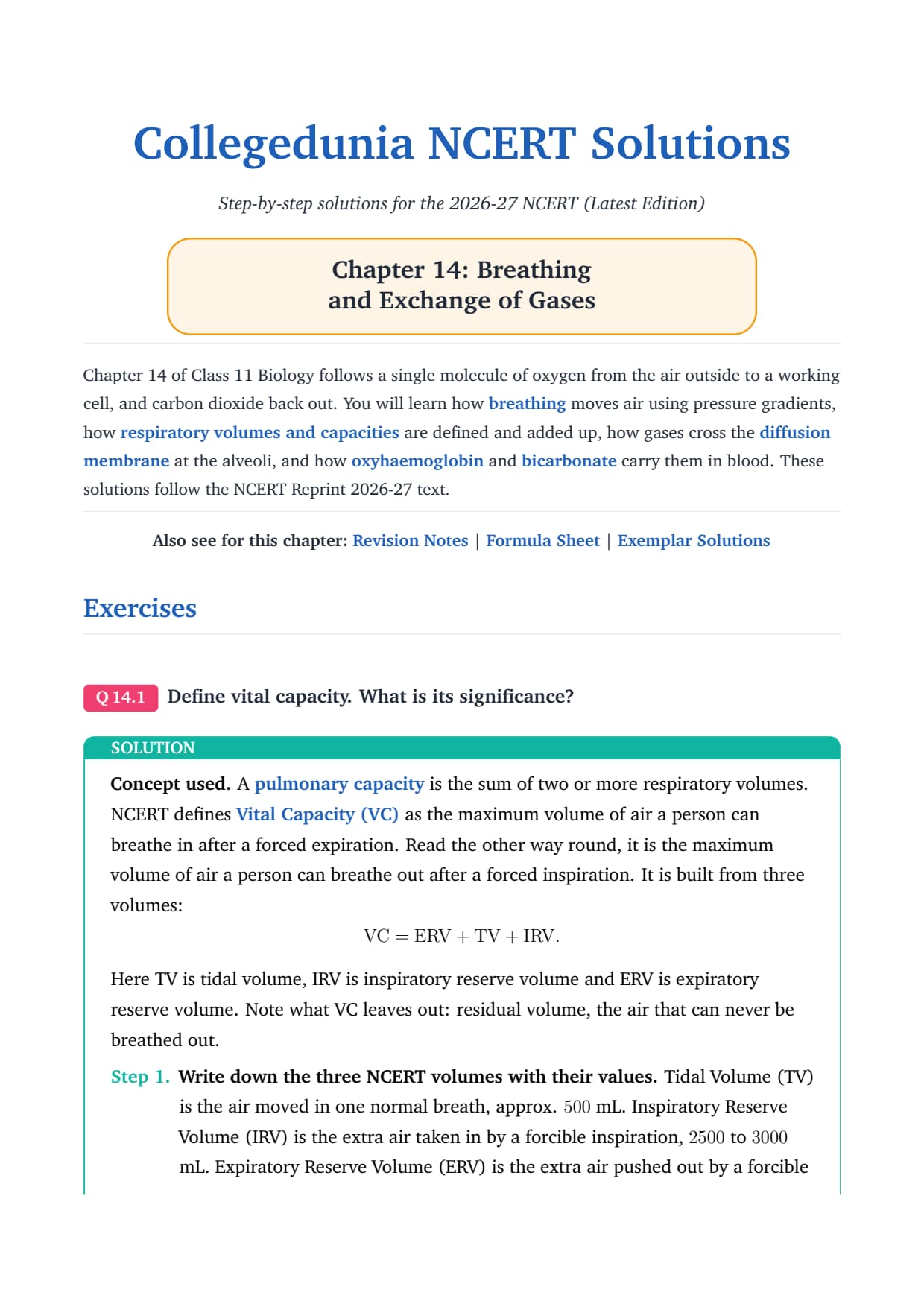
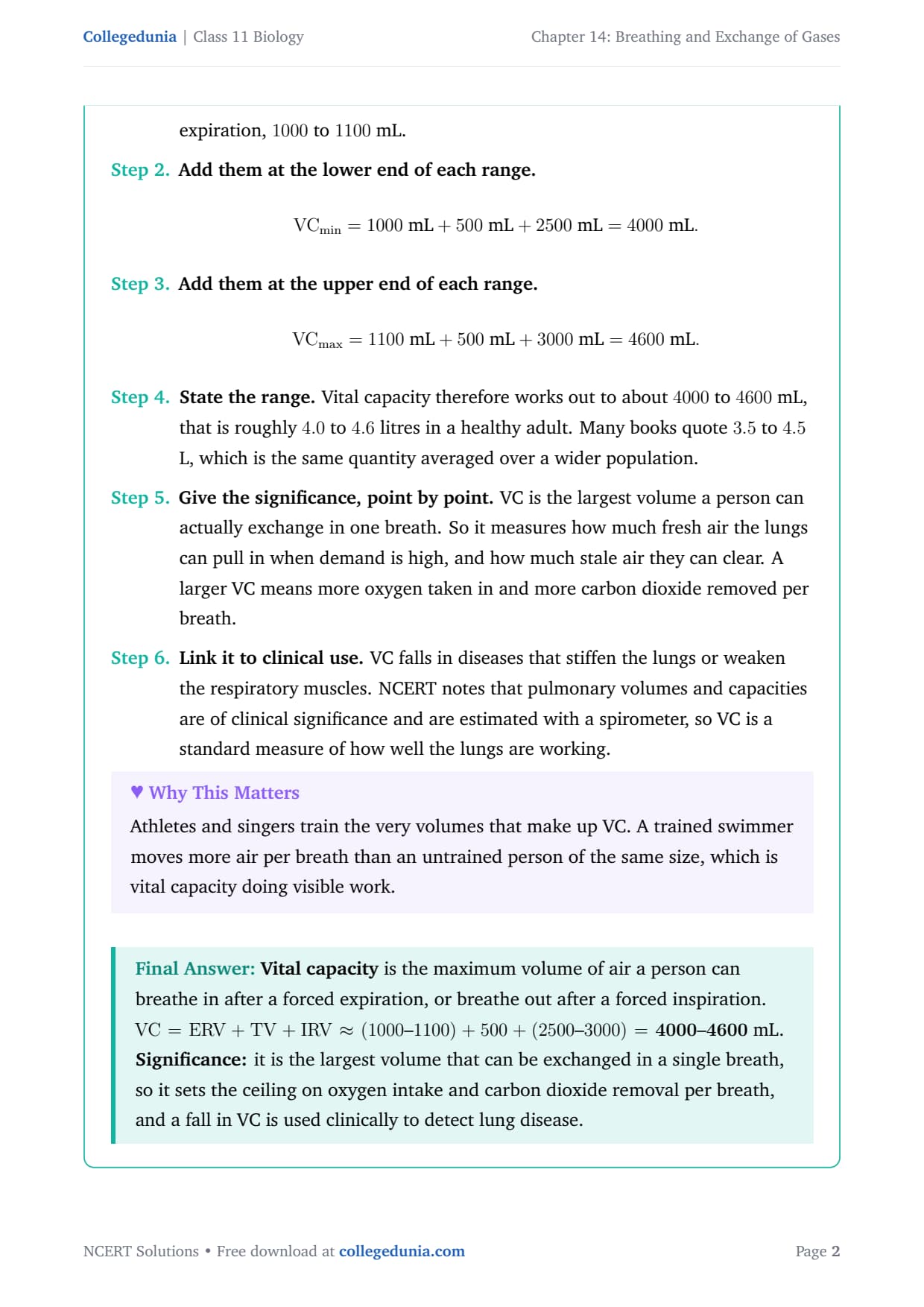
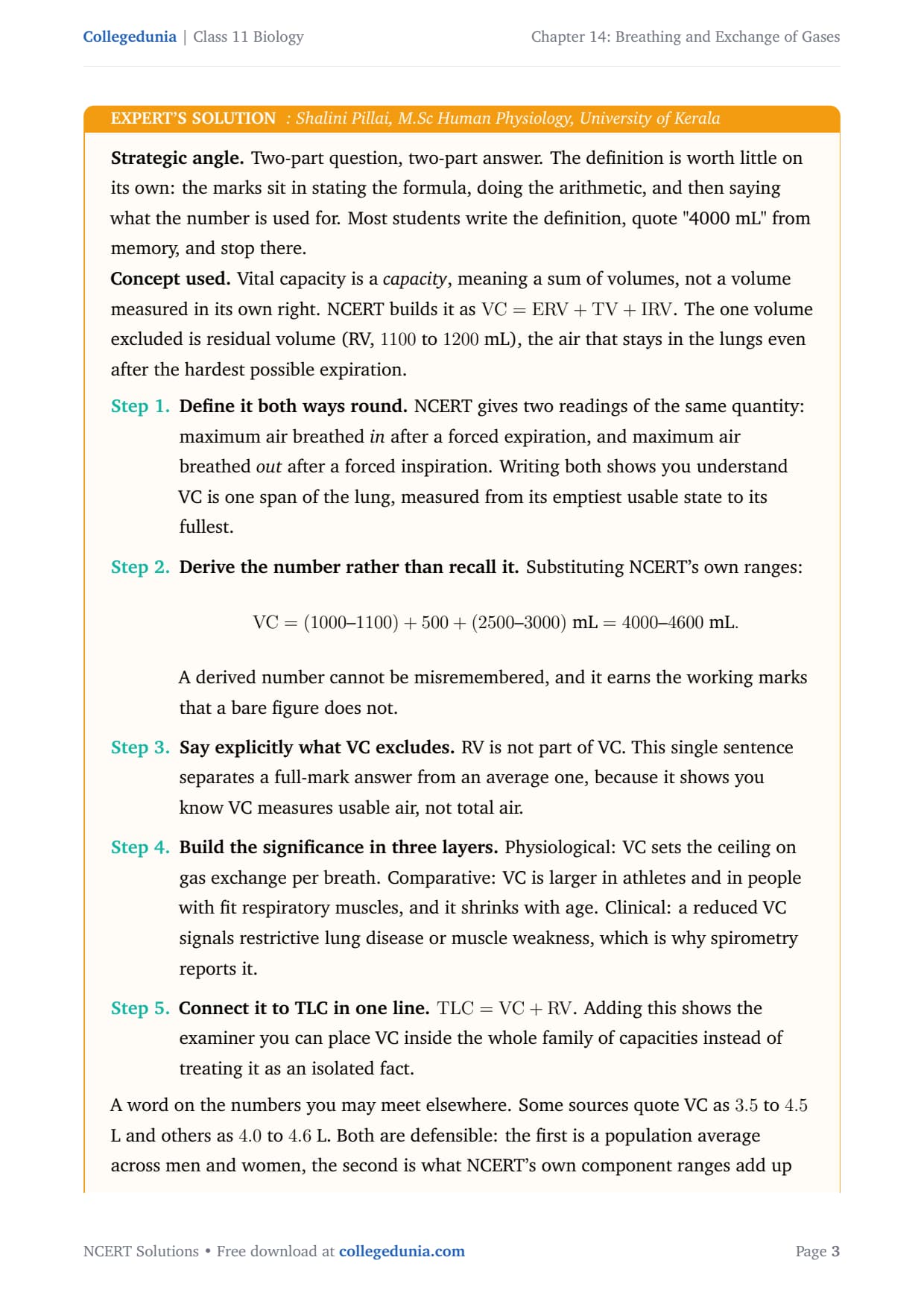
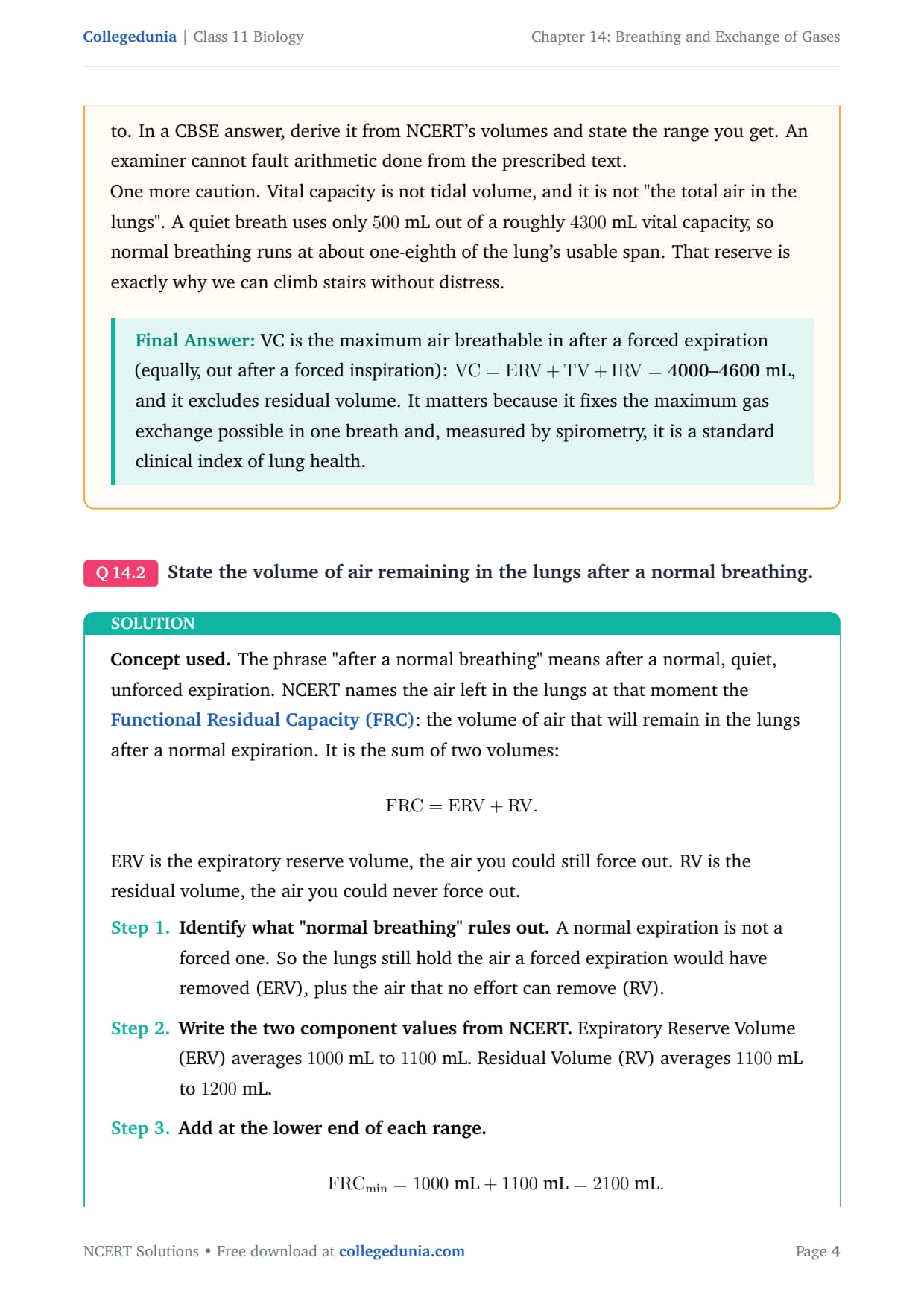
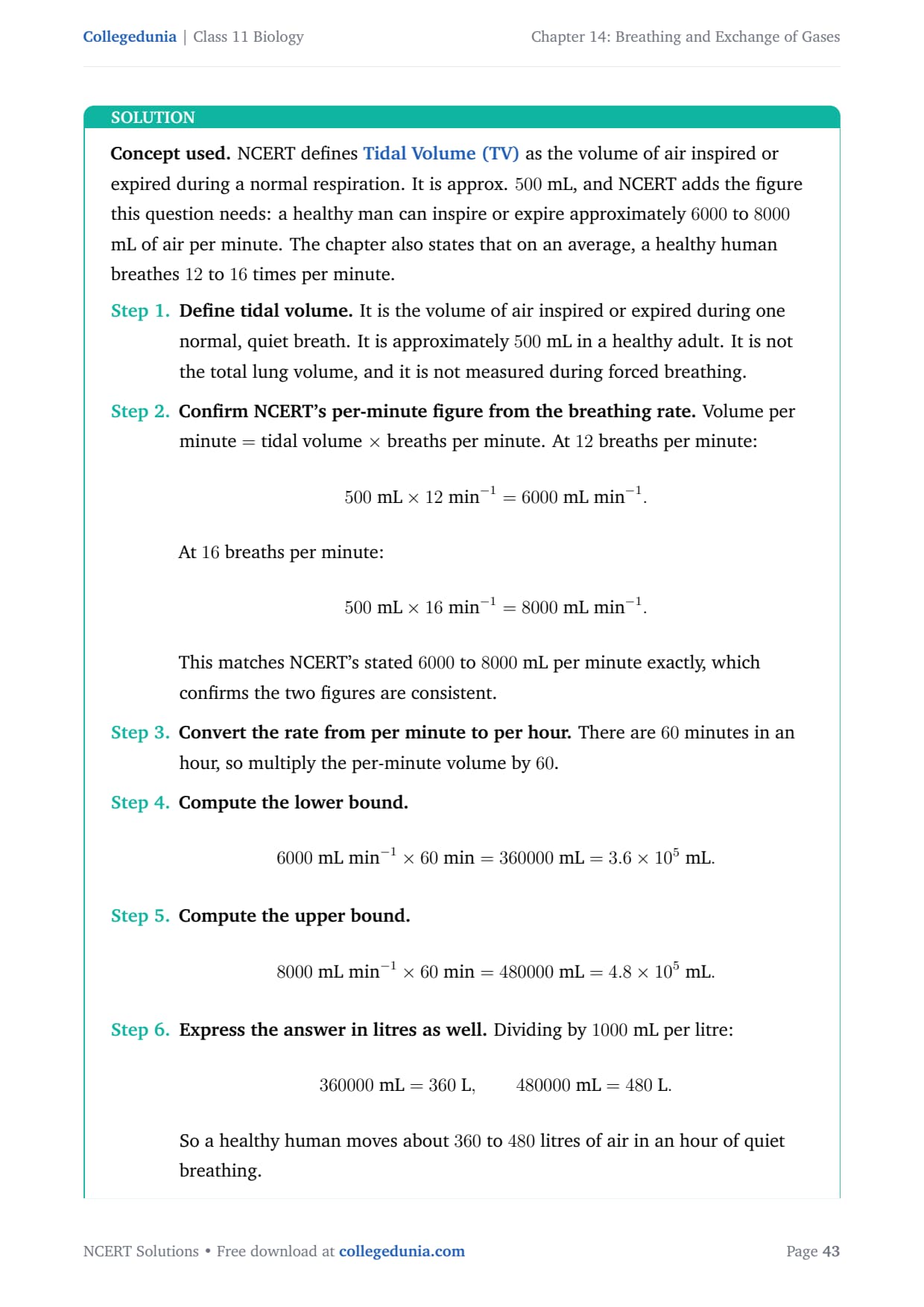
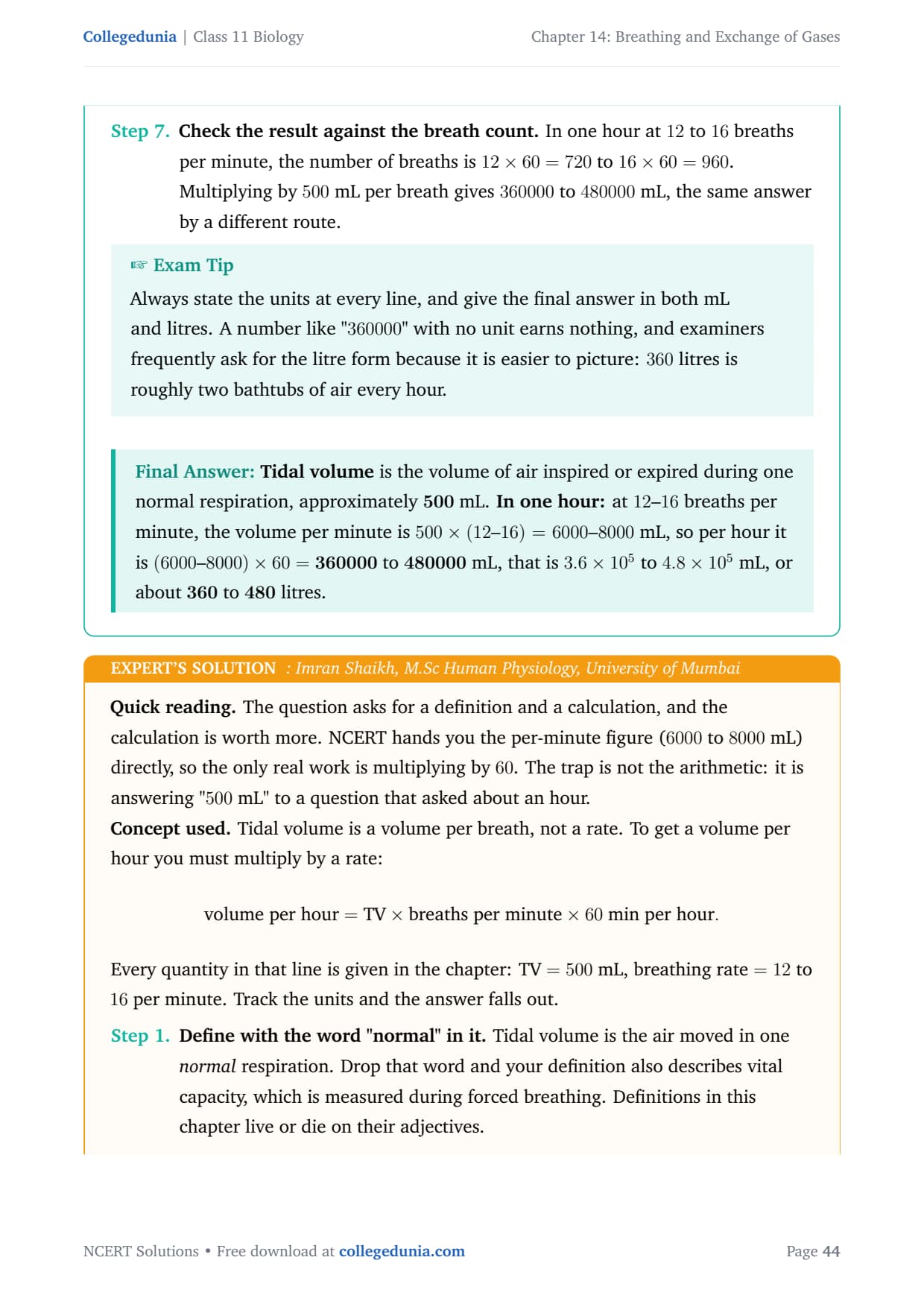
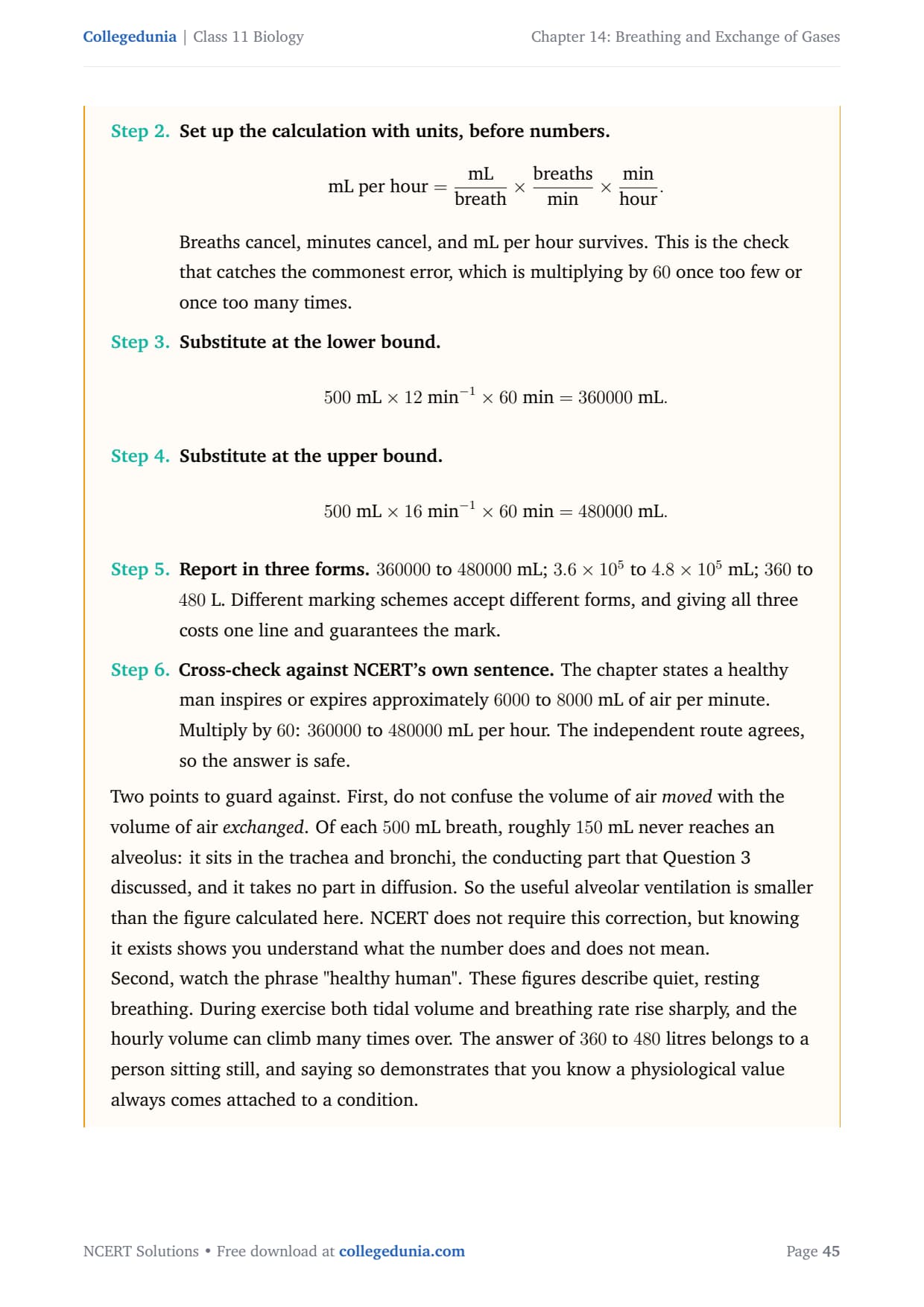
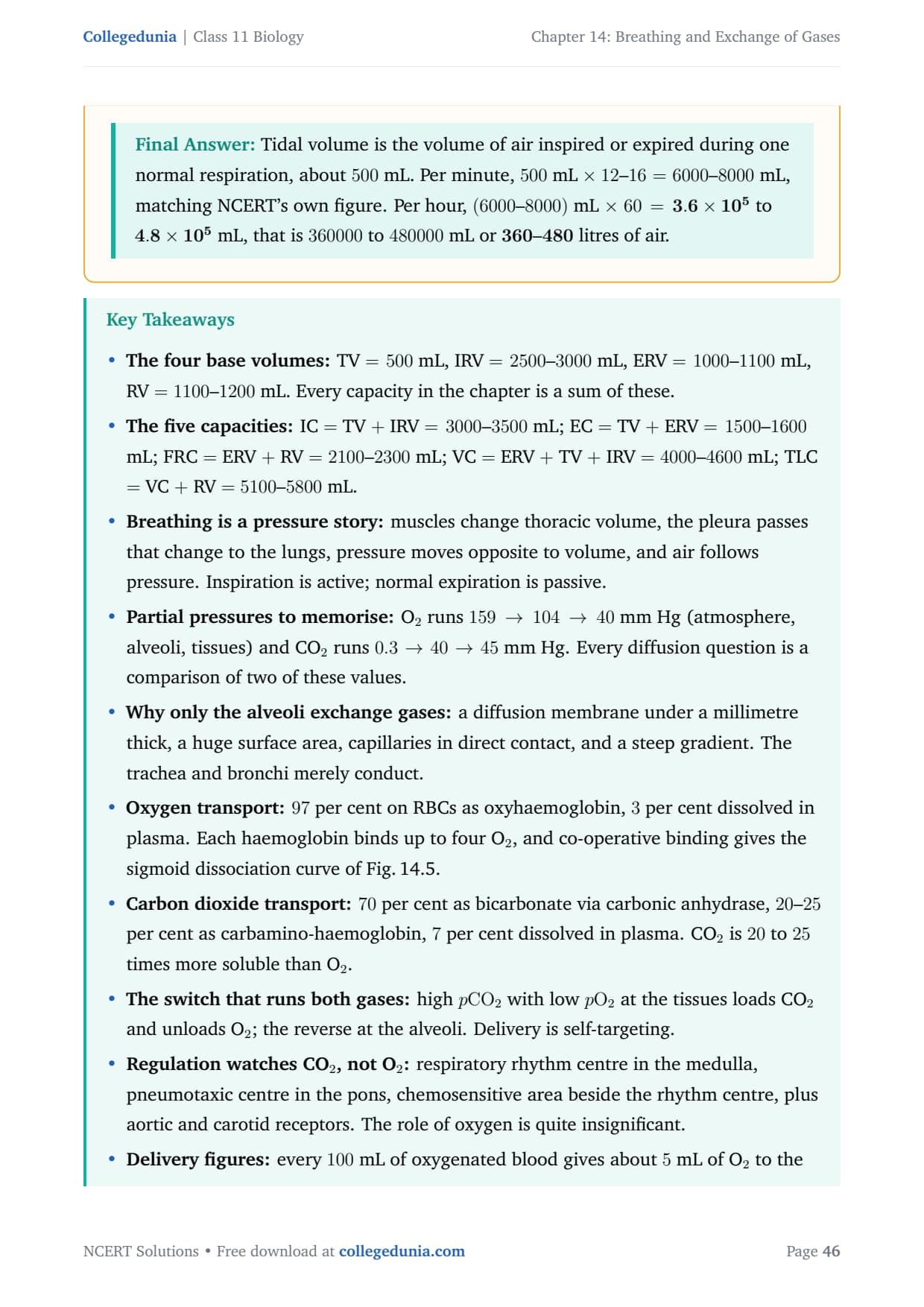
Vital capacity is the maximum air moved in one breath, while the air left after a normal breath is the functional residual capacity, ERV plus RV. A common slip is to answer "residual volume" for the air remaining after a normal breath, but a normal expiration is not forced, so the expiratory reserve volume is still inside the lungs and must be added. For tidal volume, a healthy human at 12 to 16 breaths per minute moves 500 × (12 to 16) = 6000 to 8000 mL per minute, which over an hour comes to 360000 to 480000 mL, that is about 360 to 480 litres. Refer to Exercise Q1, Q2, Q13 and Q14 for the full working.
The Mechanism of Breathing Under Normal Conditions
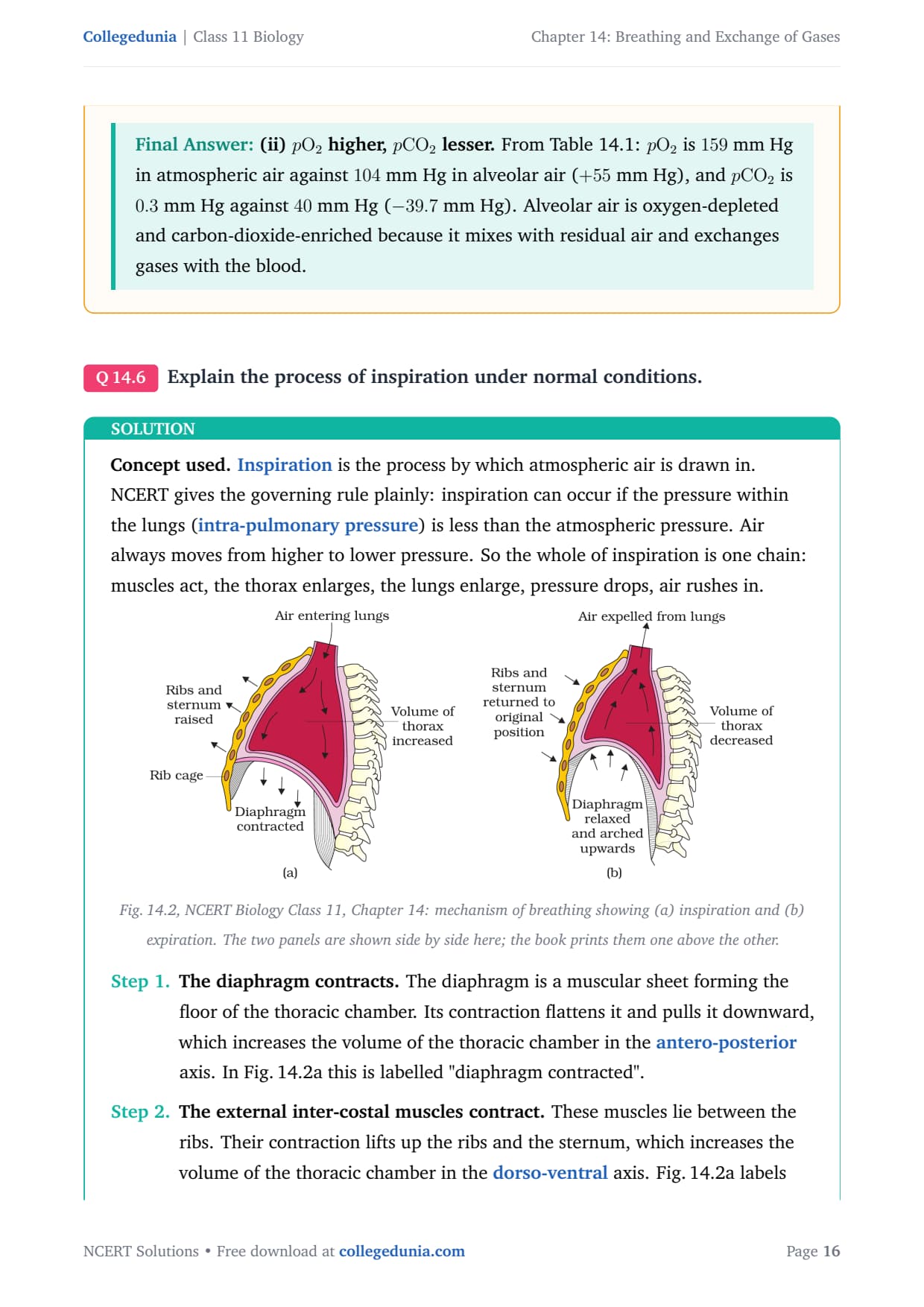
NCERT gives the rule of breathing plainly: air moves from a region of higher pressure to one of lower pressure, and inspiration occurs when the pressure inside the lungs (intra-pulmonary pressure) falls below atmospheric pressure. The whole process is one chain, muscles change volume, pressure follows volume, and air follows pressure. The one thing to keep straight is that air is never pushed into the lungs, it is drawn in once the lungs make room.
- Diaphragm contracts: the muscular floor of the thorax flattens and moves down, raising thoracic volume along the antero-posterior axis.
- External inter-costal muscles contract: the ribs and sternum are lifted, raising thoracic volume along the dorso-ventral axis.
- Lungs follow the chest wall: the pleural membranes couple the lung surface to the thoracic lining, so pulmonary volume rises with thoracic volume.
The larger space lowers the intra-pulmonary pressure below atmospheric, and about 500 mL of air flows in through the nostrils, nasal chamber, pharynx, larynx, trachea, bronchi and bronchioles to the alveoli. Inspiration is active, requiring muscle contraction, whereas a normal expiration is passive, needing only the diaphragm and inter-costal muscles to relax. When they relax, thoracic and pulmonary volume shrink, intra-pulmonary pressure rises above atmospheric, and air leaves. Under normal conditions the diaphragm and external inter-costal muscles are enough, though additional abdominal muscles can strengthen a forceful breath.
Why Diffusion of Gases Occurs Only in the Alveolar Region
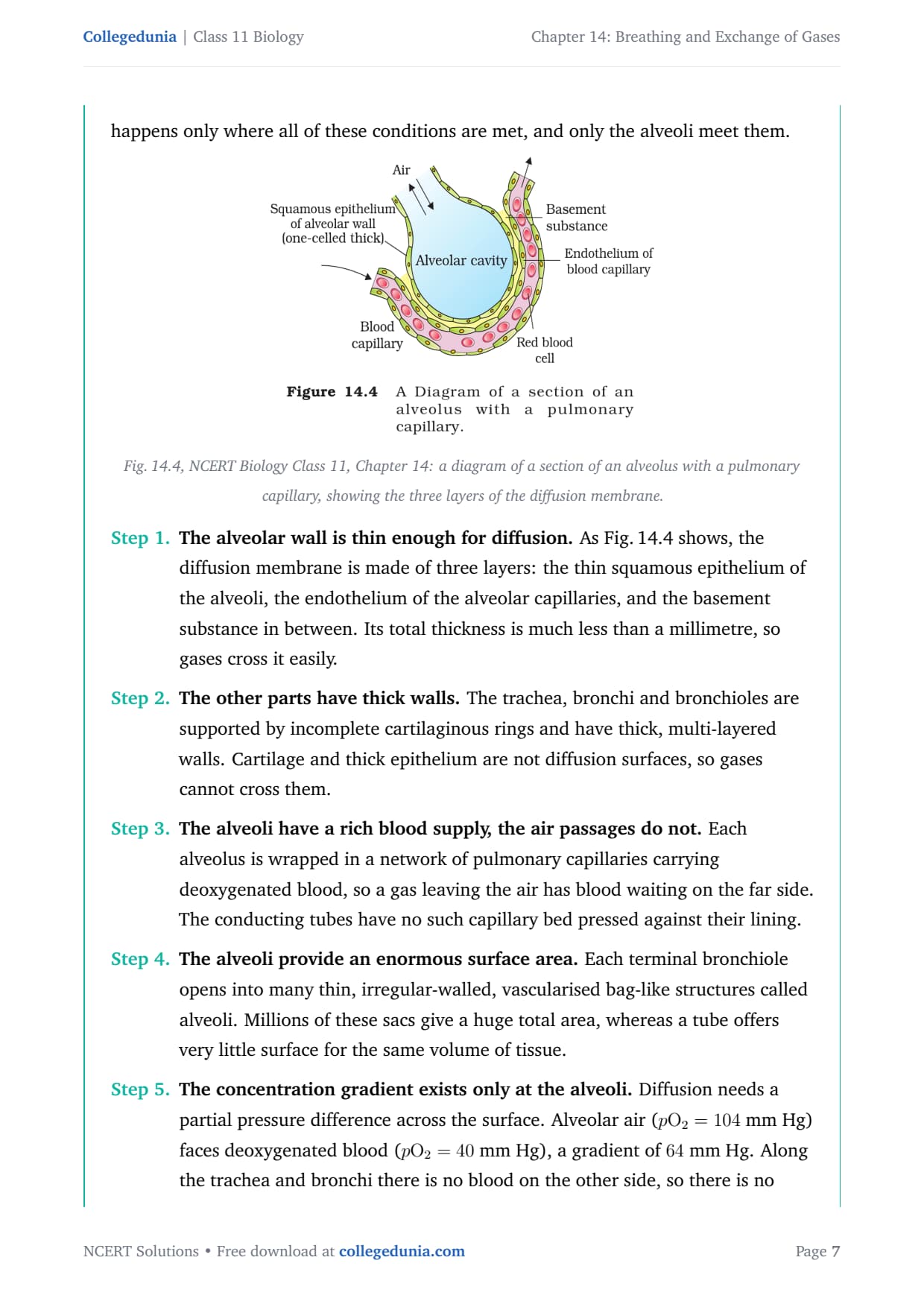
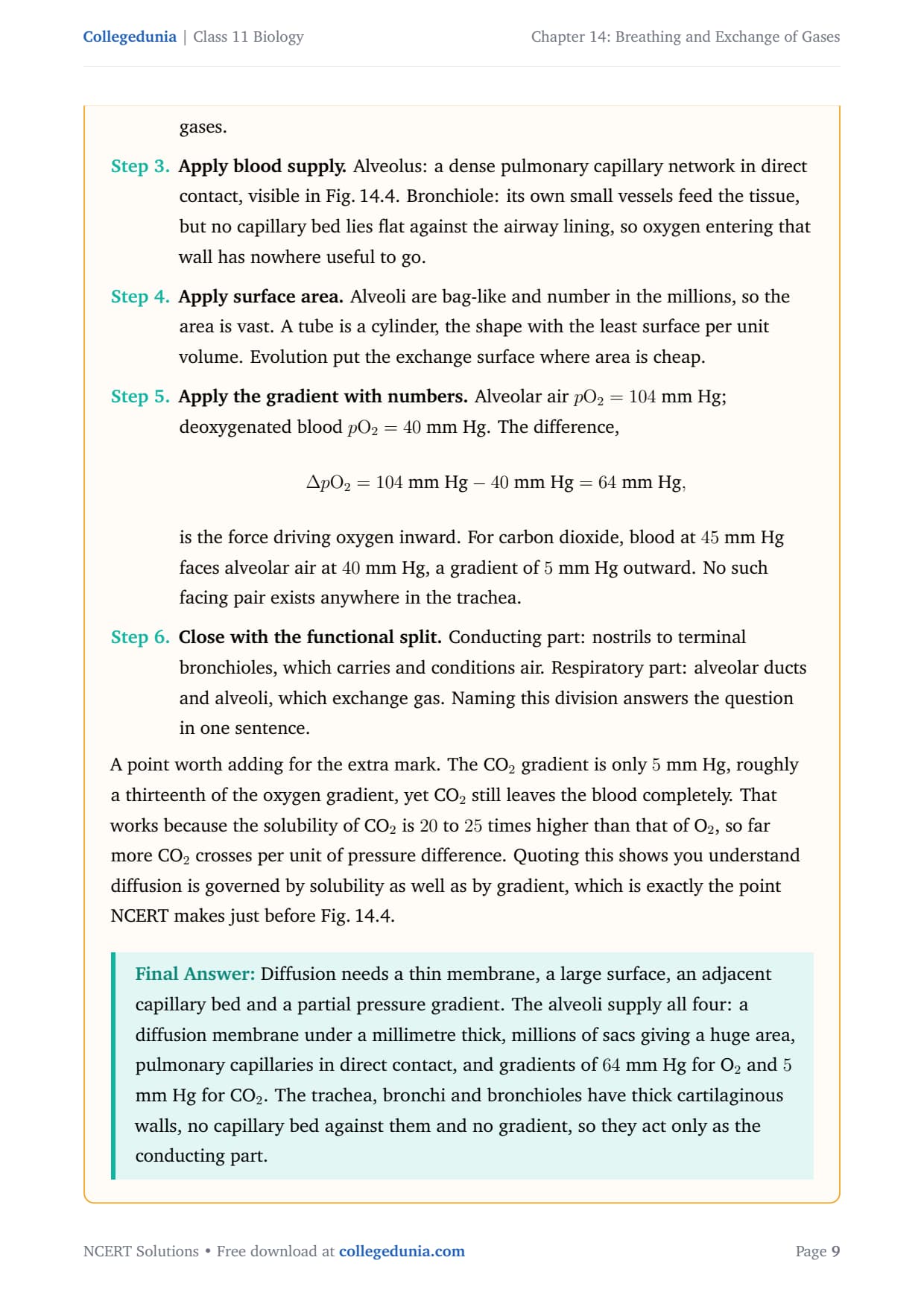
Diffusion across a biological surface needs four things to be present together: a thin membrane, a large surface area, a fluid on the far side to receive the gas, and a partial pressure gradient across it. NCERT states the first three explicitly. Only the alveoli meet all four, which is why the trachea, bronchi and bronchioles simply conduct air and cannot exchange gases.
- A thin membrane: the alveolar diffusion membrane has three layers, the thin squamous epithelium of the alveoli, the endothelium of the alveolar capillaries and the basement substance between them, together less than a millimetre thick.
- A huge surface and a blood supply: millions of thin, vascularised alveoli give an enormous area, each wrapped in pulmonary capillaries so blood waits on the far side.
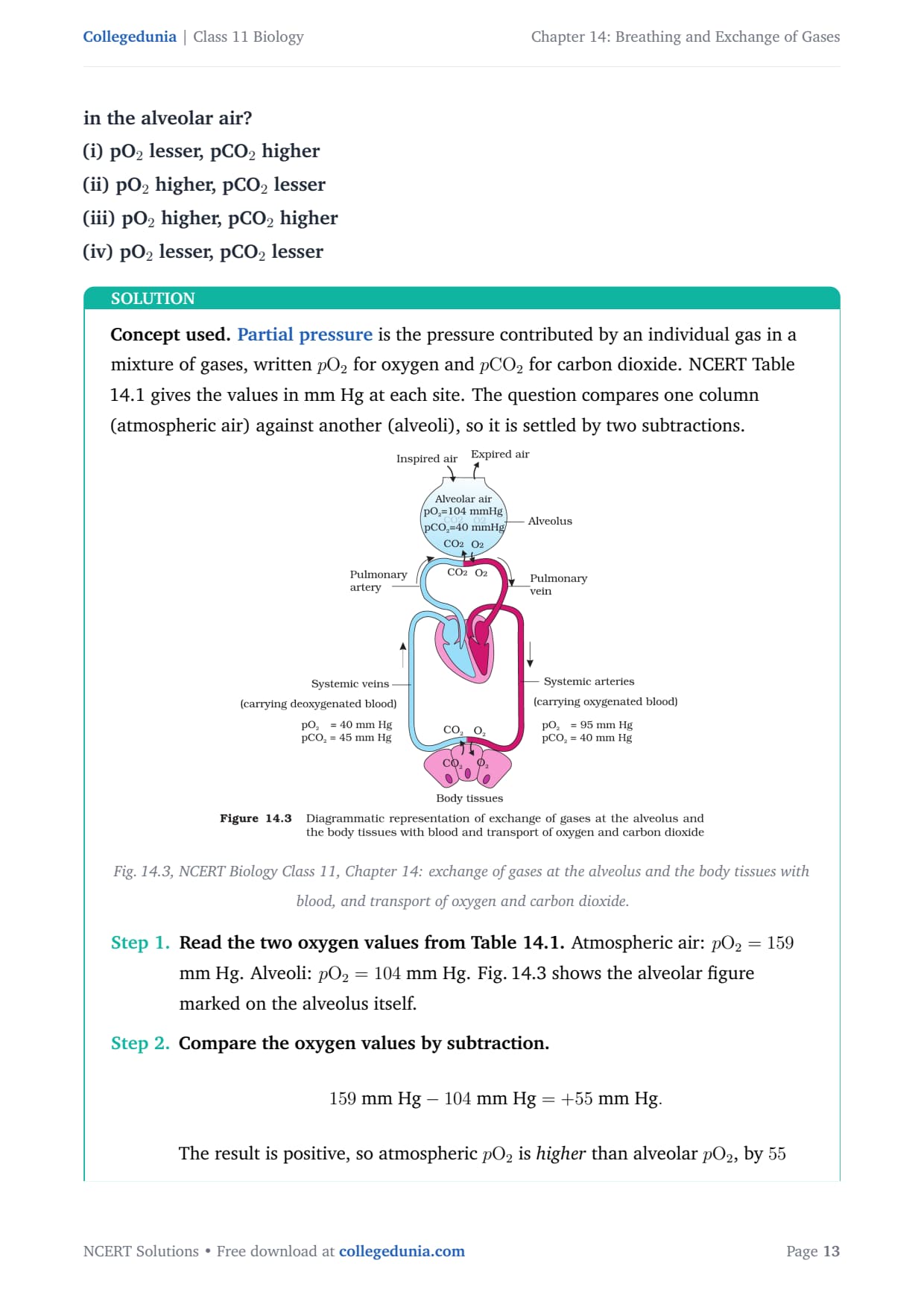
- A steep gradient: alveolar air at pO2 104 mm Hg faces deoxygenated blood at 40 mm Hg, a difference of 64 mm Hg driving oxygen inward.
The conducting tubes fail every test, they have thick cartilage-supported walls, no capillary bed against their lining, and no facing gradient. An insect shows the same principle from the other side: its site of gas exchange is the network of tracheal tubes, and the actual exchange happens at the fine, fluid-tipped tracheoles that end on the tissues, with air entering through spiracles. In an insect, blood plays no part in transporting the gases, since air is piped straight to the cells. The alveolus and the tracheole are two answers to one problem, chosen by body size, as worked in Exercise Q3 and Q10.
Partial Pressures and the Exchange of Gases
Partial pressure is the pressure contributed by an individual gas in a mixture, written pO2 for oxygen and pCO2 for carbon dioxide. A gas always diffuses down its own partial pressure gradient, so the direction of every exchange in the chapter can be read from NCERT Table 14.1. The exercise asks students to compare atmospheric air with alveolar air, which is settled by two subtractions.
| Gas | Atmospheric air | Alveoli | Deoxygenated blood | Tissues |
|---|---|---|---|---|
| pO2 (mm Hg) | 159 | 104 | 40 | 40 |
| pCO2 (mm Hg) | 0.3 | 40 | 45 | 45 |
Reading the table, atmospheric pO2 (159 mm Hg) is higher than alveolar pO2 (104 mm Hg) by 55 mm Hg, while atmospheric pCO2 (0.3 mm Hg) is lesser than alveolar (40 mm Hg) by 39.7 mm Hg, so the correct option is pO2 higher, pCO2 lesser. Alveolar air is oxygen-depleted and carbon-dioxide-enriched because it mixes with the residual air already in the lungs and exchanges gases with the blood. A quick way to remember the whole table is two lines: O2 runs 159 → 104 → 40 across atmosphere, alveoli and tissues, and CO2 runs 0.3 → 40 → 45. Oxygen falls all the way in, carbon dioxide rises all the way in, and every diffusion question is a comparison of two values from these lines.
Transport of Oxygen and the Oxygen Dissociation Curve
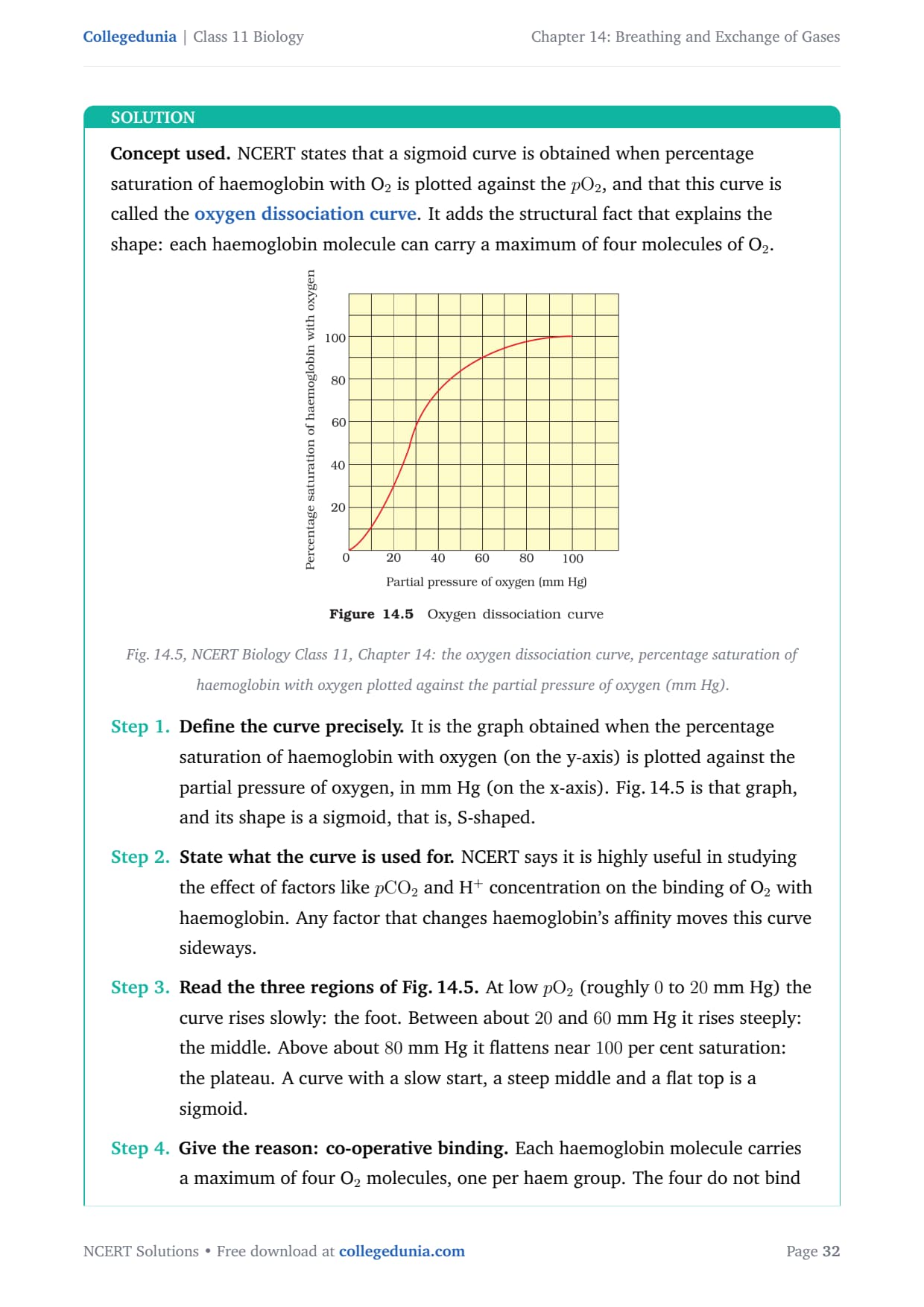
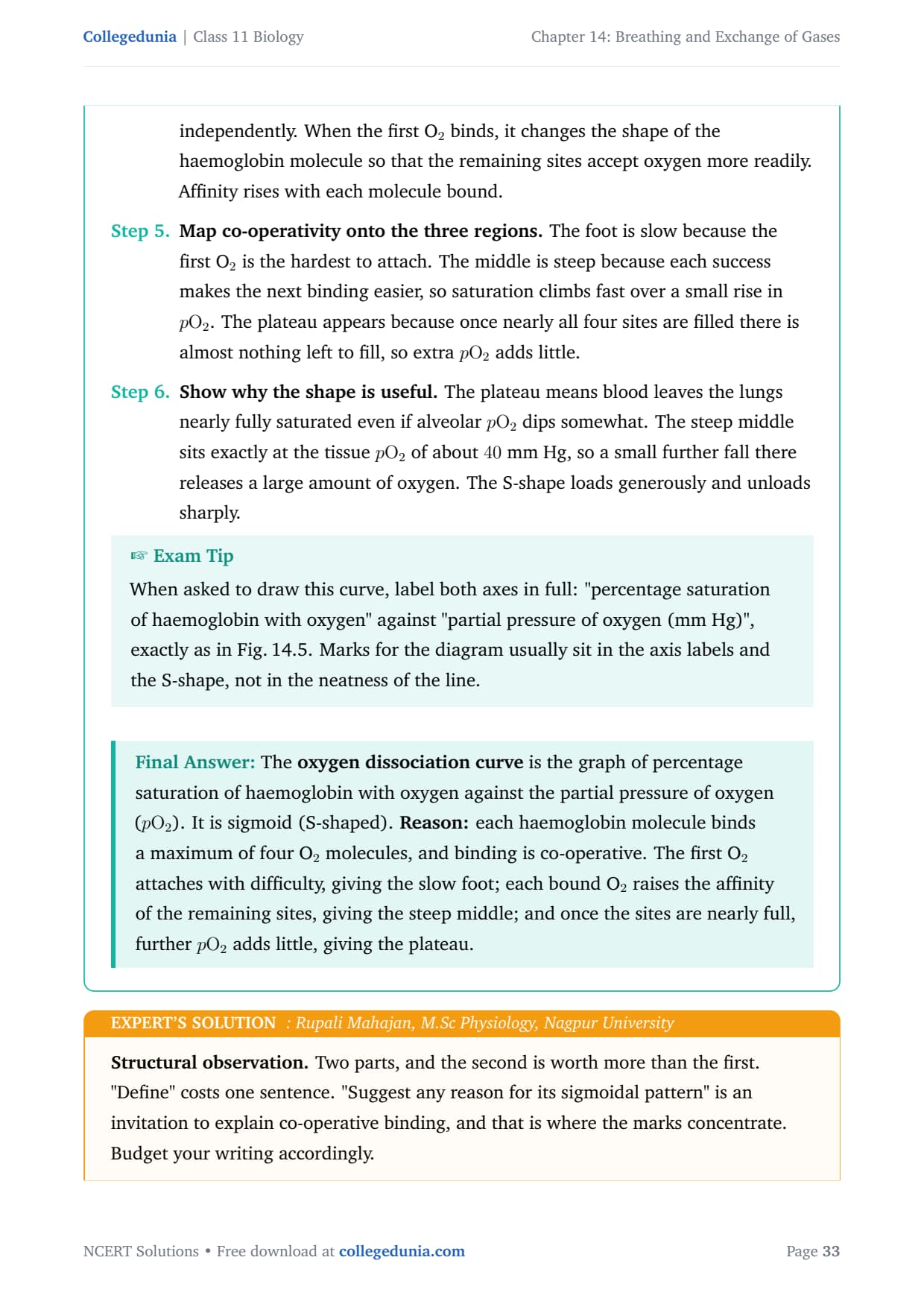
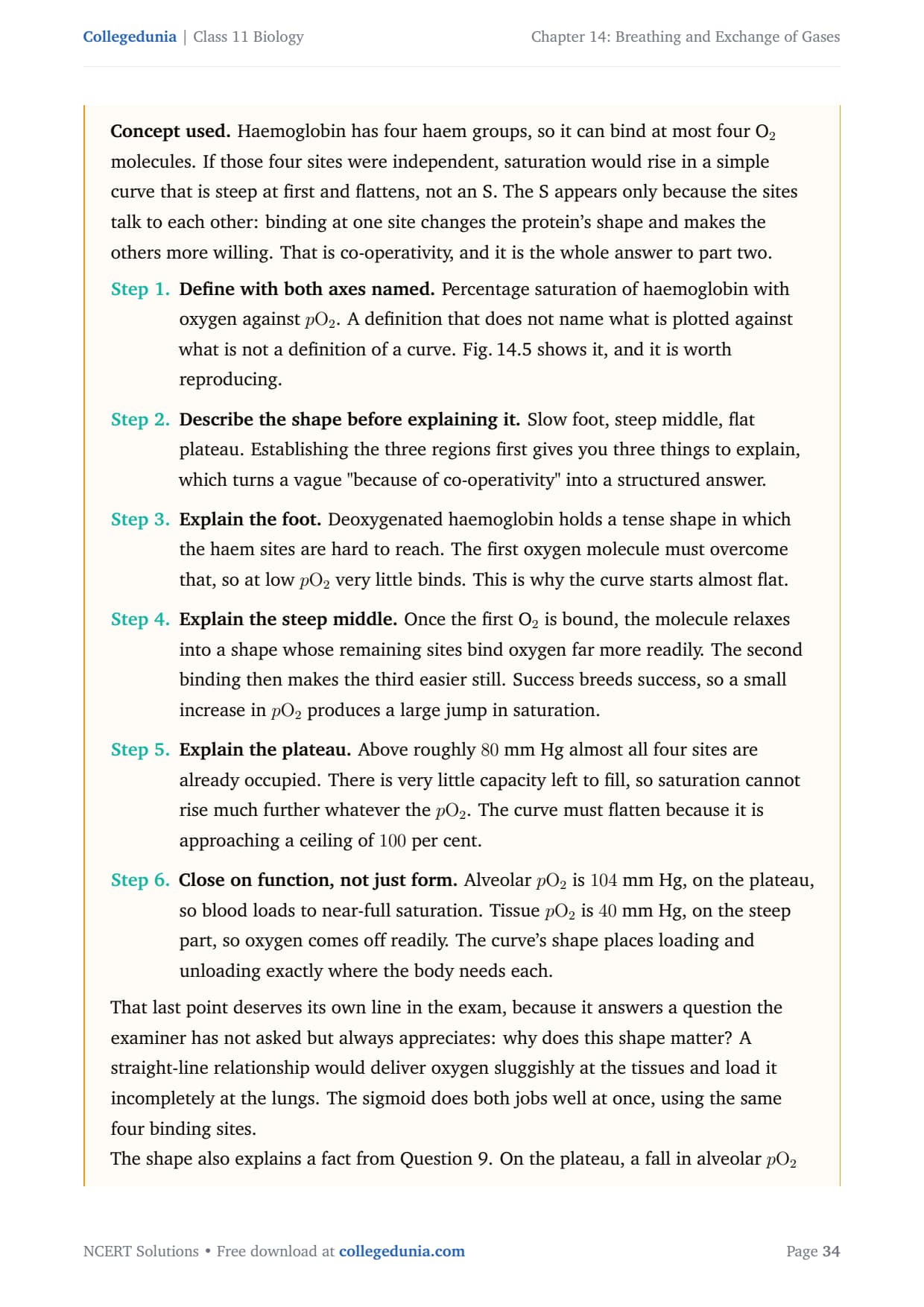
About 97 per cent of oxygen is carried by RBCs as oxyhaemoglobin, and the remaining 3 per cent travels dissolved in plasma. Binding of oxygen with haemoglobin is primarily related to pO2, while pCO2, hydrogen ion concentration and temperature are the other factors that affect it. A graph of the percentage saturation of haemoglobin against pO2 gives the S-shaped oxygen dissociation curve.
- Why it is sigmoid: each haemoglobin molecule binds a maximum of four O2 molecules, and binding is co-operative, so the first O2 attaches with difficulty (the slow foot), each bound O2 makes the next easier (the steep middle), and near-full occupancy leaves little room (the plateau).
- Loading at the lungs: alveolar pO2 of 104 mm Hg sits on the plateau, so blood leaves the lungs nearly fully saturated.
- Unloading at the tissues: tissue pO2 of about 40 mm Hg sits on the steep middle, so a small fall releases a large amount of oxygen.
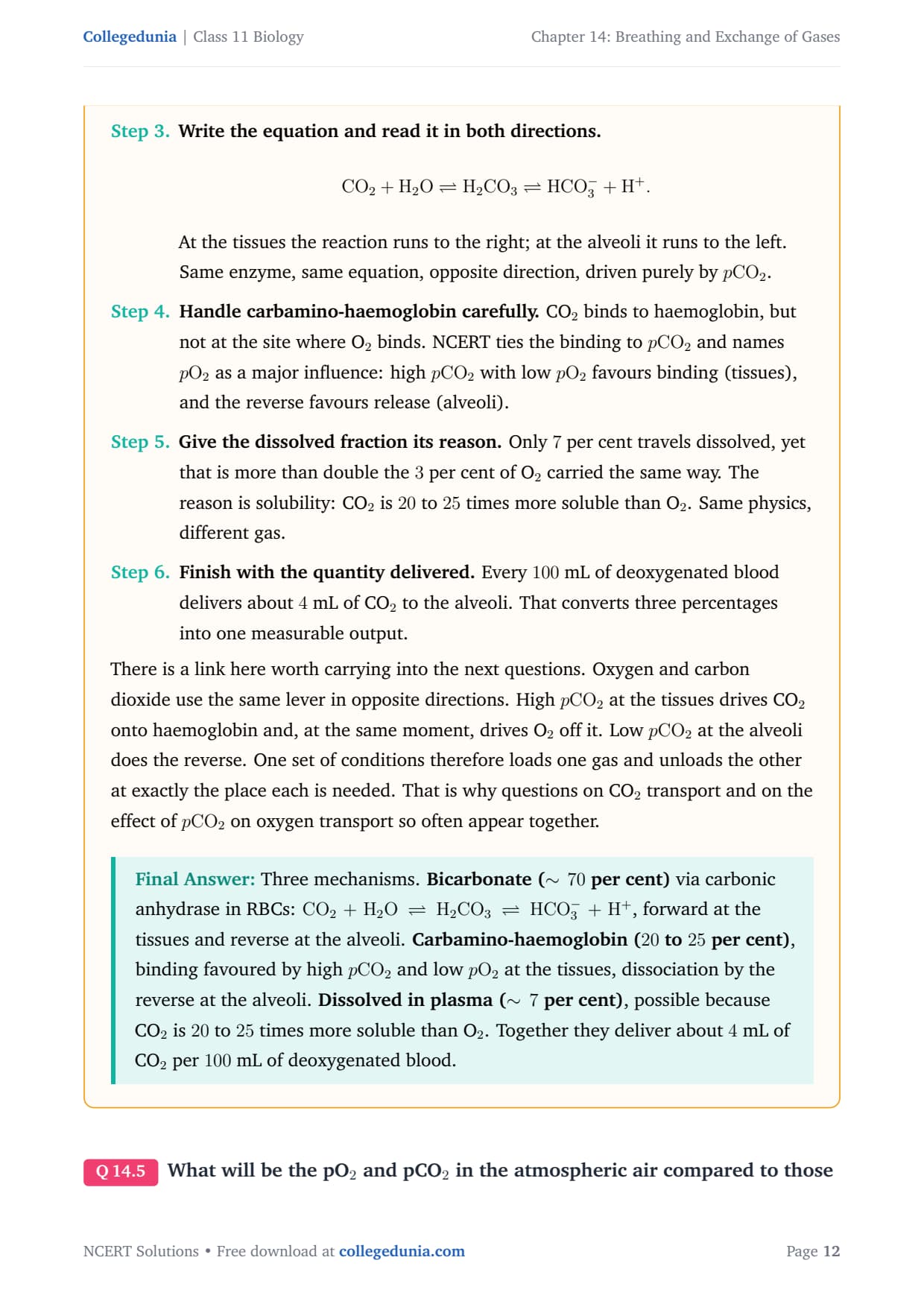
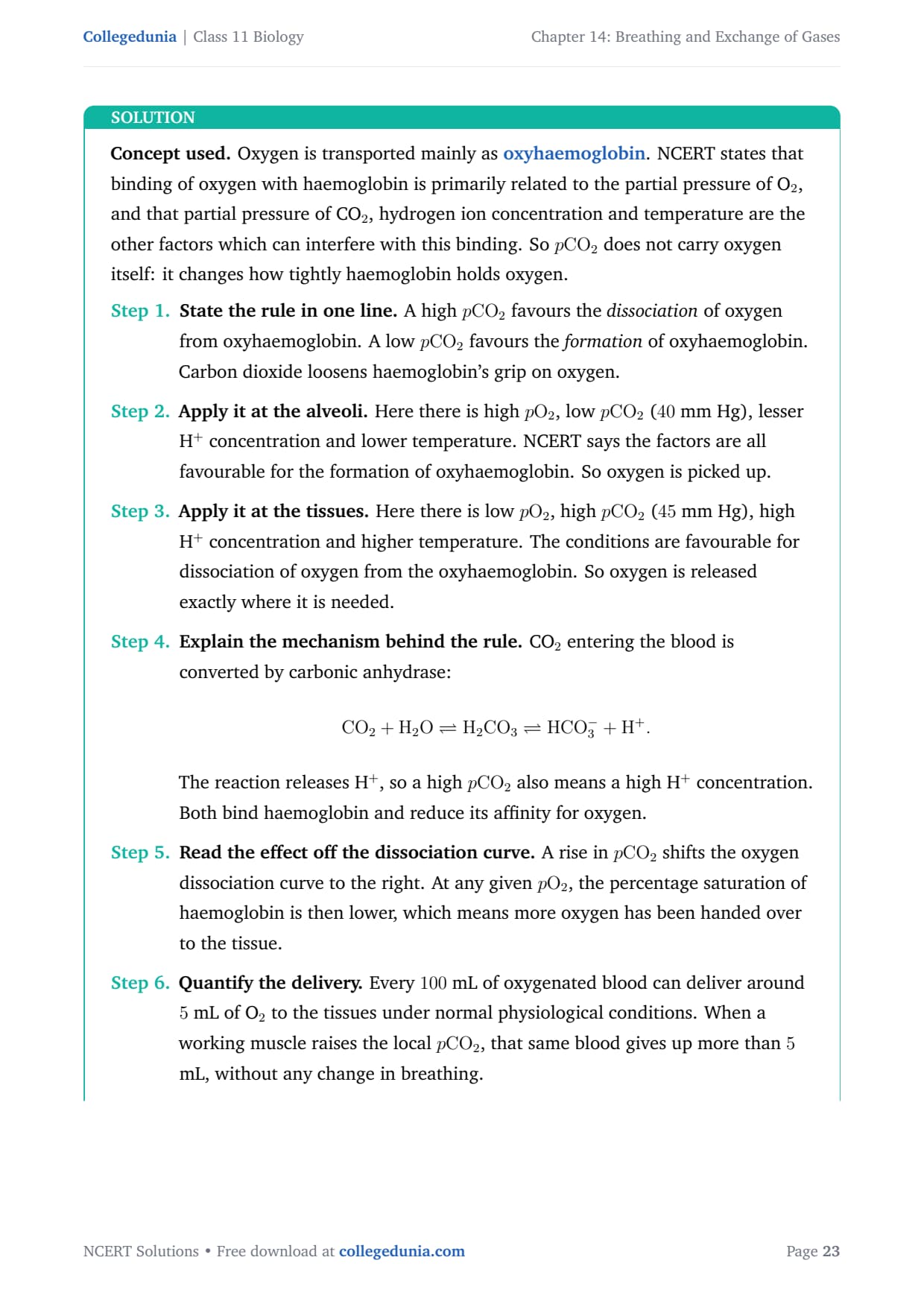
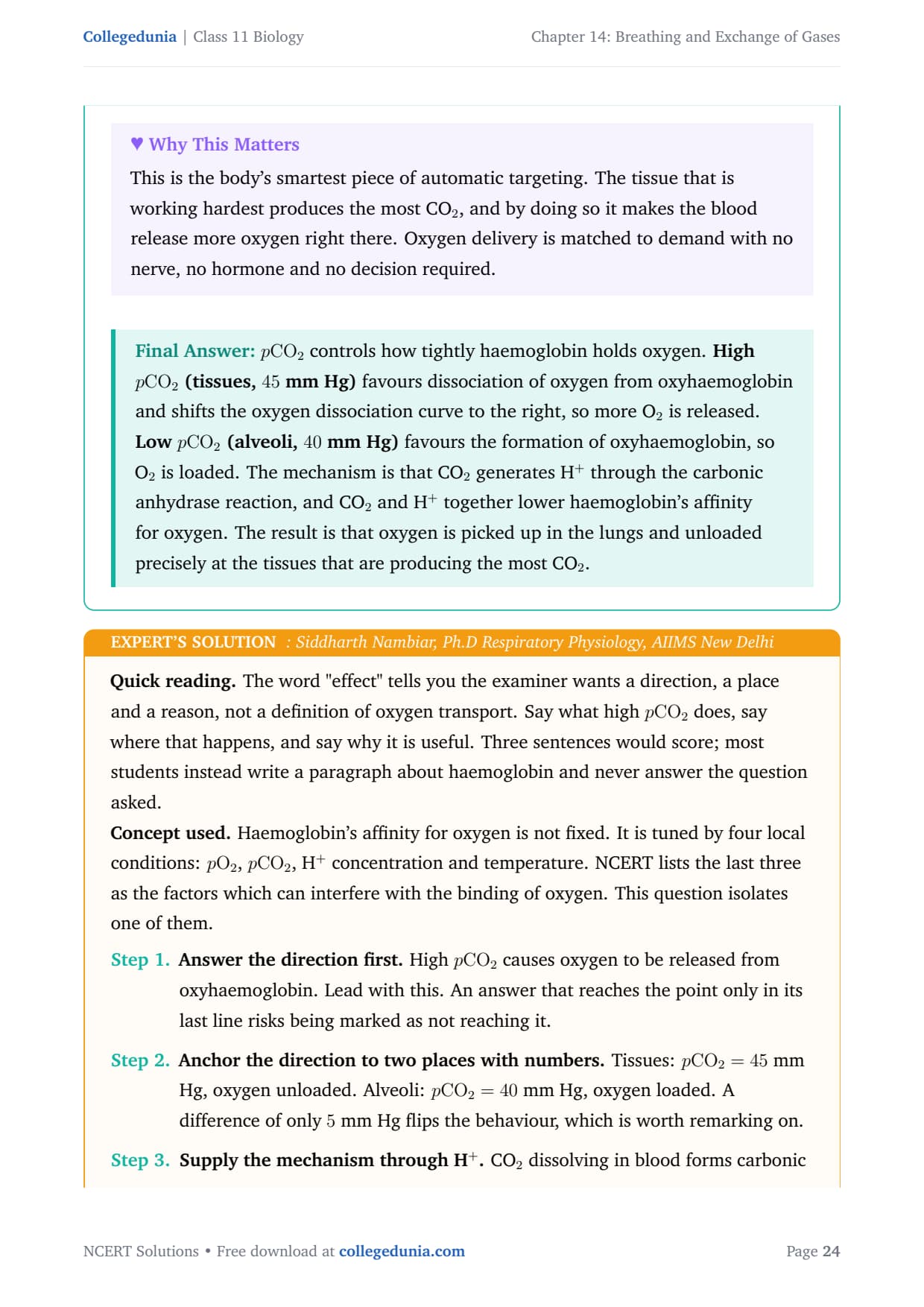
Carbon dioxide tunes this release. A high pCO2 favours the dissociation of oxygen from oxyhaemoglobin and shifts the curve to the right, so oxygen comes off exactly at the tissues (pCO2 45 mm Hg) that are working hardest, while a low pCO2 at the alveoli (40 mm Hg) favours the formation of oxyhaemoglobin. Every 100 mL of oxygenated blood delivers about 5 mL of O2 to the tissues under normal conditions. The mechanism runs through H+ produced by the carbonic anhydrase reaction, so carbon dioxide loosens haemoglobin's grip on oxygen and delivery is matched to demand automatically.
Transport of Carbon Dioxide by Blood
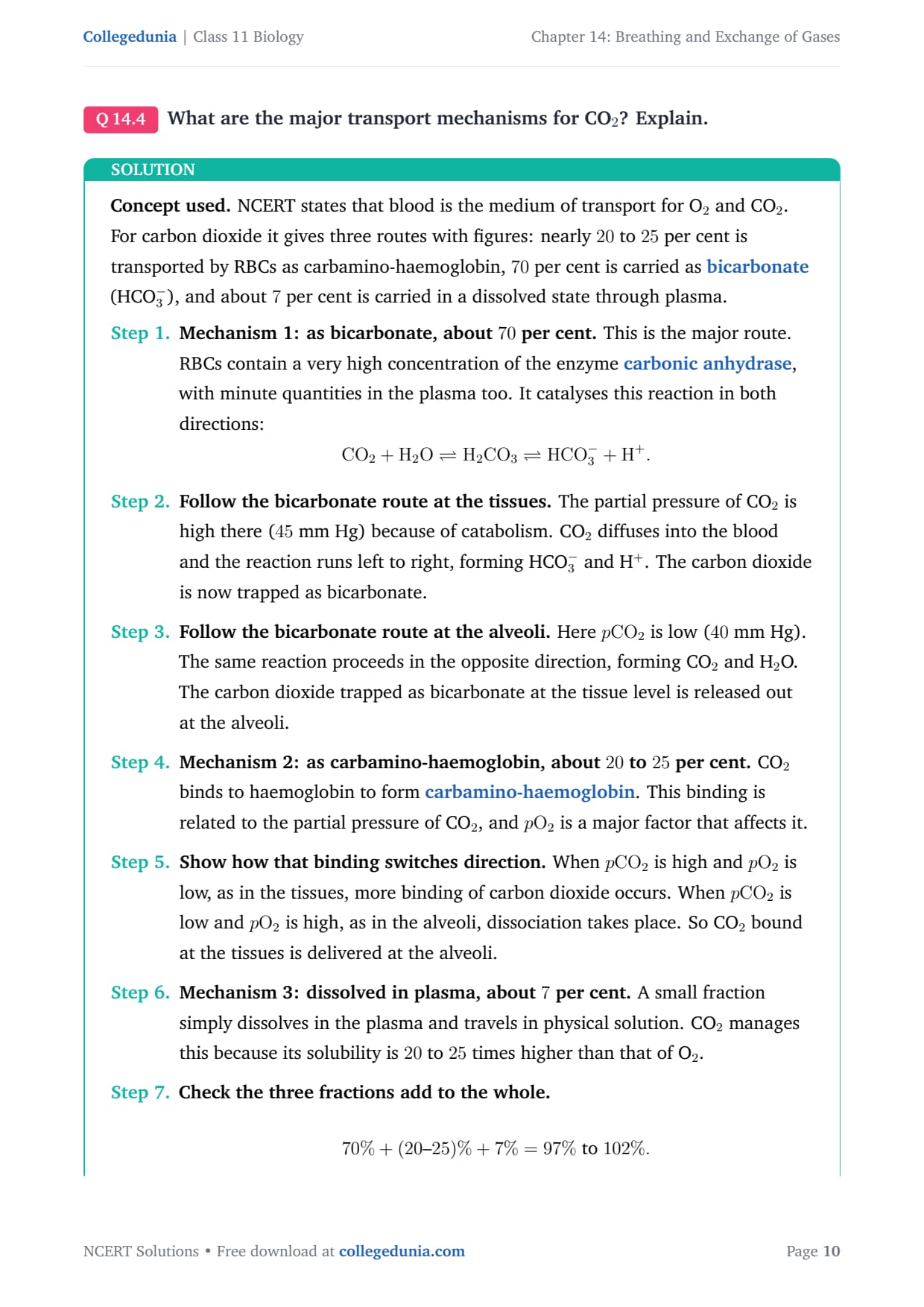
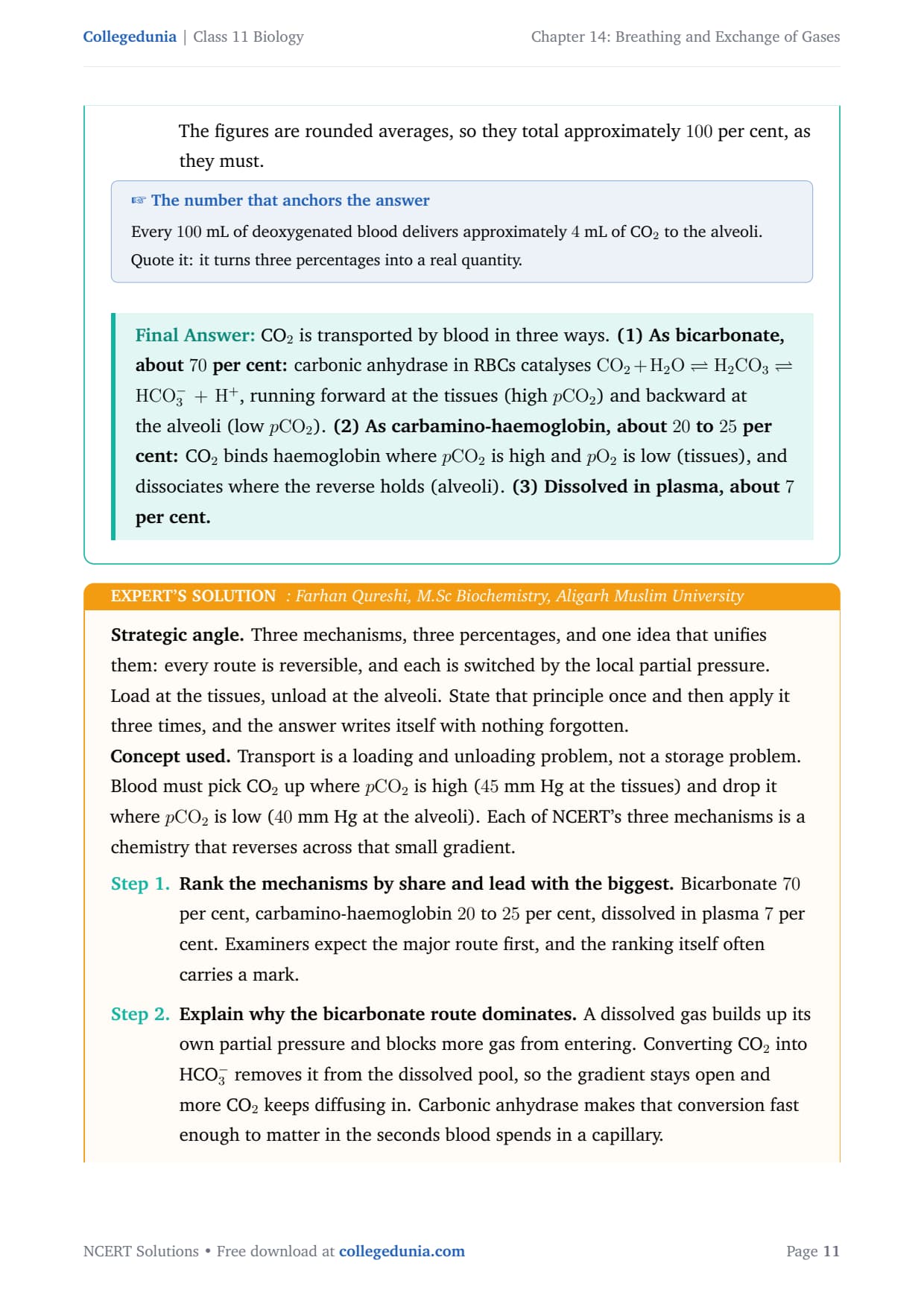
Blood is the medium of transport for both gases, and NCERT gives three routes for carbon dioxide with figures. The unifying idea is that every route is reversible and is switched by the local pCO2, so carbon dioxide is loaded at the tissues and unloaded at the alveoli. Together these routes deliver about 4 mL of CO2 per 100 mL of deoxygenated blood.
| Mechanism | Share | How it works |
|---|---|---|
| As bicarbonate (HCO3-) | about 70 per cent | Carbonic anhydrase in RBCs catalyses CO2 + H2O → H2CO3 → HCO3- + H+, running forward at the tissues and backward at the alveoli. |
| As carbamino-haemoglobin | 20 to 25 per cent | CO2 binds haemoglobin where pCO2 is high and pO2 low (tissues), and dissociates where the reverse holds (alveoli). |
| Dissolved in plasma | about 7 per cent | A small fraction travels in physical solution, possible because CO2 is 20 to 25 times more soluble than O2. |
The bicarbonate route dominates because converting CO2 into HCO3- clears it from the dissolved pool, keeping the gradient open so more CO2 keeps diffusing in. The three shares add to roughly 100 per cent, as they must. The same conditions that load carbon dioxide onto haemoglobin at the tissues also unload oxygen from it, which is why the questions on CO2 transport and on the effect of pCO2 on oxygen transport so often appear together, as detailed in Exercise Q4 and Q8.
Regulation of Respiration and the Effect of Altitude
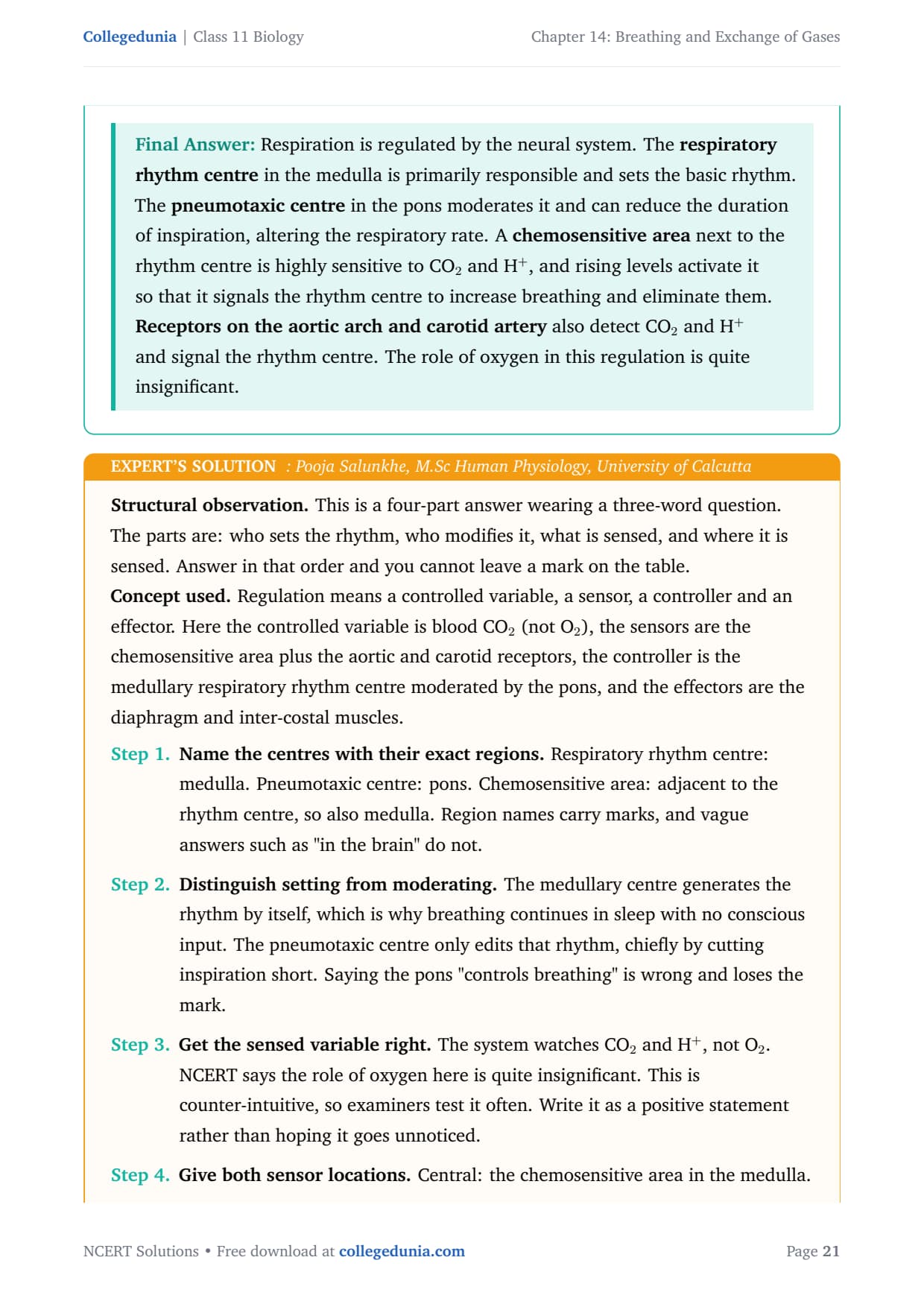
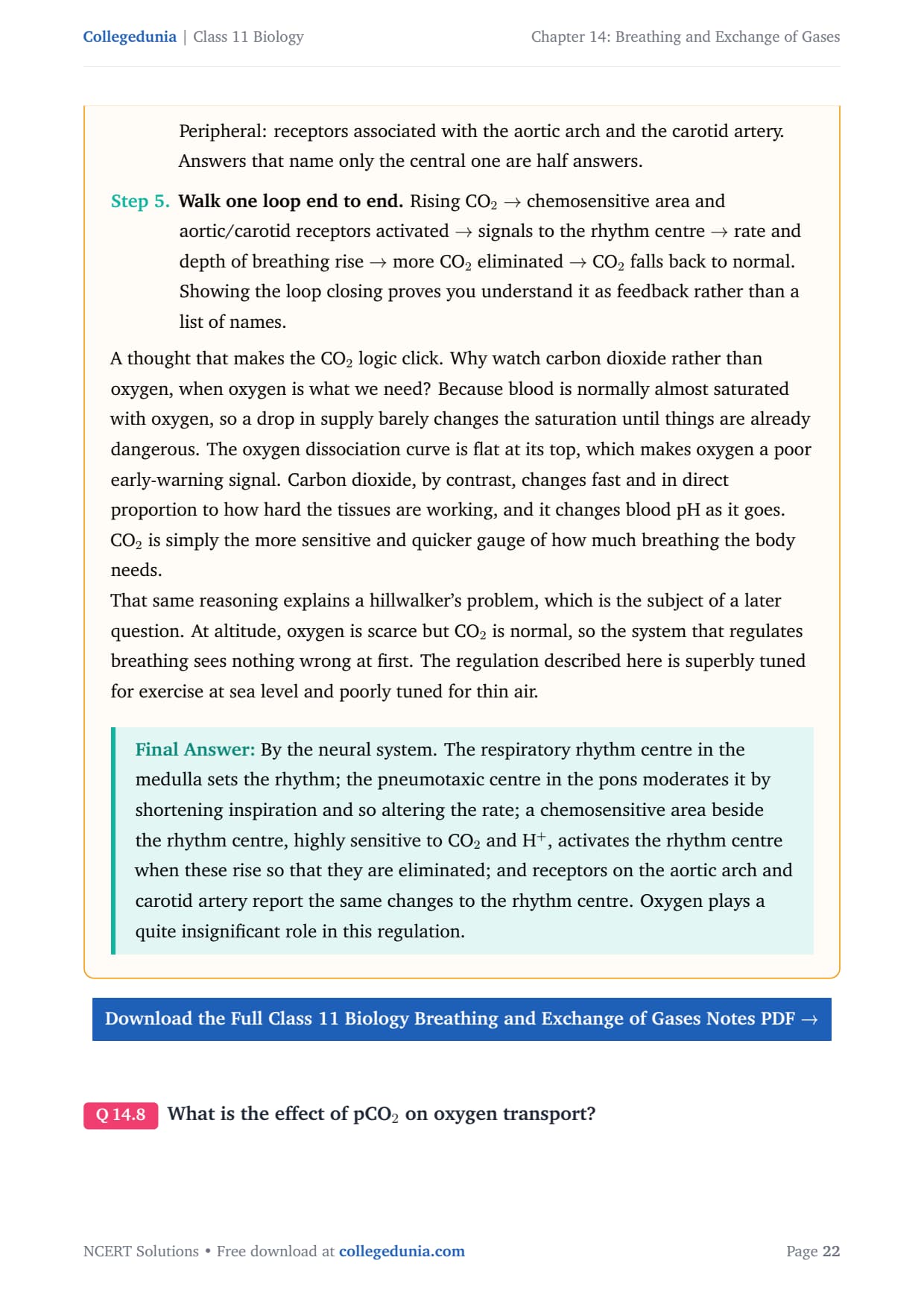
Human beings can moderate the respiratory rhythm to suit the demands of the tissues, and this is done by the neural system. Three neural structures and one chemical signal do the work, and the surprising point that NCERT stresses is that the role of oxygen in this regulation is quite insignificant. The system watches carbon dioxide, not oxygen, because CO2 changes fast and in proportion to how hard the tissues are working.
- Respiratory rhythm centre: in the medulla, it sets the basic rhythm of breathing on its own.
- Pneumotaxic centre: in the pons, it moderates the rhythm centre and can reduce the duration of inspiration.
- Chemosensitive area and receptors: a chemosensitive area next to the rhythm centre, plus receptors on the aortic arch and carotid artery, detect a rise in CO2 and H+ and signal the rhythm centre to increase breathing.
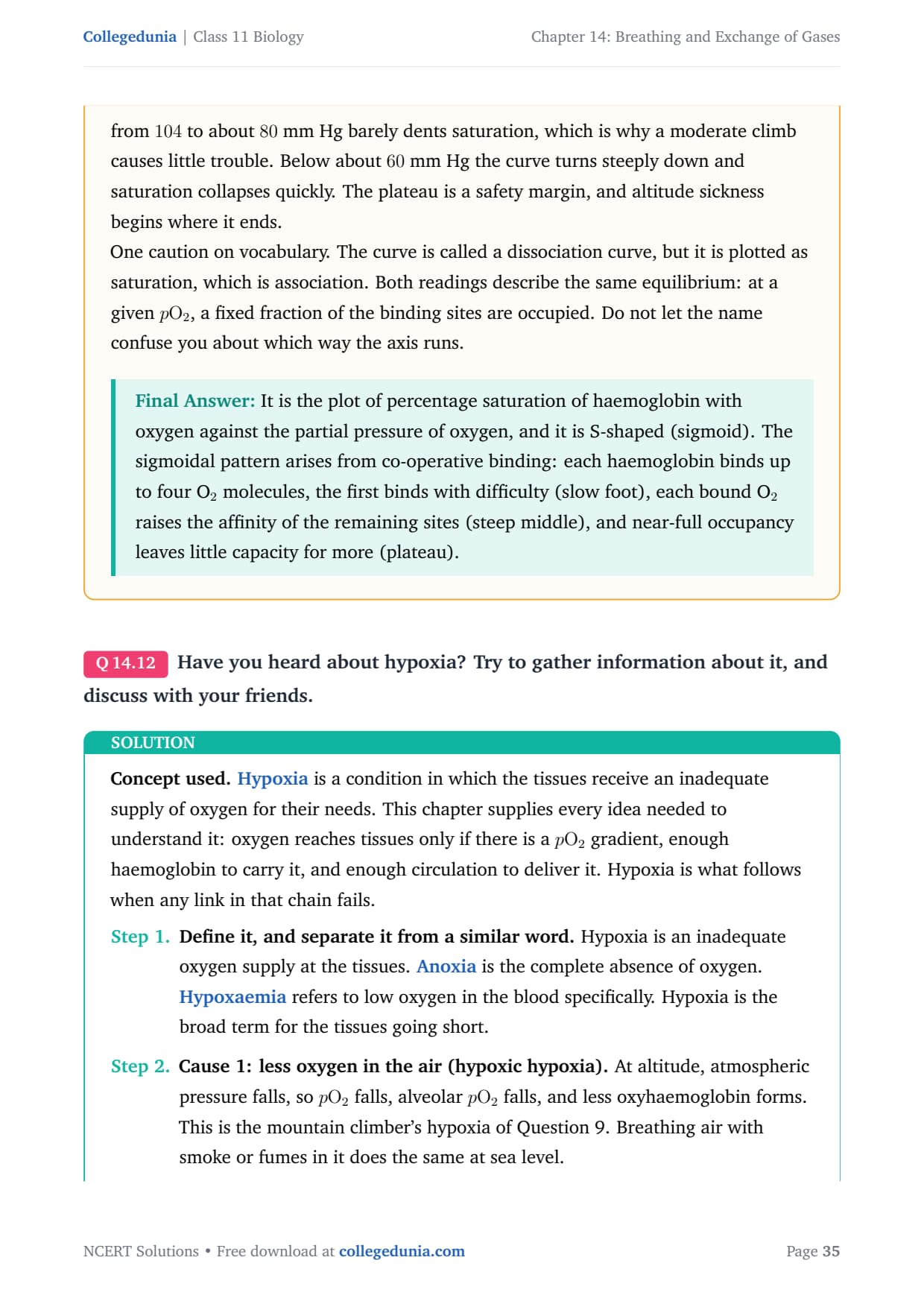
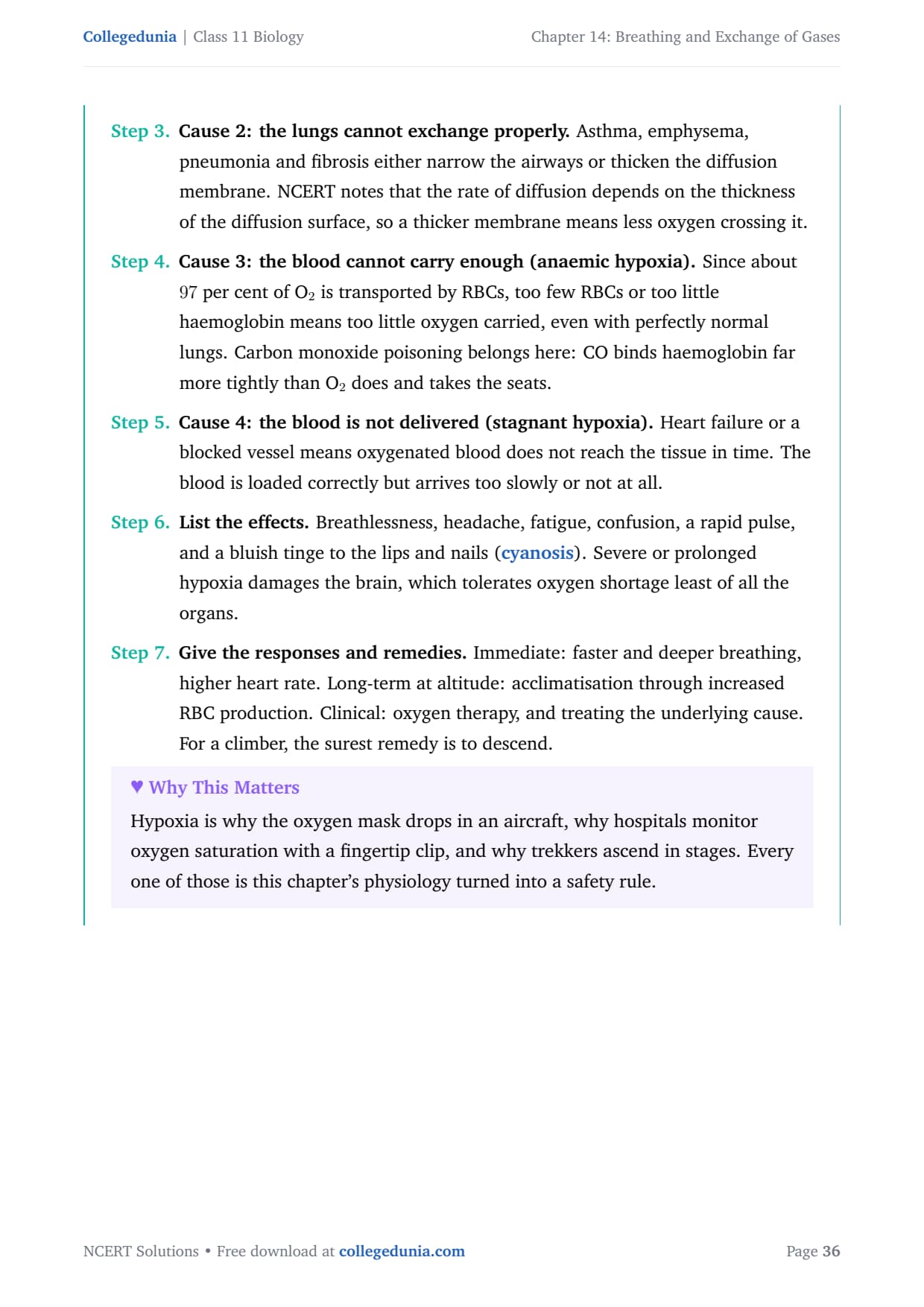
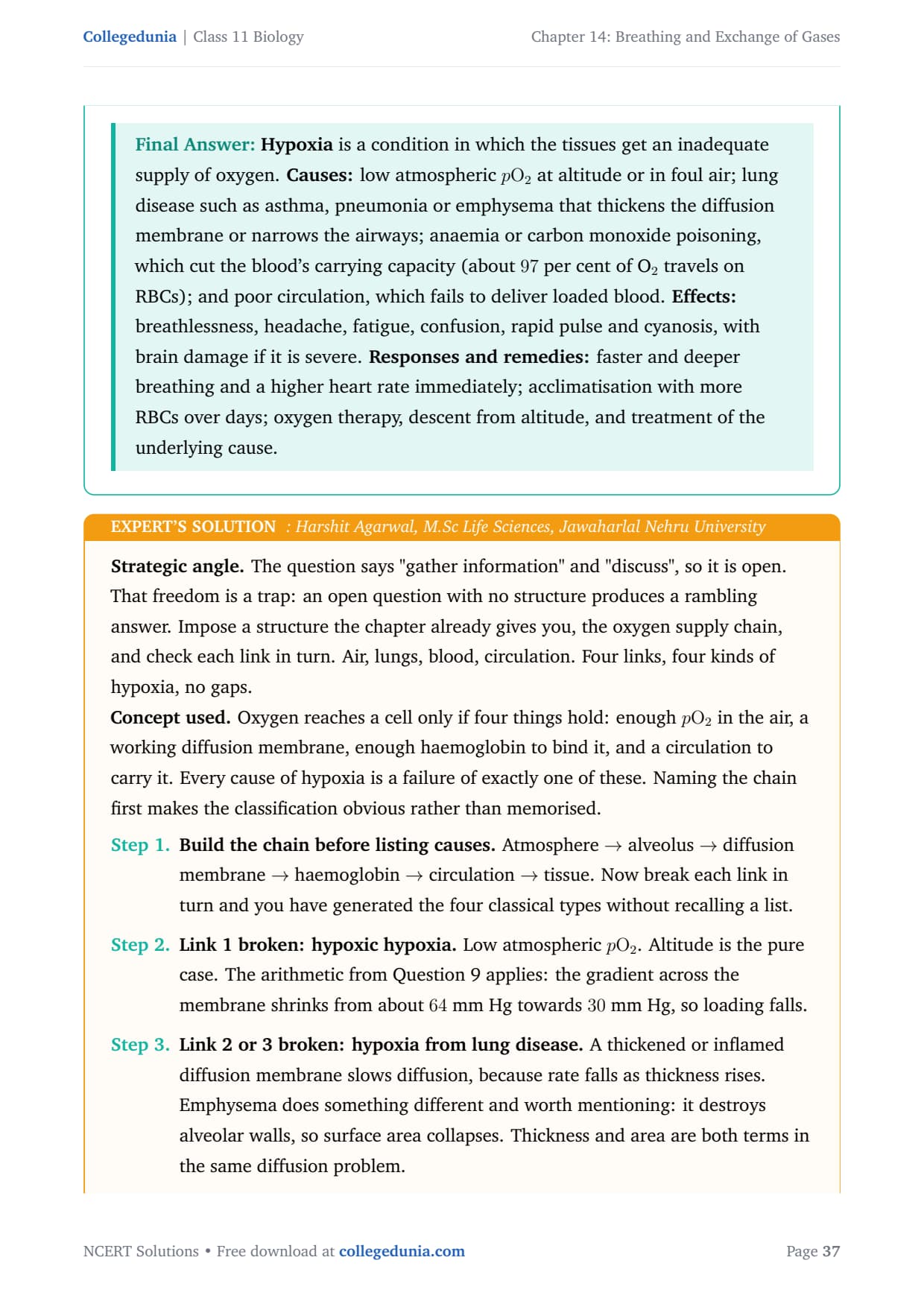
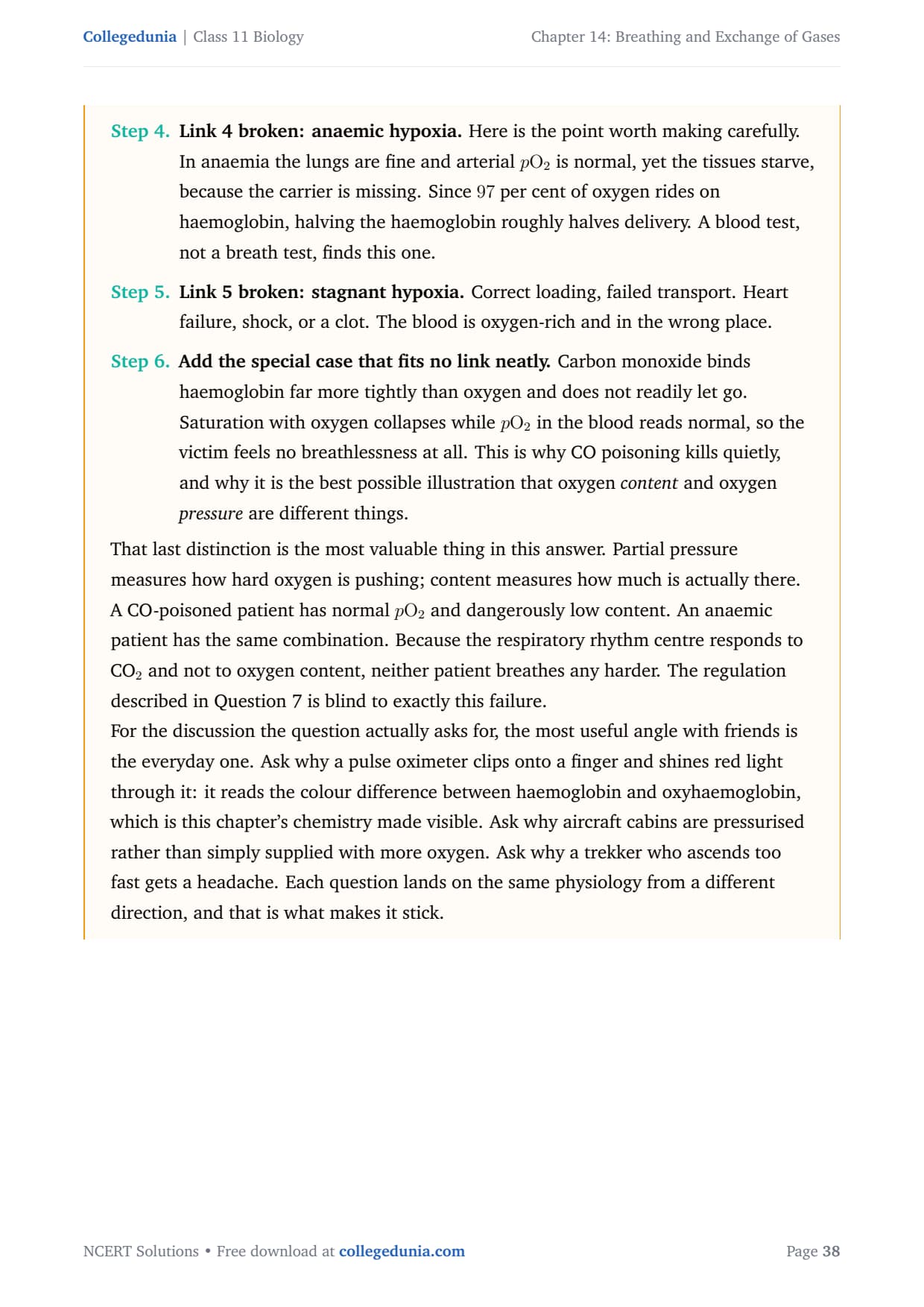
Altitude tests this system. As a person climbs, atmospheric pressure falls, so pO2 falls even though air is still about 21 per cent oxygen. Alveolar pO2 drops, the gradient driving oxygen into blood shrinks, less oxyhaemoglobin forms, and the tissues face hypoxia. The immediate response is faster, deeper breathing and a raised heart rate, felt as breathlessness and fatigue, while a longer stay triggers acclimatisation through increased RBC production. Hypoxia can arise anywhere in the oxygen supply chain, from low pO2 in the air, to lung disease that thickens the diffusion membrane, to anaemia or carbon monoxide poisoning that cut the blood's carrying capacity, to poor circulation that fails to deliver loaded blood.
Breathing and Exchange of Gases Exercise-wise Breakdown
The NCERT back exercise has 14 questions, blending definitions, numericals on lung volumes and reasoning on diffusion and transport. The table below maps the question blocks to their topics so students can plan practice by theme.
| Question block | What it tests |
|---|---|
| Q 1 to Q 2 | Vital capacity and its significance, and the air remaining after a normal breath (FRC). |
| Q 3 to Q 5 | Why diffusion is limited to the alveoli, the major transport mechanisms for CO2, and comparing atmospheric with alveolar partial pressures. |
| Q 6 to Q 7 | The process of inspiration under normal conditions and the regulation of respiration. |
| Q 8 to Q 10 | The effect of pCO2 on oxygen transport, respiration on a hill, and the site of gas exchange in an insect. |
| Q 11 to Q 14 | The oxygen dissociation curve, hypoxia, distinguishing volumes and capacities, and tidal volume per hour. |
Because the numericals reuse one small data set, the marks sit in stating the formula, substituting the standard values and tracking the units. Learn the four base volumes and the two partial-pressure lines, then derive the rest rather than recalling it. Every question in the class 11 biology NCERT solutions chapter 14 Breathing and Exchange of Gases PDF is solved with each step shown, so students can compare their working against the model answer.
Practice the solved questions: Work through the full question bank with step-by-step answers and expert tips.
Breathing and Exchange of Gases Class 11 Solved Practice Questions
Common Mistakes Students Make in Breathing and Exchange of Gases
Most marks in this chapter are lost on small slips of wording and on reading the adjective in a question. Each mistake below costs 1 to 2 marks, so watch for it at the exact step.
Mistake 1: Answering "residual volume" for the air left after a normal breath. A normal expiration is not forced, so the expiratory reserve volume is still inside the lungs, and the correct answer is the functional residual capacity, ERV plus RV.
Mistake 2: Writing that vital capacity is measured and total lung capacity is calculated. Both are capacities and both are sums, and the real difference is that TLC includes residual volume while VC does not.
Mistake 3: Saying respiration is regulated by oxygen. The system responds to CO2 and H+, and NCERT states the role of oxygen is quite insignificant.
Mistake 4: Claiming that mountain air has a smaller percentage of oxygen. The percentage is unchanged at altitude, but the lower atmospheric pressure lowers the partial pressure of oxygen.
Student Feedback on Breathing and Exchange of Gases Solutions
What 12,400 students told us about their Breathing and Exchange of Gases preparation:
- 64% of students said the respiratory volumes and capacities were the part they most often confused before practising the additions.
- Most-skipped detail: reading the adjective "normal" versus "forced" in a question, missed by about 3 in 10 students.
- Students who learned the partial-pressure table as two lines said every diffusion question became a quick comparison.
Source: 2026-27 Class 11 Biology student poll. Sample of 12,400 students from CBSE schools across 16 states, conducted before the 2026 boards.
Other Breathing and Exchange of Gases Class 11 Biology Resources
Pair these solutions with the revision notes, formula sheet and NCERT textbook PDF for the same chapter.
| Resource | Link |
|---|---|
| NCERT Notes | Breathing and Exchange of Gases Class 11 Notes |
| Formula Sheet | Breathing and Exchange of Gases Class 11 Formula Sheet |
| NCERT Book PDF | Breathing and Exchange of Gases Class 11 Book PDF |
NCERT Solutions for Class 11 Biology: All Chapters
Jump to the step-by-step solutions for any other Class 11 Biology chapter below.
| Chapter | NCERT Solutions |
|---|---|
| Chapter 1 | The Living World |
| Chapter 2 | Biological Classification |
| Chapter 3 | Plant Kingdom |
| Chapter 4 | Animal Kingdom |
| Chapter 5 | Morphology of Flowering Plants |
| Chapter 6 | Anatomy of Flowering Plants |
| Chapter 7 | Structural Organisation in Animals |
| Chapter 8 | Cell: The Unit of Life |
| Chapter 9 | Biomolecules |
| Chapter 10 | Cell Cycle and Cell Division |
| Chapter 11 | Photosynthesis in Higher Plants |
| Chapter 12 | Respiration in Plants |
| Chapter 13 | Plant Growth and Development |
| Chapter 14 | Breathing and Exchange of Gases |
| Chapter 15 | Body Fluids and Circulation |
| Chapter 16 | Excretory Products and their Elimination |
| Chapter 17 | Locomotion and Movement |
| Chapter 18 | Neural Control and Coordination |
| Chapter 19 | Chemical Coordination and Integration |
FAQs on Breathing and Exchange of Gases Class 11 NCERT Solutions
Breathing and Exchange of Gases NCERT Solutions - Frequently Asked Questions
Ques. What do the class 11 biology NCERT solutions chapter 14 Breathing and Exchange of Gases cover?
Ans. These solutions solve every back-exercise question, including vital capacity and the other lung volumes and capacities, the mechanism of inspiration, why diffusion happens only at the alveoli, the partial pressures of O2 and CO2, the transport of both gases, the oxygen dissociation curve, the effect of pCO2 on oxygen transport, respiration at altitude, hypoxia and gas exchange in insects. Every answer is worked step by step.
Ques. How do you calculate vital capacity in Class 11 Biology?
Ans. Vital capacity is the maximum volume of air a person can breathe in after a forced expiration, or out after a forced inspiration. It is the sum of three volumes, VC = ERV + TV + IRV = (1000 to 1100) + 500 + (2500 to 3000) = 4000 to 4600 mL, roughly 4.0 to 4.6 litres. It excludes the residual volume, the air that can never be exhaled.
Ques. Why does diffusion of gases occur only in the alveolar region?
Ans. The alveolar wall is a diffusion membrane under a millimetre thick, the alveoli offer an enormous surface area, they are wrapped in pulmonary capillaries, and a steep pressure gradient exists across them. The trachea, bronchi and bronchioles have thick cartilage-supported walls, no capillary bed on the far side and no gradient, so they only conduct air.
Ques. How is carbon dioxide transported in the blood?
Ans. Carbon dioxide is carried in three ways. Around 70 per cent travels as bicarbonate, formed by carbonic anhydrase in RBCs through CO2 + H2O → H2CO3 → HCO3- + H+. About 20 to 25 per cent is carried as carbamino-haemoglobin, and about 7 per cent dissolves in plasma. Together they deliver roughly 4 mL of CO2 per 100 mL of deoxygenated blood.
Ques. How is respiration regulated in humans?
Ans. The respiratory rhythm centre in the medulla sets the basic rhythm, the pneumotaxic centre in the pons moderates it, and a chemosensitive area next to the rhythm centre, along with receptors on the aortic arch and carotid artery, responds to rising CO2 and H+ and signals the rhythm centre to increase breathing. The role of oxygen in this regulation is quite insignificant.
Ques. What is the weightage of Breathing and Exchange of Gases in CBSE Class 11 Biology?
Ans. Breathing and Exchange of Gases carries about 3 to 4 marks in the CBSE Class 11 Biology paper, through short-answer and numerical questions on lung volumes, diffusion and gas transport. It is also a high-yield chapter for NEET, where questions on partial pressures, the oxygen dissociation curve and the regulation of respiration appear regularly.



Comments