




The class 11 biology NCERT solutions chapter 5 Morphology of Flowering Plants cover every back-exercise question, according to the latest 2026-27 CBSE syllabus, and help students prepare for the CBSE Boards, NEET and CUET. Each answer is worked step by step, from compound leaves and phyllotaxy to inflorescence, the parts of a flower, placentation, the floral formula of the Solanaceae, and the structure of dicot and monocot seeds.
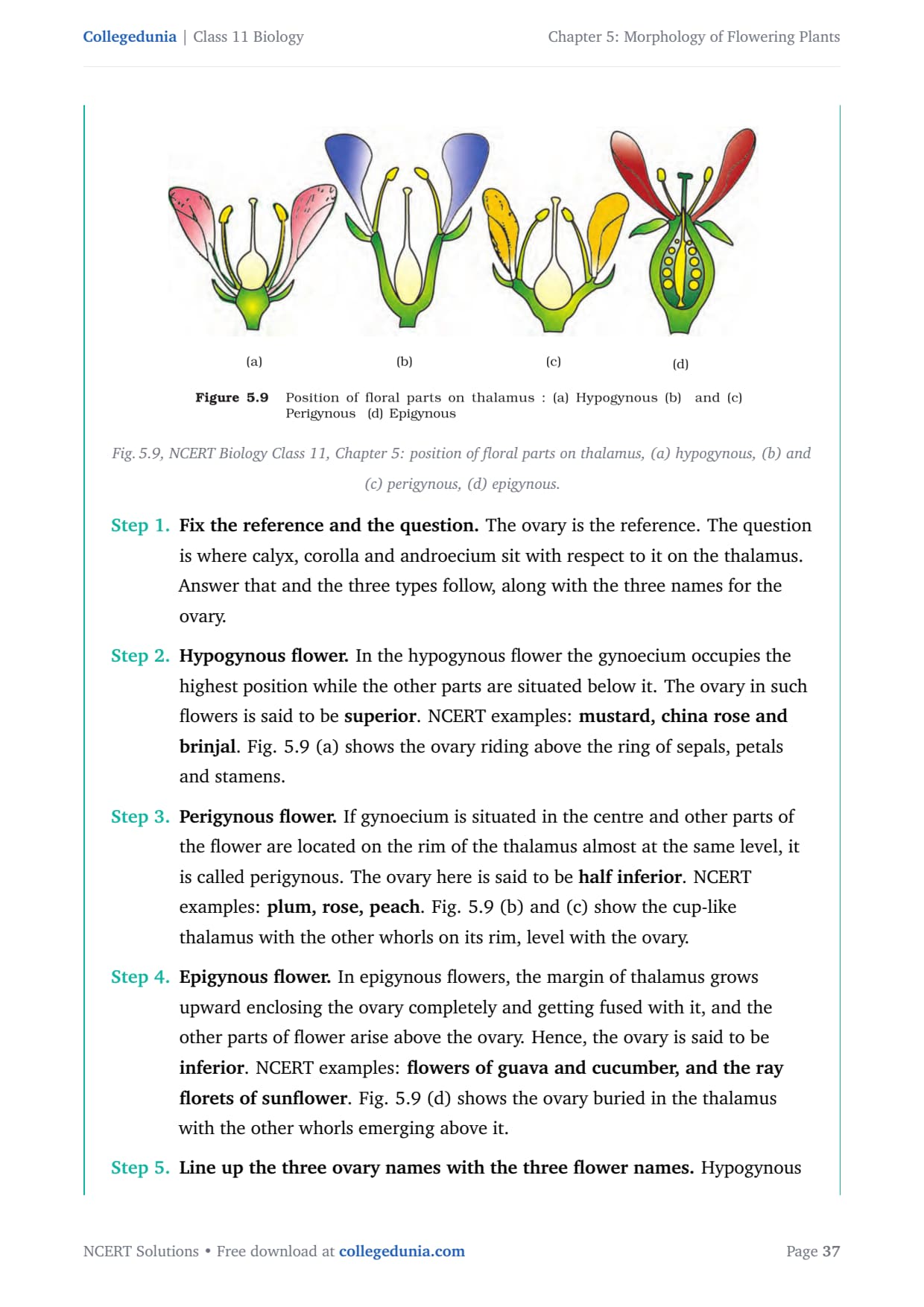
This chapter is heavy on vocabulary and diagrams, so the solutions define each term precisely and pair it with the example NCERT uses.
- CBSE Weightage: 5 to 6 marks, a core chapter of the Structural Organisation in Plants and Animals unit.
- Topics covered: the root, stem and leaf, venation and phyllotaxy, the inflorescence, the flower and its four whorls, aestivation, placentation, the floral formula and diagram, families of angiosperms, and seed structure in dicots and monocots.
- Exercise count: 10 back-exercise questions, mostly descriptive definitions, differentiations and two labelled-diagram tasks.
These class 11 biology NCERT solutions chapter 5 Morphology of Flowering Plants are curated by subject experts, based on the 2026-27 NCERT textbook, and checked against the last five years of CBSE Board and NEET papers.
Why Morphology of Flowering Plants Matters and What It Covers
Chapter 5 gives students the descriptive language of the flowering plant, the words a botanist uses to record what a plant looks like. The chapter matters because every later topic in plant biology, from anatomy to reproduction, assumes these terms. A student who can read a floral formula or name a placentation type on sight saves time in the exam and rarely loses marks to a wrong definition. This is also one of the highest-scoring chapters in NEET, since most of its questions are single-fact recall.
- Everyday role: morphology is how a farmer names a crop variety, a gardener identifies a family, and a botanist keys out an unknown plant.
- Core skill: describing a plant part by part and condensing a whole flower into a compact floral formula and diagram.
- Why it is high-yield: definitions such as aestivation, placentation and perigynous flower are asked almost every year and cost nothing but memory.
Almost every question in this chapter is a precise definition attached to a named example, so the marks sit in exact wording. That is why students who learn each term with its NCERT example find the whole chapter light. The class 11 biology NCERT solutions chapter 5 Morphology of Flowering Plants below follow the NCERT order so students can check their answers line by line.
The Leaf: Compound Leaves and Phyllotaxy
Questions 1 and 2 open the exercise with the leaf. Question 1 asks how a pinnately compound leaf differs from a palmately compound one, and Question 2 asks about the types of phyllotaxy. A compound leaf is one whose lamina is divided into several leaflets, and the two kinds differ in where those leaflets are attached. Phyllotaxy is the separate idea of how whole leaves are arranged on the stem.
| Term | Description and example |
|---|---|
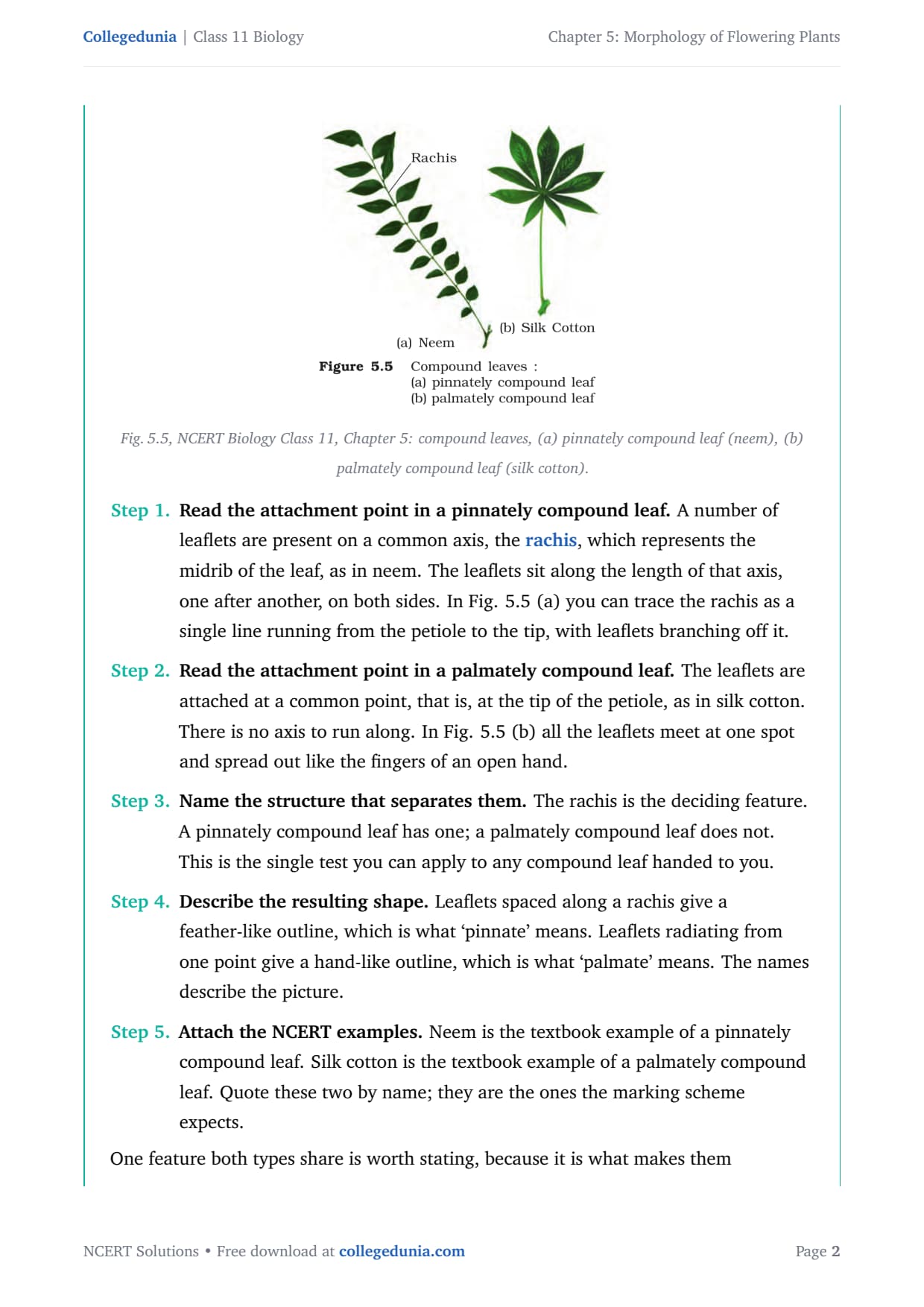
| Pinnately compound | Leaflets borne on a common axis, the rachis, which represents the midrib, giving a feather-like look (neem). |
| Palmately compound | No rachis; leaflets all attached at the tip of the petiole and radiating like fingers (silk cotton). |
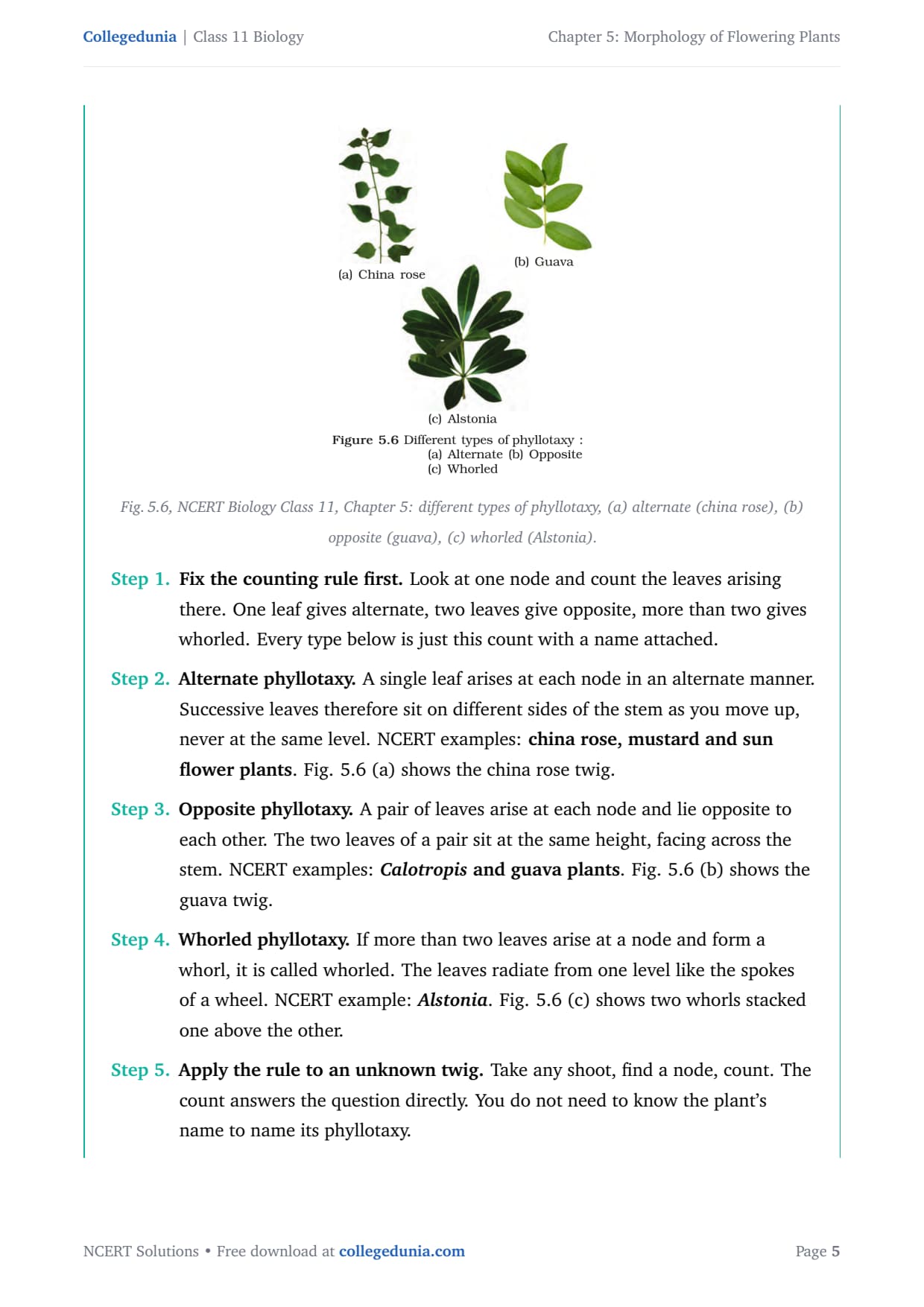
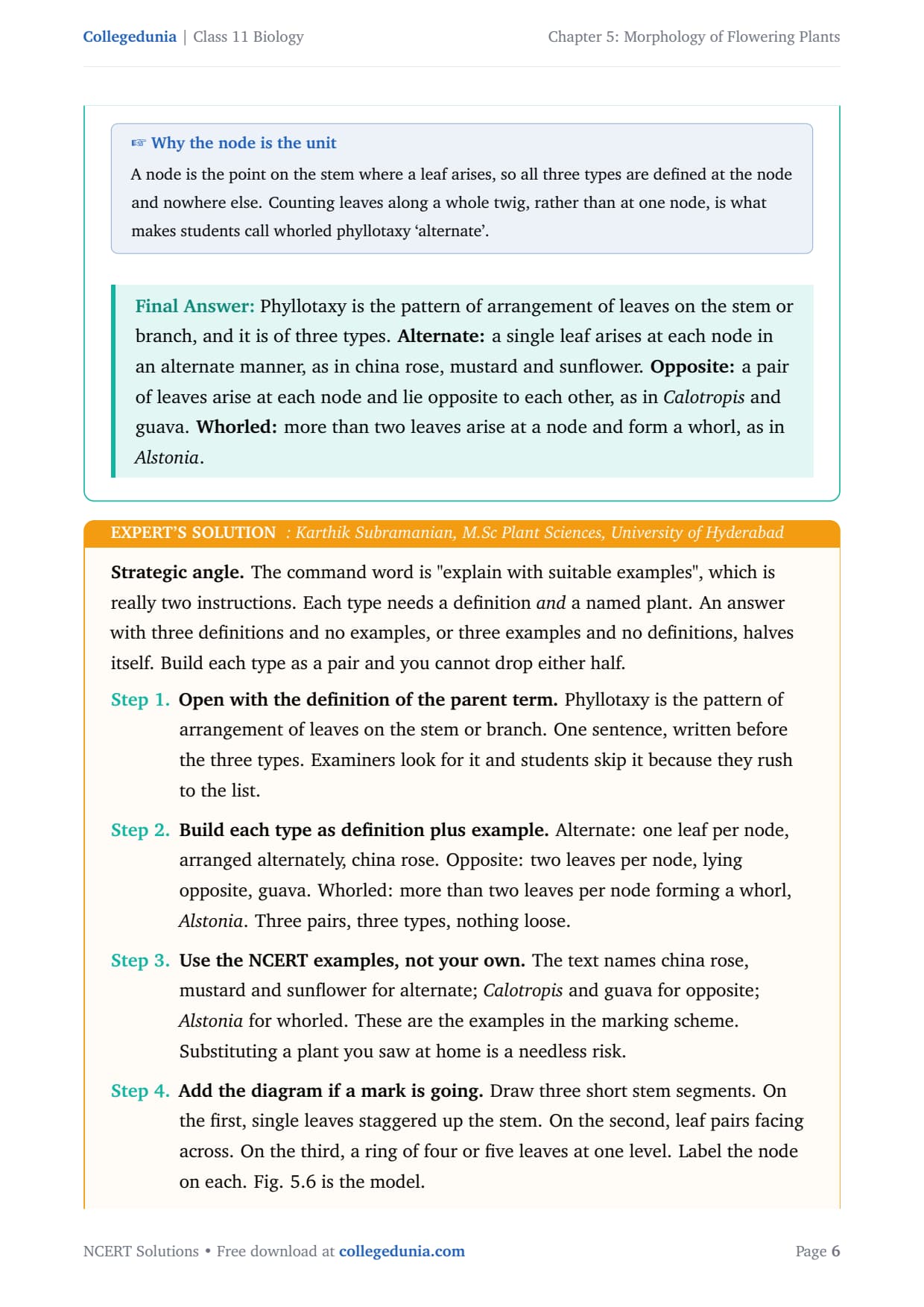
| Alternate phyllotaxy | A single leaf at each node in an alternate manner (china rose, mustard, sunflower). |
| Opposite phyllotaxy | A pair of leaves at each node, lying opposite each other (Calotropis, guava). |
| Whorled phyllotaxy | More than two leaves at a node forming a whorl (Alstonia). |
The single fact that separates the two compound-leaf types is the rachis: a pinnately compound leaf has one and a palmately compound leaf does not. Keeping compound-leaf type and phyllotaxy apart is important, because one describes a single leaf while the other describes how many leaves sit at a node. Refer to Exercise Q1 and Q2 for the full step-by-step reasoning with labelled examples.
The Flower: Parts and Symmetry
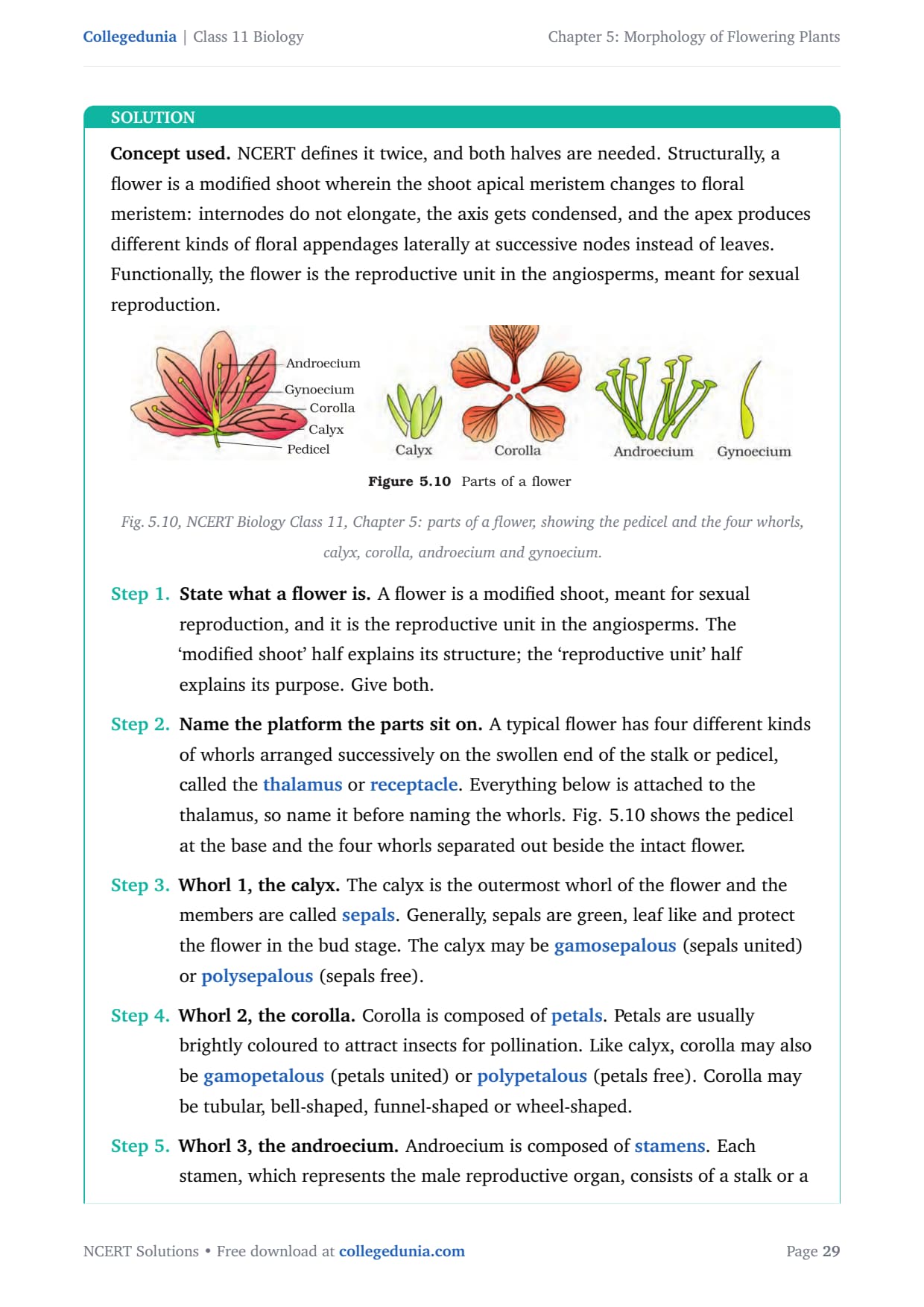
Question 8 asks what a flower is and to describe the parts of a typical angiosperm flower, and Question 3 defines the symmetry terms. A flower is a modified shoot in which the shoot apical meristem changes into a floral meristem, the internodes stop elongating, and the condensed axis bears floral appendages instead of leaves. It is the reproductive unit of angiosperms, and it carries four whorls on the swollen tip of the pedicel, the thalamus.
- Calyx: the outermost whorl of sepals, usually green and leaf-like, protecting the flower in the bud.
- Corolla: the whorl of petals, usually brightly coloured to attract insects for pollination.
- Androecium: the male whorl of stamens, each with a filament and a bilobed anther holding pollen; a sterile stamen is a staminode.
- Gynoecium: the female whorl of one or more carpels, each with a stigma, style and ovary bearing ovules.
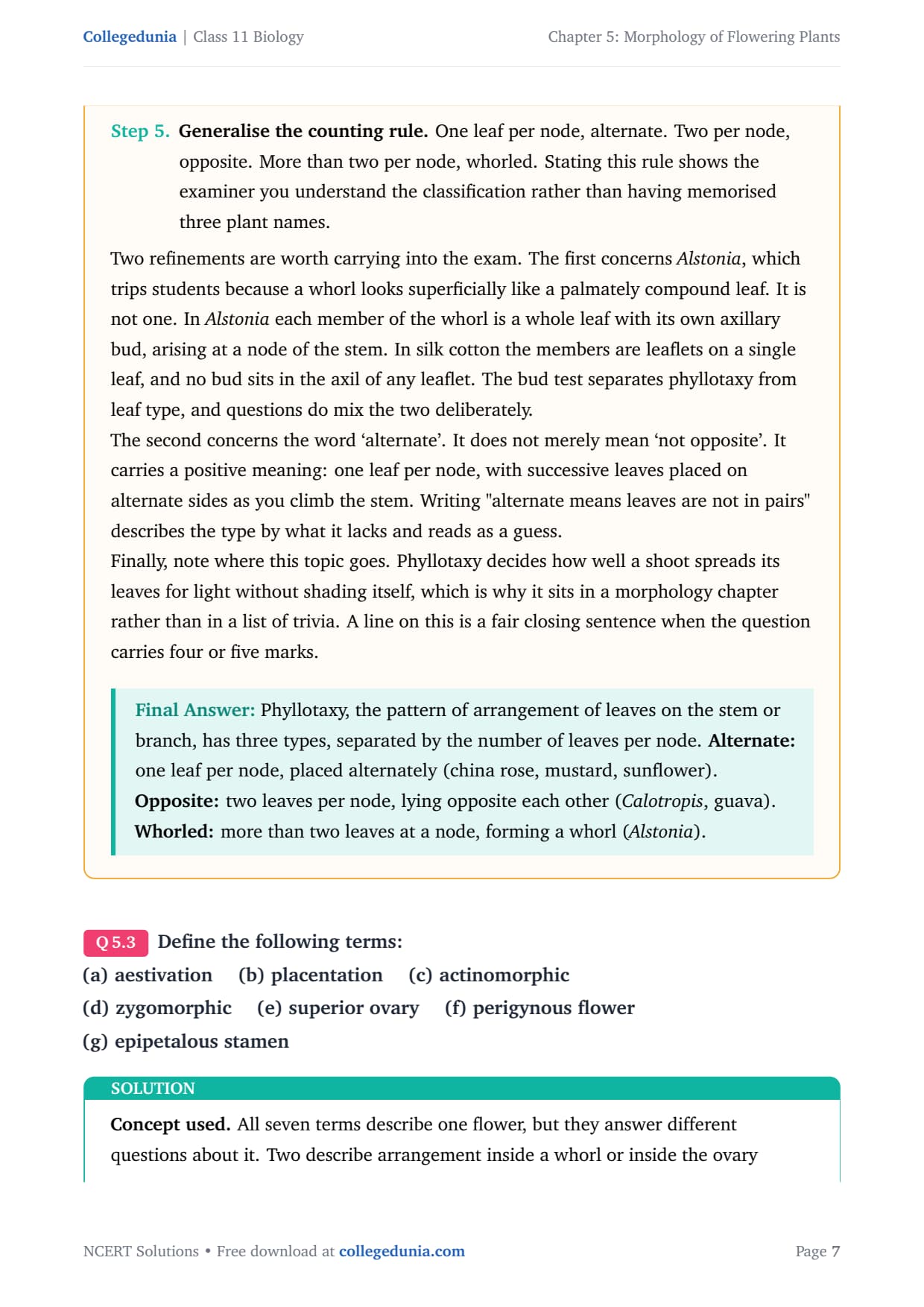
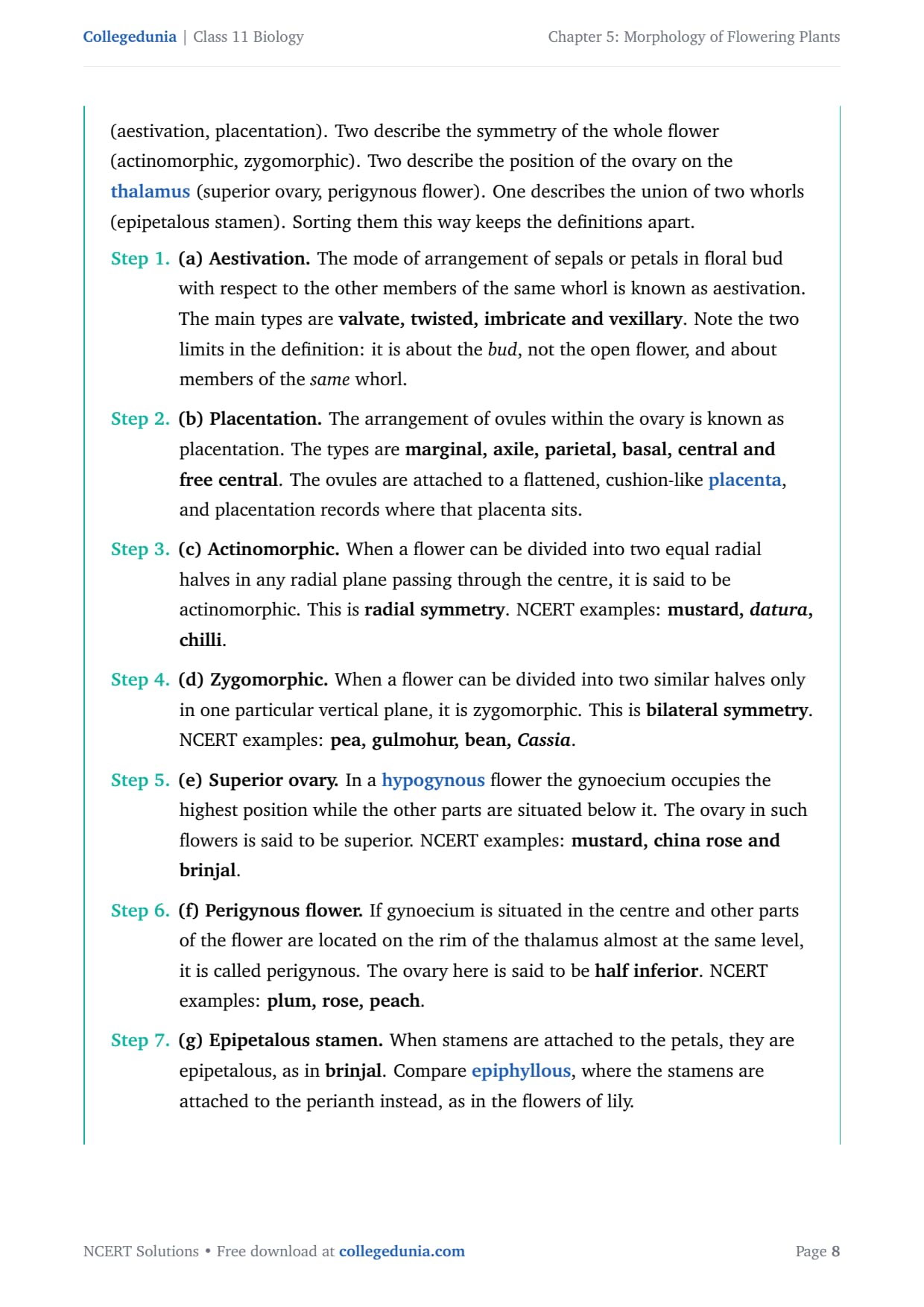
Calyx and corolla are accessory organs, while androecium and gynoecium are the reproductive organs; in flowers such as lily, where calyx and corolla are not distinct, they are together called the perianth. On symmetry, an actinomorphic flower can be divided into two equal radial halves by any plane through the centre (mustard, chilli, datura), while a zygomorphic flower divides into two similar halves in only one vertical plane (pea, gulmohur, Cassia). These two terms alone answer a common one-mark question.
Inflorescence: Racemose and Cymose Types
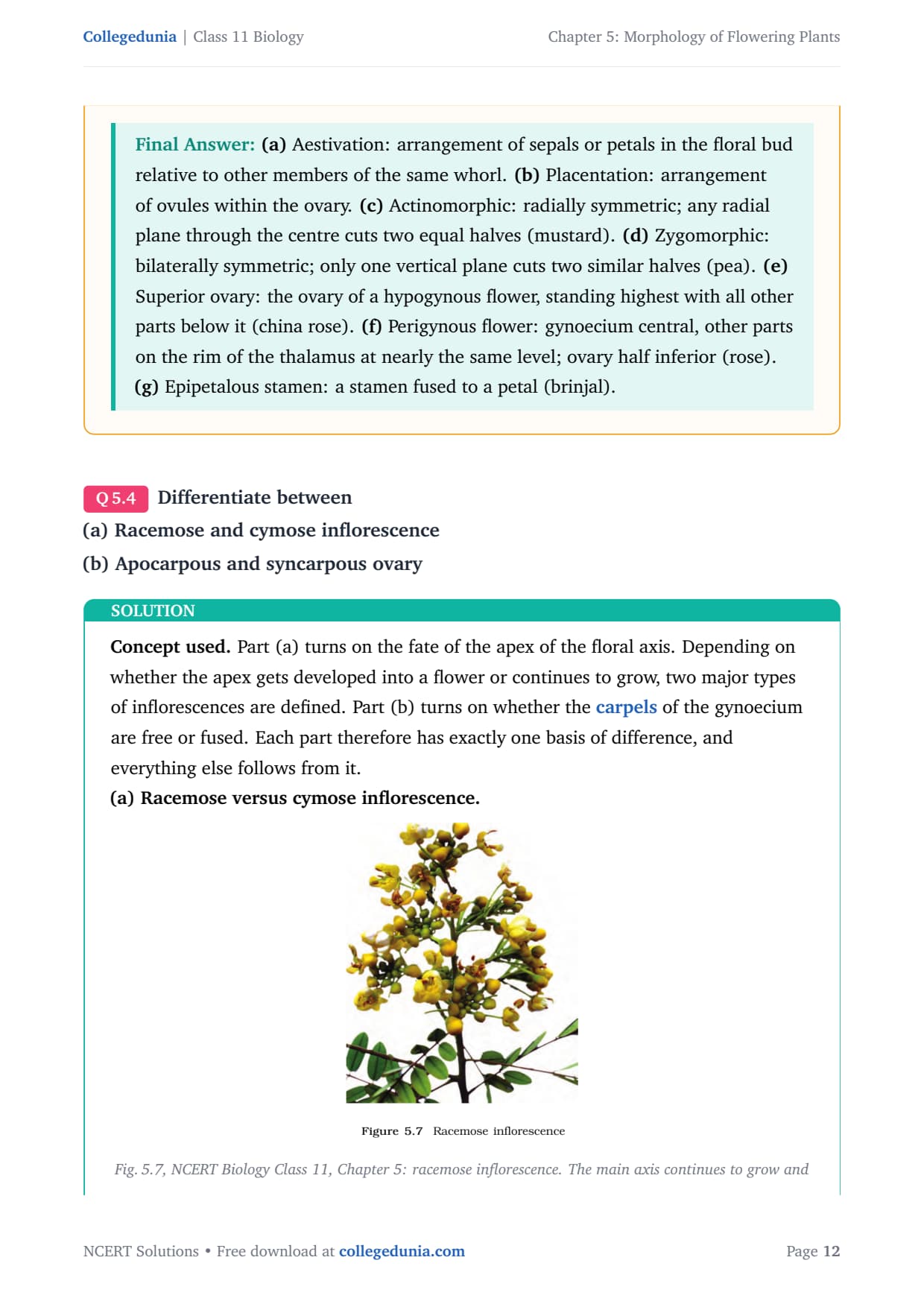
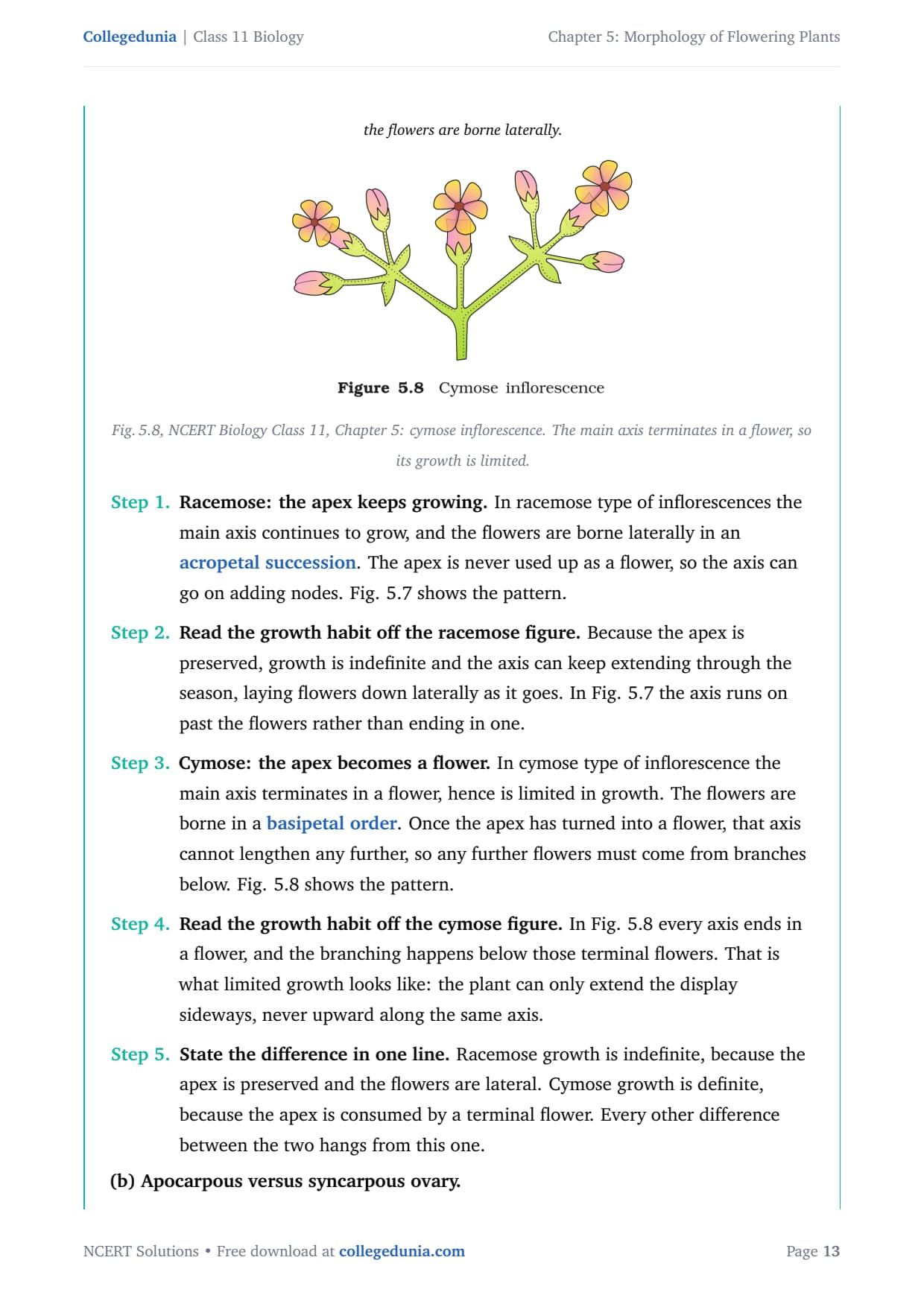
Question 9 asks for a definition of inflorescence and the basis of its types, and Question 4 asks students to differentiate the two. An inflorescence is the arrangement of flowers on the floral axis. The single basis for classifying it is whether the apex of the main axis keeps growing or is itself used up to form a terminal flower. That one decision produces the two great classes of inflorescence.
| Feature | Racemose | Cymose |
|---|---|---|
| Main axis | Continues to grow, so growth is indefinite. | Terminates in a flower, so growth is limited. |
| Order of opening | Flowers borne laterally in acropetal succession (older below, younger above). | Flowers borne in basipetal order (older at the top or centre). |
| Apex fate | Apex stays vegetative and keeps adding flowers. | Apex is converted into the first flower. |
The whole difference between racemose and cymose inflorescence comes down to one thing: whether the growing tip becomes a flower. If the apex keeps growing, the arrangement is racemose and the flowers open from the base upward. If the apex is converted into a flower, the arrangement is cymose and the flowers open from the top or centre outward. Where a single shoot tip transforms into one flower with no further branching, the flower is described as solitary. This is a favourite reasoning question because the definition and the differentiation share the same underlying idea.
The Gynoecium: Ovary Position, Placentation and Aestivation
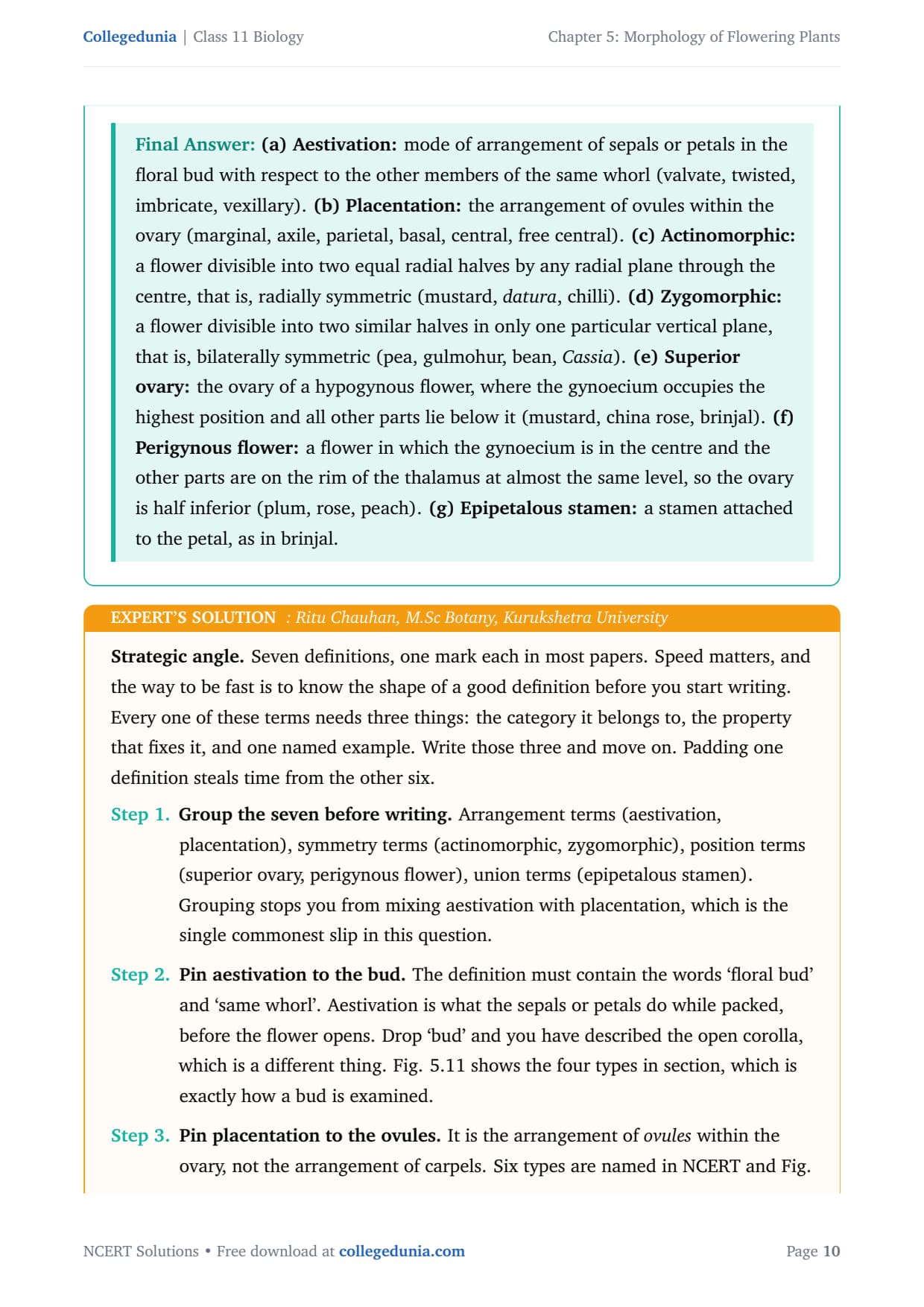
The female whorl generates several of the chapter's definitions. Question 10 asks how floral members are arranged in relation to their insertion on the thalamus, Question 7 asks for the types of placentation, and Question 3 defines aestivation along with superior ovary and perigynous flower. These ideas describe where the ovary sits and how the ovules are arranged inside it.
| Term | Meaning and example |
|---|---|
| Hypogynous (superior ovary) | Gynoecium highest, other parts below it; ovary superior (mustard, china rose, brinjal). |
| Perigynous (half inferior) | Gynoecium central, other parts on the thalamus rim at the same level (plum, rose, peach). |
| Epigynous (inferior ovary) | Thalamus encloses and fuses with the ovary, other parts arise above it (guava, cucumber, sunflower ray florets). |
| Marginal placentation | Placenta along the ventral suture, ovules in two rows (pea). |
| Axile placentation | Placenta axial, ovules on it in a multilocular ovary (china rose, tomato, lemon). |
| Parietal placentation | Ovules on the inner wall; ovary one-chambered, later two by a false septum (mustard, Argemone). |
| Free central and basal | Free central: ovules on a central axis, no septa (Dianthus). Basal: a single ovule at the ovary base (sunflower, marigold). |
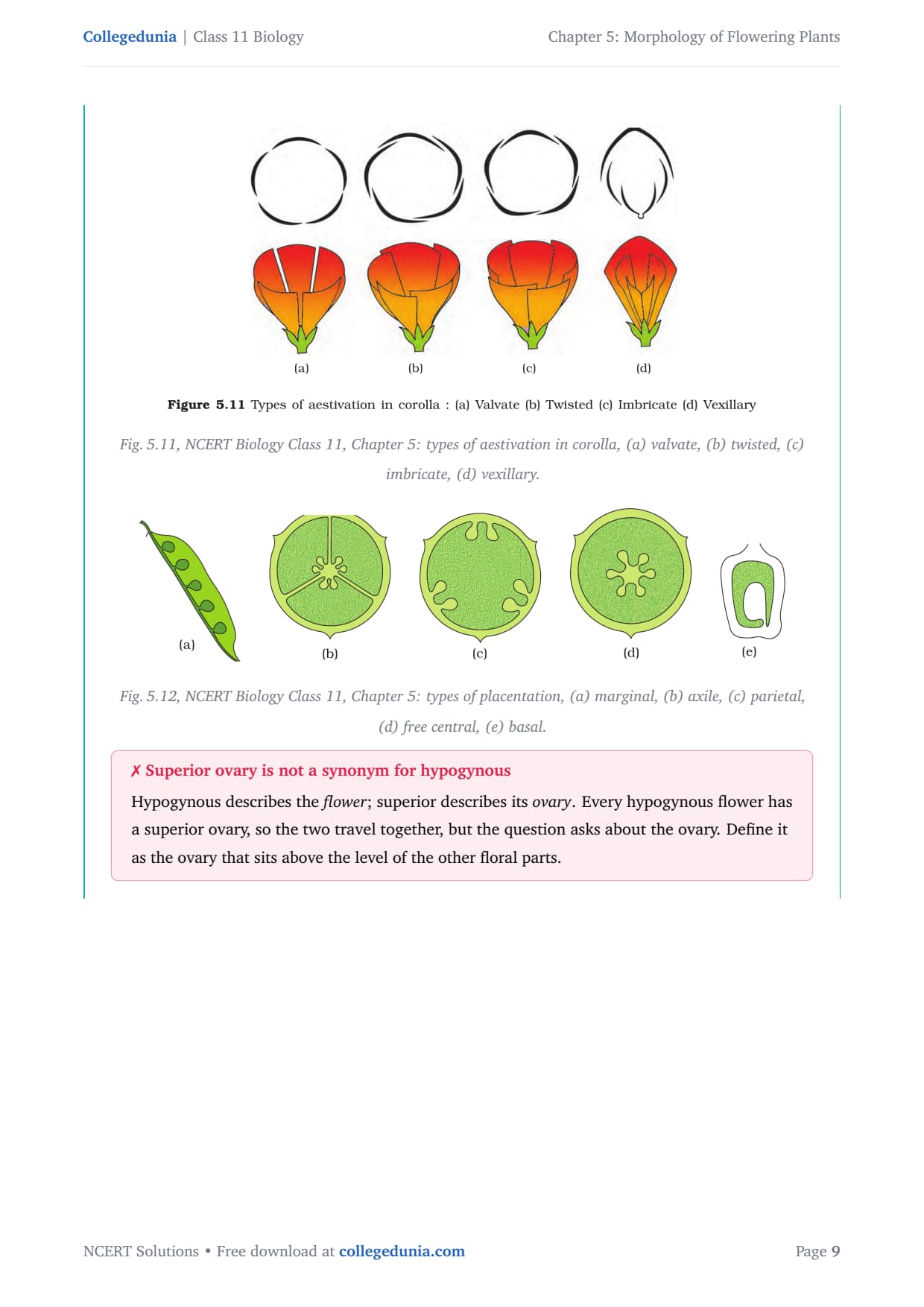
Aestivation is the mode of arrangement of sepals or petals in the floral bud with respect to the other members of the same whorl, and its types are valvate, twisted, imbricate and vexillary. Placentation is the arrangement of ovules within the ovary. Question 4 also distinguishes the ovary types: an apocarpous ovary has more than one free carpel (lotus, rose), while a syncarpous ovary has its carpels fused into one (mustard, tomato). Learning each term with its example is the fastest way to secure these marks.
Floral Formula and Semi-technical Description of the Solanaceae
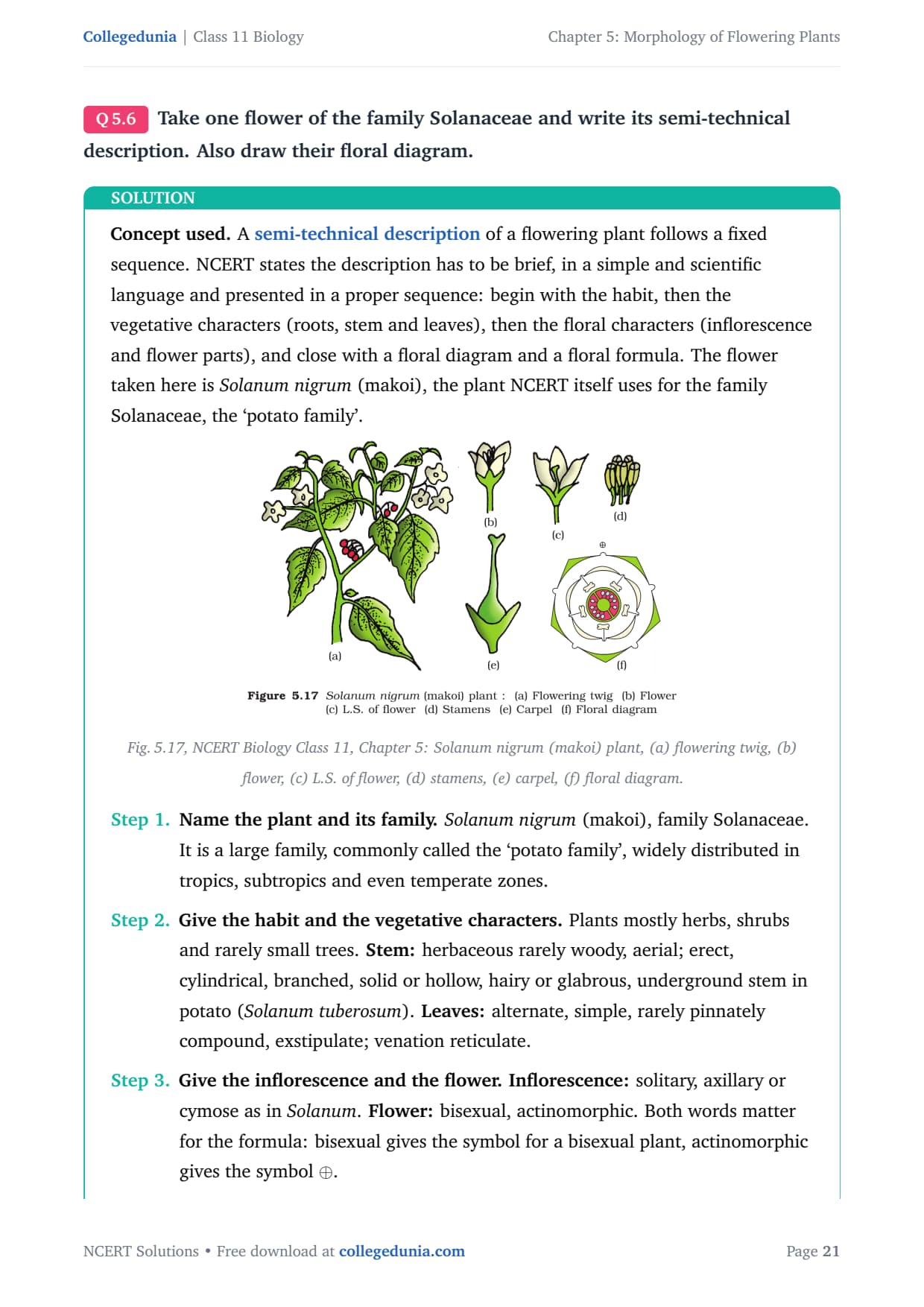
Question 6 asks students to take one flower of the family Solanaceae, write its semi-technical description, and draw its floral diagram. NCERT uses Solanum nigrum (makoi) as the model. A semi-technical description records the plant part by part in a fixed order, from habit down to the fruit and seed, and then condenses the flower into a floral formula. The description below is the one the exercise expects.
| Part | Solanaceae description |
|---|---|
| Habit and stem | Mostly herbs or shrubs; stem herbaceous, aerial, erect, cylindrical and branched. |
| Leaves | Alternate, simple, exstipulate, with reticulate venation. |
| Inflorescence and flower | Solitary, axillary or cymose; flower bisexual and actinomorphic. |
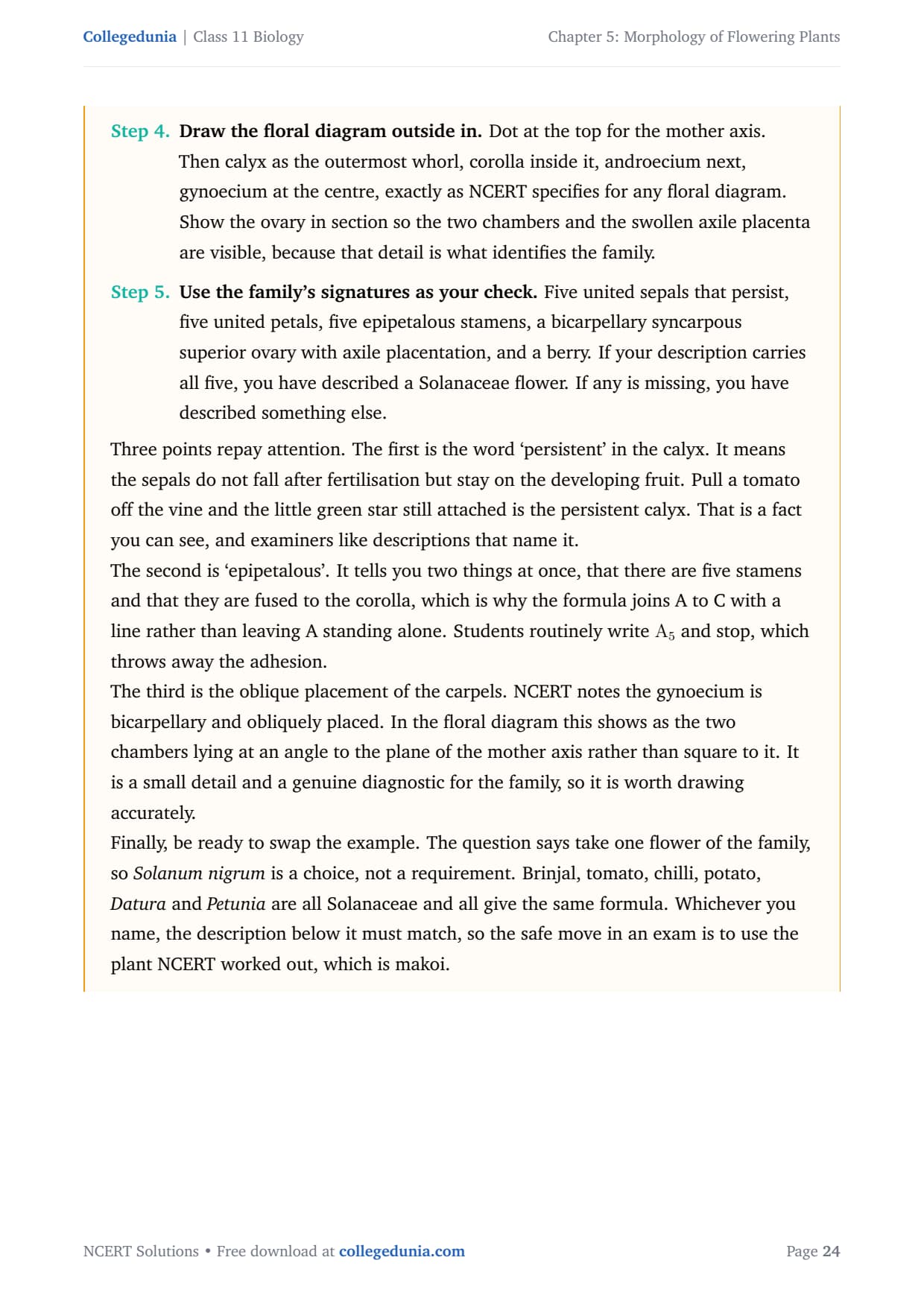
| Calyx and corolla | Five united sepals, persistent and valvate; five united petals, valvate. |
| Androecium | Five stamens, epipetalous (attached to the petals). |
| Gynoecium | Bicarpellary, syncarpous; ovary superior, bilocular, with axile placentation and many ovules. |
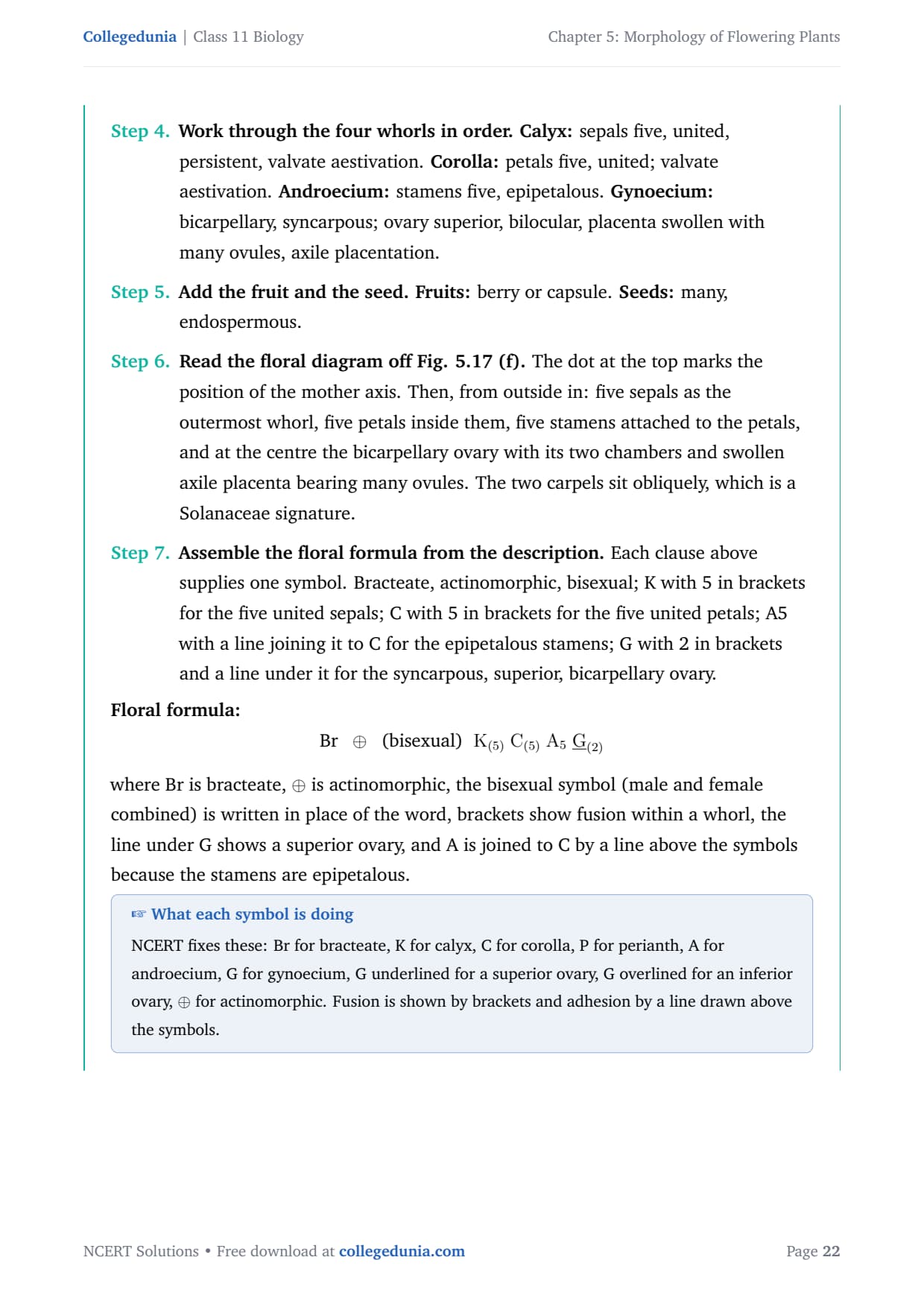
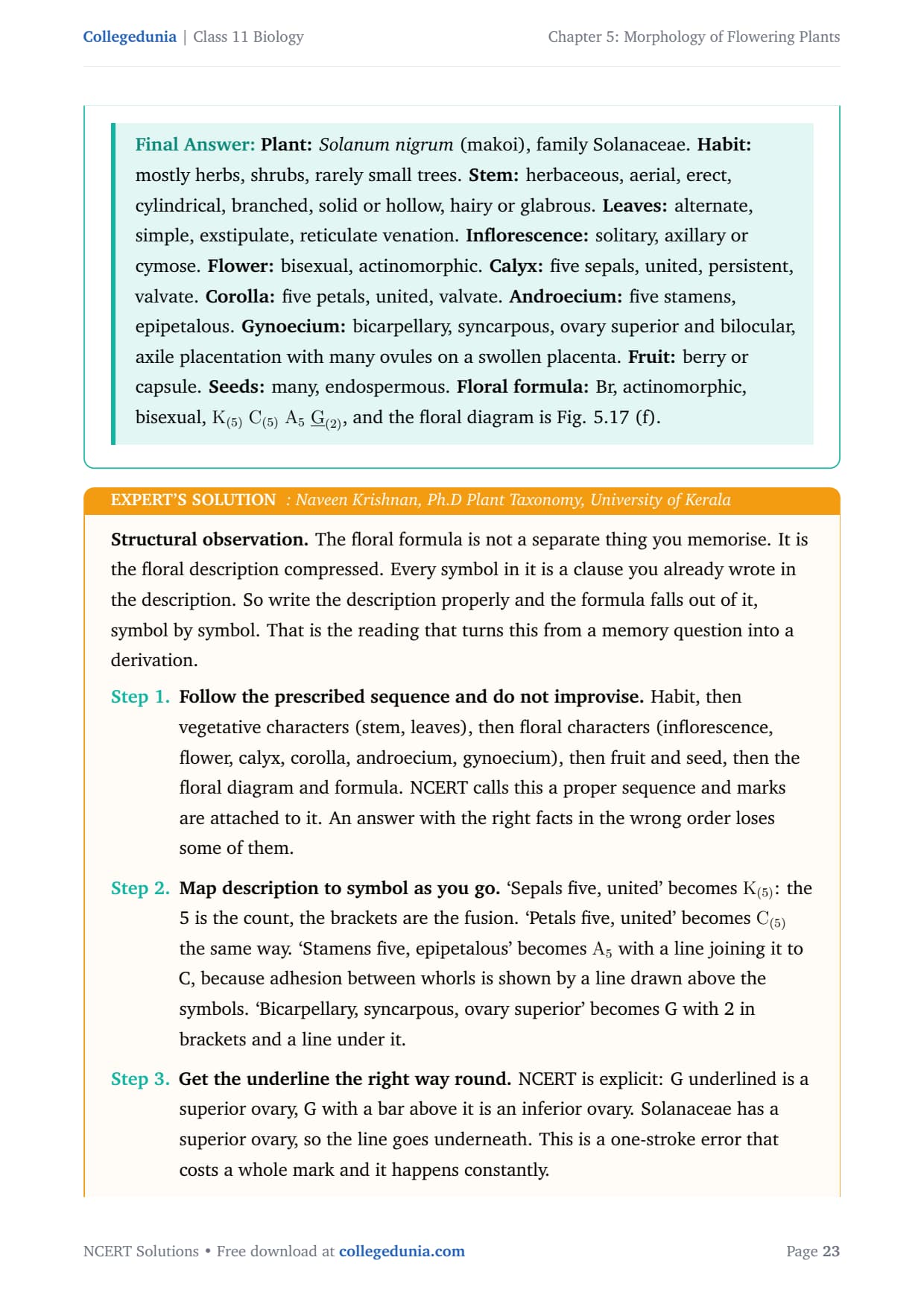
The whole flower condenses into the floral formula Br, actinomorphic, bisexual, K(5) C(5) A5 G(2), where the brackets show fusion and the line above G marks the superior ovary. The epipetalous condition, with five stamens joined to the united petals, is the signature of the Solanaceae and the point most often tested. The fruit is a berry or capsule and the seeds are many and endospermous. Drawing the floral diagram alongside the formula completes the answer and is worth practising, since the diagram carries marks of its own.
Seed Structure: Gram and Maize
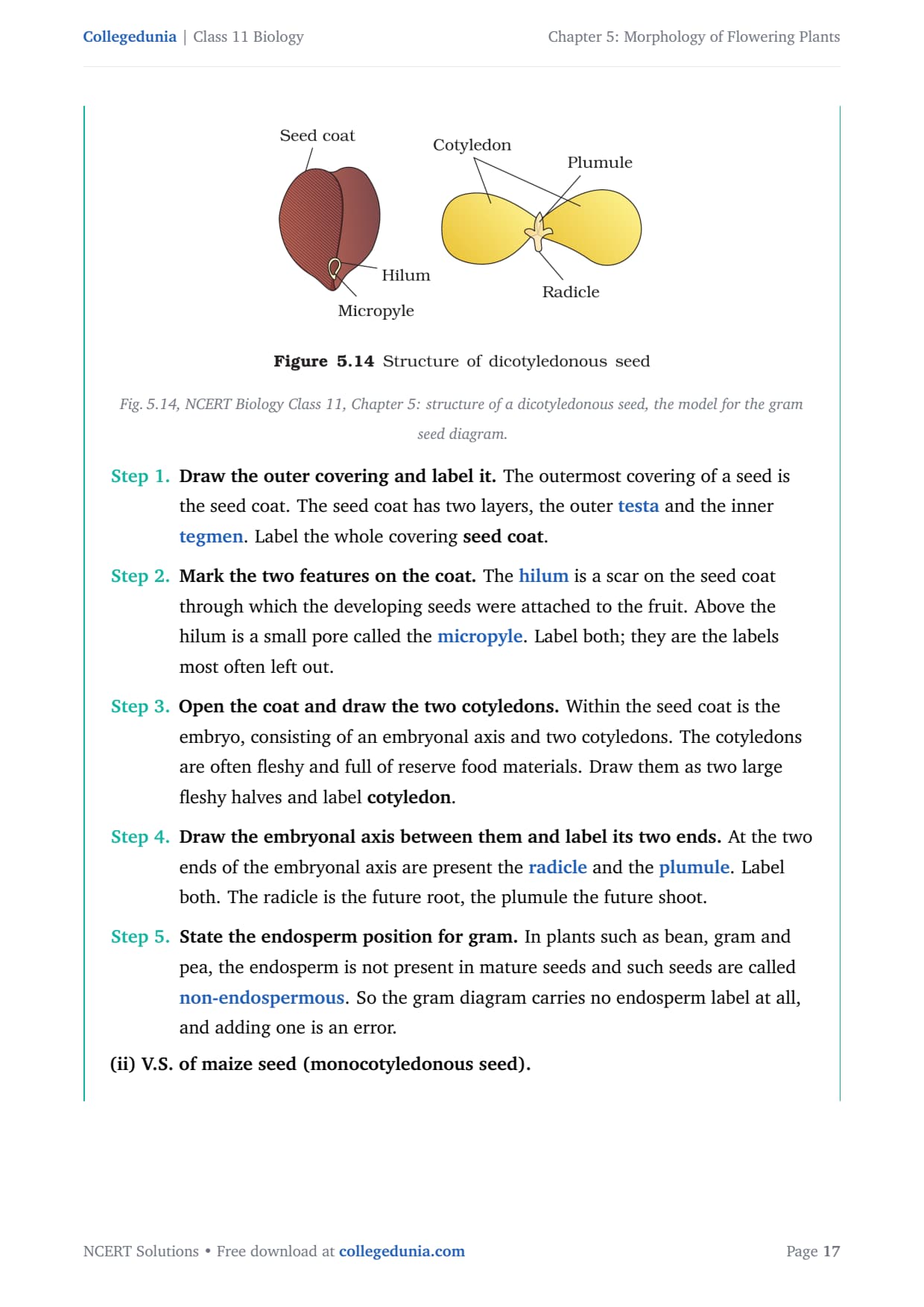
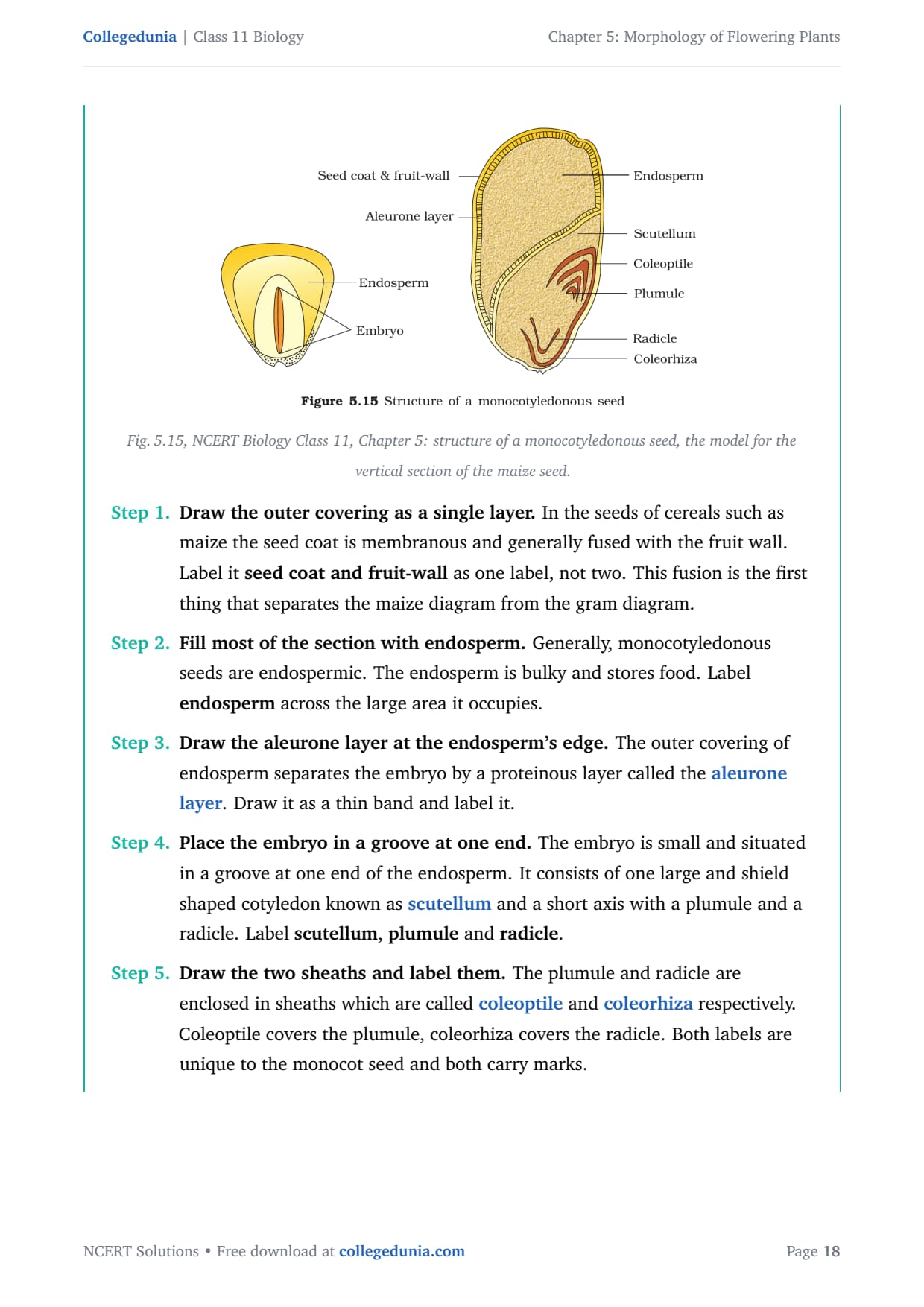
Question 5 asks for labelled diagrams of a gram seed and a vertical section of a maize seed. These two are the standard dicot and monocot examples, and the marks lie almost entirely in correct labelling. A gram seed is a non-endospermous dicot seed, so its food is stored in fleshy cotyledons, whereas a maize seed is an endospermic monocot seed, so its food is stored in a separate endosperm.
- Gram seed: draw the seed coat (testa and tegmen) with the hilum and micropyle, then the two fleshy cotyledons and the embryonal axis between them, labelling the plumule at one end and the radicle at the other.
- Maize seed (vertical section): draw the membranous seed coat fused with the fruit wall, the bulky endosperm bordered by the proteinous aleurone layer, and the embryo in a groove at one end.
- Maize embryo detail: label the shield-shaped scutellum and the axis carrying the plumule in its coleoptile and the radicle in its coleorhiza.
The key contrast for the exam is that a gram seed has no endosperm and stores food in its cotyledons, while a maize seed keeps a large endosperm and a small embryo with the protective coleoptile and coleorhiza. Students should be able to draw both cleanly and label every part, because a diagram missing the aleurone layer or the coleorhiza loses part-marks even when the outline is correct. These two seeds are also common NEET diagram questions.
Morphology of Flowering Plants Exercise-wise Breakdown
The NCERT back exercise has 10 questions, spanning the leaf, the flower, the inflorescence and the seed. The table below maps the question blocks to their topics so students can plan their practice and revise by theme.
| Question block | What it tests |
|---|---|
| Q 1 to Q 2 | Pinnately versus palmately compound leaves, and the three types of phyllotaxy. |
| Q 3 | Defining aestivation, placentation, actinomorphic, zygomorphic, superior ovary, perigynous flower and epipetalous stamen. |
| Q 4 | Differentiating racemose from cymose inflorescence, and apocarpous from syncarpous ovary. |
| Q 5 and Q 6 | Labelled diagrams of gram and maize seeds, and the semi-technical description and floral diagram of a Solanaceae flower. |
| Q 7 to Q 8 | Types of placentation, and the definition and parts of a typical angiosperm flower. |
| Q 9 to Q 10 | The inflorescence and its basis, and the arrangement of floral members on the thalamus. |
Because most questions are definitions or differentiations, the marks sit in precise wording and the right example rather than in reasoning. Learn each term as a one-line statement with its NCERT example, then practise the two diagram questions until every label is automatic. Every question in the class 11 biology NCERT solutions chapter 5 Morphology of Flowering Plants PDF is solved with the definition, the example and the diagram shown, so students can compare their answers against the model working.
Practice the solved questions: Work through the full question bank with step-by-step answers and expert tips.
Morphology of Flowering Plants Class 11 Solved Practice Questions
Common Mistakes Students Make in the Morphology of Flowering Plants Chapter
Most marks in this chapter are lost on loose definitions and mislabelled diagrams, not on hard ideas. Each mistake below costs 1 to 2 marks, so watch for it at the exact step.
Mistake 1: Confusing compound-leaf type with phyllotaxy. Pinnate versus palmate describes one leaf, while alternate, opposite and whorled describe how leaves sit on the stem.
Mistake 2: Mixing up acropetal and basipetal. Racemose flowers open acropetally from the base up, while cymose flowers open basipetally from the top or centre.
Mistake 3: Forgetting the line above G in the floral formula. The bar marks a superior ovary, and leaving it out changes the meaning of the formula.
Mistake 4: Labelling the maize embryo without the coleoptile and coleorhiza, or drawing the gram seed with an endosperm it does not have.
Student Feedback on Morphology of Flowering Plants Solutions
What 11,240 students told us about their Morphology of Flowering Plants preparation:
- 61% of students said the placentation types and the floral formula were the parts they found hardest to keep straight.
- Most-skipped detail: the line above G for a superior ovary in the floral formula, missed by about 3 in 10 students.
- Students who learned each definition with its NCERT example first said the differentiation questions became automatic.
Source: 2026-27 Class 11 Biology student poll. Sample of 11,240 students from CBSE schools across 14 states, conducted before the 2026 boards.
Other Morphology of Flowering Plants Class 11 Biology Resources
Pair these solutions with the revision notes, formula sheet and NCERT textbook PDF for the same chapter.
| Resource | Link |
|---|---|
| NCERT Notes | Morphology of Flowering Plants Class 11 Notes |
| Formula Sheet | Morphology of Flowering Plants Class 11 Formula Sheet |
| NCERT Book PDF | Morphology of Flowering Plants Class 11 Book PDF |
NCERT Solutions for Class 11 Biology: All Chapters
Jump to the step-by-step solutions for any other Class 11 Biology chapter below.
| Chapter | NCERT Solutions |
|---|---|
| Chapter 1 | The Living World |
| Chapter 2 | Biological Classification |
| Chapter 3 | Plant Kingdom |
| Chapter 4 | Animal Kingdom |
| Chapter 5 | Morphology of Flowering Plants |
| Chapter 6 | Anatomy of Flowering Plants |
| Chapter 7 | Structural Organisation in Animals |
| Chapter 8 | Cell: The Unit of Life |
| Chapter 9 | Biomolecules |
| Chapter 10 | Cell Cycle and Cell Division |
| Chapter 11 | Photosynthesis in Higher Plants |
| Chapter 12 | Respiration in Plants |
| Chapter 13 | Plant Growth and Development |
| Chapter 14 | Breathing and Exchange of Gases |
| Chapter 15 | Body Fluids and Circulation |
| Chapter 16 | Excretory Products and their Elimination |
| Chapter 17 | Locomotion and Movement |
| Chapter 18 | Neural Control and Coordination |
| Chapter 19 | Chemical Coordination and Integration |
FAQs on Morphology of Flowering Plants Class 11 NCERT Solutions
Morphology of Flowering Plants NCERT Solutions - Frequently Asked Questions
Ques. What do the class 11 biology NCERT solutions chapter 5 Morphology of Flowering Plants cover?
Ans. These solutions cover compound leaves and phyllotaxy, the definitions of aestivation, placentation, actinomorphic, zygomorphic, superior ovary, perigynous flower and epipetalous stamen, the difference between racemose and cymose inflorescence and between apocarpous and syncarpous ovaries, labelled diagrams of gram and maize seeds, the semi-technical description and floral formula of the Solanaceae, the parts of a flower, and the arrangement of floral members on the thalamus. Every question is solved step by step.
Ques. How is a pinnately compound leaf different from a palmately compound leaf?
Ans. In a pinnately compound leaf the leaflets are borne on a common axis, the rachis, which represents the midrib, giving a feather-like arrangement as in neem. In a palmately compound leaf there is no rachis, and the leaflets are all attached at the tip of the petiole and radiate out like the fingers of a palm, as in silk cotton.
Ques. What is the floral formula of the Solanaceae family?
Ans. A Solanaceae flower such as Solanum nigrum is bracteate, actinomorphic and bisexual, with five united sepals, five united petals, five epipetalous stamens, and a bicarpellary syncarpous superior ovary. Its floral formula is K(5) C(5) A5 G(2), where the line above G marks the superior ovary and the placentation is axile.
Ques. What are the types of placentation in flowering plants?
Ans. Placentation is the arrangement of ovules within the ovary. NCERT names six types: marginal (pea), axile (china rose, tomato, lemon), parietal (mustard), free central (Dianthus), basal (sunflower, marigold) and central. Each type describes where the placenta lies and how the ovules attach inside the ovary.
Ques. What is the difference between racemose and cymose inflorescence?
Ans. In a racemose inflorescence the main axis continues to grow, so growth is unlimited and the flowers open laterally in acropetal succession. In a cymose inflorescence the main axis terminates in a flower, so growth is limited and the flowers open in basipetal order. The whole difference is whether the growing apex becomes a flower.
Ques. What is the weightage of Morphology of Flowering Plants in CBSE Class 11 Biology?
Ans. Morphology of Flowering Plants carries about 5 to 6 marks in the CBSE Class 11 Biology paper as a core chapter of the Structural Organisation in Plants and Animals unit, with definitions, floral formulae and diagrams asked most often. It is also a high-scoring NEET chapter, since most of its questions are single-fact recall.



Comments