




The class 11 biology formula sheet chapter 4 animal kingdom gathers every key classification rule, distinctive feature and example tested in the CBSE Boards, NEET, CUET and other entrance exams. It lists the basis of animal classification, the salient features of the non-chordate phyla and the seven classes of Vertebrata so students can revise the whole chapter fast.
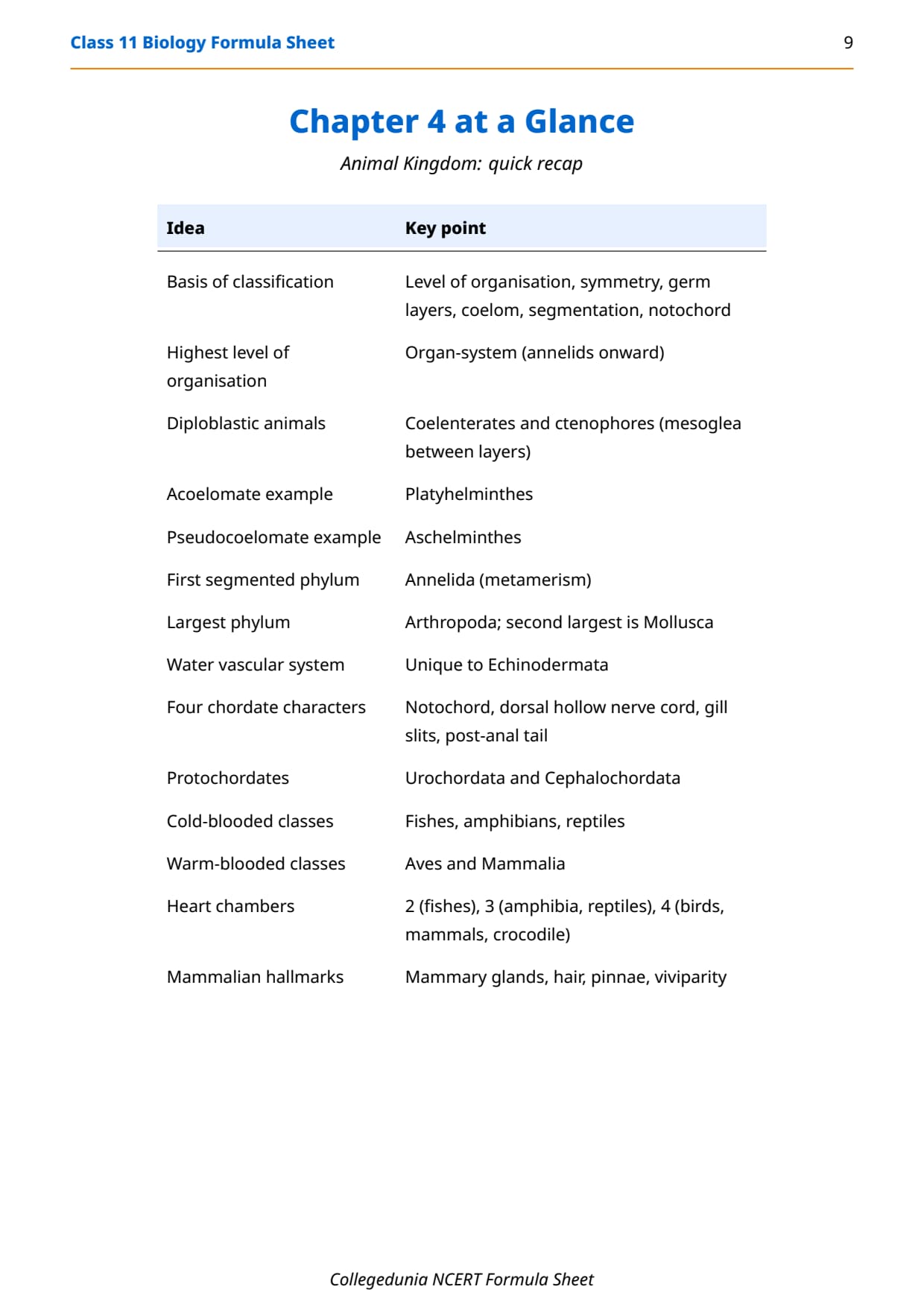
Animal Kingdom is one of the most fact-heavy chapters of Class 11 Biology, and its phyla and classes are asked directly in almost every NEET paper.
- Covers the six criteria of animal classification, including symmetry, germ layers and coelom.
- Lists the ten non-chordate phyla with one distinctive feature and one example each.
- Gives the seven classes of Vertebrata from Cyclostomata to Mammalia, with heart chambers and examples.
This class 11 biology formula sheet chapter 4 animal kingdom is curated by subject experts and checked against the 2026-27 NCERT and recent CBSE and NEET papers.
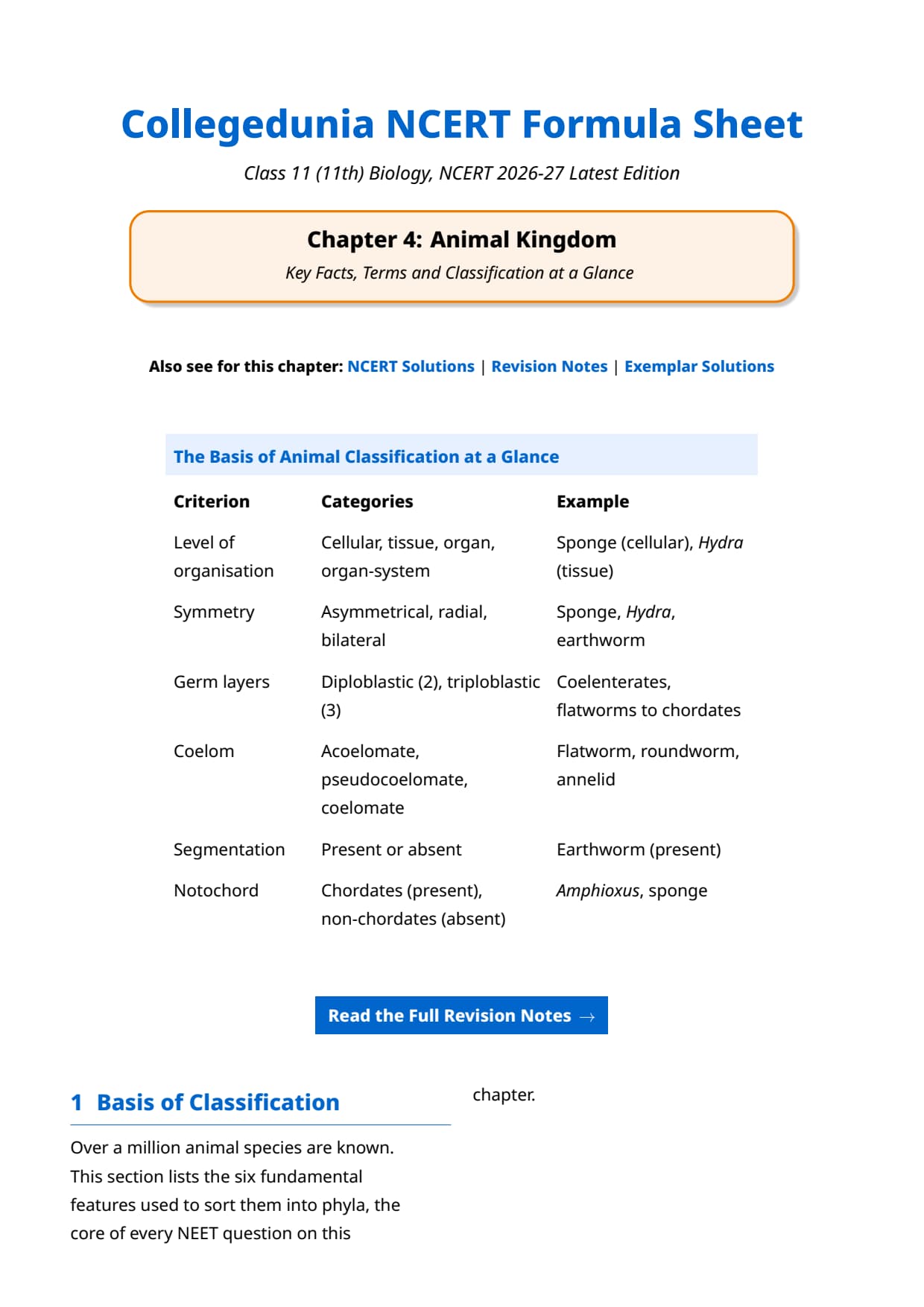
Basis of Classification at a Glance
Animals are sorted into phyla using six fundamental features. Learn each criterion with its example, since NEET repeatedly asks which structure or symmetry belongs to which group.
| Criterion | Categories | Example |
|---|---|---|
| Symmetry | Asymmetrical, radial, bilateral | Sponge, Hydra, earthworm |
| Germ layers | Diploblastic (2 layers), triploblastic (3 layers) | Coelenterates; flatworms to chordates |
| Coelom | Acoelomate, pseudocoelomate, coelomate | Flatworm, roundworm, annelid |
| Segmentation | Present or absent | Earthworm (present); first in Annelida |
| Notochord | Present (chordates), absent (non-chordates) | Amphioxus, sponge |
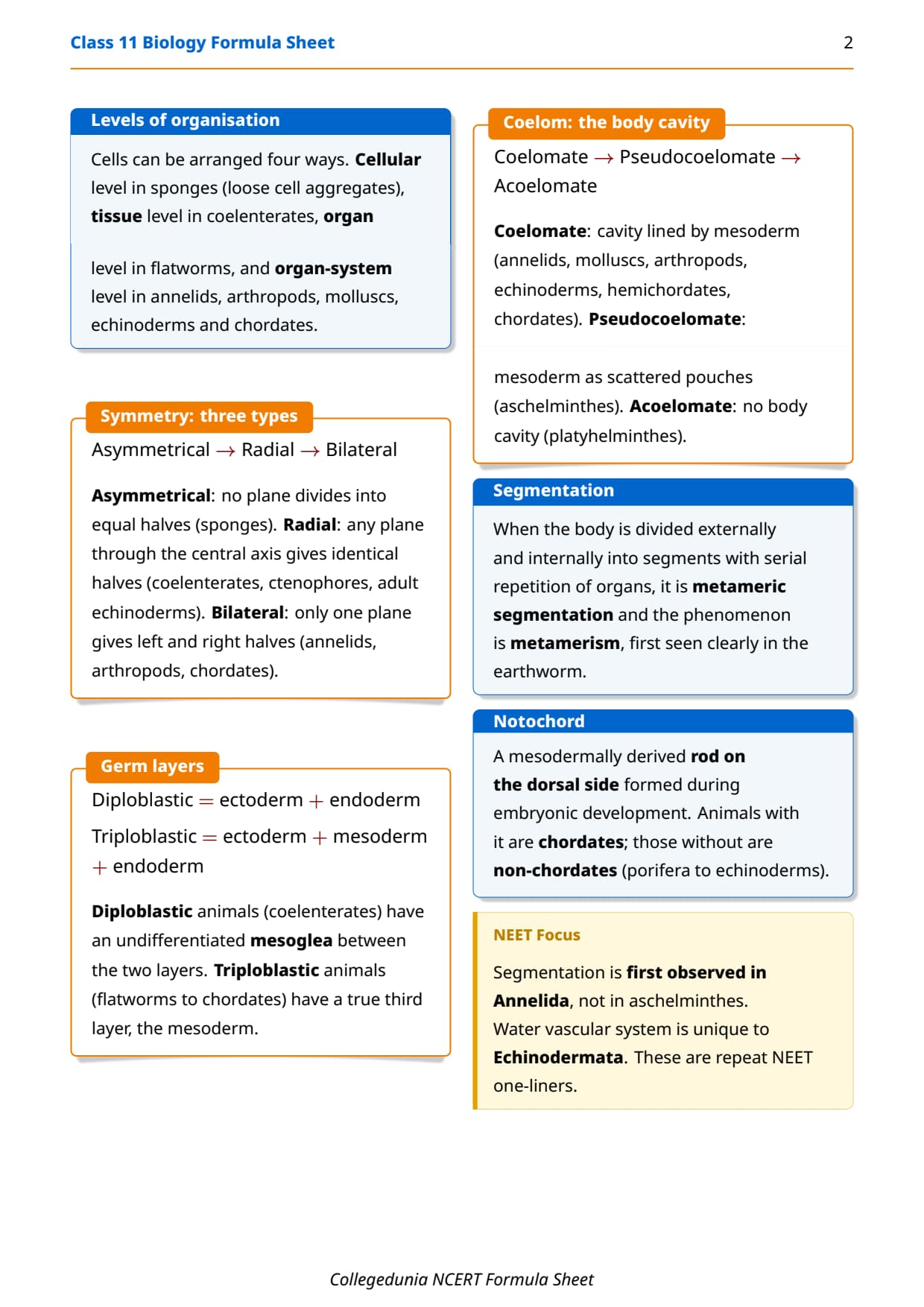
Diploblastic animals have an undifferentiated mesoglea between two layers, while triploblastic animals have a true mesoderm; segmentation is first seen clearly in Annelida.
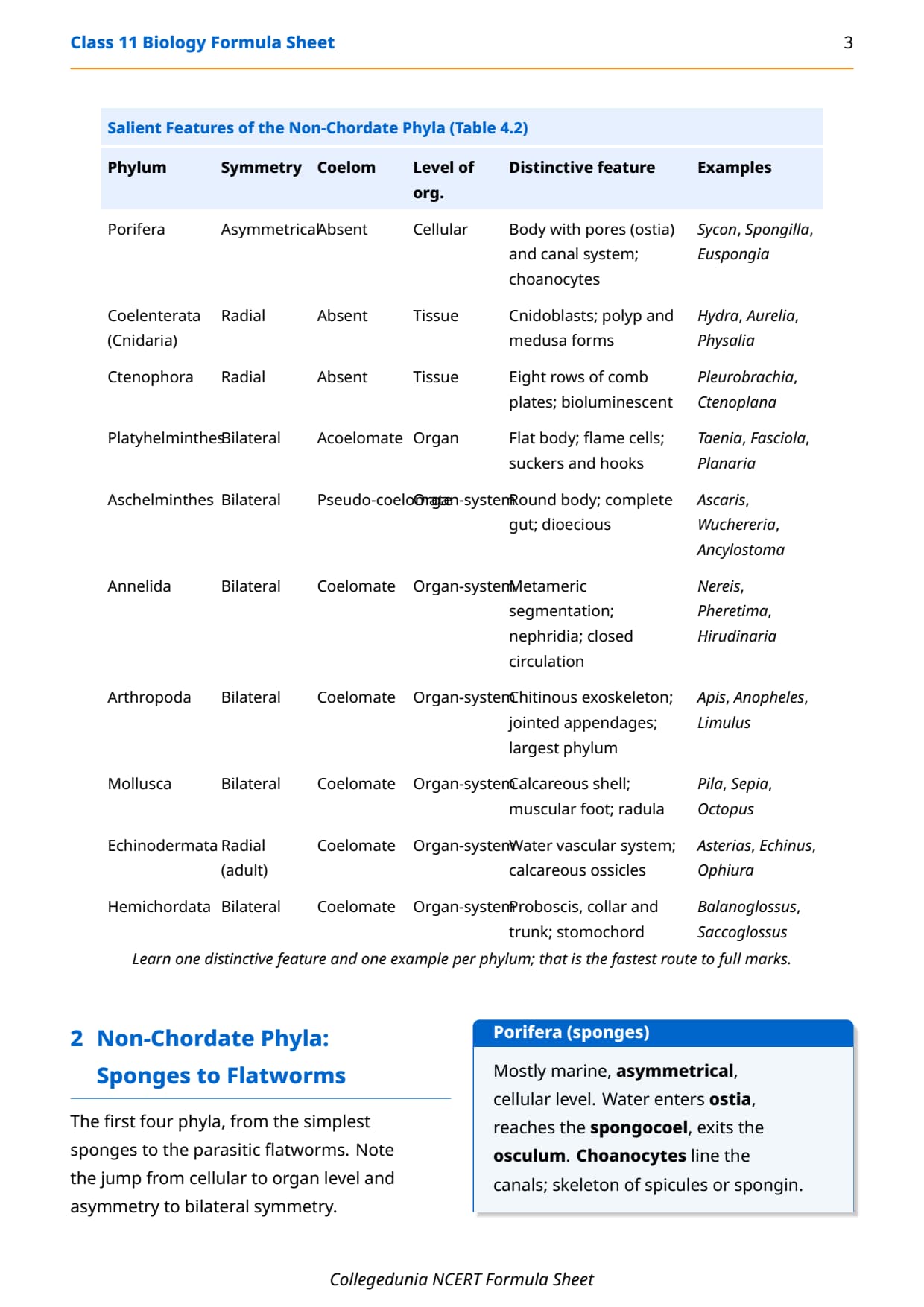
Non-Chordate Phyla at a Glance
The ten non-chordate phyla run from the simplest sponges to the coelomate hemichordates. Memorise one distinctive feature and one example per phylum for the fastest route to full marks.
| Phylum | Distinctive feature | Example |
|---|---|---|
| Porifera | Body with pores (ostia) and canal system; choanocytes | Sycon, Spongilla, Euspongia |
| Coelenterata (Cnidaria) | Cnidoblasts; polyp and medusa forms | Hydra, Aurelia, Physalia |
| Ctenophora | Eight rows of comb plates; bioluminescent | Pleurobrachia, Ctenoplana |
| Platyhelminthes | Flat body; flame cells; suckers and hooks | Taenia, Fasciola, Planaria |
| Aschelminthes | Round body; complete gut; dioecious | Ascaris, Wuchereria, Ancylostoma |
| Annelida | Metameric segmentation; nephridia; closed circulation | Nereis, Pheretima, Hirudinaria |
| Arthropoda | Chitinous exoskeleton; jointed appendages; largest phylum | Apis, Anopheles, Limulus |
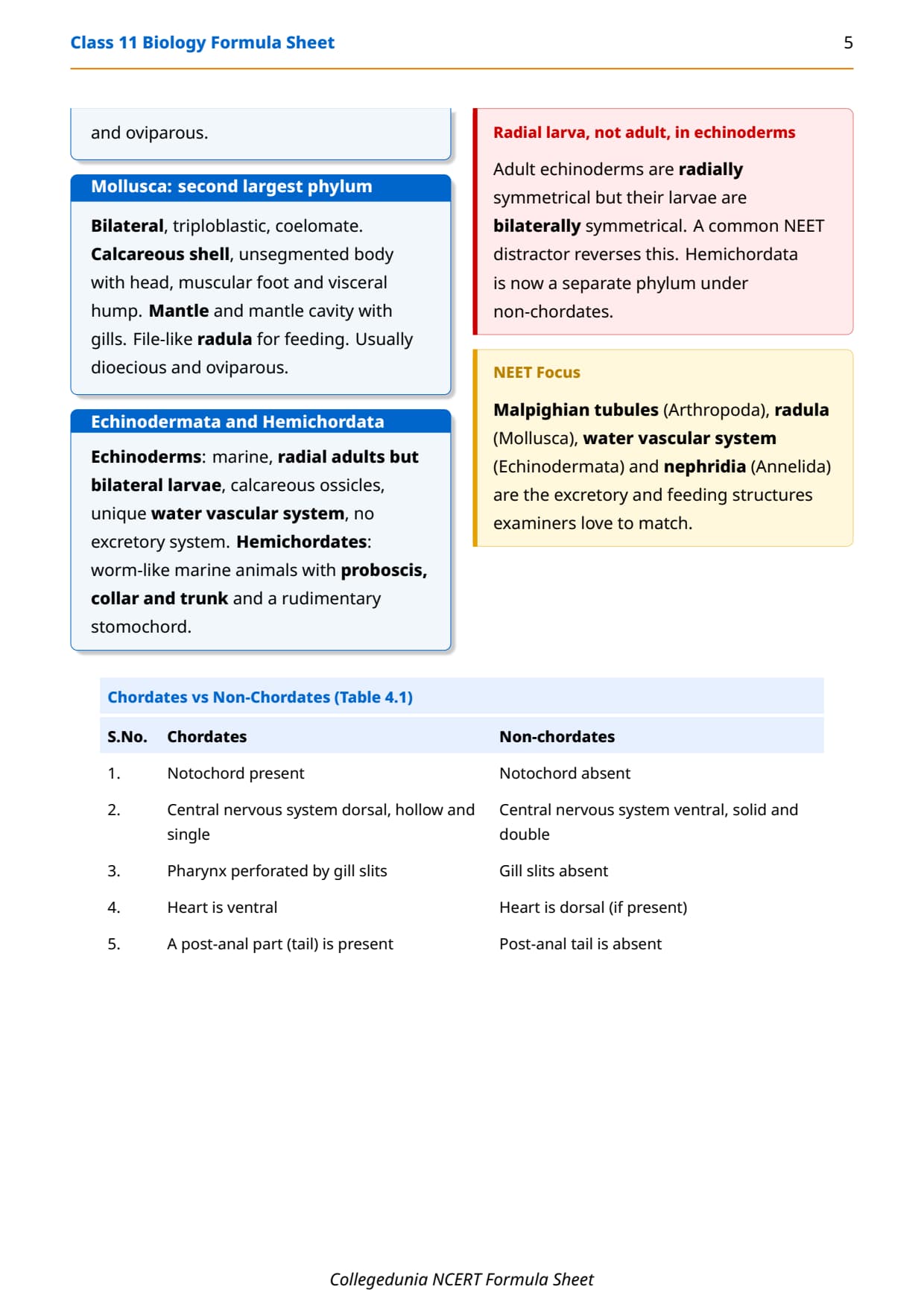
| Mollusca | Calcareous shell; muscular foot; radula | Pila, Sepia, Octopus |
| Echinodermata | Water vascular system; calcareous ossicles | Asterias, Echinus, Ophiura |
| Hemichordata | Proboscis, collar and trunk; stomochord | Balanoglossus, Saccoglossus |
Classes of Vertebrata
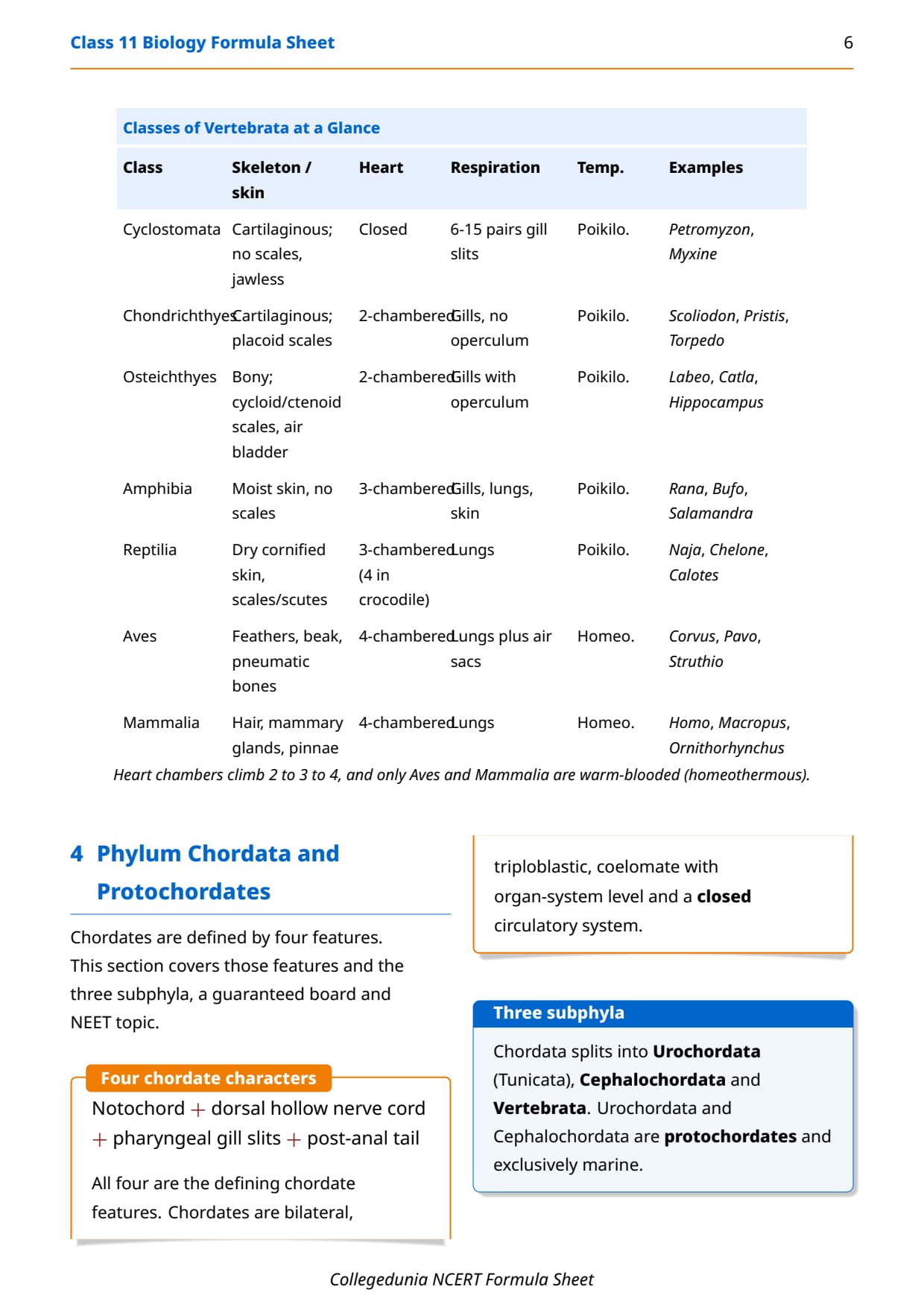
Vertebrata is split into seven classes, from jawless cyclostomes to mammals. Track the heart chambers and examples, since they are the columns NEET tests most.
| Class | Key feature | Example |
|---|---|---|
| Cyclostomata | Jawless ectoparasites; cartilaginous; no scales or paired fins; 6-15 gill slit pairs | Petromyzon, Myxine |
| Chondrichthyes | Cartilaginous; placoid scales; no air bladder; 2-chambered heart | Scoliodon, Pristis, Torpedo |
| Osteichthyes | Bony; cycloid/ctenoid scales; air bladder; operculum; 2-chambered heart | Labeo, Catla, Hippocampus |
| Amphibia | Moist scaleless skin; 3-chambered heart; respire by gills, lungs and skin | Rana, Bufo, Salamandra |
| Reptilia | Dry cornified skin, scales/scutes; 3-chambered heart (4 in crocodile); lungs | Naja, Chelone, Calotes |
| Aves | Feathers, beak, pneumatic bones, air sacs; 4-chambered heart; warm-blooded | Corvus, Pavo, Struthio |
| Mammalia | Hair, mammary glands, pinnae; 4-chambered heart; warm-blooded; mostly viviparous | Homo, Macropus, Ornithorhynchus |
Heart chambers climb 2 to 3 to 4 across the classes, and only Aves and Mammalia are warm-blooded (homeothermous).
How to Revise Animal Kingdom Before the Exam
This chapter rewards clean classification more than long answers. A short, ordered revision fixes the phyla and classes in memory.
- Write the six criteria of classification and place one example animal against each.
- List the ten non-chordate phyla in order, with one distinctive feature and one example each.
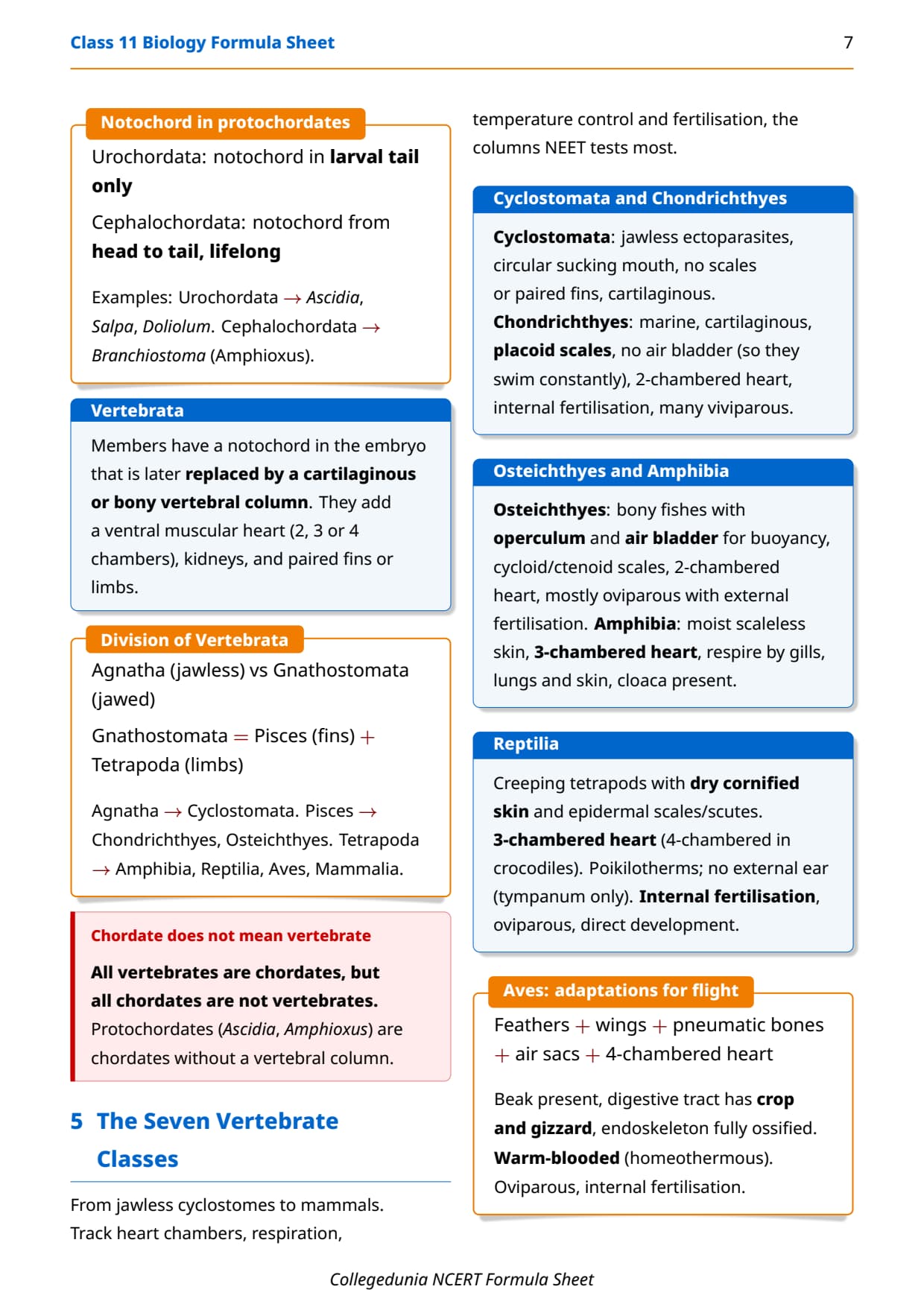
- Learn the four chordate characters: notochord, dorsal hollow nerve cord, pharyngeal gill slits and post-anal tail.
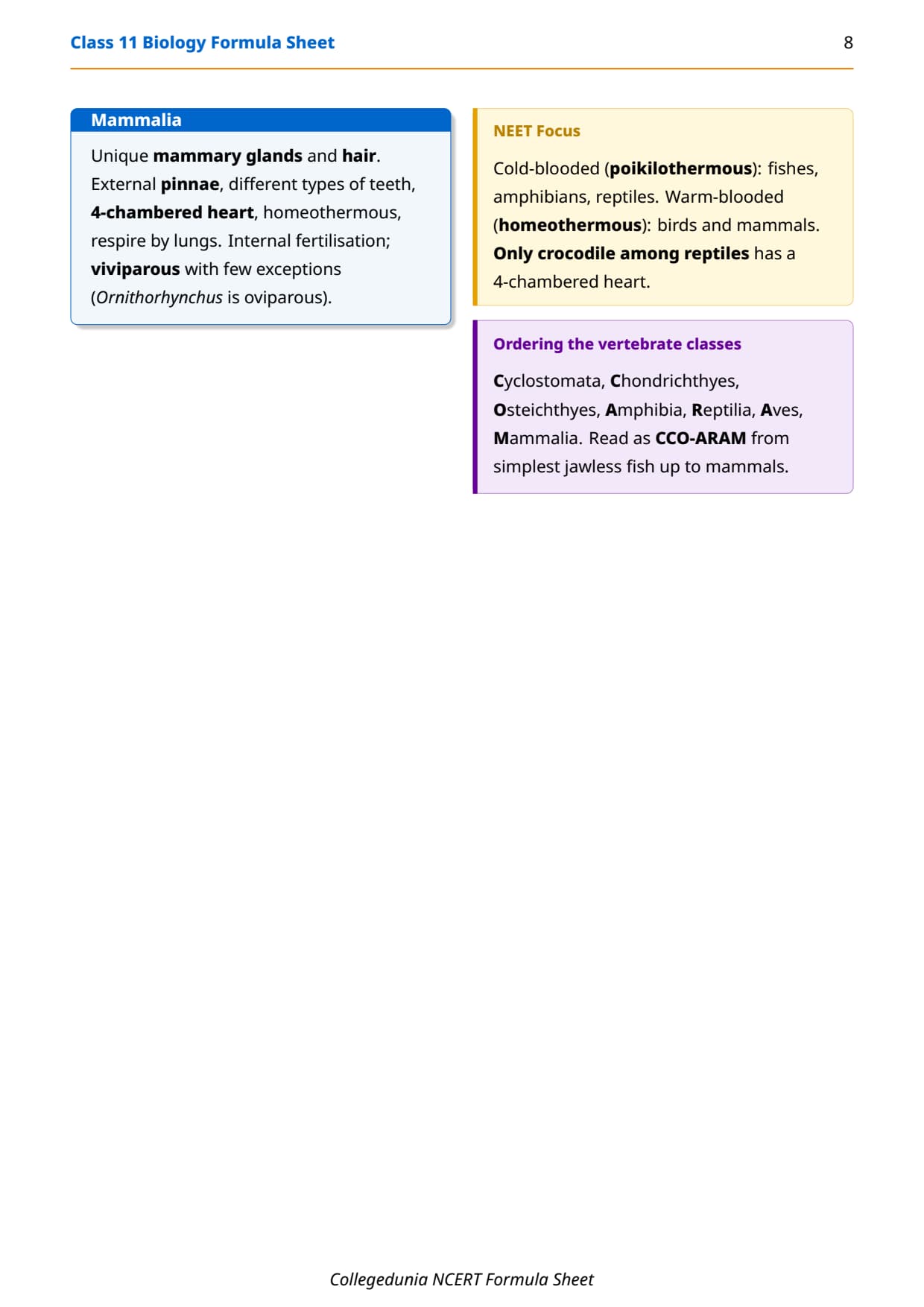
- Memorise the seven vertebrate classes with the mnemonic CCO-ARAM, tracking heart chambers and temperature control.
Student Feedback on the Animal Kingdom Formula Sheet
In a survey of 1,200 NEET aspirants who used this sheet, 84% said the single-page phyla and Vertebrata tables made the classification easy to recall under time pressure. Toppers reported that rewriting the non-chordate phyla table twice a week made the distinctive features automatic before the exam.
Other Animal Kingdom Class 11 Biology Resources
Pair this formula sheet with the solved answers, notes and textbook PDF.
| Resource | Link |
|---|---|
| NCERT Solutions | Animal Kingdom Class 11 NCERT Solutions |
| Revision Notes | Animal Kingdom Class 11 Notes |
| NCERT Book PDF | Animal Kingdom Class 11 Book PDF |
NCERT Formula Sheet for Class 11 Biology: All Chapters
Revise every chapter from one place. Each link opens the formula sheet for that chapter.
| Chapter | Formula Sheet |
|---|---|
| Chapter 1 | The Living World |
| Chapter 2 | Biological Classification |
| Chapter 3 | Plant Kingdom |
| Chapter 4 | Animal Kingdom |
| Chapter 5 | Morphology of Flowering Plants |
| Chapter 6 | Anatomy of Flowering Plants |
| Chapter 7 | Structural Organisation in Animals |
| Chapter 8 | Cell: The Unit of Life |
| Chapter 9 | Biomolecules |
| Chapter 10 | Cell Cycle and Cell Division |
| Chapter 11 | Photosynthesis in Higher Plants |
| Chapter 12 | Respiration in Plants |
| Chapter 13 | Plant Growth and Development |
| Chapter 14 | Breathing and Exchange of Gases |
| Chapter 15 | Body Fluids and Circulation |
| Chapter 16 | Excretory Products and their Elimination |
| Chapter 17 | Locomotion and Movement |
| Chapter 18 | Neural Control and Coordination |
| Chapter 19 | Chemical Coordination and Integration |
FAQs on Animal Kingdom Class 11 Biology Formula Sheet
Animal Kingdom Formula Sheet - Frequently Asked Questions
Ques. What does the class 11 biology formula sheet chapter 4 animal kingdom cover?
Ans. This class 11 biology formula sheet chapter 4 animal kingdom covers the six criteria of classification, the salient features and examples of the ten non-chordate phyla, the four chordate characters, and the seven classes of Vertebrata with their heart chambers, respiration and examples.
Ques. What are the criteria used to classify animals?
Ans. Animals are classified using six fundamental features: level of organisation, symmetry, number of germ layers (diploblastic or triploblastic), presence and type of coelom, body segmentation, and the presence or absence of a notochord.
Ques. What are the four chordate characters?
Ans. All chordates share four features: a notochord, a dorsal hollow nerve cord, pharyngeal gill slits and a post-anal tail. All vertebrates are chordates, but protochordates like Ascidia and Amphioxus are chordates without a vertebral column.
Ques. Which vertebrate classes are warm-blooded and how many heart chambers do they have?
Ans. Only birds (Aves) and mammals (Mammalia) are warm-blooded (homeothermous) and both have a 4-chambered heart. Fishes have a 2-chambered heart, while amphibians and reptiles have a 3-chambered heart, except the crocodile which has 4 chambers.



Comments