




The class 11 biology NCERT solutions chapter 12 Respiration in Plants cover every back-exercise question, according to the latest 2026-27 CBSE syllabus, and help students prepare for the CBSE Boards, NEET and CUET. Each answer follows one glucose molecule from the cytoplasm to the inner mitochondrial membrane, counting the ATP made at every step, from glycolysis through the Krebs cycle to the electron transport system.
This chapter sits in the Plant Physiology unit, and the pathway map it builds here is reused whenever respiration, photosynthesis or metabolism is tested.
- CBSE Weightage: 4 to 5 marks, part of the Plant Physiology unit that also carries photosynthesis and plant growth.
- Topics covered: cellular respiration versus combustion, glycolysis (EMP pathway), aerobic respiration, the Krebs cycle, the electron transport system, oxidative phosphorylation, the ATP balance sheet, the amphibolic pathway and the respiratory quotient.
- Exercise count: 12 back-exercise questions, mixing schematic diagrams, differentiation tables and one numerical on the respiratory quotient.
These class 11 biology NCERT solutions chapter 12 Respiration in Plants are curated by subject experts, based on the 2026-27 NCERT textbook, and checked against the last five years of CBSE Board and NEET papers.
Why Respiration in Plants Matters and What the Chapter Covers
Respiration is how a plant unlocks the energy stored in the glucose it made during photosynthesis. The chapter answers one central question: how does a cell oxidise glucose to CO2 and water while trapping usable energy as ATP instead of losing it all as heat? Once students see the whole route, every exercise question becomes a matter of knowing which step happens where.
- Everyday role: respiration runs day and night in every living cell, powering growth, transport and every synthesis the plant carries out.
- Core skill: tracing one glucose through glycolysis, the link reaction, the Krebs cycle and the ETS, and accounting for the ATP, NADH and CO2 at each stage.
- Why it is central: the ideas of stepwise oxidation and coupled ATP synthesis introduced here underpin the balance sheet, the amphibolic pathway and the respiratory quotient later in the same exercise.
Almost every question in this exercise hangs off knowing which of the four stages happens in the cytoplasm and which in the mitochondrion. That is why students who master the location map early find the numericals and comparisons far easier. The class 11 biology NCERT solutions chapter 12 Respiration in Plants below follow the NCERT order so students can check their working line by line.
Cellular Respiration versus Combustion and the Stepwise Release of Energy
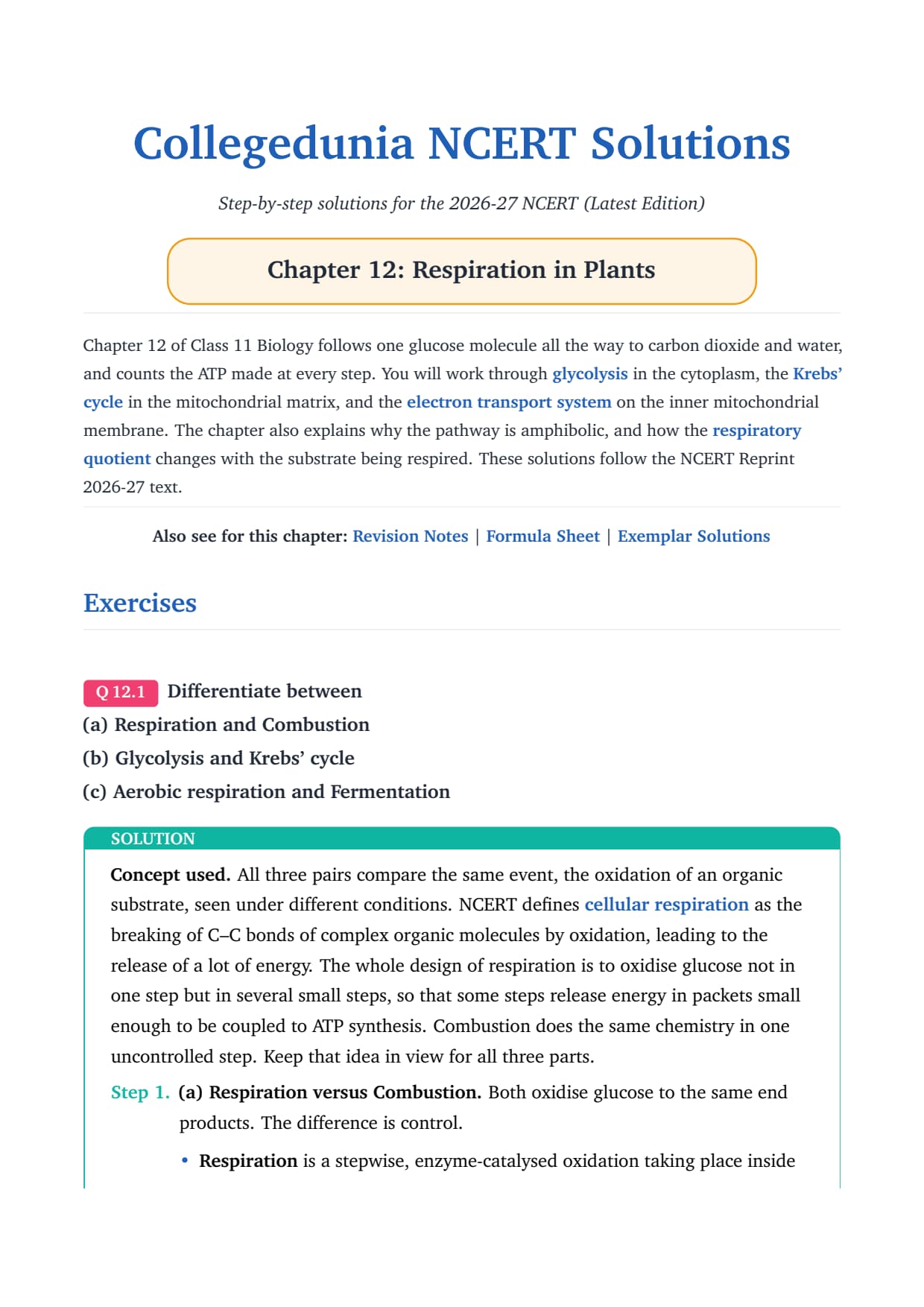
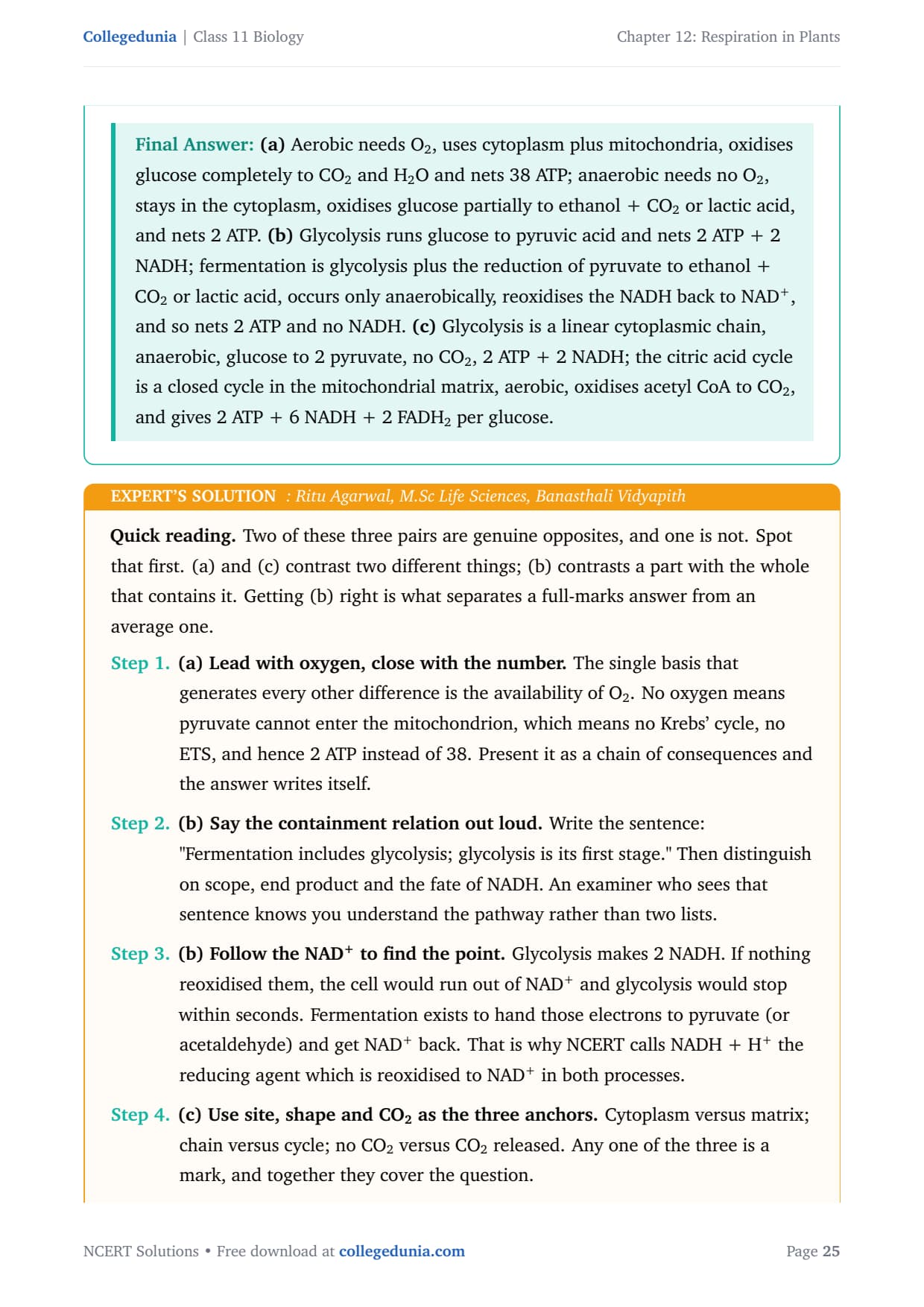
The first and last questions of the exercise frame the whole chapter. Both respiration and combustion oxidise glucose to the same end products, CO2 and water, by the equation C6H12O6 + 6O2 → 6CO2 + 6H2O + energy. The difference is control. NCERT defines cellular respiration as the breaking of C-C bonds of complex organic molecules by oxidation, releasing a large amount of energy, and the whole design is to do this in small steps.
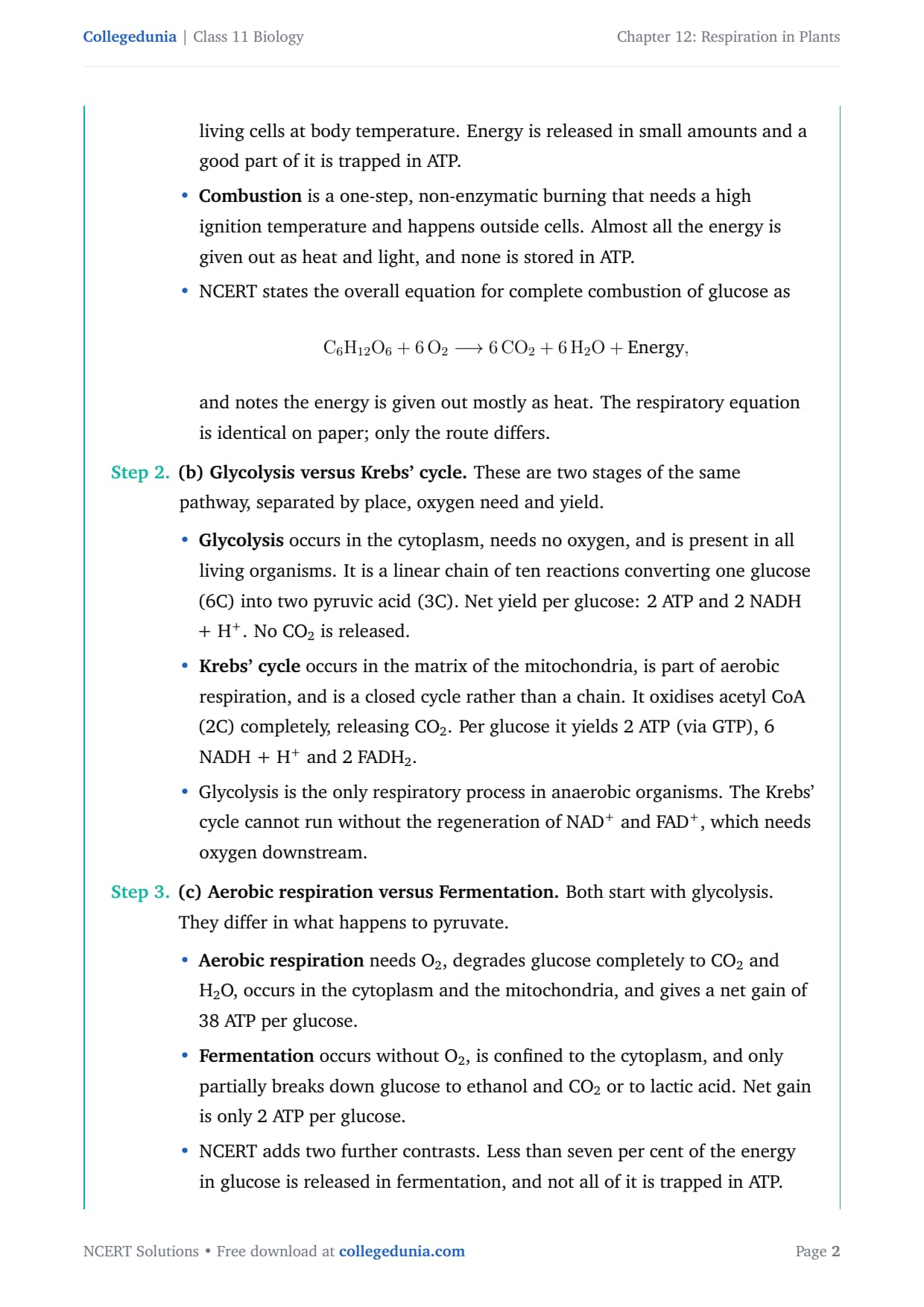
- Respiration: a stepwise, enzyme-catalysed oxidation inside living cells at body temperature, where a good part of the energy is trapped in ATP.
- Combustion: a one-step, non-enzymatic burning that needs a high ignition temperature and gives out almost all energy as heat and light.
- Why stepwise matters: a single large release cannot be captured, so it escapes as heat; small releases can each be coupled to the synthesis of one ATP from ADP and Pi.
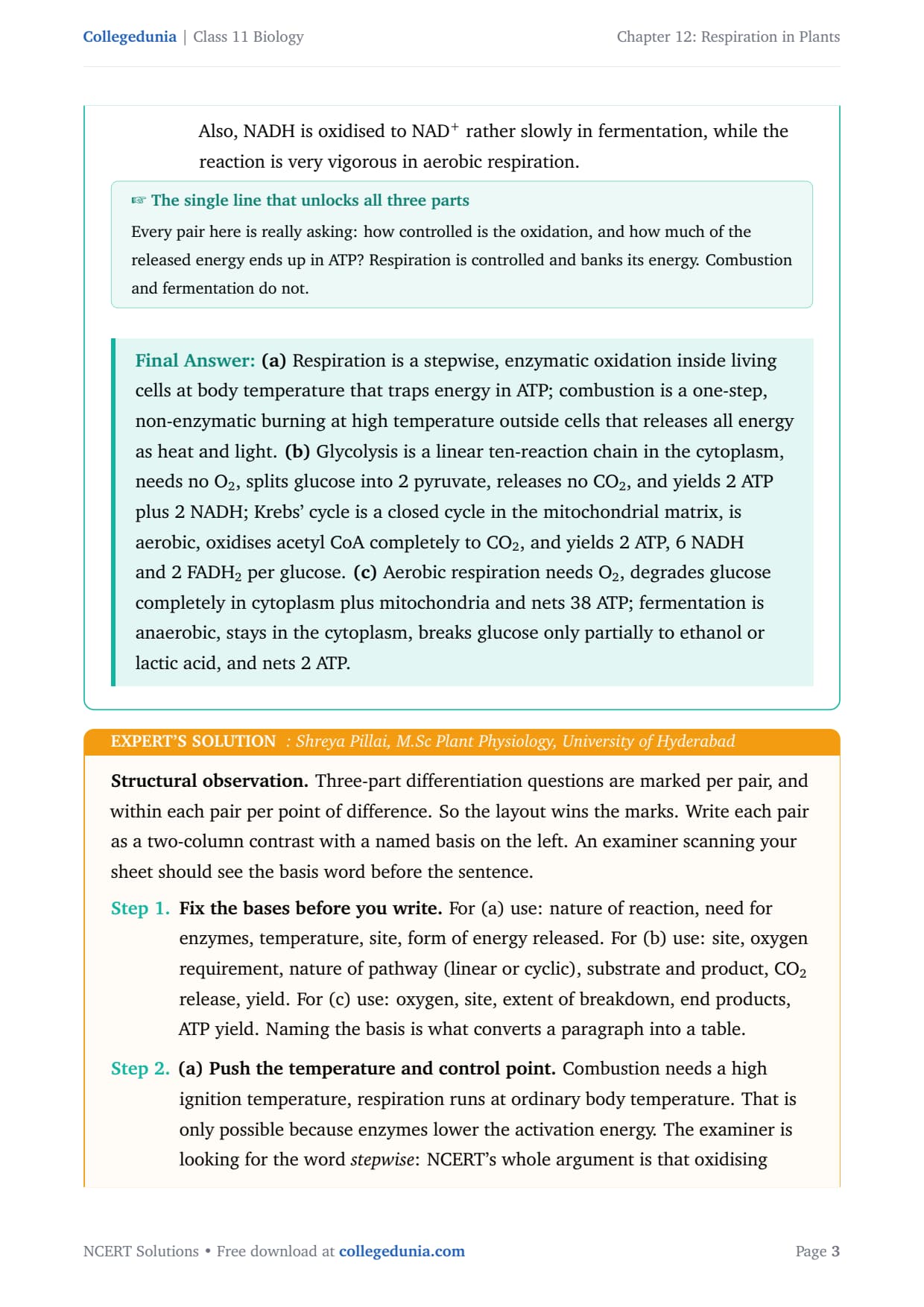
Releasing energy in packets does three jobs at once. It lets energy be banked in a usable chemical form rather than wasted, it keeps the cell at a safe temperature so enzymes do not denature, and it gives the cell many intermediate molecules it can withdraw for other syntheses. Respiration banks its energy; combustion and fermentation do not. That single idea unlocks the differentiation questions in this exercise, so keep it in view while working through Exercise Q1 and Q7.
Glycolysis: The EMP Pathway Step by Step
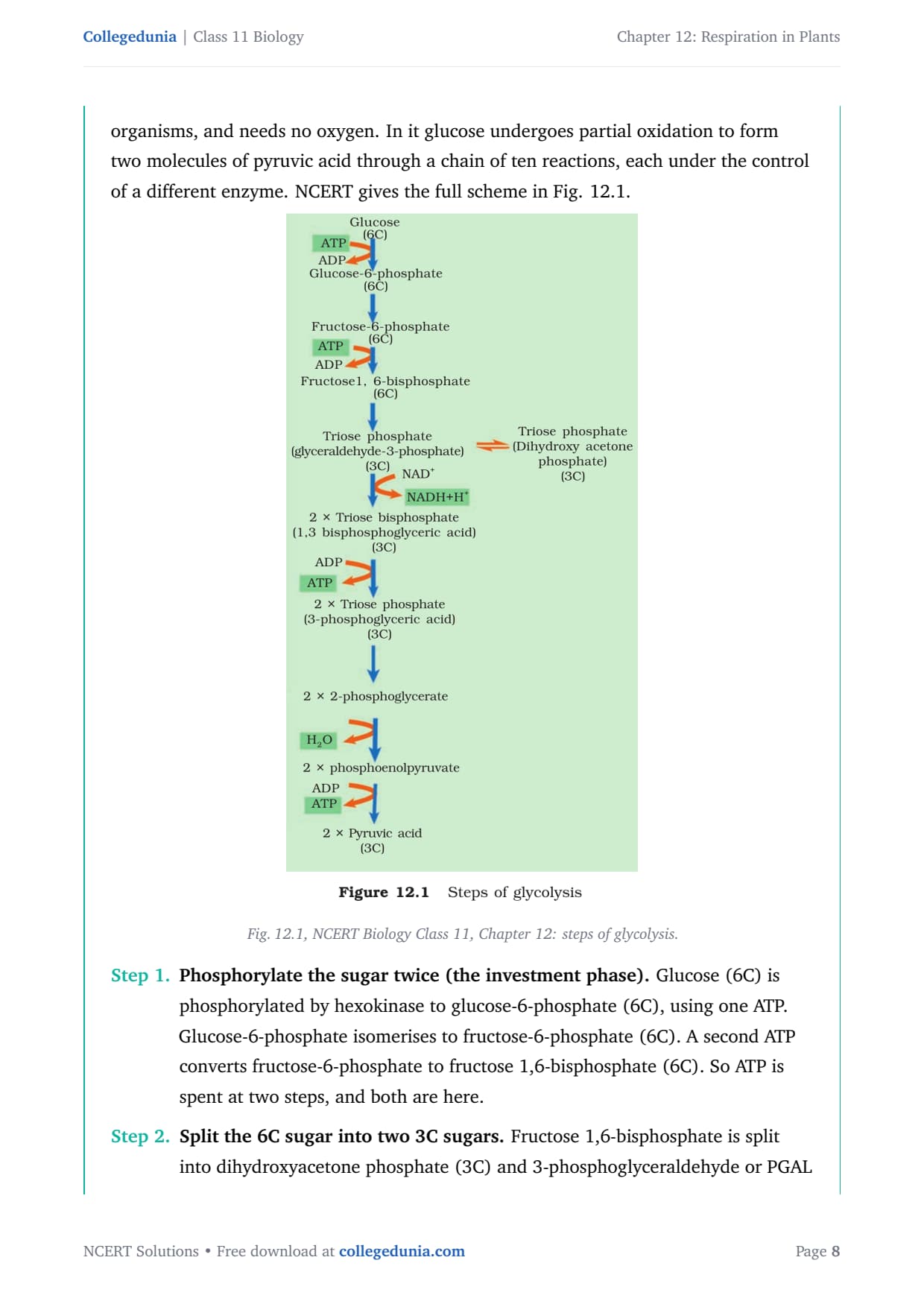
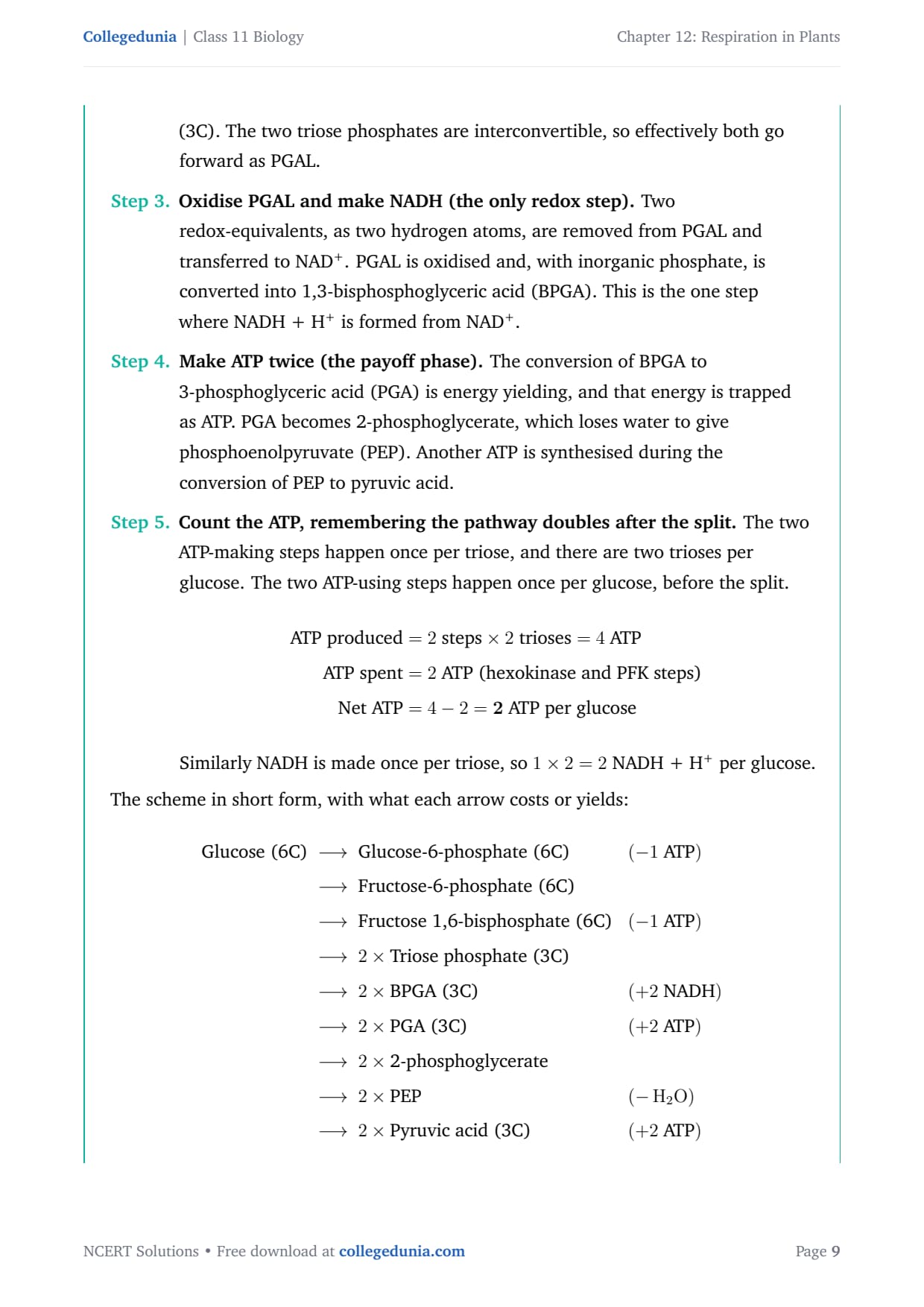
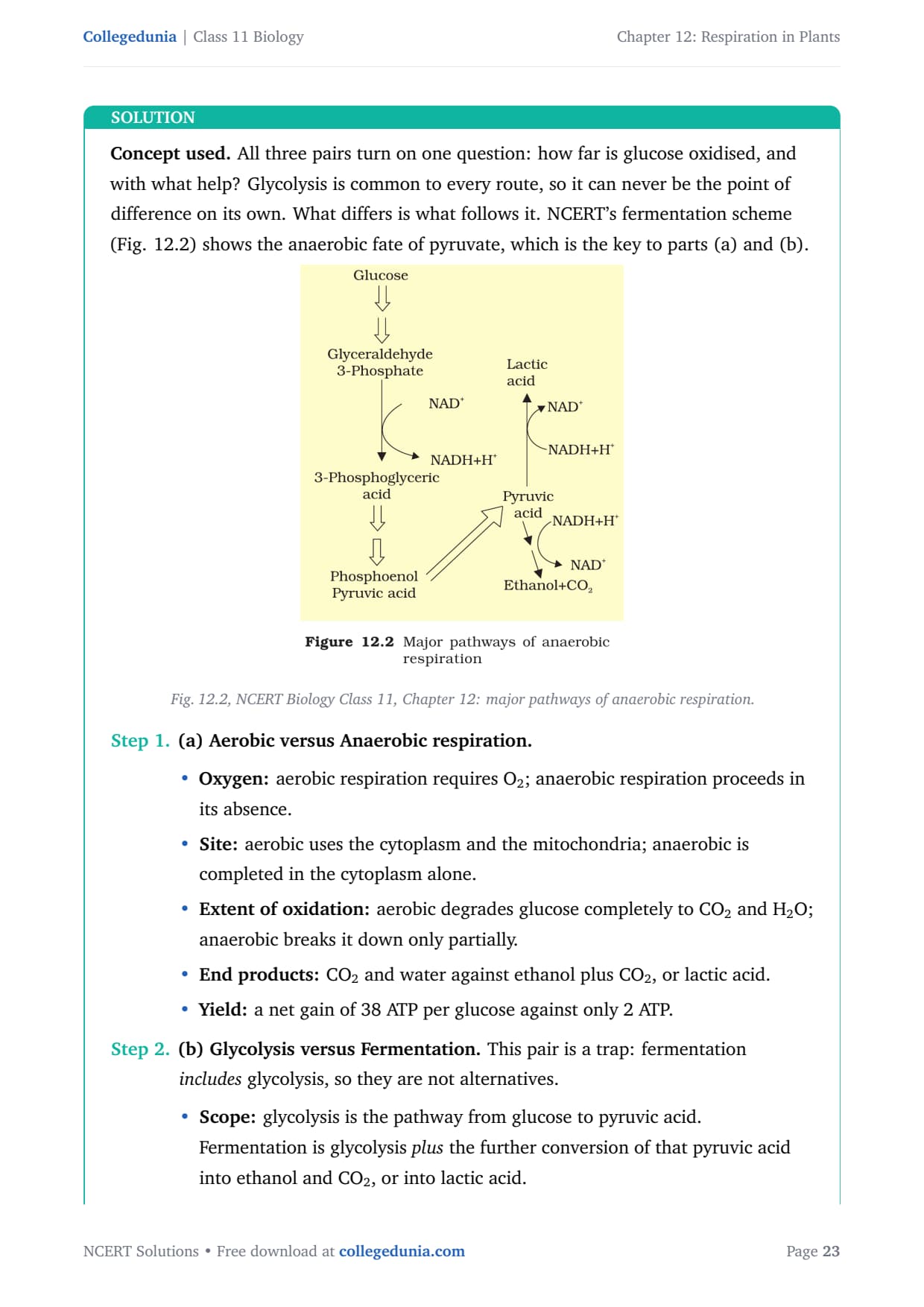
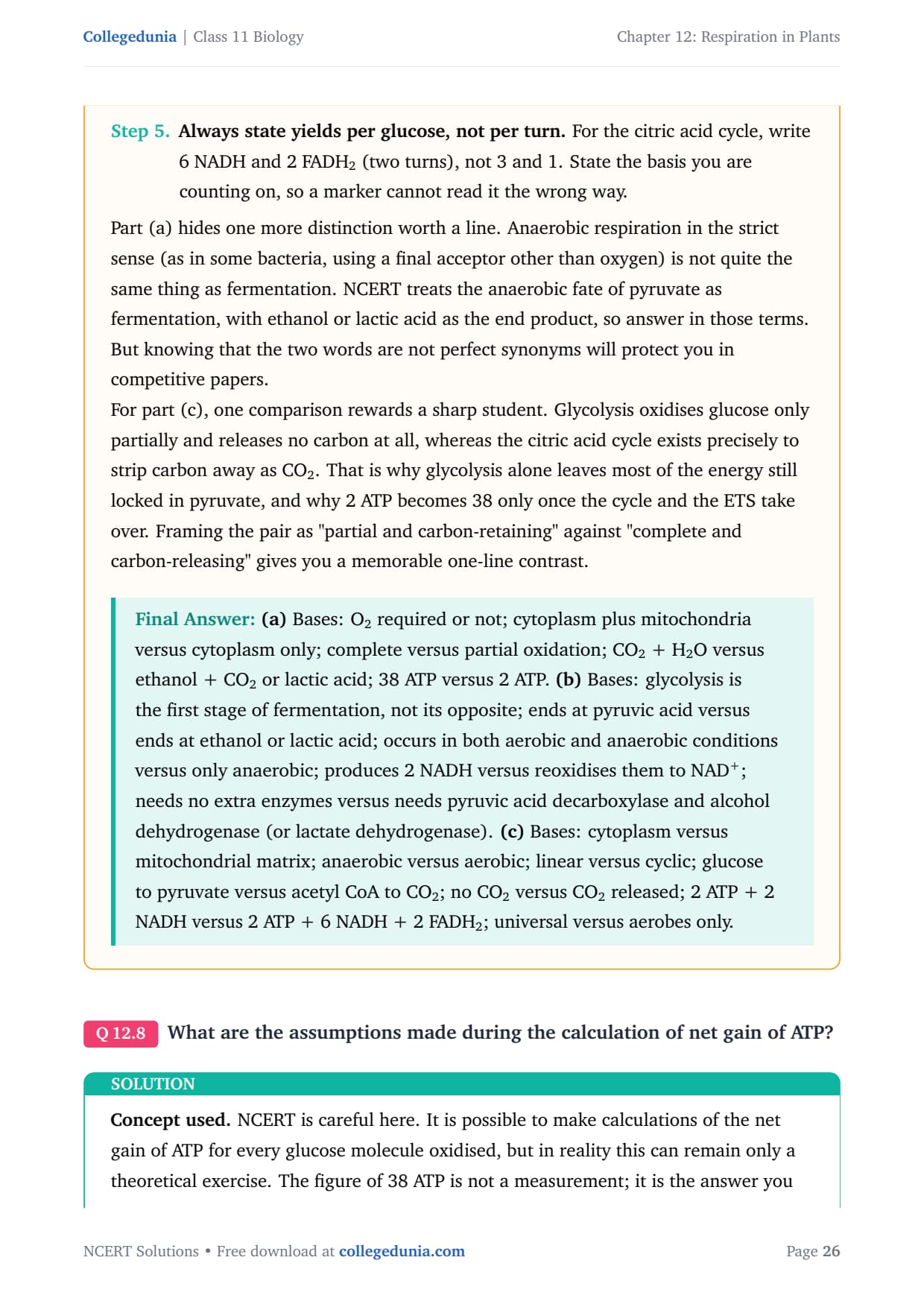
Glycolysis, from the Greek for splitting sugar, is the scheme given by Embden, Meyerhof and Parnas, so it is often called the EMP pathway. It occurs in the cytoplasm, is present in all living organisms and needs no oxygen. In it one glucose (6C) is partially oxidised through ten enzyme-catalysed reactions into two molecules of pyruvic acid (3C). The stages below track what each phase costs or yields.
| Phase | What happens | ATP / NADH change |
|---|---|---|
| Investment | Glucose → glucose-6-phosphate → fructose-6-phosphate → fructose 1,6-bisphosphate | 2 ATP used |
| Splitting | Fructose 1,6-bisphosphate splits into two interconvertible triose phosphates (PGAL and DHAP) | No change |
| Oxidation | PGAL is oxidised with inorganic phosphate to BPGA; the only redox step | 2 NADH made |
| Payoff | BPGA → PGA → 2-phosphoglycerate → PEP → pyruvic acid | 4 ATP made |
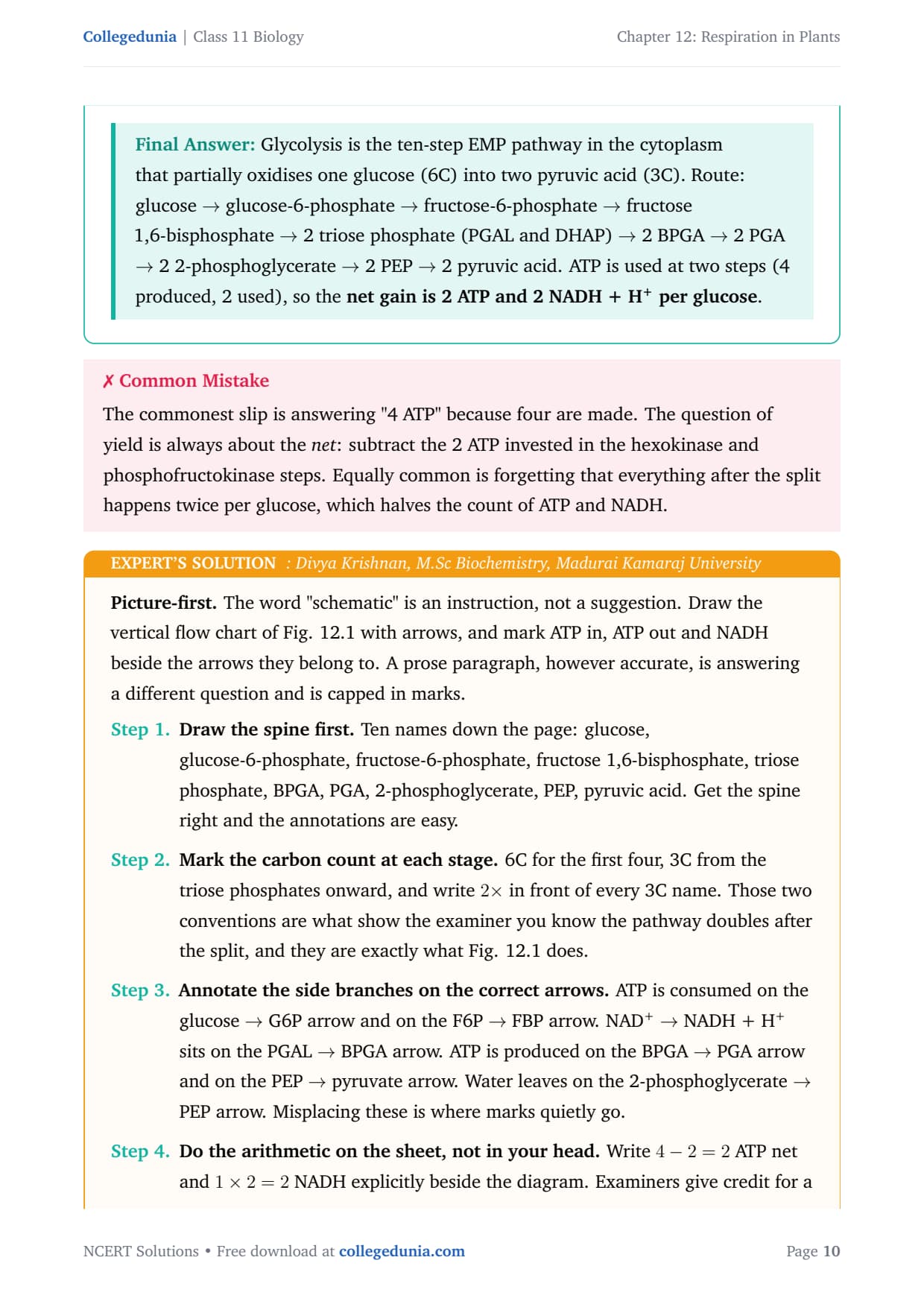
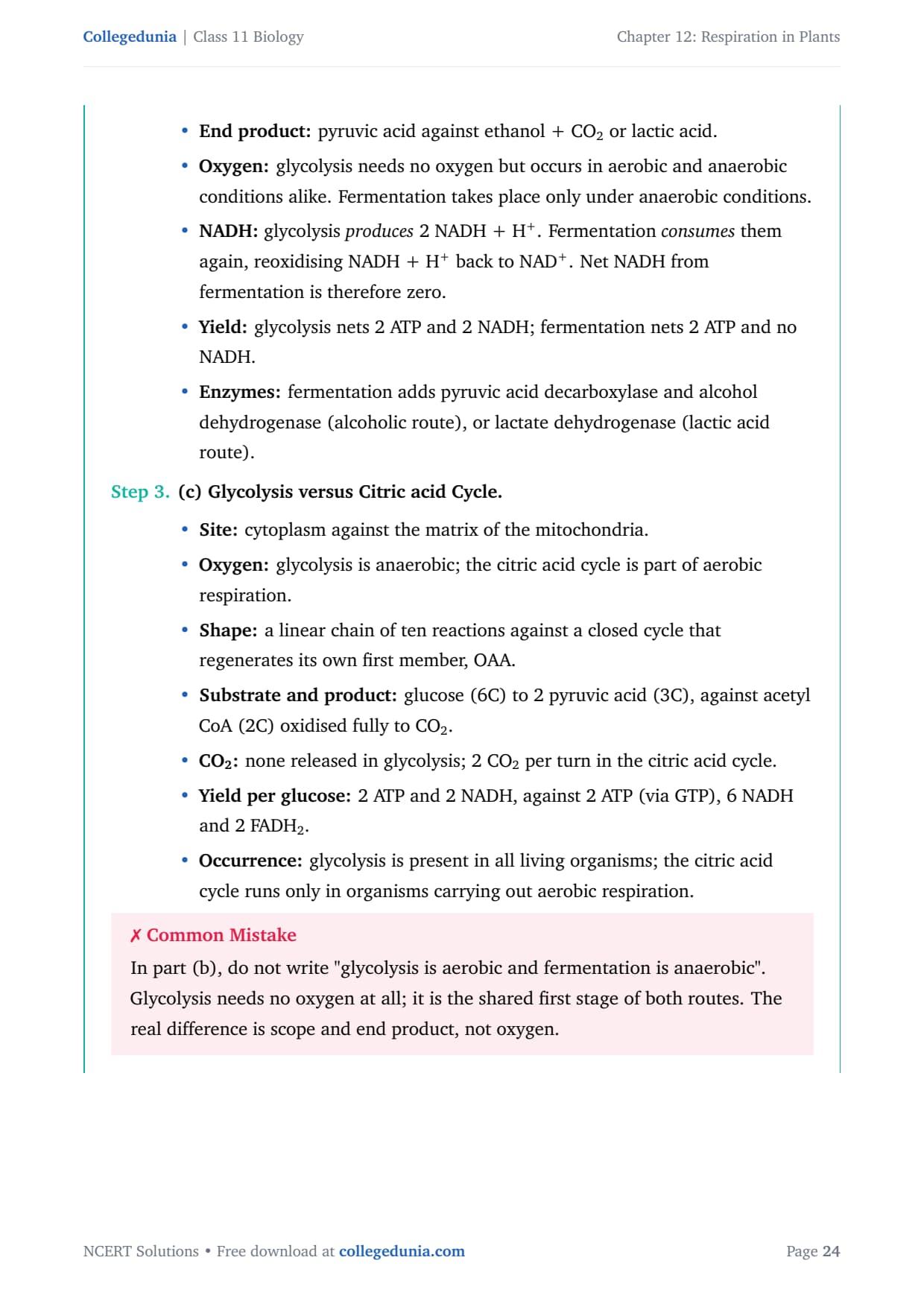
The two ATP-making steps and the NADH step happen once per triose, and there are two trioses per glucose, so everything after the split doubles. Four ATP are made and two are spent, so the net gain is 2 ATP and 2 NADH + H+ per glucose. The commonest slip is answering 4 ATP, because yield is always about the net. No CO2 leaves and no oxygen is used, so pyruvate still holds most of the energy of the original glucose, which is exactly why the cell then turns to the mitochondrion.
Aerobic Respiration and Its Four Main Steps
Aerobic respiration is the complete oxidation of organic substances in the presence of oxygen, releasing CO2, water and a large amount of energy. NCERT names two crucial events: the complete oxidation of pyruvate by the stepwise removal of all hydrogen atoms, and the passing of those electrons to molecular O2 with simultaneous ATP synthesis. The first is a matrix process, the second a membrane process. The four steps map to four addresses.
| Step | Location | Key event |
|---|---|---|
| Glycolysis | Cytoplasm | Glucose to 2 pyruvate; 2 ATP + 2 NADH; no CO2 |
| Oxidative decarboxylation | Mitochondrial matrix | Pyruvate to acetyl CoA by pyruvate dehydrogenase; first CO2 |
| Krebs cycle | Mitochondrial matrix | Acetyl CoA oxidised fully to CO2; makes NADH, FADH2, GTP |
| ETS and oxidative phosphorylation | Inner mitochondrial membrane | Electrons reach O2 to form water; bulk of ATP made |
A quick self-check is to trace the carbons. Glycolysis releases none, each of the two link reactions releases one, and each of the two turns of the Krebs cycle releases two, so 2 + 4 = 6, and all six carbons of glucose have left as CO2. Aerobic respiration therefore begins in the cytoplasm and is completed in the mitochondria. Do not merge the link reaction into the Krebs cycle, since naming oxidative decarboxylation separately is often a mark of its own in Q4.
The Krebs Cycle and Its Energy Yield
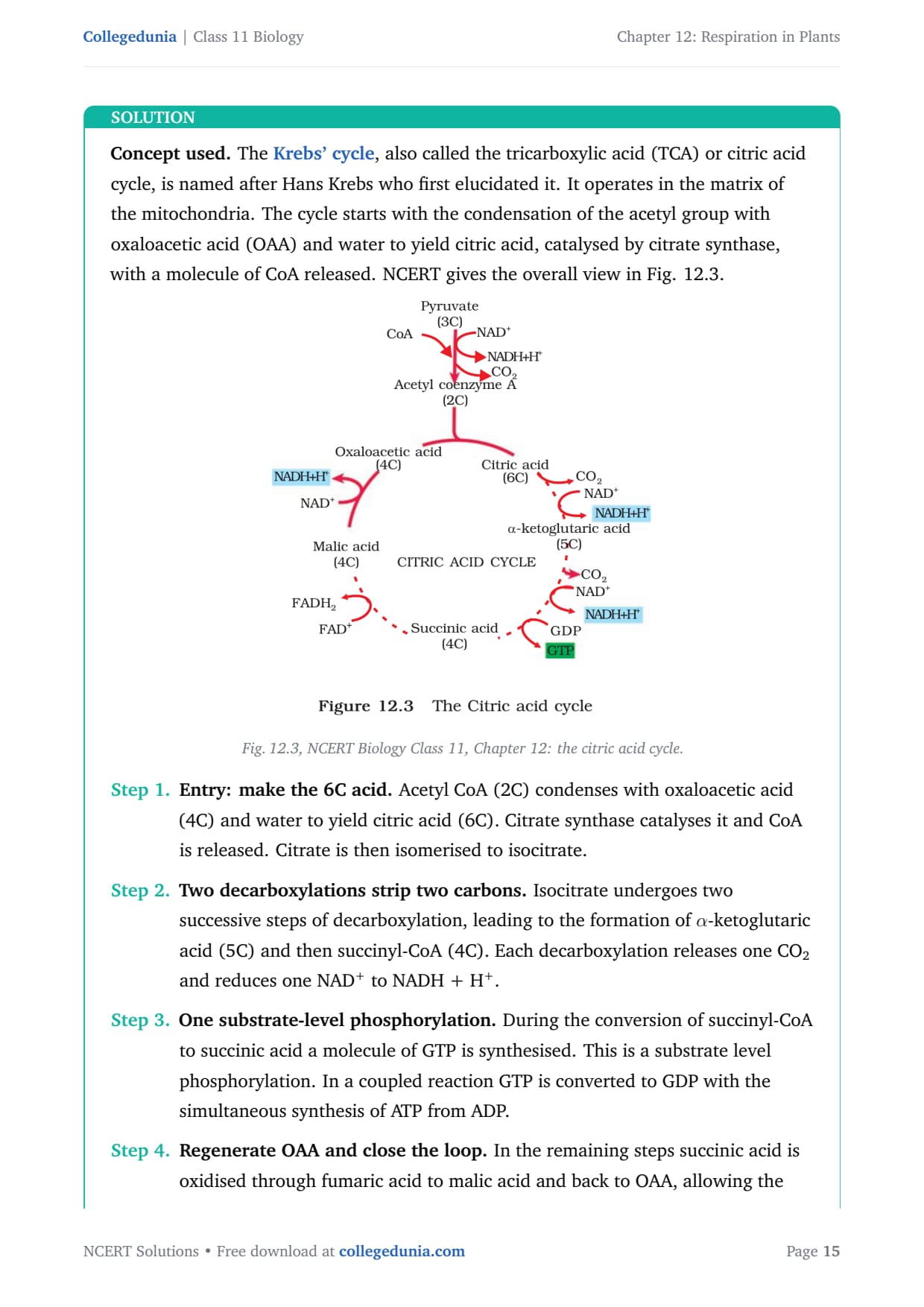
The Krebs cycle, also called the tricarboxylic acid (TCA) or citric acid cycle, operates in the mitochondrial matrix. It opens with acetyl CoA (2C) condensing with oxaloacetic acid (4C) and water to give citric acid (6C), catalysed by citrate synthase. Two decarboxylations then strip two carbons, and a series of oxidations regenerates oxaloacetic acid so the cycle can turn again.
- Entry and descent: citric acid (6C) → isocitrate → α-ketoglutaric acid (5C) → succinyl-CoA (4C), releasing one CO2 at each decarboxylation.
- Substrate-level phosphorylation: succinyl-CoA to succinic acid makes one GTP, which is converted to one ATP.
- Closing the loop: succinic acid → fumaric acid (making FADH2) → malic acid → oxaloacetic acid (making the third NADH).
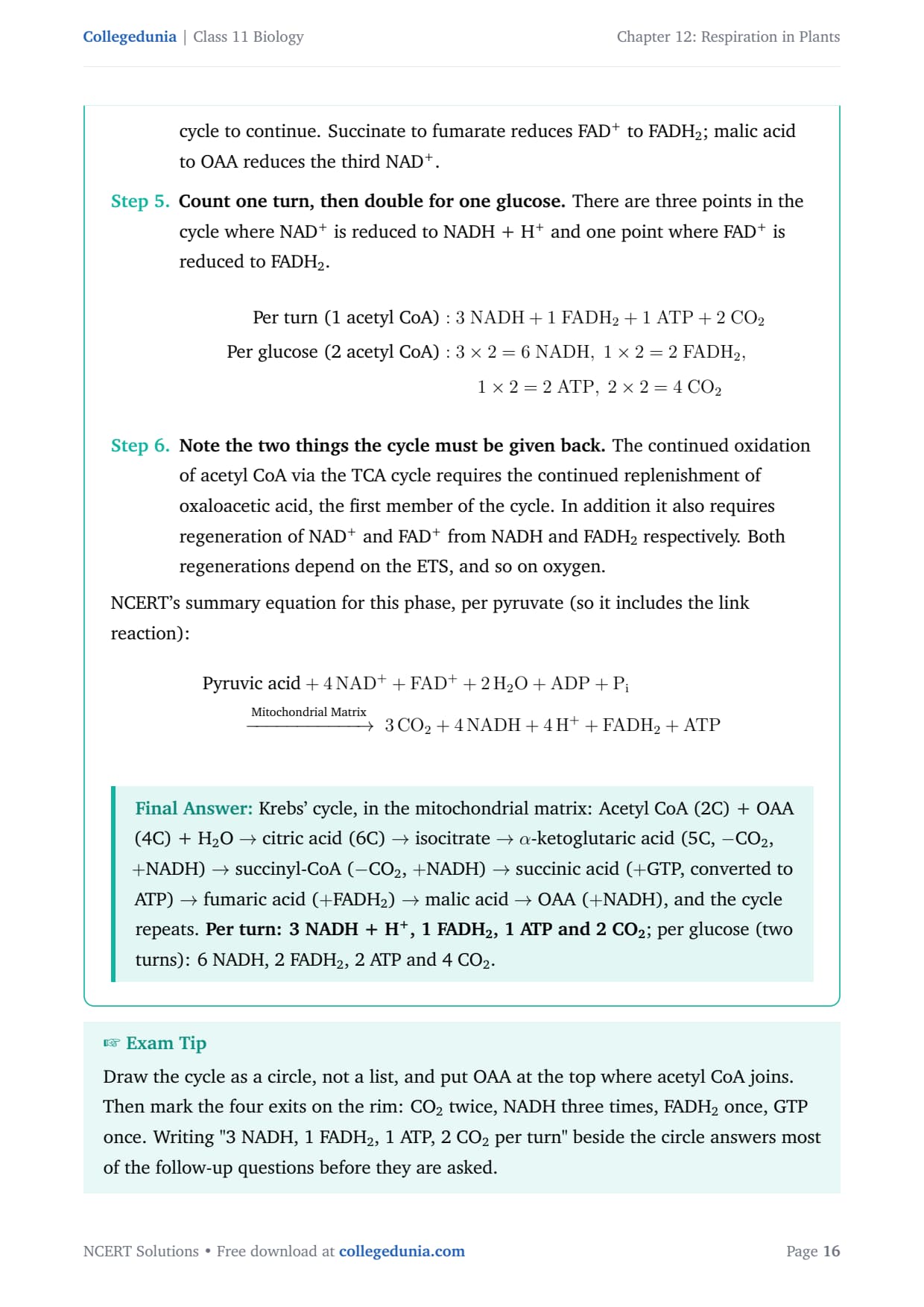
There are three points where NAD+ is reduced and one where FAD+ is reduced. Per turn the cycle yields 3 NADH + H+, 1 FADH2, 1 ATP and 2 CO2; per glucose, with two turns, that doubles to 6 NADH, 2 FADH2, 2 ATP and 4 CO2. Almost every mark lost here comes from quoting the per-turn figures as if they were per-glucose. The continued oxidation of acetyl CoA also requires the continued replenishment of oxaloacetic acid and the regeneration of NAD+ and FAD+, both of which depend on oxygen downstream.
The Electron Transport System and Oxidative Phosphorylation
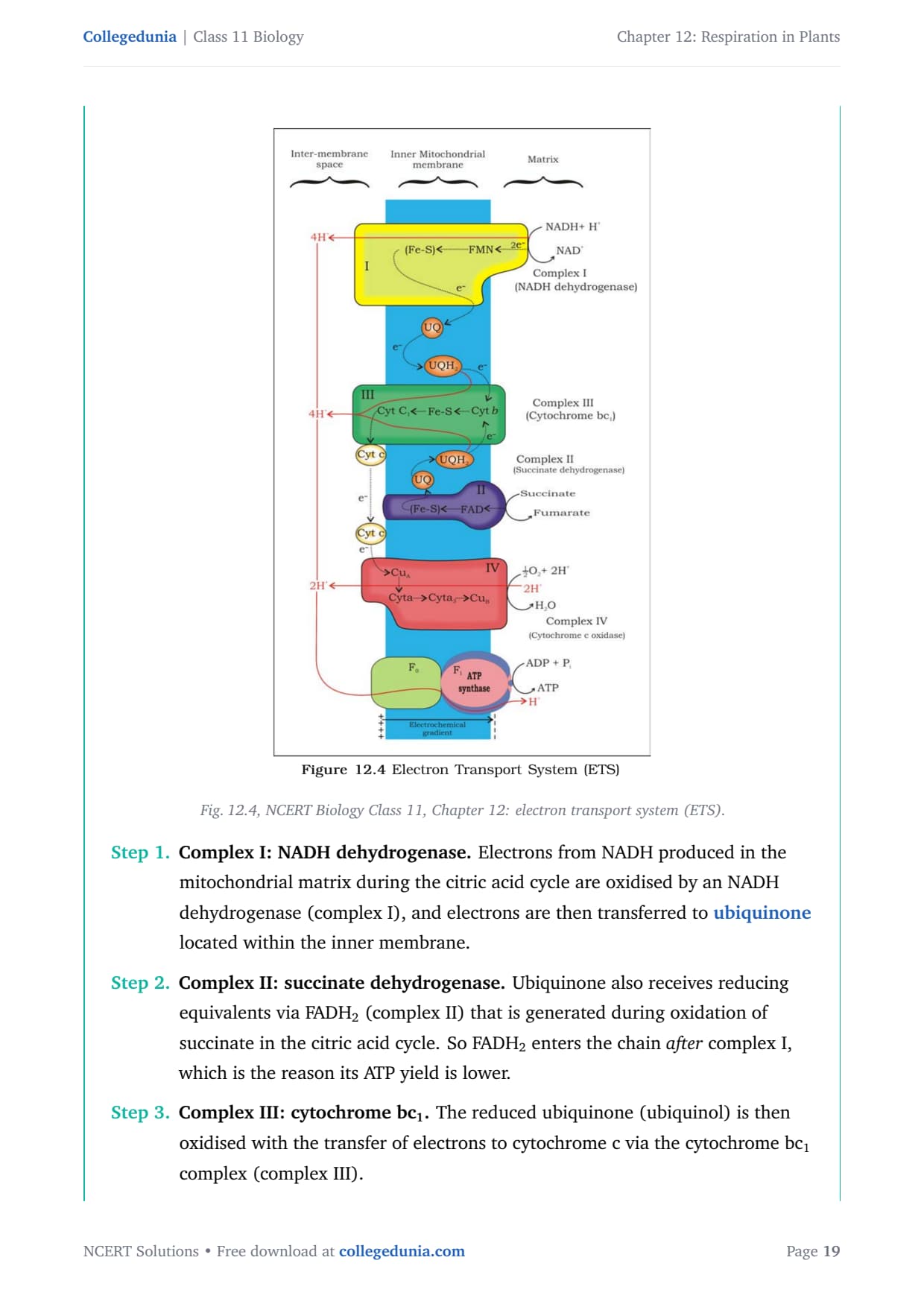
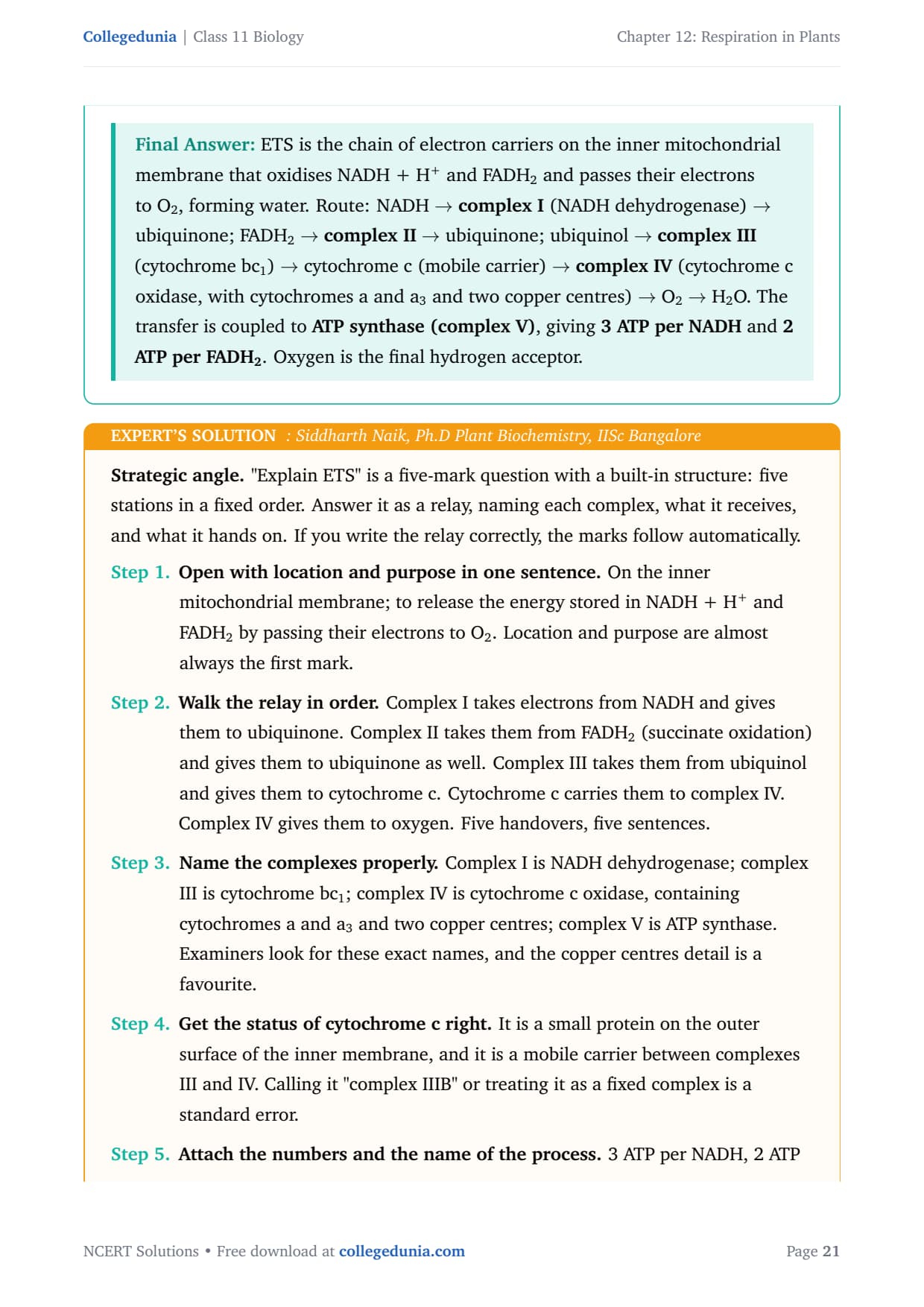
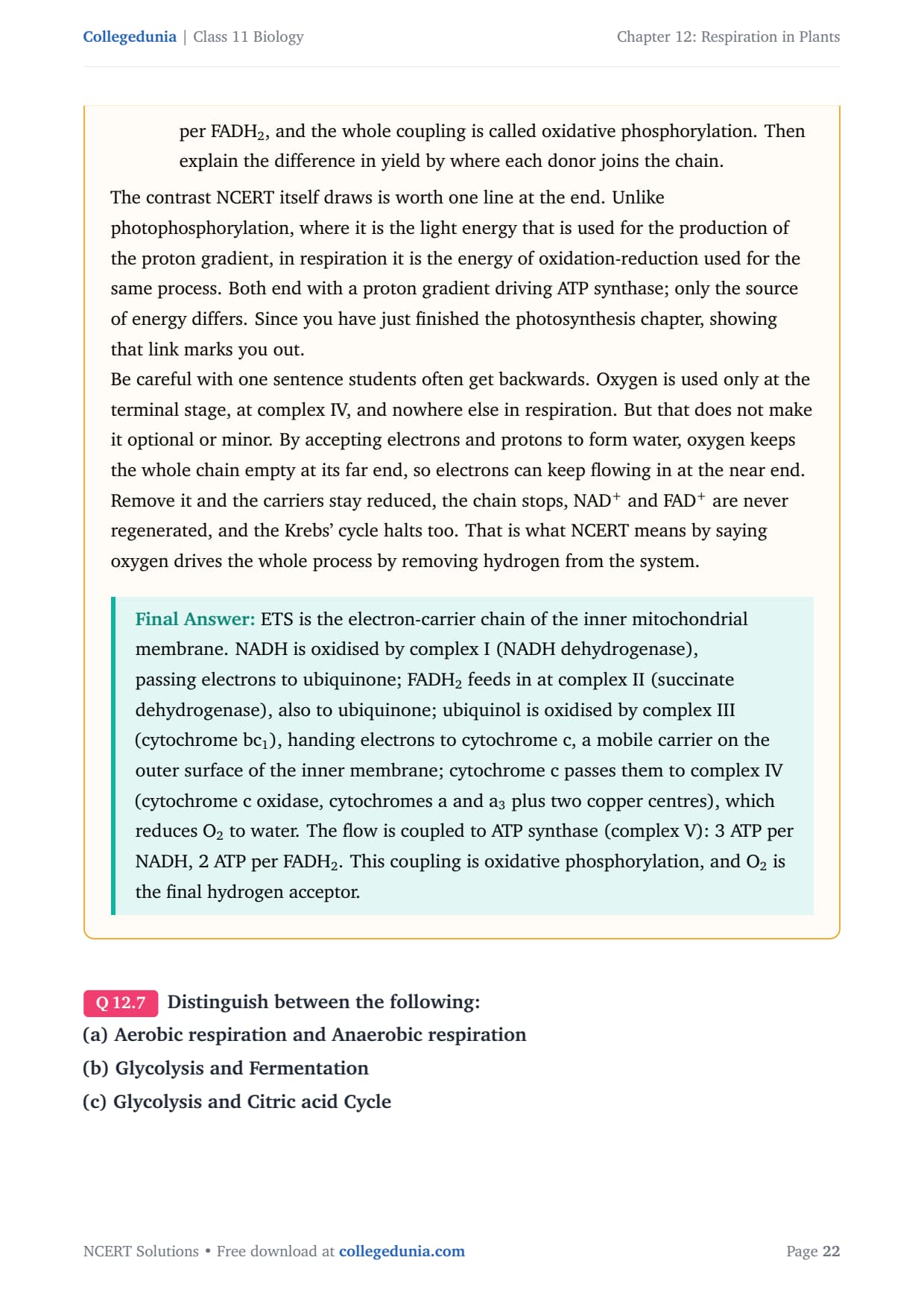
The electron transport system (ETS) is the chain of carriers on the inner mitochondrial membrane through which electrons pass from one carrier to the next. Its job is to oxidise the NADH + H+ and FADH2 made earlier, hand their electrons to O2 and form water. Answer it as a relay of five stations, each named for what it receives and what it passes on.
| Complex | Name | Role |
|---|---|---|
| Complex I | NADH dehydrogenase | Takes electrons from NADH, gives them to ubiquinone |
| Complex II | Succinate dehydrogenase | Feeds FADH2 electrons to ubiquinone, downstream of I |
| Complex III | Cytochrome bc1 | Oxidises ubiquinol, hands electrons to cytochrome c |
| Cytochrome c | Mobile carrier | Small protein shuttling electrons from III to IV |
| Complex IV | Cytochrome c oxidase | Cytochromes a and a3 plus two copper centres reduce O2 to water |
| Complex V | ATP synthase | Couples electron flow to ATP synthesis |
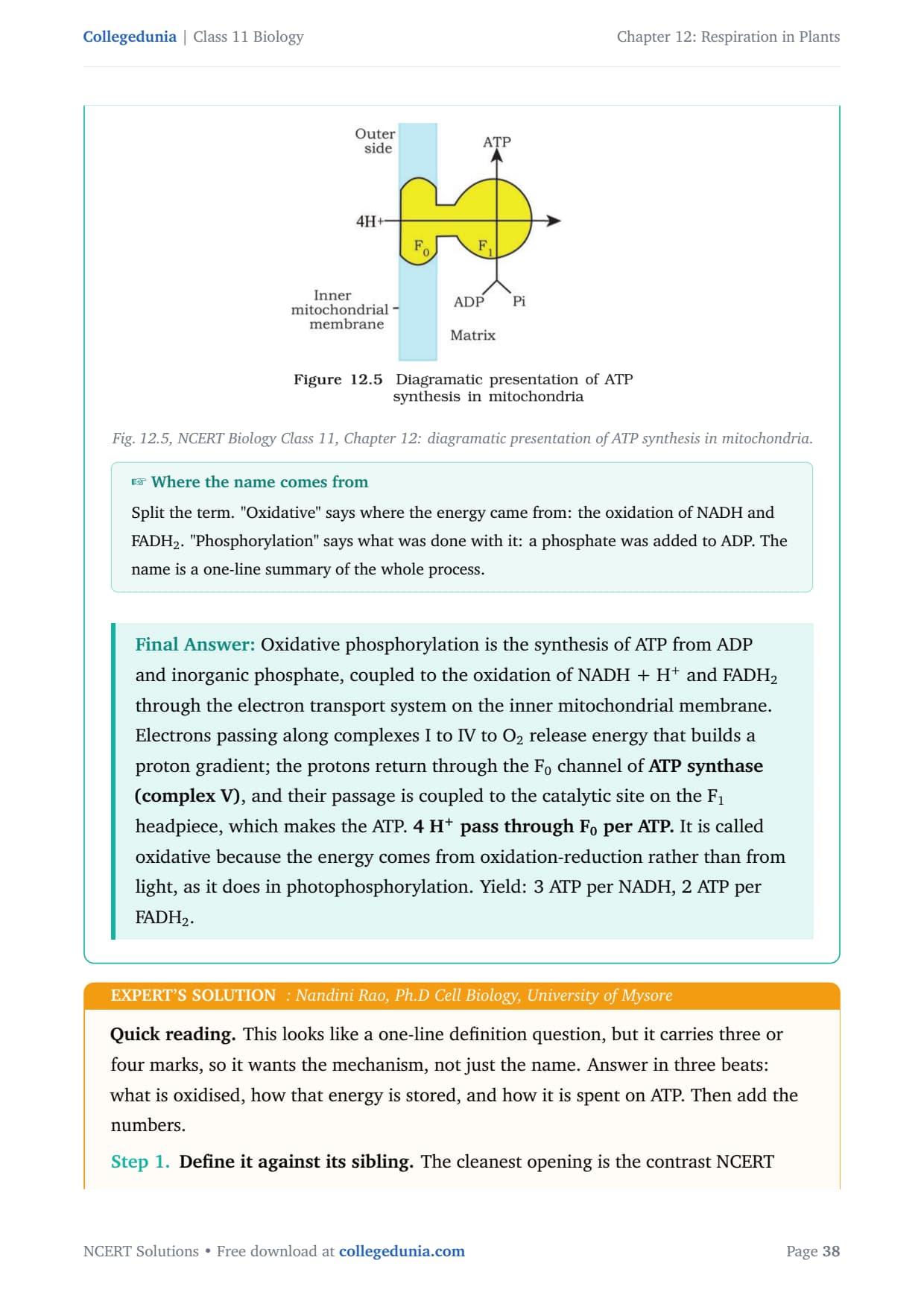
Because the phosphorylation is driven by the energy of oxidation-reduction, the process is called oxidative phosphorylation, in contrast with photophosphorylation, which uses light energy for the same proton gradient. The number of ATP made depends on the electron donor: oxidation of 1 NADH yields 3 ATP, while oxidation of 1 FADH2 yields only 2 ATP. FADH2 is worth less because it joins at complex II, downstream of complex I, so fewer proton-pumping complexes are used. Oxygen acts only at the terminal stage as the final hydrogen acceptor, yet its presence is vital because it keeps the far end of the chain empty so electrons can keep flowing.
The ATP Balance Sheet and the Assumptions Behind 38 ATP
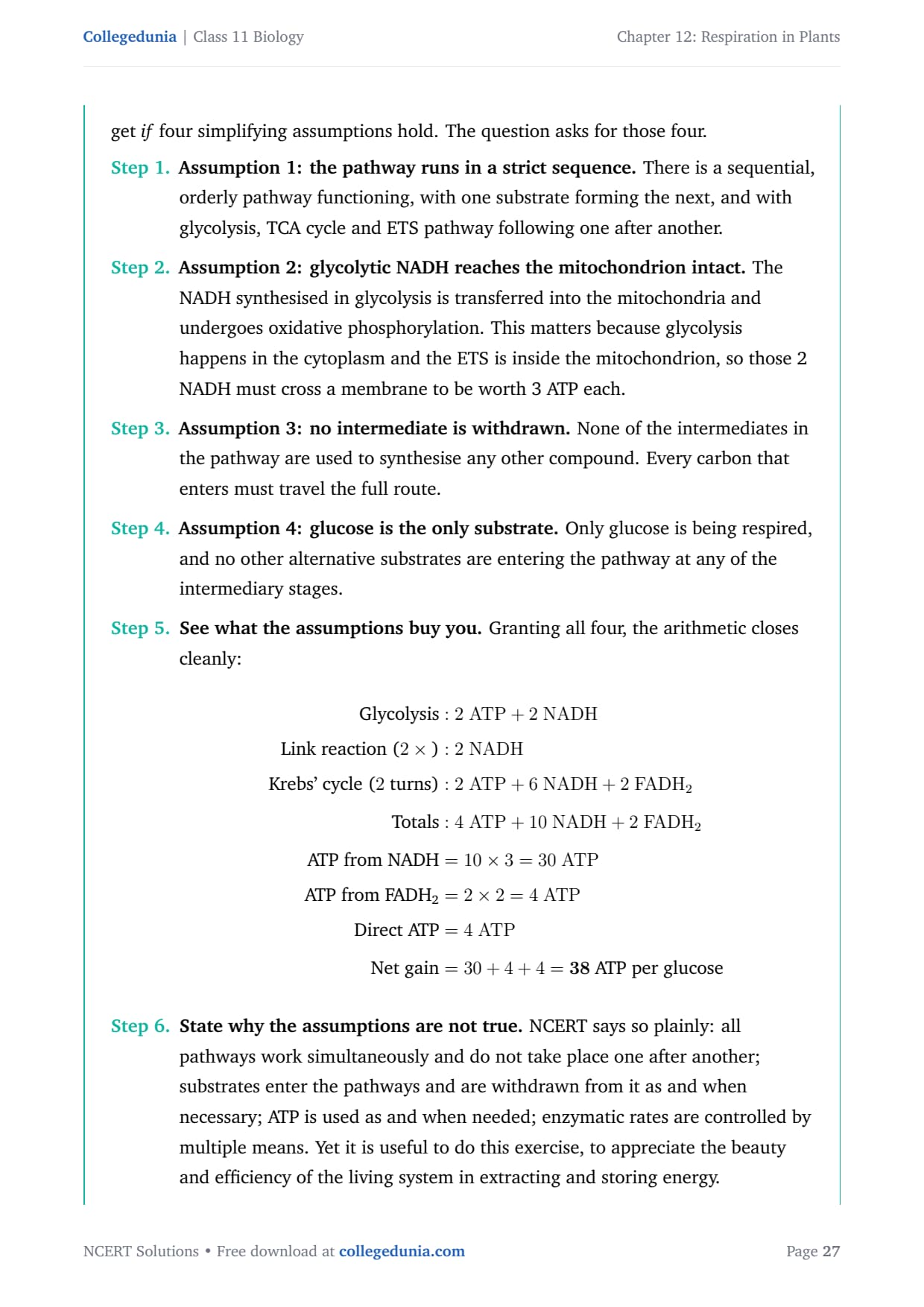
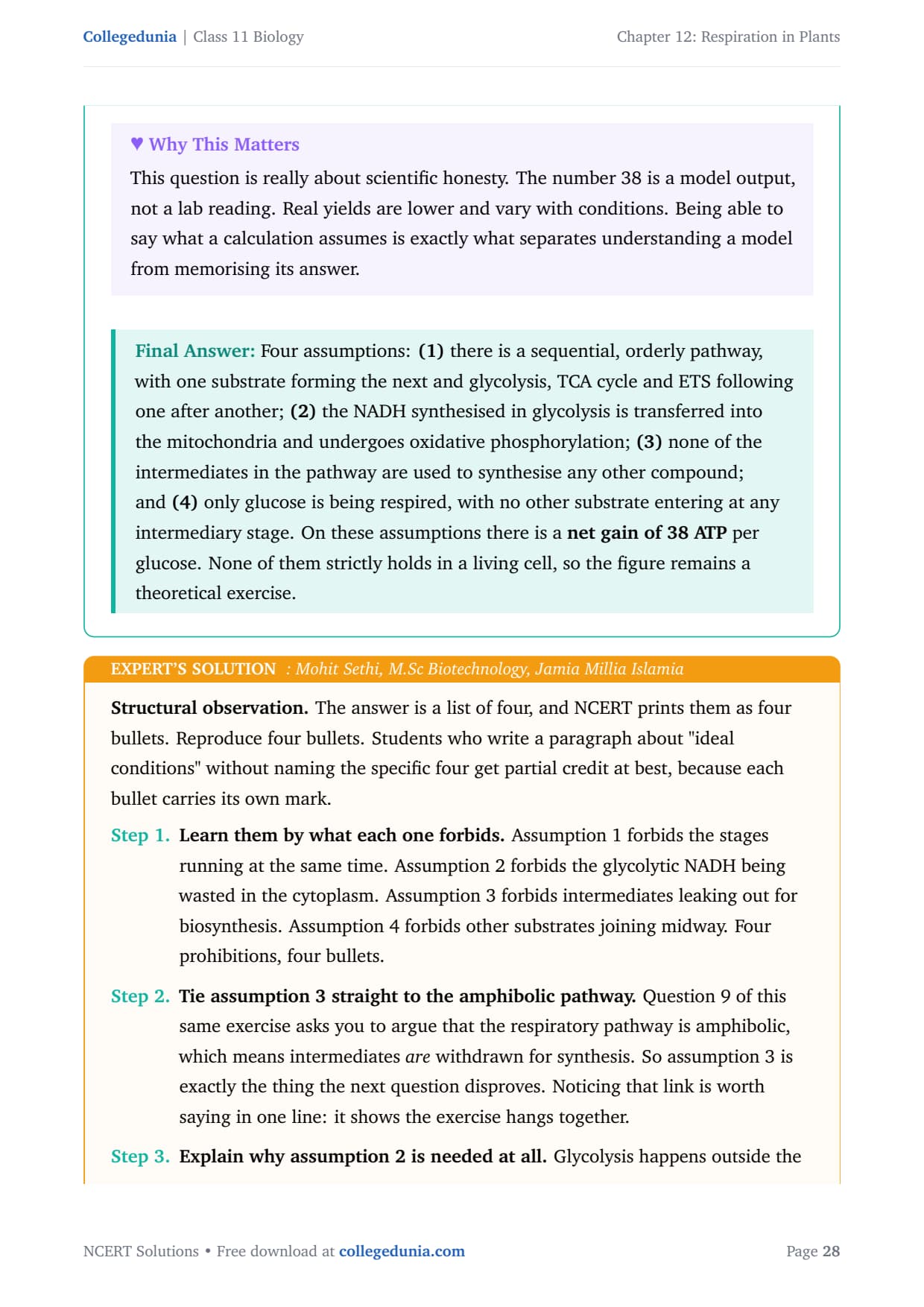
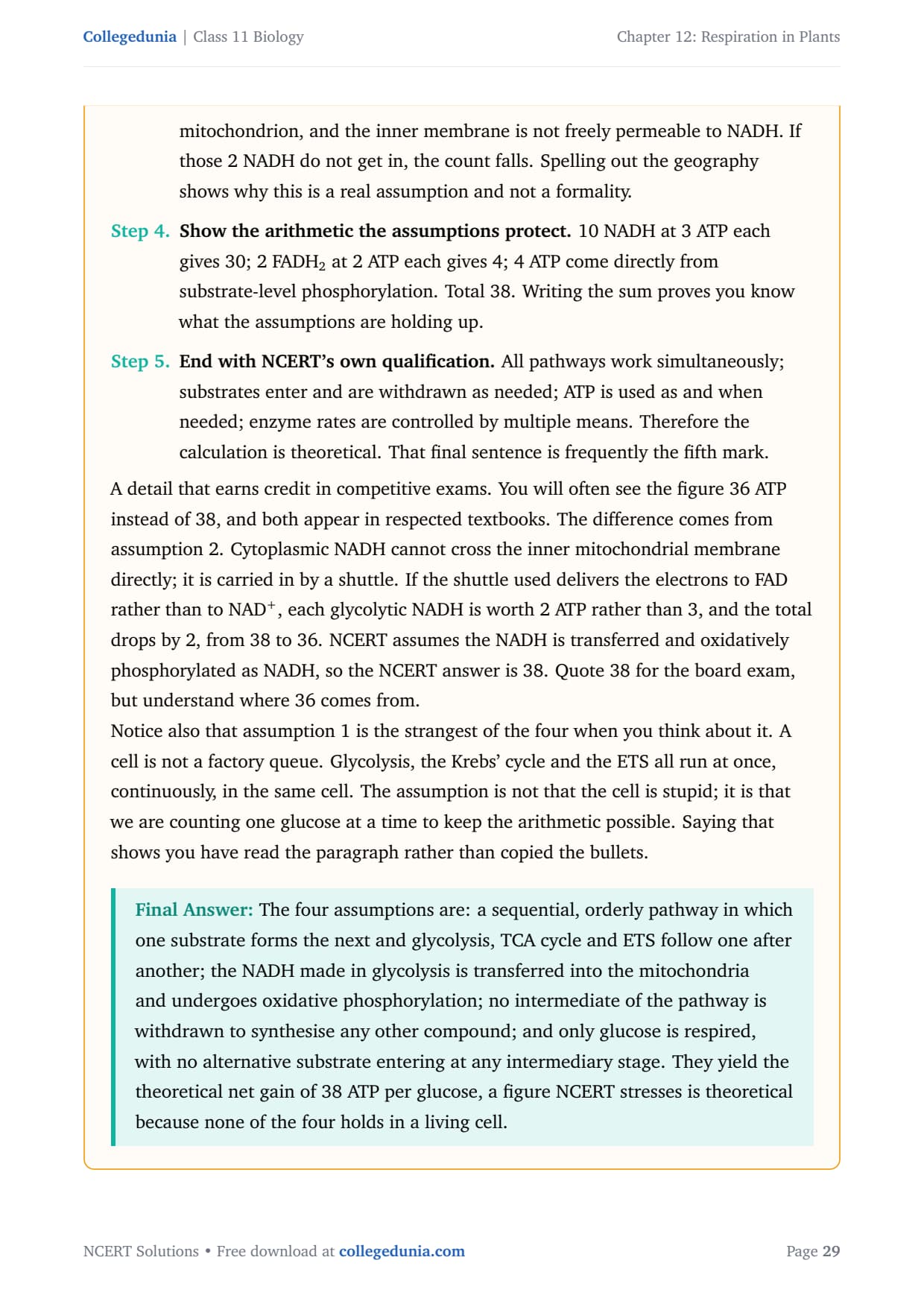
NCERT is careful to say that the net gain of ATP per glucose can be calculated, but in reality this remains a theoretical exercise. The figure of 38 ATP is not a measurement; it is the answer you get only if four simplifying assumptions hold. Q8 asks for exactly those four, and stating them shows students understand why real yields differ.
- Sequential pathway: glycolysis, the TCA cycle and the ETS run in a strict, orderly sequence, one substrate forming the next.
- Glycolytic NADH is used fully: the NADH made in the cytoplasm is transferred into the mitochondria and undergoes oxidative phosphorylation.
- No intermediates are withdrawn: nothing is siphoned off for synthesis of other compounds along the way.
- Only glucose is respired: no other substrate enters the pathway at an intermediate step.
In a living cell none of these assumptions holds strictly. The pathways work simultaneously rather than one after another, substrates enter and are withdrawn as the cell needs them, and ATP is used up as soon as it is made. That is why real cells never bank a clean 38 ATP, and why some textbooks quote 36 instead. The number is a teaching figure that shows the ceiling of the pathway, not a value you would measure in a mitochondrion.
Amphibolic Pathway and the Respiratory Quotient
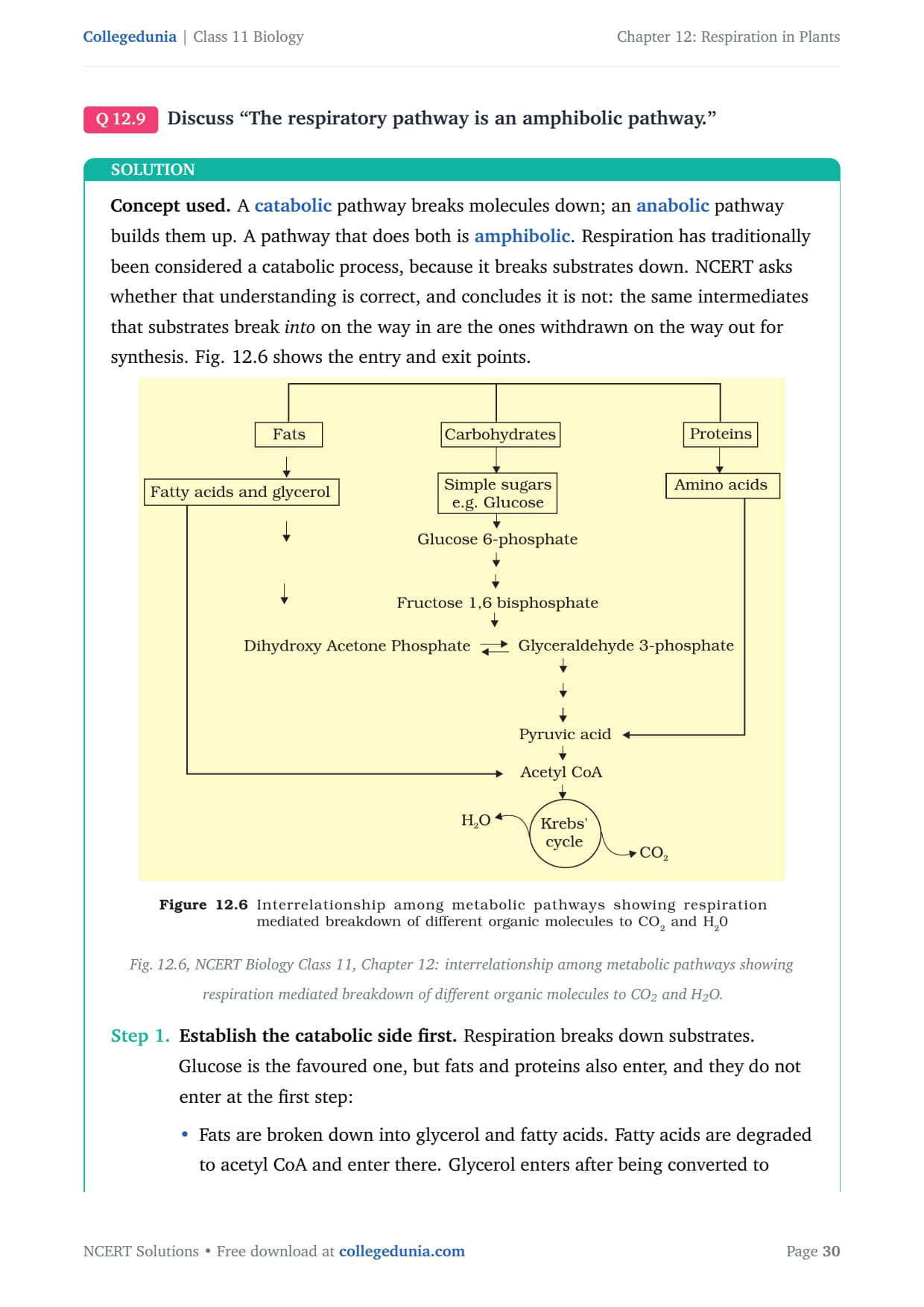
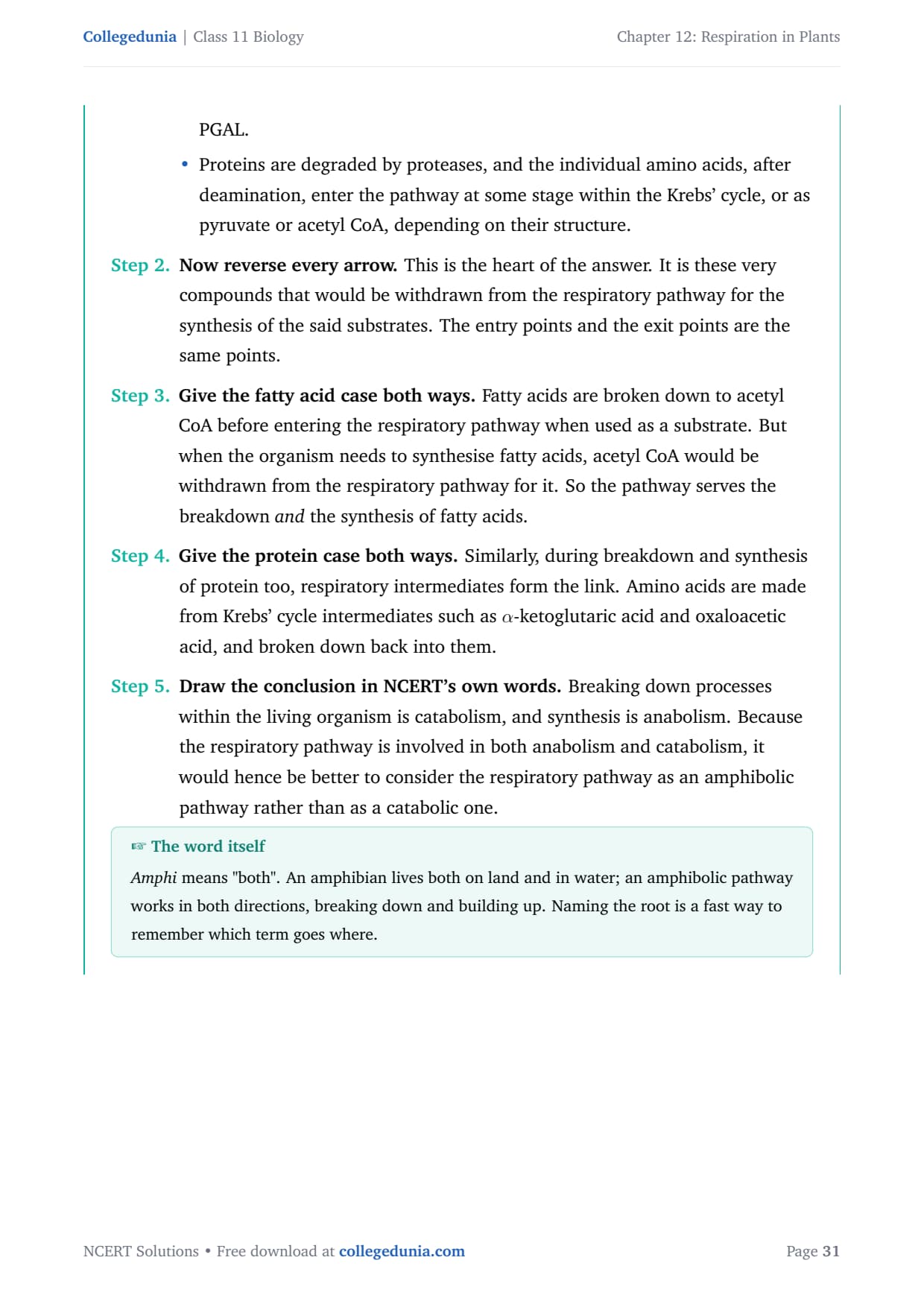
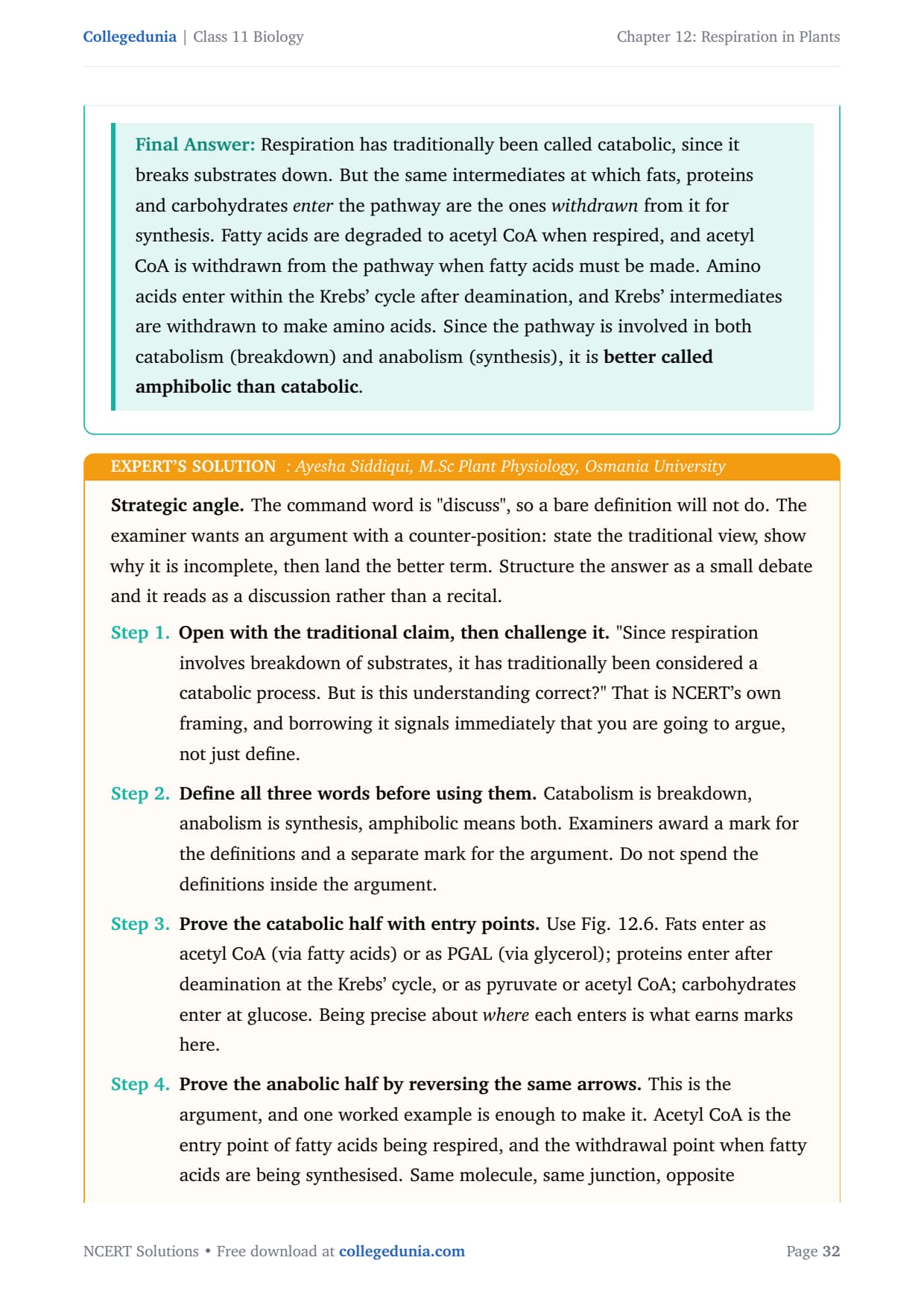
Respiration has traditionally been called a catabolic, energy-releasing process, but NCERT shows it is really an amphibolic pathway, one that both breaks down and builds up. Fatty acids, amino acids and other building blocks are withdrawn from respiratory intermediates such as acetyl CoA and the Krebs-cycle acids for synthesis. The same intermediates that substrates break into on the way in are drawn out on the way out, so respiration serves both catabolism and anabolism.
| Respiratory substrate | RQ value | Reason |
|---|---|---|
| Carbohydrates (glucose) | 1.0 | 6CO2 evolved for 6O2 consumed |
| Fats (tripalmitin) | 0.7 | 102CO2 for 145O2, so less than 1 |
| Proteins | About 0.9 | Less oxygen-poor than fats, richer than carbohydrates |
| Organic acids | Greater than 1 | Already partly oxidised, so extra CO2 released |
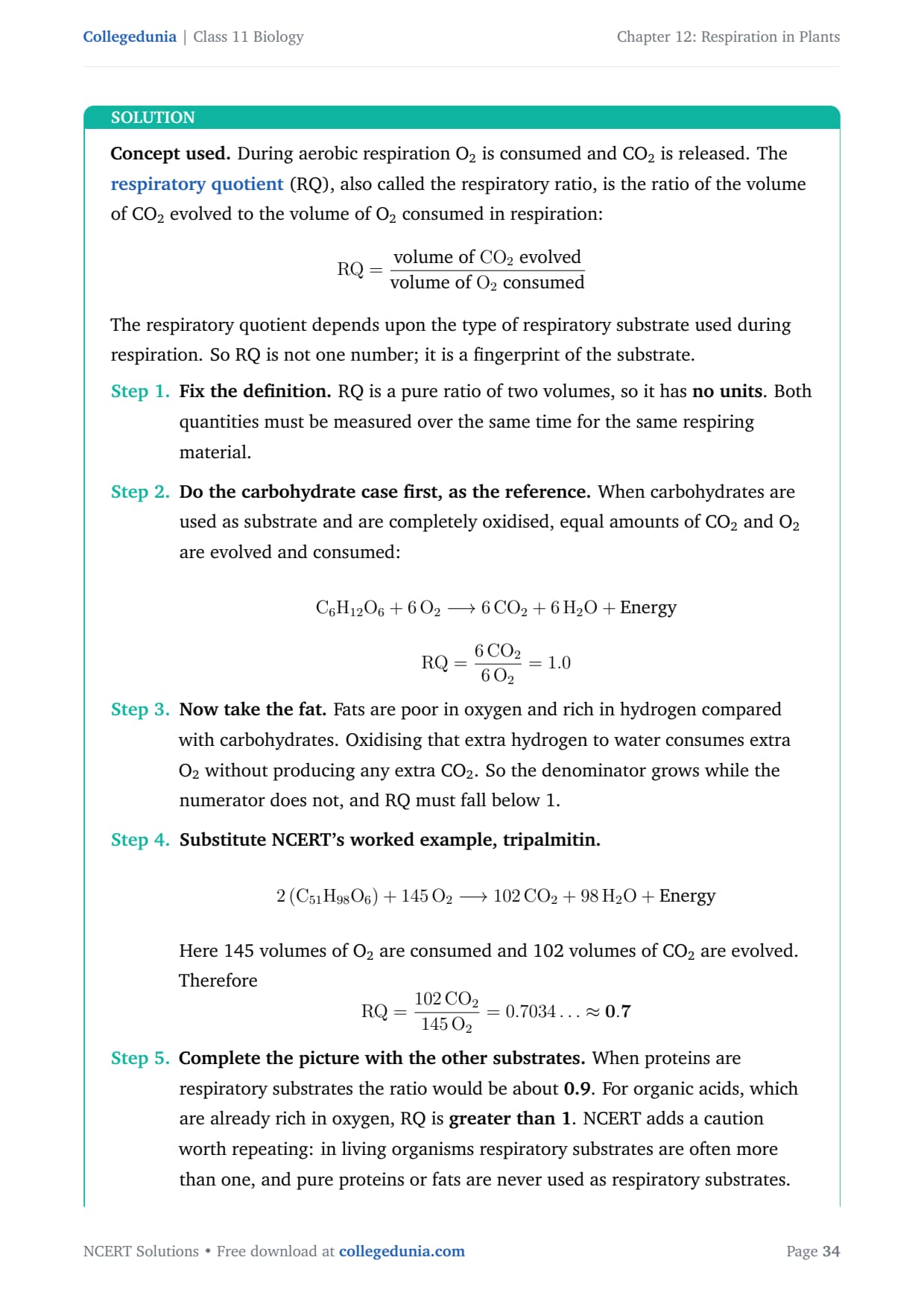
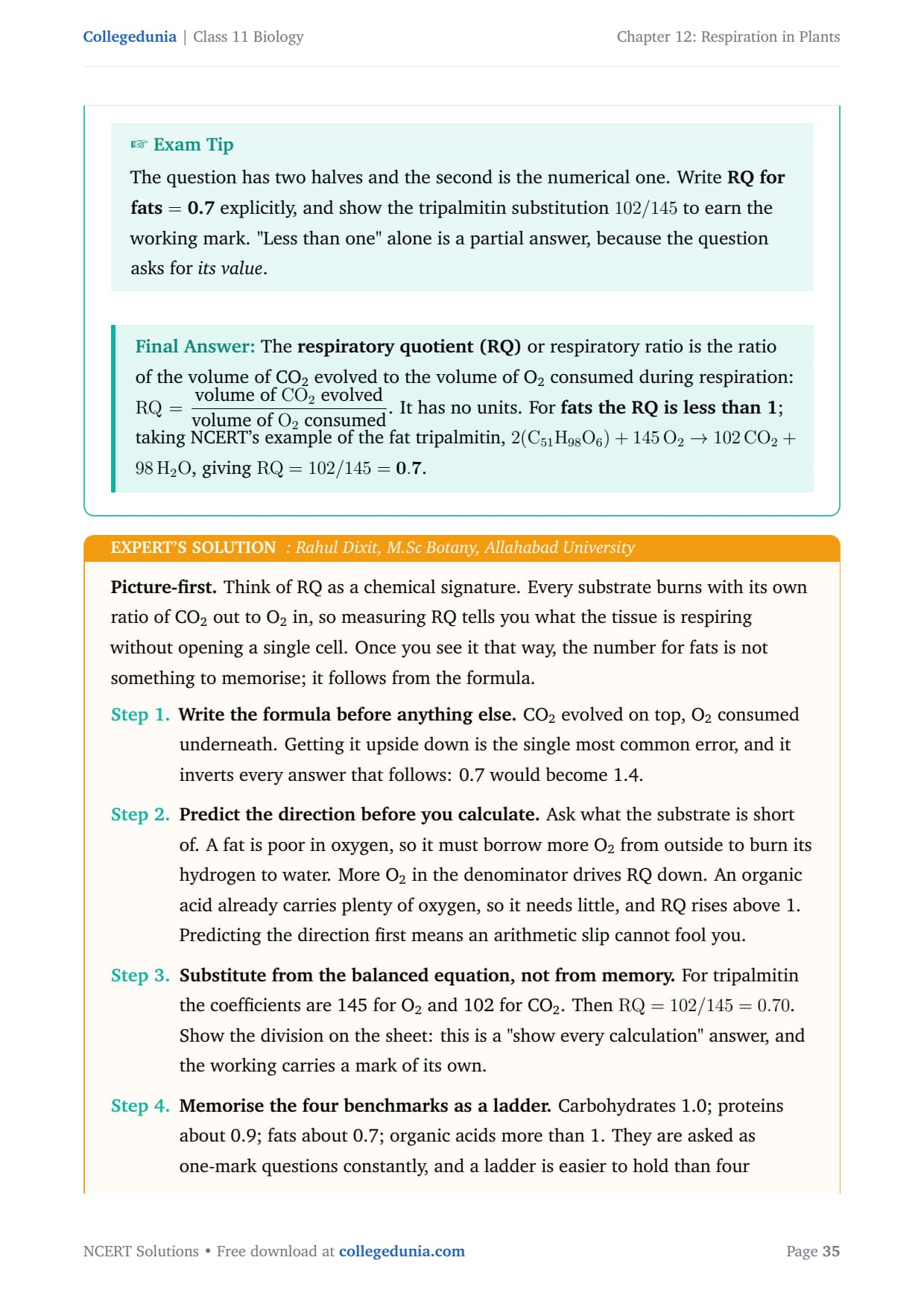
The respiratory quotient (RQ) is the ratio of the volume of CO2 evolved to the volume of O2 consumed, and it is a fingerprint of the substrate being respired. For fats the RQ is 0.7, because fats carry a great deal of hydrogen and little oxygen, so more O2 is needed to oxidise them. Working the tripalmitin case, RQ = 102/145 = 0.7. When students answer Q10 they should give the definition, name the value for fats explicitly, and show the calculation, since a bare 0.7 without the ratio loses the reasoning mark.
Respiration in Plants Exercise-wise Breakdown
The NCERT back exercise has 12 questions, mixing schematic diagrams, differentiation tables and one numerical. The table below maps the question blocks to their topics so students can revise by theme and know where the diagrams are expected.
| Question block | What it tests |
|---|---|
| Q 1 and Q 7 | Differentiating respiration, combustion, glycolysis, Krebs cycle, aerobic respiration and fermentation. |
| Q 2 | Respiratory substrates and naming glucose as the most common one. |
| Q 3 to Q 6 | Schematic diagrams of glycolysis and the Krebs cycle, the steps of aerobic respiration and the ETS. |
| Q 8 | The four assumptions behind the net gain of 38 ATP. |
| Q 9 and Q 10 | The amphibolic pathway and the respiratory quotient, including its value for fats. |
| Q 11 and Q 12 | Oxidative phosphorylation and the significance of the stepwise release of energy. |
The diagram questions carry the most marks, so students should practise drawing the glycolysis flow chart, the Krebs circle and the ETS relay by hand. Mark ATP in, ATP out and NADH on the correct arrows, and always show the doubling after the split. Every question in the class 11 biology NCERT solutions chapter 12 Respiration in Plants PDF is solved with each step shown, so students can compare their working against the model answer.
Practice the solved questions: Work through the full question bank with step-by-step answers and expert tips.
Common Mistakes Students Make in Respiration in Plants
Most marks in this chapter are lost on counting slips and misplaced labels, not on hard ideas. Each mistake below costs 1 to 2 marks, so watch for it at the exact step.
Mistake 1: Quoting 4 ATP as the yield of glycolysis. Four are made but two are invested, so the net gain is 2 ATP per glucose.
Mistake 2: Giving per-turn Krebs figures as per-glucose. One glucose gives two acetyl CoA and two turns, so the yield doubles to 6 NADH, 2 FADH2, 2 ATP and 4 CO2.
Mistake 3: Treating cytochrome c as a fixed complex. It is a small mobile protein on the outer surface of the inner membrane that shuttles electrons between complexes III and IV.
Mistake 4: Presenting 38 ATP as a measured value. It is a theoretical figure that holds only under four assumptions, and it is why some books quote 36 ATP.
Student Feedback on Respiration in Plants Solutions
What 9,740 students told us about their Respiration in Plants preparation:
- 61% of students said the ATP balance sheet and its four assumptions was the hardest part of the chapter.
- Most-skipped detail: showing the doubling after the glycolytic split, missed by about 4 in 10 students in the diagram questions.
- Students who learned the four-step location map first said the Krebs and ETS answers became automatic.
Source: 2026-27 Class 11 Biology student poll. Sample of 9,740 students from CBSE schools across 14 states, conducted before the 2026 boards.
Other Respiration in Plants Class 11 Biology Resources
Pair these solutions with the revision notes, formula sheet, exemplar solutions and NCERT textbook PDF for the same chapter.
| Resource | Link |
|---|---|
| NCERT Notes | Respiration in Plants Class 11 Notes |
| Formula Sheet | Respiration in Plants Class 11 Formula Sheet |
| Exemplar Solutions | Respiration in Plants Class 11 Exemplar Solutions |
| NCERT Book PDF | Respiration in Plants Class 11 Book PDF |
NCERT Solutions for Class 11 Biology: All Chapters
Jump to the step-by-step solutions for any other Class 11 Biology chapter below.
| Chapter | NCERT Solutions |
|---|---|
| Chapter 1 | The Living World |
| Chapter 2 | Biological Classification |
| Chapter 3 | Plant Kingdom |
| Chapter 4 | Animal Kingdom |
| Chapter 5 | Morphology of Flowering Plants |
| Chapter 6 | Anatomy of Flowering Plants |
| Chapter 7 | Structural Organisation in Animals |
| Chapter 8 | Cell: The Unit of Life |
| Chapter 9 | Biomolecules |
| Chapter 10 | Cell Cycle and Cell Division |
| Chapter 11 | Photosynthesis in Higher Plants |
| Chapter 12 | Respiration in Plants |
| Chapter 13 | Plant Growth and Development |
| Chapter 14 | Breathing and Exchange of Gases |
| Chapter 15 | Body Fluids and Circulation |
| Chapter 16 | Excretory Products and their Elimination |
| Chapter 17 | Locomotion and Movement |
| Chapter 18 | Neural Control and Coordination |
| Chapter 19 | Chemical Coordination and Integration |
FAQs on Respiration in Plants Class 11 NCERT Solutions
Respiration in Plants NCERT Solutions - Frequently Asked Questions
Ques. What do the class 11 biology NCERT solutions chapter 12 Respiration in Plants cover?
Ans. These solutions cover all 12 back-exercise questions, including the difference between respiration and combustion, the schematic of glycolysis, the four steps of aerobic respiration, the Krebs cycle, the electron transport system, oxidative phosphorylation, the four assumptions behind the 38 ATP figure, the amphibolic pathway, the respiratory quotient and the significance of the stepwise release of energy. Every question is solved step by step.
Ques. What is the net gain of ATP per glucose in aerobic respiration?
Ans. Complete aerobic oxidation of one glucose gives a theoretical net gain of 38 ATP: 2 from glycolysis, 2 from the Krebs cycle and the rest from oxidative phosphorylation, where each NADH gives 3 ATP and each FADH2 gives 2 ATP. The figure holds only if the pathway is strictly sequential, glycolytic NADH is fully used, no intermediates are withdrawn, and only glucose is respired, which is why real yields are lower.
Ques. What is the respiratory quotient of fats?
Ans. The respiratory quotient (RQ) is the ratio of the volume of CO2 evolved to the volume of O2 consumed. For fats it is less than 1, and for tripalmitin the calculation gives RQ = 102/145 = 0.7. Fats carry much hydrogen and little oxygen, so more O2 is consumed than CO2 released. Carbohydrates give an RQ of 1.0 and organic acids give an RQ greater than 1.
Ques. Where does each step of aerobic respiration take place?
Ans. Glycolysis occurs in the cytoplasm, converting glucose to pyruvate. Oxidative decarboxylation of pyruvate to acetyl CoA and the Krebs cycle both occur in the mitochondrial matrix. The electron transport system and oxidative phosphorylation occur on the inner mitochondrial membrane, where electrons reach oxygen and the bulk of the ATP is made. So aerobic respiration begins in the cytoplasm and is completed in the mitochondria.
Ques. Why is the respiratory pathway called amphibolic?
Ans. A catabolic pathway breaks molecules down and an anabolic pathway builds them up. Respiration does both: while it oxidises substrates for energy, its intermediates such as acetyl CoA and the Krebs-cycle acids are also withdrawn for the synthesis of fatty acids, amino acids and other compounds. Since it serves both catabolism and anabolism, NCERT calls it an amphibolic pathway rather than a purely catabolic one.
Ques. What is the weightage of Respiration in Plants in CBSE Class 11 Biology?
Ans. Respiration in Plants carries about 4 to 5 marks in the CBSE Class 11 Biology paper, tested through diagram-based questions on glycolysis and the Krebs cycle, the ATP balance sheet and the respiratory quotient. It is also high-yield for NEET, where the ETS, the ATP count and the RQ of different substrates appear regularly.



Comments