



Education Content Expert
Acetylene is a hydrocarbon and the simplest alkyne. Ethyne, Narcylen, and Vinylene are the other names used to refer to Acetylene.
- The chemical formula of Acetylene is C2H2.
- Acetylene is widely used as fuel and a chemical building component.
- It is utilized as a solution even though it is unstable in its most basic form.
- It is an unsaturated compound made up of two carbon atoms joined together by double bonds.
- Pure acetylene is a colorless gas with a pleasant smell.
Acetylene can be broken down into its constituent parts when heat is released. The breakdown may or may not result in an explosion. Pure acetylene explodes violently when subjected to pressure greater than 15 pounds per square inch, whether in liquid or solid form.
Read More: NCERT Solutions for Class 11 Chemistry Hydrocarbons
| Table of Content |
Key Terms: Acetylene, Hydrocarbon, Alkyne, Carbon, Methane, Hydrogen, Acetone, Ethane, Combustion, Calcium Carbide, Ethyne
What is Acetylene?
[Click Here for Sample Questions]
Acetylene is an unsaturated chemical compound with the molecular formula C2H2.
- Acetylene is an emitted gas made up of hydrogen and carbon.
- It is a hydrocarbon and is the simplest alkyne known till date.
- The compound is unstable in its basic form.
- Acetylene is also referred to as Ethyne, Narcylen, and Vinylene.
- It is prepared by bringing calcium carbide into contact with water.
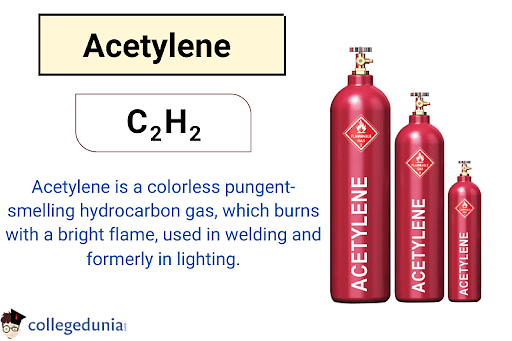
Acetylene
Read More:
| Relevant Concepts | ||
|---|---|---|
| Unsaturated Hydrocarbons | Aliphatic Hydrocarbons | Preparation of Alkynes |
| Physical Properties of Alkynes | Nomenclature of Alkane, Alkene and Alkyne | Addition Reaction of Alkynes |
Production of Acetylene
[Click Here for Previous Year Questions]
Acetylene has been produced from the incomplete combustion of Methane (CH4) since the year 1950.
- 4,00,000 tonnes of Acetylene were produced up until 1983.
- Friedrich Wohlerthe found a reaction that was used to make Acetylene in 1862.
Acetylene is produced as a result of the Hydrolysis of Calcium Carbide:
| CaC2 + 2H2O → Ca(OH)2 + C2H2 |
The reaction takes place in an electric arc furnace at a very high temperature of about 2000°C.
Read More: Hydrocarbon Important Questions
Structure of Acetylene
[Click Here for Sample Questions]
Acetylene is an unsaturated compound that is unstable in its basic form.
- It is made up of two carbon atoms joined together by double bonds.
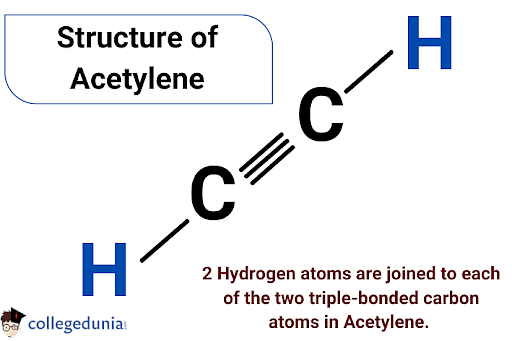
- Two hydrogen atoms are joined to each of the two triple-bonded carbon atoms in acetylene.
- The structure of Acetylene is given as H−C≡C−H.
Acetylene Formula
[Click Here for Previous Year Questions]
Acetylene Formula is given as C2H2. The extended formula of acetylene is CH≡CH.
- Acetylene is the simplest alkyne, which is a functional group characterized by having triple bonds.
- Owing to the presence of a triple bond, acetylene is more unsaturated hydrocarbon than ethylene.
- The triple bond consists of one sigma and two pi-bonds in order to form a linear molecule.
Acetylene Formula
Properties of Acetylene
[Click Here for Sample Questions]
The important properties of Acetylene are as follows:
| Properties of Acetylene | |
|---|---|
| Chemical Formula | C2H2 |
| Molar Mass | 26.038 g/mol |
| Molecular Shape | Linear Structure |
| Appearance | Colorless Gaseous Hydrocarbon |
| Density | 1.097 kg/m3 |
| Odor | Odorless |
| Melting Point | −80.8 °C |
| Solubility | A little soluble in alcohol or water, and soluble in acetone and benzene. |
| Conjugate Acid | Ethynium |
Physical Properties of Acetylene
Acetylene in its purest form is an odorless, colorless gas with a smell akin to garlic.
- The melting and boiling points of acetylene are −80.8 °C and -84.7°C respectively.
- The density of acetylene can be expressed as 1.097 kg/m3.
- Acetylene is miscible with acetone, water, benzene, and chloroform.
- It is mildly soluble in carbon disulfide and ethanol.
- Prolonged exposure to heat or fire can explode acetylene containers violently.
Chemical Properties of Acetylene
The various chemical properties of acetylene are listed below:
- Reaction with HBr
Ethylidene bromide is the product when acetylene is treated with HBr.
| CH≡CH (Acetylene) + HBr → CH2 = CHBr → CH3 CHBr2(Ethylidene Bromide) |
- Reaction with Sodium Metal
Acetylene and Sodium combine to form Sodium Hydro Acetylide and hydrogen.
| Na + C2H2 → NaHC2 +H2 |
- Reaction with HCI
When acetylene reacts with HCI, CH3CHCI2 is formed.
| C2H2 + HCI → CH2 = CHCI CH2 = CHCI + HCI → CH3CHCI2 |
Read More: Important MCQs on Hydrocarbons
Uses of Acetylene
[Click Here for Previous Year Questions]
The major uses of Acetylene are as follows:
- Acetylene is commonly used as a fuel additive.
- It is used in welding setups or with oxy-acetylene torches.
- Numerous chemical molecules, including alcohol, ether, and carboxylic acids, are also synthesized using it.
- C2H2 is used to create synthetic rubber and plastic bottles.
- Acetylene is added to hydrogen cyanide in the presence of a catalyst made of cupric chloride to create vinyl cyanides.
- Acetylene is used to create toys and plastic bottles.
- It is used in brazing and in the glass industry.
- It is also used as an additive to preserve food.
Read More: Structure of Benzene
Health Hazards of Acetylene
[Click Here for Sample Questions]
The health hazards associated with Acetylene are as follows:
- When created using processes that result in the impurities of other chemical compounds, Acetylene becomes poisonous.
- Acetylene also burns easily and produces a sooty blaze.
- Additionally, it should not be stored with oxidizing substances nearby.
- Most significantly, it catches fire or heat and explodes.
- People may suffer from headaches, loss of consciousness, and dizziness in case of contact with acetylene.
Also Check:
| Related Topics | ||
|---|---|---|
| Saturated Hydrocarbons | Aromatic Hydrocarbons | Alkanes |
| Nomenclature of Saturated Hydrocarbons | Ethane | Halogenation of Alkanes |
Things to Remember
- Acetylene is the simplest and best-known member of the hydrocarbon group.
- The chemical formula of Acetylene is C2H2.
- Acetylene is a colorless gas with a faint ether-like odor.
- Acetylene is produced through the incomplete combustion of Methane.
- Production of Acetylene is given through the reaction CaC2 + 2H2O → Ca(OH)2 + C2H2.
- Acetylene is used in the glass industry, brazing, soldering metals, and manufacturing of acetic acid.
- The health hazards associated with acetylene are headaches, loss of dizziness, and frostbite due to inhalation.
Previous Years’ Questions
- Acetylene is used in the large-scale production of…
- What will be obtained when acetylene is treated with… (Rajasthan PMT 2004)
- In the acetylene molecule, between the carbon atoms, there are…
- What is the product formed when acetylene reacts with… (UP CPMT 2012)
- The relationship between acetylene and benzene can be… (JIPMER 1998)
- Bond length of ethane (I), ethene (II), acetylene (III), and benzene…
- Acetylenic hydrogens are acidic because… (NEET 1989)
- Reaction of ethyne with HCN, in the presence of… (JIPMER 2002)
- Gasoline is a mixture of hydrocarbons containing… (AIIMS 2000)
- In preparation of alkene from alcohol using… (NEET 2001)
Sample Questions
Ques. What is Acetylene? (3 Marks)
Ans. Acetylene, denoted by the chemical formula C2H2, is the simplest alkyne chemical compound. It is also known as Ethyne or Narcylen or Vinylene. The compound is unstable in its purest form and is handled as a solution. Acetylene is an unsaturated compound with two carbon atoms in it linked together with a double bond.
Ques. List some uses of Acetylene. (3 Marks)
Ans. The uses of Acetylene are as follows:
- It is used in brazing and the glass industry.
- It is used in the manufacturing of synthetic rubber and soldering metals.
- It is used as a fuel additive and a feedstock in the manufacturing of acrylonitrile.
Ques. Are Acetylene and Ethyne the same? (2 Marks)
Ans. Yes, Acetylene, also called Ethyne, is the simplest member of the hydrocarbon series with one or more pairs of carbon atoms linked by triple bonds, known as acetylenic series, or, alkynes. Narcylene and Vinylene are also used to refer to acetylene.
Ques. How is acetylene produced? (3 Marks)
Ans. The production of Acetylene was discovered by Friedrich Wohler. Acetylene is prepared by mixing coke and lime in a blast furnace. Calcium carbide is manufactured as the product. It is reacted with water to produce acetylene gas. The reaction for the production of Acetylene is as follows: CaC2 + 2H2O → C2H2 + Ca(OH)2
Ques. What are the chemical properties of Acetylene? (3 Marks)
Ans. Acetylene is an extremely reactive chemical compound due to its electrons in the C-C triple bond. Acetylene is a brilliant nucleophile due to the same reason. Acetylene goes through a wide variety of reactions to obtain commercial products, such as acrylic acid, acetylide, alcohol, and a vinyl compound. It is also used to obtain organometallic compounds when reacting with a metal such as copper.
Ques. What are the physical properties of acetylene? (3 Marks)
Ans. Acetylene is a colorless gas with a faint garlic-like odor. It burns with a sooty flame. It is lighter than air. Commercial-grade acetylene has an ether-like odor. The density of acetylene can be expressed as 1.097 g/mL-1. Acetylene is easily soluble in water, chloroform, acetone, and benzene while it is slightly soluble in carbon disulfide and ethanol.
Ques. Why is acetylene a hazardous gas? (3 Marks)
Ans. In general industrial practice, acetylene is not considered to be a toxic compound. Acetylene exposure can cause headaches, dizziness, and passing out. Acetylene can affect when inhaled, and contact with the liquid acetylene can cause frostbite. Even in the absence of air, it can decompose explosively into its constituent elements- carbon and hydrogen.
Ques. Where is acetylene commonly used? (3 Marks)
Ans. Acetylene is used in the fabrication industry. It is the only fuel gas that can be used for welding. It is also used for cutting, flame gouging, brazing, hardening, cleaning, texturing, spot heating, and thermal spraying of many materials. It is used to produce solvents and alkenes, which serve as monomers in plastic production
Ques. Is Acetylene corrosive to metals? (2 Marks)
Ans. In its pure form, acetylene is a colorless gas. It can inhibit top-line corrosion usually occurring in gas pipelines. It is sprayed as a corrosion inhibitor, due to its high volatility.
Ques. Which metal must be avoided while dealing with Acetylene? (2 Marks)
Ans. On reaction with active metals like silver, copper (alloys of more than 70% copper), and mercury, acetylene forms explosive acetylide compounds. Decomposition of their acetylides can lead to explosions of the compressed acetylene.
Check-Out:



Comments