



Education Journalist | Study Abroad Lead
Chloroform is an organic chemical molecule that was used as an anesthetic in the past. It was created for the first time in 1831. CHCl3 is the chemical formula. It's a colorless, sweet-smelling thick liquid that's mass-produced. Chloroform is formed through the chlorination of drinking water, wastewater, and swimming pools, and it can be discharged into the air.
| Table of Content |
Key Terms: Chloroform, Molecule, Hydrogen, Chlorine, Carbon, Atom, Methane, Ethanol, Chloroform anesthesia, CHCL3
What is Chloroform?
[Click Here for Sample Questions]
Chloroform is a chemical that can be used as a lacrimator in industry. It is non-flammable, making it a safer alternative to ethanol. Chloroform is a methane tri chloro derivative. Chloroform's structure is created by replacing three hydrogen atoms in a methane molecule with three chlorine atoms. The structure of chloroform is made up of Hydrogen, Chlorine, and Carbon.
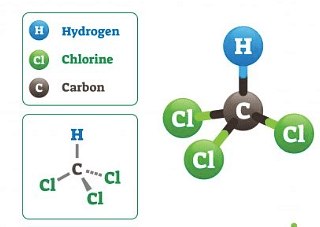
Structure of Chloroform
Read More:-
| Related Concepts | ||
|---|---|---|
| Ester Hydrolysis | Fehling Test | Iodoform Test |
| Hell-Volhard-Zelinsky Reaction | Friedel-Crafts acylation reaction | Butyric Acid |
| Resonance | Grignard Reagent | Enantiomers |
Physical Properties of Chloroform- CHCI3
[Click Here for Sample Questions]
Chloroform is a clear liquid with an ether-like odor and a somewhat sweet taste. Although it is a naturally occurring chemical, the majority of chloroform in the environment is man-made. It is water soluble. Today, the United States produces nearly all of the chloroform used in the production of other chemicals. However, it also sells or exchanges some of its products with other nations. India imports chloroform as well.
When chloroform is exposed to the air, it swiftly evaporates. Because chloroform does not adhere well to dirt. As a result, it might go down to the groundwater level through the soil.
| Parameters | Chemical |
| Odor | Ether-Like Odour |
| Appearance | Clear Liquid |
| Covalently- Bonded Unit | 1 |
| Complexity | 8 |
| Heavy Atom Count | 4 |
| Solubility | Insoluble in Water |
Chemical Properties of Chloroform
[Click Here for Sample Questions]
The reaction of chloroform with acetone is extremely explosive in alkaline conditions or in the presence of a solid base. Dinitrogen tetroxide and chloroform combinations are also explosive. Polyhalogenated organic compounds, which are a particularly significant class of chemicals, are made possible by the high reactivity rate of halogens.
- Chloroform is a member of this group of chemicals. Such chemicals have been shown to have negative impacts on the environment as well as the human body. Despite this, because of their great usefulness and a wide variety of applications, businesses continue to employ these compounds.
- Chloroform produces sodium acetate, sodium hydroxide, and water when it interacts with the base sodium hydroxide. The chemical formula is shown below.
HCOONa + 3NaCl + 2H2O = CHCl3 + 4NaOH
- Phosgene and hydrochloric acid are formed when chloroform is oxidized. The chemical formula is shown below.
2CHCl3 + O2 → 2COCl2 + 2HCl

Melting and Boiling point of Chloroform
Preparation of Chloroform
[Click Here for Sample Questions]
When chloroform reacts with sodium hydroxide, it generates sodium acetate, sodium hydroxide, and water. The chemical formula may be found in the table below.
CHCl3 + 4NaOH = HCOONa + 3NaCl + 2H2O
When chloroform is oxidized, phosgene and hydrochloric acid are produced. The chemical formula may be found in the table below.
2COCl2 + 2HCl = 2CHCl3 + O2
Uses of Chloroform
[Click Here for Sample Questions]
Chloroform is a liquid that is both volatile and colorless. It is a trichloromethane derivative with an ether-like odor. Initially, it was widely used as an inhalation anesthetic during surgery.
- In dentistry, it's also utilized as an anesthetic during root canal operations. Its primary application now is in the field of agriculture. It is used as a solvent in agriculture. It also serves a specific role in the production of the refrigerant Freon.
- Pure chloroform's spectrum can be used as a reference or backdrop. Also suitable for FTIR analysis is pure cholesterol powder or its extract from milk products, which dissolves in chloroform.
- It was once used as an extraction dissolvable for fats, greases, oils, and other things, as well as a laundry spot.
- It may also be used as an indirect food additive in the form of adhesive components in food packaging materials and as a component of food contact products.

Uses of Chloroform
Things to Remember
- Chloroform is a chemical that can be used as a lacrimator in industry. It is non-flammable, making it a safer alternative to ethanol.
- Chloroform's structure is created by replacing three hydrogen atoms in a methane molecule with three chlorine atoms.
- Chloroform produces sodium acetate, sodium hydroxide, and water when it interacts with the base sodium hydroxide.
- When chloroform reacts with sodium hydroxide, it generates sodium acetate, sodium hydroxide, and water.
- Chloroform has an ether-like odor. Initially, it was widely used as an inhalation anaesthetic during surgery,dentistry andas an indirect food additive.
Read More:-
Sample Questions
Ques. Is chloroform an acid or a base by nature? (2 marks)
Ans. The color is measured against a 2 mL blank of distilled water with a pH range of 5.0–7.0. The deuterated chloroform is acidic if the sample solution is yellow in comparison to the blank, which is blue-green.
Ques. How does chloroform cause people to pass out? (2 marks)
Ans. Chloroform efficiently knocks a person out by interfering with intercellular protein synthesis's main function. Doctors use a cotton mask with a continuous drip of chloroform (or occasionally ether) on it. Furthermore, a wireframe is placed over the nose and mouth to knock someone unconscious with chloroform.
Ques. What are some of the applications of chloroform? (2 marks)
Ans. Chloroform is a flammable, colorless liquid that is a trichloromethane derivative with an ether-like odor. Chloroform, which was once employed as an inhalation anesthetic in surgery, now finds its major usage in agriculture as a solvent and, more importantly, in the production of the refrigerant freon.
Ques. What are the effects of chloroform on the human body? (2 marks)
Ans. Shortness of breath, as well as irritation of the nose and throat, are common side effects of chloroform inhalation. Systemic symptoms such as agitation, nausea, and vomiting, as well as ataxia, dizziness, and sleepiness, might occur after an acute inhalation.
Ques. Comment about chloroform's physical appearance. (2 marks)
Ans. Chloroform is a clear liquid with an ether-like odor and a somewhat sweet taste. Although chloroform is a naturally occurring chemical, much of the chloroform found in the environment is man-made.
Ques. What causes people to pass out when they are exposed to chloroform? (2 marks)
Ans. By inhibiting the activities of intercellular protein synthesis, chloroform effectively renders a human unconscious. To knock someone unconscious using chloroform, doctors will use a cloth mask with a continuous flow of chloroform (or ether) on it, and put it over the nose and mouth with a wire frame.
Ques. What are the effects of chloroform on the human body? (3 marks)
Ans. Chloroform's effects on the human body are readily apparent. Shortness of breath and irritation of the nose and throat are some of the local symptoms of chloroform inhalation. Acute inhalation of this substance can cause systemic symptoms such as agitation, nausea, and vomiting, as well as ataxia, dizziness, and sleepiness.
Ques. What is the maximum amount of chloroform that is harmful to humans? (3 marks)
Ans. Chloroform has a hazardous dosage of 7 – 25 mg/dL, or 0.59 – 2.1 m mol/L. Physical symptoms including dizziness, fatigue, and headache have been recorded at breathed doses of strength less than 1500 ppm. In addition, anesthesia occurs at a concentration of 1500 to 30,000 parts per million. Chloroform is a kind of chloroform.
Read More:-



Comments