



Education Content Expert
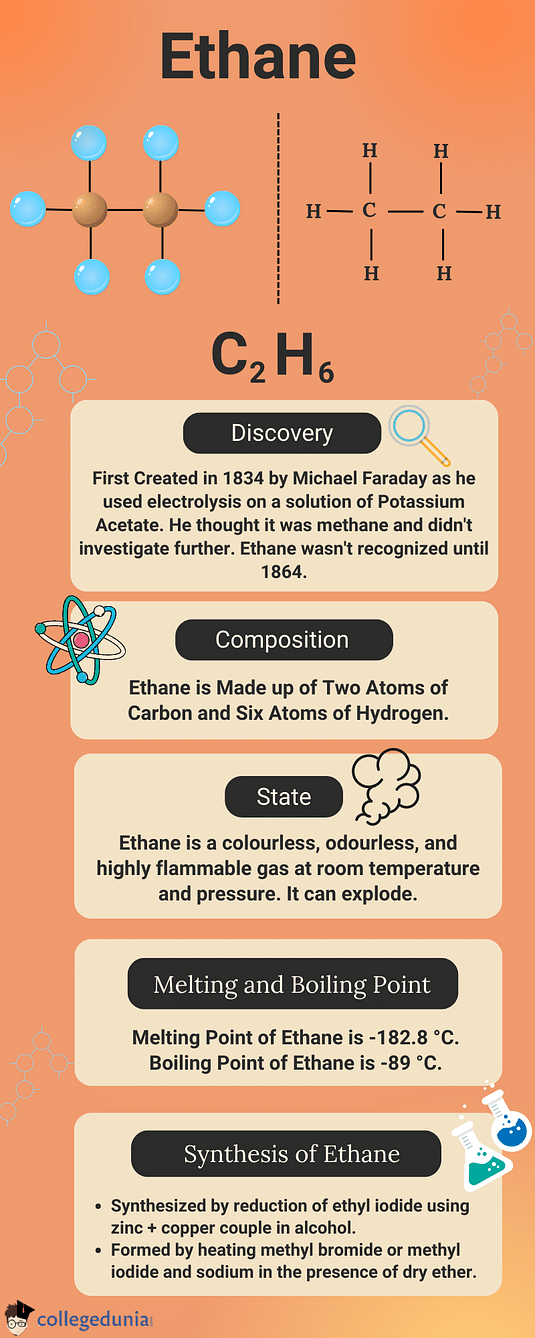
Ethane is a saturated hydrocarbon that contains a single carbon-carbon bond. Ethane occurs as an odorless, colorless, and flammable gas at room temperature and pressure. Ethane is formed when two atoms of carbon and six atoms of hydrogen bond together.
- Ethane is the second simplest alkane after methane.
- Ethane contains 2 carbon atoms and 6 hydrogen atoms, thus, the chemical formula for Ethane is C2H6.
- Ethane is a key constituent of natural gas and also occurs dissolved in petroleum oils.
- Ethane gas can be separated from natural gas when liquified under pressure or at reduced temperatures.
Natural Sources of Ethane are pyrolysis of biomass, marine biology, and biogas formation in anaerobic digesters. Methane can also be produced industrially by steam cracking of ethane, ethylene, or gasoline fractions from petroleum refining. Ethane is used especially in the petroleum industry, where it is used as a reactant in alkylation, olefins metathesis, and cracking processes.
Read More: NCERT Solutions For Class 11 Chemistry Organic Chemistry Some Basic Principles and Techniques
Key Terms: Ethane, Saturated Hydrocarbons, Alkanes, Pyrolysis, Valence Electrons, Electronegativity, Ethylene, Carbon, Alkene
What is Ethane?
[Click Here for Sample Questions]
Ethane is an organic compound with the chemical formula C2H6. Ethane is also known as Methyl methane, Dimethyl, Bi methyl, and Ethyl hydride.
- Ethane is a simple alkane, containing two carbon atoms and six hydrogen atoms.
- It is a saturated hydrocarbon found in a gaseous state.
- Ethane is a versatile organic compound that reacts easily.
- It reacts readily with hydrogen to give ethylene, the simplest alkene.
- Ethane is a gas at room temperature but becomes a liquid when cooled below -78.5 °C.
- Ethane occurs naturally through the pyrolysis of biomass, marine biology (bio-loading), and biogas formation in anaerobic digesters.
- It is also produced industrially by steam cracking of ethane, ethylene, or gasoline fractions from petroleum refining.
Read More:
Preparation of Ethane
[Click Here for Previous Years' Questions]
Ethane can be prepared in the following manner:
(I) Ethane is manufactured by the reduction of ethyl iodide using zinc + copper couple in alcohol. The chemical equation for the reaction is as follows:
| CH3CH2I + 2[H] → C2H6 + HI |
(II) Ethane can also be prepared by Wurtz reaction. Ethane is formed when methyl bromide or methyl iodide and sodium are heated in the presence of dry ether.
| CH3I + 2Na + CH3I → CH3– CH3 + 2NaI |
Structure of Ethane
[Click Here for Sample Questions]
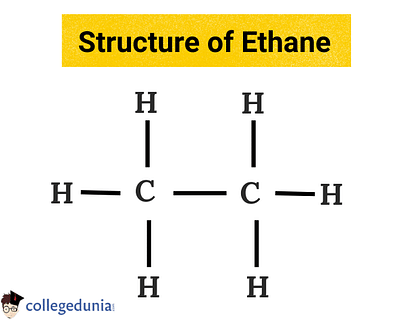
Structure of Ethane is like a straight chain with only a single carbon-carbon bond. The stricture of ethane makes it the simplest hydrocarbon.
- Ethane has a pair of carbon atoms connected by an ethyl group CH3.
- Carbon atoms share two pairs of valence electrons making them highly reactive.
- The ethyl group has one pair of valence electrons, leaving two spare electrons.
- Carbon has the largest electronegativity of the four elements, meaning that it has the greatest tendency to share electrons with its neighbors making it highly reactive.
- It is this reactivity that makes it possible for the ethyl group to form bonds with the carbon atoms.
Structure of Ethane
Read More: Organic Chemistry: Basic Principles and Techniques
Properties of Ethane
[Click Here for Previous Years' Questions]
The physical and chemical properties of Ethane are as follows:
Physical Properties of Ethane
- Ethane is an odorless and colorless gas.
- It remains colorless, odorless, and highly flammable under normal temperature and pressure.
- It is found in 5 – 10% concentration in natural gas.
- It is partially soluble in water and is lighter than air.
- Ethane has a melting point of -182.8 °C and a boiling point of 89 °C.
- The vapor density of ethane is 1.05 g/cm3.
Read More: Hydrocarbons Important Questions
Chemical Properties of Ethane
- 1 molecule of C2H6 or the molar mass of C2H6 is 30.07 g.
- Ethane acts as raw material in the production of ethylene through the process of pyrolysis: CH3CH3 ⟶ CH2CH2 + H2
- It can be produced using sodium propionate in the laboratory method. The reaction is: CH3CH2COONa + NaOH → C2H6 + Na2CO3
- Ethane reacts with nitric acid vapor at 400°C to form nitroethane. The reaction for the same is: C2H6 + HONO2 → C2H5NO2 + H2O
-
Ethane reacts with chlorine in diffused daylight when all the 6 “H” atoms are replaced in turn by chlorine atoms yielding a mixture of various chloro- derivatives.
CH3.CH3 + Cl2 → CH3.CH2
CH3.CH2Cl + Cl2 → CH2Cl.CH2Cl + HCl → CH3CHCl2 + HCl
Here is a summarization of the properties of Ethane:
| Properties of Ethane | |
|---|---|
| Ethane | C2H6 |
| Density | 1.36 kg/m³ |
| Molecular Weight/ Molar Mass | 30.07 g/mol |
| Boiling Point | -89 °C |
| Melting Point | -182.8 °C |
Uses of Ethane
[Click Here for Sample Questions]
Ethane is a widely used chemical in various industries. A few uses of ethane are listed below:
- Ethane is used as the raw material for the production of ethylene for further production of plastics, fruit ripening, and detergent making.
- It is used as the most specific volatile marker for the investigation of lipid peroxidation.
- Ethane is used in the preparation of ethanol, acetaldehyde, and acetic acid which find use in paints, varnishes, adhesives, plastic, etc.
- When liquified, ethane can also be used as a fuel in automobiles.
Also Check:
Things to Remember
- Ethane is one of the simplest saturated hydrocarbons which is found in a gaseous state.
- The chemical formula of ethane is C2H6.
- Ethane can be produced by distilling and purifying crude ethane.
- Ethane can also be prepared by converting ethane to ethylene and hydrogen by the reaction with hydrogenation and carbon monoxide over an iron catalyst.
- Ethane is an odorless, colorless, and flammable gas at standard temperature and pressure.
- Ethane reacts readily with hydrogen to give ethylene, the simplest alkene.
- Ethane can be produced naturally as well as in an artificial manner.
- Ethane has a wide variety of industrial applications and is an important chemical feedstock in industry.
Previous Years’ Questions
- The 4th higher homologue of ethane is… [WBJEE 2014]
- Among the following derivatives of ethane, the one having…
- A mixture of ethane and ethene occupies 41L at… [KEAM]
- In the eclipsed conformation of ethane, the dihedral angle… [KEAM]
- In the following skew conformation of ethane… [JEE Main 2019]
- Ethylene-1, 2-diamine is an example of… [JIPMER 2015]
- Which of the following is an example of an elimination reaction…
- Which of the following give ammonia, on heating with NaOH… [Haryana PMT 2003]
- Which one of the following is NOT formed when a mixture of methyl… [KCET 2012]
- The structural formula of 2-methyl-2-butene is…
Sample Questions
Ques. What is Ethane? (3 Marks)
Ans. Ethane is a colorless, odorless, gaseous hydrocarbon, a compound made up of hydrogen and carbon.
- The chemical formula of ethane is C2H6.
- Ethane is the simplest hydrocarbon that contains a single carbon-carbon bond.
- It is the second most important constituent of natural gas.
- Ethane also occurs dissolved in petroleum oils and as a by-product of oil refinery operations and of the carbonization of coal.
Ques. How is ethane formed? (3 Marks)
Ans. Ethane can be manufactured both from natural sources as well as in an artificial manner. The two methods of preparing ethane are:
Ethane is prepared by Wurtz reaction. Whenever methyl bromide or methyl iodide and sodium are heated in the presence of dry ether, ethane is formed.
CH3I + 2Na + CH3I → CH3-CH3 + 2NaI
Ethane is also synthesized by reduction of ethyl iodide using zinc + copper couple in alcohol. The reaction is as follows:
CH3CH2I + 2[H] → C2H6 + HI
Ques. What are hydrocarbons? (3 Marks)
Ans. Hydrocarbons are organic compounds that are made up of only two elements Carbon and Hydrogen. There are two kinds of hydrocarbons: saturated and unsaturated. Hydrocarbons are typically colorless gases that have very weak odors. Hydrocarbons can be classified into four subcategories, namely alkanes, alkenes, alkynes, and aromatic hydrocarbons. The study of hydrocarbons provides a deep insight into the chemical properties of other functional groups and their preparation.
Ques. List a few uses of ethane. (3 Marks)
Ans. There are wide uses of ethane is industries some of which are as follows:
- Ethane is mainly used as the raw material for the production of ethylene for further production of plastics, fruit ripening, and detergent making.
- Ethane is used in liquid form for vitrifying water-rich materials in scientific research.
- Ethane is also used for producing ethyl alcohol, acetic acids, or other similar organic compounds.
- It is also liquefied to be used as fuel for automobiles.
Ques. What is the melting and boiling point of ethane? (1 Mark)
Ans. The melting point of ethane is -182.8 °C while the boiling point of ethane is 89 °C.
Ques. Where is Ethane found? (3 Marks)
Ans. Ethane is an organic hydrocarbon, a naturally found compound of carbon and hydrogen. Ethane is widely found under the ground in the natural gas deposit. It is found there as a mixture of natural gas or with other components like sulfur, carbon dioxide, etc., and hydrocarbons. It is found in good quantities in shale and coal beds. Ethane can also be manufactured or isolated from natural gas. There are several countries such as the USA and Saudi Arabia that have been producing ethane on an industrial scale.
Ques. Is ethane a hydrocarbon? (3 Marks)
Ans. Yes, Ethane is one of the simplest hydrocarbons as it is a compound made up of carbon and hydrogen. Methane is the first in the family of hydrocarbons which is formed by one atom of carbon and four atoms of hydrogen. Ethane is formed when two atoms of carbon and six atoms of hydrogen bond together.It is second in the family of hydrocarbons after Methane (CH4) and was created artificially by Michael Faraday in 1834. Ethane is also known as Methyl methane, Dimethyl, and Ethyl hydride.
Ques. How is ethylene formed? (1 Mark)
Ans. Ethane acts as raw material in the production of ethylene through the process of pyrolysis:
CH3CH3 ⟶ CH2CH2 + H2.
Ques. Can ethane be classified as a hydrocarbon? (2 Marks)
Ans. Ethane is a colorless, odorless, and flammable gas with a chemical formula of C2H6. It has two carbon (C) atoms and six hydrogen (H) atoms. It’s only composed of carbon and hydrogen atoms, so it is classified as a hydrocarbon.
Ques. What is ethane used for? (2 Marks)
Ans. Ethane has a lot of applications in industries as well as homes, It is the second most abundant component in natural gas, thus, is widely used in many homes. Ethane is used for the production of a chemical called ethylene, which is used in the manufacturing of goods such as automotive antifreeze, plastics, and detergent.
Ques. How is ethane produced? (2 Marks)
Ans. In order to produce ethane, the first step is to remove various impurities from the oil and natural gas. The processing of natural gas removes hydrocarbons such as butane, propane, and other hydrocarbons from the gas stream, along with water and other impurities.
Check-Out:



Comments