



Exams Prep Master
Adenine (A), along with cytosine (C), guanine (G), and thymine (T), is one of four chemical bases found in DNA. Adenine bases on one strand chemically interact with thymine bases on the opposing strand within the DNA molecule. DNA is made up of A, C, G, and T. Adenine has the virtue of always being located opposite thymine in the double helix; therefore, adenine and thymine couple upon each strand. Adenine is found throughout the cell, not just in DNA and RNA, but also in the molecule adenosine triphosphate, which serves as the cell's energy source. As a result, adenine has a dual purpose in the cell: it aids in the construction of DNA and RNA, as well as storing energy. In this article, we will learn more about its structure, properties, and functions and answer some important questions.
| Table of Content |
Key Terms: Adenine, DNA, triphosphate, chemical.
Structure of Adenine
[Click Here for Sample Questions]
Adenine is a carbon, nitrogen, and hydrogen atom-based compound. C5H5N5 is its chemical formula. A nucleotide is formed when a base, such as adenine, binds to ribose and phosphate. Purines are a category of nucleotides that includes adenine. A purine is a nitrogen ring with six members joined to a nitrogen ring with five members.
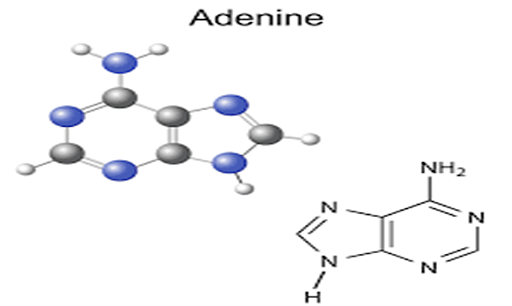
Pyrimidines are the other sort of nucleotide group. Pyrimidines are smaller than purines because they only have one nitrogen ring. The purine group includes adenine and guanine, while the pyrimidine group includes cytosine and thymine.
Read More:
| Chapter Related Concepts | ||
|---|---|---|
| Carbohydrate Metabolism | RNA and DNA | |
| Cellulose | Fats and Oils | Sucrose |
Properties of Adenine
[Click Here for Sample Questions]
C5H5N5 is the chemical formula for adenine, a purine nucleobase. Purines are heterocyclic aromatic organic compounds that are heterocyclic in nature. Adenine is made up of two carbon rings: a pyrimidine ring and an imidazole ring, making it a purine. It is referred to as adenine residue when it is a component of DNA and is covalently connected to the deoxyribose sugar.
- Molecular mass: 135.13 g/mol
- Appearance: Crystalline, white to bright yellow in color.
- 1.6 grams per cubic centimeter
- Melting point: 360 to 365 degrees Celsius (680 to 689 degrees Fahrenheit; 633 to 638 degrees Kelvin). decomposes
- In water, it dissolves at a rate of 0.103 g/100 mL.
- Solubility: In ethanol, it is insoluble; nevertheless, it is soluble in hot water and/or aqua ammonia
- Acidity (pKa): 4.15 (secondary), 9.80 (tertiary) (primary)
Adenine formation and other forms
[Click Here for Sample Questions]
When adenine is coupled to ribose, it forms adenosine, a nucleoside, and when it is attached to deoxyribose, it generates deoxyadenosine, a nucleoside. When three phosphate groups are added to adenosine, it creates adenosine triphosphate (ATP), a nucleoside triphosphate. Adenosine triphosphate is one of the most basic mechanisms of transmitting chemical energy across chemical processes in cellular metabolism.
Biological function of Adenine
[Click Here for Sample Questions]
Adenine is a crucial component of adenosine triphosphate (ATP), which is adenosine with three phosphate groups attached to it, in addition to being a major component of nucleic acids. ATP is a high-energy molecule that is essential for cellular metabolism and other biological processes.
Health Effects
[Click Here for Sample Questions]
Certain types of irregular heartbeats are treated (as a prescription-only intravenous medicine).
Weight loss in persons with advanced cancer is treated. In people with advanced non-small-cell lung cancer and other tumors, intravenous ATP appears to improve appetite, food intake, and quality of life.
Poor circulation causes wounds, which usually occur in the legs (venous stasis ulcers). Fluid retention, itching, swelling, and redness caused by venous stasis ulcers may be relieved by intramuscular AMP.
Biological reaction of Adenine
[Click Here for Sample Questions]
In an acidic solution, the purine nucleobases of DNA (and RNA) get protonated, allowing the hydrolysis of the bond between these nucleobases and the sugar–phosphate backbone of DNA, a process called depurination.
Things to Remember
- Adenine bases on one strand create chemical interactions with thymine bases on the opposing strand within the DNA molecule.
- The genetic instructions of the cell are encoded in a four-base DNA sequence. Adenosine triphosphate (ATP) is a type of adenine that serves as an energy storage molecule and is utilized to power various chemical activities within the cell.
- Adenine is a carbon, nitrogen, and hydrogen atom-based compound.
- Adenine is a crucial component of adenosine triphosphate (ATP), which is adenosine with three phosphate groups attached to it, in addition to being a major component of nucleic acids.
- Adenine is made up of two carbon rings: a pyrimidine ring and an imidazole ring, making it a purine.
- Adenine is found throughout the cell, not just in DNA and RNA, but also in the molecule adenosine triphosphate, which serves as the cell's energy source.
Read More:
Sample Questions
Ques. Can adenine pair with guanine? (2 marks)
Ans. In an acidic solution, the purine nucleobases of DNA (and RNA) get protonated, allowing the hydrolysis of the bond between these nucleobases and the sugar–phosphate backbone of DNA, a process called depurination.
Ques. When is adenine used? (2 marks)
Ans. The "letters" that make up the genetic code are known as bases. The code letters A, T, G, and C stand for the DNA molecules adenine, thymine, guanine, and cytosine, respectively. In base pairing, adenine always pairs with thymine, while guanine always couples with cytosine.
Ques. Can adenine pair it with itself? (2 marks)
Ans. Adenine and thymine are always paired together, and cytosine and guanine are always paired together. The pairing characteristic of DNA is advantageous since it facilitates reproduction. You can always reproduce the other side of a DNA molecule if you know one side. Only one other base can be paired with each base.
Ques. When does adenine pair with uracil? (2 marks)
Ans. Each of these nitrogenous bases can be found in deoxyribonucleic acid (DNA), with the exception of thymine, which is substituted with uracil. Uracil partners only with adenine and guanine couples only with cytosine during the synthesis of an RNA strand from a DNA template (transcription).
Ques. Why don't adenine pair with cytosine? (2 marks)
Ans. Because the purine and pyrimidine bases only pair in specific combinations, Adenine cannot pair with Cytosine. Guanine pairs with cytosine G:C, while adenine pairs with thymine A:T. Two hydrogen connections connect adenine and thymine through atoms connected to positions 6 and 1.
Ques. How do adenine and thymine differ from each other? (2 marks)
Ans. One of DNA's four building units is adenine. DNA is made up of the letters A, C, G, and T. Adenine has the virtue of always being located opposite thymine in the double helix, therefore adenine and thymine couple up on each strand.
Ques. Are adenine and guanine equal? (2 marks)
Ans. In 1968, the second parity rule was discovered. It indicates that the amount of adenine units in single-stranded DNA is roughly equal to the number of thymine units (percent A percent T), and the number of cytosine units is roughly equal to the number of guanine units (percent C percent G).
Ques. What are the adenine and thymine hydrogen bonds? (2 marks)
Ans. Adenine and thymine form two hydrogen bonds. Three hydrogen bonds connect guanine and cytosine. This results in a strength discrepancy between the Watson and Crick bases. In DNA, guanine and cytosine base pairs are stronger than thymine and adenine base pairs.
Ques. Adenine and guanine are larger and called as? (2 marks)
Ans. Bases of DNA. Purines are adenine and guanine. Purines are the larger of the DNA's two types of bases. The fused rings' 9 atoms (5 carbon, 4 nitrogen) are numbered 1 through 9.
Ques. How is adenine different from the other bases? (2 marks)
Ans. One of the four components of DNA is adenine. DNA is composed of the letters A, C, G, and T. Because adenine is always located opposite thymine in the double helix, adenine and thymine form a pair on each strand.



Comments