



Education Journalist | Study Abroad Lead
The Axis of symmetry is used to describe a line or curve that divides a geometric shape into two symmetrical parts. This line or curve is also referred to as the line of symmetry. An axis of symmetry can be found in many different shapes, including triangles, rectangles, and circles, and is an important concept in geometry.
- The concept of an axis of symmetry is important in many areas of mathematics, including algebra and calculus.
- In algebra, the axis of symmetry is used to find the vertex of a parabola and to solve quadratic equations.
- In calculus, the axis of symmetry is used to find the maximum or minimum value of a function.
- Axis of symmetry is important not only in mathematics but also in other fields such as engineering, architecture, and art.
| Table of Content |
Key Terms: Symmetry, Line, Curve, Parabola, Quadratic Equations, Geometry, Vertex, Co-ordinates
What is an axis of symmetry?
[Click Here for Sample Questions]
An axis of symmetry is a line, curve, or plane that divides a shape into two identical halves that mirror each other.
- It is a concept that is commonly used in geometry to describe the symmetry of a shape.
- The axis of symmetry can be a line that passes through the centre of a shape or curve, or it can be a plane that bisects a three-dimensional object.
If a shape has an axis of symmetry, it means that it can be folded along that line, curve, or plane and the two resulting halves will exactly overlap each other. The axis of symmetry can be horizontal, vertical, or even diagonal, depending on the shape and its orientation.
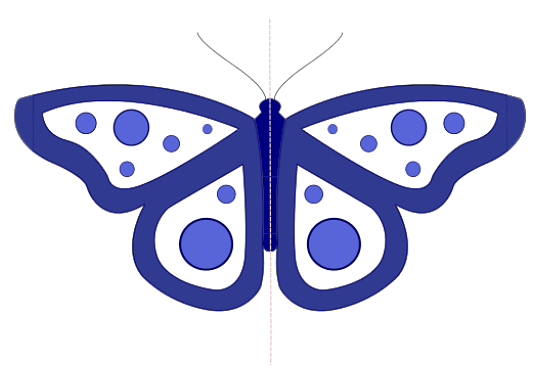
Axis of symmetry
Types of Axis of symmetry
[Click Here for Sample Questions]
There are several types of axes of symmetry, including:
- Horizontal axis of symmetry: A line that runs horizontally through the centre of a shape and divides it into two identical mirror images of each other.
- Vertical axis of symmetry: A line that runs vertically through the center of a shape and divides it into two identical mirror images of each other.
- Diagonal axis of symmetry: A line that runs diagonally through the center of a shape and divides it.
- Radial axis of symmetry: A line or plane that passes through the center of a circle or sphere. A circle has an infinite number of radial axes of symmetry, each passing through its center.
- Planar axis of symmetry: A plane that bisects a three-dimensional object into two identical halves that are mirror images of each other.
- Point symmetry: It is a type of symmetry where a shape looks identical after being rotated by a certain angle around a fixed point. The fixed point is known as the center of rotation, and each rotation produces an axis of symmetry passing through the center of rotation.
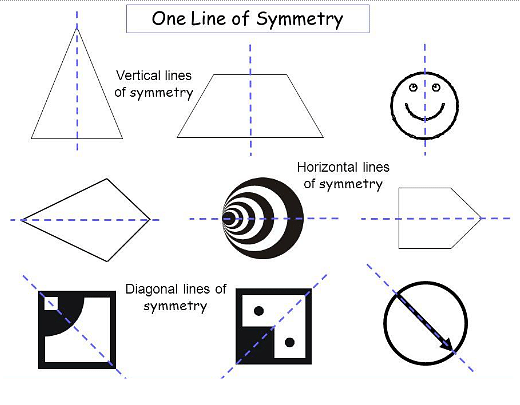
Types of Axis of symmetry
Also Read:
| Related Articles | ||
|---|---|---|
| Coordinate System | Equation of a Plane | Remainder Theorem |
| Slope of Line | Straight Lines | Prime Numbers |
Examples of axis of symmetry in geometry
[Click Here for Sample Questions]
A square has four axes of symmetry: Two vertical and two horizontal. Each axis of symmetry divides the square into two identical halves that are mirror images of each other.
An equilateral triangle has three axes of symmetry: One vertical and two diagonal. Each axis of symmetry divides the triangle into two identical halves that are mirror images of each other.
A rectangle has two axes of symmetry: One vertical and one horizontal. Each axis of symmetry divides the rectangle into two identical halves that are mirror images of each other.
A circle has an infinite number of radial axes of symmetry: Each passing through its center. Each axis of symmetry divides the circle into two identical halves.
A regular pentagon has five axes of symmetry: One vertical, two diagonal, and two rotational. Each axis of symmetry divides the pentagon into two identical halves that are mirror images of each other.
A regular hexagon has six axes of symmetry: Three vertical and three diagonal. Each axis of symmetry divides the hexagon into two identical halves that are mirror images of each other.
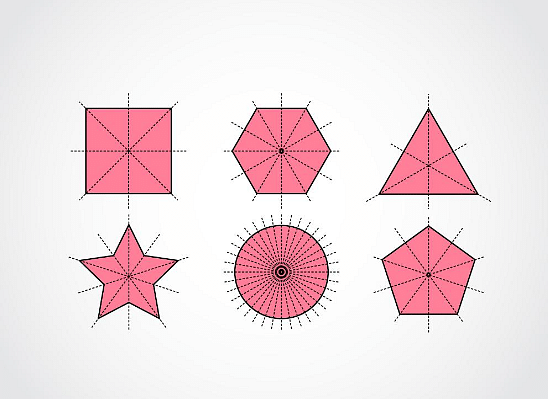
Examples of axis of symmetry in geometry
Axis of Symmetry Formula
[Click Here for Sample Questions]
The axis of symmetry is a line that divides a parabola into two symmetric halves. It is a useful tool for analyzing the behaviour and properties of parabolas. The formula for finding the axis of symmetry depends on the form of the quadratic equation.
Standard form
For a parabola in standard form, y = ax2 + bx + c, the formula for the axis of symmetry is x = – b / 2a. This is derived by using the fact that the vertex of the parabola is at (-b/2a, c - b2/4a). Since the axis of symmetry passes through the vertex, it must have an x-coordinate of – b/2a.
Vertex form
For a parabola in vertex form, y = a(x-h)2 + k, the formula for the axis of symmetry is simply x = h. This is because the vertex of the parabola is at (h, k), so the axis of symmetry passes through this point.
Finding the axis of symmetry of a parabola
[Click Here for Sample Questions]
The axis of symmetry divides the parabola into two identical halves that are mirror images of each other. It is also the line of symmetry of the graph of the parabola.
The axis of symmetry of a parabola is a vertical line that passes through the vertex of the parabola. It is an important concept in algebra and calculus, as it helps us to graph and analyze quadratic functions.
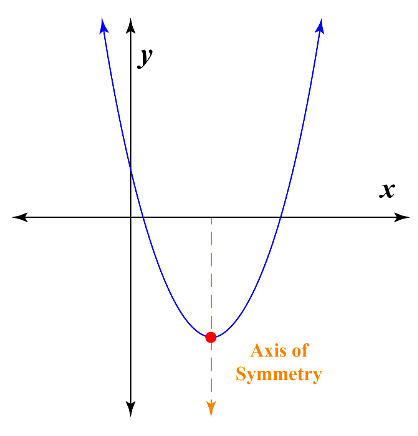
Finding the axis of symmetry of a parabola
To find the axis of symmetry of a parabola, follow these steps:
- Identify the coefficients of the quadratic equation in standard form: f(x) = ax2 + bx + c
- The axis of symmetry of a parabola is always a vertical line that passes through the vertex of the parabola. The x-coordinate of the vertex is given by – b/2a.
- To find the equation of the axis of symmetry, we substitute the x-coordinate of the vertex into the equation of a vertical line, which is given by x = a constant.
- Therefore, the equation of the axis of symmetry of the parabola is x = – b/2a.
Solved Example
Example: Find the axis of symmetry for the quadratic equation f(x) = 2x2 - 4x + 1
Solution: Step1: Identify the coefficients of the quadratic equation: a = 2, b = -4, c = 1.
Step 2: The x-coordinate of the vertex is given by – b/2a = – (-4)/(2*2) = 1.
Step 3: Substitute the x-coordinate of the vertex into the equation of a vertical line: x = 1.
Step 4: Therefore, the axis of symmetry of the parabola is x = 1.
Derivation of the Axis of Symmetry
[Click Here for Sample Questions]
The standard form of a quadratic function is given by:
f(x) = ax2 + bx + c, where a, b, and c are constants.
To find the axis of symmetry of the parabola represented by this function, we need to first find the vertex of the parabola. The vertex of the parabola can be found by completing the square as follows:
f(x) = a(x2 + bx/a) + c
f(x) = a(x2 + bx/a + b2/4a2) + c - ab2/4a2
f(x) = a(x + b/2a)2 + (4ac - b2)/4a
The vertex of the parabola is located at the point (h, k), where h = – b/2a and k = (4ac - b2)/4a. The axis of symmetry of the parabola is a vertical line passing through the vertex, so the equation of the axis of symmetry is x = – b/2a.
Using the axis of symmetry to solve quadratic equations
[Click Here for Sample Questions]
The axis of symmetry can be used to solve quadratic equations of form ax2 + bx + c = 0. The general approach is to use the axis of symmetry to find the x-coordinate of the vertex of the parabola, which is also the x-coordinate of the axis of symmetry. Once we know the x-coordinate of the vertex, we can easily find the y-coordinate by substituting it into the original equation. This gives us the coordinates of the vertex, which we can then use to solve the quadratic equation.
Here are the steps to use the axis of symmetry to solve quadratic equations:
- Identify the coefficients a, b, and c in the quadratic equation ax2 + bx + c = 0.
- Find the x-coordinate of the vertex of the parabola by using the formula x = – b / (2a). This is also the x-coordinate of the axis of symmetry.
- Substitute the x-coordinate of the vertex into the original equation to find the y-coordinate. That is, calculate f(x) = ax2 + bx + c where x is the x-coordinate of the vertex.
- The vertex of the parabola is (x,y), where x is the x-coordinate of the vertex and y is the y-coordinate found in step 3.
- Use the vertex to solve the quadratic equation. If the vertex is (h,k), then the equation can be written in vertex form as y = a(x - h)2 + k. If a is positive, then the vertex is a minimum point and the lowest value of y is k. If a is negative, then the vertex is a maximum point and the highest value of y is k.
Solved Example
Example: Solve the quadratic equation 2x2 - 8x + 6 = 0.
Solution: Step 1: Identify the coefficients: a = 2, b = -8, c = 6.
Step 2: Find the x-coordinate of the vertex: x = -b / (2a) = -(-8) / (2*2) = 2.
Step 3: Find the y-coordinate of the vertex: f(2) = 2(2)2 - 8(2) + 6 = -2.
Step 4: The vertex is (2, -2).
Step 5: The quadratic equation can be written in vertex form as y = 2(x - 2)2 - 2. Since a is positive, the vertex is a minimum point and the lowest value of y is -2. Therefore, the solutions of the quadratic equation are x = 2 + sqrt(2/2) and x = 2 - sqrt(2/2), or x = 2 + sqrt(2) and x = 2 - sqrt(2).
Note: Using the axis of symmetry to solve quadratic equations is especially useful when the equation is not factorable, as it provides a systematic approach to finding the solutions without relying on trial and error.
Also Read:
Things to Remember
- The axis of symmetry is a vertical line that passes through the vertex of the parabola.
- The equation of the axis of symmetry for a parabola that opens upward or downward is always in the form x = h, where h is the x-coordinate of the vertex.
- The axis of symmetry divides the parabola into two symmetrical halves.
- The distance between any point on the parabola and the axis of symmetry is equal to the distance between that point and the vertex.
- The axis of symmetry is useful for finding the vertex, which is the minimum or maximum point on the parabola, and for solving quadratic equations.
- If the equation of the parabola is in standard form y = ax2 + bx + c, then the x-coordinate of the vertex and the equation of the axis of symmetry can be found using the formula x = -b / (2a).
Sample Questions
Ques. Find the equation of the axis of symmetry of the parabola y = 3x2 + 6x + 1. (3 marks)
Ans. Using the formula x = – b/2a, we get x = – 6/6 = -1. Therefore, the equation of the axis of symmetry is x = -1.
To verify this, we can also complete the square to rewrite the equation of the parabola in vertex form:
y = 3(x + 1)2 - 2
The vertex of the parabola is (-1, -2), which lies on the axis of symmetry.
Ques. Find the axis of symmetry of the graph of the function y = 2x2 + 4x - 3. (3 marks)
Ans. Using the formula x = – b/2a, we get x = – 4/4 = -1. Therefore, the equation of the axis of symmetry is x = -1.
To verify this, we can also complete the square to rewrite the equation of the parabola in vertex form:
y = 2(x + 1)2 - 5
The vertex of the parabola is (-1, -5), which lies on the axis of symmetry.
Ques. Find the equation of the axis of symmetry of the parabola y = – x2 + 2x + 4. (3 marks)
Ans. Using the formula x = – b/2a, we get x = – 2 / – 2 = 1. Therefore, the equation of the axis of symmetry is x = 1.
To verify this, we can also complete the square to rewrite the equation of the parabola in vertex form:
y = – (x - 1)2 + 5
The vertex of the parabola is (1, 5), which lies on the axis of symmetry.
Ques. Find the equation of the axis of symmetry of the parabola y = – 4x2 + 12x - 9. (3 marks)
Ans. Using the formula x = -b/2a, we get x = -12/-8 = 3/2. Therefore, the equation of the axis of symmetry is x = 3/2.
To verify this, we can also complete the square to rewrite the equation of the parabola in vertex form:
y = -4(x - 3/2)2 + 27/2
The vertex of the parabola is (3/2, 27/2), which lies on the axis of symmetry.
Ques. Find the axis of symmetry of the graph of the function y = – 2x2 + 8x - 7. (3 marks)
Ans. Using the formula x = -b/2a, we get x = -8/-4 = 2. Therefore, the equation of the axis of symmetry is x = 2.
To verify this, we can also complete the square to rewrite the equation of the parabola in vertex form:
y = – 2(x - 2)2 - 3
The vertex of the parabola is (2, -3), which lies on the axis of symmetry.
Ques. Find the equation of the axis of symmetry of the parabola y = 5x2 - 20x + 15. (3 marks)
Ans. Using the formula x = -b/2a, we get x = 20/10 = 2. Therefore, the equation of the axis of symmetry is x = 2.
To verify this, we can also complete the square to rewrite the equation of the parabola in vertex form:
y = 5(x - 2)2 - 5
The vertex of the parabola is (2, -5), which lies on the axis of symmetry.
Ques. Solve the quadratic equation x2 + 6x + 5 = 0 by using the axis of symmetry. (3 marks)
Ans. To find the vertex, we can use the formula x = -b/2a and plug in the values of a, b, and c from the given equation:
x = – 6/2 = -3
Now we can substitute this value of x into the original equation to find the corresponding y-value at the vertex:
y = (-3)2 + 6(-3) + 5 = 4
Therefore, the vertex of the parabola defined by the equation is (-3, 4), and the x-value of the axis of symmetry is -3. We can use this value to find the roots of the equation:
x = (-6 ± sqrt(62 - 4(1)(5))) / (2(1)) = (-6 ± sqrt(16)) / 2 = -5 or -1
Therefore, the roots of the equation are x = -5 and x = -1.
Ques. Solve the quadratic equation 2x2 + 4x - 3 = 0 by using the axis of symmetry. (5 marks)
Ans. To find the vertex, we can use the formula x = -b/2a and plug in the values of a, b, and c from the given equation:
x = -4 / (2 * 2) = -1/2
Now we can substitute this value of x into the original equation to find the corresponding y-value at the vertex:
y = 2(-1/2)2 + 4(-1/2) - 3 = -4
Therefore, the vertex of the parabola defined by the equation is (-1/2, -4), and the x-value of the axis of symmetry is -1/2. We can use this value to find the roots of the equation:
x = (-4 ± sqrt(42 - 4(2)(-3))) / (2(2)) = (-4 ± sqrt(40)) / 4 = (-1 ± sqrt(10))/2
Therefore, the roots of the equation are x = (-1 + sqrt(10))/2 and x = (-1 - sqrt(10))/2.
Ques. Solve the quadratic equation 3x2 - 6x + 2 = 0 by using the axis of symmetry. (5 marks)
Ans. To find the vertex, we can use the formula x = – b/2a and plug in the values of a, b, and c from the given equation:
x = 6 / (2 * 3) = 1
Now we can substitute this value of x into the original equation to find the corresponding y-value at the vertex:
y = 3(1)2 - 6(1) + 2 = -1
Therefore, the vertex of the parabola defined by the equation is (1, -1), and the x-value of the axis of symmetry is 1. We can use this value to find the roots of the equation:
x = (6 ± sqrt(62 - 4(3)(2))) / (2(3)) = (6 ± sqrt(24)) / 6 = 1 ± sqrt(6)/3
Therefore, the roots of the equation are x = 1 + sqrt(6)/3 and x = 1 - sqrt(6)/3.
Ques. Solve the quadratic equation 4x2 + 12x + 7 = 0 by using the axis of symmetry. (5 marks)
Ans. To find the vertex, we can use the formula x = -b/2a and plug in the values of a, b, and c from the given equation:
x = -12 / (2 * 4) = -3/2
Now we can substitute this value of x into the original equation to find the corresponding y-value at the vertex:
y = 4(-3/2)2 + 12(-3/2) + 7 = -2
Therefore, the vertex of the parabola defined by the equation is (-3/2, -2), and the x-value of the axis of symmetry is -3/2. We can use this value to find the roots of the equation:
x = (-12 ± sqrt(122 - 4(4)(7))) / (2(4)) = (-12 ± sqrt(32)) / 8 = (-3 ± sqrt(2))/2
Therefore, the roots of the equation are x = (-3 + sqrt(2))/2 and x = (-3 - sqrt(2))/2.
For Latest Updates on Upcoming Board Exams, Click Here: https://t.me/class_10_12_board_updates
Also check:



Comments