



Content Curator
Benedict's test is a chemical test that helps in the determination of whether or not there is a presence of reducing sugars in an analyte.
- It helps in the identification of only simple carbohydrates consisting of a free ketone or aldehyde functional group.
- Benedict's reagent can be referred to as a complex mixture of sodium citrate, sodium carbonate, and copper(II) sulphate pentahydrate.
- When Benedict's reagent is subjected to reducing sugars, the result of the reactions leads to the production of a brick-red precipitate, indicating a positive Benedict's test.
| Table of Content |
Key Terms: Benedict’s test, Benedict's reagent, Sodium citrate, Sodium carbonate, Benedict’s Test Principle, Cuprous ions, Reducing agent, Copper sulphate pentahydrate
What is Benedict’s Test?
[Click Here for Sample Questions]
Benedict's test is a chemical test used to detect the presence of reducing sugars in an analyte.
- Therefore, this test can identify simple carbohydrates having a free ketone or aldehyde functional group.
- Benedict's reagent (also known as Benedict's solution) is a complex mixture consisting of sodium citrate, sodium carbonate, and copper(II) sulfate pentahydrate.
- When Benedict's reagent is exposed to reducing sugars, the reactions it undergoes result in the production of a brick-red precipitate.
- This indicates a positive Benedict's test.
- It should be noted that Benedict's test can also be used to detect the presence of glucose in urine.
- Because this test identifies any aldehydes and -hydroxy ketones, and glucose is an aldose whose open chain produces an aldehyde group when glucose is present in the analyte, the test gives a positive result.
- However, the presence of ascorbic acid, homogentisic acid, and other reducing chemicals in urine can also cause a positive result.
- As a result, a positive Benedict's test does not always indicate that the test participant is diabetic.
Also check:
| Other Concepts | ||
|---|---|---|
| Structure of glucose and fructose | Carbon and Its Compounds | Atomic Radius |
| Electronegativity | Isomerism | Beryllium |
Benedict’s Test Principle
[Click Here for Sample Questions]
An enediol formation takes place when a reducing sugar is heated in the presence of an alkali (as it is a more powerful reducing agent).
- When reducing sugars are present in the analyte, Benedict's reagent's cupric ions (Cu2+) are reduced to cuprous ions (Cu+).
- The combination of these cuprous ions with the reaction mixture leads to the formation of copper(I) oxide, which results in the precipitation of a brick-red substance.
An example of the reaction between an aldose and Benedict's reagent that results in the formation of cuprous oxide is shown below.

Benedict’s Test Procedure
[Click Here for Sample Questions]
Given below are the preparation, testing and results of Benedict's test.
Preparation of Benedict’s Reagent
The process for the preparation of Benedict’s reagent is as follows
- Combine 17.3 gm of copper sulphate pentahydrate (CuSO4.5H2O), along with 100 gm of sodium carbonate (Na2CO3), and 173 gm of sodium citrate in distilled water in order to make one litre of Benedict's reagent.
- Copper(II) sulphate serves as a source of Cu2+ ions, sodium carbonate serves as an alkaline medium, and sodium citrate creates Cu2+ ion complexes.
- As a solvent, distilled water is used.
- The purity of Benedict's reagent can be determined by heating it in a test tube.
- The fact that the blue colour of the solution does not change when heated indicates that the reagent is pure.
Testing for Reducing Sugar
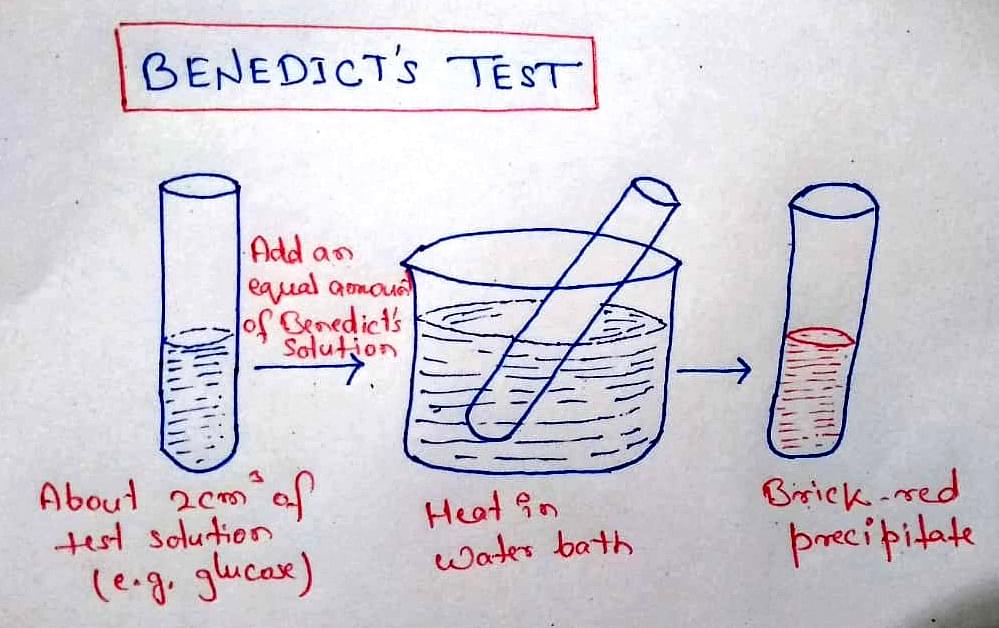
In order to test the presence of reducing sugar in a mixture one ml of analyte sample must be taken and mixed with 2 ml of Benedict's reagent.
- It should then be heated for 3 to 5 minutes in a boiling water bath.
- If there is a presence of brick-red coloured cuprous oxide precipitate the presence of reducing sugars in the analyte is confirmed.
Result of Benedict’s Reagent Test
The following are the results of Benedict’s Reagent Test
| Colour of the Precipitate | g% of Reducing Sugar |
|---|---|
| Green | 0.5% |
| Yellow | 1% |
| Red | 1.5% |
| Orange | 2% |
Limitation of Benedict’s Test
[Click Here for Sample Questions]
Benedict's test has the following limitations:
- If some medicines are present, such as salicylates, isoniazid, streptomycin, penicillin, and p-aminosalicylic acid, false-positive results in the test can occur.
- Benedict’s reactivity can be reduced by the presence of urate, creatinine, and ascorbic acid in a concentrated amount in urine.
Also check:
| MCQ On Some Basic Concepts of Chemistry | Chemical Formula | Physical and Chemical Classification of Matter |
| Solutions | Equilibrium | Raoult's Law |
Things to Remember
- Benedict's test is a basic chemical procedure for detecting reducing sugars.
- Reducing sugars are the carbohydrates that contain a free aldehyde or ketone functional group in their chemical structure.
- Benedict's reagent, commonly known as Benedict's solution, is used to detect simple sugars like glucose in Benedict's test.
- Benedict's test can also be performed to see if there is any glucose in a urine sample.
- In order to test the presence of reducing sugar in a mixture one ml of analyte sample must be taken and mixed with two ml of Benedict's reagent.
- It should then be heated for 3 to 5 minutes in a boiling water bath.
- If there is a presence of brick-red coloured cuprous oxide precipitate the presence of reducing sugars in the analyte is confirmed.
Sample Questions
Ques. Define Benedict’s test. (1 Mark)
Ans. Benedict's test is a basic chemical procedure for detecting reducing sugars.
Ques. What does Benedict’s test detect? (2 Marks)
Ans. Benedict's test is mainly used to determine the presence of simple carbohydrates in an unidentified analyte. This test can identify reducing sugars with free aldehyde or ketone functional groups. A monosaccharide or a disaccharide can be used as the reducing sugar.
Ques. What is reducing sugar? (1 Mark)
Ans. Carbohydrates with a free aldehyde or ketone functional group in their chemical structure are known as reducing sugars.
Ques. What is Benedict’s reagent? (2 Marks)
Ans. Benedict's reagent, commonly known as Benedict's solution, is a chemical reagent composed of a complex mixture of sodium citrate, sodium carbonate, and copper(II) sulfate pentahydrate. Benedict's reagent changes colour from clear blue to brick red when exposed to reducing sugars and other reducing substances.
Ques. What are the limitations of Benedict’s test? (3 Marks)
Ans. Benedict's test has the following limitations:
- If some medicines are present, such as salicylates, isoniazid, streptomycin, penicillin, and p-aminosalicylic acid, false-positive results in the test can occur.
- Benedict’s reactivity can be reduced by the presence of urate, creatinine, and ascorbic acid in a concentrated amount in urine.
Ques. How is Benedict’s solution prepared? (2 Marks)
Ans. To prepare Benedict's solution (or Benedict's reagent), cupric ions (Cu2+ cations) are complexed with citric acid molecules in a basic environment provided by sodium carbonate. The final product can be used to detect the presence of reducing sugars.
Ques. How is Benedict’s test used for the determination of glucose in urine samples? (3 Marks)
Ans. Benedict's test can also be performed to see if there is any glucose in a urine sample. This diagnostic test for urine helps in identifying any aldehydes and -hydroxy ketones present in the urine. Since glucose is an aldose that has an open chain which produces an aldehyde group, the test results are positive if there is a presence of glucose in the analyte. In the presence of homogentisic acid, ascorbic acid, and several other reducing chemicals, however, a positive reaction occurs. As a result, a positive Benedict test does not necessarily imply that the test participant has diabetes.
Ques. State Benedict’s test principle. (2 Marks)
Ans. A reducing sugar is transformed into an enediol when it is heated in the presence of an alkali (which is a relatively powerful reducing agent). When reducing sugars are present in the analyte, Benedict's reagent's cupric ions (Cu2+) are reduced to cuprous ions (Cu+). The combination of these cuprous ions along with the reaction mixture leads to the generation of copper(I) oxide, which precipitates as a brick-red substance.
Ques. Write the preparation of Benedict’s reagent. (3 Marks)
Ans. The combination of 17.3 gm of copper sulphate pentahydrate (CuSO4.5H2O), 100 gms of sodium carbonate (Na2CO3), and 173 gm of sodium citrate in distilled water helps in the making of one litre of Benedict's reagent. Copper(II) sulphate serves as a source of Cu2+ ions, sodium carbonate serves as an alkaline medium, and sodium citrate creates Cu2+ ion complexes. As a solvent, distilled water is used.
The purity of Benedict's reagent can be determined by heating in a test tube, you can determine its purity. The fact that the blue colour of the solution does not change when heated indicates that the reagent is pure.
Ques. Write the result of Benedict’s reagent test. (3 Marks)
Ans. Result of Benedict’s reagent test
| Colour of the precipitate | Concentration of reducing sugar in g% |
| Blue or No change in colour | 0% |
| Green | 0.5% |
| Yellow | 1% |
| Orange | 1.5% |
| Red | 2% |
Ques. Which substances give a positive result for Benedict’s test? (2 Marks)
Ans. The following are some examples of substances that provide positive results on Benedict's test.
- Glucose
- Fructose
- Ribose
For Latest Updates on Upcoming Board Exams, Click Here: https://t.me/class_10_12_board_updates
Also Read:



Comments