



Education Journalist | Study Abroad Lead
Aldehydes and ketones are the organic compounds having the carbonyl functional group. Aldehyde contains the carbonyl group that is bonded to at least one hydrogen atom. Ketones contain a carbonyl group that is bonded to two carbon atoms. Aldehydes and Ketones, despite having a carbon atom at the center have fundamental differences that lie in their distinct chemical structure.
| Table of Content |
Keywords: Aldehyde, Ketone, Carbon, Atoms, Chemical compounds, Reactive, Functional group, Oxidation, Oxygen, Reduction, Methanoyl group
Aldehyde
[Click Here for Sample Questions]
The name Aldehyde derives its name from the 'dehydration of alcohol.' Aldehydes are considered one of the most important functional groups. They are usually called the formyl or methanoyl group. An aldehydes' chemical structure is R-CHO, where the C atom is doubly bonded to oxygen that becomes (R-(C=O)-H). Aldehyde groups can be found only towards the end of a carbon chain as one end of an aldehyde always contains an H atom. In industries, aldehydes' are useful chemical compounds. When compared to Ketones, aldehydes are more reactive.

Aldehyde
According to the IUPAC system, naming aldehydes ends with the suffix 'al'. Propanal, butanal, hexanal, etc aldehydes fall under the alkyl group.
Read More:
| Related Concepts | ||
|---|---|---|
| Redox Titration | Volumetric Analysis | Conformation |
| SN1 Reaction | SN2 Reaction | Wurtz Reaction |
Ketones
[Click Here for Sample Questions]
The carbonyl group is a ketone that appears among two carbon atoms. Ketones' chemical structure is formed as R-CO-R. Here the C atom is bonded doubly with oxygen atoms. A ketone can never be found towards the end of carbon because the carbonyl bond is surrounded by the alkyl group on the further side. Ketones cannot be oxidized further as they are already in their highest oxidation form. As compared to aldehydes, ketones are relatively less reactive.

Ketones are used as industrial solvents,i.e acetone. According to the IUPAC system, ketones end with the suffix 'one'. Pentanone, butanone, hexanone, etc are some examples.
Difference Between Aldehyde and ketones
[Click Here for Sample Questions]
| Aldehydes | Ketones |
|---|---|
| Aldehydes have the form: R-CHO. | Ketones have the form: R-CO-R'. |
| Aldehydes occur towards the end of the carbon chain. | Ketones occur towards the middle of the carbon chain. |
| Aldehydes end with the suffix 'al'. | Ketones end with a suffix; one’. |
| Aldehydes are found in volatile compounds. | Ketones are found in sugar. |
| Aldehydes are more reactive. | Ketones are relatively less reactive. |
Aldehyde Vs Ketones
[Click Here for Sample Questions]
The main difference between Aldehydes and ketones lie in their chemical structure. Aldehydes are more reactive than Ketones as they go through oxidation forming carboxylic acids. Since Ketones lack the hydrogen atom, they are less reactive than aldehydes. Ketones can be oxidized with powerful oxidizing agents when exposed to overheating. The IUPAC names are used for aldehydes and ketones. The aldehydes can be converted by oxidation as the common names of aldehydes are taken from the names of the acids.
Owing to the presence of a carbonyl functional group, both aldehydes and ketones are similar in many of their reactions.
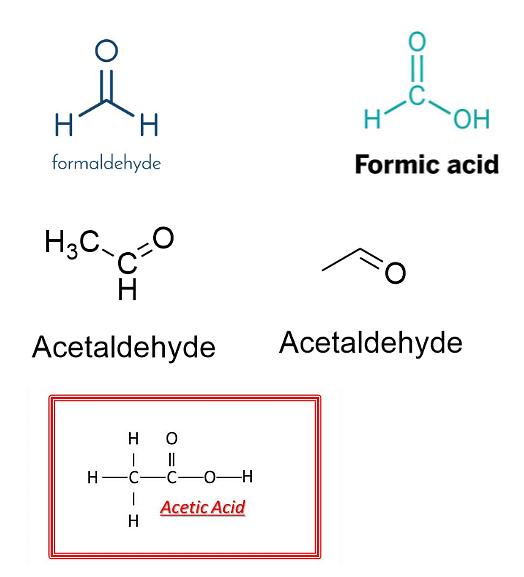
Aldehydes are freely oxidized to carboxylic acids. Ketones resist oxidation.
Aldehydes can be distinguished from Ketones through various laboratory-grade tests. The most popular ones are- Tollens' Test, The Schiffs' Test, Fehlings' Test, etc.
One such example is - in Fehlings' test, the Ketones do not show any reaction whereas the aldehydes form a red precipitate.
- Aldehydes got their name from the alkane chain. It ends with the suffix 'al'. The '-e' is removed and replaced with 'al'
- Ketones got their name from the alkane chain. It ends with the suffix 'one'. The '-e' is removed and replaced with 'one'
- Acetaldehyde is used in making acetic acid and pyridine derivations
- Ketones are used in beauty sectors as well in medical sectors like treating of acne is one such example
Things to Remember
- Ketones are commonly found in sugar and are called as ketoses
- Aldoses are sugars that are made from aldehyde.
- The smell of aldehyde is reminiscent of almonds
- Ketones cannot be oxidized like aldehydes as it lacks hydrogen atoms as compared to aldehydes
- Butanone otherwise known as methyl ethyl ketone, used in the production of textile, paraffin wax, plastics and paint thinners
Read More:
Sample Questions
Ques. Where can we find Aldehydes and ketones naturally? Is ketone a carbonyl? [3 marks]
Ans. Aldehydes are found in volatile compounds, such as perfumes, plants, animals, and the human body. Ketones are found in sugar and it gets produced in the human liver.
Yes, as Ketones contains the carbonyl group bonded to two carbon atoms. Both aldehydes and ketones are organic compounds that incorporate a carbonyl functional group, i.e C=O.
Ques. What are ketones used for? [3 marks]
Ans. Ketones have various roles and functions. Some of them are listed below:
- Ketones are used as solvents in industries, paints, and textiles.
- In the human body, it is used as fuel to drive the body's metabolism and to support muscular function. When insulin levels drop in the human body, the body requires ketone.
Ques. Why are aldehydes found more stable than Ketones? [3 marks]
Ans. The carbonyl carbon present in aldehydes has a more partial positive charge in comparison to ketones. This is due to the electron-donating nature of the alkyl group. Owing to the presence of a carbonyl functional group, both aldehydes and ketones are similar in many of their reactions. Aldehydes are freely oxidized to carboxylic acids. Ketones resist oxidation.
Ques. Draw the structure of 3- methylbutanal. [3 marks]
Ans. The Structure of 3- methylbutanal is given below:

Ques. Give a reason why propanal is more reactive than propanone. [3 marks]
Ans. Propanal is more reactive than propanone due to the presence of an alkyl group on both sides of carbonyl carbon. Both methyl groups have an electron-freeing tendency due to the -l effect. This is the reason why propanal seems more reactive than propanone.
Ques. What is common between Aldehydes and ketones?[3 marks]
Ans.
- Both aldehydes and ketones are organic compounds that incorporate a carbonyl functional group,i e C=O.
- The most common reactions between aldehydes and ketones are nucleophilic addition reactions. It leads to the formation of alcohols, alkenes, diols, etc.
- Compounds such as cinnamaldehyde, vanillin, lemongrass, camphor trees are found in micro-organisms and plants are some common examples of aldehydes and ketones.
Ques. What is the chemical formula of Aldehyde and Ketone? [3 marks]
Ans. The chemical formula of aldehyde is RCHO.
Ketones' chemical structure is formed as R-CO-R.
R represents hydrogen atom or carbon/hydrogen chain.
CO represents the carbonyl.
H represents the hydrogen fixed to the carbonyl chain.
Ques. What is Tollen’s reagent? Write one usefulness of this reagent. [3 marks]
Ans. Tollen's reagent is made up of a solution of silver nitrate, ammonia, and sodium hydroxide. Tollens' reagent is a chemical reagent that can be used to differentiate between aldehydes and ketone functional groups, as well as some alpha-hydroxy ketones that can tautomerize into aldehydes.
It's used to test for aldehydes. Tollen's reagent is reduced to a shining silver mirror by both aliphatic and aromatic aldehydes. It's also used to tell the difference between aldehydes and ketones.

For Latest Updates on Upcoming Board Exams, Click Here: https://t.me/class_10_12_board_updates
Check-Out:



Comments