



Content Curator
Aldehydes are organic compounds that consist of a carbonyl center (a carbon double-bonded to oxygen), a bonded hydrogen, and a side-chain R group. Some of the properties of aldehydes include volatility and flammability. Due to the high flammability in the lower members of the aldehyde family, fire and explosion precautions are a must.
| Table of Content |
Keyterms: Organic Compounds, Carbonyl Compound, Carbon, Hydrogen, Carbon Oxygen Bond, Atom, Pi Bond, Dipole Moment
Read More: Clemmensen Reduction Reaction
Structure of Aldehydes
[Click Here for Sample Questions]
In the aldehydes, the C-atom is sp2 hybridized. The unhybridized atomic orbital of C-atom and the parallel 2p orbital of oxygen atom forms a pi-bond. Due to the electro-negativity difference in C and O atoms, there is polarity and hence, aldehydes possess a dipole moment.
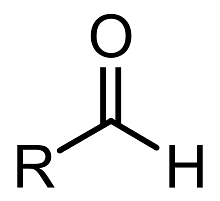
Structure of Aldehyde
Naturally Occurring Aldehydes
[Click Here for Sample Questions]
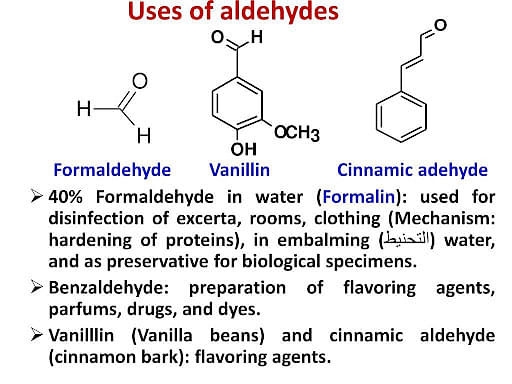
Aldehydes are known for imparting odors to different substances. Examples are vanillin (from vanilla beans), salicylaldehyde (from meadowsweet), and cinnamaldehyde (from cinnamon).
Surprisingly, aldehydes are also found in the human body. An aldehyde by the name of Retinal (retinaldehyde) is found in the retina and is required for vision. Most of the sugars are also aldehyde derivatives.
Also Read:
General Properties of Aldehyde
[Click Here for Sample Questions]
Aldehydes are simple compounds that contain a carbonyl group - a carbon-oxygen double bond. They don’t have any other reactive groups such as -OH or -Cl attached directly to the carbon atom. Some of the general properties of Aldehydes are listed below:
Physical State
Out of all the aldehydes, only formaldehyde is a colorless gas at room temperature. The aldehydes up to C12 are colorless liquids. From C12 and onwards, aldehydes are solids. All the lower aldehydes give an unpleasant smell. The higher aldehydes have a pleasant smell.
Boiling Point
The boiling point of aldehydes is directly proportional to their molecular weight. The boiling point of aldehydes (carbonyl compounds) falls in between the boiling points of alcohols and alkanes. Carbonyl compounds have dipole-dipole Vander Waals force of attraction present.
This makes their boiling point higher than alkanes as they are non-polar. On the other hand, due to the absence of hydrogen bonding, which is present in alcohols, the boiling point of aldehydes is less than that of alcohols.
Solubility
Solubility in water is inversely proportional to the molecular weight. Therefore, the aldehydes, from C1 to C3 i.e. formaldehyde, acetaldehyde, and propionaldehyde, are freely soluble in water.
This solubility is due to the ability to form hydrogen bonding with water molecules. All the aldehydes from C5 and onwards are insoluble in water. Moreover, all the aldehydes are soluble in organic solvents.

Aldehyde-Water Hydrogen Bonding
Common Reactions of Aldehydes
[Click Here for Sample Questions]
Aldehydes and ketones undergo various reactions that lead to the formation of different products. The most common reactions are nucleophilic addition reactions. These reactions produce alkenes, alcohols, diols, cyanohydrins, and imines, to name a few.

Types of Reactions
Nucleophilic Addition Reaction
In this reaction, a nucleophile (chemical species with a free pair of electrons) attacks the electrophile carbon atom of the polar carbonyl group which changes the hybridization of the carbon from sp2 to sp3.
This results in the formation of a tetrahedral alkoxide intermediate. This intermediate captures a proton from the reaction medium to give the electrically neutral product. The net result is the addition of Nu– and H+ across the carbon-oxygen double bond.

Nucleophilic Addition Reaction
Some common examples of Nucleophilic Addition Reaction are:
- Addition of hydrogen cyanide (HCN)
- Addition of sodium hydrogen sulphite
- Addition of alcohols
- Addition of ammonia and its derivatives
Reduction
Aldehydes show two types of reduction reactions: reduction to alcohols and reduction to hydrocarbons. Aldehydes are reduced to primary and secondary alcohols by sodium borohydride (NaBH4). This reaction can also be achieved by catalytic hydrogenation.
Aldehydes are reduced to the CH2 group on treatment with zinc amalgam and concentrated hydrochloric acid (Clemmensen reduction). This reaction can also be achieved on treatment with hydrazine followed by heating with sodium or potassium hydroxide in a high boiling solvent such as ethylene glycol (Wolf-Kishner reduction).
Oxidation
Aldehydes undergo easy oxidation to carboxylic acids on treatment with common oxidizing agents like nitric acid, potassium permanganate, potassium dichromate, Tollens’ reagent, and Fehlings’ reagent.

Oxidation Reaction of Aldehyde
Also Read:
Uses of Aldehydes
[Click Here for Sample Questions]
The various uses of aldehydes are listed below.
- Aldehydes are used as reagents for the synthesis of other products. They are also used in chemical industries as solvents and starting materials.
- Formaldehyde is used to preserve biological specimens and to prepare polymeric products such as bakelite (a phenol-formaldehyde resin), and urea-formaldehyde glues.
- Acetaldehyde is used to manufacture acetic acid, ethyl acetate, vinyl acetate, polymers, and drugs.
- Benzaldehyde is used in perfumery and dye industries.
- Aldehydes also impart fragrance to substances such as vanillin, cinnamaldehyde, etc.
Things to Remember
- Aldehydes are organic compounds in which one hydrogen atom is connected to one alkyl or aryl group by a carbonyl group.
- Nomenclature of aldehydes: The suffix “e” of an alkane is replaced by the suffix “al”.
- The boiling point of aldehydes is higher than hydrocarbons and ethers of comparable molecular mass. This is because of the high magnitude of dipole-dipole interactions.
- Aldehydes have a lower boiling point as compared to alcohols of similar molecular masses. This can be associated with the absence of intermolecular hydrogen bonding.
- The lower members of aldehydes and ketones are miscible with water. The reason being, the formation of hydrogen bonds with water. Yet, the solubility reduces with an increase in the length of the alkyl chain.
Read More: Rosenmund reduction reaction
Sample Questions
Ques. Who has the higher boiling point: alcohol or aldehyde? Why? (2 Marks)
Ans. Aldehydes and ketones have lower boiling points compared to alcohol (−OH) and acid have hydroxyl groups which involve hydrogen bonding to give higher boiling points than aldehydes and ketones.
Ques. Perform Clemmensen Reduction and Wolf-Kishner Reduction. (3 Marks)
Ans. The key difference between Clemmensen and Wolff Kishner reduction is that the Clemmensen reduction involves the conversion of ketone or aldehydes into alkanes whereas the Wolff Kishner reduction involves the conversion of carbonyl groups into methylene groups.

Ques. Give examples of the addition of alcohol and the addition of ammonia derivatives reactions. (3 Marks)
Ans. Addition of alcohol:

Addition of ammonia derivative:

Ques. What is the mechanism of the Nucleophilic Addition Reaction shown by the aldehydes? (4 Marks)
Ans. Nucleophilic addition reaction is the most common reaction of aldehydes and ketones. The carbonyl carbon comes with a small degree of positive charge. Nucleophiles such as CN- can attack the carbonyl carbon and uses its bond pair to form a new carbon–nucleophile’ a ‘bond.
At the same time, two electrons from the carbon-oxygen double bond move to the most electronegative oxygen atom. This forms an alkoxide ion. In this process, the hybridization of carbon changes from sp2 to sp3

The tetrahedral intermediate can be protonated by water or acid to form an alcohol.

Ques. Describe the structure of aldehydes. (4 Marks)
Ans. An aldehyde is a functional group that is characterized by the presence of a hydrogen atom bonded to the carbon of a carbonyl group, a group characterized by a carbon doubly bonded to an oxygen atom. Below are examples of aldehydes:

The presence of the carbonyl group makes aldehydes relatively polar. The carbonyl oxygen is partially negative while the carbonyl carbon is partially positive. The presence of these partial charges makes aldehyde a highly reactive compound.
Ques. Which aldehydes are soluble in water? (4 Marks)
Ans. The general rule of thumb is that aldehydes and ketones with fewer than six carbon atoms are water-soluble.
Explanation:
The solubility of an aldehyde or ketone is a competition between its polar "head" and its nonpolar "tail". Small aldehydes and ketones are miscible with water in all proportions because they can form hydrogen bonds with water.
However, solubility decreases with chain length, because the hydrocarbon "tails" of the molecules have to force themselves between water molecules. They have to break the strong hydrogen bonds between water molecules without replacing them with anything as good. This makes the process energetically less favorable, so solubility decreases.
If you define "soluble" as "greater than 1 g/100 mL", the dividing line is between five and six carbon atoms. Hexanal and hexan-2-one are insoluble, but pentanal and pentan-2-one are soluble.
Ques. What are the different uses of aldehydes? (6 Marks)
Ans. Each type of Aldehyde, in its different form, has its uses that are beneficial to both the industry and society.
Formaldehyde:
- Preservative: It is used in preserving biological and anatomical specimens. This type of Aldehyde is commonly used in large scientific facilities in the preservation of the specimen. It is also used to sterilize surgical equipment.
- Treatment of diseases: It has been used over the centuries to treat disorders such as the common cold. Research has it that Cinnamaldehyde is a natural medicinal compound that clears the common cold and also treats diarrhea.
- Making polymeric products: Polymeric products such as germicides, insecticides, and fungicides are used to keep away germs, insects, and fungi. It is because of the Formaldehyde component that is used to make these products.
Acrolein:
- Super Absorbent Polymers: The acrolein aldehyde is used to create absorbent polymers that are used to make diapers, sanitary towels, and absorbing materials that are used in agriculture.
- Pesticide and Microbicide: Plants such as Hyacinth and weeds tend to clog the waterways making navigation difficult. The acrolein is used to clear the water and prevent the growth of these plants.
- Cosmetic products: Have you ever wondered why nail polishes are shiny and clear, creating a beautiful picture when applied? It is because of the Acrolein component found in them that makes these polishes appealing to the eye and gives it a soft texture. It is also used in making glue.
Acetaldehyde:
- Making alcohol: It is an intermediate in the process of alcohol metabolism. The acetaldehyde has a narcotic action and corrodes the mucous membrane when consumed in large amounts.
- Carbohydrates metabolism: This type of Aldehydes facilitates the easy metabolism of carbohydrates in the human body. It does this by providing a medium of interchange of the carbon atoms found in proteins, carbohydrates, and lipids in the body.
- Perfumes Production: Have you ever had a morning where your nose is so dry due to too much inhalation of perfumes? Well, it is because of the acetaldehyde component that was used to produce the perfume. It has strong components that give the perfumes concentrated smells. It is also used in the production of dyes.
Benzaldehyde:
- Printing/ Painting: Given that benzene is contained in the base and top coat paints, it is used in many printing industries for cleaning as well as to maintain the printing equipment.
- Chemicals/Plastics: Benzyne is used to make plastic substances as well as synthetic products like nylon. Most of the plastic industries use benzene in a variety of activities, including making detergents.
Petroleum/Oil/Asphalt: Aldehyde is used to produce petroleum products such as gasoline. It is also used to produce asphalt that is used by roofing companies.
For Latest Updates on Upcoming Board Exams, Click Here: https://t.me/class_10_12_board_updates
Also check:



Comments