



Content Curator
Botanical name of coconut is Cocos nucifera. Coconut trees count among the very tall trees in the world. The length of the coconut trees extends to 25 m.
Sandy soils, rainfalls and abundant sunlight are the main ingredients required for the flourishing of the coconut trees. Tropical coastal regions in the world are the most favorable places where these trees can be seen.
- Coconut trees fall in the family of palm trees (Arecaceae).
- Coconut trees are the inherent members of the genus coco.
- The use of coconut helps in the improvement of digestion and absorption.
- Rich amounts of antioxidants can be effectively found in coconut trees.
- Coconut trees contain a high amount of potassium, calcium, magnesium and sodium.
- These minerals help in the management of the electrolytes in the body.
Key Terms: Family, Genus, Botanical Name, Binomial Nomenclature, Taxonomy, Coconut, Cocos Nucifera
Botanical Name of Coconut
[Click Here for Sample Questions]
The botanical name of the coconut plant is Cocos Nucifera (Coconut Palm). The botanical name is the scientific name of the plants or species. This name comes from the International Nomenclature of Plants (ICN).
- The name of the coconut plant came from the old Portuguese word coco. Coco means the skull or the head.
- This plant originated in the tropical coastal areas of the world. Indo-Malaya is the suspected region for the origination of the coconut plant.
- These palms start growing after 5-6 years. The full bearing of the plants can be attained after 15 years.
- The initial growth of the plant attained the heights of 8-10 years.
- Botanical names are also known as binomial names or two-part names.
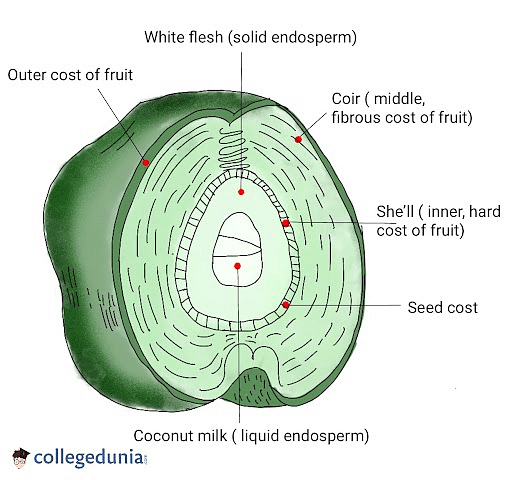
Coconut Labeled Diagram
Also Check:
Classifications of Coconut Plants
[Click Here for Previous Year Questions]
The classifications of the plants involve the classifications of the kingdom, phylum, class, family, species and genus of the plants. Classifications of the plant are the process by which the plants can be grouped into convenient categories.
Thus, Coconut Classification can be shown as
| Type | Classification |
|---|---|
| Scientific Name | Cocos Nucifera |
| Kingdom | Plantae |
| Class | Monocot |
| Phylum | Angiospermae |
| Family | Arecaceae |
| Genus | Cocos |
| Species | C. Nucifera |
| Tribe | Cocoeae |
| Division | Magnoliophyta |
Read Also: Mammalia: Classification, Order, Subclass & Examples
Benefits of Coconut Plants
[Click Here for Sample Questions]
The many benefits of Coconut Plants include:
- Coconut water gathered to form the coconut plant contains crucial nutrients.
- Coconut oil provides important nutrients to the hair.
- Husks; the natural scrubber and the crafts material can be generated with the use of the coconut trees.
- Handicrafts, baskets and fans can be created with the use of the coconut trees.
- Shells of the plants are used in the steaming of the food.
Read More:
Things to Remember
- The botanical name is the binomial name of the plant and the animals.
- “Coco” is the genus of the coconut plant.
- Coconut plants are grown in the tropical coastal regions of the world.
- “Tree of the wealth” is the common sentence use of the coconut plants.
- The coconut plant is renowned as the "Tree of life".
Read Also: Binomial Nomenclature
Previous Year Questions
- Read the statements given below and identify the incorrect … (KCET 2012)
- Edaphology is… (KCET 2007)
- Which one of the following is oviparous?... (NEET 2015)
- The process of growth is maximum during … (NEET 2020)
- Which of the following taxonomic categories of housefly is… (KEAM)
- Small mammals and birds are rarely found in polar regions … (KCET 2021)
- Which of the following is not an attribute of a population … (NEET 2020)
- The zoological name of Indian buffalo is … (COMEDK UGET 2005)
- Bladderworm/cysticercus is the larval stage of… (NEET 1991)
- Which of the following organisms possesses characteristics of a plant and an animal? (NEET 1995)
Sample Questions
Ques: What is the optimum temperature for the coconut plant to grow in tropical regions? (2 marks)
Ans: Coconut plants are grown at high temperatures and thus require almost 270C to grow in the tropical regions of the world.
Tropical climate generally possesses a temperature range of 270C and thus provides a suitable climate for the growth of coconut plants.
Ques: Which plant is known as “tree of life"? (1 mark)
Ans: Due to the incredible values associated with Coconut plants, it is known as the “Tree of life”. The mineral-rich coconut water helps in dealing with the diseases like dengue and provides effective nutrients to individuals.
Ques: What is the age of the coconut tree? (1 mark)
Ans: The coconut tree has a lifespan of 60-80 years. It is known as the three-generation tree. Farmers, children and grandparents can be supported with the benefits of this tree.
Ques: Which nation is the largest producer of coconut? (1 mark)
Ans: Indonesia is the largest producer of coconut fruit in the world. Indonesia produced 17,074,536 coconuts in the year 2019. India is the second largest producer of coconut followed by the Philippines and Brazil.
Ques: Is coconut a seed or fruit? (1 mark)
Ans: Coconut is a fruit that can be found in tropical regions of the world. The fruit has a hard stony shell which covers the important minerals of the fruit.
Ques: What is the type of coconut tree? (1 mark)
Ans: Dwarf and tall are the two types of coconut trees found in the tropical regions of the world. Tall trees grow with a height of 50-90 ft. While the dwarf tree grows at the height of 20-60ft.
Ques: Which Indian place is famous for coconut trees? (2 marks)
Ans: The Indian southern regions possess a tropical climate and thus the high production of coconut can be seen in these regions.
Regions like Tamil Nadu, Kerala and Karnataka are famous places for coconut fruit in India.
Ques: Show a diagrammatic representation of Coconut. (3 marks)
Ans: A representation of coconut is:

Coconut
Ques: Name the factors that influence Botanical Names? (2 marks)
Ans: Plants are given scientific names called botanical names. Botanical names follow the International Code of Nomenclature's guidelines for binary names (ICN).
The first name of a plant identifies its genus, whereas the second name identifies its species. To prevent misunderstanding or mistaken identification between two living things with similar names, each living thing is given a unique botanical name.
Ques: Give a brief description of coconut? (4 marks)
Ans: With a height that can range from 12 to 30 meters, the coconut palm is a thin palm tree that is found all over the tropics.
The coconut tree's trunk has cylindrical stipes that are thin (20–30 cm in diameter), slanted, dark or brownish-gray in color, and bears the round leaf scars left behind when the old leaves fall to the ground.
The palms feature a structure called a stipe in place of a trunk. They often have little thickness since the stipe is known for not branching out and maintaining the same width from the base to the terminal tip.
The distinctive "marks" left behind by the petioles of discarded leaves—commonly referred to as circular leaf scars—appear on the surface of the palm. The palm leaves, which are born in the crown or acrocaulis, are found at the end of the stipe.
A tall, erect petiole covers its leaves. They are arranged differently and are typically 2 to 6 meters long, pinnate or palmate, glossy green or colorful.
Read More:



Comments