



Content Curator
Hibiscus (Hibiscus rosa-sinensis) refers to a genus of flowers of the Malvaceae family. There are several hundred species of Hibiscus in the genus, and they are often found all throughout the world. Tropical, subtropical, and warm temperate regions are home to these flowers.
The rose mallow or hibiscus are both common names for the species that make up this genus. Other names for this plant include Hardy Hibiscus, Tropical Hibiscus, and Rose of Sharon. Perennial, annual, tiny trees, herbs and woody shrubs are all included in the genus.There are more than a hundred species that are discovered and utilized as food and medicinal all over the world.
| Table of Content |
Key Takeaways: Hibiscus, Botany, Hibiscus rosa-sinensis, Hibiscus sabdariffa, Angiospermae
Classification of Hibiscus
[Click Here for Sample Questions]
Hibiscus is a genus of flowering plants. It is a very hardy, versatile plant and is found in tropical conditions enhancing the beauty of these regions. Hibiscus belongs to the family Malvaceae.
| Kingdom | Plantae |
| Class | Magnoliopsida |
| Order | Malvales |
| Division | Tracheophyta |
| Subdivision | Angiospermae |
| Family | Malvaceae |
| Genus | Hibiscus |

Hibiscus
Characteristics of Hibiscus
[Click Here for Previous Year's Questions]
The characteristics of Hibiscus are given below:
Flower
- The flowers of the hibiscus are prominent and spectacular.
- The trumpet-shaped blooms come in a variety of colors, including red, orange, yellow, pink, and purple.
- Hibiscus flowers have five or more petals.
- Hibiscus rosa-sinensis, the most prevalent species, with bright red flowers have an eye-catching orange anther.
- They are full of natural acids and also contain iron, phosphorus, calcium, and vitamin B complex, hibiscus flowers have an acidic flavor.
- Epicalyx is usually present.
- The pollen grains are spiky in character and the stamens are joined together to create a tube.
- The female component of a hibiscus flower bears the male structures, which are the stamens that produce pollen (pistil).This unfamiliar arrangement is a common sight among members of the family Malvaceae.
- A capsule or schizocarp makes up the fruit.
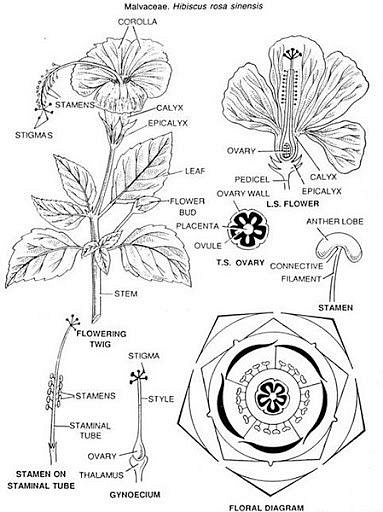
Hibiscus Diagram
Leaf
- The alternately borne leaves range in shape from ovate to lanceolate.
- The leaf edge frequently has teeth or lobes.
- It might have trichomes or be smooth.
- Proteins make about 2-3% of the fresh leaves' composition, along with traces of iron, calcium, and phosphorus.
Read More: Anatomy of Leaf
Habitat
- Around the world, the genus flourishes in warm, temperate, tropical, and subtropical climates.
- The plants have annual or perennial life cycles.
- It is entomophilous, or insect-pollinated.
Also Read:
| Related Links | ||
|---|---|---|
| Genus | Ornithology | Difference between herbs and shrubs |
| Flora and Fauna | Numerical Taxonomy | Species Definition |
Common Species of Hibiscus
[Click Here for Sample Questions]
- Hibiscus rosa-sinensis – The Chinese hibiscus, China rose, shoeblack plant, and rose mallow are all popular names for this important species of Hibiscus.It is an ornamental plant.
- Hibiscus syriacus – It got its name since it was initially collected in Syrian gardens. It is also referred to as the Korean rose and is regarded as the South Korean flag flower.It is also an ornamental plant.
- Hibiscus sabdariffa – It is a fiber-producing plant sometimes referred to as Jamaican sorrel or roselle. It is used for the production of bast fibre.
- Hibiscus cannabinus – It is a different fiber-producing plant that is also referred to as kenaf or Deccan hemp. It is used for making paper.
Floral Formula of Hibiscus
[Click Here for Previous Year's Questions]
A floral formula is a numerical representation of the several floral components that make up a flower. It is used to denote different floral sections by describing a flower using various signs and symbols.
The Hibiscus rosa-sinensis flower formula is as follows:
Br Brl ⊕ ⚥ K( 5 ) C( 5 ) A(∞)G(5)
Uses of Hibiscus
[Click Here for Sample Questions]
- In many countries, hibiscus flower tea is offered as a hot beverage as well as a cold one. The beverage is colorful, tangy, and flavorful.
- The protein- and antioxidant-rich seed is consumed after meals or in place of coffee.
- The oil extracted from Hibiscus seeds is used in cooking.
- Researchers have asserted that extracts from hibiscus flowers and roots have potent contraceptive properties.
- In Indian Ayurveda, hibiscus flowers are also used extensively.
Health Benefits of Hibiscus
[Click Here for Previous Year's Questions]
- Hibiscus may have anti-cancer and anti-bacterial properties, according to some data. The majority of this information comes from lab research, although both animal and human studies have demonstrated how hibiscus can benefit heart health.
- The chemical components largely responsible for the health advantages of hibiscus, according to researchers, are anthocyanins.
- Plant chemicals called anthocyanins serve as antioxidants and give certain plants their red, blue, and purple hues.
- Hibiscus may offer the following health advantages:
- Lower Cholesterol
- Improvement in Blood Pressure
Also Check:
Things to Remember
- Hibiscus is a genus of flowering plants in the mallow family, Malvaceae.
- It is widely known as hardy hibiscus, rose of sharon, and tropical hibiscus.
- Scientific name of china rose is - Hibiscus.
- The flower has cultural significance across many parts of the world, including India.
- A species called Hibiscus cannabinus is used for making paper.
- Other species of this genus are used in the construction of rope as well as canoes.
Previous Year Questions
- The scientist widely regarded as the triple crown of biology (AMUEEE 2015)
- Read the statements given below and identify the incorrect statement (KCET 2012)
- Reason of diversity in living beings is (NEET 2001)
- Edaphology is (KCET 2007)
- Phenetic classification is based, on (MU OET 2012)
- The first phylogenetic system of plant classification was proposed by (JIMPER 2004)
- Karyotaxonomy is the modern branch of classification which is based on (MU OET 2013)
- The label of a herbarium sheet does not carry information on (NEET 2016)
- The correct sequence of taxonomic hierarchy is (KCET 2018)
- Which of the following pairs of specific names belongs to same common genus?
- The development of sporophyte from vegetative cells of gametophyte is called (KCET 1998)
- Phylogenetic system of classification was supported by (JIMPER 1998)
- Match the following columns and select the correct option (NEET 2020)
- The roots that originate from the base of the stem are (NEET 2020)
- In which of the following animals, haemocyanin pigment is found? (NEET 2001)
- In which of the following animals post anal tail is found? (NEET 2001)
- In Hydra, waste material of food digestion and nitrogenous waste material are removed respectively from (NEET 2001)
- Bicarpellary gynoecium and oblique ovary occurs in (NEET 2001)
- Tetradynamous conditions occur in (NEET 2001)
- Edible part of banana (NEET 2001)
Sample Questions
Ques: What is the hibiscus flower known for? (2 Marks)
Ans: The beautiful, noticeable flowers of the hibiscus are used as interior basket plants or as ornaments. Tea may be made from the flower extract and drunk as a beverage.
Ques: Can hibiscus be poisonous to humans? (1 Mark)
Ans: No, hibiscus is not poisonous to humans.
Ques: How long do hibiscus flowers last? (1 Mark)
Ans: The Hibiscus flowers last only for a single day.
Ques: What is Taxonomy? (1 Mark)
Ans: Taxonomy can be defined as the science of naming , describing, and classifying all the species of living organisms, like- plants, animals, microorganisms etc.
Ques: What is Floriculture? (1 Mark)
Ans: Floriculture is the branch of Biology that studies flowers, their cultivation, and applications.
Ques: Floriculture is also known as. (1 Mark)
Ans: Anthology
Ques: What is the difference between Botany and Zoology? (2 Marks)
Ans: Botany is the study of plants while Zoology is the study of animals.
Ques: What angiospermae means? (2 Marks)
Ans: Angiosperms are plants that produce flowers and bear their seeds in fruits. They are the largest and most diverse group within the kingdom Plantae, with about 300,000 species. Angiosperms represent approximately 80 percent of all known living green plants.
Also Check:



Comments