



Education Content Expert
CaCO3 is an odourless inorganic chemical compound known as Calcium Carbonate. It is one of the most well-known non-toxic chemical.
- It is found in rocks such as the minerals calcite and aragonite.
- It is the primary component of eggshells, gastropod shells, shellfish skeletons, and pearls.
- Calcareous refers to things that contain or resemble calcium carbonate.
- It is prepared on a large scale by passing carbon dioxide gas through calcium hydroxide.
- It is mostly used as an antacid or calcium supplement.
Key Terms: Calcium Carbonate, Calcite, Calcium, Calcium Hydroxide, Chemical Compound, Carbonic Salt, Limestone
What is CaCO3?
[Click Here for Sample Questions]
CaCO3 is the chemical formula for Calcium Carbonate. Calcium Carbonate is an odourless inorganic chemical compound that appears as a white mineral found naturally in the earth's crust.
- It is a carbonic salt of calcium.
- Calcium carbonate can be seen in chalk, limestone, marble and many more.
- Even though they are physically different in appearance they are chemically the same.
- It is used in food products to preserve food and also in the manufacture of medicines.
- Excessive consumption of calcium carbonate is hazardous to health and can also cause poor digestion.
Calcium Carbonate Formula
[Click Here for Sample Questions]
Calcium carbonate is a chemical substance with the formula CaCO3.
- Natural occurrences of this compound include marble, chalk, limestone, shells, calcite, pearls, and other similar compounds.
- It is a white, insoluble powder-like substance.
- In medicine, it is used as an antacid or a calcium supplement.
- It is also useful as a cosmetic filler.
- It is widely used in the industrial business as a component in quick lime, cement, and building materials (marble).
Read More:
Calcium Carbonate Structure
[Click Here for Sample Questions]
The structure of Calcium Carbonate is as follows:
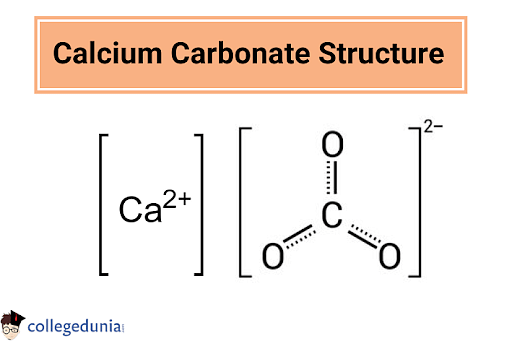
Calcium Carbonate Structure
Forms of Calcium Carbonate
[Click Here for Sample Questions]
Calcite, aragonite, and vaterite are the three polymorphic forms of calcium carbonate.
- Calcite is the most stable and least soluble of the minerals. It is a mineral that forms rocks and is widely found in sedimentary, metamorphic, and igneous rocks. Calcite is found in sedimentary rocks such as limestone and marble. It is widely utilised in construction materials, agricultural soil remediation, pharmaceuticals, and a variety of other applications.
- Argonite is more soluble and less stable than calcite. It is created as a result of biological and physical processes, such as precipitation from marine and freshwater settings. Aragonite offers sea life nutrients while also keeping pH levels at their natural range. It is employed to remove contaminants such as zinc, cobalt, and lead from contaminated wastewater.
- Vaterite is a hexagonal-shaped mineral that is less stable than calcite and aragonite but has a higher solubility. Natural sources include springs, organic tissue, urinary calculi, gallstones, and plants. It is used in regenerative medicine and a variety of personal care items.
Preparation of Calcium Carbonate (CaCO3)
[Click Here for Sample Questions]
CaCO3 is extracted by the process of mining and quarrying. It can be prepared using calcium hydroxide (slaked lime, Ca(OH)2) and carbon dioxide as raw materials.
When carbon dioxide compound is allowed to pass through the slaked lime, calcite is obtained.
Ca(OH)2 + CO2 \(\to\) CaCO3 + H2O
Calcite can otherwise be obtained by adding sodium carbonate to calcium chloride.
CaCl2 + Na2CO3 \(\to\) CaCO3 + 2NaCl
Caco3 can also be prepared chemically with the help of calcium oxide (quick lime, CaO) with water that forms calcium hydroxide (Ca(OH)2). Later, Carbon dioxide is made to pass through this solution.
CaO + H2O \(\to\) Ca(OH)2
Ca(OH)2 + CO2 \(\to\) CaCO3\(\downarrow\) + H2O
Properties of Calcium Carbonate (CaCO3)
[Click Here for Sample Questions]
The properties of Calcium Carbonate are as follows:
- It appears as a powdery texture that is white in colour.
- Molecular Weight/ Molar Mass of Calcium carbonate (in g/mol) is 100.0869 g/mol.
- The density of Calcium carbonate is 2.71 g/cm³.
- The boiling point of Calcium carbonate is 899°C/1200 K (decomposes at 899°C/1200 K).
- The melting point of Calcium carbonate is 825 °C.
- Calcium carbonate in reaction with dilute acids forms carbon dioxide as a by-product.
Uses of Calcium Carbonate (CaCO3)
[Click Here for Sample Questions]
The uses of Calcium Carbonate are listed below:
- Calcium carbonate is largely used in the paper, paints and pulp industries.
- It is used as a pigment and filter in cosmetics to produce whiter and higher-quality pigment when compared to other minerals.
- It can be used in the manufacturing of tablets and as an antacid to relieve stomach upset, and heartburn.
- It plays an important role in the manufacturing of construction materials such as marble or as an ingredient in cement.
- It is used as a calcium supplement in cases of low levels of calcium.
- It is also used in the process of refining the sugar.
- It is used in agriculture in neutralizing acidic soil.
- It is used in water and sewer plant treatment to remove acidity and impurities.
Commercial Production of Calcium Carbonate
[Click Here for Sample Questions]
Calcium Carbonate is available in two forms commercially. Both of these forms compete in the industrial market primarily on the basis of particle size and the attributes given to a product.
- Ground calcium carbonate is extracted and processed from naturally occurring deposits.
- The GCC crystal form is irregularly rhombohedral, with a larger size distribution.
- Precipitated calcium carbonate is created through chemical precipitation using a carbocation technique or as a byproduct of a few bulk chemical processes.
- The shape of the PCC crystal varies depending on the product, and the particles are more regular and homogenous, with a restricted size distribution.
- PCC features smaller particles that are purer, less abrasive, and have a higher brightness than GCC.
Check More:
Things to Remember
- CaCO3 is the chemical formula of Calcium Carbonate.
- Calcium Carbonate is an odourless and water-insoluble chemical compound.
- It is a carbonic salt of calcium and is mainly found in rocks.
- Calcite, Vaterite, Aragonite are some of the forms of Calcium Carbonate.
- CaCO3 is prepared using Calcium Hydroxide (Ca(OH)2) and Carbon Dioxide as raw materials.
- It is commonly used as a dietary supplement and antacid.
Sample Questions
Ques. What is Calcium Carbonate? (2 Marks)
Ans. Calcium Carbonate is an inorganic chemical compound with the chemical formula CaCO3. It is found in rocks as the minerals calcite and aragonite, and it is the primary component of the shells of marine animals, snails, and eggs. Calcium carbonate is also a key component of buffers in blood and other bodily fluids, and it is utilised in the manufacture of cement and lime.
Ques. Mention some properties of Calcium Carbonate. (3 Marks)
Ans: Some properties of calcium carbonate are:
- The melting point of calcium carbonate is 825 °C while its boiling point is 899 °C/ 1200 K.
- It forms carbon dioxide as a by-product in reaction with dilute acids.
- In water and alcohol, it is practically insoluble.
- It dissolves with effervescence in diluted acetic acid, diluted hydrochloric acid, and diluted nitric acid, and the resultant solutions pass calcium tests after boiling.
- When heated to the point of decomposition, it releases irritating fumes and smoke.
Ques. What are some dietary uses of Calcium Carbonate? (3 Marks)
Ans. Some dietary uses of Calcium Carbonate are:
- It can also be found in milk and fortified foods.
- It is used to regulate acidity, as an anticaking agent, and as a stabiliser.
- It is a calcium source in some soy milk and almond milk products.
- Many vegetable products that are canned or packaged use it as a firming agent as well.
- Fruits like organic apples, pears, and other citrus fruits use it as a food preservative and colour stabiliser.
Ques. How is Calcium Carbonate obtained? (3 Marks)
Ans. Calcium carbonate occurs naturally in a variety of mineral forms. It is mostly derived from natural sources through mining and processing. Calcite, aragonite, and vaterite are calcium carbonate minerals. Limestone, chalk, marble, and travertine are likewise mainly calcium carbonate and are the primary industrial sources of calcium carbonate.
- It is obtained biologically from corals, clamshells, eggshells, snail shells, and the majority of seashells. In the industrial sector, oyster shells are employed as a source of nutritional calcium. In the diet, dark green vegetables such as broccoli and kale contain substantial levels of calcium carbonate.
- It can also be produced chemically by reacting quicklime (calcium oxide) with water to produce calcium hydroxide (Ca(OH)2). The calcium carbonate salt is then produced by treating this with carbon dioxide.
Ques. What are the applications of Calcium Carbonate? (5 Marks)
Ans. The following are a few applications of Calcium carbonate:
- It is used as a pigment and filter in cosmetics to produce whiter and higher-quality pigment.
- It can be used in the manufacturing of tablets and as an antacid to relieve stomach upset, and heartburn.
- Calcium carbonate is mostly used in the construction industry, either as a building material or as limestone aggregate for road construction, or as an ingredient in cement.
- Calcium carbonate is also used in blast furnaces to refine iron from iron ore.
- Calcium carbonate is added to drilling fluids in the oil industry as a formation-bridging and filter cake-sealing agent; it is also a weighting substance that raises the density of drilling fluids to manage downhole pressure.
- Calcium carbonate is used in swimming pools as a pH corrector to preserve alkalinity and offset the disinfection agent's acidic characteristics.
- Blackboard chalk has been mostly composed of calcium carbonate in the form of chalk.
Ques. What effect does Calcium Carbonate have on pH? (3 Marks)
Ans. The hydrochloric acid in stomach secretions is neutralised by Calcium Carbonate.
- The action of the pepsin enzyme can be inhibited when the pH of the stomach rises.
- By neutralising gastric acid, calcium carbonate functions as a barrier in the acidic environment of the stomach.
- Calcium carbonate dissociates in the stomach into a carbonate ion and ionised calcium.
- Carbonate anion binds to free protons in the stomach and raises the pH by lowering the concentration of hydrogen ions.
Ques. What are the advantages of consuming Calcium Carbonate? (3 Marks)
Ans. Calcium is primarily absorbed through our diets, but as we age, calcium levels in our bones drop, resulting in reduced bone density and other bone-related issues.
- Calcium is important for strong bones, and the teeth and bones absorb and store 99 per cent of it. The body uses the remaining calcium to manage other bodily activities.
- Calcium is needed for muscular contraction regulation. Because your body does not generate calcium, it must be obtained through food.
- Calcium is obtained and used in a variety of processes such as muscular contraction and blood circulation.
- When there is tissue injury, calcium is responsible for triggering a regulatory response. Calcium ions enter wounded cells and activate phospholipases, causing mitochondrial electron transport to be disrupted.
Ques. Is Calcium Carbonate basic in nature or not? If yes, then why? (1 Mark)
Ans. Yes, Calcium carbonate is a salt with a strong base due to the presence of the calcium ion in it and it is a weak acid because of the presence of the carbonate ions derived from carbonic acid.
Ques. What happens if too much Calcium Carbonate is consumed? (3 Marks)
Ans. Calcium carbonate can be found in antacids (heartburn medications) and several dietary supplements. Overdose of calcium carbonate occurs when a person consumes more than the typical or recommended amount of a product containing this ingredient. This might occur accidentally or on purpose.
Calcium carbonate is not poisonous and hence, recovery is likely. But long-term overuse of calcium carbonate is more serious than a single overdose because it can cause kidney stones, impair kidney function, raise blood pH, induce nausea and vomiting, confusion or changes in thinking or mentation, itching, and, in extreme situations, irregular heartbeat, Pain in the abdomen, Bone aches, Coma, Depression, Diarrhea and Headache.
Ques. Why is Calcium Carbonate basic in nature, while being composed of a weak acid and a weak base? (3 Marks)
Ans. Calcium carbonate is a natural basic salt. CaCO3 is formed as follows:
CaO + CO2 \(\to\) CaCO3
- CaO is a basic element, whereas CO2 is an acidic element. CaCO3 is nearly insoluble in water.
- Another more plausible hypothesis is that it combines with acids to produce carbon dioxide and water.
- It is the salt of calcium ion, which is a strong base, and carbonic acid, which is a relatively weak acid.
- An acid-base reaction is the reaction of an acid with calcium carbonate.
- An acid will react with a base to generate salt and water in these processes. The base neutralised the acid.
- Carbonic acid is unstable, forming carbon dioxide and water.
Check-Out:



Comments