



Content Writer
Calcium hydroxide is commonly known as slaked lime. A substance that is not organic is calcium hydroxide.
- Ca(OH)2 is its chemical formula.
- In its solid state, calcium hydroxide has a white powdery look, however, when it is crystallized, it appears colorless.
- Also called hydrated lime, slack lime, pickling lime, and caustic lime, the calcium hydroxide compound also goes by several other names.
- Calcium oxide and water are combined to create calcium hydroxide (quick lime).
Read more: Soda lime
| Table of Content |
KeyTerms: Hydroxide, Quick Lime, Chloride, Ionic Bonds, Calcium hydroxide
Calcium Hydroxide
[Click Here for Sample Questions]
Ionic interactions between the calcium ion Ca2+ and two hydroxide ions OH are what hold calcium hydroxide molecules together. Humans are at risk from unprotected exposure to this substance, which can cause chemical burns and skin irritation. Concentrated calcium hydroxide exposure can cause eye and lung damage.
Calcium hydroxide has a molecular weight or molar mass of 74.093 grams. Calcium hydroxide has a density of 2.211 grams per cubic centimeter. Calcium hydroxide has a melting point of 853K. Like all metal hydroxides, calcium hydroxide adopts a polymeric structure. The structure, or cadmium iodide motif, is the same as the brucite structure of Mg(OH)2.
Structure of Calcium Hydroxide
[Click Here for Sample Questions]
Calcium hydroxide acquires a polymeric structure, much like all metal hydroxides do. Magnesium hydroxide and calcium hydroxide have similar chemical structures. Since both calcium and hydroxide are present in their ionic forms, the bond in calcium hydroxide is ionic. Ca2+ and OH- ions are connected by ionic bonds. Additionally, two hydroxide ions are joined to the metal ion of calcium.
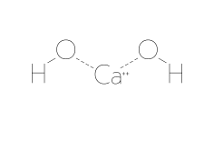
Structure of Ca(OH)2
Properties of Calcium Hydroxide
[Click Here for Sample Questions]
The following table lists some of calcium hydroxide's properties.
| Properties of Calcium Hydroxide | |
|---|---|
| IUPAC Name | Calcium Hydroxide |
| Chemical Formula | Ca(OH)2 |
| Density | 2.211 grams/cubic centimeter |
| Molecular Weight | 74.093 grams per mole |
| Melting Point | 853K |
| Color | Colorless crystal or White powder |
Physical Properties
A few of the following listed physical properties of calcium hydroxide:
- Ca(OH)2 has a hexagonal crystal structure.
- Calcium hydroxide has a solubility product Ksp of 5.5×10⁻⁶ in water, making it relatively insoluble. According to the following reaction, calcium hydroxide's solutions are basic because its acid dissociation constant Ka is so large:
Ca(OH)2 → Ca2+ + 2OH−
- Calcium hydroxide dissolves in pure water at room temperature to create an alkaline solution with a pH of 12.4. Chemical burns can be brought on by calcium hydroxide solutions.
- Its solubility dramatically declines at high pH levels. For cement pastes, this behavior is appropriate. Limewater is a calcium hydroxide aqueous solution.
- These bases have a mild strength and react with acids to attack some metals like aluminum while preventing corrosion in other metals. When there is carbon dioxide present, lime water becomes milky. It results from calcium carbonate production. Carbonation is the action at hand. For example, lime water
Ca(OH)2 + CO2 → CaCO3 + H2O
- When heated to 512°C, calcium hydroxide decomposes into calcium oxide and water when the equilibrium partial pressure of water with calcium hydroxide reaches 101 kPa.
Chemical Properties
Chemical properties of Calcium hydroxide are as follows:
- Calcium hydroxide is somewhat soluble in water but quite soluble in acids and glycerol. When it is dissolved in water until it reaches the saturation point, it produces a solution known as lime water that functions as a moderate base.
- Salts are produced when lime water combines with acids.
- Metals like aluminum react with and dissolve in the saturated calcium hydroxide solution in water.
- Calcium carbonate is formed as a result of its reaction with carbon dioxide (CaCO3). In general, this reaction can be referred to as carbonation.
Read more:
| Relevant Concepts | ||
|---|---|---|
| Chemical Equilibrium | Ammonium chloride | Fermentation |
| Acids and Bases | Carboxylic acids | Galvanic corrosion |
Uses of Calcium Hydroxide
[Click Here for Sample Questions]
Calcium hydroxide has a lot of applications, of which a few are mentioned below.
- Calcium hydroxide is used as a clarifying agent or a flocculant during the sewage treatment process.
- To turn wood into wood pulp via the Kraft process, the paper industry uses Ca(OH)2.
- It is an important compound in the production of ammonia.
- Due to its basicity, this substance is also used as a pH modifier.
- The most common tool used to pickle cucumbers is Ca(OH)2.
- Calcium hydroxide is a component used in the manufacturing of several polymers.
- In addition, it is utilized in the production of ebonite, hair care products, and herbicides.
- This substance is used to fill the cavities in human teeth during root canal operations.
- Ca(OH)2 is used in the carbonation process, which is how sugar beets and sugarcane are processed.
- In the leather business, calcium hydroxide is used to extract the fur and hair from the animal hide.
Things To Remember
- At 70 °C, calcium hydroxide is approximately half as soluble as it is at 25 °C. This is a result of the exothermic mechanism by which calcium hydroxide dissolves in water. Also, it follows Le Chatelier's principle.
- A decrease in temperature enables the removal of heat during the dissolving process, raises the equilibrium dissociation constant of Ca(OH)2, and increases its solubility at low temperatures. Because their dissolving reactions are exothermic, the different hydrated forms of calcium sulphate also have retrograde solubility.
- Commercially, calcium hydroxide is mostly produced by treating calcium oxide with water.
- The preparation of calcium hydroxide in the lab also involves the reaction of calcium chloride and sodium hydroxide, which produces NaCl as a byproduct.
- Calcium hydroxide contains two hydroxyl groups and dissociates into two hydroxyl ions per molecule, it can be regarded as a di-acidic molecule.
Sample Questions
Ques. What are the uses of calcium hydroxide? (2 marks)
Ans. Calcium hydroxide is a white powder that has no distinctive smell. It is employed in industrial applications such as waste management, paper production, construction, and food processing. This substance is also used in a number of medical and dental procedures. For instance, calcium hydroxide is frequently utilized as a filler material in root canal procedures.
Ques. Is calcium hydroxide acidic or basic? (2 marks)
Ans. When dissolved in aqueous solutions, calcium hydroxide, sometimes referred to as slaked lime (with the chemical formula Ca(OH)2, serves as a source of hydroxide ions. This substance is a base as a result. This substance releases OH- ions as a result of electrolyte dissociation.
Ques. How can calcium hydroxide be prepared? (5 marks)
Ans. Slaked lime is another name for calcium hydroxide. When it is in a solid condition, it is white, and when it is in a crystalline state, it is colorless. By reacting with calcium oxide, also known as slaked lime Ca(OH)2, water creates the calcium hydroxide chemical. The majority of it remains in a suspension known as lime milk, while a smaller percentage of it dissolves when combined with water to make a solution called limewater.
It can also be created chemically by combining calcium chloride, sodium hydroxide, and water; one of the products of this reaction is calcium hydroxide. Unprotected exposure to, or direct contact with, concentrated calcium hydroxide damages the lungs, irritates the eyes, and can occasionally even cause blindness. Although this substance is less soluble in water, it begins to mix with the water when the solution's temperature rises.
Ques. Why is Calcium Hydroxide less Soluble in Water? (3 marks)
Ans. Slaked lime, also known as calcium hydroxide, is generally less soluble in water but becomes more soluble as the temperature is raised. This causes the substance to break down. The lattice energy of hydroxide salts has decreased, which accounts for the reduced solubility. The solution created when calcium hydroxide and water combine is known as milk of lime. Calcium hydroxide is employed as a pH corrector to lessen a solution's acidity since, unlike water, it is readily soluble in acids and glycerol.
Ques. Which is stronger NaOH or CAOH? (1 mark)
Ans. Because the amount of OH- ions a base releases determines how strong it is, Ca(OH)2 will release more OH- ions than NaOH and is therefore a stronger base.
Ques. Is calcium hydroxide harmful? (1 mark)
Ans. In addition to coughing, fluid in the lungs, and breathing difficulties, calcium hydroxide can result in persistent skin dermatitis, desquamation, vesiculation, and ulceration.
Ques. Why do dentists use calcium hydroxide? (2 marks)
Ans. If the infection and bleeding are under control, calcium hydroxide may be used to protect the essential pulp and to treat root fractures, perforations, open apices, and root resorptions. Endo-perio lesions are complicated, and effective therapy depends on a precise diagnosis.
Ques. Is calcium hydroxide an antacid? (2 marks)
Ans. An antacid that combines calcium carbonate and magnesium hydroxide is used to relieve heartburn, indigestion, and upset stomach. There are additional uses for calcium carbonate and magnesium hydroxide not covered in this medicine guide.
Ques. Mention the chemical formula for calcium hydroxide (1 mark)
Ans. Ca(OH)2
Ques. What happens when carbon dioxide reacts with lime water? (2 marks)
Ans. When there is carbon dioxide present, lime water becomes milky. It results from calcium carbonate production. Carbonation is the action at hand. For example, lime water
Ca(OH)2 + CO2 → CaCO3 + H2O
Check out:



Comments