



Content Curator
To calculate the pH of a weak acid, it is first important to keep in mind that pH has no units, thus it is required to define it with H+ ion concentration. pH is a quantitative measure of acidity or basicity of aqueous or other liquids. The formula to calculate pH of weak acid is:
| \(K_{a} \; = \; \frac{ [ H^{+} ] \;[ B^{-} ]}{ [HB] }\) |
- The pH value represents whether a substance is acidic, basic, or neutral in nature.
- It is used widely in chemistry, biology, and agronomy.
- The pH value ranges from 0 to 14, the lowest value signifying acidity (any value less than 7) and the highest signifying basicity (any value greater than 7).
- Neutral solutions (such as pure water) have a pH of 7, acidic solutions have a pH of less than 7, and alkaline solutions have a pH of 7.
- The pH of lemon juice is 2.4 and that of household ammonia is 11.5. The normal pH of human blood is 7.4.
Read More: Importance of pH in Everyday Life
| Table of Content |
Key Terms: Base, Acid, pH value, pH of a weak base, Hydrogen, pH Table, Litmus Paper, Alkaline Solutions, Weak Acids, Strong Acids, H+ ion concentration
What is pH?
[Click Here for Sample Questions]
pH is the concentration of hydrogen ions (that is, protons) in a substance. pH is an abbreviation of the Potential of Hydrogen. The p in pH stands for ‘potenz’ in German, meaning power. The pH scale was developed in 1923 by the Danish biochemist Søren Peter Lauritz Sørensen for numerical measurement of the acidity or alkalinity of a solution. It is usually measured on a scale of 0-14. pH is reported in "logarithmic units". Each number represents a 10-fold change in the acidity/basicness of the water.
- pH is the negative logarithm of the H+ ion concentration.
- The meaning of pH is that it justifies the power of Hydrogen.
- A litmus paper is used as an indicator to specify whether a substance is an acid or base.
- For instance, Vinegar is an acid and has a pH value of 2.4.

pH Diagram
The litmus paper is an index used to determine whether a substance is an acid or a base. The color of the litmus paper indicates the pH value of what kind of substance is being tested. For example, vinegar is an acid and measures 2.4 on the pH scale. Water with a pH of five is ten times more acidic than water having a pH of six.
pH Formula
It claims that pH equals the negative logarithmic value of hydrogen ion (H+) concentration. It does not have any Unit. Thus, the formula of pH can be represented as:
| pH = – log [H+] |
pH of Acids and Bases
A solution with a pH of 0 is known as a strong acid solution. Also, as the pH rises from 0 to 7, the acidity drops, and a solution with a pH of 14 is called a strongly basic solution. When the pH drops from 14 to 7, the alkalinity drops. The strength of acids and bases depends on the number of H + and OH – ions formed. Acids that provide more H + ions are known to be strong acids and vice versa.
The degree of acid and base ionization depends on the acid and base. It helps determine the strength of acids and bases. The strength of the acid also depends on the concentration of hydronium ions (H3O+). You can distinguish between acids and bases by comparing the concentrations of hydronium and hydroxyl ions.
- For acidic solution: [H3O+] > [OH–]
- For neutral solution: [H3O+] = [OH–]
- For basic solution: [H3O+] < [OH–]
Read Also: Chloroauric acid
pH Table
[Click Here for Sample Questions]
The pH values chart for different substances is mentioned below:
| Substance | pH Value |
|---|---|
| Water | 7 (For Pure Water), 6.5 to 7.5 (Common Bottled Water), 5.7 (Distilled Water), Approx. 8 (Ocean Water) |
| Acid Rain | 4.0 |
| Milk | Approx. 6.7 to 6.9 (Cow’s Milk) |
| Stomach | 1.5 to 3.5 |
| Milk of Magnesia | 10.52 |
| Ammonia | 11.50 (Household Ammonia Solution) |
What is Weak Acid?
[Click Here for Sample Questions]
In an aqueous solution or water, a weak acid is one that partially dissociates into its ions. However, in water, a strong acid entirely dissociates into its ions. A weak acid's conjugate base is also a weak base. Similarly, a weak base's conjugate acid is also a weak acid.
- Weak acids have a greater pH value than strong acids at the same concentration.
- Strong acids are far less prevalent than weak acids.
- In everyday life, they can be found in vinegar (acetic acid) and lemon juice (citric acid).
- The strength of a weak acid is based on how much it dissociates.
- Thus, the more it is seen to dissociate, the stronger will be the acid.
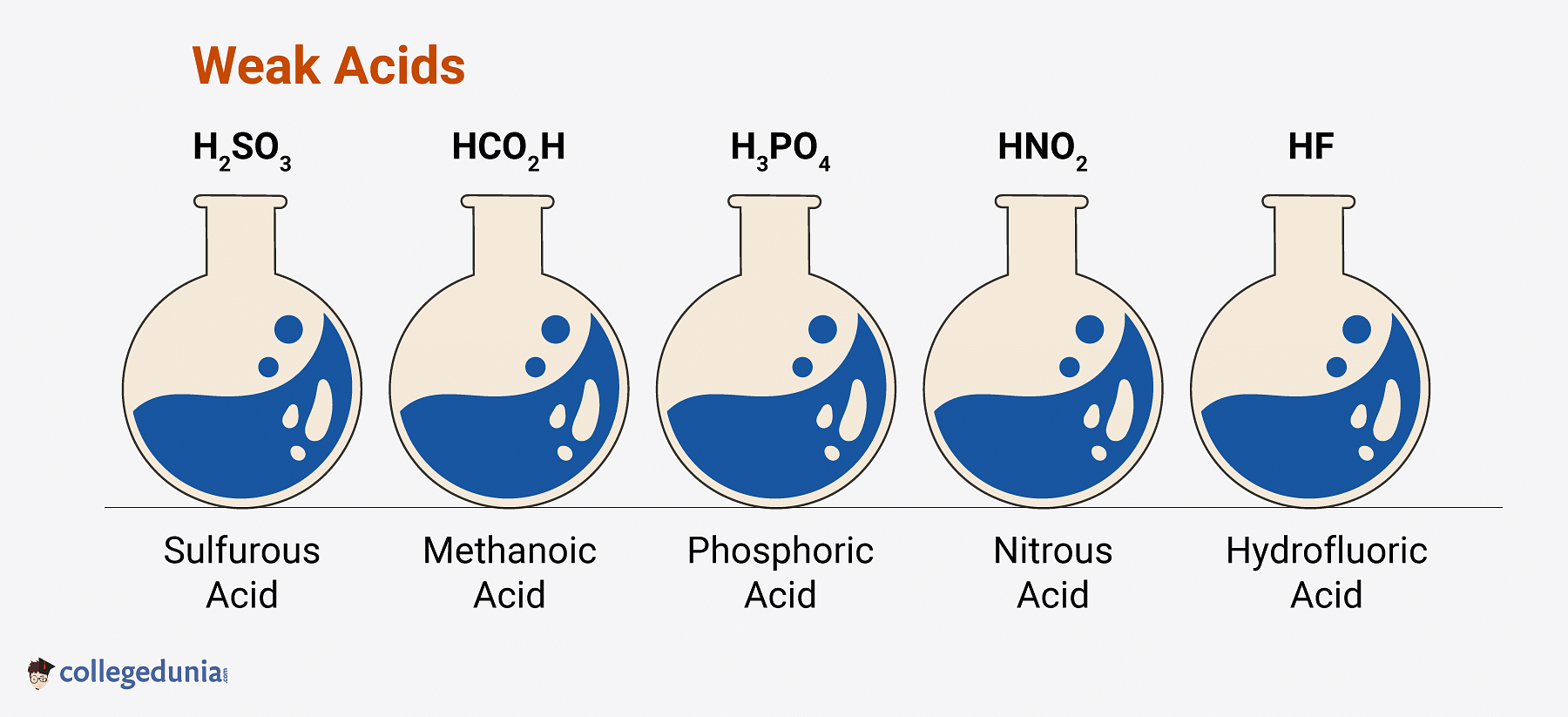
Weak Acid Examples
Read more:
Calculating pH of Weak Acid
[Click Here for Sample Questions]
pH has no units and it can be defined with the help of H+ ion concentration. Hence,
| aH+ = [H+] / mol L-1 |
Therefore, the pH of a compound can be shown as,
→ pH = – log(aH +)
Since weak acids do not completely breakdown in water so calculating the pH value is difficult.
Read More: High-Density Polyethylene structure
Calculation of pH
The calculation of pH of acids and bases can be obtained on the basis of chemical speciation calculation. The solution's nature decides the level of complicacy demanded to evaluate the pH value.Thus, the pH value of a weak acid with the help of an example is shown below:
Example: Calculate the pH of a Benzoic acid solution of concentration 0.01 M.
Solution: For a 0.01 M concentration of Benzoic acid sample, Ka (Acid dissociation constant) is 6.5 x 10⁻⁵.
Now, a Benzoic acid sample 0.01 M concentration is when mixed with water or aqueous solution,
the dissociation reaction can be expressed as:
| C6H5COOH → H+ + C6H5COO− |
According to the formula for Ka, it can be expressed as – Ka = [H+] * [B-] /HB . . . . . . . . . (1)
Considering this as equation 1.
Where [H+] is the Hydrogen ion concentration. [B-] is conjugate base ion concentration.
HB is an un-dissociated or unionized acid molecule concentration. [For reaction such as HB → H+ + B-]
To get a C6H5COO- ion, Benzoic acid ionizes one H+ ion, so we can write [H+] = [C6H5COO-].
Let us now consider the H+ ions concentration which can dissociate from HB as ‘x’.
From the above consideration, we can write HB = C – x (wherein C is the concentration at the beginning of the reaction).
Now, putting these values in equation 1 for evaluating:
Ka = x . x / (C – x) Ka = x2 / (C – x) . . . . . . (2)
Considering as equation 2
(C – x) . Ka = x2
Therefore, x2 = (C . Ka – x . Ka) x2 + KaX – CKa = 0 . . . . . . (3)
Considering as equation 3, we need to take the quadratic equation to get the following values. Thus, x =\( \frac{- b \pm \sqrt{ b^2 – 4ac }}{ 2a }\) . . . . . . (4)
Considering the above as equation 4. Thus,
x = [-Ka + (Ka2 + 4CKa)1/2] / 2 . . . . . . (5)
Considering as equation 5
This leaves us with two equations to calculate the value of x. Its value cannot be negative as it signifies the ion concentration in the solution.
Now, putting the value of Ka as 6.5 x 10⁻⁵ and C as 0.01 M in equation 5,
We have, x = [(-6.5 x 10⁻⁵) + {(6.5 x 10⁻⁵)2 + 4 . (0.01) . (6.5 x 10⁻⁵)}1/2] / 2
On solving this or simplifying this, we have x = [-6.5 x 10⁻⁵ + 1.6 X 10⁻³] / 2 x = [1.5 X 10⁻³] / 2
Finally, X = 7.7 x 10⁻⁴
Now, to answer how to find pH of a weak acid, put these values in the pH equation which can be expressed as pH = – log [H+]
Putting the value of H+,
We have pH = - log x Putting the value of x, we have, pH = – log [7.7 x10⁻⁴]
Further, pH = - (-3.11) = + 3.11
Therefore, you can calculate using this method and quickly tell that 0.01 M concentration of Benzoic acid has a pH value of 3.11.
Alternate Method
To know how to calculate the pH of a weak acid, you can also follow this process below.
It gives an approximate value of pH for weak acids and can be calculated more quickly.
For weak acids, the degree of dissociation or ionisation is nominal.
For instance, here Benzoic acid of concentration 0.01 M was dissociated by a mere value of 7.7 x 10⁻⁴ M.
This value is about 770 times weaker than the original concentration of 1 x 10⁻².
Therefore, from equation 2:
we have, Ka = x2 / (C – x)
Since the dissociation is nominal in the case of weak acids, the value of (C – x) will be almost equal to C.
So we get, Ka = x2 / C
This saves you from another complicated step of solving the quadratic equation, and we can write –
x2 = Ka.C x2 = (6.5 x10⁻⁵) . (0.01)x2 = 6.5 x10⁻⁷x = 8.06 x 10⁻⁴
Now, to answer how to calculate the pH of a weak acid, put these values in the pH equation which can be expressed as:
| pH = - log [H+] |
Therefore, we can write, pH = - log xpH = - log (8.06 x 10⁻⁴)
Therefore, pH = - (-3.09) = 3.09.
This is a rather simple method for calculating the pH of the weak acid.
The difference in answers between the two is approximately 0.02, which is very minor in comparison. In most cases, you can go with the second method; even though the first one provides more accurate results.
Check Also:
Solved Examples Related to pH
[Click Here for Sample Questions]
Ques: Which one of the following will turn red litmus paper blue
- Vinegar
- Lemon juice
- Baking soda solution
- Aerated cold drinks
Ans: c) Baking soda solution
Explanation: Since Bases turn red litmus paper blue, acids turn blue litmus paper red and baking soda is basic in nature so it turns red litmus paper to blue.
Ques: pH is a measure of which factor:
- Ion concentration
- Hydrogen-ion concentration
- Density
- Concentration of Solute
Ans: b) Hydrogen-ion Concentration
Ques: The neutral value of pH scale is?
- Less than 5
- Equal to 7
- Less than 8
- Less than 10
Ans: b) Equal to 7
Ques: Who had invented the pH Scale?
- S.P.L Sorenson
- Benjamin Franklin
- Henry Moseley
- Wilhelm Rontgen
Ans: a) S.P.L Sorenson
Read More: List of Strong Acids
Things to Remember
- pH can be defined as the concentration of hydrogen ions in a substance.
- pH is an abbreviation of the Hydrogen Potentials.
- If the pH value is lower than 7, the solution is acidic.
- If pH is 7, the solution is neutral.
- If pH is higher than 7, the solution is basic.
- The pH value of weak acids decreases with an increase in temperature due to increased ionization.
- The pH value of a weak base increases with an increase in temperature due to ionization or an increase in [OH] ion concentration.
Check out: Importance of pH testing in everyday life
Sample Questions
Ques: Explain whether an aqueous solution with pH = 7.92 is acidic, basic, or neutral? (4 marks)
Ans: At 25 degrees, pure water will have a pH value of exactly 7.0.
- Therefore, since the neutral solution is assigned a value of 7.0.
- Values higher than 7.0 are called alkaline, and solutions with a pH lower than 7.0 are called "acidic" and this fact applies to chemicals that are only at room temperature.
- As the temperature changes, the pH value of the neutral water changes slightly and you will see an aqueous solution with a pH of 7.92.
- This value is greater than 7.0, so you can quickly conclude that it is basic in nature.
Ques: An acidic solution has: (1 mark)
(A) Less concentration of hydrogen ions than hydroxide ions.
(B) More concentration of hydroxide ions than hydrogen ions.
(C) More concentration of hydroxyl ions.
(D) Equal concentration of hydroxide and hydrogen ions.
Ans: B) More concentration of hydroxide ions than hydrogen ions
Ques: What is the pH value of pure alcohol? (1 mark)
(A) 7
(B) 7.33
(C) 7.80
(D) 8
Ans: B) 7.33
Ques: What will be the litmus test if the solution is basic? (1 mark)
(A) Red litmus will turn to blue
(B) Blue litmus will turn to red
(C) No change in colour
(D) It will change into orange-pink.
Ans: A) Red litmus will turn to blue
Ques: Which statement is correct regarding Buffer Solution? (1 mark)
(A) It is a solution whose pH changes when a small amount of an acid or base is added to it.
(B) It is a solution whose pH does not change when a small amount of an acid or base is added to it.
(C) It does not use pH value as constant in a wide variety of chemical applications.
(D) The solution of methanoic acid is an example of an effective buffer solution.
Ans: B) It is a solution whose pH does not change when a small amount of an acid or base is added to it
Ques: Why do we measure the pH of seawater? (1 mark)
(A) It helps in corrosion research.
(B) It helps in agricultural activity.
(C) It helps in fermentation.
(D) It helps in sterilization.
Ans: A) It helps in corrosion research.
Ques: Determine the percent of formic acid (HCOOH) that is going to be dissociated in a 0.1 M solution of formic acid? Here, it is mentioned that the Ka of formic acid is 1.77 x 10⁻⁴. (3 marks)
Ans: As per the question, it can be said that:

Ques: What is the pH of a 0.001 M solution of H2SO4? HSO4- has a pKa of 1.2 x 10- 2. (2 marks)
Ans: Sulfuric acid's first deprotonation is in the form a strong acid. Thus, we have 0.001 M H+ concentration to begin and 0.001 M hydrogen sulfate. Because hydrogen sulfate is a weak acid, this problem becomes very similar to the last one (see ). The calculated value for pH is 2.73 pH units (note that it is lower than 3 due to the dissociation of hydrogen sulfate).
Ques: What is the pH of 0.001M of a HCl solution? (2 Marks)
Ans: HCl is known to be a very strong acid on its own. This means that it completely dissolves into water and dissociates in H+ and Cl-.
Hence,
pH = - log [H+]
pH = -log [0.001] = 3
Thus, the pH of the HCl solution is 3.
Ques: What is the reaction between NaOH and HCl known as? (2 Marks)
Answer: The reaction that occurs between NaOH and HCl is known as a Neutralization reaction.
It can be shown as:
NaOH + HCl → NaCl + H2O
Also Check:



Comments