



Exams Prep Master
Cardiac Cycle is the time taken by the one systole followed by immediate diastole of the heart. In common terms one heartbeat of a person is known as one cardiac cycle. It is the chain of events that occurs inside the human heart when the heart beats. The human heart is a muscular organ that pumps blood through a set of connections between arteries and veins, known as the cardiovascular system. It involves systemic and pulmonary circulation. Human heart beats 72 times in one minutes or one heartbeat or cardiac cycle is completed in 0.85 seconds .
| Table of Content |
Key terms: cardiac cycle, Right Atrium, Right Ventricle, Left Atrium, Left Ventricle, Systolic phase.
What is Cardiac Cycle?
[Click Here for Sample Questions]
Time taken by one systole followed by immediate diastole of a heart is called heartbeat or cardiac cycle. In each cardiac cycle blood has to pass twice through the heart to circulate ones through the body. Once it passes through the right side from where it reaches into the left side through lungs (short pulmonary circulation) secondly, it passes through the left side to all the body parts to the right side of the heart through the right auricle. Figure 1.1 explains this .
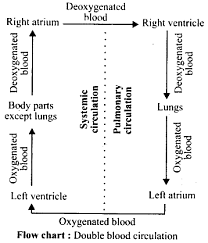
Cardiac Cycle
Deoxygenated blood from body parts enters the right auricle through superior and inferior venae cava ,from there it is transported to right ventricle from right ventricle deoxygenated blood move to lungs through pulmonary arteries.After oxygenation blood from lungs travels to left auricle through four pulmonary veins, from left auricle blood travels to left ventricle and from there oxygenated blood travels to all the body parts through aortic arteries.
Also Read:
Origin of Cardiac Cycle
[Click Here for Sample Questions]
In the walls of the heart four bundles of specialized fibers are present .They have the properties of neurons ,they are termed as nodule tissues.One such bundle the sinu-atrial node or SA Node is present in the wall of right auricle near the opening superior vena cava .Another node the Auricular-ventricular node or AV Node arises out of Bundle of His ,They give out Purkinje fibers forming a network which spreads throughout the walls of ventricles .The heartbeat originates at the S-A Node also called the Pacemaker.Figure 1.2
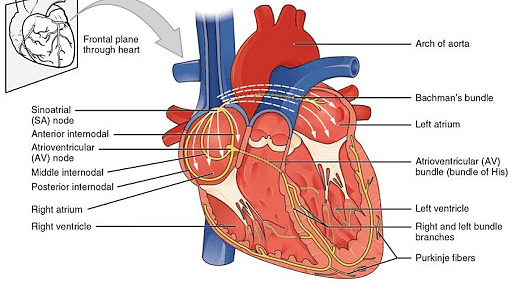
Origin of Cardiac Cycle
Cardiac Cycle Diagram
[Click Here for Sample Questions]
The given below diagram shows the different phases of the cardiac cycle. The atrial systole, ventricular diastole, ventricular systole and ventricular diastole.

Cardiac Cycle Diagram
Cardiac Cycle Physiology
[Click Here for Sample Questions]
The human heart comprises four chambers, including left and right halves, where two upper chambers include left and right atria; lower two chambers include right and left ventricles. The main function of the right ventricle is to pump deoxygenated blood through the pulmonary arteries and pulmonary trunk to the lungs. Whereas the left ventricle is responsible for pumping newly oxygenated blood to the body through the aorta.
Phases of Cardiac Cycle
[Click Here for Sample Questions]
The different phases that occur in a cardiac cycle are:
Atrial Diastole: Here, chambers of the heart are calmed. Meaning, when the aortic valve and pulmonary artery closes and atrioventricular valves open, which causes chambers of the heart to relax.
Atrial Systole: At this stage, blood cells flow from atrium to ventricle andhere, atrium contracts.
Isovolumic Contraction: At this phase, ventricles begin to contract. The atrioventricular valves, valve, and pulmonary artery valves close, but there won’t be any transformation in volume.
Ventricular Ejection: At this stage, ventricles contract and empty. Pulmonary artery and aortic valve close.
Isovolumic Relaxation: Here no blood enters the ventricles and consequently, pressure decreases, ventricles stop contracting and begin to relax. Pulmonary artery and aortic valve close due to the pressure in the aorta.
Ventricular Filling Stage: In this stage, blood flows from atria into the ventricles which altogether known as one stage (first and second stage). After that, there are three phases that involve the flow of blood to the pulmonary artery from ventricles.
Duration of Cardiac Cycle
[Click Here for Sample Questions]
The heartbeat of a normal person is 72 beats/minute. So, the duration of one cardiac cycle can be calculated as:
1/72 beats/minute =.0139 minutes/beat
At a heartbeat 72 beats/minute, the duration of each cardiac cycle will be 0.8 seconds.
Duration of different stages of the cardiac cycle:
- Atrial systole: continues for 0.1 seconds
- Ventricular systole: continues for 0.3 seconds
- Atrial diastole: continues for 0.7 seconds
- Ventricular diastole: continues for 0.5 seconds
| Related Topics for Body Fluids and Circulation | ||
|---|---|---|
| Difference Between RBC and WBC | Lymphocyte | Stroke Symptoms |
| Difference between Monocytes and Lymphocytes | Rh Grouping | Transportation in Human Beings |
| Heart Diseases | Phagocytosis | Glycosaminoglycans |
Points to Remember
- Sinu-atrial node is also called the pacemaker.
- The circulation of blood through the human body takes place through double circulation.
- The amount of blood pumped by the heart per minute is called the cardiac input.
- Deoxygenated blood travels to lungs from pulmonary arteries through the right atrium and right ventricles .
- Oxygenated blood travels to all the body parts from pulmonary veins .
- Systole is the phase in which respective parts of the heart contracts whereas diastole is the phase in which respective parts of the heart relaxes.
Sample Questions
Ques: What is Atrial systole? (3 marks)
Ans: The atrial systole is for 0.1 sec; during this period the atria contract and ventricles relax Atrial depolarization causes atrial systole. As the atria contract, they exert pressure within; this causes the blood to move through the AV valves. Due to atrial systole, the total volume of 25ml of blood reaches to the ventricles which already contains 105ml of blood within it. At the end of atrial systole, which is also the end of ventricular diastole.
Ques: What is Ventricular Systole? (2 marks)
Ans: The ventricular systole is for 0.3 sec; during this period, the ventricles contract and the atria are relaxed.The ventricular depolarization causes ventricular systole.As the ventricles contract, pressure rises within the ventricles and pushes the blood up against the AV valves forcing them to shut. for about 0.005 sec, both the AV valves and semilunar valves are closed.
Ques: What is Joint Diastole? (2 marks)
Ans: This period is for 0.4 sec. During this period, both the atria and ventricles relax. Ventricular repolarization causes ventricular relaxation.The relaxation period is for a longer time than the contraction period because if the cardiac muscles relax for longer duration, more powerful and forceful is the next contraction. This results in more stroke volume; hence more cardiac output.
Ques: How many chambers are there in a human heart? (1 mark)
Ans: There are four chambers, right atrium, left atrium, right ventricle and left ventricle.
Ques: What are venae cavae? (2 marks)
Ans: There is a specific set of blood vessels associated with each heart chamber. The right atrium receives deoxygenated blood from the body, (the venous return), via two veins called venae cavae. The superior/ anterior vena cava returns blood from the head and neck and the inferior/posterior vena cava returns blood from the rest of the body.
Ques: Name the valves present in the heart and their uses? (3 marks)
Ans: There are four valves in the heart whose job is to prevent backflow of blood in the heart.The tricuspid valve is between the right atrium and right ventricle. It will be open when the heart relaxes and fills (diastole) and shut when the ventricle is contracting (systole). The bicuspid (mitral) valve is between the left atrium and the left ventricle. It will be open when the heart relaxes and fills (diastole) and shut when the ventricle is contracting (systole). The pulmonary semilunar valve, at the base of the pulmonary arch, is shut when the heart relaxes and fills, but opens when the right ventricle contracts to pump blood through the arch to the lungs. The aortic semilunar valve, at the base of the aortic arch, is shut when the heart relaxes and fills, but opens when the left ventricle contracts to pump blood through the arch to the body.
Ques: Why does the right atrium contract before the left atrium? (2 marks)
Ans: The SAN or Sinu-atrial- node generates impulses which spread through and depolarize the cardiac muscle causing contraction. Thus the right atrium receives impulses before the left atrium and so the right atrium contracts before the left atrium.
Ques: Why does heart make ‘lubb' and ‘dubb’ sound? (1 mark)
Ans: The lubb and dubb sound of the heart is made when the valves inside the heart opens and closes.
Ques: How does heart rate control ? (1 mark)
Ans: Heart rate controlled by both nervous and endocrine systems
Ques: What is Systemic Circulation? (1 mark)
Ans: Circulation of oxygenated blood from the left ventricle to the right auricle through various body parts is called systemic circulation.
Also check:



Comments