



Content Curator
A pendulum is a system that consists of a small mass (known as the bob) hanging from a fixed support by a light inextensible thread.
- When the bob is moved from its equilibrium position and released, the force of gravity causes it to oscillate back and forth around that position.
- The length of a simple pendulum, indicated by L, is the vertical distance between the point of suspension and the center of mass of the suspended body while it is in its mean position.
- This type of pendulum operates on a resonant system that has a single resonant frequency.
- The time period of a pendulum is the time it takes to complete one full oscillation.
- It is the time it takes for the pendulum to swing from one side to the other and back again.
- The time period is denoted by the letter T and is measured in seconds (s).
The time period of a pendulum is given by
T = 2π \(\sqrt{\frac{L}{g}}\)
Where
- L is the length of the pendulum
- g is the acceleration due to gravity
| Table of Content |
Key Terms: Time period, Frequency, Simple pendulum, Spring constant, Force, Acceleration due to gravity, Simple harmonic motion
Pendulum Swing Experiment
[Click Here for Sample Questions]
A pendulum swing experiment is a scientific study of the motion of a pendulum.
- Pendulums are objects that are suspended from a fixed point and swing back and forth under the effect of gravity.
- Pendulum swing experiments can be performed to determine the acceleration due to gravity, the time period of a pendulum, and the effects of different factors on the motion of the pendulum.
- Galileo Galilei conducted one of the most famous pendulum swing experiments in the early 1600s.
- Galileo used his heartbeat to time the swings of a pendulum and established that the period of a pendulum remains constant regardless of the amplitude of the swing.
- This finding led to the invention of the pendulum clock, which for centuries was the most precise timekeeping instrument.
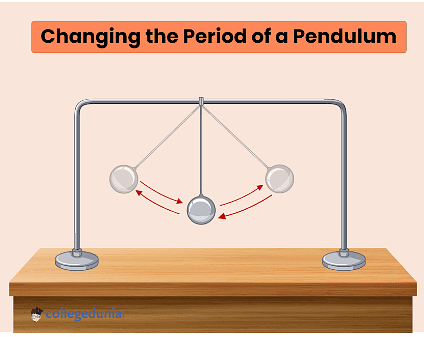
A Pendulum
Also Check Out:
| Important Topics | ||
|---|---|---|
| Distance and Displacement | Motion in a Straight Line | Uniform Circular Motion |
Aim
[Click Here for Previous Year Questions]
To change the period of a pendulum
Apparatus Required
[Click Here for Sample Questions]
The apparatus required to perform this experiment are
- Weights
- Stopwatch
- Thread
- Tape
- Table
- Ruler
- Straw

Pendulum Swing Experiment
Procedure
[Click Here for Previous Year Questions]
The following is the procedure to perform the experiment to change the period of a pendulum
- Attach a weight to a thread.
- Tie the thread to the straw and tape it to the table so that about half an inch hangs over the edge.
- Tape the other end of the thread to the table such that the length from the end of the straw to the center of the weight is 4 inches.
- Allow the pendulum to settle and become steady.
- Pull the bob about an inch and gently release it. Make sure the pendulum swings in a straight line.
- When you let it go, start the stopwatch and count the number of times it swings from its starting position to the original until you reach ten. Repeat this three times and take the average of the three trials' results. The period of the pendulum is defined as the number of swings divided by the time taken.
- Extend the pendulum to 5 inches in length and repeat the whole process.
- Increase the weight of the bobs and repeat the process mentioned above.
Conclusion
[Click Here for Sample Questions]
Only the length of a pendulum determines its period. Changing the weights and the distance pulled to the swing has no effect on the time it takes to complete a swing from the starting to the finishing position. In both circumstances, the period of the pendulum remains constant.
Things to Remember
- A pendulum is a device made of a weight suspended from a pivot so that it can swing freely.
- The time taken for one complete oscillation to occur is called the Time Period. It is denoted by T.
- The formula of time period of a pendulum is T = 2π√(l/g)
- The time period of a pendulum is directly proportional to square root of its length.
- The time period of a pendulum is inversely proportional to the square root of the value of acceleration due to gravity.
- A pendulum swing experiment is a scientific study of the motion of a pendulum.
- Frequency is the number of occurrences of a repeating event per unit of time. It is measured in hertz (Hz), which is equal to one cycle per second.
Also Check Out:
| Important Topics | ||
|---|---|---|
| Type of Motion Measurement | Laws of Motion MCQs | Wave Motion |
| Oscillations MCQs | Rectilinear Motion of Particles | Study Notes on Laws of Motion |
Previous Year Questions
- In the given circuit, what will be the equivalent resistance between the points…. [JIPMER 2006]
- How to adjust a system of three identical capacitors to get high electrostatic energy with the given battery… [UPSEE 2006]
- The surface charge density of the Earth…. [DUET 2009]
- A point dipole with dipole moment... [KEAM]
- The time of fall of the electron, in comparison to the time of fall of the proton is….[NEET 2018]
- An electric dipole of dipole moment is placed in a uniform external electric field…. [KEAM]
- An infinite number of charge, each of charge…
- Infinite charges of magnitude q each are lying at… [JKCET 2004]
- Two long current carrying thin wires, both with current… [JEE Main 2015]
- Identify the wrong statement… [KEAM]
- An electron enters a uniform electric field maintained by parallel plates and… [KEAM]
- When a soap bubble is charged… [KCET 2020]
- Two pith balls carrying equal charges are suspended from a common point by… [NEET 2013]
- A glass rod rubbed with silk is used to change a gold leaf electroscope… [JEE Advanced 2011]
- A copper rod AB of length l is rotated about end A with a constant angular… [VITEEE 2021]
- Two charges of equal amount +Q are placed on a line… [WBJEE 2016]
Sample Questions
Ques. The time period of a simple pendulum is 4 s. Find its frequency. (3 Marks)
Ans. The frequency of a pendulum is defined as the number of oscillations per second. It is given by
f = 1/T
Where T is the time period of the pendulum.
Given the period of the oscillation of the pendulum is, T = 4 s
On substituting the value, we get
Frequency, f = 1/T = 1/4 = 0.25 Hz
Ques. What is a simple pendulum? (2 Marks)
Ans. A simple pendulum consists of a heavy point mass (referred to as the bob) hanging from a rigid support by a massless and inextensible thread. A pendulum is set to motion when a bob from its mean position is pulled to one side and then released.
Ques. What is the formula for the period of a simple pendulum? (2 Marks)
Ans. The time period of a simple pendulum can be calculated by the formula
T = 2π \(\sqrt{\frac{L}{g}}\)
Where L is the length of the string.
Ques. For a simple pendulum, why is a spherical bob chosen? (2 Marks)
Ans. For a simple pendulum, a spherical bob is used for the following reasons:
- The spherical shape has the smallest volume for a given density value.
- The spherical shape reduces air friction.
Ques. The small bob of a simple pendulum has a mass m and the length of the pendulum is l. It is oscillating on a circular arc of angle θ in a vertical plane. At the end of this arc, another ball of mass m is placed at rest. What is the momentum transferred to this ball by the bob of the pendulum? (2 Marks)
Ans. Since another ball that is at rest is kept at the extreme position of the pendulum, at the extreme position, the velocity of the bob of the pendulum is zero i.e. v = 0.
Momentum at the extreme position, p = m(dv/dt) = 0
Hence momentum transferred to the ball by the bob of the pendulum is zero.
Ques. Two simple pendulums of length 1 m and 1.21 m are at their mean positions with velocities in the same direction at some instant. After how many oscillations of the bigger pendulum they will again be in the same phase? (5 Marks)
Ans. The length of the smaller pendulum, l1 = 1 m
Therefore, its time period is, T1 = 2π√(1/g)
The length of the bigger pendulum, l2 = 1.21 m
Therefore, its time period is, T2 = 2π√(1.21/g)
Taking the ratio of both time periods, we get
T1/T2 = [2π√(1/g)]/[2π√(1.21/g)]
⇒ T1/T2 = 10/11
⇒ 11T1 = 10T2
Therefore after completing 10 oscillations of the bigger pendulum, the smaller pendulum will complete 11 oscillations.
Hence after 10 oscillations of the bigger pendulum, they will again be in the same phase.
Ques. What is periodic motion? (2 Marks)
Ans. Periodic motion is a type of motion in which an object repeats its motion at regular intervals. This means that the object returns to the same position and velocity at the same time after a certain amount of time has passed.
Ques. A spring balance has a scale that reads from 0 to 50 kg. The length of the scale is 20 cm. A body suspended from this balance, when displaced and released, oscillates with a period of 0.6 s. What is the weight of the body? (5 Marks)
Ans. Given
- The maximum mass that the scale can read, M = 50 kg
- The maximum displacement of the spring = Length of the scale, l = 20 cm = 0.2 m
- Time period, T = 0.6 s
Maximum force exerted on the spring, F = Mg
On substituting the values, we get
F = 50 × 9.8 = 490
Now, spring constant, k = F/l
⇒ k = 490/0.2 = 2450 N m-1
Let mass m be suspended from the balance, then the time period of the pendulum is given by
T = 2π√(m/k)
⇒ m = (T/2π)2 x k
On substituting the values, we get
m = (0.6/2x 3.14)2 x 2450 = 22.36 kg
Hence, the weight of the body is, W = mg = 22.36 x 9.8 = 219 N
Ques. Why do we use heavy bob which is small in size in a simple pendulum? (2 Marks)
Ans. The restoring force of a heavy bob is sufficient to overcome air resistance. A small bob has less resistance due to air. As a result, a heavy bob having a small size is used as a bob in a simple pendulum.
Ques. What is the relationship between time period and frequency? (2 Marks)
Ans. The time period and frequency are inversely proportional to each other, and it is given by
f = 1/T
Where f is the frequency and T is the time period.
Ques. The time period of a simple pendulum is 2 s. Find its frequency. (3 Marks)
Ans. The frequency of a pendulum is defined as the number of oscillations per second. It is given by
f = 1/T
Where T is the time period of the pendulum.
Given the period of the oscillation of the pendulum is, T = 2 s
On substituting the value, we get
Frequency, f = 1/T = 1/2 = 0.5 Hz
Ques. What is simple harmonic motion? (2 Marks)
Ans. Simple harmonic motion (SHM) is a special type of periodic motion in which the restoring force is directly proportional to the displacement of the object from its equilibrium position and acts towards the equilibrium position.
Ques. The time period of oscillation of a simple pendulum is √2 s, If its length is decreased to half of the initial length, then what is its new period? (5 Marks)
Ans. The time period of a simple pendulum is given by
T = 2π√(l/g)
From the above equation, for the constant value of g, the time period of the simple pendulum is directly proportional to the square root of its length i.e.
T ∝ √l
⇒ T1/T2 = (√l1)/(√l2)
Where
- T1 and T2 are the initial and final time periods.
- l1 and l2 are the initial and final lengths of the string of the pendulum.
Given
- T1 = √2 s
- l2 = l1/2
On substituting the values, we get
(√2)/T2 = (√l1)/(√l1/2) = √2
⇒ T2 = 1s
Hence, the new time period will be 1 second.
Ques. Define the time period of a pendulum. (2 Marks)
Ans. The time period of a pendulum is the time it takes to complete one full oscillation. It is the time it takes for the pendulum to swing from one side to the other and back again. The time period is denoted by the letter T and is measured in seconds (s).
Ques. Define oscillatory motion. (2 Marks)
Ans. Oscillatory motion is a type of motion in which an object moves back and forth repeatedly about a fixed point. This fixed point is called the equilibrium position. Oscillatory motion is a special type of periodic motion, which means that the object repeats its motion at regular intervals.
For Latest Updates on Upcoming Board Exams, Click Here: https://t.me/class_10_12_board_updates
Check-Out:



Comments