


NCERT Solutions for Class 12 Maths Chapter 1 Relations And Function Miscellaneous Exercise

Shekhar Suman logo

Shekhar Suman

Content Curator

NCERT Solution for Class 12 Maths Chapter 1 relations and functions Miscellaneous Exercise is based upon the theories covered in the previous four exercises.

  • In class 12 maths NCERT Solutions for chapter 1 relations and functions miscellaneous exercise there are around 19 questions including objectives and descriptive questions.
  • Nearly 7, 9 and 3 questions from relations, functions and binary operations respectively are provided in the miscellaneous exercise.

Check NCERT Solution for Class 12 Maths Chapter 1 relations and functions Miscellaneous Exercise (PDF Link)

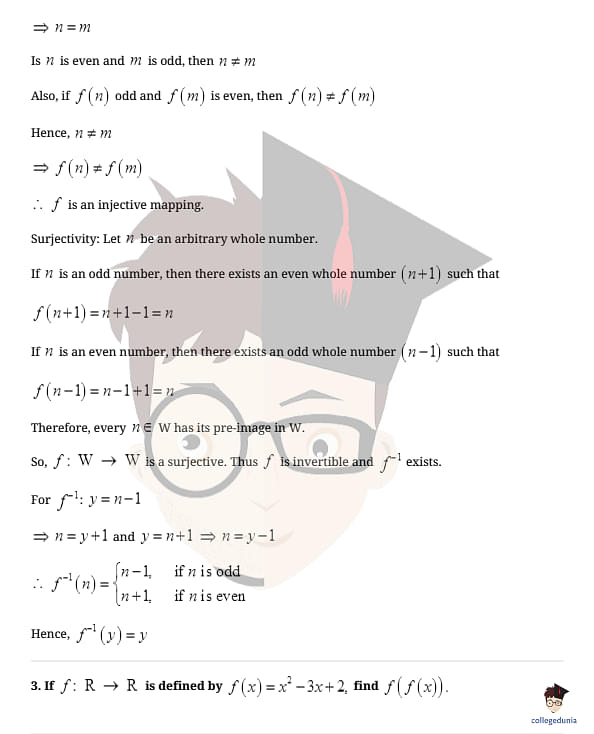
Check Class 12 NCERT Maths Chapter 1 Relations and Functions Exercises: 

Read More:

Class 12 Mathematics Guides:

CBSE CLASS XII Related Questions

  • 1.
    Find the vector and cartesian equations of the line passing through the point of intersection of the lines \( \vec{r} = (\hat{i} + \hat{j} - \hat{k}) + \lambda(3\hat{i} - \hat{j}) \) and \( \vec{r} = (4\hat{i} - \hat{k}) + \mu(2\hat{i} + 3\hat{k}) \) and parallel to the line \( \frac{x - 1}{-2} = \frac{7 - y}{-3} = z \).


      • 2.

        Evaluate:
        \[ \int_{0}^{1} \frac{x \tan^{-1}x}{(1+x^2)^{3/2}}\,dx \]


          • 3.
            A relation $R$ on set $A=\{1,2,3\}$ defined as $R=\{(1,2),(2,1),(2,2)\}$ is

              • Reflexive only
              • Reflexive and Transitive
              • Symmetric and Transitive
              • Symmetric only

            • 4.
              Which of the following equations is NOT a Linear Differential Equation?

                • \((1 + x^2) \, dy + 2xy \, dx = \cot x \, dx\)
                • \(y + \frac{d}{dx}(xy) = x(\sin x + \log x)\)
                • \(x(1 + y^2) \, dx - y(1 + x^2) \, dy = 0\)
                • \(y \, dx - (x + 3y^2) \, dy = 0\)

              • 5.
                Find:

                The principal value of \[ \sec^{-1}(\sqrt{2})+2\csc^{-1}(-2) \] is:

                  • \(-\frac{\pi}{2}\)
                  • \(-\frac{\pi}{4}\)
                  • \(\frac{\pi}{4}\)
                  • \(\frac{\pi}{2}\)

                • 6.
                  If \( xy = e^{x - y} \), then find \( \frac{dy}{dx} \).

                    CBSE CLASS XII Previous Year Papers

                    Comments


                    No Comments To Show
