



Content Curator
The term class interval (or class size) refers to the numerical width of any class in a particular distribution. It is defined mathematically as the difference between the upper-class limit and the lower class limit. Class Interval (width of the class) is the difference between the upper limit and lower limit, denoted by the letter h. Class intervals are useful in drawing histograms or graphs. Hence “Class interval = Upper-class limit- lower-class limit. The upper limit of the class is the maximum value or the value above which there exists no item in that class. Similarly, the lower limit of the class is the least value or the value below which there exists no item in that class.
| Table of Content |
Keyterms: Class, Interval, upper-class limit, the lower class limit, Statistics
Also Read: Statistics
Abstract
[Click Here for Sample Questions]
This article gives information about Class Mark, one of the interesting topics in Statistics. In order to understand the Class Mark topic better, it is required to describe some vocabulary terms such as Class, Class Interval, Upper limit, and lower limit. Then it becomes easier to understand Class intervals along with solved examples.
The video below explains this:
Class Mark Detailed Video Explanation:
Class
[Click Here for Sample Questions]
A class is a group or collection of values to calculate frequency distribution, a representation that displays the number of observations within a given interval.
Also Read: Frequency Distribution Table Statistics
Class Interval
[Click Here for Sample Questions]
The term class interval (or class size) refers to the numerical width of any class in a particular distribution. It is defined mathematically as the difference between the upper-class limit and the lower class limit.
Hence “Class interval = Upper-class limit- lower-class limit. The end values of a class are called its limits. Now here comes the doubt – What are upper class and lower class limits of the class?
The upper limit of the class is the maximum value or the value above which there exists no item in that class. Similarly, the lower limit of the class is the least value or the value below which there exists no item in that class. For example, Of class 60-79, 60 is the lower limit and 79 is the upper limit, i.e. in this case, there can be no value that is less than 60 or more.
Class intervals are useful in drawing histograms or graphs.
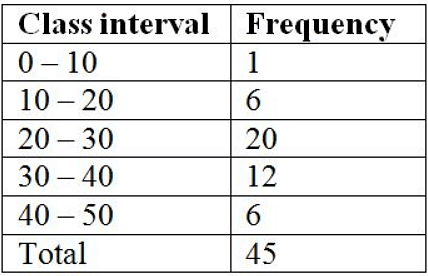
Class Interval
Example:
Let us examine the use of class interval with the following example:
Here we have grouped the data – 8, 19, 58, 35, 45, 12, 6, 13, 18, 47 into classes and found class intervals.
In the above data, the lowest term is 6, the highest term is 58. We can group the data by 0-10, 10-20, 20-30, 30-40, 40-50, 50-60.
The class intervals for these groups are 10-0=10, 20-10=10, 30-20=10, 40-30=10, 50-40=10, 60-50=10 respectively. All the groups are having the same class interval.
Also Read: Variance
Class Mark
[Click Here for Sample Questions]
Class Mark is defined as the mid-value (or middle value) of each class interval. It is also called “Average of values of upper limit and lower limit. Class Mark is calculated by the formula
Class Mark = (Upper Limit + Lower Limit)/2
And the difference between the true upper limit and true lower limit of the class interval is termed as the Class Size (or size of the class), which is calculated by the formula
Class Size h = Upper limit – Lower Limit.

Example Problems
[Click Here for Sample Questions]
Question 1: Find the class mark of class 20-30 and 30 – 40
Solution: Here we are given two classes – 20-30 and 30-40.
The upper limit and lower limit of 20-30 are 30 and 20 respectively
So the class mark of 20-30 is (20+30)/2 = 50/2 = 25
The upper limit and Lower limit of 30-40 are 40 and 30 respectively
So the class mark of 30-40 is (30+40)/2= 70/2= 35
Question 2: The class marks of distribution are: 47, 52, 57, 62, 67, 72, 77, 82, 87, 92, 97, and 102. Determine the class size, the class limits, and the true class limits.
Solution: Here the class marks are uniformly spaced. So, the class size is the difference between any two consecutive class marks
∴ Class size h = 52 – 47 = 5
We know that, if a is the class mark of a class interval and h is its class size, then the lower and upper limits of the class interval are
a−(h/2) and a+(h/2) respectively.
∴ The lower limit of the first-class interval
= 47−52 = 44.5
And, the upper limit of the first-class interval
= 47+52
= 49.5
So, the first-class interval is 44.5 – 49.5
Question 3: Classmarks of distribution are found to be 82, 88, 94, 100, 106, 112, and 118. Find out the class size and the classes.
Solution: We know that the class size is the difference between two consecutive class marks.
∴ Class size = 88 – 82 = 6.
82 is the class mark of the first class, whose width h = 6.
∴ Class limits of the first class are 82−(6/2) and 82+(6/2) i.e. 79 and 85.
Thus, the first class is 79-85.
Similarly, the other classes are 85–91, 91– 97, 97–103, 103 –109, 109 –115, and 115 –121.
Question 4: The frequency distribution of the age of persons (in years) attending trekking camp is given below:
| Age (in years) | Number of persons |
|---|---|
| 15−19 | 16 |
| 20−24 | 60 |
| 25−29 | 50 |
| 30−34 | 30 |
Find the class mark of class 20−24. (Note: A frequency distribution shows the frequency of repeated items in a graphical form or tabular form.)
Solution: Classmark is the midpoint of a given class interval
The midpoint of the class 20−24= (20+24)/2
=44/2
=22
Therefore, the class mark of class 20−24 is 22.
Question 5: The class marks of a frequency distribution are given as follows: 15, 20, 25, Find out the class corresponding to the class mark 20
- 12.5 – 17.5
- 17.5 – 22.5
- 18.5 – 21.5
- 19.5 – 20.5
Solution: Given that the class marks of a frequency distribution: 15, 20, 25, ...
Class size h for the given frequency distribution: 20-15=5
We can use the below formula to find the class related to the class mark 20
Upper limit = class mark + (class size / 2)
= 20 +(5/2) = (40+5)/2 = 45/2= 22.5
Lower limit = class mark – (class size/2)
= 20 – (5/2) = 35/2= 17.5
Hence, “17.5 - 22.5” is the corresponding class to the class mark 20
Therefore option (B) is correct.
Question 6: In a frequency distribution, the classmark (or middle-value of a class) is 10 and the width of the class is 6. Find out the lower limit of the class:
(A)6 (B) 7 (c) 8 (D) 12
Solution: Let x and y be the upper and lower class limits in the frequency distribution.
We know that the formula for mid-value of given class = (x+y)/2
The mid-value of the class is already given to be 10.
(x+y)/2= 10
x+y = 20 ---à (1)
Also, given that width of the class = 6
x-y = 6 ---à (2)
Now, add equations (1) and (2),
We get
x+y+x-y = 20+6 = 26
2x= 26
x=26/2 = 13
x+y+x-y = 20+6
x= 26/2 = 13
Substituting x=13 in equation (1)
x+y= 20
13+y=20
y=20-3= 7
Hence, the lower limit of the class is 7
Therefore option (B) is correct.
Things to Remember
- Class Interval (width of the class) is the difference between the upper limit and lower limit, denoted by the letter h.
- Class interval = Upper-class limit- lower-class limit.
- Class Mark is defined as the mid-value (or middle value) of each class interval.
- Class Mark = (Upper limit+Lower limit)/2
- The upper limit of the class is the maximum value or the value above which there exists no item in that class.
- The lower limit of the class is the least value or the value below which there exists no item in that class
- Class intervals are useful in drawing histograms or graphs.
Sample Questions
Ques: Find the class mark of 95 - 100
Sol. We know that class mark = (lower class+upper class)/2
given that lower-class = 95, upper class = 100
Hence class mark = (95+100)/2 = 97.5
Ques: Find the class marks of 15.5 - 18.5, and 50 - 75
Sol. We know that Class mark = (lower class+upper class)/2
we apply this for both
class mark of 15.5- 18.5 = (15.5+18.5)/2= 34/2 = 17
class mark of 50-75 = (50+75)/2= 125/2 = 62.5
Ques: The class marks of continuous distribution are : 1.04, 1.14; 1.24; 1.34; 1.44; 1.54; and 1.64 Is it correct to say that the last interval is 1.55 - 1.73 ? Justify the answer.
Sol. Classmark is the midpoint of a class interval.
We know the difference between two consecutive class marks is always equal to the class size.
Now 1.14−1.04=0.1 and
1.24−1.14=0.1
1.34−1.24=0.1 and so on
Class size =0.1 → (1)
But in the class interval (1.55−1.73), 1.73−1.55=0.8 ≠ (1)
So class interval (1.55−1.73) cannot be the "correct class interval" for the given class marks.
Ques: The frequency of the class interval 3−5 in the following distribution is :
Sol. 5,5,6,4,9,5,3,2,7,6,3,8,4
Ques: In a frequency distribution, the mid-value of a class is 10 and the width of the class is 6. Find the lower limit of the class:
Sol. Given that the mid-value of the class =10
and the Width of the interval =6
then lower limit = Mid value−Width/2
= 10−3=7
Ques: The class mark of a class is 25 and if the upper limit of that class is 40. Then find its lower limit
Sol. We know that Class mark= (Lower limit+Upper limit)/2
⇒25= (Lower limit+40)/2
⇒Lower limit=50−40=10
Ques: Let m be the mid-point and l be the upper class limit of a class in a continuous frequency distribution. Then find the lower class limit of the class
Sol. Let a be lower class limit, l is the upper class limit and m is the mid-point
then, mid-point m=(a+l )/2
Therefore, a=2m−l
Ques: If the class intervals of a frequency distribution are 16−25,26−35,36−45,46−55, then find
(a) both the class limits and class boundaries of class 36−45
(b) both the class size and the class mark of the class interval 26−35
(c) both the class intervals when changed into the overlapping class interval
Sol. (a) Lower class limit of the interval 36 - 45 = 36 and
Upper class limit of the interval 36 - 45 = 45
(b) Class Size of the interval 26 - 35 = 10 and
Class Mark of the interval 26 - 35 = 30 (Class Mark is the average of the limits of the class interval)
(c) The class intervals when changed into overlapping class intervals are
15.5 - 25.5
25.5 - 35.5
35.5 - 45.5
45.5 - 55.5
Ques: In a frequency distribution, the width of each of five continuous classes is 5 and the lower class limit of the lowest class is 10. Find the upper-class limit of the highest class
Sol. Given that Lower class limit =10
Each class width =5
Width of the upper-class limit for a frequency distribution having 5 classes =5×5=25
Hence, the upper-class limit of highest class =10+25=35
For Latest Updates on Upcoming Board Exams, Click Here: https://t.me/class_10_12_board_updates
Also Check:



Comments