



Exams Prep Master
An insulator is a material that does not conduct electrical current. Most of the electrical conductors are covered by insulation. Generally insulators are rated at hundreds of volts, but some of the insulators that are used in power distribution are rated as high as hundreds of thousands of volts. Let’s understand the facts and concepts in a more effective way. Electric conductivity expresses the phenomena of mobility of electrons through a material. Conductivity depends on the types of atoms present in a material. In easy words, materials with high electron mobility such as many free electrons are known as conductors, and materials with low electron mobility i.e few or no free electrons are known as insulators.
| Table of Content |
Key Terms: Insulators, perfect insulators, Conductors, Thermal insulator, electrical insulators, induction
Definition of Insulators
[Click Here for Sample Questions]
Insulators are materials that inhibit electrons from easily passing from one particle of one element to the next. If we apply a charge to such an element at any point on the surface, the charge remains in the same place and does not spread throughout the surface. Charging by rubbing (with the help of appropriate materials for specific parts) and charging by induction are two common ways of charging such components.

On the other hand, semiconductors and conductors conduct electric current that easily acts opposite to the insulator. Insulators have higher resistivity compared to semiconductors or conductors.
Examples of Insulators- glass, rubber, oil, asphalt, fiberglass, porcelain, quartz, wood, plastic, air, ceramic, diamond, pure water, etc.
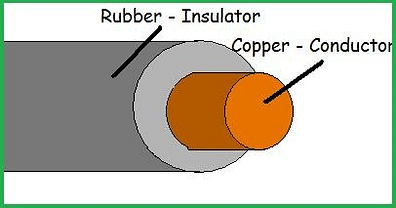
Example of Conductors
Example of Conductors- silver, copper, gold, aluminum, iron, steel, brass, bronze, mercury, graphite, impure water, etc.
Why does the Perfect Insulator not Exist?
Insulators contain a very small amount of mobile charges or charge carriers that conduct current. All insulators become electrically conductive by applying a sufficient voltage to generate the electric field to remove electrons from the atoms. The voltage is known as the breakdown voltage of an insulator. Glass, paper, and Teflon have commonly used insulators with high resistivity. Some groups of materials, with lower bulk resistivity, can prevent significant current flow and act as insulation for electrical wiring and cables. Examples of such materials are rubber-like polymers and plastics which act as thermosets or thermoplastic.
Read More:
| Related Articles | ||
|---|---|---|
| Electrical properties of solids | Maxwell’s Equation | Resitance Formula |
| Electric Charges and Fields | Unit of Electric Flux | Resistance |
Use of Insulators
[Click Here for Sample Questions]
Insulators are mainly used to separate electrical conductors and prevent current flow through themselves. Basically, insulation refers to the process of wrapping up electrical cables and other types of equipment by using an insulating material in bulk. Apart from this, these materials are also used to fasten electric power transmission or distribution lines to transmission towers as well as utility poles. Without allowing the current flow through the tower to the ground, they hold the weight of hanging wires.
When there is no voltage rating given, there exist few wires which have mechanical coverings, such as service drop, doorbells, thermostat wire and so on. Moreover, an insulated wire holds a voltage rating and the highest conductor temperature rating.
Application of Insulators
[Click Here for Sample Questions]
Apart from using in wires, some of the applications of insulators are as follows:
- In electronic units, printed circuit boards are made from fiberglass and epoxy plastic which acts as an insulator of conductive copper foil layers. Some small conductive components are insulated by phenolic or epoxy plastics, ceramic coatings, baked glass, etc.

Application of Insulators
- The silicon matter inside the integrated circuits and transistors are the conductor. But, It can be converted into an insulator by the reaction with oxygen and heat. Silicon becomes quartz on oxidation which forms silicon dioxide, which is an insulator.
- A liquid insulator such as oil is used in high voltage capacitors and transformers to prevent arcs. Some other insulation materials for high voltage devices are glass or ceramic holders, vacuum, gas, etc.
Types of Electrical Insulators
[Click Here for Sample Questions]
Some common classes of insulators are stated below:
- Pin insulator:
- Post insulator
- Suspension insulator
- Strain insulator
- Shackle insulator
- Bushing
- Line post insulator
- Station post insulator
- Cut-out

Thermal Insulator
[Click Here for Sample Questions]
A thermal insulator resists the flow of heat through the material. Some examples of Thermal Insulators are:
- polystyrene foam
- water
- mineral wool
- plastic

The thermal insulating capacity of a material is measured by the reciprocal of thermal conductivity (k). Lower thermal conductivity means higher insulating capability. The important parameters to measuring the insulating properties of materials are density (ρ) and specific heat capacity (c).
Applications of Thermal Insulators
- Maintaining comfortable temperatures in buildings, thermal insulations are also commonly used to trap air cells such as fiberglass like glass wool, cellulose, rock wool, polystyrene foam, urethane foam, vermiculite, perlite, cork, etc.
- Thermal insulation is done on pipes to prevent condensation in cold weather.
- A refrigerator uses a heat pump and is thermally insulated to control temperature.
- The heat produced by the Internal combustion engines can hurt various heat-sensitive components like sensors, batteries, and starter motors. Sometimes, thermal insulation is used to prevent the heat from affecting such components.
- Cars have thermal insulation to increase the engine performance.
Things to Remember
- The topic “Insulators” is covered in Unit 1 i.e, The Solid State of NCERT Class 12 Chemistry.
- The whole Unit 1 will carry a weightage of 8 periods and students can expect around 4 marks in the board exam.
- There will be no reduction in CBSE syllabus for the academic year 2021-22.
- In insulators, the valence (outer) electrons are tightly held together.
- Plastic, rubber, wood are good insulators which are used to make kitchen utensils or as a coating of electrical wires in appliances.
Read More:
Sample Questions
Ques: Is the Human Body an insulator or a conductor? (1 mark)
Ans: If we touch a charged object the charge flows through our body to the earth and the charged body loses charge. So, our body can conduct electricity.
Ques: Why is Pure Water not conducting electricity? (3 marks)
Ans: When a solution conducts electricity, the ions carry the charge through the solution. Ions have an electrical charge. Some of them conduct negative charges and some of them conduct positive charges. Due to the presence of very few ions, pure water does not conduct electricity and behaves like an insulator. After adding some impurities like acids, bases, or salts water conducts electricity.
Ques: Which allotrope of carbon behaves like insulators? (2 marks)
Ans: Diamond, which is a crystalline allotrope of carbon behaves like an insulator. Every atom of carbon makes a covalent bond with the neighboring carbon atom. So, there are no free electrons to conduct electricity in Diamond. Therefore Diamond behaves like an insulator.
Ques: Write the use of glass and plastic as an insulator? (2 marks)
Ans: Materials like glass and plastic are insulators that are used to stop electricity and prevent it from flowing through our bodies. Conducting wires are made up of plastic for safe handling.
Ques: Give some examples of heat insulators? (2 marks)
Ans: Materials that are poor conductors of thermal energy are known as thermal insulators. Example likes gases such as air, plastic and wood act as a thermal insulator.
Ques: What are insulators? Give some examples. (3 marks)
Ans: Insulators are materials that inhibit electrons from easily passing from one particle of one element to the next. If we apply a charge to such an element at any point on the surface, the charge remains in the same place and does not spread throughout the surface. Charging by rubbing (with the help of appropriate materials for specific parts) and charging by induction are two common ways of charging such components.
Examples of Insulators- glass, rubber, oil, asphalt, fiberglass, porcelain, quartz, wood, plastic, air, ceramic, diamond, pure water, etc.
Ques: Differentiate between conductors and insulators. (3 marks)
Ans: Conductors: Materials that allow heat or electricity to travel through them are called conductors. Within the conductor, electrons are free to travel about. Silver, aluminum, and iron are examples of conductors.
Insulators: Materials that prevent heat and electricity from passing through them. Within the insulator, electrons cannot freely migrate. Paper, wood, and rubber are all examples of insulators.
Ques: What are semiconductors? Describe the two main types of semiconductors. (Comptt. Delhi 2012)
Ans: The solid materials whose electrical conductivity lies between those of typical metallic conductors and insulators are called semiconductors. The two main types of semiconductors rae:
- n-type semiconductor: These types of semiconductors are formed by doping of higher group element impurity. For example, when ‘As’ is doped in ‘Ge’.
- P-type semiconductors: Impurity of lower groups forms electron deficient bonds in the structure and this electron deficiency develops to p-type.
Ques: What are intrinsic semiconductors? (Comtt. All India 2012)
Ans: Intrinsic semiconductors are the insulators at room temperature and become semiconductors when the temperature is raised. For example, silicon and germanium.
For Latest Updates on Upcoming Board Exams, Click Here: https://t.me/class_10_12_board_updates
Check-Out:



Comments