



Education Content Expert
Convex Polygon is a closed figure whose all vertices point outward and all interior angles are less than 180°.
- ‘Convex’ is a term used to describe a shape with a curve or protruding surface.
- The boundary is entirely made up of straight lines that point outwards.
- Numerous shapes in Geometry fall within the category of convex polygons such as pentagons, hexagons, squares, etc.
- Generally, a polygon is always convex in nature.
- Hexagon is a convex polygon because all its internal angles are less than 180°.
Read More: NCERT Solutions for Class 8 Mathematics Understanding Quadrilaterals
Key Terms: Convex Polygon, Polygon, Concave Polygon, Interior Angles, Exterior Angles, Geometry, Square, Pentagon
What is Convex Polygon?
[Click Here for Sample Questions]
Polygon is a two-dimensional closed shape with at least three sides and three angles. Convex Polygon is a closed figure with all of its vertices pointing outward.
- All the vertices of a convex polygon point outwards.
- The interior angles of a convex polygon are always less than 180°.
- A regular polygon in geometry is always convex.
- Convex polygons are the opposite of the concave polygons.
![Convex Polygon]()
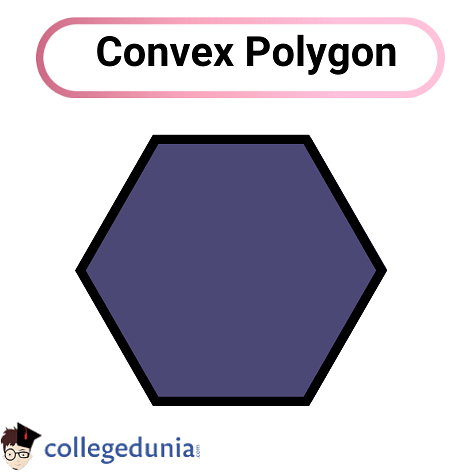
Convex Polygon
What is Regular Convex Polygon?
Regular Convex Polygon is a type of polygon in which all the sides are of the same length and all the interior angles are equal and less than 180 degrees.
Example: Square is a regular convex polygon with equal sides and equal internal angles which are less than 180°.
Read More:
| Relevant Concepts | ||
|---|---|---|
| Polygon Formula | Polygon Curve Angle | Heptagon |
| Geometry Formula | Dodecagon | Regular Hexagon |
Properties of Convex Polygon
[Click Here for Sample Questions]
The properties of a convex polygon are as follows:
- The internal angles of a convex polygon are always less than 180°.
- The diagonals lie completely inside the polygon in convex polygons.
- A polygon is considered convex if the line connecting every pair of its points lies entirely within it.
- The sum of the interior angles of a convex polygon of sides n is given as 180(n-2)°.
- Area of the convex polygon is calculated by dividing the polygon into triangles and then summing up the area of each triangle.
Types of Convex Polygons
[Click Here for Sample Questions]
Convex Polygons can be divided into two types namely
- Regular Convex Polygon
- Irregular Convex Polygon
Regular Convex Polygon
- All the sides of a regular convex polygon are of the same length.
- All interior angles of a regular convex polygon are equal and less than 180°.
- Its vertices are equidistant from the center.
- Examples of regular convex polygons are pentagons, squares, and equilateral triangles.
Irregular Convex Polygon
- Each side of an irregular convex polygon has a different length.
- The internal angles of an irregular convex polygon have a different measure.
- For instance, an irregular parallelogram is an irregular convex polygon.
Read More: Understanding Quadrilaterals MCQs
Difference between Convex and Concave Polygon
[Click Here for Sample Questions]
A polygon with all internal angles less than 180° is called a convex polygon. A polygon with at least one of the angles greater than 180° is called a concave polygon.
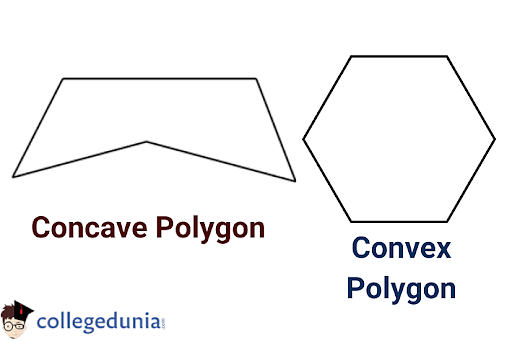
Convex and Concave Polygon
The difference between a convex and concave polygon is as follows:
| Convex Polygon | Concave Polygon |
|---|---|
| The complete outline of a convex polygon points outwards which means there are no dents. | In a concave polygon, some part of the outline points inwards. i.e. there is a dent. |
| A convex polygon has all interior angles less than 180°. | At least one internal angle is more than 180°. |
| Any line connecting any two vertices of the convex polygon lies within it. | The line connecting any two vertices of the concave polygon may or may not lie within it. |
Convex Polygon Formulas
[Click Here for Sample Questions]
Polygon is a geometrical shape with a minimum of three sides and three angles. Given below are the formulas that help to find out the area, the sum of the exterior angles, and the sum of the interior angles of a convex polygon.
Area of a Convex Polygon
Area of Polygon is the space occupied by a polygon. It is the space occupied inside the boundary of a convex polygon.
Assuming that the coordinates of the convex polygon are (x1, y1), (x2, y2), (x3, y3)....(xn,yn), then the area of the polygon will be given as
| A = 1/2 |(x1y2 - x2y1)+(x2y3 - x3y2)+……..+(xny1 - x1yn)| |
Sum of Interior Angles
For a convex polygon with n sides, the sum of the interior angles is given as 180(n-2)°.
| Example: A hexagon is a convex polygon with six sides. Thus, the sum of its inner angles is 180(6-2)°= 720°. |
Sum of Exterior Angles
The sum of the exterior angles of a convex polygon is equal to 360°/n, where n is the number of the sides of a polygon.
Check More:
Things to Remember
- Convex Polygon is a closed shape with all its vertices pointing outwards.
- Each interior angle in a convex polygon is less than 180 degrees.
- Regular Convex Polygon and Irregular Convex Polygon are the two types of convex polygons.
- All the sides and internal angles of a regular convex polygon are equal.
- An irregular convex polygon has unequal sides and interior angles.
- The sum of the interior angles of a convex polygon is by the formula 180(n-2)°.
- The sum of the exterior angles of a convex polygon is given as 360°/n.
Sample Questions
Ques. Find the area of the convex polygon with three sides whose vertices are (7, 9), (5, 2), and (-4, 5). (3 Marks)
Ans. Given that
- (x1, y1) = (7,9)
- (x2, y2) = (5, 2)
- (x3, y3) = (-4, 5)
Using the area of convex polygon formula, we get
A = 1/2 |(x1y2 - x2y1)+(x2y3 - x3y2)+……..+(xny1 - x1yn)|
A = ½ | (14 - 45) + (25 + 8 ) + (-36 - 35)|
A = ½ |-73|
A = 73/2 = 36.5 square units.
Therefore, the area of the convex polygon is 36.5 square units.
Ques. Find the area of the convex polygon with three sides whose vertices are (10, 7), (4, 2), and (-2, 4). (3 Marks)
Ans. It is given that,
- (x1, y1) = (10,7)
- (x2, y2) = (4, 2)
- (x3, y3) = (-2, 4)
Using the area of convex polygon formula, we get
A = 1/2 |(x1y2 - x2y1)+(x2y3 - x3y2)+……..+(xny1 - x1yn)|
A = ½ | (20 - 28) + (16 + 4 ) + (-14 - 40)|
A = ½ |66|
A = 66/2 = 33 square units
Therefore, the area of the convex polygon is 33 square units.
Ques. What is the measure of an interior angle of a regular convex polygon like a pentagon? (3 Marks)
Ans. A pentagon has five sides, which means n = 5. A convex polygon with n sides has a total interior angle sum of 180(n-2)°. Consequently, the pentagon's interior angles as a whole are:
180 × (5-2)° =180 × (3)° = 540°
All five interior angles of the provided pentagon measure the same because it is a regular shape. As a result, each internal angle is measured at 540°/5 = 108°.
Therefore, the required angle is 108°.
Ques. Find the area of a regular convex polygon whose vertices are (6,8), (4.1), and (-3, 6). (3 Marks)
Ans. The area of a regular convex polygon is given by the formula,
A = 1/2 |(x1y2 - x2y1)+(x2y3 - x3y2)+……..+(xny1 - x1yn)|
Substituting the values we get,
Area = 1/2 |(6 - 32) + (24 - (-3)) + (-24 - 36)|
= 1/2 |-26 + 27 - 60|
= 1/2 |-59|
= 1/2 |59|
= 59/2 = 29. 5 Square Units
Therefore, the area of the convex polygon is 29. 5 square units.
Ques. Find the area of the polygon whose vertices are (5, 7), (9, 2), and (-4, 8). (3 Marks)
Ans. The vertices are: (5, 7), (9, 2), and (-4, 8)
- (x1, y1) = (5, 7)
- (x2, y2) = (9, 2)
- (x3, y3) = (-4, 8)
Using the area of convex polygon formula, we get
A = 1/2 |(x1y2 - x2y1)+(x2y3 - x3y2)+……..+(xny1 - x1yn)|
A = ½ | (10 - 63) + (72 + 8 ) (-40 - 28)|
A = ½ | -41|
A = ½ |41|
A = 41/2 = 20.5 square units
Therefore, the area of the convex polygon is 20.5 square units.
Ques. A convex polygon has 44 diagonals, find the number of sides of this polygon. (3 Marks)
Ans. The number of diagonals in a polygon of n sides is given by the formula n(n-3)/2.
n(n-3)/2 = 44
n(n−3) = 88
n(n−3) = 11(11−3)
n = 11
Thus, the number of sides in the given polygon is 11.
Ques. What is the measure of each interior angle of a regular convex polygon with six sides? (3 Marks)
Ans. The sum of the interior angles of a polygon is given by the formula,
(n − 2) × 180°
(6 − 2) × 180° = 4 × 180° = 720°
Let each angle be x.
x + x + x + x + x + x = 720° (Angle Sum Property)
6x = 720°
x = 120°
Thus, each angle of the regular convex polygon with five sides is 120°.
Ques. The sum of all the interior angles of a polygon is 1440°. How many sides does the polygon have? (3 Marks)
Ans. Given, the sum of interior angles of the given polygon is 1440. Thus,
(n – 2) × 180 = 1440
n – 2 = 1440 / 180
n – 2 = 144 / 18 = 8
n – 2 = 8
n = 10
Therefore, the number of sides is 10.
Ques. Is it possible to have a polygon, where the sum of interior angles is 9 right angles? (3 Marks)
Ans. Number of Sides = 1/2 [(sum of interior angles/90) + 4]
= ½ ( (9 × 90) / 90 + 4)
= ½ ( 9 + 4)
= ½ ( 13 )
= 6.5
No, it is not possible to construct a polygon where the sum of interior angles is 9 right angles.
Ques. Is it possible to have a polygon whose sum of interior angles is 910°? (3 Marks)
Ans. Number of Sides = 1/2 [(sum of interior angles/90) + 4]
n = ½ ( 910°/90° + 4)
n = ½ (10.11 + 4 )
The angle is not a whole number so the polygon with an interior angle sum of 910 degrees is not possible.
Check-Out:



Comments