



Education Journalist | Study Abroad Lead
Hybridization refers to the process of cross-breeding two different species of plants or animals to produce a hybrid, with the aim of creating a new variety with desirable traits from both parent species.
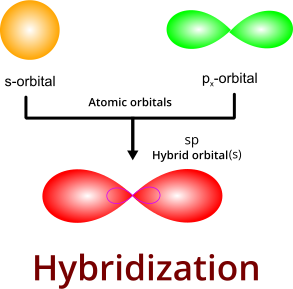
- Hybridization is the intermixing of atomic orbitals having the same energy levels to provide a same number of a new type of hybrid orbitals.
- In molecular biology, hybridization refers to the process of binding complementary single-stranded nucleic acids, like DNA or RNA, to form a stable double-stranded molecule.
- The term is also used to describe the formation of hybrid orbitals in chemistry.
- Mainly, the atomic orbitals having the same energy level take part in hybridization.
Types of Hybridization
The different types of hybridization are –
sp³ hybridization
SP3 hybridization is a chemical bonding process in which one s orbital and three p orbitals mix together to form a new equivalent orbital.
- This hybridization occurs in molecules where the central atom has one s and three p orbitals, such as methane (CH4) and NH3.
sp² hybridization
When a s orbital and two p orbitals of an atom mix together to form a new orbital, it is called sp2 hybridization.
- This type of hybridization is commonly seen in BF3.
sp hybridization
When a s and a p orbital from the same shell of an atom combine to form a new orbital, it is called sp hybridization.
- This type of hybridization is typically seen in molecules with an sp3 hybridization that results in tetrahedral geometry around the central atom
- The molecules showing sp hybridization, have a linear shape and a 180° angle.
sp3d Hybridization
sp3d hybridization mixes one- s orbital, three- p orbitals and one- d orbital to form 5 sp3d hybridized orbitals having equal energy.
- The mixture of s, p and d orbital has trigonal bipyramidal symmetry.
- Three hybrid orbitals in the horizontal plane are inclined at a 120° angle known as the equatorial orbitals.
- The remaining two orbitals are in a vertical plane at 90 degrees known as axial orbitals.
- For example: PCl5.
sp3d2 hybridization
sp3d2 hybridization involves the mixing of one s, three p, and two d orbitals to form 6 identical sp3d2 hybrid orbitals.
- These 6 orbitals are inclined at an angle of 90o to one another.
- For example, SF6.
sp3d3 hybridization
This involves the process of mixing one s orbital, three p orbitals, and three d orbitals to form seven sp3d3 hybrid orbitals with equivalent energy.
For example – IF7
Read More:



Comments