



Content Curator
- They cannot be used interchangeably since they have different interpretations.
- However, effusion and diffusion are common occurrences.
- Diffusion is the process by which oxygen, vitamins, and energy are transported through the body.
- Whenever a certain amount of gas tries to flow from one location to another, a barrier seems to be present or absent, which is the main difference between effusion and diffusion.
| Table of Content |
Key Terms: Diffusion, Effusion, States of Matter, Pressure, Concentration, Gas, Liquid, Osmosis, Kinetic energy, Collision, Compressible, Attractive force, Molecule
What is Gas?
[Click Here for Sample Questions]
Among the three states of matter, gas or say gaseous state also marks its position. It does not uphold independent shape, size, and volume and can be transferred from one portion to another.
- Gas has low attractive force unlike solid and liquid.
- The molecules of gas are scattered in all places of the container or space where it is present.
- The nature of gas is highly compressible.
- It produces high pressure on the walls of the object it is placed.

Also Read:
| Related Articles | ||
|---|---|---|
| Organic compounds structure | Isomerism | Combustion reactions |
| Soaps and detergents | Valency of Carbon | Versatile nature of carbon |
What is Effusion?
[Click Here for Sample Questions]
In chemistry, effusion means the movement of gas from a small hole to a bigger area.
- The hole path which is also known as pinhole must be smaller than the mean path of the molecule.
- So, in effusion, the movement takes place from high pressure to low pressure.
- This means in this case the molecules come closer to each other exerting high pressure and tend to move out from a point by releasing the pressure.
Examples of Effusion
Some examples of effusion can be given as
- Deflating balloon: A point where the whole air comes out exerting pressure.
- Gas cylinder with a leakage: Gas comes out from the nozzle with high pressure, and this tendency of movement of gas from high concentration to low concentration via a small point or whole makes effusion

Effusion
What is Diffusion?
[Click Here for Sample Questions]
Diffusion is the movement of molecules or atoms or any substance from high concentration to low concentration under a concentration gradient.
- It can occur in all the states of matter such as in solid, liquid, and gas.
- In diffusion, the materials are not forced to move from a narrow path instead the process is just due to differences in concentration.
- The speed or the rate at which diffusion occurs depends upon the temperature and pressure of the given area.
Examples of Diffusion
Some examples of diffusion are given below
- The aroma of a rose when kept in a flower vase can be sensed all around.
- The smoke of cigarettes diffused in the air.

Diffusion
Difference Between Effusion and Diffusion
[Click Here for Sample Questions]
Diffusion and effusion are the movement of particles from one place to another.
- Due to their rhyming names and the similar tendency of movement, confusion between effusion and diffusion occurs.
- On one hand, diffusion is the mixing of gases from high concentration to low concentration.
- On the other hand, effusion is the movement of gases from a small hole from high pressure to low pressure.
The following are the differences between effusion and diffusion
| Sr. Number | Effusion | Diffusion |
|---|---|---|
| 1 | Effusion is the movement of gases from a pinhole to a bigger area. | Diffusion is the movement of molecules that helps to mix one gas with the other kind after colliding with each other. |
| 2 | In effusion, the difference in pressure is crucial. | In diffusion, the difference in concentration is crucial. |
| 3 | In effusion, the mean path must have been smaller than the pinhole. | In diffusion there is no primacy of any hole, it occurs without any barrage of the medium. |
| 4 | In effusion, particles move faster without the involvement of kinetic energy. | In diffusion, particles move with respect to the temperature and pressure of the surroundings and in this kinetic energy is involved. |
| 5 | For example, a deflating balloon gives out air with high pressure from a hole. | For example, the aroma of perfume when sprayed in a room, the whole room gets aromatic. |
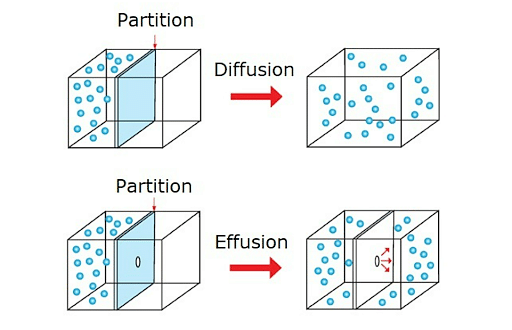
Difference between effusion and diffusion
Things to Remember
- There are three states of matter, namely solid, liquid, and gas.
- In the gaseous state, the attraction between the molecules is lesser than the others.
- Effusion is the movement of gases from a small hole also known as a pinhole.
- This movement occurs due to a difference in pressure and the gas moves from an area of high pressure to an area of low pressure.
- Diffusion is the mixing of gases of different concentrations.
- The major difference between effusion and diffusion is the area from which they move.
Also Read:
Sample Questions
Ques. What do you mean by diffusion? Name the types of diffusion. (2 Marks)
Ans. Diffusion is the mixing of gases of different concentrations. In diffusion, the molecules atoms, or substances move from high concentration to low concentration. There are majorly two types of diffusion, namely – Simple Diffusion and Facilitated Diffusion.
Ques. What causes effusion? (2 Marks)
Ans. Pleural effusion-related disorders include congestive heart failure, kidney disease, pulmonary embolism, trauma, and infection. Patients with pleural effusion may have severe chest discomfort, shortness of breath, and coughing. Following therapy for the underlying illness, the symptoms of pleural effusion appear to improve.
Ques. Why diffusion is faster in gases? (2 Marks)
Ans.
Diffusion is caused by concentration variations. When substances such as perfume are released into a room, their particles mix with those of the surrounding air. Gas diffusion is fast because the particles in a gas travel quickly. It happens considerably faster with hot gases because the gas particles are moving faster.Ques. What is Graham's law of diffusion and effusion? (2 Marks)
Ans. Graham’s law of diffusion and effusion states that the rate of gas is inversely proportional to its square root of molecular weight.
Ques. State some examples of effusion and diffusion. (2 Marks)
Ans. Examples of effusion can be stated as – gas coming out of a gas stove with high pressure from the cylinder. An example of diffusion can be stated as – the smell of incense sticks scattered in a room.
Ques. What is the major difference between diffusion and effusion? (2 Marks)
Ans. The major difference between effusion and diffusion is that effusion occurs when gas moves out from a small hole or point whereas in diffusion there is no primacy of point or whole the gases are mixed due to variation in concentration gradient.
Ques. On what factors rate of diffusion is dependent? (2 Marks)
Ans. Diffusion is a mixture of gases of various concentrations especially it moves from high concentration to lower concentration. So, this difference is dependent on the concentration of gas, and the concentration of gas is dependent on the temperature and pressure of that specified area.
Ques. Saumya deflates a balloon as a result gas moves out. Elucidate whether this phenomenon is effusion or diffusion. And how did this phenomenon take place? (2 Marks)
Ans. The phenomenon from where the gas comes out when deflated is termed effusion. Effusion occurs in this case as gas moves out from a hole of a balloon by traversing from high pressure to low pressure.
Ques. The rate of diffusion and effusion is the same. Do you agree with this statement? Elucidate your point. (2 Marks)
Ans. No, the rate of diffusion and effusion cannot be the same. As effusion is dependent on pressure variation and diffusion is based on concentration variation the sole reason between both tend to differ thus making a difference between their rate.
Ques. What is the difference between diffusion and osmosis? (2 Marks)
Ans. Osmosis is a tendency of movement of solvents via a semi-permeable membrane from a dilute solution to a concentrated solution. Whereas diffusion is the movement of particles from high concentration to lower concentration without the need for any membrane. Osmosis occurs in liquid medium only whereas diffusion occurs in all states of matter.
For Latest Updates on Upcoming Board Exams, Click Here: https://t.me/class_10_12_board_updates
Check-Out:



Comments