



Content Curator
Plasma and serum are both formed from the liquid portion of the blood, but they are quite different from each other.
- Blood is a fluid connective tissue that travels the whole body transporting nutrients, oxygen, and metabolic wastes.
- It is mainly composed of RBC (Red Blood Cells), WBCs (White Blood Cells), plasma, and serum.
- Plasma is the liquid part of blood, whose purpose is to transmit proteins, nutrients, hormones, and antibodies, among others, throughout the body.
- Serum is the fluid part that is devoid of blood clotting factors and cells.
- Plasma and Serum are mainly used when the blood group of a patient is tested.
| Table of Content |
Key Terms: Plasma, Serum, Difference Plasma between Serum, Functions of plasma, Functions of serum, Blood, Composition of blood, Nutrients, Hormones, Fibrin, Blod clotting.
What is Plasma?
[Click Here for Sample Questions]
Plasma is the liquid part of blood; it is 90% water and constitutes around 55% of total blood volume.
- Its function is to transport proteins, nutrients, hormones, and antibodies throughout the body.
- Because plasma circulates throughout the body, cells release waste into it as well.
- Plasma consists of water, protein, lipids, glucose, and salt.
- Plasma often serves to maintain the temperature of the body and blood pressure.
- Plasma has a lengthy shelf life and can be kept for up to a year.
Also Read:
| Related Articles | ||
|---|---|---|
| Blood Coagulation | White Blood Cells | Red Blood Cells |
| Contraception | Blood Group Test | Blood Composition |
What is Serum?
[Click Here for Sample Questions]
The serum is the fluid part that lacks blood clotting factors and cells. When the clotting factor is eliminated from the blood, the protein fibrinogen converts to fibrin.
- Fibrin is a protein, yet it is insoluble.
- It helps to repair damaged tissue by creating a clot and preventing blood flow through the wound.
- Aside from water, plasma contains albumin, fibrinogen, globulin, hormones, nutrients, amino acids, and nitrogenous waste.
- Notably, the serum has a short shelf life and can only be stored for a few months.
- It is useful for diagnosing issues with cholesterol, blood sugar, blood pressure, and so on.
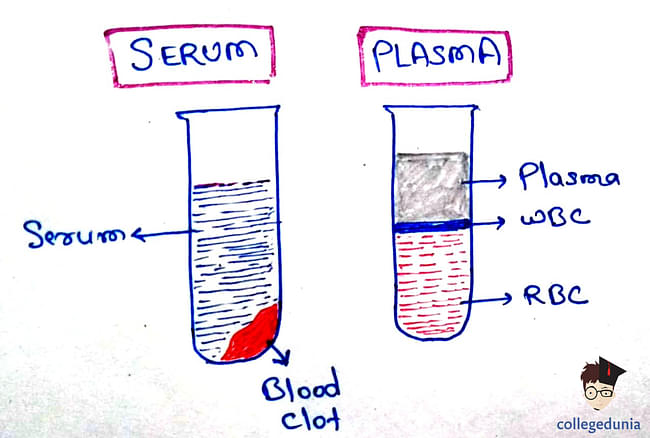
Difference between Plasma and Serum
[Click Here for Sample Questions]
The differences between Serum and Plasma are given below
| PLASMA | SERUM |
|---|---|
| Plasma is transparent and yellowish (straw-colored part of the blood). | The serum is an extracellular part of the blood. |
| Cells are freely suspended in plasma. | Here, cells are attached with clot formation. |
| Fibrinogen is present in the plasma. | There is an absence of Fibrinogen in the serum. |
| 1.025 g/ml density | 1.024 g/ml density |
| Plasma is the medium for excretory product transportation | The serum is an important source of electrolytes. |
| Plasma requires an anticoagulant so that its sample can be obtained from the blood | There is no need for an anti-coagulant in the serum. |
| it has a long shelf life and can be stored for about a year. | it has a shorter life and can be stored only for a few months. |
| It is a composition of Blood cells with salts, glucose, lipid, and protein. | It is a composition of antigens, antibiotics, proteins, and hormones. |
| it makes up 55% of the blood. | it is lesser in volume in comparison to plasma. |
| It helps in regulating blood pressure and body temperature. | whereas, it is used for the diagnosis of cholesterol, sugar, protein, etc. |
| It is comparatively easier and takes less time to separate. | Separating serum is a difficult and time-consuming job as compared to plasma |
| It is 92% water with proteins, salts, lipids, and glucose | It consists of 90% of water with dissolved hormones, proteins, and carbon dioxide. |
Function of Plasma
[Click Here for Sample Questions]
The following are the functions of Plasma
Coagulation
Plasma includes a variety of substances, including proteins such as thrombin and fibrinogen, which play an important role in the clotting process and prevent bleeding.
Immunity
Plasma also contains disease-fighting proteins, which help you create a strong immune system and protect you from harmful diseases.
Blood Pressure
Plasma includes albumin, a protein that regulates oncotic pressure and keeps fluids from leaking into your body and skin. It also ensures proper blood flow through blood vessels.
Transportation
Plasma helps the transfer of nutrients, hormones, proteins, and other essential substances throughout the body. It also eliminates waste and distributes it to the lungs, liver, and skin.
Body Temperature
Plasma helps to maintain body temperature by balancing heat intake and loss inside the body.
pH Balance
All of the substances contained in plasma help it to maintain a proper pH level, which maintains the function of cells.
Function of Serum
[Click Here for Sample Questions]
The following are the functions of serum
- It helps in the transportation of hormones and fatty acids and ensures the proper functioning of the body.
- The serum also helps in the distribution of the antibiotics in the whole body.
- Albumin helps in the binding of the curable substances in the antibiotics.
Separation of Blood Plasma and Serum
[Click Here for Sample Questions]
Plasma and Serum can be separated through the centrifugation method.
- Variation in the size, density, weight, etc helps in the separation of the components of plasma and Serum.
- An anticoagulant is required to separate the components of blood like white blood cells and red blood cells from plasma.
- Although the process is quite complex.
- EDTA Heparin is an anticoagulant that can be used in separation.
Things to Remember
- Blood composed of RBC (Red Blood Cells), WBCs (White Blood Cells), plasma, and serum
- It is a fluid connective tissue that travels the whole body transporting nutrients, oxygen, and metabolic wastes.
- Plasma is the liquid part of blood; it is 90% water and constitutes around 55% of total blood volume.
- The serum is the fluid part that lacks blood clotting factors and cells.
- Plasma helps to maintain body temperature by balancing heat intake and loss inside the body.
- Serum helps in the transportation of hormones and fatty acids and ensures the proper functioning of the body.
- Plasma and Serum can be separated through the centrifugation method.
Also Read:
Sample Questions
Ques. What is the composition of Serum and Plasma? (2 Marks)
Ans. Plasma has suspended blood cells, glucose, salts, proteins, and lipids. it also has a clotting factor and water (90%). Whereas, Serum has electrolytes, hormones, antigens, and proteins (Globulin, Albumin).
Ques. How does Plasma keep the body healthy? (2 Marks)
Ans. Plasma is an important part of anyone's body, it ensures that it carries all the nutrients, vitamins, and proteins in every part of the body and also helps in the treatment and diagnosis of severe health issues the body might face. Plasma contains many components like proteins, antibodies, clotting factors, etc.
Ques. What is Serum? (1 Mark)
Ans. It is the liquid portion of the blood; It is plasma without any clotting factors.
Ques. What is Plasma? (1 Mark)
Ans. It is also the liquid portion of the blood made up of 90% water; it is a serum with the presence of Fibrinogens.
Ques. Why do we conduct a Serum test? (2 Marks)
Ans. When the kidney starts failing, Albumin is a protein that starts leaking into the urine. The test is done to check the amount of albumin in the blood and helps in diagnosing liver and kidney abnormalities.
Ques. Name the protein that helps in preventing Blood clotting. (2 Marks)
Ans. Heparin (Anticoagulant) is present in plasma, and it enhances the rate of the Anti-thrombin 3 inactivates activated the clotting factors. Anti-thrombin 3 is also a protein that prevents blood clotting.
Ques. How is the plasma collected from the body? (2 Marks)
Ans. The blood is first drawn from the body with the help of a needle, and then the separation of RBCs, WBCs, and platelets is done. But this takes a lot of time approximately an hour.
Ques. What is Centrifugation? (2 Marks)
Ans. Centrifugation is a technique where components of the mixtures are separated using centrifugal force. The mixture is put in the device which is called a centrifuge and it is rotated at a very high speed so that the components get separated.
Ques. What is the difference between Fibrin and Fibrinogen? (2 Marks)
Ans. Fibrinogen is a protein present in the plasma that helps in the clotting factors. But if we remove the clotting factors from the blood then the fibrinogen changes to fibrin, and it is insoluble.
Ques. What is blood coagulation? (2 Marks)
Ans. It is a process where all the fluid components of the blood turn into an insoluble gel and leak into the blood vessels that cover the wounds so that no foreign objects enter the body.
Ques. What is the importance of Blood Clotting? (2 Marks)
Ans. Clotting is a process that activates a cascade of proteases, it results in the conversion of fibrinogen into fibrin to clot the blood. It prevents excessive bleeding when the blood vessel is injured. Clots can occur in veins or in the arteries which are the parts of the circulatory system.
Ques. What happens to the donated Plasma? (2 Marks)
Ans. Plasma has a longer shelf life and can be stored for about a year.
- It’s kept frozen so that it can be used in the hospitals
- It is also used in pharmaceutical products.
- People with the type of AB blood should consider themselves for plasma donation as it is the only universal plasma.
Ques. What are the side effects of donating plasma? (2 Marks)
Ans. Plasma donation can cause minor side effects:
- Dehydration
- Fatigue
- Dizziness, fainting, and light-headedness
- Infection
- Bruising and Discomfort
- Citrate Reaction (Citrate binds together a small number of calcium molecules for a small amount of time, the effect is small and temporary. You can feel numbness, tingling, vibrations, shortness of breath, slow pulse, rapid pulse, or shivering)
For Latest Updates on Upcoming Board Exams, Click Here: https://t.me/class_10_12_board_updates
Check-Out:



Comments