



Education Journalist | Study Abroad Lead
Implicit function is a function that is stated in terms of both dependent and independent variables, such as y – 3x2 + 2x + 5 = 0. An explicit function, on the other hand, is one that is expressed in terms of an independent variable. For instance, y = 3x+1 expresses that y is a dependent variable that is dependent on the independent variable x. In the case of differentiation, an implicit function can be simply differentiated without having to reorganise the function and differentiate each term separately. Because y is a function of x, we will use the chain rule as well as the product and quotient rules.
| Table of Contents |
Key Terms: Implicit Function, Differentiation, Implicit Function Theorem, Explicit Function, Inverse Functions, Variables, Derivatives, Dependent Variable, Independent Variable
What is an Implicit Function?
[Click Here for Sample Questions]
The concept of an implicit function states that when we are unable to isolate the dependant variable in an equation, the function becomes an implicit function. In this form of function, both dependent and independent variables are present. The function becomes an implicit function when the dependant variable is not explicitly isolated on either side of the equation.
When the equations have the form y = f(x), it is very easy to solve them. When a function is expressed in this way, the explicit function is represented. However, y can be expressed implicitly in terms of f(x). We employ the concept of implicit function differentiation in this example.
The implicit definition of the unit circle is the set of points (x,y) that satisfy the equation x2 + y2=1.
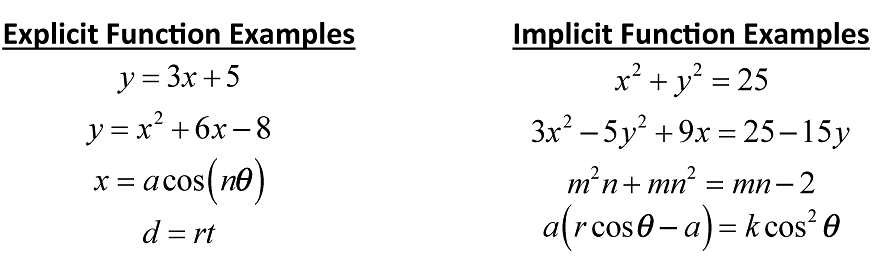
Example of Implicit Differentiation
Read More: Differential Equations Formula & Solved Questions
Discover about the Chapter video:
Continuity and Differentiability Detailed Video Explanation:
Implicit Function Theorem
[Click Here for Sample Questions]
The implicit function theorem is a method in Mathematics that allows relations to be turned into functions of several real variables. It is most commonly found in multivariable calculus. It is possible to do so by describing the relationship as a function graph.
Although an individual function graph may not describe the entire connection, such a function on a constraint of the relation's domain may exist. The implicit function theorem provides a sufficient condition for ensuring that such a function exists.
Suppose a function with n equations is given, such that, fi (x1 , …, xn, y1, …, yn) = 0, where i = 1, …, n or we can also represent as F(xi yi) = 0, The implicit theorem thus asserts that, with a reasonable condition on the partial derivatives at a point, the m variables yi are differentiable functions of the xj in some segment of the point. Because we cannot represent these functions in closed form, the equations implicitly define them.
Read More: Continuity and Differentiability of a Function
Differentiation of Implicit Function
[Click Here for Sample Questions]
It is not essential to discover the formula for an implicit function in order to calculate its derivative. Indeed, it is not always easy to acquire the formula for an implicit function without first creating a distinct type of function:
Consider the relation cos y = x once more. Using a method known as implicit differentiation, we may find the derivative of the implicit functions of this connection where the derivative exists. The idea underlying implicit differentiation is to think of y as a function of x. To depict this, let us rewrite the relation mentioned above by replacing y with y(x):
i.e. cos(y(x)) = x
Here, differentiate both sides of that equation and set their derivatives equal to each other. As we do not know the formula for y(x), we leave its derivative as y'(x):
sin(y(x)) · y'(x) = 1
Lastly, we will solve for y'(x) to get the required formula:
y'(x) = -1 /sin(y(x))
= -1/sin y
The notion of implicit differentiation is not dissimilar to the meaning of normal differentiation. Because we cannot explicitly decrease implicit functions in terms of independent variables, we shall adopt the chain rule to achieve differentiation without rearranging the equation.
Read More: Inverse Process of Differentiation, Methods & Formulas
Things to Remember
- An implicit function is a function that can be written in terms of both dependent and independent variables, like y-3x2+2x+5 = 0.
- The implicit function cannot be written as y = f(x).
- The implicit function is always written as f(x, y) = 0.
- The implicit function is a multivariable nonlinear function.
- The implicit function is built with both the dependent and independent variables in mind.
- We can calculate the derivative of the implicit functions, where the derivative exists, using a method called implicit differentiation.
Sample Questions
Ques. Find dy/dx, If y=sin(x) + cos(y) (3 Marks)
Ans. The provided function is implicit, according to the implicit function.
As a result, we shall calculate the implicit function's derivative without rearranging the equation.
Performing On both sides and for each word, implicit functions are differentiated with regard to x.
dy/dx=cos(x)-sin(y)*dy/dx
Rearranging the above equation
dy/dx+sin(y)*dy/dx=cos(x)
dy/dx(1+sin(y))=cos(x)
Solve the equation
dy/dx=cos(x)/1+sin(y)
Ques. Differentiate 10x4 - 18xy2 + 10y3 = 48 with respect to x. (3 Marks)
Ans. The implicit function meaning holds true for the function mentioned.
Hence, we will use the product rule of differentiation on xy2 i.e (FG)’ = F G’ + F’ G
Now, let us calculate the derivative of Implicit function by differentiating each term in the equation:
10 (4x2) - 18(x(2y * dy/dx) + y2) + 10(3y2 * dy/dx) = 0
Let us further simplify the above equation.
40x3 - 36xy * dy/dx - 18y2 + 30y2 * dy/dx = 0
Bring out all dy/dx on the left side and rest of the terms on the right side
-36xy * dy/dx + 30y2 * dy/dx = 40x3 + 18y2
Taking dy/dx common
(30y2 - 36xy) dy/dx = 18y2 - 40x2
Divide both sides by two and solve the equation
dy/dx = 9y2 - 20x2/(15y2 - 18xy)
Ques. Find y′ by implicit differentiation for 2y3 + 4x2 – y = x5 (3 Marks)
Ans. First, we just need to take the derivative of everything with respect to
x and we’ll need to recall that y is really y(x) and so we’ll need to use the Chain Rule when taking the derivative of terms involving y.
Differentiating with respect to x gives : 6y2y’ + 8x - y’ = 6x5
Finally, solving this for y’ gives
(6y2 – 1)y’ = 6x5 – 8x
y’ = 6x5 – 8x / 6y2 – 1
Ques. Find y′ by implicit differentiation for 4x2y7−2x = x5+4y3. (3 Marks)
Ans. First, we just need to take the derivative of everything with respect to x. Here we’ll need to recall that y is really y(x) and so we’ll need to use the Chain Rule when taking the derivative of terms involving y. This also means that the first term on the left side is really a product of functions of x and hence we will need to use the Product Rule when differentiating that term.
Differentiating with respect to x gives,
8xy7 + 28x2y6y′ − 2 = 5x4 +12y2y′
Finally, all we need to do is solve this for Y′
8xy7−5x4−2 = (12y2−28x2y6)y′
⇒
y′=8xy7−5x4−2/12y2−28x2y6
Ques. What are the Inverse Functions? (3 Marks)
Ans. Inverse functions are a category of implicit functions. Implicit differentiation is easily applicable to these functions to calculate their derivatives.
Let us consider that y is a function of x that is y=f(x) the inverse function of f is f-1 such that x is in terms of y x=f-1(y).
Now let us apply implicit differentiation to inverse functions. Consider an inverse function y=sin-1(x)
Non-inverting the equation we get,
x=sin(y)
Differentiating both sides
1=cos(y)*dy/dx
Rearranging the equation
dy/dx=1/cos(y)
Ques. Find the derivative of the implicit function x2 + y2 + 4xy + 7 = 0, and find dy/dx. (3 Marks)
Ans. The given function is x2 + y2 + 4xy + 7 = 0
Now, differentiate the function with respect to x.
d/dx.x2 + d/dx.y2 + d/dx.4xy + d/x.7 = 0
2x + 2y.dy/dx + 4(x.dy/dx + y.d/dx.x) + 0 = 0
2x + 2y.dy/dx + 4(x.dy/dx + y) = 0
2x + 2y.dy/dx + 4x.dy/dx + 4y = 0
2x + 4y + (4x + 2y).dy/dx = 0
2(x + 2y) + 2(2x + y).dy/dx = 0
(x + 2y) + (2x + y).dy/dx = 0
(2x + y).dy/dx = -(x + 2y)
dy/dx = -(x + 2y)/(2x + y)
Therefore, the derivative of the implicit function is -(x + 2y)/(2x + y).
Ques. Find the derivative of the implicit function x + Sinxy - y = 0 (3 Marks)
Ans. The given function is x + Sinxy - y = 0
Now, differentiate the function with respect to x.
d/dx.x + d/dx.Sinxy - d/dx.y = 0
1 + Cosxy.(d/dx.xy) - dy/dx = 0
1 + Cosxy.(x.dy/dx + y.d/dx.x) - dy/dx = 0
1 + Cosxy(x.dy/dx + y) - dy/dx = 0
1 + xCosxy.dy/dx + yCosxy - dy/dx = 0
1 + yCosxy + dy/dx(xCosxy - 1) = 0
dy/dx(xCosxy - 1) = -(1 + yCosxy)
dy/dx = -(1 + yCosxy)/(xCosxy - 1)
dy/dx = (1 + yCosxy)/(1 - xCosxy)
Therefore, the derivative of the given implicit function is (1 + yCosxy)/(1 - xCosxy).
Related links:



Comments