



Content Writer-SME
Have you ever thought about how the blades of the electric fan move, and how mixers work as they chop and grind things very fast or how a water pump pumps water from the underground and reaches the water tank?
All these things are done with the help of a device called Electric Motor which was first demonstrated by Michael Faraday in 1821. It converts electrical energy into mechanical energy. In this article, we will learn about the components and working of electric motor & its uses in more detail.
Electric Motor
[Click Here for Sample Questions]
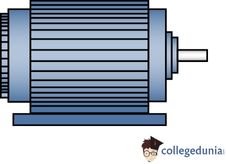
A major component of electrical appliances like fan, mixer, car etc. which uses electrical energy to generate mechanical energy is called electric motor. An electric motor can use both alternating and direct current as a source of electrical energy.
Working Principle of Electric Motor
Electric Motor works on the principle of electromagnetic current. The working principle of an electric motor class 10 can be understood as:
| “Whenever we place a coil in a magnetic field and allow the current to pass through the coil, then a force will act on the coil and it will start to rotate continuously.” |
Components of Electric Motor
[Click Here for Sample Questions]
A machine that transforms electrical energy into mechanical energy is called an electric motor. The Electric Motor consists of the following parts:
- Power Source:
A power source such as a battery is required to provide power to the motor armature to the magnetic field produced by the magnets.
- Split Rings:
In an electric motor, a split ring is used to constantly change the direction of the current passing through the coil. These rings are essentially needed to help the coil rotate and act as a commutator.
- Magnets:
Magnet is a very essential part as it helps in creating a magnetic field. Electric motors use magnets to generate rotational motion by combining the forces of electrical current and magnetic fields.
- Armature core:
The electric current interacts with the magnetic field to create motion in the rotating coil. Armature is used in giving support to the coil and to remain in its place.
- Carbon Brushes:
Carbon Brushes are used to provide current from a stationary object to the rotating part in an electric motor and they ensure a spark-free commutation.
Working of Electric Motor
[Click Here for Sample Questions]
The working of an Electric Motor is based on a principle - whenever a current-carrying conductor passes through a magnetic field produced by magnets, it experiences a force. There’ll be two forces of equal magnitude and both forces will act in opposite directions. This causes a rotational movement of a motor.
- The ends of the coil have to be connected to the two halves P and Q of a split ring attached and the edges of P and Q should come in contact with the X and Y carbon brushes.
- When the Electric current is passed through one carbon brush X, it flows through all the end corners of the rectangular coil ABCD and then to the second brush Y and from Y to the battery.
- After the above process, it is noticeable that the electric current between arms BC and AD is parallel to the magnetic field produced and the electric current, between arms AB and CD, is perpendicular to the magnetic field.
- Now applying Fleming’s Left-hand rule, we observed that the force acting on the AB arm pushes it in a downward direction whereas the force that acts on arm CD pushes it upwards.
- A coil ABCD starts to move in the anticlockwise direction.
- After half of the rotation, one side of the split ring i.e. Q comes in contact with Carbon brush X and P with Y.
- Then the current in the coil will reverse and will flow along the path DCBA.
- Now after applying Fleming’s Left-hand rule, we have observed that the force acting on the AB arm pushes it in an upward direction whereas the force that acts on the arm CD pushes it downwards.
- So, the coil and axle starts moving again in the same direction.

Working of Electric Motor
NOTE:
- An Electric motor comprises a coil with four sides named ABCD, made up of insulated copper wire.
- The Rectangular coil is placed between the south and the north pole of a magnetic field.
- Arms of the coil AB and CD are to be perpendicular to the direction of the magnetic field.
Types of Electric Motor
[Click Here for Sample Questions]
Generally, there are two types of electric motors-
AC Motor (Alternating Current)
AC Motor converts electrical energy into mechanical energy, and the magnetic energy produced will be made using the force generated by magnetic fields produced by the current that flows through its coils.
- The term "AC motor" refers to an electric motor that is powered by alternating current.
- The two primary types into which AC motors are usually divided are synchronous and asynchronous motors.
- Appliances like clocks, conveyor belts, and synchronous generators that need exact and constant speed utilize synchronous motors.
- Asynchronous motors are utilized in industrial appliances (such as water pumps, oven, fans) due to their increased power output and efficiency.
DC Motor (Direct Current)
DC Motor converts direct current electrical energy into mechanical energy. It works on the principle of an electromagnet, the speed of a DC motor can also be controlled by changing the strength of the current or by changing the voltage applied to the armature.
- A direct current motor uses the laws of electromagnetism to convert electrical energy into mechanical energy.
- Nowadays, Modern DC motors have been introduced that can be controlled by various power electronics systems.
- These types of motors are mostly used in mills, Electric Vehicles, Elevators, and Lifts.
Uses of Electric motor
[Click Here for Sample Questions]
The electric motor is used to produce rotational energy. It is used in various appliances such as-
- Fan
- Drill Machines
- Water Pump
- Washing Machines
- Electrical Appliances
- Industrial Appliances
- CD Disks
Sample Questions
Question: What do you mean by magnetic fields? (1 mark)
Answer: The region around the magnet, in which the magnet attracts and repulse is called a magnetic field.
Question: What is the principle upon which an electric motor works? (1 mark)
Answer: The principle used is that when a current-carrying conductor is placed perpendicular to the magnetic field it experiences a force.
Question: What is an electric motor? (1 mark)
Answer: Electric motor is a device that works on the principle of electromagnetic current. It converts electrical energy into mechanical energy.
Question: What are the different types of electric motors? (1 mark)
Answer: There are two types of Electrical Motors-
- AC motors
- DC motors
Question: What are the applications of electric motors? (1 mark)
Answer: Electric motors are generally used in fans, mixers, coolers, water pumps, electric vehicles, mills, etc.
Question: What do you mean by a commutator, and which component of an electric motor acts as a commutator in its working? (1 mark)
Answer: Commutator is a device that reverses the direction of the current’s flow through a circuit and in electric motors a split ring acts as a commutator.
Question: What do you mean by Fleming’s left-hand rule? (1 mark)
Answer: Fleming’s left-hand rule states that whenever a current-carrying conductor is in a magnetic field, the conductor experiences a force. This force is perpendicular to the magnetic field and the direction of the current flow.
Check-Out:



Comments