



Content Curator
Excretion is the physiological process by which metabolic waste is eliminated from the body.
- It is necessary for all living organisms to accumulate excretory products in their body and work towards their elimination.
- Excretion is the process of getting rid of nitrogenous waste products which are formed during the metabolism of the body.
- The metabolic wastes and the undigested products that are stored in the body need to be eliminated as they are harmful to the body.
- Ammonia, urea, and uric acid are the three types of excretory products that are eliminated from the body of animals.
| Table of Contents |
Key Terms: Excretory Products, Elimination, Animals, Organisms, Human, Excretory Organs, Excretion, Blood vessel, glomerulus
Human Excretory Organs
[Click Here for Sample Questions]
Body of animals has well-defined functions to make the body free of toxic excretory products.
The different organs which are responsible for it are:
Kidney
There are two kidneys on each side of the body, weighing 140gm each.
- The cortex is the outer part and the medulla is the inner part of the kidney.
- It is located between the lumbar vertebra and the last thoracic.
- Adrenal glands are situated on the top of each kidney.
Nephron
Nephrons are the several kidney ducts that form the structural and functional unit of each kidney.
- Bowman's capsule or the glomerular capsule is the twin-walled cup-like structure in each kidney.
- Nephron consists of the renal tubule and the glomerulus.
- The blood vessels in Bowman's capsule make up the glomerulus.
- It is two types of arterioles- the afferent arterioles which take blood to the glomerulus and the afferent arteriole which take out the blood from the glomerulus.
Ureter
The hilum of each kidney gives rise to a whitish and thin tube that is 28cm long.
They carry urine to the urinary bladder.
Urinary Bladder
Urinary bladder is a sac-like and pear-shaped structure that is made up of detrusor muscle. It stores urine which is to be excreted out of the body.
Read More: Difference between Egestion and Excretion
Urethra
The tube-like structure arising from the neck of the urinary bladder is known as the urethra.
- The size differs in males and females where it is usually shorter in females than males.
- It also helps in storing urine until it is expelled out of the body.
Read Also:
| Related Articles | ||
|---|---|---|
| Kidney Test | Excretion in plants | |
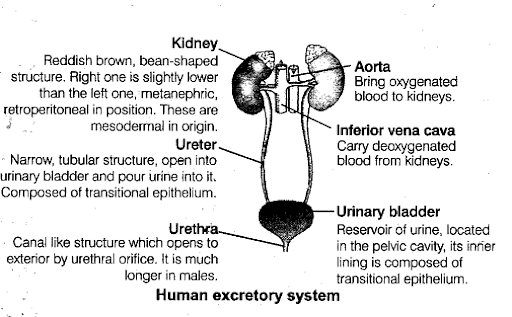
Human Excretory System
Excretory Products
[Click Here for Sample Questions]
- Ammonia: Protein metabolism gives rise to the first metabolic waste which is an amino acid. Excess of amino acids is controlled by animals by reducing them into their keto groups. They generate ATP and are used in catabolism. Aquatic amphibians release ammonia from the body in the form of ammonotelic. Ammonia is considered the most toxic excretory product.
- Urea: It is the least toxic form of metabolic waste as it is less soluble in water and stays in the body for a short period of time. Terrestrial animals excrete urea from the body which is known as ureotelic.
- Uric acid: They tend to remain in the body for a longer time as they are insoluble in water and they have non toxic crystals.
- Urine: Urine is a major excretory product that has 95% of water as well as other constituents such as uric acid, urea, sodium, and chloride, organic and inorganic potassium. The acidic pH of the urine is 6. Dissociation of haemoglobin produces urochromes because of which urine is light yellow.
Different Organisms and Excretory Parts
[Click Here for Sample Questions]
| Organisms | Excretory Parts |
|---|---|
| Paramecium | Contractile vacuole |
| Leucon | General body surface |
| Taenia | Protonephridia |
| Spider | Coxal gland, malpighian gland |
| Pheretima | Nephridial system |
| Palaemon | Antennary gland |
| Amoeba | Contractile vacuole |
| Hydra | General body surface |
| Ascaris | Renetta cells |
| Periplaneta | Malpighian tubule |
Read Also: A disorder of the excretory system
Things to Remember
- Skin, liver, and lungs are some of the other excretory organs in the body
- Indigestion of certain substances, pathogenic microbes, environmental factors, and certain underlying illnesses causes the failure of the function of the excretory system
- The formation of urines takes place in three different processes, glomerular filtration, reabsorption, and secretion.
- The nephron consists of nearly a million complex tabular structures.
- Earthworms and annelids have a tubular excretory structure that eliminates nitrogenous wastes known as nephridia
- Prawns and crustaceans remove excretory products through antennal glands or green glands.
- The human excretory system consists of columns of Bertini, nephrons, Bowman's capsule, proximal convoluted tubule, Henle's loop, distal convoluted tubule, collecting duct, etc.
Sample Questions
Ques. What is micturition? (2 Marks)
Ans. Micturition is the process of releasing urine with the help of a neural network which is also known as the micturition reflex. The process consists of two phrases- storing and voiding phrases. Bodily disorders such as detrusor instability, urinary retention, and spinal cord trauma affect the process of micturition. Micturition occurs as the smooth muscle of the urethra contracts.
Ques. List some of the disorders of the excretory system. (3 Marks)
Ans.
- Uremia: A condition where there is an accumulation of urea in the blood as a result of malfunctioning of the kidney. Through the process of hemodialysis, the urea is removed in such patients.
- Acute renal failure: Also known as kidney failure where kidney transplantation from a donor is the only option in acute renal failure.
- Renal calculi: Formation of stone or insoluble mass in the kidney
- Glomerulonephritis: The condition where the glomeruli of the kidney get inflamed.
Ques. What is the function of the kidney? (2 Marks)
Ans. The kidney is a major excretory organ of the body. Its main function is to purify the blood plasma. Through the process of urination, the excess nitrogenous waste is excreted out. It also removes the acid that is produced by the body in order to maintain the balance of salt, water, and minerals in the body.
Ques. What is the function of the tubule? (2 Marks)
Ans. Tubular secretion helps in maintaining the acid-base level in the body. It also maintains the PH and ionic balance in the body fluid. During the process of urination, the tabular cells produce K+, H+, and ammonia.
Ques. What is secreted from the liver? (2 Marks)
Ans. The liver is the largest gland in our body. It eliminated substances that contain bile biliverdin, bilirubin, degraded steroid hormones, cholesterols, vitamins, and drugs.
Ques. Why is the composition of urine different from that of glomerular filtrate? (2 Marks)
Ans. The volume of filtrate is 180 litres per day and the volume of urine is 1.5liters. Through the process of reabsorption, 99% of the filtrate is reabsorbed by the renal tubules. Glucose, amino acid, and sodium are some of the substances which are not found in urine but are actively reabsorbed in the filtrate.
Ques. Which part is known as the artificial kidney? (2 Marks)
Ans. The hemodialysis unit is known as the artificial kidney. It purifies the blood by eliminating urea from the kidney for people with kidney failure. Nitrogenous wastes are absent in the dialyzing fluid which is why blood is removed. The purified blood is transported back to the body through a vein after supplementing with anti-heparin.
Ques. What is the renin angiotensin system? (2 Marks)
Ans. The renin angiotensin system is also known as the renin-angiotensin- aldosterone system. It is considered a psychological hormone system. It regulates blood plasma, sodium concentration, and arterial blood pressure In our blood.
Ques. What is the treatment for acute renal failure? (2 Marks)
Ans. Only by the procedure of kidney transplantation, one can correct the condition of acute renal failure. The possibility of rejection from the host immune system can be minimised by transplanting the kidney from a close relative having a functional kidney.
Ques. What is the difference between ammonotelic, uricotelic, and ureotelic organisms? (3 Marks)
Ans.
| Ammonotelic organism | Uricotelic organisms | Ureotelic organisms |
|---|---|---|
| They release nitrogenous waste substances in the form of ammonia | They release nitrogenous waste substances in the form of uric acid | They release nitrogenous waste substances in the form of urea. |
| They include octopus, bonefish, sepia, etc | They include birds, lizards, insects, etc | They include cartilaginous fish, adult amphibians, a few bony fishes, and mammals. |
Check-Out:



Comments