



Content Curator
The filament of an incandescent light bulb is a crucial component that is responsible for producing light. The filament is made of a thin wire, typically made of tungsten, which is heated to a high temperature by an electric current to produce light. Tungsten is an ideal material for use in incandescent light bulbs due to its high melting point and low vapor pressure. This means that the tungsten filament can be heated to very high temperatures without melting or evaporating, making it suitable for use in incandescent light bulbs.
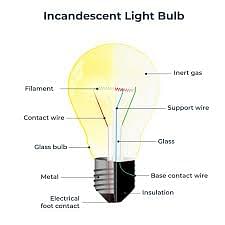
Light Bulb
Tungsten is a chemical element with the symbol W and atomic number 74. It is a dense, silvery-white metal that is known for its high melting point and high strength. Some important facts about tungsten include:
- High melting point: Tungsten has the highest melting point of all the elements, at 3410°C. This makes it an ideal material for high-temperature applications, such as in furnace linings and high-temperature electrical components.
- High density: Tungsten is one of the densest elements, with a density of 19.25 grams per cubic centimeter. This high density makes it useful for weighting applications, such as in fishing lures and golf club heads.
- High strength: Tungsten has a high tensile strength, making it useful for a variety of structural applications.
- Electrical and thermal conductivity: Tungsten is a good conductor of electricity and heat, making it useful for electrical and thermal applications.
- Chemical properties: Tungsten is highly resistant to corrosion and is not affected by air or water, even at high temperatures. This makes it useful for chemical and structural applications where resistance to corrosion is important.
- Production: Tungsten is mostly produced from tungsten ore, which is commonly found in China, Russia, and Canada. The production process involves reducing tungsten oxide to produce tungsten metal.
- Uses: Tungsten is used in a variety of applications, including electrical and electronic components, alloys, furnace linings, and high-temperature structural materials. Tungsten is also used as a catalyst in chemical reactions and as a radiation shielding material.
Overall, the filament of an incandescent light bulb is an important component that plays a crucial role in producing light. The use of tungsten as the material for the filament helps to ensure that the bulb can produce light efficiently and effectively.
Also check:



Comments