


NCERT Solutions For Class 12 Physics Chapter 1: Electric Charges and Fields

Jasmine Grover logo

Jasmine Grover

Education Journalist | Study Abroad Lead

NCERT Solutions for Class 12 Physics Chapter 1 Electric charges and fields are provided in this article. Electric charge is the basic property of matter that causes it to experience a force when it is kept in an electric or a magnetic field. The electric field lines start from the positive charge and end on the negative charge. 

The chapter is included in the unit Electrostatics which together with Current Electricity has a weightage of 17 marks in the CBSE Class 12 Physics Exam. The NCERT Solutions for Class 12 Physics Chapter 1 covers concepts of electric charge, conductors and insulators, Coulomb’s Law, electric field lines, Gauss’s law, and electric dipole.  

Download PDF: NCERT Solutions for Class 12 Physics Chapter 1 Electric Charges and Fields


NCERT Solutions for Class 12 Physics Chapter 1

The NCERT Solutions for class 12 physics chapter 1 Electric Charges and fields are as given below – 
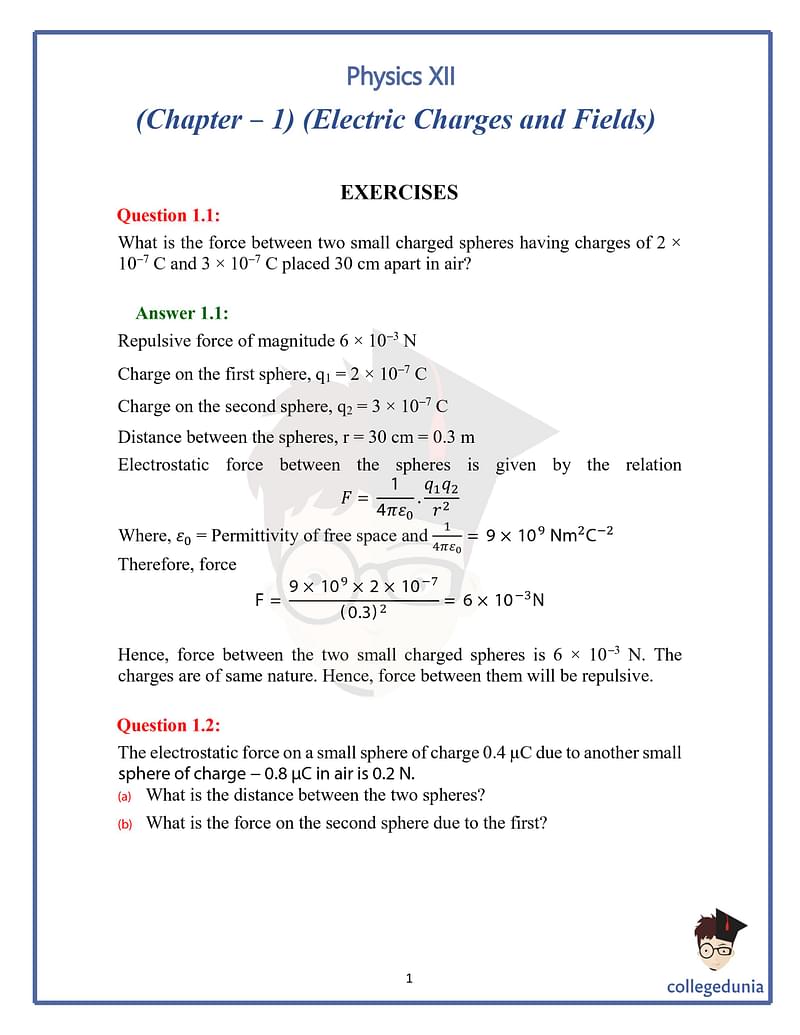
NCERT Solutions For Class 12 Physics: Chapter 1 Electric Charges and FieldsNCERT Solutions For Class 12 Physics: Chapter 1 Electric Charges and FieldsNCERT Solutions For Class 12 Physics: Chapter 1 Electric Charges and FieldsNCERT Solutions For Class 12 Physics: Chapter 1 Electric Charges and FieldsNCERT Solutions For Class 12 Physics: Chapter 1 Electric Charges and FieldsNCERT Solutions For Class 12 Physics: Chapter 1 Electric Charges and FieldsNCERT Solutions For Class 12 Physics: Chapter 1 Electric Charges and FieldsNCERT Solutions For Class 12 Physics: Chapter 1 Electric Charges and FieldsNCERT Solutions For Class 12 Physics: Chapter 1 Electric Charges and FieldsNCERT Solutions For Class 12 Physics: Chapter 1 Electric Charges and FieldsNCERT Solutions For Class 12 Physics: Chapter 1 Electric Charges and FieldsNCERT Solutions For Class 12 Physics: Chapter 1 Electric Charges and FieldsNCERT Solutions For Class 12 Physics: Chapter 1 Electric Charges and FieldsNCERT Solutions For Class 12 Physics: Chapter 1 Electric Charges and FieldsNCERT Solutions For Class 12 Physics: Chapter 1 Electric Charges and FieldsNCERT Solutions For Class 12 Physics: Chapter 1 Electric Charges and FieldsNCERT Solutions For Class 12 Physics: Chapter 1 Electric Charges and FieldsNCERT Solutions For Class 12 Physics: Chapter 1 Electric Charges and FieldsNCERT Solutions For Class 12 Physics: Chapter 1 Electric Charges and Fields

Check out: Electric Charges and Fields MCQ


Important Topics of Electric Charges and Fields

  • Electric Charge refers to the property of subatomic particles that leads it to experience a force when it is placed in an electric and magnetic field.

Electric Charges are of two types – like charges and unlike charges

  1. Like Charges repel each other.
  2. Unlike Charges attract each other.
  • An electric charge has 3 fundamental properties –  quantization, additive nature, and conservation of electric charge.
  • Quantization –  The total charge of a body denotes the integral multiple of a basic quantum of charge.
  • Additive –  This property represents the total charge of a body as an algebraic sum of all the singular charges that act on the system.
  • Conservation – This property expressed that the total charge of a system is not affected with time. Charges can neither be created nor destroyed.
  • Coulomb’s law states that mutual electrostatic force that exists between two point charges A and B is directly proportional to their product, AB and inversely proportional to the square of the distance between them.
Fe \({kq_1q_2\over r^2}\)
  • Electric flux is the total number of electric field lines that pass through a given area in a unit of time.

The electric flux Δθ through an area element of ΔS can be denoted by

Δθ = E.ΔS = EΔScosθ

  • Conductors are the objects that assist in the movement of electric charge.
  • Insulators offer resistance to the flow of electricity through them.

Examples of Conductors – Human bodies, Earth, metal, etc.

Examples of Insulators – Nylon, Wood, Porcelain, etc.

  • Gauss law states that the total amount of electric flux that passes through a closed surface is directly proportional to the enclosed electric charge. The Gauss law formula is expressed by-
Φ = \({Q \over ϵo}\)

Previous Year Questions

  1. The system will be in equilibrium if the value of q is…. [WBJEE 2016]
  2. bulk modulus of a spherical object is subjected to uniform pressure, the the fractional radius will be.. [NEET 2017]
  3. A hollow metal sphere of radius RR is uniformly charged. The electric field due to the sphere... [NEET 2019]
  4. The equilibrium separation between the balls... [NEET 2013]
  5. The energy required to rotate the dipole by 90 is….[NEET 2013]
  6. When a soap bubble is charged ? [KCET 2020]

Also Read:

Check-Out: 

CBSE CLASS XII Related Questions

  • 1.
    What is displacement current (\( i_d \))? Considering the case of charging of a capacitor, show that \( i_d = \varepsilon_0 \frac{d\Phi_E}{dt} \). What is the value of \( i_d \) for a conductor across which a constant voltage is applied?


      • 2.
        Four independent waves are expressed as \[ (i)\; y_1=A_1\sin\omega t, \] \[ (ii)\; y_2=A_2\sin 2\omega t, \] \[ (iii)\; y_3=A_3\cos\omega t, \] \[ (iv)\; y_4=A_4\sin\left(\omega t+\frac{\pi}{3}\right) \] The interference between two of these waves is possible in

          • (i) and (iii) only
          • (iii) and (iv) only
          • (i), (iii) and (iv) only
          • All of them

        • 3.
          Assertion (A) : All atoms have a net magnetic moment. Reason (R) : A current loop does not always behave as a magnetic dipole.

            • Both Assertion (A) and Reason (R) are true and Reason (R) is the correct explanation of the Assertion (A).
            • Both Assertion (A) and Reason (R) are true, but Reason (R) is not the correct explanation of the Assertion (A).
            • Assertion (A) is true, but Reason (R) is false.
            • Both Assertion (A) and Reason (R) are false.

          • 4.
            Two small identical metallic balls having charges \( q \) and \( -2q \) are kept far at a separation \( r \). They are brought in contact and then separated at distance \( \frac{r}{2} \). Compared to the initial force \( F \), they will now:

              • attract with a force \( \frac{F}{2} \)
              • repel with a force \( \frac{F}{2} \)
              • repel with a force \( F \)
              • attract with a force \( F \)

            • 5.
              If Bohr’s quantization postulate (angular momentum \( = \frac{nh}{2\pi} \)) is a basic law of nature, it should be equally valid for the case of planetary motion also. Why, then, do we never speak of quantization of orbits of planets around the Sun? Explain.


                • 6.
                  Draw the number of scattered particles versus the scattering angle graph for scattering of alpha particles by a thin foil. Write two important conclusions that can be drawn from this plot.

                    CBSE CLASS XII Previous Year Papers

                    Comments


                    No Comments To Show
