



Education Journalist | Study Abroad Lead
Flerovium is a manmade element that is exceedingly radioactive. Flerovium is a radioactive, superheavy synthetic element that is placed in Group 14 and Period 7 of the modern periodic table. There is not much known about this element and it is categorized as metal. This metal is said to be a part of the theory named the “island of stability.” Flerovium was first discovered by Joint Institute for Nuclear Research (JINR), Russia in the year 1998. Flerovium is made by hitting plutonium and calcium ions with neutrons. Flerovium is a rare element that is only employed in a few applications. It has an atomic number of 114 and a mass of 289 g.mol-1.
Key Terms: Flerovium, Elements, Modern Periodic Table, Plutonium, Calcium, Ions, Metals, Atomic Number, Atomic Mass, Radioactive Element, Melting Point, Boiling Point
What Is Flerovium?
[Click Here for Sample Questions]
Scientists have found 118 elements to date, with Flerovium being one of the most recent additions to the list. Flerovium is a very heavy manmade chemical element with the symbol Fl. Flerovium is a manmade element that is exceedingly radioactive. It isn't much known and it's only been used a few times thus far.

Flerovium
This element is categorized as a metal by scientists since it is expected to remain solid at normal or room temperature. They believe the element will appear near Element 114 and that it will be part of the "island of stability." The Island of Stability is formed when neutrons and protons combine to form a solid structure. Here are some important properties of Flerovium:
| Particulars | Details |
|---|---|
| Group | 14 |
| Period | 7 |
| Block | p |
| Atomic Number | 114 |
| State At 20°C | Solid |
| Electron Configuration | [Rn] 5f146d107s27p2 |
| Melting Point | Unknown |
| Boiling Point | Unknown |
| Density (g cm−3) | Unknown |
| Relative Atomic Mass | [289] |
| Key Isotopes | 289Fl |
Also Read:
| Related Articles | ||
|---|---|---|
| Group 14 Elements | Silicon Dioxide | Silicates |
| Boric Acid | Diborane | Tellurium |
Discovery of Flerovium
[Click Here for Sample Questions]
Flerovium was first discovered by Joint Institute for Nuclear Research (JINR), Russia in 1998. Flerovium was discovered when scientists at the Flerov Laboratory blasted atoms of plutonium (Element 94) with calcium ions (Element 20) contained in a beam.
Uses of Flerovium
[Click Here for Sample Questions]
Only a few atoms of Fl have been created so far, and it hasn't been used much since its discovery. Furthermore, the element does not have any commercial use. Only one thing about the element has been disclosed by scientists that it is dangerous due to its high radioactivity. As a result, there isn't much known about its application because scientists have only employed it for a few research projects or scientific studies.
Properties of Flerovium
[Click Here for Sample Questions]
Here are the known chemical and physical properties of Flerovium:
Chemical Properties of Flerovium
- The Fl element belongs to the P-Block, Group 14, and Period 7 in the modern periodic table.
- Fl has 114 protons and electrons, as well as 175 neutrons.
Physical Properties of Flerovium
- Melting Point: Although the melting point of the element is still unknown, several experts have decided that it is 70 degrees Celsius after doing extensive research. The outcome is still a guess, and no scientist is certain about it.
- Boiling Point: According to several scientists, the boiling point of the Fl element is 150 degrees Celsius or 300 degrees Fahrenheit. This is also a forecasted figure. Due to the element's lack of uses and applications, scientists have been unable to determine its physical properties.
- Density: According to some scientists, the Fl element's density is 22 gcm cube. The scientists arrived at this conclusion after completing a variety of studies on the element.
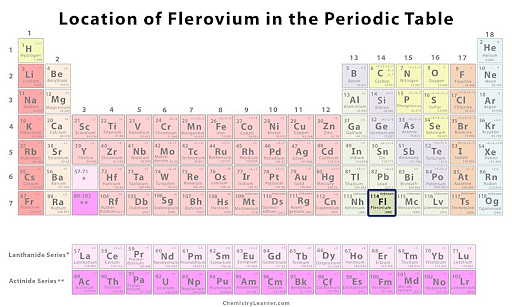
Location of Flerovium in Periodic Table
Characteristics of Flerovium
[Click Here for Sample Questions]
Here are some characteristics of Flerovium:
- Flerovium is a rare element that is only employed in a few applications. It has an atomic number of 114 and a mass of 289.
- The hue of the element is thought to be silvery-white, grey, or metallic, according to certain scientists. Ununquadio is another name for it.
- Because of its high density, the Fl is classified as a metal, and there are only around five synthetic isotopes identified so far.
- All of these isotopes are thought to have a half-life, which indicates that half of the element's fundamental atoms die in a short period of time. These five isotopes have mass numbers ranging from 285 to 289.
- All of these isotopes are exceedingly unstable in nature, according to scientists, and only 289 Fl is regarded as the most stable isotope of the Fl element. The half-life of the isotope 289 Fl is approximately 2.6 seconds.
Things to Remember
- Flerovium is a manmade element that is exceedingly radioactive. It isn't much known about this element and it is categorized as metal.
- It is a superheavy synthetic element that is placed in Group 14 and Period 7 of the modern periodic table.
- Flerovium has an atomic number of 114 and a mass of 289 g.mol-1.
- This element was first discovered by Joint Institute for Nuclear Research (JINR), Russia in 1998.
- Flerovium is made by hitting plutonium and calcium ions with neutrons. It is easily generated in the aforementioned nuclear reactors.
- There are only around five synthetic isotopes of Flerovium identified so far.
Also Read:
Sample Questions
Ques. What are the Properties of Flerovium? (5 Marks)
Ans. The properties of Flerovium are as follows:
- Flerovium is made by bombarding plutonium -94 ions with calcium -20 ions that are enclosed in a beam.
- There are around five synthetic isotopes with known half-lives and mass numbers ranging from 285 to 289 in the metal. All of them are thought to be unstable in nature, however, 289Fl is the most stable of the flerovium isotopes having a half-life of roughly 2.6 seconds.
- Nuclear reactors can also produce the metal Flerovium.
- This element, which belongs to the periodic table's p-block elements, is the heaviest metal among the carbon group's members. It is sometimes referred to as a noble metal.
Ques. What are the uses for flerovium? (3 Marks)
Ans. Only in the realm of study does this radioactive element find use. Flerovium is made up of a small number of atoms. As a result, it isn't employed in any commercial applications. However, because of its high radioactivity, this metal is recognized to be hazardous.
Ques. Is flerovium a metal or a non-metal? (3 Marks)
Ans. Flerovium was initially discovered in 1998 and announced in 1999 by scientists at the Joint Institute of Nuclear Research. They created one Element 114 atom. Flerovium is a synthetic radioactive element about which very little is known. It's a metal, and it's supposed to be solid at room temperature.
Ques. What led to the discovery of flerovium? (5 Marks)
Ans. Flerovium was created for the first time in 1998 by scientists at the Joint Institute for Nuclear Research in Dubna, Russia. They used calcium ions to blast plutonium atoms. Flerovium-289, an isotope with a half-life of around 21 seconds, was created as a result of this process.
A fusion reaction of element 20 with element 94 produced flerovium: calcium-48 with plutonium-244. In the U400 cyclotron (a particle accelerator) in Dubna, calcium ions were synthesized into a beam that accelerated to 10% of the speed of light before hitting the plutonium target.
Ques. What is the number of isotopes in flerovium? (3 Marks)
Ans. Because Flerovium (114Fl) is a synthetic element, it does not have a conventional atomic weight. It has no stable isotopes as do all synthetic elements. In 1999, 289Fl was the first isotope to be produced (or possibly 1998). There are seven known isotopes of Flerovium, as well as two nuclear isomers.
Ques. When did flerovium become a member of the periodic table? (3 Marks)
Ans. The addition of two new elements to the periodic table of elements was originally announced in December 2011. It has finally been made public. The International Union of Pure and Applied Chemistry approved Flerovium and Livermorium, elements 114 and 116, on May 31st.
Ques. What is Flerovium's atomic number? (3 Marks)
Ans. Un is the name given to number 1, which is further abbreviated to u, according to the IUPAC nomenclature for elements with an atomic number greater than 100. As a result, it is obvious that Flerovium has the atomic number 114, as implied by its name. It is also simple to write its symbol in the same order as its name sequence using abbreviations. Only the first letter should be written in capital letters; the remainder should be written in lowercase.
For Latest Updates on Upcoming Board Exams, Click Here: https://t.me/class_10_12_board_updates
Check-Out:



Comments