



Education Journalist | Study Abroad Lead
Fullerene is basically crystalline carbon allotrope. They’re made by heating graphite in an electric arc with inert gas. The molecules formed by the thick carbon dioxide contain mainly C60 fullerene molecules. Widely known as Buckminster-fullerene, its shape resembles a soccer ball. It is also otherwise referred to as buckyballs.
| Table of Content |
Key Takeaways: Fullerene, C60, Buckminster-fullerene, Carbon Nanotubes, Allotropes
What are Fullerenes?
[Click Here for Sample Questions]
Fullerene is a molecule made entirely of carbon, in the form of a blank circle, ellipsoid, or tube. They’re similar in structure to carbon nanotubes, but have higher concentrations and are less empty. Discovered in 1985 by Sir Harold Kroto, James R. Heath, Sean O'Brien, and Robert Curl, while investigating usage of carbon in arc emissions. They found that the carbon dioxide produced by the exit formed 60 carbon atoms, which they named buckminsterfullerene, after Richard Buckminster Fuller.
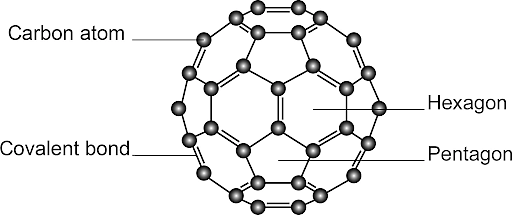
Fullerene
- A new family of carbon allotropes comprises a set of carbon atoms, like C32, C50, C60, C70, C84, etc.
- Fullerenes are formed by the heat of graphite in an electric arc where there are incoming gasses such as helium or argon.
- Among these an allotrope with molecular formula C60 is essential. It is called Buckminsterfullerene.
- The C60 molecule is a perfect circle and looks like a soccer ball and is also known as a bucky-ball.
- A six-member ring is attached to a six- or five-member ring but a five-member ring can only meet six rings.
- All carbon atoms are equal and perform sp2 hybridization.
- Each carbon atom forms three sigma bonds and three other carbon atoms.
- The remaining electron in each carbon is separated by orbitals from cells, which in turn give off a sweet-smelling molecule.
- This ball-shaped molecule consists of 60 vertices and each holds a single carbon atom and contains both single and double bonds.
Also Read:
| Related Articles | ||
|---|---|---|
| Red Phosphorus | Ammonium Phosphate | Uses of oxides of carbon group |
| Compounds of Boron | Silicic Acid Formula | Boron Carbide |
Properties of Fullerene
[Click Here for Sample Questions]
Fullerenes have a wide variety of unusual structures, including high strength and durability, thermal and electrical conductivity, and corrosion resistance. And they are not very stable, and they are not affected by many solvents or gasses.
- Its behavior and structure depends on the temperature. As the temperature rises, the fullerene is converted to C70.
- Its structure can change under different pressures.
- Fullerene possesses an ionization enthalpy of 7.61 electron volts.
- Its electron affinity is between 2.6 to 2.8 electrons volts.
Chemical Properties of Fullerene
[Click Here for Sample Questions]
Fullerene is usually stable and cannot be affected by heat. It does not dissolve in water and solvents. Additionally, it is also a good electric conductor.
- In a chemical reaction, fullerene can act as an electrophile.
- It acts as an electron receptor and often as an oxidizing agent.
- When coated or polished with alkali or alkaline earth metals, they exhibit superconductivity properties.
- Fullerene is ferromagnetic and naturally chiral.
- It is soluble in natural solvents such as toluene, chlorobenzene, and 1,2,3-trichloropropane.
Types of Fullerenes
[Click Here for Sample Questions]
Fullerenes exist in two large families, depending on specific properties and applications. The two families include closed buckyballs and open cylindrical carbon nanotubes. However, there are also integrated structures that may exist between these two categories. It can be carbon nanobuds that are basically nanotube bound with hemispherical meshes or large "buckybuds".
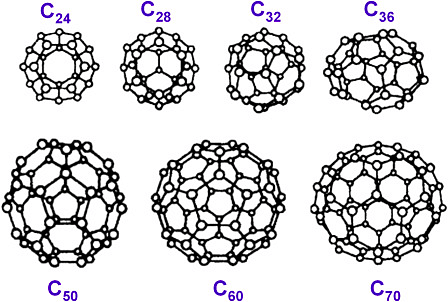
Types of Fullerenes
Buckyball collections
These fullerenes are incomplete versions of dodecahedra. These are also some of the smaller members of the fullerene group. Its structural formula is C20.
Buckminsterfullerene
Buckminster-fullerene is the smallest molecule. Contains pentagonal and hexagonal rings and no two pentagons will share the edge. Buckminster-fullerene exists in the form of C60 and is the most common in nature. The structure of buckminsterfullerene is a reduced icosahedron similar to that of a football.
Connected Ball and Chain Dimer
Herein, two buckyballs are attached mainly to a carbon chain. Fullerenes, such as, heterofullerenes with heteroatoms convert carbon into a cage or tube-shaped structures. Additionally, the molecules of metallofullerene are composed of metal atoms trapped inside a full cage.
Carbon Nanotubes
Carbon Nanotubes are usually small and cylindrical in shape. However, their length can be up to a few millimeters long. Several other carbon nanotubes can both be closed and open. Because of their unique cellular structure, they have some unique macroscopic features. Some of them include combining high gravitational force with electrical flexibility, high ductility and thermal conductivity involving related chemical malfunctions.
C60
The C60 is a ball-shaped molecule combining 60 carbon atoms. It is the most common molecule of fullerene.
C70
The C70 is a rugby-shaped molecule consisting of 70 carbon atoms. It is less common than the C60.
C84
The C84 is a ball-shaped molecule containing 84 carbon atoms. The largest molecule of fullerene.
Fullerene production
[Click Here for Sample Questions]
Fullerene repair begins with the production of fullerene-rich lead. The method used to produce fullerene involves transmitting large amounts of electricity between two adjacent graphite electrodes in an inactive area. It is further formed by releasing carbon into plasma, which then decomposes into sooty residue. Alternatively, ash can also be produced by laser ablation of graphite or pyrolysis of fragrant hydrocarbons. Processes like these result in the production of different fullerenes in various compounds and other forms of carbon. They are further extracted from the gums using appropriate natural solvents. Ideally, its mixture is separated by the use of chromatography.
Uses Of Fullerene
[Click Here for Sample Questions]
- Fullerene is often used in nanotechnology by the production of small, stable structures.
- It is also utilized for delivering drugs to specific body parts, increasing the effectiveness of the drug.
- It is also widely used to boost efficiency of solar cells.
- Fullerene can be used to stimulate chemical reactions, acting as catalysts, and speeding up the process.
- Fullerenes are used in the medical field as light-emitting antimicrobials.
- Fullerenes are utilized in biomedical programs, including the design of highly effective MRI comparison agents, comparative X-ray agents, photodynamic therapy and genetic delivery.
Things to Remember
- Fullerenes are formed by burning graphite in an electric arc in front of incoming gasses.
- Fullerenes are cage-like molecules. Contains twenty-six rings and twenty-five rings.
- All C atoms are equal, which will undergo sp2 hybridization. Each carbon atom forms three sigma bonds and three other C atoms. This ball-shaped molecule has 60 vertices.
- It also contains both single and double bonds with C-C grades 143.5 pm and 138.3 pm.
Also Read:
Sample Questions
Ques. Describe the Flame Building. (3 marks)
Ans. Fullerenes, especially the C60 sphere, have high proportions. Fullerenes are composed of a sheet of connected hexagonal rings, similar to graphite, except that they have pentagonal (or sometimes heptagonal) rings that prevent the sheet from being planar. Depending on their nature, they are called buckyballs or buckytubes. The most popular fullerene is the C60, which does not have two pentagons with the same point. The average carbon-carbon bond length in the C60 molecule is 1.44 angstrom.
Ques. Describe properties of Fullerene. (5 marks)
Ans. The properties of Fullerene are,
- As the temperature rises, the behavior and structure of the fullerene changes. Fullerene is converted to C70 form at high temperatures.
- Fullerene has an ionization enthalpy of 7.61 electron volts and electron affinity of 2.6 to 2.8 electron volts.
And its Chemical properties are,
- In a chemical reaction, fullerene (C60) resembles an electrophile.
- It often also acts as an electron receiver that can absorb three or more electrons. As a result, it serves as an oxidizing agent.
- To achieve superconductivity, fullerenes doped alkali or alkaline earth metals.
Ques. What are some of the carbon allotropes? (3 marks)
Ans. Carbon contains many allotropes. Carbon allotropes are compounds that have similar chemical properties but have different physical characteristics. There are four main types of carbon. The four main allotropes in Carbon are Diamond, graphite, fullerene and graphene. These compounds have the same chemical properties but due to changes in their physical properties, they end up having some differences in the rest of their lives.
Ques. Establish the major factors of Fullerene. (5 marks)
Ans.
Soft and smooth: A few strong bonds that hold molecules together but weaken only the strength of Van Der Waals between molecules.
Electricity Protection: No movement of electrons available from one molecule to the next. The only exception would be the formation of nanotubes that can conduct electricity at their own length. These are the subject of some research on microelectronics. As an Insulating material, It can be used for cables, pipes in the refrigerator, etc.
Soluble in water: There is only Van der Waals' only weak link between carbon atoms and water molecules while carbon atoms are firmly attached to each other in molecules.
Low soluble solids: Normal solid crystals where only Van der Waals interactions should be broken to dissolve.
Lubricant: Also used as an oil in the industry and as a catalyst. As a lubricant It can be used in commercial activities and as a catalyst, It is used to increase the rate of chemical reactions.
Ques. Describe the structure of fullerene. (3 marks)
Ans. Being the allotropes of carbon, fullerene C-60 (C - sixty) has carbon atoms arranged in the form of a football and it looks like a geodesic dome designed by the US architect Buckminster fuller. Thus, the molecule was named fullerene. There are 20 hexagons and 12 pentagons of carbon atoms in 1 molecule of buckminsterfullerene.

Fullerene Structure
Ques. Write the uses of Fullerene. (3 marks)
Ans. The usage of fullerene in medical and tumor research is extensive. In the field of medicine, fullerene is used,
- To light-activated antimicrobial agents
- To target cancer cells, mostly like antimicrobial agents
- Buckminsterfullerene is extensively utilized in drug delivery systems.
Ques. What are fullerenes? (1 mark)
Ans. Fullerenes basically are the third crystalline form of carbon. Although they have just been found, their existence lies within the dust between stars and other geological systems.
Ques. Highlight some major factors of Buckminsterfullerene. (3 marks)
Ans.
- Buckminsterfullerene is a type of fullerene with the formula C − 60.
- It has a ball-shaped (icosahedron)-shaped ball-shaped structure, composed of 20 hectares and 12 pentagons (60 vertices and 32 faces), with a carbon atom on each vertex of each polygon and each bond polygon edge.
- Every atom is sp2 hybridized and is also connected to three consecutive atoms.
For Latest Updates on Upcoming Board Exams, Click Here: https://t.me/class_10_12_board_updates
Check-Out:



Comments