



Education Journalist | Study Abroad Lead
Heat Capacity or Thermal Capacity, in Thermodynamics, is defined as the amount of heat required to change the temperature of an object by one unit. Being an inherent property of a substance, heat capacity can also be defined as the ratio of the amount of heat absorbed by a system to the change in temperature.
Read More: Concepts in Chemistry
Key Terms: Heat Capacity, Specific Heat Capacity, Cp, Cv, Molar Heat Capacity, Isobaric process, isochoric process.
What is Heat Capacity?
[Click Here for Sample Questions]
Heat is the transfer of energy from one body to another owing to the temperature difference between them. In a thermodynamic system, each molecule or compound reacts differently to heat. The temperature of a body rises when it absorbs heat or vice versa. When a body absorbs heat, it is converted into kinetic energy of the particles, resulting in the rise of temperature. As a result, the temperature change is directly proportional to the amount of heat transfer.
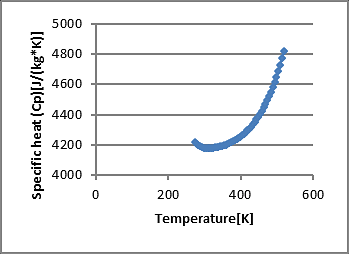
Heat Capacity of Water Graph
Heat Capacity is calculated by the formula:
Q = C\(\Delta\)T
so,
C= Q/\(\Delta\)T
where,
Q is the amount of heat required in Joules
\(\Delta\)T is the change in temperature (Final temperature – Initial temperature) in K
C is the heat capacity
Therefore the S.I unit of heat capacity is joule per kelvin (J/K).
Heat Capacity can also be calculated using specific heat capacity (c) by the mathematical equation:
Q = mc\(\Delta\)T
Where,
Q is the heat capacity in Joules
m is the mass in grams
c is the specific heat of an object in J/g °C or K
\(\Delta\)T is the change in the temperature in °C or K
Also Read:
Types of Heat Capacity
[Click Here for Sample Questions]
There are three types of heat capacity namely,
- Molar Heat Capacity (C),
- Specific Heat Capacity,
- Cp and Cv.
Molar Heat Capacity (cm)
Molar heat capacity of any substance is the amount of heat energy required to raise the temperature of one mole of a substance by one unit.
Molar heat capacity is calculated as:
cm = C/n
cm = Q/\(\Delta\)T/n
cm = Q/n\(\Delta\)T
where,
Q is the amount of heat required to change the temperature (\(\Delta\)T) in one mole of any given substance.
C the molar heat capacity of the body of the given substance.
n is the amount in moles
Unit of Molar heat capacity is given by,
Q = Joules (J)
n = moles
\(\Delta\)T = K
Thereby substituting in the equation above, we get cm = (J/(K⋅mol), or J K−1 mol−1.
Specific Heat Capacity (c)
Specific heat capacity of any substance is defined as “the amount of heat required to change the temperature of a unit mass of the substance by 1 degree.”
The below-mentioned formula can be used to calculate specific heat capacity values:
Q = mc\(\Delta\)T
Therefore specific heat capacity (c) = Q/(m\(\Delta\)T)
The SI unit of specific heat capacity is joule per kelvin per kilogram, J/(kg . K)
Specific Heat Capacity Video Explanation
Constant Pressure (Cp)
At constant pressure, the amount of heat energy released or absorbed by a unit mass of substance with a change in temperature is known as molar heat capacity at constant pressure or Cp.
At constant pressure, \(\delta\)Q = dU + PdV (isobaric process)
Cp can be written as:
Cp = [dH/dT]p
where
Cp represents the specific heat at constant pressure
dH is the change in enthalpy
dT is the change in temperature
Constant Volume (Cv)
Cv or the molar heat capacity at constant volume is the amount of heat energy released/absorbed per unit mass of a substance at constant volume during a small change in the temperature of a substance.
At constant volume, dV = 0, \(\delta\)Q = dU (isochoric process)
Cv can be written as:
Cv = [dU/dT]v
Where,
Cv represents the specific heat at constant volume
dU is the small change in the internal energy of the system
dT is the change in temperature of the system.
Also Read:
Relationship between CP and CV
[Click Here for Sample Questions]
According to the first law of thermodynamics,
q = n cm \(\Delta\)T. . . . . . . . . . (1)
At constant pressure P, equation one changes to
qP = n CP\(\Delta\)T
This value is equal to the change in enthalpy, that is,
qP = n CP\(\Delta\)T = \(\Delta\)H. . . . . . . . . . (2)
Similarly, at constant volume V, we have
qV = n CV\(\Delta\)T
This value is equal to the change in internal energy, that is,
qV = n CV\(\Delta\)T = \(\Delta\)U. . . . . . . . . . . (3)
The formula for one mole (n=1) of an ideal gas,
\(\Delta\)H =\(\Delta\)U + \(\Delta\)(PV )
\(\Delta\)H = \(\Delta\)U +\(\Delta\)(RT)
On rearranging the above equation, we have
ΔH = ΔU + R ΔT
Therefore, ΔH = ΔU + R ΔT
Substituting the values of ΔH and ΔU from the equations (2) and (3) in the former equation (1),
nCPΔT = nCVΔT + R ΔT
For (n=1), the above equation can be written as:
CPΔT = CVΔT + R ΔT
By taking ΔT as a common term, then
Cp×ΔT=(Cv+R)ΔT
By cancelling the terms \(\Delta\)T on both sides, then
CP = CV + R
CP – CV = R
Read More: Formula Related to Heat Capacity
Things to Remember
[Click Here for Sample Questions]
- The SI unit of molar heat capacity is joule per kelvin per mole (J/(K⋅mol), or J K−1 mol−1
- The calorimeter is the device used for measuring heat.
- The molar heat capacity at constant pressure CP is always greater than the molar heat capacity at constant volume Cv because the substance expands when heat is supplied at constant pressure.
- When the size of the body increases with temperature (heat), it results in thermal expansion of that body.
Also Read:
Sample Questions
Ques. A piece of iron 130 g has a specific heat = 0.45 J/g°C. The iron piece is heated from 100°C to 500°C. Find how much heat energy is required? (3 marks)
Ans. mass (m) = 130 g
specific heat of iron, (c) = 0.45J/g°C
change in temperature (ΔT) = 500 – 100 = 400°C
Calculation
Q = mc \(\Delta\)T
Q = (130 g) (0.45J/g°C) (400°C)
Q = 23400 J
So, the heat capacity of 130 g of iron is 23400 J.
Ques. What is the formula to calculate heat capacity using the specific heat capacity of the given material? (1 mark)
Ans. The formula used to calculate the heat capacity using the specific heat capacity of the given material is
Q = mcΔT
Ques. What is the International System of Units (SI) for heat capacity and specific heat capacity? (1 mark)
Ans. The SI unit for heat capacity and specific heat capacity is joule per kelvin (J/K) and joule per kelvin per kilogram ( J/(kg⋅K)) respectively.
Ques. If we have 3.5 kg of water. How much heat capacity the water has if the water’s specific heat is 4180 J/kgoC. (2 marks)
Ans. c = 4180 J/kgoC
m = 3.5 kg
C = mc
= 3.5*(4180)
= 14630 J/oC
Ques. A cube of copper, 600 gm in volume, is heated from a temperature of 30oC to 80oC. If copper’s specific heat is given as 0.385 J/goC, calculate the energy that is required to heat the copper. (3 marks)
Ans. m = 600 gm
c = 0.385 J/goC
ΔT = (80–30)oC
= 50oC
We know that, Q = mc\(\Delta\)T
= (600)(0.385)(50)
= 11550 J
Ques. A metal ball of 35 grams is heated at a temperature of 100oC with 2000 J of energy. Compute the specific heat of the metal ball. (3 marks)
Ans. m = 35 gms
ΔT = 100oC
Q = 2000 J
Putting these values in Q = mcΔT
2000 J = (35 g) c (100oC)
2000 J = (3500goC) c
When we divide both the sides by 3500 goC
2000 J/ 3500 goC = c
c = 0.571 J/goC
Ques. In a bomb calorimeter, a 1.75g sample of octane (C18 H18) is burned in excess of oxygen in a bomb calorimeter. The temperature of the calorimeter rises from 250 to 310 K. Find the heat transferred to the calorimeter, if the heat capacity of the calorimeter is 8.93 kJ/K. (2 mark)
Ans. Mass of octane, m = 1.750g.
= 0.00175.
Heat capacity, c = 8.93 kJ/k
Rise in temp, ΔT= (310–250) K
=60 K
Heat transferred to calorimeter, Q = mcΔT
= 0.00175 x 8.93 x 60
= 0.938 kJ
Ques. What is the main difference between heat capacity and specific heat capacity? (2 mark)
Ans. Specific heat capacity and heat capacity differ from each other in various aspects. The main difference is that the former does not depend on the mass of the substance, whereas heat capacity depends on the mass of the substance.
For Latest Updates on Upcoming Board Exams, Click Here: https://t.me/class_10_12_board_updates
Check-Out:



Comments