



Education Journalist | Study Abroad Lead
A horizontal line in mathematics is a straight line that runs parallel to the x-axis on a coordinate plane.
- It has a slope of zero and can be found at a specific y-value on the graph.
- Horizontal lines are commonly used in various mathematical applications, including geometry, trigonometry, and calculus.
- They have important real-world applications in fields such as engineering, architecture, and computer graphics.
- Understanding horizontal lines is fundamental to understanding basic geometry and algebraic concepts.
| Table of Content |
Key Terms: Line, Segment, Horizontal, Slope, Equation, Symmetry, Co-ordinates, Parallel.
Horizontal Line Definition
[Click Here for Sample Questions]
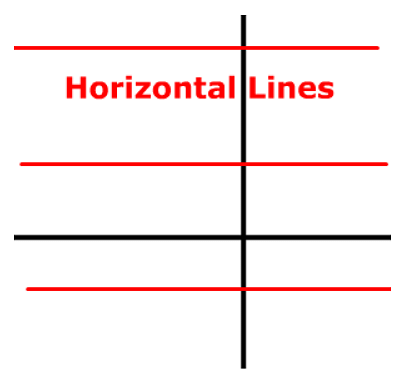
A horizontal line is a straight line that runs parallel to the x-axis on a coordinate plane.
- In mathematics, a horizontal line is typically represented as y = c, where "c" is a constant value that indicates the y-coordinate of any point lying on the line.
- Alternatively, a horizontal line can also be represented as a straight line with a slope of zero.
- This means that as the line moves from left to right, it does not rise or fall, maintaining a constant y-coordinate value for all the x-coordinate values.
- Visually, a horizontal line appears as a straight, flat line that stretches infinitely in both directions along the x-axis.
Horizontal Line
Slope of Horizontal Line
[Click Here for Sample Questions]
The equation of a horizontal line is given by y = c, where "c" is a constant that represents the y-coordinate of any point lying on the line. The slope of a line is represented by the ratio of the change in y to the change in x between any two points on the line.
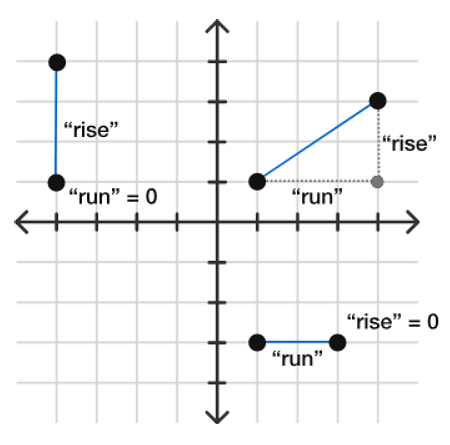
- Since a horizontal line has a constant y-coordinate value, the change in y (rise) between any two points on the line is always zero.
- This means that the slope of a horizontal line is always zero, regardless of the change in x (run).
- In mathematical terms, we can use the slope formula to derive the slope of a horizontal line.
Let's consider the equation of a horizontal line y = c, where c is a constant value. Now, let (x1, y1) and (x2, y2) be any two points lying on this line.
The change in y (rise) between these two points is:
y2 - y1 = c - c = 0
The change in x (run) between these two points is:
x2 - x1
Since the slope of a line is given by the ratio of the change in y to the change in x, we have:
slope = (y2 - y1) / (x2 - x1)
Substituting the values of change in y and change in x for a horizontal line, we get:
slope = 0 / (x2 - x1)
And since the denominator (x2 - x1) is non-zero, the slope is always zero.
Therefore, the slope of a horizontal line is always zero, and it can be derived using the equation of the line y = c and the slope formula.
Slope of Horizontal Line
Also Read:
| Related Topics | |
|---|---|
| Coordinate System | Equation of a Plane |
| Straight Lines | Slope of Line |
Horizontal Line Equation
[Click Here for Sample Questions]
The equation of a horizontal line is a mathematical expression that describes the relationship between the x and y coordinates of any point lying on the line.
- A horizontal line is a straight line that lies parallel to the x-axis, and therefore, the y-coordinate of any point on the line remains constant.
- The general equation of a straight line is given by y = mx + c, where m is the slope of the line, and c is the y-intercept.
- However, for a horizontal line, the slope is zero, as it does not rise or fall, and therefore, the equation can be simplified to y = c, where c is a constant.
In the equation y = c, c represents the y-coordinate of any point lying on the line.
For example, if the horizontal line passes through the point (2, 5), then the equation of the line would be y = 5. This means that the y-coordinate of any point lying on the line is always equal to 5, regardless of the x-coordinate value.
Note: The equation of a horizontal line does not contain any variable with an x in it. This is because the slope of a horizontal line is always zero, and therefore, there is no change in the y-coordinate value for any change in the x-coordinate value.
How to Draw a Horizontal Line?
[Click Here for Sample Questions]
To draw a horizontal line mathematically, we need to specify its equation, which is y = c, where "c" is a constant value representing the y-coordinate of any point on the line.
To draw the line, we can follow these steps:
- Take a sheet of graph paper and label the x and y axes.
- Choose a value for "c" that represents the y-coordinate of any point on the horizontal line. For example, c = 3.
- Plot a point on the graph paper with coordinates (0, 3). This represents the point where the horizontal line intersects the y-axis.
- Using a ruler or a straightedge, draw a line passing through the point (0, 3) and parallel to the x-axis. Since the line is horizontal, it should not rise or fall as it extends from left to right.
- The resulting line is a horizontal line with equation y = 3, which passes through all points with a y-coordinate equal to 3.
Mathematically, a horizontal line is a line with a slope of 0, meaning that it has no change in y for any change in x. This is reflected in its equation y = c, where c remains constant for all values of x. By plotting a point on the y-axis with the y-coordinate equal to the constant value "c" and drawing a line parallel to the x-axis through that point, we can create a horizontal line.
Horizontal Line Symmetry
[Click Here for Sample Questions]
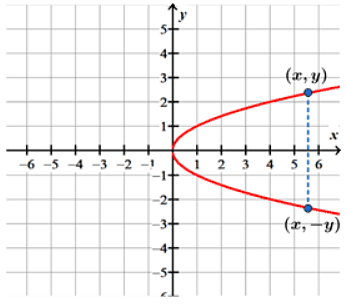
A horizontal line has a special type of symmetry called horizontal symmetry or symmetry about the horizontal line. This means that if any point on the line is reflected across the line, the image will be an exact match of the original point.
Mathematically, the reflection of a point (x, y) across a horizontal line with equation y = c can be found by taking the reflection of the y-coordinate alone, which is given by the formula (x, 2c - y).
Example: The horizontal line with equation y = 4 and the point (2, 6) lying above the line, the reflected point across the line would be (2, 2 x 4 - 6) = (2, 2). This point lies below the line, and if we connect it to the original point (2, 6), we get a line that is perpendicular to the horizontal line and passes through the point of reflection.
Horizontal Line Symmetry
Also Read: Equation of a Line
Horizontal Line Test
[Click Here for Sample Questions]
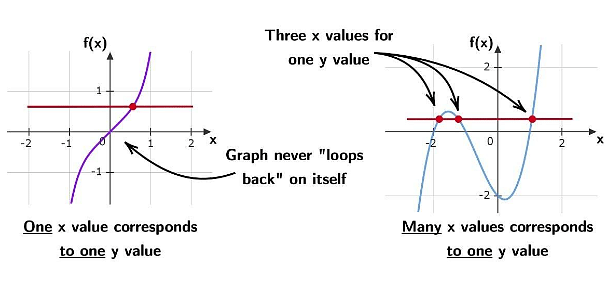
The horizontal line test is a tool used in calculus and graph theory to determine whether a function is one-to-one or not. A function is said to be one-to-one if each input (x-value) corresponds to a unique output (y-value).
- To perform the horizontal line test, we draw a horizontal line across the graph of the function.
- If the line intersects the graph at more than one point, then the function is not one-to-one.
- On the other hand, if the horizontal line intersects the graph at most one point, then the function is one-to-one.
Example: Consider the function f(x) = x2. If we draw a horizontal line at y = 4, the line intersects the graph at two points (x = -2 and x = 2), which means that the function is not one-to-one. However, if we consider the function g(x) = sin(x), the horizontal line intersects the graph at most one point for any value of y, indicating that the function is one-to-one.
Horizontal Line Test
Horizontal line segment
[Click Here for Sample Questions]
A horizontal line segment is part of a horizontal line that is bounded by two points. It is a straight line segment that runs parallel to the x-axis and has the same y-coordinate for both of its endpoints.
- To specify a horizontal line segment, we need to know the coordinates of its endpoints.
- If the endpoints have coordinates (x1, y) and (x2, y), where y is a constant value representing the y-coordinate of the line segment, then the length of the line segment is given by the absolute value of the difference between the x-coordinates: |x2 - x1|.
For example, if we consider the horizontal line segment with endpoints (1, 3) and (5, 3), the y-coordinate of both endpoints is 3, indicating that the line segment is horizontal. The length of the line segment is |5 - 1| = 4 units, since the difference between the x-coordinates of the endpoints is 4.
Horizontal and Vertical Lines
[Click Here for Sample Questions]
A horizontal line is a line that runs parallel to the x-axis and has a constant y-coordinate.
- This means that all points on the line have the same y-coordinate, while their x-coordinates can vary.
- The equation of a horizontal line is of the form y = c, where c is a constant representing the y-coordinate of the line.
- Horizontal lines have a slope of zero, and they are neither increasing nor decreasing as we move from left to right.
A vertical line, on the other hand, is a line that runs parallel to the y-axis and has a constant x-coordinate.
- This means that all points on the line have the same x-coordinate, while their y-coordinates can vary.
- The equation of a vertical line is of the form x = c, where c is a constant representing the x-coordinate of the line.
- Vertical lines have an undefined slope, and they are neither increasing nor decreasing as we move from bottom to top.
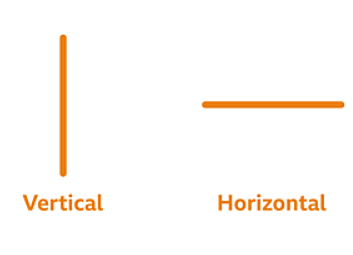
Horizontal and Vertical Lines
| Characteristic | Horizontal Line | Vertical Line |
|---|---|---|
| Orientation | Parallel to x-axis | Parallel to y-axis |
| Equation | y = c, where c is a constant | x = c, where c is a constant |
| Slope | 0 (zero) | Undefined |
| Direction | Neither increasing nor decreasing | Neither increasing nor decreasing |
| Intersecting lines | Perpendicular to vertical lines | Perpendicular to horizontal lines |
| Applications | Coordinate geometry, trigonometry, calculus, graph theory | Coordinate geometry, trigonometry, calculus, graph theory, engineering, science, everyday life |
Also Read:
Things to Remember
- A horizontal line is a line that runs parallel to the x-axis.
- The equation of a horizontal line is of the form y = c, where c is a constant representing the y-coordinate of the line.
- A horizontal line has a slope of zero.
- All points on a horizontal line have the same y-coordinate, while their x-coordinates can vary.
- A horizontal line is neither increasing nor decreasing as we move from left to right.
- Horizontal lines are perpendicular to vertical lines, and they intersect at a right angle (90 degrees).
Sample Questions
Ques. Find the equation of the horizontal line passing through the point (4, -2) and perpendicular to the line y = 3x + 1. (3 marks)
Ans. Since the line we are looking for is horizontal, its slope is 0. To find the equation of the line, we just need to determine its y-intercept by substituting the given point into the equation:
y = mx + b
-2 = 0(4) + b
b = -2
Therefore, the equation of the horizontal line passing through the point (4, -2) is y = -2.
Ques. Consider the points (2, 6) and (7, 6). Find the distance between these points along the horizontal line passing through (2, 6). (3 marks)
Ans. Since the line passing through (2, 6) is horizontal, we know that the y-coordinates of both points are the same. Therefore, the distance between the points along the horizontal line is simply the difference between their x-coordinates:
distance = |7 - 2| = 5
Therefore, the distance between the points (2, 6) and (7, 6) along the horizontal line passing through (2, 6) is 5 units.
Ques. Find the equation of the horizontal line that passes through the point (3, 8) and is parallel to the line y = -4x + 7. (5 marks)
Ans. Since the line we are looking for is parallel to y = -4x + 7, it has the same slope (-4). However, the y-intercept may be different. To find the y-intercept, we can substitute the given point into the point-slope form of the equation:
y - y1 = m(x - x1)
where m is the slope and (x1, y1) is a point on the line. Substituting m = -4, x1 = 3, and y1 = 8, we get:
y - 8 = -4(x - 3)
Simplifying, we get:
y - 8 = -4x + 12
y = -4x + 20
Therefore, the equation of the horizontal line passing through the point (3, 8) and parallel to the line y = -4x + 7 is y = -4x + 20.
Ques. Find the coordinates of the point where the horizontal line y = -2 intersects the line y = 3x - 5. (5 marks)
Ans: Since the given horizontal line has a fixed y-coordinate of -2, we can substitute this value into the equation of the second line to find the x-coordinate of the point of intersection:
-2 = 3x - 5
3x = 3
x = 1
Substituting x = 1 into the equation of the horizontal line, we get:
y = -2
Therefore, the point of intersection is (1, -2).
Ques. Determine the equation of the horizontal line that passes through the point (2, -4). (2 marks)
Ans. Since the line is horizontal, the slope is 0. Therefore, the equation of the line can be written as y = -4, since all points on the line will have a y-coordinate of -4. Thus, the equation of the horizontal line passing through the point (2, -4) is y = -4.
Ques. A horizontal line passes through the point (5, -3). Find the x-coordinate of another point on the line, if its y-coordinate is -3. (2 marks)
Ans. Since the line is horizontal, all points on the line will have the same y-coordinate of -3. Therefore, the x-coordinate of any point on the line will be the answer to the question. Thus, the x-coordinate of another point on the horizontal line passing through (5, -3) is 5.
Ques. Find the equation of the horizontal line that passes through the point (-6, 8). (2 marks)
Ans. Since the line is horizontal, the slope is 0. Therefore, the equation of the line can be written as y = 8, since all points on the line will have a y-coordinate of 8. Thus, the equation of the horizontal line passing through the point (-6, 8) is y = 8.
Ques. A horizontal line passes through the points (3, 2) and (-2, 2). Find the equation of the line. (1 mark)
Ans. Since the line is horizontal, all points on the line will have the same y-coordinate of 2. Therefore, the equation of the line can be written as y = 2. Thus, the equation of the horizontal line passing through the points (3, 2) and (-2, 2) is y = 2.
Ques. Determine the equation of the horizontal line passing through the midpoint of the line segment joining the points (-2, 5) and (6, 5). (3 marks)
Ans. The midpoint of the line segment joining the points (-2, 5) and (6, 5) can be found by taking the average of the x-coordinates and the average of the y-coordinates of the two points. The x-coordinate of the midpoint is (-2 + 6) / 2 = 2, and the y-coordinate of the midpoint is (5 + 5) / 2 = 5. Therefore, the point (2, 5) is the midpoint of the line segment.
Since the line passing through (2, 5) is horizontal, its equation can be written as y = 5, since all points on the line will have a y-coordinate of 5. Thus, the equation of the horizontal line passing through the midpoint of the line segment joining the points (-2, 5) and (6, 5) is y = 5.
Ques. A horizontal line passes through the points (-3, 7) and (5, 7). Find the slope of the line.(1 mark)
Ans. Since the line is horizontal, the slope is 0, as the y-coordinates of both points are the same. Therefore, the slope of the line passing through the points (-3, 7) and (5, 7) is 0.
Ques. Find the distance between the horizontal lines y = -3 and y = 5.(1 mark)
Ans. The distance between two horizontal lines is simply the difference between their y-coordinates. Therefore, the distance between y = -3 and y = 5 is |5 - (-3)| = 8 units.
For Latest Updates on Upcoming Board Exams, Click Here: https://t.me/class_10_12_board_updates
Do Check Out:



Comments