



Content Curator
Reproduction is a biological process in which one gives birth or rise to a new organism. Reproduction is a distinctive characteristic of organisms. It is a reason for the existence of living organisms. From organism to organism process of reproduction differs.
| Table of Contents |
Key Terms: Sexual Reproduction, Asexual Reproduction, Contraceptive Methods, Cell, Offspring, Gamete, Ovaries, Sperm
Asexual reproduction
[Click Here for Sample Questions]
Asexual reproduction is a mode of reproduction that doesn’t require the involvement of sex cell or gamete. The organism can reproduce new offspring without a mate. Most of the time these new offsprings are clones of their parent.
Asexual reproduction is followed by
- unicellular organisms like bacteria, archaea, etc.
- plants like ginger, ferns, dahlia, etc
- animals like annelid worms, polychaetes oligochaetes, etc

Budding
Types of Asexual Reproduction:-
- Fission is most common in unicellular organisms. When fission results in two daughter cells, it is called binary fission (e.g.paramecium) while in many daughter cells it is called union fission (e.g. Plasmodium). Planes of fission are exchanged for unconventional organisms.
- Budding is a type of asexual reproduction in which a little cyst structure. It is formed following the parent's body, which gives rise to a subsidiary individual where the bud may remain attached to the parent (yeast) or may split and become an abnormal individual (hydra).
- Regeneration is the development of the organ or body part by the organism (e.g. lizard).
- Fragmentation is the process by which an organism gets fragmented into smaller pieces and each fragment grows into a mingle auxiliary organism. E.g. Planaria, Hydra
- Spore formation: Organisms such as fungi make spores that can mass into combined add-on individuals when remote from their fruiting body.
Sexual reproduction
[Click Here for Sample Questions]
The sexual reproduction is specified below:
- The mode of reproduction involves two individuals; one male and one female. They produce sex cells or gametes which integrate to form more organisms. Fertilization is the process of the combination of the nucleus of a male gamete as well as the nucleus of a female gamete.
- In humans, each gamete has half the number of the quantity of 46 chromosomes that the body requires (23 chromosomes within a gamete are referred to as a haploid).
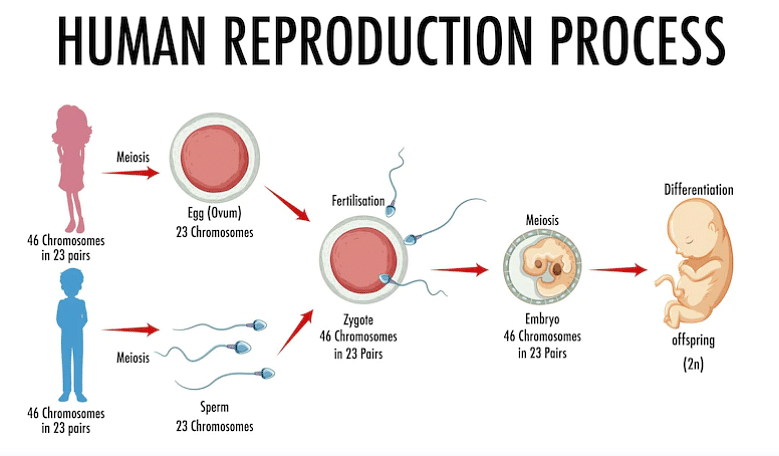
Human Reproduction Process
- When egg and sperm cells include in fertilization, they unite the two sets of chromosomes, ending in the works following 46 chromosomes in immovable form. The maternal chromosomes from the egg cell and the paternal chromosomes from the sperm cell pair take place.
- The zygote will epoch into an embryo. It has DNA from both the mother and the father, therefore, will have a blend of characteristics from both parents.
- In this habit, sexual reproduction introduces variation into a species. The zygote grows by mitosis to form an embryo and as the embryo develops, the cells begin to differentiate.
Sexual reproduction uses a type of cell disaffection called meiosis, which creates gametes, such as sperm and egg cells. The process of meiosis happens in the male and female reproductive organs. Just joined to in mitosis, a cell starts meiosis in interphase, and in interphase, the DNA is copied, the cell grows and the organelles are copied too.
After interphase: Two meiotic divisions occur, meaning the cell divides twice to form four gametes each gamete has half the number of chromosomes found in body cells (one chromosome for each pair) and is therefore known as haploid.
All gametes are genetically varied from each and the resultant cell is called a zygote. It is diploid as it has two copies of every one chromosome allowance- one came from the sperm cell and one came from the egg cell.
Cells made are genetically identical to starting cells and each total. If cells made are genetically interchange to starting cell and each subsidiary two cells are produced four cells are produced and one hostility occurs. Two divisions occur Interphase happens to the front cell isolation Interphase happens past cell estrangement sexual reproduction.
Two parents are needed in sexual reproduction as, during this process, the nuclei of the male and female gametes are collective in order to make a zygote. This process is known as fertilization.
The gametes are:
- eggs (female)
- sperm (male)
The offspring produced in sexual reproduction are genetically changing to each new and to the parents. This process results in variation as it involves the mixing of genetic material.
Male Reproductive System: The formation of male gametes or sperm (haploid in nature) in testes is known as spermatogenesis. Seminiferous tubules are the site for spermatogenesis whereas testis produces a male hormone known as testosterone needed for the male secondary sexual characteristics as well as for spermatogenesis.

Male Reproductive System
Female Reproductive System: Sperm enters the female vagina at the time of sexual intercourse from where the sperm reaches the fallopian tube where it fuses the ova to form a zygote. This is known as fertilization.
Then the zygote divides to form an embryo and the embryo gets implanted into the uterus. The embryo development occurs in the uterus to form the foetus. Mother supplies nutrition to the growing foetus via the placenta.
The placenta helps in the exchange of nutrients, and gases and the removal of excretory products. The development of a child inside the womb of the mother takes place for about 9 months. Then the rhythmic uterine contraction leads to the delivery of the baby outside the female body.

Female Reproductive System
Contraceptive Methods
[Click Here for Sample Questions]
- Understanding the reproductive system is also a part of reproductive health awareness as reproductive health deals with the prevention of STDs and unwanted pregnancy.
- Contraceptives help to prevent unwanted pregnancy and STDs. They can be of various types: mechanical barriers, hormonal/chemical methods, surgical methods, etc. Some contraceptive methods are specified below:
- Sexual intercourse Interruptus is a very unreliable contraceptive method where the sexual intercourse is stopped before the male ejaculates inside the female reproductive tracts.
- The rhythm method is an unreliable method of contraception where sexual intercourse is avoided when the female is fertile and the chances of fertilization are very high.
- Condoms are one of the most effective methods of contraception which provides a mechanical barrier that stops the semen from entering the female tract preventing pregnancy and the possibility of contracting STDs.
- Diaphragms are barriers that can be added inside the female reproductive tracts to stop the entry of semen inside the female tract and thus prevent pregnancy.
- Emergency pills are those pills that can be taken after sexual intercourse to avoid pregnancy. They quickly change the level of hormones in the body and prevent successful implantation even if the egg gets fertilized.
- IUD stands for Intrauterine Device, a device that is inserted into the uterus, changing its shape and preventing successful implantation of the zygote.
- Sterilization is a surgical method of going permanently sterile ( can be done in both males and females). In males, it is called vasectomy and whereas in females, it is called tubal ligation.
Also Check: Regeneration: Definition, Types, and Modes
Things To Remember
- Reproduction is a distinctive characteristic of organisms.
- In asexual reproduction organism can reproduce new offspring without a mate.
- Budding and binary fission are some types of asexual reproduction.
- The development of a child inside the womb of the mother takes place for about 9 months.
- Contraceptives help to prevent unwanted pregnancy and STDs.
- Condoms, emergency pills, and sterilization are some of the contraceptive methods.
Sample Questions
Ques: What is Fission? (2 Marks)
Ans: Fission is the separation of a single body into two new bodies by duplication of the genetic material of the organism. In the process of fission, deoxyribonucleic acid undergoes division to form two parts. The second process is termed cytokinesis. Binary fission is an example of asexual reproduction and organisms falling under Bacteria and Archaea exhibit this type of reproduction process.
Ques: What is the male reproductive system? (2 Marks)
Ans: The formation of male gametes or sperm(haploid in nature) in testes is known as spermatogenesis. Seminiferous tubules are the site for spermatogenesis whereas testis produces a male hormone known as testosterone needed for the male secondary sexual characteristics as well as for spermatogenesis.
Ques: Which process leads to the formation of gametes? (2 Marks)
Ans: Gametogenesis is the process of formation of gametes, wherein two distinct sex cells, i.e. male and female haploids, are formed. The entire process takes place in the pre-fertilization stage of sexual reproduction.
Ques: List six specific characteristics of sexual reproduction? (2 Marks)
Ans: Characteristics are - i) The process requires two individuals (male and female). ii) Gametes are formed through reductional division. iii) Fertilization is the process of fusion of gametes iv) Fertilization facilitates zygote formation. v) Sexual reproduction is responsible for variation in offspring vi) Maintains chromosome number in species.
Ques: What are the Benefits of Vegetative Propagation? (3 Marks)
Ans: The major benefits are; that the new plants will retain the genetic material of a single parent. It means that if specific desirable traits have been identified in the parent plant, the same will be replicated in the offspring as well. However, for that to happen, growing conditions have to be kept the same.
Ques: What is Meant by Spore Formation? (3 Marks)
Ans: Spore formation is a process of asexual reproduction exhibited by plants such as moss, ferns, fungi, etc. Spores are essentially reproductive bodies that are unicellular. Those are present in a sac-like structure known as sporangia. On attaining maturity, spores burst out from sporangia and are transmitted to various places with the help of wind, air, or water.
Ques: What do you mean by asexual reproduction? (3 Marks)
Ans: Asexual reproduction refers to the mode of reproduction that involves a single individual creating a new generation of species. Under this mode of reproduction, a single parent generates/produces a new offspring. These offspring are physically and genetically identical to their parents. There are many unicellular and multicellular organisms that follow asexual reproduction. However, not all of them follow this mode of reproduction. Some of these unicellular organisms exhibit the sexual mode of reproduction as well. Asexual mode of reproduction can include parthenogenesis, budding, fission, and fragmentation.
Ques: What is the function of sexual reproduction? (2 Marks)
Ans: These are the functions of sexual reproduction in plants, animals, and human beings – a) creates new organisms, b) is responsible for variation in progeny c) prevents a species from going extinct.
Ques: How is the process of pollination different from fertilization? (3 Marks)
Ans: Pollination refers to the process of transferring pollen from the anther of one plant to the stigma. This process is done with the help of pollinators. Pollinators refer to the mode of transformation of pollen. These pollinators can include water, wind, and even a few insects. Whereas, fertilization refers to the process of a fusion between the male and female games. Fertilization takes place in the ovule. This further leads to the formation of the zygote.
Ques: What are the benefits and disadvantages of sexual reproduction? (3 Marks)
Ans: The advantages of Sexual Reproduction are that:
Allows species to survive in a different changing environment due to variations. For the survival of the species, it is considered a major benefit.
Produces genetic variations in their younger ones.
The disadvantages of Sexual Reproduction are:
To ensure the gametes are brought together at the right time of the year, the organism may have to change its usual pattern of activity.
Ques: What are the benefits and disadvantages of asexual reproduction? (3 Marks)
Ans: The advantages of Asexual Reproduction:
There is no need to spend energy and time finding a mate.
The disadvantages of Asexual Reproduction:
These species cannot survive after the environmental change.
Ques: What is fertilization? (3 Marks)
Ans: Fertilization is one of the most significant events in sexual reproduction and is also known as syngamy. It is a process wherein male and female gametes fuse to form a diploid zygote. Typically, fertilization tends to occur either inside (internal fertilization) or outside the body of an organism (external fertilization). Notably, in certain organisms like honeybees, rotifers, turkey, and some lizards, the female gametes can form a new organism without being fertilized. Such a phenomenon is known as parthenogenesis.
Check-Out:



Comments