



Content Curator
Hydrolysis is a decomposition type of chemical reaction where water is used to break the bond between the units of a polymer into simple monomeric units.
- This term is commonly used to describe substitution, elimination, and solvation processes in which water acts as the nucleophile.
- During the process of Hydrolysis of a polymer, the water molecule usually attaches to the two separated parts of that polymer.
- One part will get the H+ ion group and the other will get the OH- ion group.
- This is how hydrolysis takes place.
- Biological hydrolysis is the breakdown of biomolecules in which a water molecule is consumed to impact the separation of a bigger molecule into constituents.
- Hydrolysis converts carbohydrates into a component of sugar molecules.
- For example, saccharification is the process by which sucrose is broken down into glucose and fructose.
- Hydrolysis can be done for the breakdown of different polymeric units of components like Salts, Acids, Bases, Fats, Proteins, and Complex Carbohydrates present in Food.
| Table of Content |
Key Terms: Hydrolysis, Polymer, Monomer, Acid, Base, Salt, Chemical reaction, Ammonia, Molecules, Ions, Sodium acetate, ATP hydrolysis, Glucose, Sucrose
What is Hydrolysis?
[Click Here for Sample Questions]
The term hydrolysis is derived from the Greek words hydro, which means water, and lysis, which means to break or unbind.
| Hydrolysis is a common kind of chemical reaction in which water is used to break down chemical bonds between two substances. |
Water molecules are generally connected to two parts of a molecule during hydrolysis.
- One molecule of a substance will receive the H+ ion, while the other will receive the OH- group.
- The hydrolysis process is mainly used for breaking down polymers into monomers.
- So, when studying chemistry, hydrolysis is the act of separating compounds by adding water.
- When water reacts with another chemical substance, two or more products are formed.
- Examples of hydrolysis include dissolving a salt of a weak acid or base in water or dissolving sulphuric acid in water, which results in the formation of hydronium and bisulfate compounds.
- Hydrolysis is also helpful in the breakdown of proteins, lipids, and complex carbohydrates found in food.
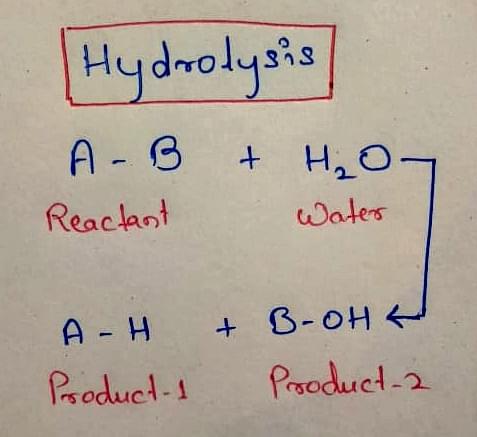
The general formula of a hydrolysis reaction is
\(AB+H_2O\:\: \rightarrow \:\: AH+BOH\)
Also check:
| Related Topics | ||
|---|---|---|
| Equilibrium Important Questions | Biomolecules Important Questions | Inorganic Chemistry |
| Important Questions on Organic Chemistry | Organic Chemistry | Biomolecules in living organisms |
Examples of Hydrolysis
[Click Here for Sample Questions]
Some examples of Hydrolysis are
Hydrolysis of Ester
In the presence of either an acid or a base, an ester breaks to produce an alcohol and a carboxylic acid. Consider the following reaction:
\(CH_3COOCH_3 + H_2O \:\: \rightarrow \:\: CH_3COOH + CH_3OH\)
Hydrolysis of Sodium Acetate
Sodium acetate hydrolysis results in the formation of two compounds: carboxylic acid and sodium hydroxide. Consider the following reaction:
\(CH_3COONa + H_2O \:\: \rightarrow \:\: CH_3COOH + NaOH\)
Hydrolysis of Ammonia
Ammonia combines with water to produce ammonium and hydroxide ions during hydrolysis. The corresponding chemical reaction is as follows:
\(NH_3 + H_2O \:\: \rightarrow \:\: NH_4 + OH^{1-}\)
Types of Hydrolysis
[Click Here for Sample Questions]
The different types of Hydrolysis are
- Salt Hydrolysis
- Acid and Base Hydrolysis
- ATP Hydrolysis
Salt Hydrolysis
One of the most common hydrolysis processes is salt hydrolysis.
- There is a cation-anion interaction between salt and water when it reacts with water.
- Salts undergo hydrolysis and break down totally or partly to generate ions (anion and cation).
- The breakdown limit, which includes both total and partial breakdown, is determined by the solubility factor.
For example:
\(CH_3COONa + H_2O \:\: \rightarrow \:\: CH_3COOH + NaOH\)
Acid and Base Hydrolysis
Acid or base hydrolysis occurs when esters or amides react with water.
- To produce new compounds, the hydroxyl ion from water combines with the carbonyl carbon of ester and amide.
- The carboxylic acid group and a side product such as alcohol are the results of the hydrolysis of Exeter and amides.
For example:
\(NH_3 + H_2O \:\: \rightarrow \:\: NH_4 + OH^{1-}\)
ATP Hydrolysis
ATP stands for adenosine triphosphate.
- It is the most biochemical reaction that occurs, with enzymes acting as catalysts.
- The catalytic reaction of these enzymes allows for the breakdown of lipids, proteins, oils, fats, and carbohydrates.
- Pyrophosphate bonds exist in the ATP molecule.
- When two phosphate units combine, they produce bonds that release energy when needed.
ATP undergoes hydrolysis in two ways:
First, terminal phosphate is removed to generate adenosine diphosphate (ADP) and inorganic phosphate.
The reaction is as follows:
\(ATP + H_2O \:\: \rightarrow \:\: ADP + Inorganic \:Phosphate +Energy\)
Second, a terminal diphosphate is removed to provide adenosine monophosphate, AMP, and pyrophosphate.
- The latter is broken down into its two component phosphates.
- As a result, biosynthetic reactions occur in chains.
- When the phosphate bonds have been hydrolyzed, they can be pushed in the direction of synthesis.
Application of Hydrolysis
[Click Here for Sample Questions]
The following are the applications of Hydrolysis
- The Hydrolysis of sugar is known as scarification.
- Sucrose is hydrolyzed to produce glucose, sugar, and fructose.
- Hydrolysis is used to dissolve a mild acid and a base salt in water.
- Strong acids can also be hydrolyzed through hydrolysis.
- When sulfuric acid is dissolved in water, it produces bisulfate and hydronium.
- Acid-base catalyzed hydrolysis is a good application of hydrolysis.
- In biological systems, hydrolysis is catalyzed using enzymes.
- This chemical process is well shown by ATP.
- Proteins, lipids, and carbohydrates are all digested by hydrolysis.
Also check:
| Acid and Base Reaction | Acids, Bases and Salts | Difference Between Acid and Base |
| Properties of Acids and Bases | Experiments on Properties of Acids and Bases | Acids, Bases and Salts Important Questions |
Things to Remember
- In Hydrolysis, water is used to break down chemical bonds between two substances.
- The hydrolysis process is mainly used for breaking down polymers into monomers.
- Different types of hydrolysis are Salt Hydrolysis, Acid and Base Hydrolysis, and ATP Hydrolysis.
- ATP stands for adenosine triphosphate.
- Acid or base hydrolysis occurs when esters or amides react with water.
- Hydrolysis converts carbohydrates into a component of sugar molecules.
Sample Questions
Ques. pKa of acetic acid and pKb of ammonium hydroxide are 4.76 and 4.75 respectively. Calculate the pH of the ammonium acetate solution. (3 Marks)
Ans. Ammonium acetate is formed by the reaction between a weak acid, acetic acid, and a weak base of ammonium hydroxide. So it is a salt formed by a weak acid and a weak base. Now, to calculate the pH of the ammonium acetate solution:
pH = 7 + 1/2 ( pKa – pKb)
⇒ pH = 7+ 1/2 ( 4.76 – 4.75)
⇒ pH= 7 + 1/2 ( 0.01)
⇒ pH= 7 + 1/200
⇒ pH= 7+ 0.005
⇒ pH= 7.005
Ques. Why is the process called hydrolysis? (1 Mark)
Ans. Any chemical reaction in which a molecule of water breaks one or more chemical bonds between two substances is referred to as hydrolysis.
Ques. What is required for hydrolysis? (2 Marks)
Ans. Hydrolysis literally means "water reaction." It is a chemical process in which a molecule is broken into two parts by adding a molecule of water. The most common hydrolysis occurs when a salt with a weak acid or weak base (or both) is dissolved in water.
Ques. What is hydrolysis used for? (3 Marks)
Ans. Hydrolysis is usually used in the industrial process to break down substances into smaller fractions or pieces. For example, a molecule known as organophosphate ester can be hydrolyzed or undergo a hydrolysis process. This hydrolysis helps in the production of insecticides and chemical sprays.
Ques. How is the conversion of ATP to ADP done in Photosynthesis? (2 Marks)
Ans. ATP or Adenosine Tri- Phosphate is an important energy currency in the human body and hydrolysis of ATP is done to break it into ADP and Pi by its reaction with water. It is an important reaction done under the metabolic activity of the human body.
Ques. How are the types of salt solutions different from each other? (3 Marks)
Ans. There are three types of salt solutions: Acidic, Basic, and Neutral. They are different in terms of their components of Cations and Anions. As Acidic salt is formed by the combination of Strong Acid and Weak Base, Basic salt is formed by the combination of Strong Base and Weak Acid, and Neutral Salt is formed by the combination of Strong Acid and Strong Base.
Ques. Why do NaCl, KCl, KNO3 do not undergo hydrolysis? (2 Marks)
Ans. NaCl, KCl, and KNO3 do not undergo hydrolysis because they furnish strong Acids and Strong Bases in Aqueous solutions that are dissociated completely.
Ques. What is the purpose of a hydrolysis reaction? (2 Marks)
Ans. When synthesizing a polymer from monomers, hydrolysis processes use water to break down polymers into monomers. This is the inverse of dehydration synthesis, which shapes water. Hydrolysis reactions break bonds and produce steam.
Ques. Why does CaF2 not undergo hydrolysis easily? (2 Marks)
Ans. CaF2 does not undergo hydrolysis easily because polyvalent metal ions like CaF2 are particularly smaller ionic fluorides and are very sparingly soluble in water due to their higher lattice energy.
Ques. Write a balanced chemical equation for the hydrolysis of PCL5 with heavy rainwater. (2 Marks)
Ans. PCl5 on treatment with heavy water i.e., D2O, phosphorous oxychloride formed with deuterium chloride as a byproduct.
The reaction involved is:
PCl5 + D2O → POCl3 + 2DCl
POCl3 - phosphorus oxychloride
Ques. What is hydrolysis and condensation? (2 Marks)
Ans. Hydrolysis processes are the inverse of condensation, in which two molecules connect to form a bigger one and expel a water molecule. Hydrolysis therefore adds water to the breakdown, whereas when all other solvents are removed, condensation occurs.
For Latest Updates on Upcoming Board Exams, Click Here: https://t.me/class_10_12_board_updates
Also Read:



Comments