



Education Journalist | Study Abroad Lead
Sulphuric acid is basically a strong acid with oxidizing and hygroscopic properties. It is a mineral acid which is also known as ‘King of Chemicals’. Sulphuric acid has the chemical formula H2SO4. It is also known as Sulfuric acid. It has acidic nature and is a very corrosive, odorless, colorless, oily liquid. It is found both in combined as well as a free state. Sulphuric acid is also recognized as Mattling acid or Oil of vitriol. It acts as a dehydrating agent and an oxidizing agent, at higher concentrations. Sulphuric Acid is water-soluble and releases heat when dissolved in water. The acid is widely used in the manufacturing of fertilizers. It is also used in waste water processes and chemical synthesis.
| Table of Content |
Keyterms: Mattling Acid, Oil of Vitriol, Oxidizing agent, Boiling Point, Melting point, Sulpher, Sulpher Dioxide
Read More: Perchloric Acid
Overview of Sulphuric Acid
[Click Here for Sample Questions]
- Sulphuric acid - H2SO4
- Molecular Weight/ Molar Mass - 98.079 g/mol
- Density - 1.84 g/cm3
- Boiling Point - 337 °C
- Melting Point - 10 °C
Read More: Phosphorus Pentachloride
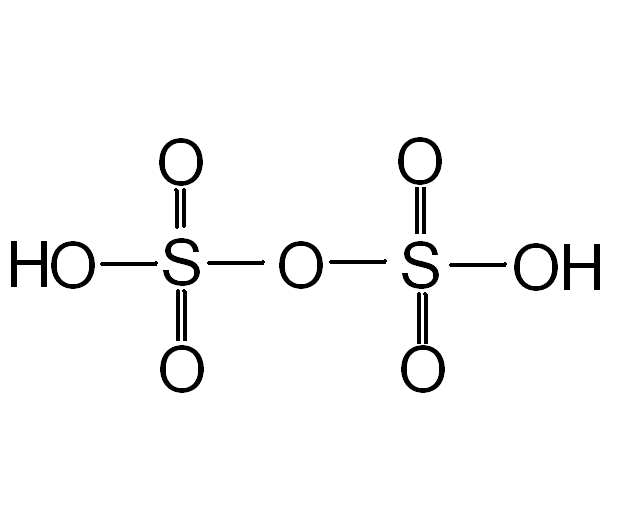
Structure of oxoacids of sulphur
Sulphur forms many oxoacids, out of which the most important one is sulphuric acid. Some acids are known in the form of their salts only, like sulphurous and dithionic acids, as the free acids are unstable and cannot be isolated.
Manufacturing Process of Sulphuric Acid
[Click Here for Sample Questions]
There are two techniques for the industrial production of sulfuric acid, namely
- Lead chamber process
- Contact process
Processes in detail
Contact Process

The contact process can be understood in its three major steps.
Step - I: Production of Sulphur Dioxide
Sulphur dioxide is produced by heating sulphide ores or sulphur.
For example, iron pyrites in excess of air.
S + O2 + Δ → SO2
i.e. Sulphur + Oxygen + Heat Sulphur dioxide
4FeS + 7O2 + Δ → 2Fe2O3 + 4SO2
i.e. Iron Pyrites + Oxygen + Heat Ferric Oxide + Sulphur dioxide
Step - II: Formation of Sulphur Trioxide
After its production, sulphur dioxide is oxidized with the atmospheric oxygen to sulphur trioxide by using V2O5 as a catalyst.
2SO2 + O2 + V2O5 →SO3
i.e. Sulphur dioxide + Oxygen + Catalyst Sulphur trioxide
Step - III: The Conversion of Sulphur Trioxide into Sulphuric Acid
After it is formed, the sulphur trioxide is broken into 98% Sulphuric acid to give oleum. Another name for oleum is pyrosulfuric acid. Oleum is then diluted with the help of water to produce sulfuric acid of the desired concentration.
SO3 + H2SO4 → H2S2O7
i.e. Sulphur trioxide + (Sulfuric acid-98%) (Pyrosulfuric acid/Oleum)
H2S2O7 + H2O → 2H2SO4
i.e. Pyrosulfuric acid/Oleum + Dilution Sulfuric acid
Read More: Praseodymium
Lead Chamber Process

This process is used as one of the most common techniques of manufacturing. It results in around 50-60 B-grade acids. In this process, we use wet SO2 in the presence of nitrogenous oxides (dynamic impetus). As a result, the SO2 gets oxidized with the oxygen present in the air and results in the formation of sulphur trioxide.
This reaction can be expressed as
2SO2 + O2 → 2SO3
Sulphur trioxide is then made to react with water to get H2SO4. This reaction is expressed as
SO3 + H2O → H2SO4
Also Read:
| Related Articles | ||
|---|---|---|
| Inner Transition Metals | Actinoids | Ammonium phosphate |
| Argon | Astatine | Gallium |
| Hypochlorite | Electronic Configuration of Iron | Mercuric Chloride |
Properties of Sulphuric Acid
[Click Here for Sample Questions]
Physical Properties
- Sulphuric acid is a thick oily fluid and is colorless.
- The specific gravity of Sulphuric acid is 1.84 at 298 K.
- The boiling point of the Sulphuric acid is 611 K. Due to hydrogen bonding, it has a higher boiling point and thickness.
- Sulphur reacts vigorously with water, releasing quite a lot of heat. Thus, never add water to H2SO4. Instead, add the acid to water, slowly with proper stirring.
Chemical Properties
- Sulfuric acid is a strong dibasic acid and is diprotic and ionizes in two stages in the aqueous solution.
- Sulphur is highly corrosive, reactive, and is soluble in water. It acts as a strong oxidizing agent thus has a very high oxidizing power. Due to this, it can oxidize both non-metals as well as metals. Moreover, it itself reduces to sulphur dioxide.
- It has very low volatility. Therefore, it plays a part in the preparation of more volatile acids from their comparing salts.
- Sulphur is used for drying many wet gases which do not react with the acid as concentrated sulfuric acid is a very strong dehydrating agent.
Uses of Sulphuric Acid
[Click Here for Sample Questions]
In Industries
- It is used as a cleaning agent in industries to remove the rust from steel and iron.
- More than 50% of Sulphur manufactured is used in the production of phosphoric acid which is in turn used to make phosphate fertilizers.
- It is used in the manufacturing of metals such as copper, zinc, ammonium sulfate, etc.
- 5% of the produced acid is used in the making of fibers.
In Domestic Environments
- Sulphur is used in acidic drain cleaners.
- It can be used to remove the tissue paper due to its strong dehydrating property.
As a Catalyst
- Sulphur is used in the Manheim process in the manufacturing of HCl.
- It is used in petroleum refining.
- Sulphur is used as a catalyst to convert cyclohexanone oxime to caprolactam used to make nylon.
- It is used in petroleum refining.
- In lead-acid batteries, it is used as an electrolyte.
- It is used in storage batteries.
Also Read:
Sample Questions
Ques. How Sulphuric acid is produced? (2 marks)
Ans. Sulphuric acid is produced from sulphur. Sulphur dioxide is obtained by burning the molten sulphur in the presence of air. Sulphur dioxide is then converted to sulphur trioxide in the presence of a catalyst such as vanadium pentoxide.
Ques. What is sulphuric acid used for? (2 marks)
Ans. The primary application of sulfuric acid is in fertilizer processing. It is commonly used in chemical processing, e.g. in the manufacture of nitric acid, dyes and pigments, explosives, and medicines.
Ques. What is the pH of Sulphuric acid? (2 marks)
Ans. As sulphuric acid is a strong acid, a sulphuric acid solution of 0.50 M has a pH near zero.
Ques. Will sulphuric acid dissolve metal? (2 marks)
Ans. Aluminum is a highly reactive metal and will not dissolve in oxidizing acids like nitric acid, as a protective layer of aluminum oxide will grow on its surface. Thallium dissolves in sulphuric acid, but not in hydrochloric acid.
Ques. How do you neutralize sulphuric acid? (2 marks)
Ans. Pouring the baking soda directly into a spill of acid will neutralize light acids such as vinegar, strong acids such as muriatic and sulphuric acids. Douse with the baking soda the entire contaminated region to neutralize the acid.
Ques. Is H2SO4 a Monoprotic acid? (2 marks)
Ans. The monoprotic acid is hydrobromic acid because of one proton (H) hydrogen. No monoprotic hydrogen exists. In the starting acid, sulphuric acid (H2SO4), there are two acid protons.
Ques. Can you neutralize sulphuric acid with water? (2 marks)
Ans. When you have a certain amount of concentrated sulphuric acid, you should pour it into a sodium hydroxide solution. Water dilutes and carries off some heat that the sodium carbonate produces when it neutralizes the acid.
Ques. Is sulfuric acid ionic or molecular? (2 marks)
Ans. Water forms a compromise between H2O and H3O+ and -OH. That doesn’t make anything ionic. Since all the bonds are covalent, It is a compound with covalence.
Ques. (a) When concentrated sulphuric acid is added to an unknown salt present in a test tube, a bron gas (A) evolved. This gas intensified when copper turnings are added to this test tube. On cooling, the gas (A) change into a colourless solid (b). Identify (A) and (B). Write the chemical reactions involved.
(b) Draw the chemical structure of XeOF4. (Comptt. All India 2017) (4 marks)
Ans. (a) The unknown salt present in a test tube is sodium nitrate and sulphuric acid evolves a brown gas that is NO2 gets intensified when Cu turnings are added.

NO2 condenses as a brown liquid on cooling which again turns paler on cooling and eventually becomes a colourless solid due to the formation of dimerized NO2 i.e., N2O4 (Dinitrogen tetraoxide).
(i) – Nitrogen Dioxide (NO2)
(ii) – Dinitrogen tetraoxide (N2O4)
(b) The structure of XeOF4,

Ques. (i) Compare the oxidising of F2 and Cl2 by considering the parameters like bond dissociation enthalpy, electron gain enthalpy and hydration enthalpy.
(ii) Whate are the conditions to maximize the yeild of sulphuric acid by contact process.
(iii) Arrange the following in the increasing order of property mentioned:
(a) H3PO3, H3PO4 , H3PO2 (Reducing character)
(b) NH3, PH3, AsH3, SbH3, BiH3 (Base strength) (Delhi 2016) (4 marks)
Ans. (i) As the standard reduction potential value of Fluorine is more than that of Chlorine, therefore Fluorine is a stronger oxidising agent.
- Bond dissociation enthalpy of F2 is less than that of Chlorine.
- The negative electron gain enthalpy of Fluorine is slightly less than that of Chlorine.
- The hydration entahlapy of Floride ion is much higher than that of Chloride ion due to smaller size.
(ii) The favourable conditions for manufacturing sulphuric acid by contact process are as follows:
- There must be high pressure of about 2 bars.
- Low temperature of about 720 K.
- Presence of V2O5 catalyst.
(iii) (a) H3PO4 < H3PO3 < H3PO2
(b) BiH3 < SbH3 < AsH3 < PH3 < NH3
Ques. (a) Write the balanced equations for the following reactions:
(i) Chlorine reacts with dry slaked lime
(ii) Carbon reacts with concentrated H2SO4.
(b) Describe the contact process for the manufacture of sulphuric acid with a special reference to the reaction conditions, catalyst used, and the yeild in the process. (Comptt. Delhi 2015) (4 marks)
Ans. (a)

(b) The contact process of sulphuric acid are,
- Formation of sulphur dioxide by burning eithrr sulphur or iron pyrites excess in air. S + O2 → SO2 ; 4FeS2 +11O2 → 2Fe2O3 + 8SO2
- Catalytic Oxydation of SO2 into SO3 with the help of V2O5 as catalyst.

(c)According to Le-Chatelier’s principle, the reaction conditions are as follows,
- High concentration of reactants.
- Low temperature (623 – 723 K).
- High pressure (2 bar).
The yeild of sulphuric acid by obeying the above conditions will be, 96 – 98%
(iii) The absorption of SO3 in 98% H2SO4 gives Oleum (H2S2O7)
SO3 + H2SO4 → H2S2S7 (Oleum)
(iv) Dilution of Oleum to give sulphuric acid.
H2S2O7 + H2O = 2H2SO4
Ques. (a) Explain the principle of contact process in brief for the manufacture of sulphuric acid by contact process with the help of chemical equations.
(b) Bismuth is a strng oxidising agent in the pentavalent state. Explain. (Comptt. All India 2013) (3 marks)
Ans. (a) The contact process- burning sulphur in an excess of air,
S + O2 → SO2
or, by heating sulphide ores like pyrites in an excess of air,
4FeS2 +11O2 → 2Fe2O3 + 8SO2
In any one of the two cases, an excess of air is used so that the SO2 produces is already mixed with oxygen for the next stage. This is the reversible reaction and the formation of SO3 is exothermic in the presence of catalyst V2O5 at 720 K.


This can not be done by adding water to the SO3 . This reaction is so uncontrollable that it creates a fog of sulphuric acid. Instead the SO3 is first dissolved in cone, H2SO4
H2SO4 + SO3 → H2S2O7
The product is the fuming sulphuric acid or oleum to which water is added to get H2SO4
H2S2O7 + H2O → 2H2SO4
Ques. Mention three areas where sulphuric acid plays an important role. (3 marks)
Ans. The three areas in which sulphuric acid plays an important role are,
- Sulphuric acid is used for manufacturing a number of chemicals like hydrochloric acid, phosphoric acid, nitric acid along with a large number of organic compounds.
- A mixture of concentrated nitric acid and concentrated sulphuric acid is used in the manufacture of explosives like picric acid, dynamite, T.N.T and so on.
- Dilute solution of acid is employed in petroleum refining to remove the unwanted impurities of sulphur.
Ques. Write the conditions to maximise the yeild of sulphuric acid by contact process. (3 marks)
Ans. The key step in the manufacture of sulphuric acid is the oxidation of SO2 to SO3 in the presence of the catalyst V2O5.

The reaction is reversible and at the same time, exothermic. Therefore, low temperature and high pressure are the favourable conditions for the maximum yeild of SO3. In practice a pressure of 2 bar and temperature of 720 K is maintained.
For Latest Updates on Upcoming Board Exams, Click Here: https://t.me/class_10_12_board_updates
Check-Out:



Comments